PriorityDriven Scheduling of Periodic Tasks Prioritydriven vs clockdriven
- Slides: 13
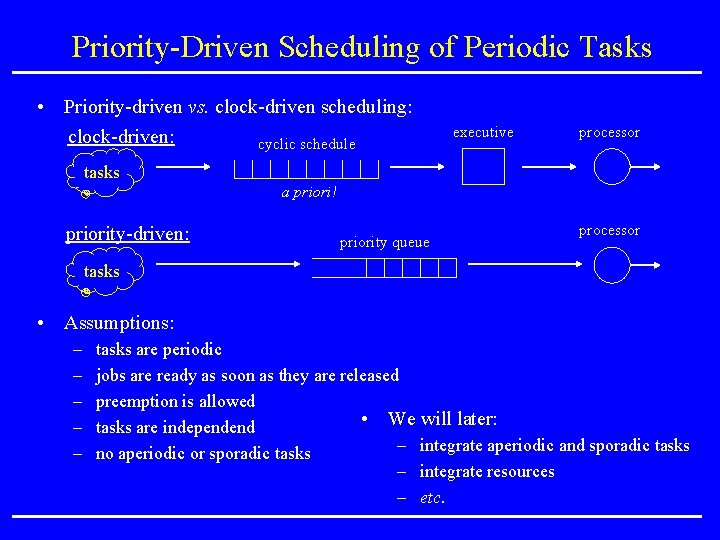
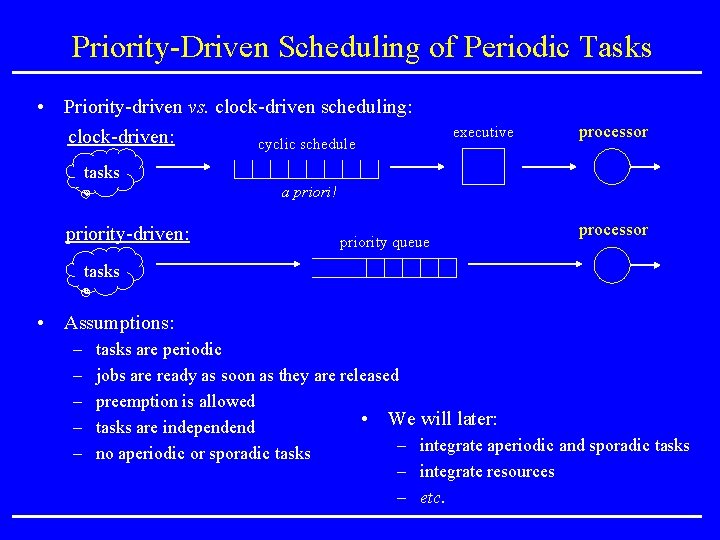
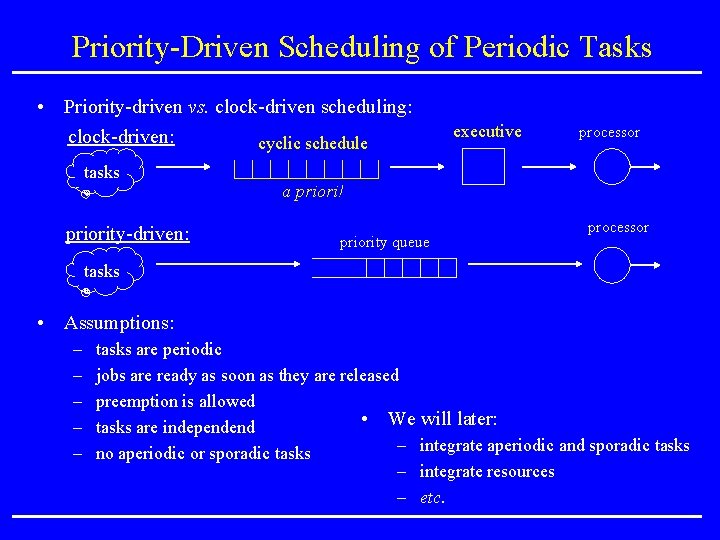
Priority-Driven Scheduling of Periodic Tasks • Priority-driven vs. clock-driven scheduling: clock-driven: cyclic schedule executive processor tasks a priori! priority-driven: priority queue processor tasks • Assumptions: – – – tasks are periodic jobs are ready as soon as they are released preemption is allowed • We will later: tasks are independend – integrate aperiodic and sporadic tasks no aperiodic or sporadic tasks – integrate resources – etc.
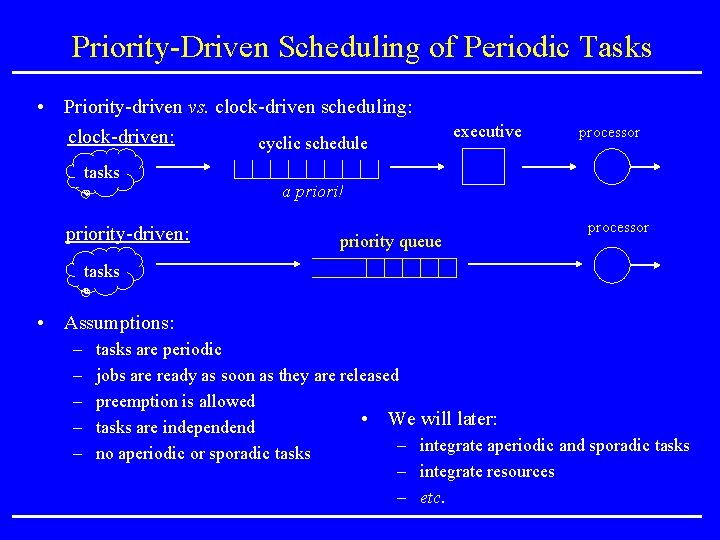
Priority-Driven Scheduling of Periodic Tasks • Priority-driven vs. clock-driven scheduling: clock-driven: cyclic schedule executive processor tasks a priori! priority-driven: priority queue processor tasks • Assumptions: – – – tasks are periodic jobs are ready as soon as they are released preemption is allowed • We will later: tasks are independend – integrate aperiodic and sporadic tasks no aperiodic or sporadic tasks – integrate resources – etc.
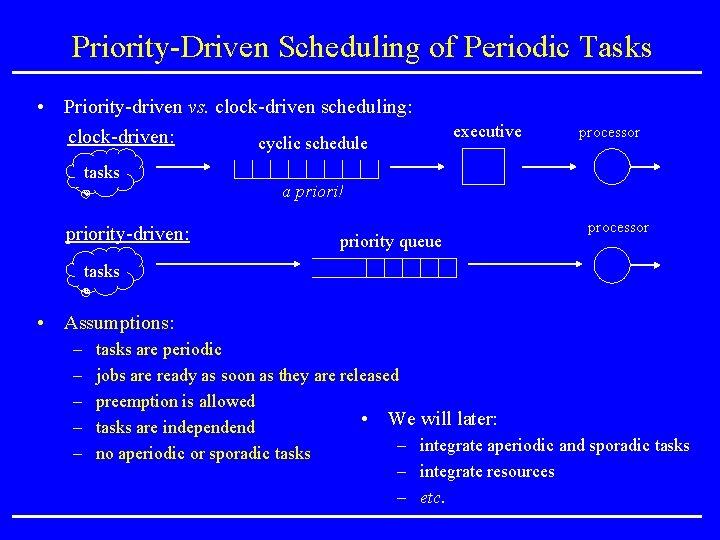
Priority-Driven Scheduling of Periodic Tasks • Priority-driven vs. clock-driven scheduling: clock-driven: cyclic schedule tasks priority-driven: executive processor a priori! priority queue processor tasks • Assumptions: – – – tasks are periodic jobs are ready as soon as they are released preemption is allowed • We will later: tasks are independend – integrate aperiodic and sporadic tasks no aperiodic or sporadic tasks – integrate resources – etc.
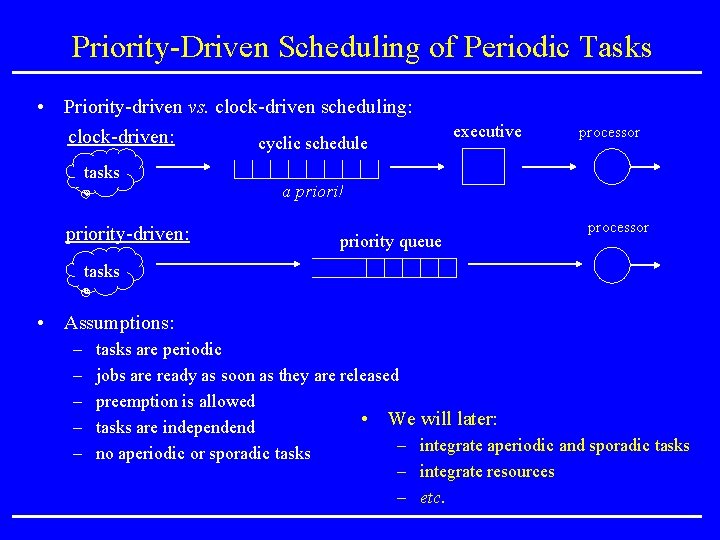
Priority-Driven Scheduling of Periodic Tasks • Priority-driven vs. clock-driven scheduling: clock-driven: cyclic schedule tasks priority-driven: executive processor a priori! priority queue processor tasks • Assumptions: – – – tasks are periodic jobs are ready as soon as they are released preemption is allowed • We will later: tasks are independend – integrate aperiodic and sporadic tasks no aperiodic or sporadic tasks – integrate resources – etc.
Priority-Driven Scheduling of Periodic Tasks • Priority-driven vs. clock-driven scheduling: clock-driven: cyclic schedule tasks priority-driven: executive processor a priori! priority queue processor tasks • Assumptions: – – – tasks are periodic jobs are ready as soon as they are released preemption is allowed • We will later: tasks are independend – integrate aperiodic and sporadic tasks no aperiodic or sporadic tasks – integrate resources – etc.
Priority-Driven Scheduling of Periodic Tasks • Priority-driven vs. clock-driven scheduling: clock-driven: cyclic schedule tasks priority-driven: executive processor a priori! priority queue processor tasks • Assumptions: – – – tasks are periodic jobs are ready as soon as they are released preemption is allowed • We will later: tasks are independend – integrate aperiodic and sporadic tasks no aperiodic or sporadic tasks – integrate resources – etc.
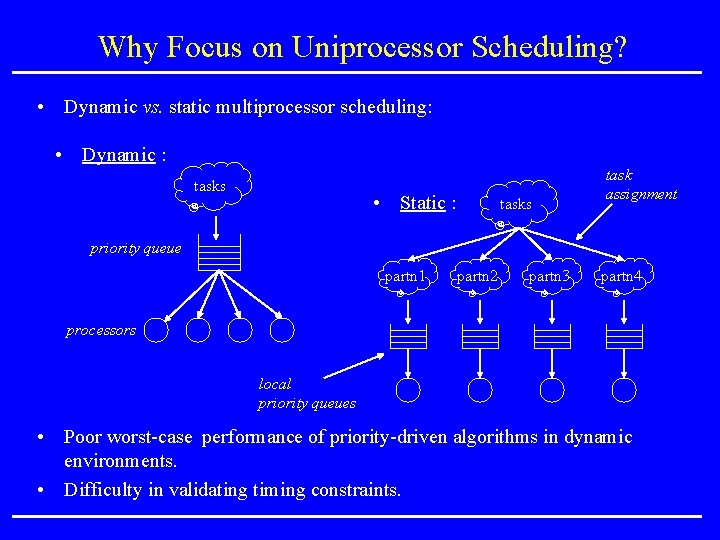
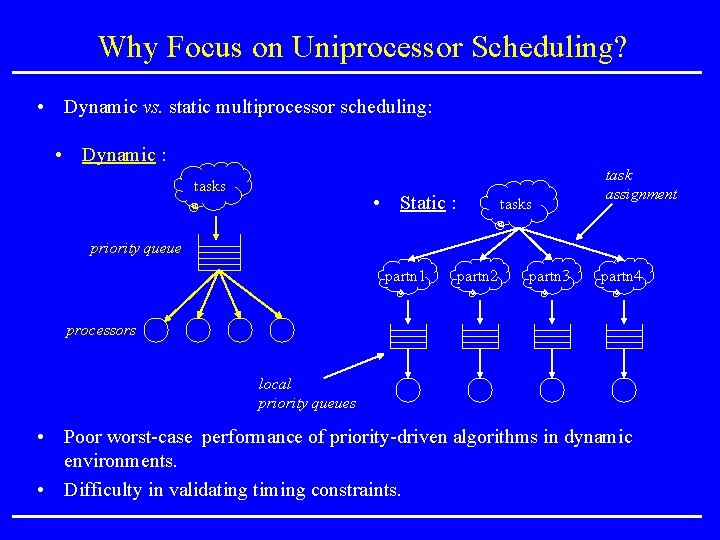
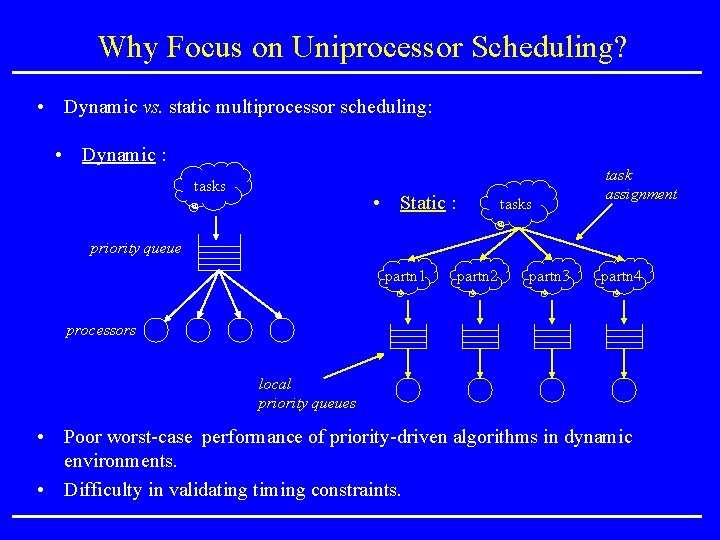
Why Focus on Uniprocessor Scheduling? • Dynamic vs. static multiprocessor scheduling: • Dynamic : tasks • Static : tasks task assignment priority queue partn 1 partn 2 partn 3 partn 4 processors local priority queues • Poor worst-case performance of priority-driven algorithms in dynamic environments. • Difficulty in validating timing constraints.
Why Focus on Uniprocessor Scheduling? • Dynamic vs. static multiprocessor scheduling: • Dynamic : tasks • Static : tasks task assignment priority queue partn 1 partn 2 partn 3 partn 4 processors local priority queues • Poor worst-case performance of priority-driven algorithms in dynamic environments. • Difficulty in validating timing constraints.
Why Focus on Uniprocessor Scheduling? • Dynamic vs. static multiprocessor scheduling: • Dynamic : tasks • Static : tasks task assignment priority queue partn 1 partn 2 partn 3 partn 4 processors local priority queues • Poor worst-case performance of priority-driven algorithms in dynamic environments. • Difficulty in validating timing constraints.
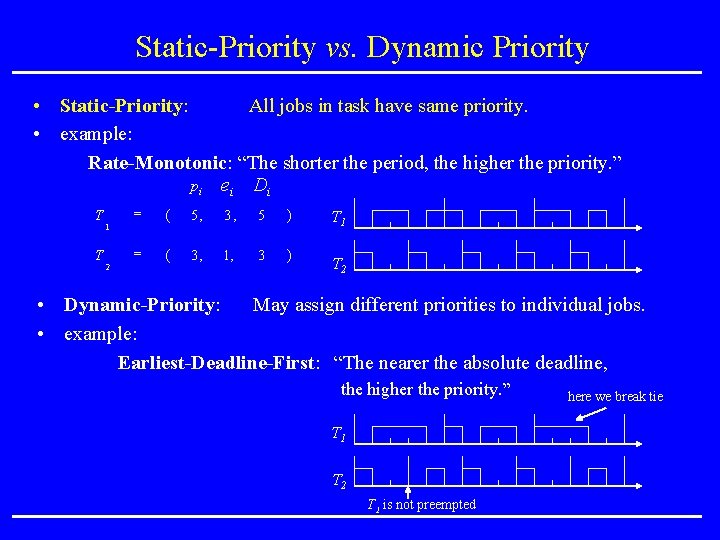
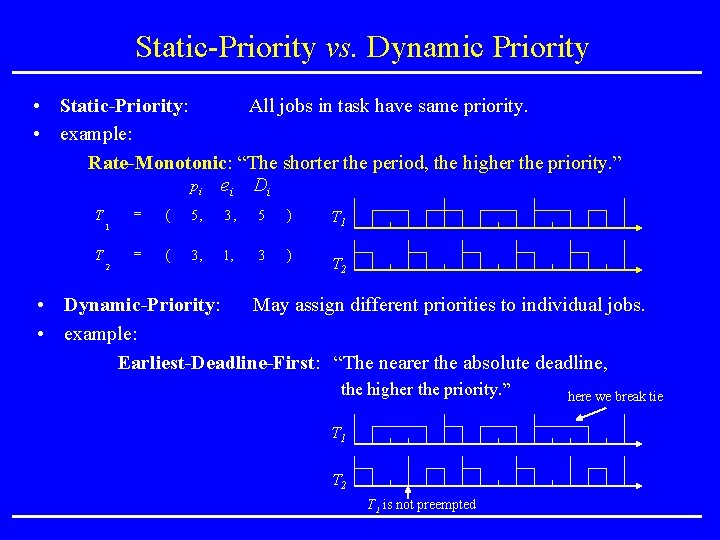
Static-Priority vs. Dynamic Priority • Static-Priority: All jobs in task have same priority. • example: Rate-Monotonic: “The shorter the period, the higher the priority. ” pi ei Di T T = ( 5, 3, 5 ) = ( 3, 1, 3 ) 1 2 T 1 T 2 • Dynamic-Priority: May assign different priorities to individual jobs. • example: Earliest-Deadline-First: “The nearer the absolute deadline, the higher the priority. ” T 1 T 2 T 1 is not preempted here we break tie
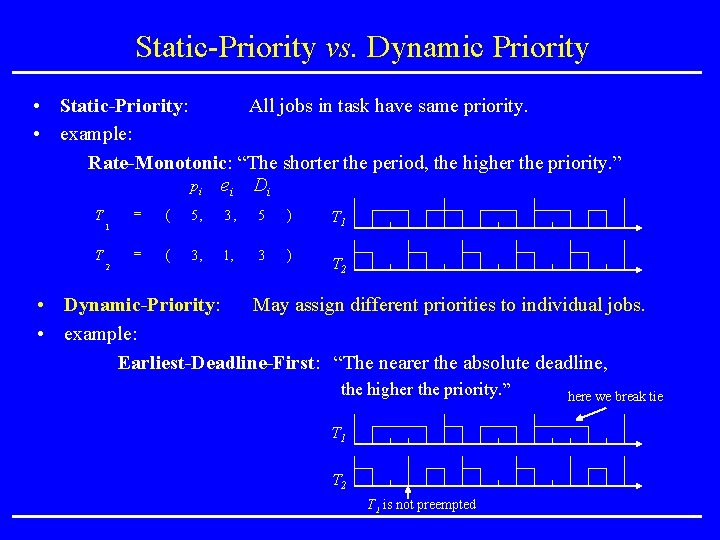
Static-Priority vs. Dynamic Priority • Static-Priority: All jobs in task have same priority. • example: Rate-Monotonic: “The shorter the period, the higher the priority. ” pi ei Di T T = ( 5, 3, 5 ) = ( 3, 1, 3 ) 1 2 T 1 T 2 • Dynamic-Priority: May assign different priorities to individual jobs. • example: Earliest-Deadline-First: “The nearer the absolute deadline, the higher the priority. ” T 1 T 2 T 1 is not preempted here we break tie
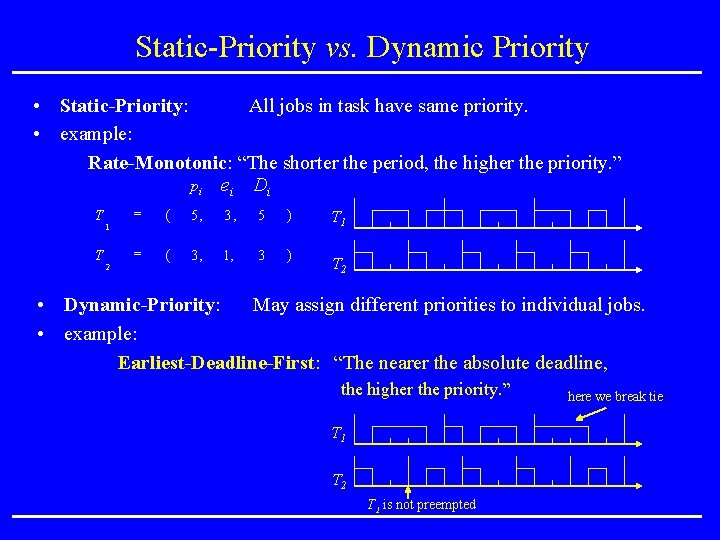
Static-Priority vs. Dynamic Priority • Static-Priority: All jobs in task have same priority. • example: Rate-Monotonic: “The shorter the period, the higher the priority. ” pi ei Di T T = ( 5, 3, 5 ) = ( 3, 1, 3 ) 1 2 T 1 T 2 • Dynamic-Priority: May assign different priorities to individual jobs. • example: Earliest-Deadline-First: “The nearer the absolute deadline, the higher the priority. ” T 1 T 2 T 1 is not preempted here we break tie
Static-Priority vs. Dynamic Priority • Static-Priority: All jobs in task have same priority. • example: Rate-Monotonic: “The shorter the period, the higher the priority. ” pi ei Di T T = ( 5, 3, 5 ) = ( 3, 1, 3 ) 1 2 T 1 T 2 • Dynamic-Priority: May assign different priorities to individual jobs. • example: Earliest-Deadline-First: “The nearer the absolute deadline, the higher the priority. ” T 1 T 2 T 1 is not preempted here we break tie