
Do you belong to NZ Maths Teachers Stats
Do you belong to NZ Maths Teachers & Stats teachers NZ Closed Facebook Groups? Just ask to join.
A Vision of NZ HS Maths and Stats for the 21 st Century Cami Sawyer Institute Fundamental Sciences C. Sawyer@massey. ac. nz
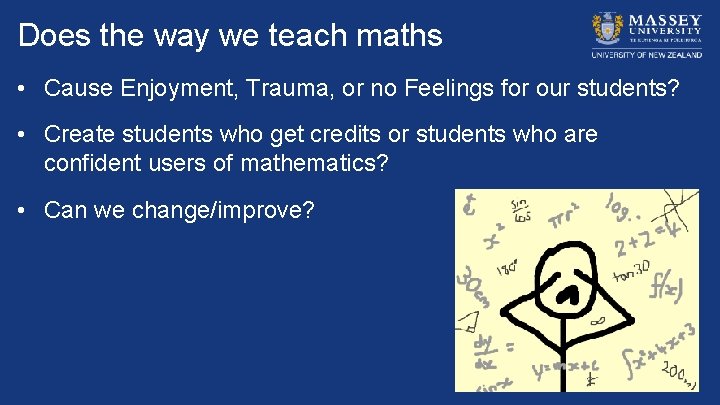
Does the way we teach maths • Cause Enjoyment, Trauma, or no Feelings for our students? • Create students who get credits or students who are confident users of mathematics? • Can we change/improve?
Lee Mann, Master of Ed 2017 • Surveyed N = 434 Yr 9 students in NZ. • Looked at Maths Test Anxiety & Learning Anxiety • Found that 21. 4% of students, particularly girls, reported high levels of mathematics anxiety. • For comparison, ~ 17% of the USA population have high levels of mathematics anxiety; studies in other countries arrive at similar estimations https: //www. cerme. nz/blog/LMann. MEd
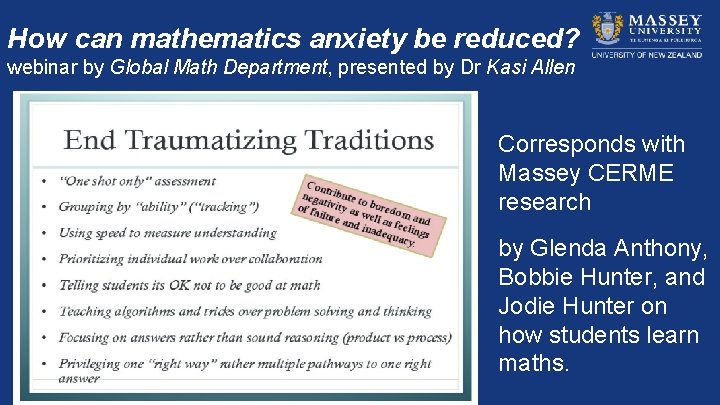
How can mathematics anxiety be reduced? webinar by Global Math Department, presented by Dr Kasi Allen Corresponds with Massey CERME research by Glenda Anthony, Bobbie Hunter, and Jodie Hunter on how students learn maths.
Formative/dynamic assessment (End: “one shot only” assessment) • Students’ thinking and activity is viewed as a source of ideas of which to make deliberate use. • Assessment as search for potential - rather than deficits - in students’ thinking and work.
Group Work (End: Grouping by “ability”) • Regular opportunities to work on and talk about solving problems, in collaboration with peers. • Tasks should be rich enough to elicit a variety of problemsolving strategies and provide multiple entry points for students at different levels of understanding (Low floor/high ceiling: NRich, Dan Meyer, Desmos, . . . )
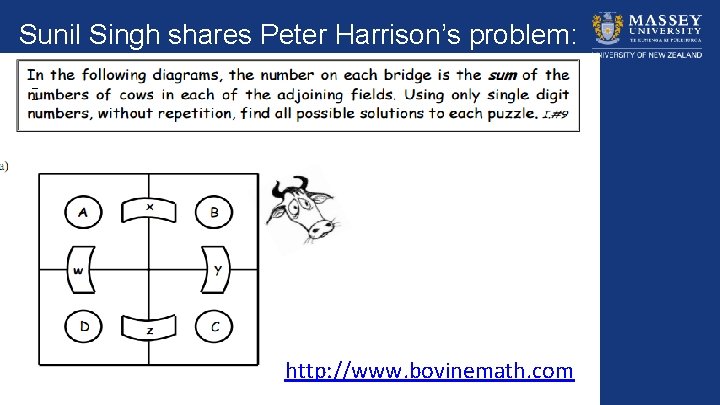
Sunil Singh shares Peter Harrison’s problem: http: //www. bovinemath. com
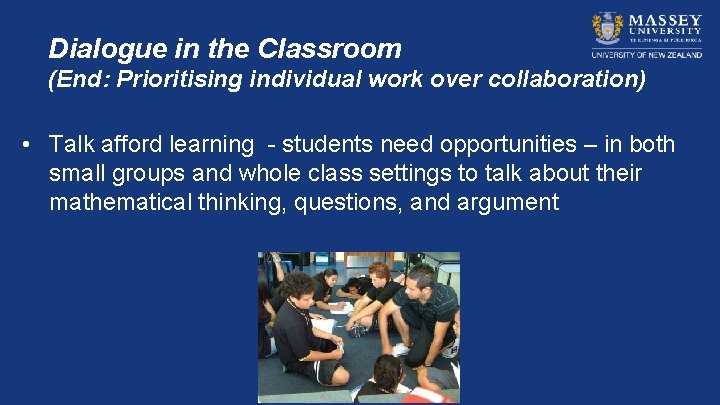
Dialogue in the Classroom (End: Prioritising individual work over collaboration) • Talk afford learning - students need opportunities – in both small groups and whole class settings to talk about their mathematical thinking, questions, and argument
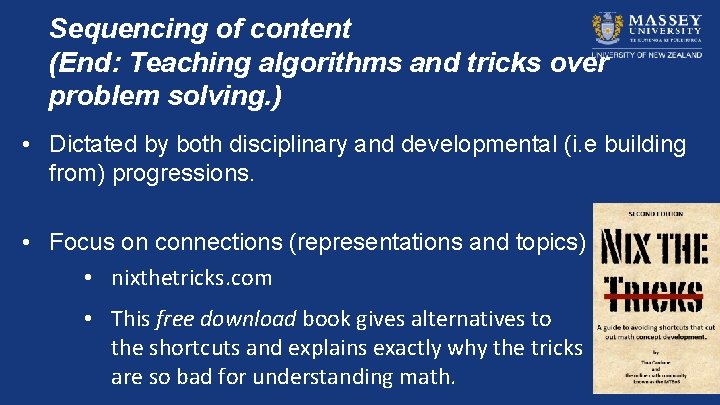
Sequencing of content (End: Teaching algorithms and tricks over problem solving. ) • Dictated by both disciplinary and developmental (i. e building from) progressions. • Focus on connections (representations and topics) • nixthetricks. com • This free download book gives alternatives to the shortcuts and explains exactly why the tricks are so bad for understanding math.
Feedback (End: *Using speed to measure understanding *Focusing on answers rather than sound reasoning) • Students have time to struggle with tasks, without teacher ‘telling’ (rather than Frequent feedback from teacher/answers/computer. ) • Feedback (from peers/teacher) must position students as ‘coparticipants’ in discourse about how one knows something is in/correct. (Dan Meyer: using students answers as a window into their thinking. )
Mathematical tasks (End: Privileging one “right way” rather than multiple pathways to one right answer) • Tasks that initiate students to new ideas and deepen their understanding of concepts • Task that help them become more competent in what they know
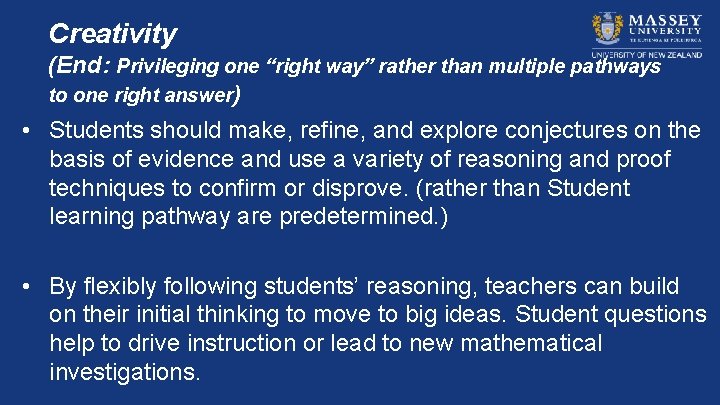
Creativity (End: Privileging one “right way” rather than multiple pathways to one right answer) • Students should make, refine, and explore conjectures on the basis of evidence and use a variety of reasoning and proof techniques to confirm or disprove. (rather than Student learning pathway are predetermined. ) • By flexibly following students’ reasoning, teachers can build on their initial thinking to move to big ideas. Student questions help to drive instruction or lead to new mathematical investigations.
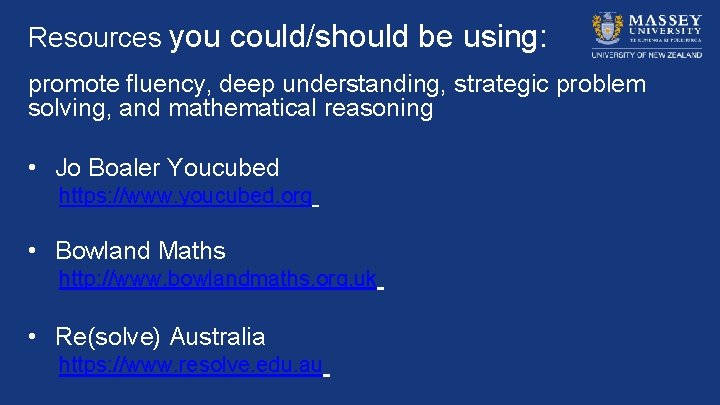
Resources you could/should be using: promote fluency, deep understanding, strategic problem solving, and mathematical reasoning • Jo Boaler Youcubed https: //www. youcubed. org • Bowland Maths http: //www. bowlandmaths. org. uk • Re(solve) Australia https: //www. resolve. edu. au
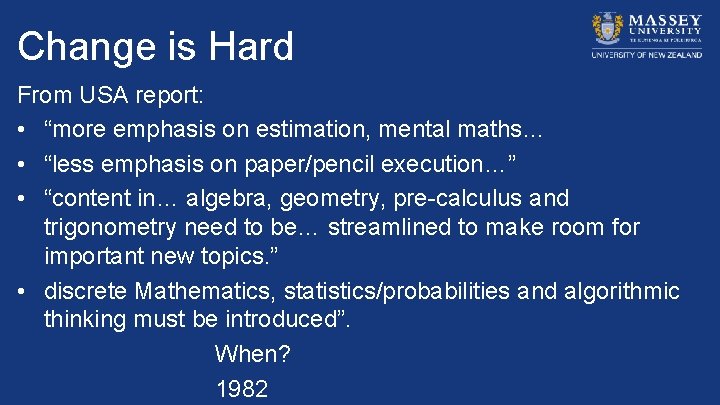
Change is Hard From USA report: • “more emphasis on estimation, mental maths… • “less emphasis on paper/pencil execution…” • “content in… algebra, geometry, pre-calculus and trigonometry need to be… streamlined to make room for important new topics. ” • discrete Mathematics, statistics/probabilities and algorithmic thinking must be introduced”. When? 1982
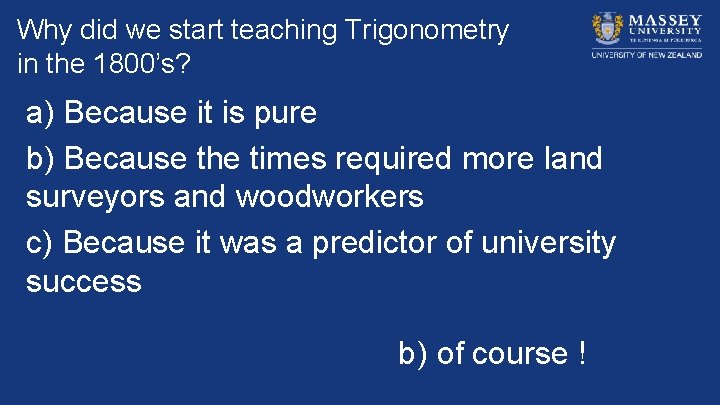
Why did we start teaching Trigonometry in the 1800’s? a) Because it is pure b) Because the times required more land surveyors and woodworkers c) Because it was a predictor of university success b) of course !
2000 NZ Changes in Stats Curriculum Recognise • Technology was available to teach differently • Students only learned to calculate • Students didn’t understand how statistics was used
Keith Devlin, Stanford Center for Curriculum Redesign https: //curriculumredesign. org/maths-for-the-21 st-century-conference-stronglysupports-critical-necessary-changes-of-oecds-pisa-maths-for-2021 -4 dedu • https: //www. youtube. com/watch? v=q. BOn WZyq 468&feature=youtu. be • Tools: Start at 3 min - 9 • Heuristic: Start at 22 min
Center for Curriculum Redesign proposal to change PISA • Australia first country to hire CCR to redesign their maths curriculum
Discuss & Debate: Should we change maths (curriculum, teaching, assessment)? 1. Parents against changing maths 2. Parents for changing maths 3. Employers against changing maths 4. Employers for changing maths 5. Students against changing maths 6. Students for changing maths 7. Teachers/academics against changing maths 8. Teachers/academics for changing maths
Curious Minds, www. curiousminds. nz Profiles of Women in STEM Stories from innovative New Zealand women of all ages and backgrounds who work with science, technology, engineering, maths and mātauranga Māori. Maths/Stats focus: • • Sophie Mormede Gaye Betty Nokuthaba Sibanda Monique Ladds
- Slides: 22