Principles of Geology Glaciers Mian Liu Outline of


- Slides: 30
Principles of Geology Glaciers Mian Liu
Outline of Chapter 18 What are glaciers? n Formation and movement n Glacial landforms n The ice age n
Outline of Chapter 18 What are glaciers? n Formation and movement n Glacial landforms n The ice age n
Glacier: n A mass of ice (with included rocks and air) on land formed by compaction and recrystallization of snow, and moves under its own weight.
Why are they important? < 10% of continental area, but occurred at various times over the Earth’s history at 3/4 of continental surface (last major iceage: Pleistocene (1. 6 -0. 01 Ma)); n Store ~75% of the fresh water on earth; n Glacier meltwater: major source for summer stream flow for many regions. n
Outline of Chapter 18 What are glaciers? n Formation and movement n Glacial landforms n The ice age n
Basic conditions for glacier formation Snow to survive summer melting n Enough precipitation n ¨ Winter snowfall - summer melting = accumulation n Metamorphism of snow: ¨ Snow -> firn -> ice
Formation of glacier ice
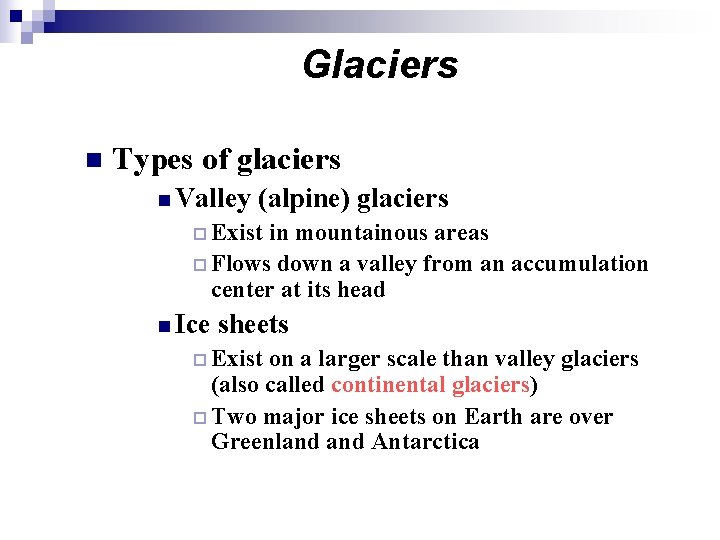
Glaciers n Types of glaciers n Valley (alpine) glaciers ¨ Exist in mountainous areas ¨ Flows down a valley from an accumulation center at its head n Ice sheets ¨ Exist on a larger scale than valley glaciers (also called continental glaciers) ¨ Two major ice sheets on Earth are over Greenland Antarctica
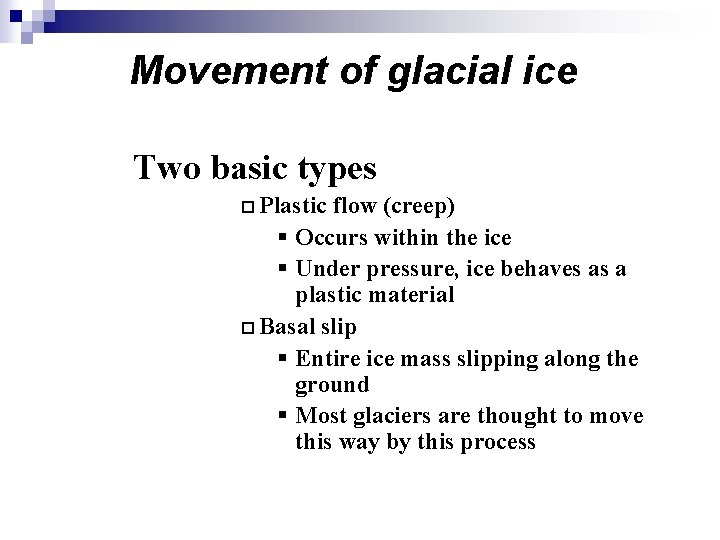
Movement of glacial ice Two basic types ¨ Plastic flow (creep) § Occurs within the ice § Under pressure, ice behaves as a plastic material ¨ Basal slip § Entire ice mass slipping along the ground § Most glaciers are thought to move this way by this process
Movement of glacial ice n Rates of glacial movement n Rates n Some of up to several meters per day glaciers exhibit extremely rapid movements called surges
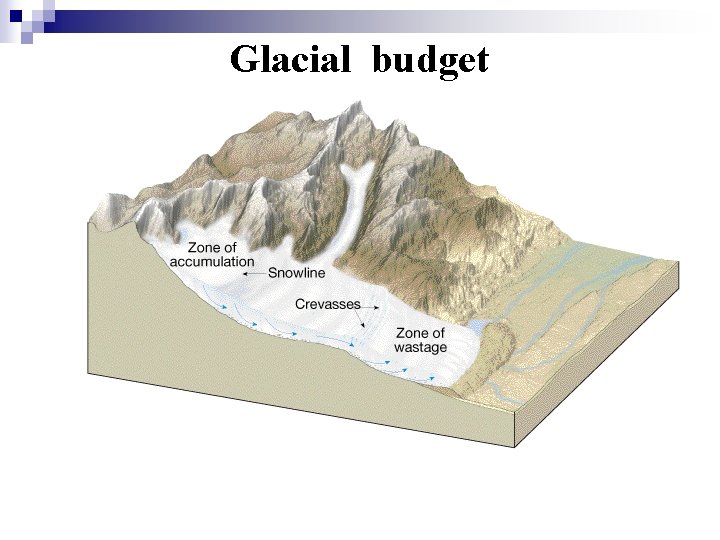
Glacial budget
Glacial structures 1 st order: stratification (discernible layers or bands resulted from annual cycles of snow accumulation and ablation above the snowline) n 2 nd order: n ¨ Foliation: layering due to shear in the ice ¨ Crevasses: cracks formed in the top layer, ranging from miniature fractures to gaps several meters wide.
Outline of Chapter 18 What are glaciers? n Formation and movement n Glacial landforms n The ice age n
Erosional Glacial Landforms
Glacial erosion Glaciers are capable of great erosion and sediment transport n Glaciers erode the land primarily in two ways n n Plucking – lifting of rocks n Abrasion ¨ Rocks within the ice acting like sandpaper to smooth and polish the surface below
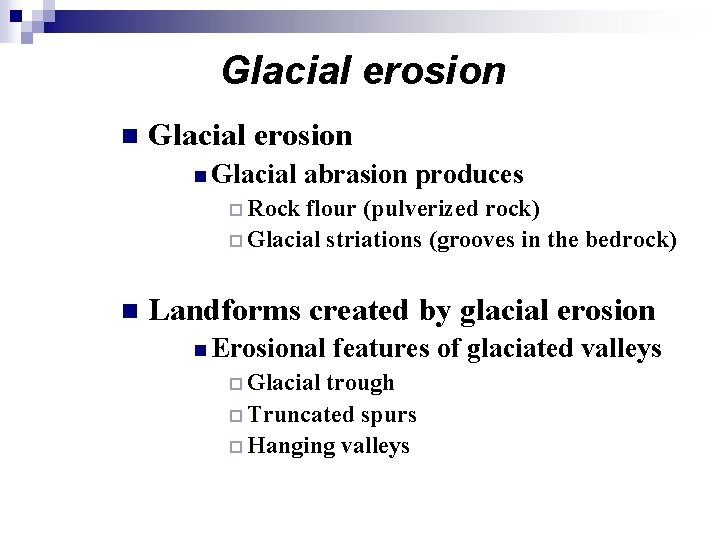
Glacial erosion n Glacial abrasion produces ¨ Rock flour (pulverized rock) ¨ Glacial striations (grooves in the bedrock) n Landforms created by glacial erosion n Erosional ¨ Glacial features of glaciated valleys trough ¨ Truncated spurs ¨ Hanging valleys
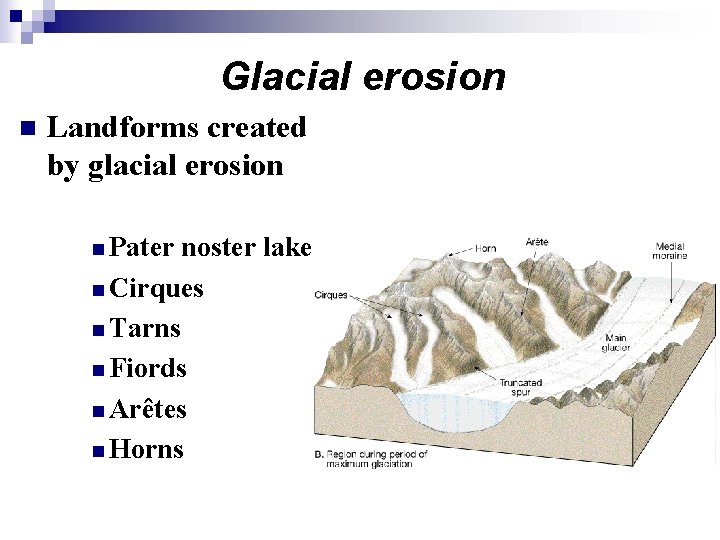
Glacial erosion n Landforms created by glacial erosion n Pater noster lakes n Cirques n Tarns n Fiords n Arêtes n Horns
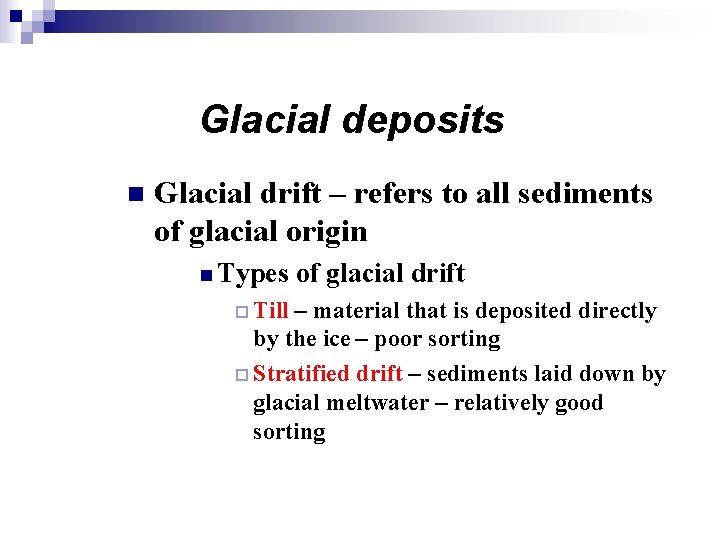
Glacial deposits n Glacial drift – refers to all sediments of glacial origin n Types ¨ Till of glacial drift – material that is deposited directly by the ice – poor sorting ¨ Stratified drift – sediments laid down by glacial meltwater – relatively good sorting
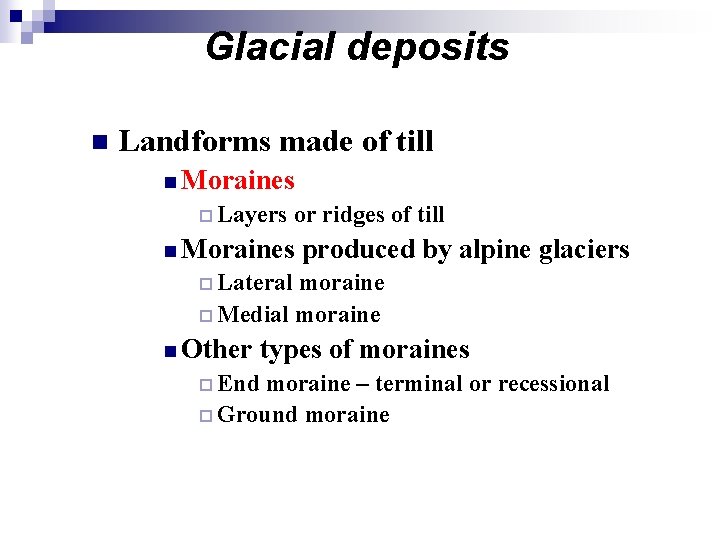
Glacial deposits n Landforms made of till n Moraines ¨ Layers or ridges of till n Moraines produced by alpine glaciers ¨ Lateral moraine ¨ Medial moraine n Other types of moraines ¨ End moraine – terminal or recessional ¨ Ground moraine
Glacial deposits n Landforms made of till n Drumlins ¨ Smooth, elongated, parallel hills ¨ Steep side faces the direction from which the ice advanced ¨ Occur in clusters called drumlin fields ¨ Formation not fully understood
Glacial deposits n Landforms made of stratified drift n Outwash plains (with ice sheets) and valley trains (when in a valley) ¨ Broad ramp-like surface composed of stratified drift deposited by meltwater leaving a glacier ¨ Located adjacent to the downstream edge of most end moraines ¨ Often pockmarked with depressions called kettles
Glacial deposits n Landforms made of stratified drift n Ice-contact ¨ Deposited deposits by meltwater flowing over, within, and at the base of motionless ice ¨ Features include § Kames § Kame terraces § Eskers
Ice ages and the Ice Age
Glaciers of the past n Ice Age n The Ice Age began between two million and three million years ago n Most of the major glacial stages occurred during a division of geologic time called the Pleistocene epoch
Causes of glaciation n Any successful theory must account for n What causes the onset of glacial conditions n What caused the alteration of glacial and interglacial stages that have been documented for the Pleistocene epoch
Causes of glaciation n Some possible causes of glaciation n Plate tectonics ¨ Continents were arranged differently in the past ¨ Changes in oceanic circulation n Variations ¨ The in Earth’s orbit Milankovitch hypothesis
Causes of glaciation n Some possible causes of glaciation n Milankovitch hypothesis ¨ Shape (eccentricity) of Earth’s orbit varies ¨ Angle of Earth’s axis (obliquity) changes ¨ Earth’s axis wobbles (precession) ¨ Changes in climate over the past several hundred thousand years are closely associated with variations in the geometry of Earth’s orbit n Other factors are probably also involved
End