PPA From its infancy to present A work
- Slides: 22
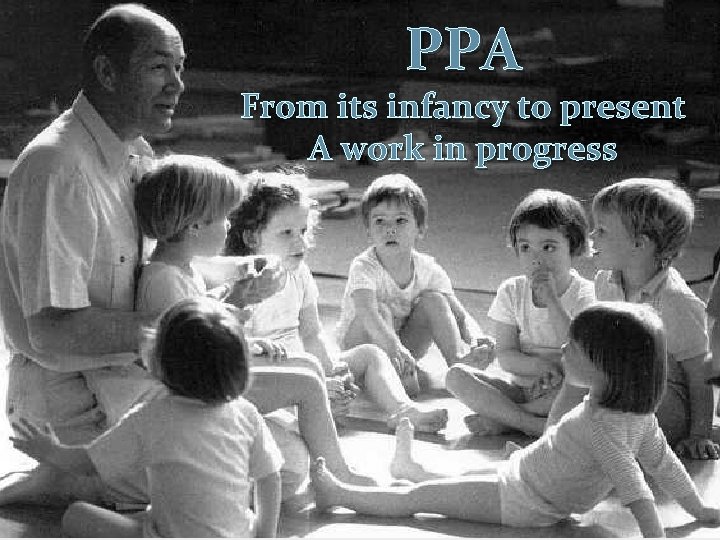
PPA From its infancy to present A work in progress Debra Hamilton Psychomotor Project – November 2015
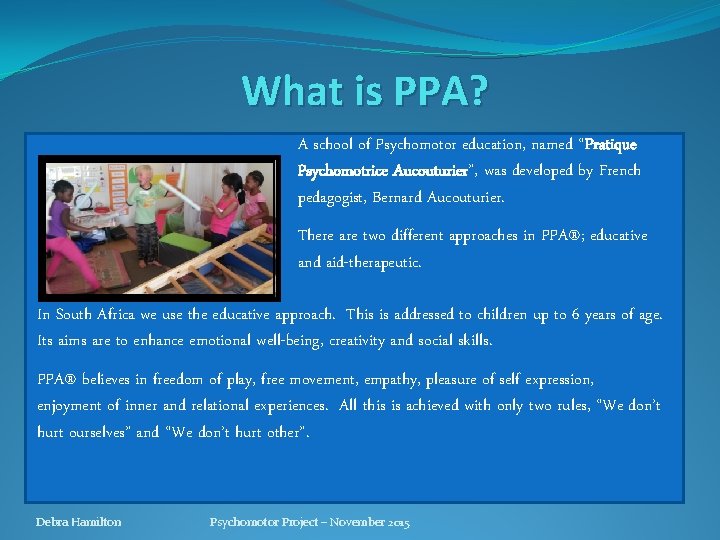
What is PPA? A school of Psychomotor education, named “Pratique Psychomotrice Aucouturier”, was developed by French pedagogist, Bernard Aucouturier. There are two different approaches in PPA®; educative and aid-therapeutic. In South Africa we use the educative approach. This is addressed to children up to 6 years of age. Its aims are to enhance emotional well-being, creativity and social skills. PPA® believes in freedom of play, free movement, empathy, pleasure of self expression, enjoyment of inner and relational experiences. All this is achieved with only two rules, “We don’t hurt ourselves” and “We don’t hurt other”. Debra Hamilton Psychomotor Project – November 2015
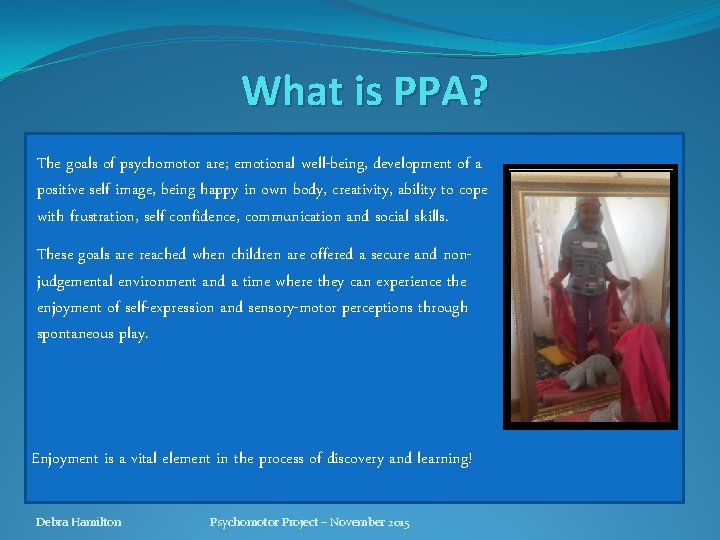
What is PPA? The goals of psychomotor are; emotional well-being, development of a positive self image, being happy in own body, creativity, ability to cope with frustration, self confidence, communication and social skills. These goals are reached when children are offered a secure and nonjudgemental environment and a time where they can experience the enjoyment of self-expression and sensory-motor perceptions through spontaneous play. Enjoyment is a vital element in the process of discovery and learning! Debra Hamilton Psychomotor Project – November 2015
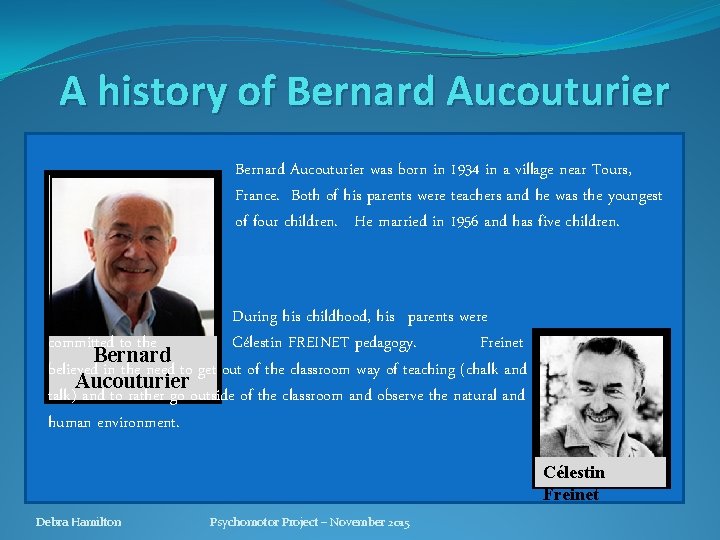
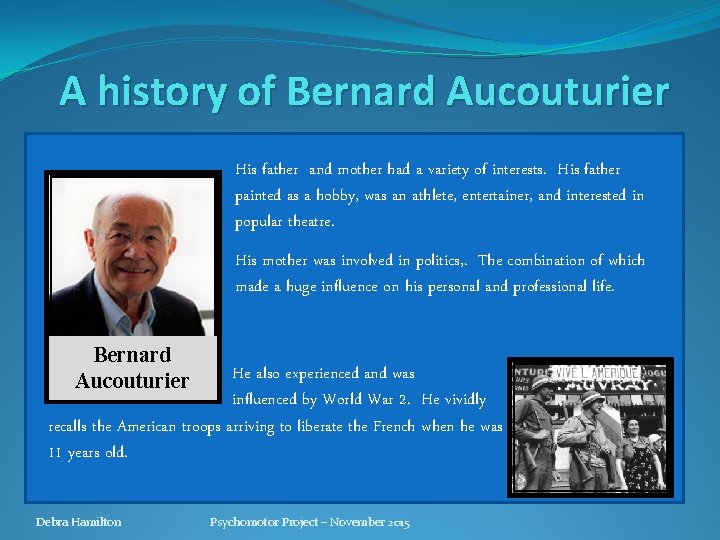
A history of Bernard Aucouturier was born in 1934 in a village near Tours, France. Both of his parents were teachers and he was the youngest of four children. He married in 1956 and has five children. During his childhood, his parents were committed to the Célestin FREINET pedagogy. Freinet Bernard believed in the need to get out of the classroom way of teaching (chalk and Aucouturier talk) and to rather go outside of the classroom and observe the natural and human environment. Célestin Freinet Debra Hamilton Psychomotor Project – November 2015
A history of Bernard Aucouturier His father and mother had a variety of interests. His father painted as a hobby, was an athlete, entertainer, and interested in popular theatre. His mother was involved in politics, . The combination of which made a huge influence on his personal and professional life. Bernard Aucouturier He also experienced and was influenced by World War 2. He vividly recalls the American troops arriving to liberate the French when he was 11 years old. Debra Hamilton Psychomotor Project – November 2015
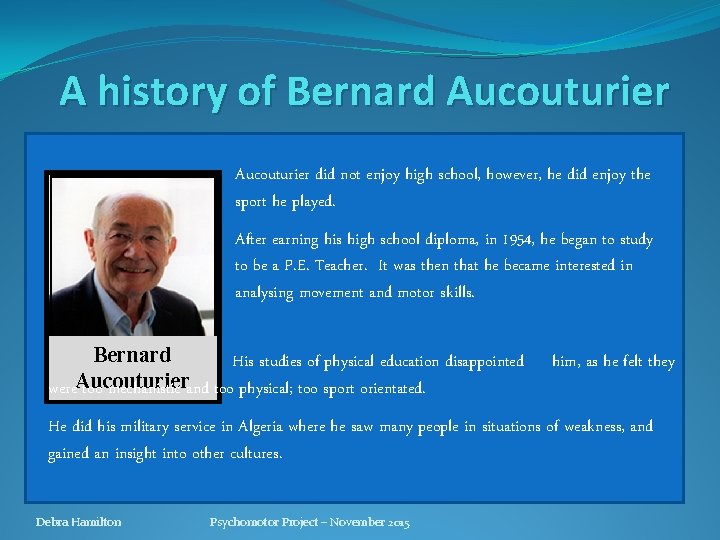
A history of Bernard Aucouturier did not enjoy high school, however, he did enjoy the sport he played. After earning his high school diploma, in 1954, he began to study to be a P. E. Teacher. It was then that he became interested in analysing movement and motor skills. Bernard His studies of physical education disappointed were. Aucouturier too mechanistic and too physical; too sport orientated. him, as he felt they He did his military service in Algeria where he saw many people in situations of weakness, and gained an insight into other cultures. Debra Hamilton Psychomotor Project – November 2015
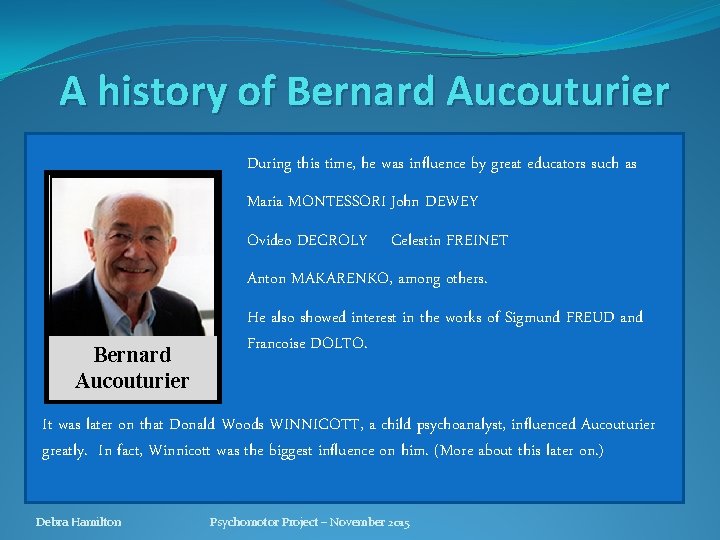
A history of Bernard Aucouturier During this time, he was influence by great educators such as Maria MONTESSORI John DEWEY Ovideo DECROLY Celestin FREINET Anton MAKARENKO, among others. Bernard Aucouturier He also showed interest in the works of Sigmund FREUD and Francoise DOLTO. It was later on that Donald Woods WINNICOTT, a child psychoanalyst, influenced Aucouturier greatly. In fact, Winnicott was the biggest influence on him. (More about this later on. ) Debra Hamilton Psychomotor Project – November 2015
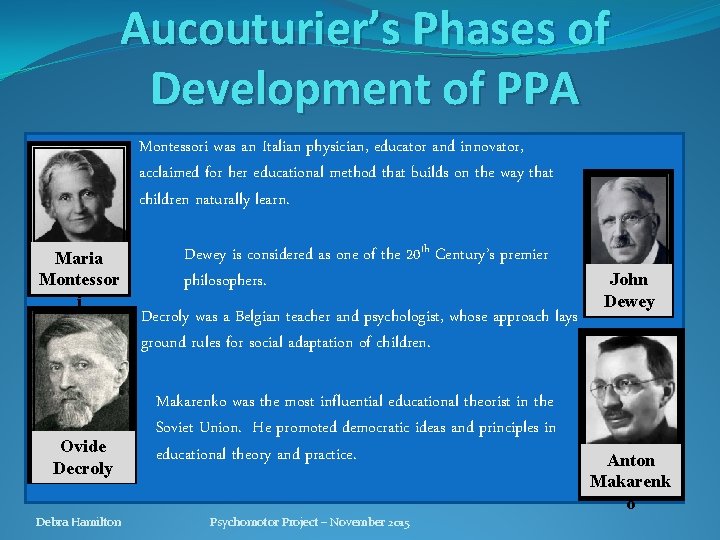
Aucouturier’s Phases of Development of PPA Montessori was an Italian physician, educator and innovator, acclaimed for her educational method that builds on the way that children naturally learn. Maria Montessor i Ovide Decroly Debra Hamilton Dewey is considered as one of the 20 th Century’s premier philosophers. Decroly was a Belgian teacher and psychologist, whose approach lays ground rules for social adaptation of children. Makarenko was the most influential educational theorist in the Soviet Union. He promoted democratic ideas and principles in educational theory and practice. Psychomotor Project – November 2015 John Dewey Anton Makarenk o
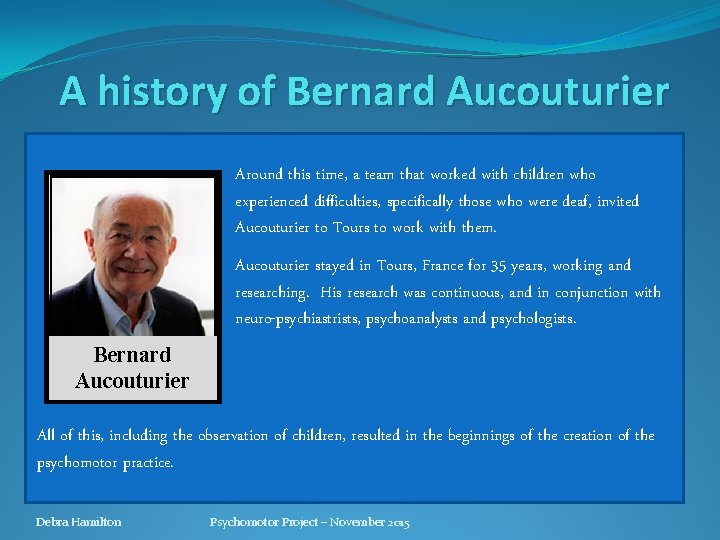
A history of Bernard Aucouturier Around this time, a team that worked with children who experienced difficulties, specifically those who were deaf, invited Aucouturier to Tours to work with them. Aucouturier stayed in Tours, France for 35 years, working and researching. His research was continuous, and in conjunction with neuro-psychiastrists, psychoanalysts and psychologists. Bernard Aucouturier All of this, including the observation of children, resulted in the beginnings of the creation of the psychomotor practice. Debra Hamilton Psychomotor Project – November 2015
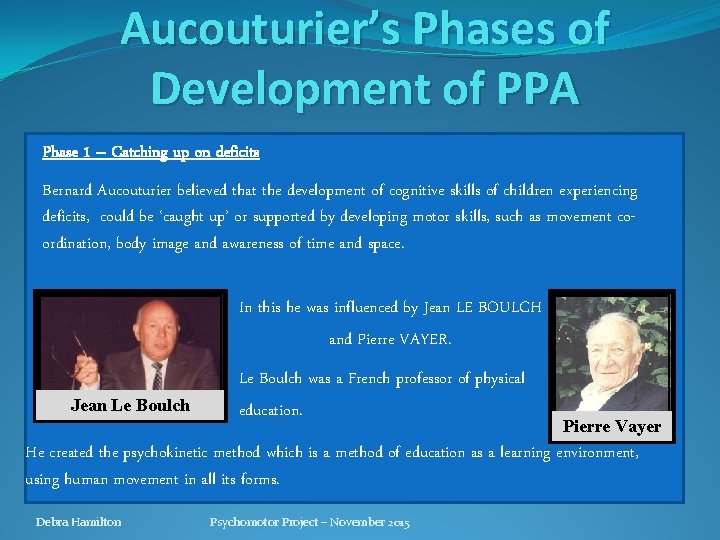
Aucouturier’s Phases of Development of PPA Phase 1 – Catching up on deficits Bernard Aucouturier believed that the development of cognitive skills of children experiencing deficits, could be ‘caught up’ or supported by developing motor skills, such as movement coordination, body image and awareness of time and space. In this he was influenced by Jean LE BOULCH and Pierre VAYER. Jean Le Boulch was a French professor of physical education. Pierre Vayer He created the psychokinetic method which is a method of education as a learning environment, using human movement in all its forms. Debra Hamilton Psychomotor Project – November 2015
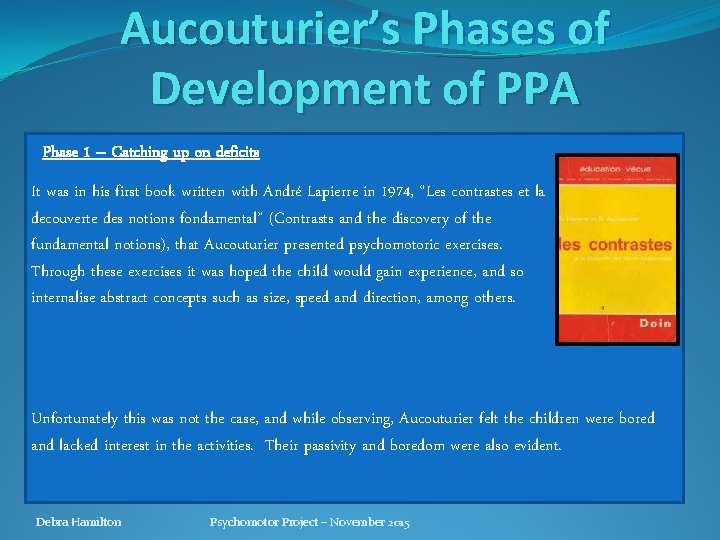
Aucouturier’s Phases of Development of PPA Phase 1 – Catching up on deficits It was in his first book written with André Lapierre in 1974, “Les contrastes et la decouverte des notions fondamental” (Contrasts and the discovery of the fundamental notions), that Aucouturier presented psychomotoric exercises. Through these exercises it was hoped the child would gain experience, and so internalise abstract concepts such as size, speed and direction, among others. Unfortunately this was not the case, and while observing, Aucouturier felt the children were bored and lacked interest in the activities. Their passivity and boredom were also evident. Debra Hamilton Psychomotor Project – November 2015
Aucouturier’s Phases of Development of PPA Phase 2 – Affective and emotional expression Through observation, Aucouturier noted that through psychometric exercises, some adaptations of movement could be learnt. However, these movements stood on their own and could not be related to learning skills. From this, Aucouturier concluded that difficulties experienced by the child, and physical expression, often stems from deeper, more meaningful problems. Problems that could be detected in how the child expresses their emotions by their behaviour as well as their decision making. Debra Hamilton Psychomotor Project – November 2015
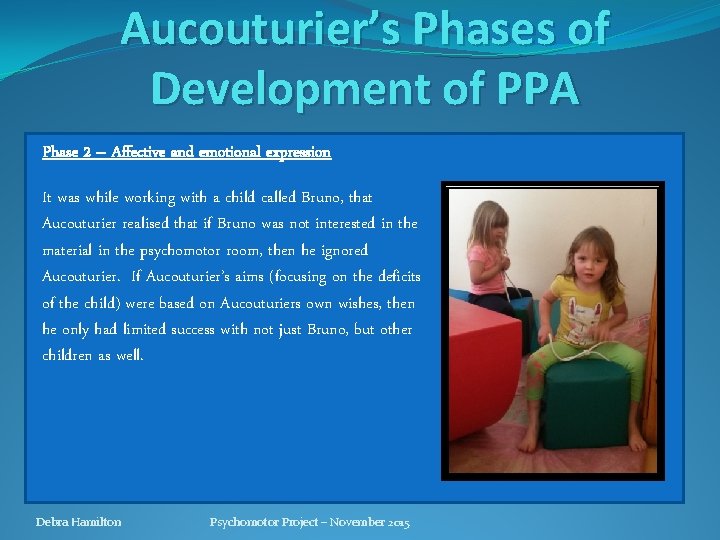
Aucouturier’s Phases of Development of PPA Phase 2 – Affective and emotional expression It was while working with a child called Bruno, that Aucouturier realised that if Bruno was not interested in the material in the psychomotor room, then he ignored Aucouturier. If Aucouturier’s aims (focusing on the deficits of the child) were based on Aucouturiers own wishes, then he only had limited success with not just Bruno, but other children as well. Debra Hamilton Psychomotor Project – November 2015
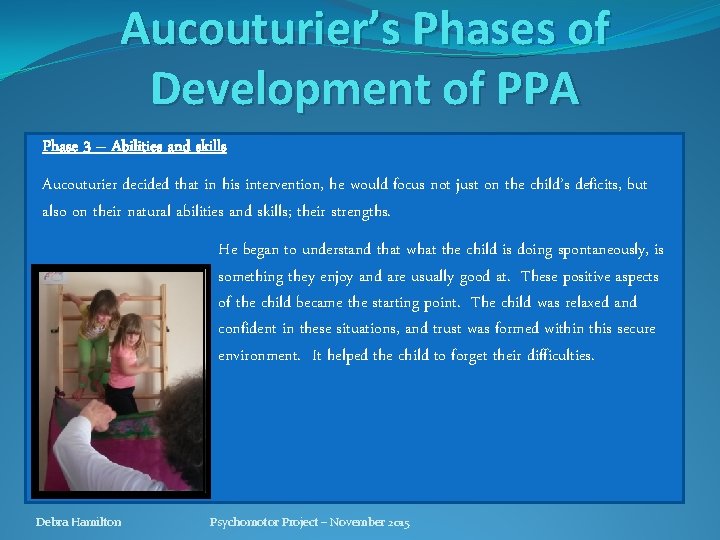
Aucouturier’s Phases of Development of PPA Phase 3 – Abilities and skills Aucouturier decided that in his intervention, he would focus not just on the child’s deficits, but also on their natural abilities and skills; their strengths. He began to understand that what the child is doing spontaneously, is something they enjoy and are usually good at. These positive aspects of the child became the starting point. The child was relaxed and confident in these situations, and trust was formed within this secure environment. It helped the child to forget their difficulties. Debra Hamilton Psychomotor Project – November 2015
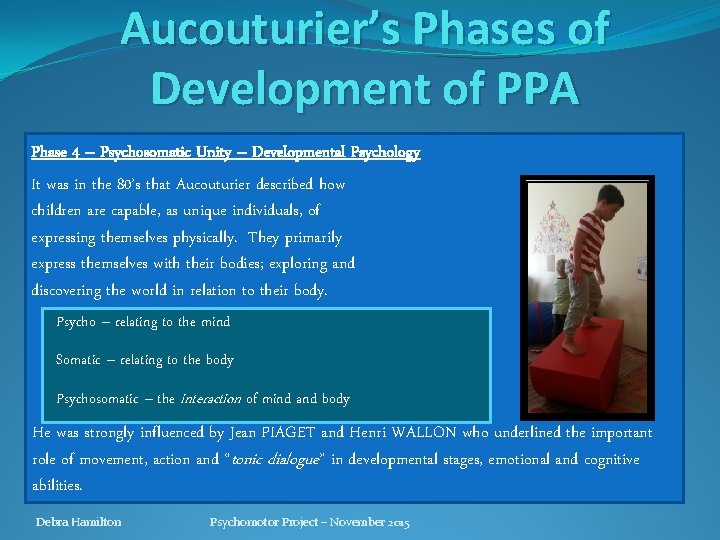
Aucouturier’s Phases of Development of PPA Phase 4 – Psychosomatic Unity – Developmental Psychology It was in the 80’s that Aucouturier described how children are capable, as unique individuals, of expressing themselves physically. They primarily express themselves with their bodies; exploring and discovering the world in relation to their body. Psycho – relating to the mind Somatic – relating to the body Psychosomatic – the interaction of mind and body He was strongly influenced by Jean PIAGET and Henri WALLON who underlined the important role of movement, action and “tonic dialogue” in developmental stages, emotional and cognitive abilities. Debra Hamilton Psychomotor Project – November 2015
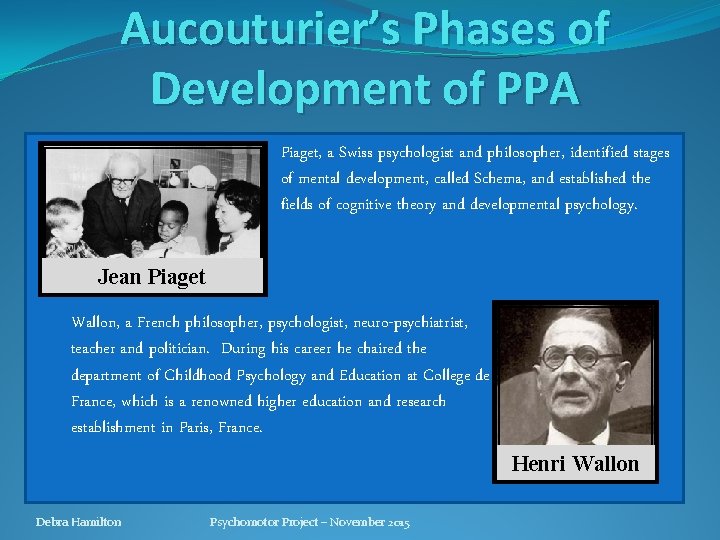
Aucouturier’s Phases of Development of PPA Piaget, a Swiss psychologist and philosopher, identified stages of mental development, called Schema, and established the fields of cognitive theory and developmental psychology. Jean Piaget Wallon, a French philosopher, psychologist, neuro-psychiatrist, teacher and politician. During his career he chaired the department of Childhood Psychology and Education at College de France, which is a renowned higher education and research establishment in Paris, France. Henri Wallon Debra Hamilton Psychomotor Project – November 2015
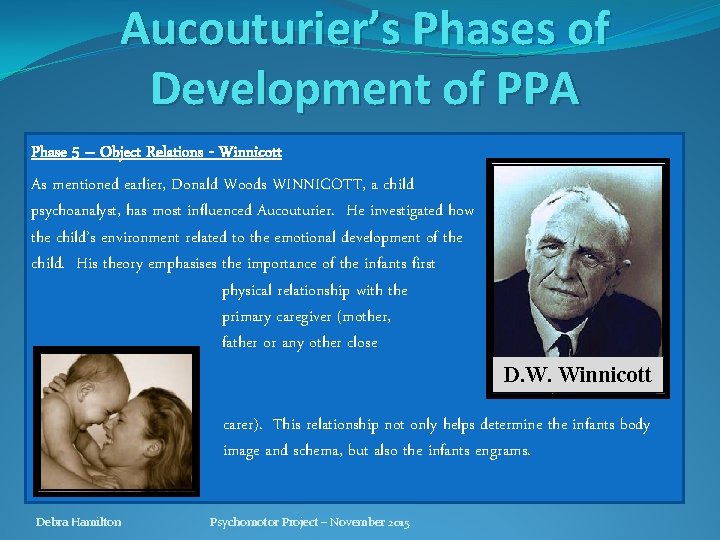
Aucouturier’s Phases of Development of PPA Phase 5 – Object Relations - Winnicott As mentioned earlier, Donald Woods WINNICOTT, a child psychoanalyst, has most influenced Aucouturier. He investigated how the child’s environment related to the emotional development of the child. His theory emphasises the importance of the infants first physical relationship with the primary caregiver (mother, father or any other close D. W. Winnicott carer). This relationship not only helps determine the infants body image and schema, but also the infants engrams. Debra Hamilton Psychomotor Project – November 2015
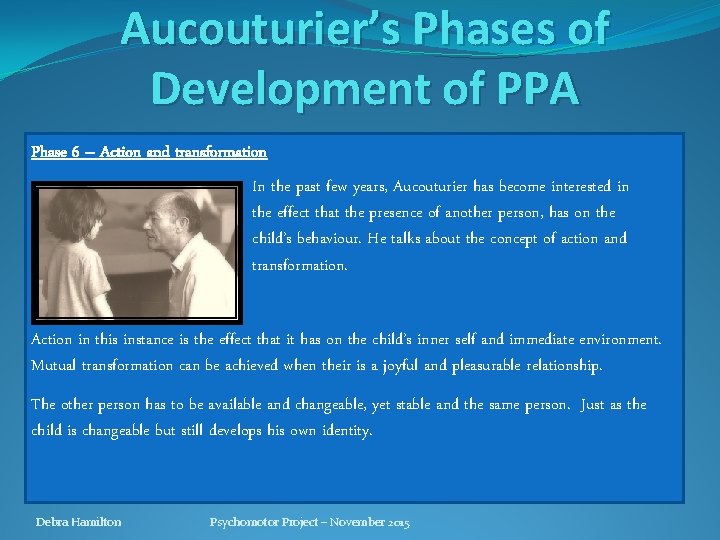
Aucouturier’s Phases of Development of PPA Phase 6 – Action and transformation In the past few years, Aucouturier has become interested in the effect that the presence of another person, has on the child’s behaviour. He talks about the concept of action and transformation. Action in this instance is the effect that it has on the child’s inner self and immediate environment. Mutual transformation can be achieved when their is a joyful and pleasurable relationship. The other person has to be available and changeable, yet stable and the same person. Just as the child is changeable but still develops his own identity. Debra Hamilton Psychomotor Project – November 2015
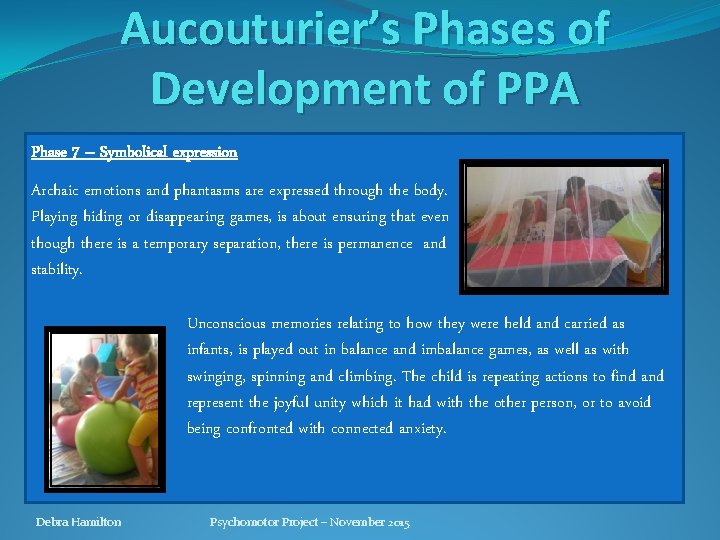
Aucouturier’s Phases of Development of PPA Phase 7 – Symbolical expression Archaic emotions and phantasms are expressed through the body. Playing hiding or disappearing games, is about ensuring that even though there is a temporary separation, there is permanence and stability. Unconscious memories relating to how they were held and carried as infants, is played out in balance and imbalance games, as well as with swinging, spinning and climbing. The child is repeating actions to find and represent the joyful unity which it had with the other person, or to avoid being confronted with connected anxiety. Debra Hamilton Psychomotor Project – November 2015
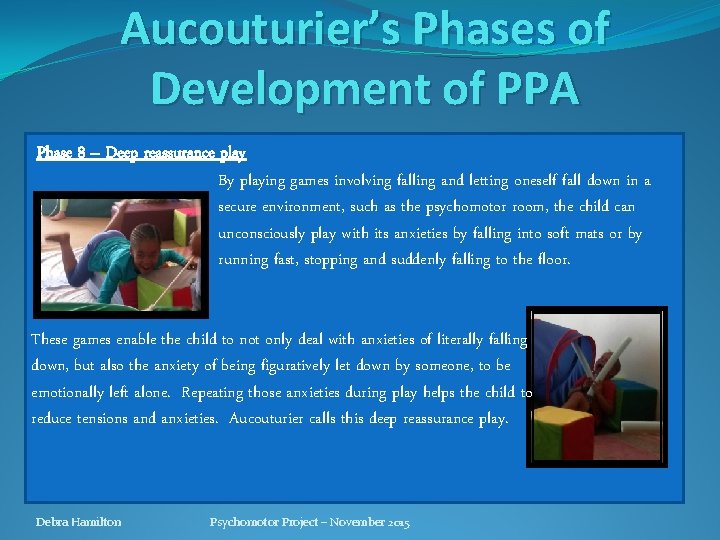
Aucouturier’s Phases of Development of PPA Phase 8 – Deep reassurance play By playing games involving falling and letting oneself fall down in a secure environment, such as the psychomotor room, the child can unconsciously play with its anxieties by falling into soft mats or by running fast, stopping and suddenly falling to the floor. These games enable the child to not only deal with anxieties of literally falling down, but also the anxiety of being figuratively let down by someone, to be emotionally left alone. Repeating those anxieties during play helps the child to reduce tensions and anxieties. Aucouturier calls this deep reassurance play. Debra Hamilton Psychomotor Project – November 2015
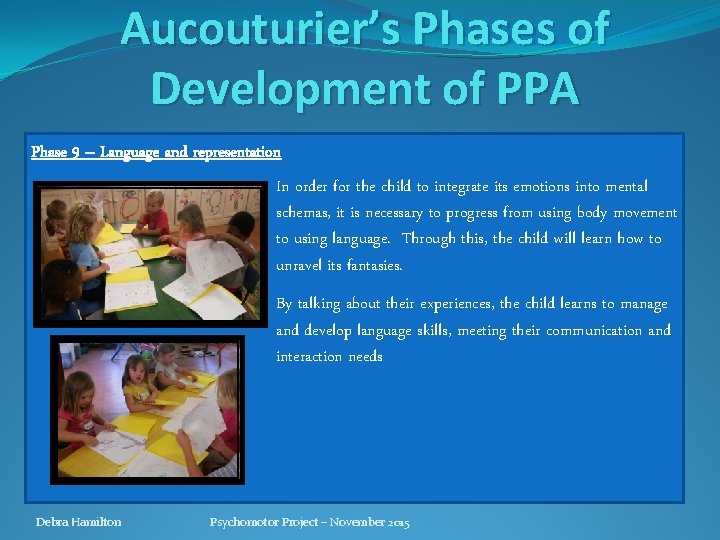
Aucouturier’s Phases of Development of PPA Phase 9 – Language and representation In order for the child to integrate its emotions into mental schemas, it is necessary to progress from using body movement to using language. Through this, the child will learn how to unravel its fantasies. By talking about their experiences, the child learns to manage and develop language skills, meeting their communication and interaction needs Debra Hamilton Psychomotor Project – November 2015
Bibliography http: //www. biography. com/people/jean-piaget-9439915, November 2015 http: //www. google. com/imgres? imgurl=http: //www. labcss. com/lecole/wpcontent/uploads/2014/09/slide 5. jpg&imgrefurl=http: //www. labcss. com/lecole/? lang%3 Den&h=600&w=940&tbnid=WY 9 ENDKSwb. Xvn. M: &docid=1 axwf. Os. Dz 5 IQM&itg=1&ei=8 GNXVobs. Oojka. ISVq. Jg. G&tbm=isch&ved=0 ah. UKEwi. Gp. O 7 F 767 JAh. UIMho. KHYQKCm. MQMwh. CK Bsw. Gw, November 2015 http: //www. google. com/imgres? imgurl=https: //lapsicomotricidad. files. wordpress. com/2013/04/aucouturier. jpg&imgrefur l=https: //lapsicomotricidad. wordpress. com/2013/04/02/704/&h=430&w=601&tbnid=Tt. Q 6 wms 8 F_s. J 0 M: &docid=X 6 cnal. Kd 2 Uvy. GM&ei=8 GNXVobs. Oojka. ISVq. Jg. G&tbm=isch&ved=0 ah. UKEwi. Gp. O 7 F 767 JAh. UIMho. KHYQKCm. MQMwgo. KAsw. Cw, November 2015 http: //www. ibe. unesco. org/publications/Thinkers. Pdf/freinete. pdf, November 2015 http: //www. oxforddictionaries. com/definition/english/, November 2015 http: //www. peisa. org. za/Newsletters/October 2009. pdf, November 2015 https: //es. wikipedia. org/wiki/Bernard_Aucouturier, November 2015 PPA Aucouturier’s Phases of Development, Rossella Meusel Pratique Psychomotrice Aucouturier, Rossella Meusel and Michele Kocheleff, January 2012 Debra Hamilton Psychomotor Project – November 2015