
Plant Protection Act Sec 7721 The Plant Pest

- Slides: 19
Plant Protection Act Sec. 7721 The Plant Pest and Disease Management and Disaster Prevention Program and The National Clean Plant Network FY 19 Spending Plan & FY 20 Update Feridoon Mehdizadegan National Operations Manager, 2019
Farm Bill – Sec. 10007 -No more APHIS Plant Protection and Quarantine • Sec. 10007 of the 2014 Farm Bill charged APHIS with allocating funds to strengthen the nation’s infrastructure for pest detection and surveillance, identification, and pest risk mitigation, while working to safeguard nursery production systems. • This authority was codified in Sec. 7721 of the Plant Protection Act (PPA). APHIS have access to $75 million to fund cooperators and projects for safeguarding domestic plant health. slide 2
PPA – Sec. 7721 APHIS Plant Protection and Quarantine • PPA Sec. 7721 funding supports: – The Plant Pest and Disease Management and Disaster Prevention Program strengthens APHIS’ ability to protect agriculture and natural resources from plant pest threats by funding projects that expand or enhance pest survey, identification, inspection, mitigation, risk analysis, and public education and outreach. – The National Clean Plant Network provides high quality asexually propagated plant material free of targeted plant pathogens/pests to protect the environment and ensure U. S. global competitiveness of specialty crops. slide 3
PPA – Sec. 7721 APHIS Plant Protection and Quarantine Both Programs are Strategically Aligned with - USDA Strategic Goal #2: Maximize the Ability of American Agricultural Producers to Prosper by Feeding and Clothing the World Objective 3: Protect agricultural health by preventing and mitigating the spread of agricultural pests and diseases. slide 4
PPA – Sec. 77 Plant Pest and Disease Management and Disaster Prevention Program • Clear and Transparent Process 21 • Broad Stakeholder Collaboration – Federal – State Government(s) – Tribal Nation(s) – Academia – Industry – Private /Non Profits Entities slide 5
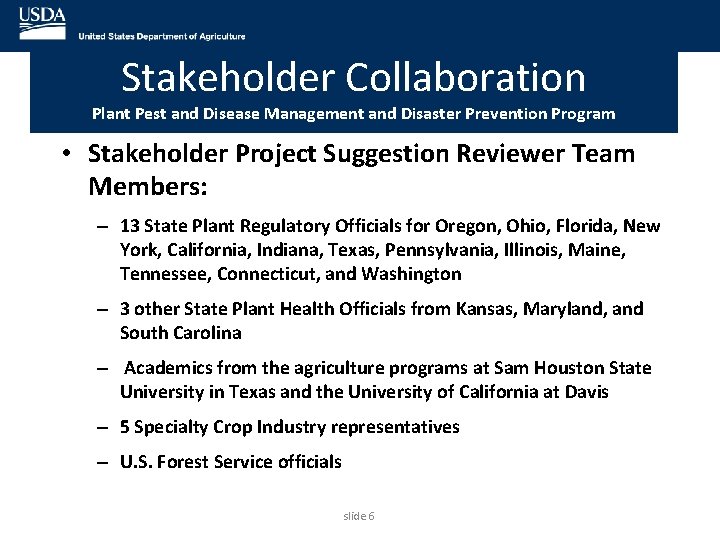
Stakeholder Collaboration Plant Pest and Disease Management and Disaster Prevention Program • Stakeholder Project Suggestion Reviewer Team Members: – 13 State Plant Regulatory Officials for Oregon, Ohio, Florida, New York, California, Indiana, Texas, Pennsylvania, Illinois, Maine, Tennessee, Connecticut, and Washington – 3 other State Plant Health Officials from Kansas, Maryland, and South Carolina – Academics from the agriculture programs at Sam Houston State University in Texas and the University of California at Davis – 5 Specialty Crop Industry representatives – U. S. Forest Service officials slide 6
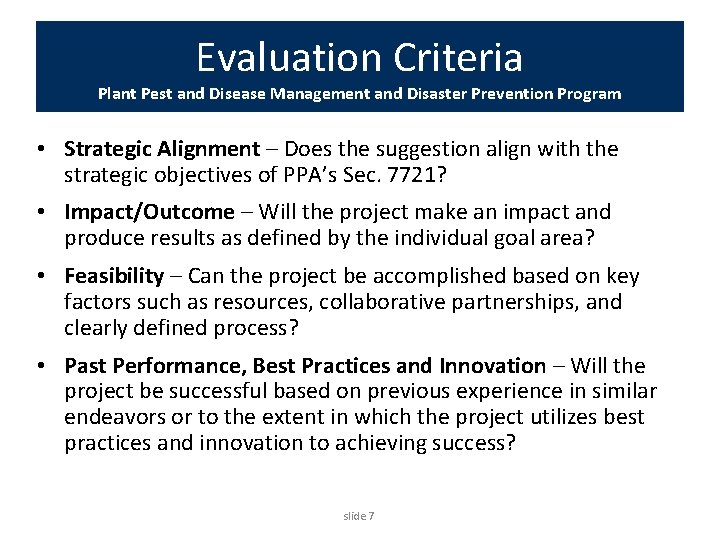
Evaluation Criteria Plant Pest and Disease Management and Disaster Prevention Program • Strategic Alignment – Does the suggestion align with the strategic objectives of PPA’s Sec. 7721? • Impact/Outcome – Will the project make an impact and produce results as defined by the individual goal area? • Feasibility – Can the project be accomplished based on key factors such as resources, collaborative partnerships, and clearly defined process? • Past Performance, Best Practices and Innovation – Will the project be successful based on previous experience in similar endeavors or to the extent in which the project utilizes best practices and innovation to achieving success? slide 7
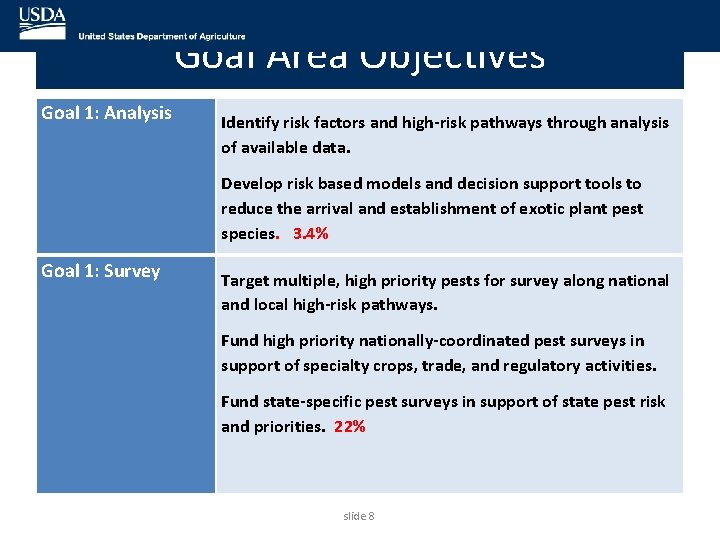
Goal Area Objectives Goal 1: Analysis Identify risk factors and high-risk pathways through analysis of available data. Develop risk based models and decision support tools to reduce the arrival and establishment of exotic plant pest species. 3. 4% Goal 1: Survey Target multiple, high priority pests for survey along national and local high-risk pathways. Fund high priority nationally-coordinated pest surveys in support of specialty crops, trade, and regulatory activities. Fund state-specific pest surveys in support of state pest risk and priorities. 22% slide 8
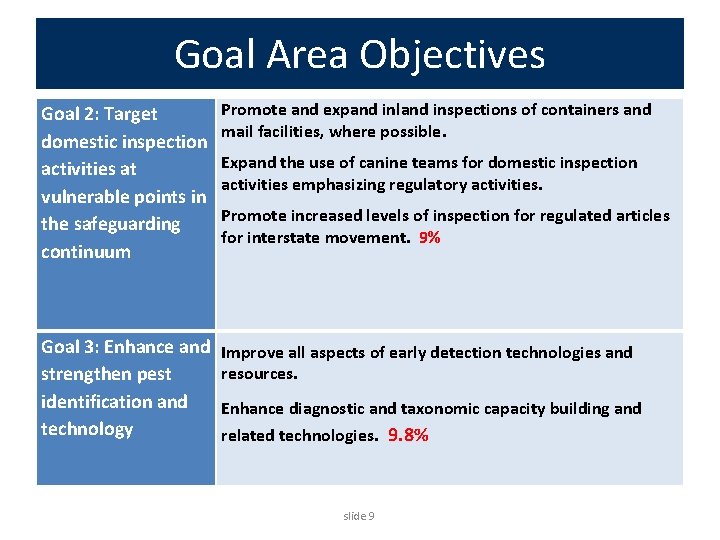
Goal Area Objectives Goal 2: Target domestic inspection activities at vulnerable points in the safeguarding continuum Promote and expand inland inspections of containers and mail facilities, where possible. Goal 3: Enhance and strengthen pest identification and technology Improve all aspects of early detection technologies and resources. Expand the use of canine teams for domestic inspection activities emphasizing regulatory activities. Promote increased levels of inspection for regulated articles for interstate movement. 9% Enhance diagnostic and taxonomic capacity building and related technologies. 9. 8% slide 9
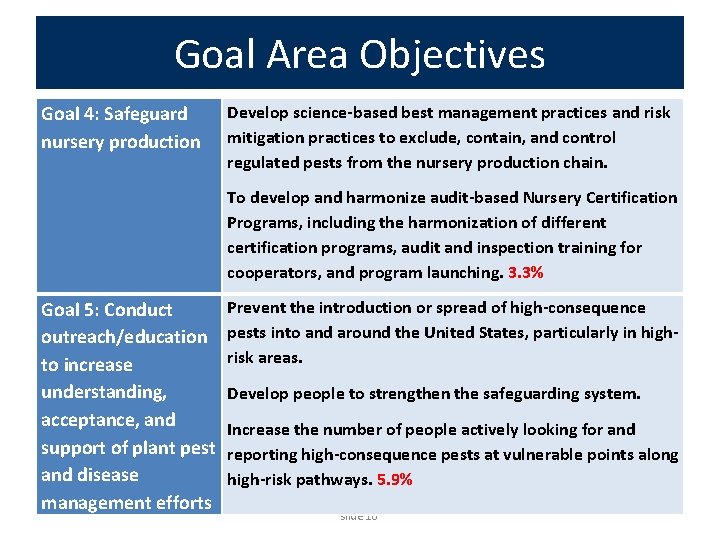
Goal Area Objectives Goal 4: Safeguard nursery production Develop science-based best management practices and risk mitigation practices to exclude, contain, and control regulated pests from the nursery production chain. To develop and harmonize audit-based Nursery Certification Programs, including the harmonization of different certification programs, audit and inspection training for cooperators, and program launching. 3. 3% Goal 5: Conduct outreach/education to increase understanding, acceptance, and support of plant pest and disease management efforts Prevent the introduction or spread of high-consequence pests into and around the United States, particularly in highrisk areas. Develop people to strengthen the safeguarding system. Increase the number of people actively looking for and reporting high-consequence pests at vulnerable points along high-risk pathways. 5. 9% slide 10
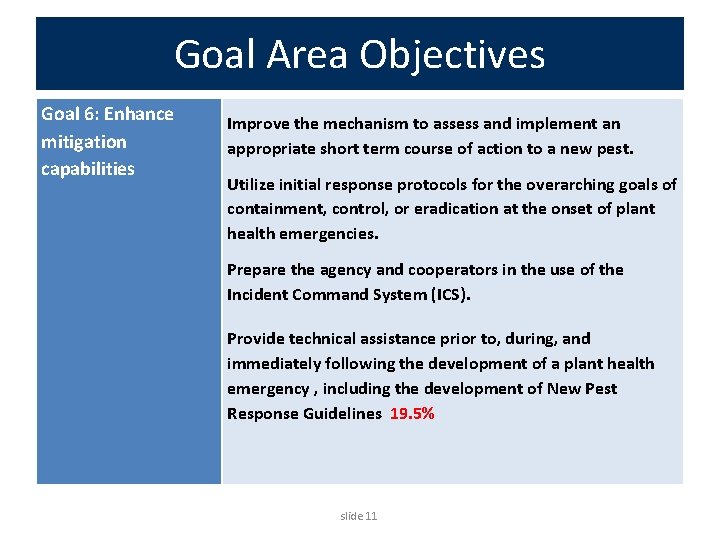
Goal Area Objectives Goal 6: Enhance mitigation capabilities Improve the mechanism to assess and implement an appropriate short term course of action to a new pest. Utilize initial response protocols for the overarching goals of containment, control, or eradication at the onset of plant health emergencies. Prepare the agency and cooperators in the use of the Incident Command System (ICS). Provide technical assistance prior to, during, and immediately following the development of a plant health emergency , including the development of New Pest Response Guidelines 19. 5% slide 11
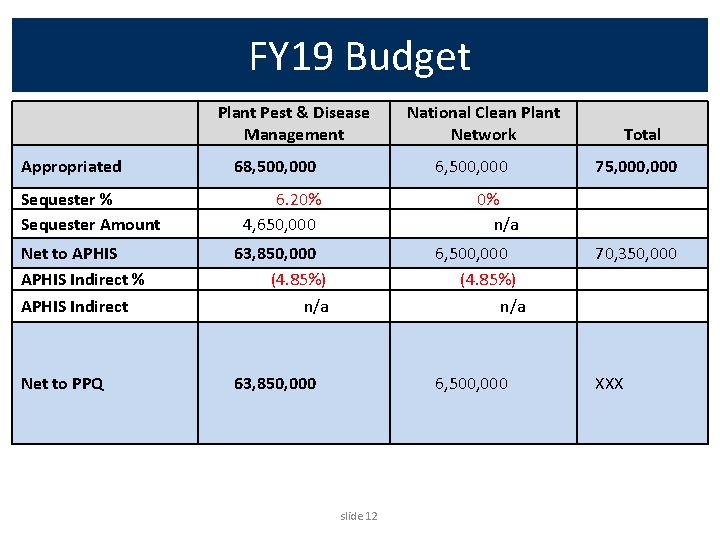
FY 19 Budget Plant Pest & Disease Management Appropriated Sequester % Sequester Amount 68, 500, 000 National Clean Plant Network Total 6, 500, 000 6. 20% 4, 650, 000 0% n/a Net to APHIS Indirect % APHIS Indirect 63, 850, 000 (4. 85%) n/a 6, 500, 000 (4. 85%) n/a Net to PPQ 63, 850, 000 6, 500, 000 slide 12 75, 000 70, 350, 000 XXX
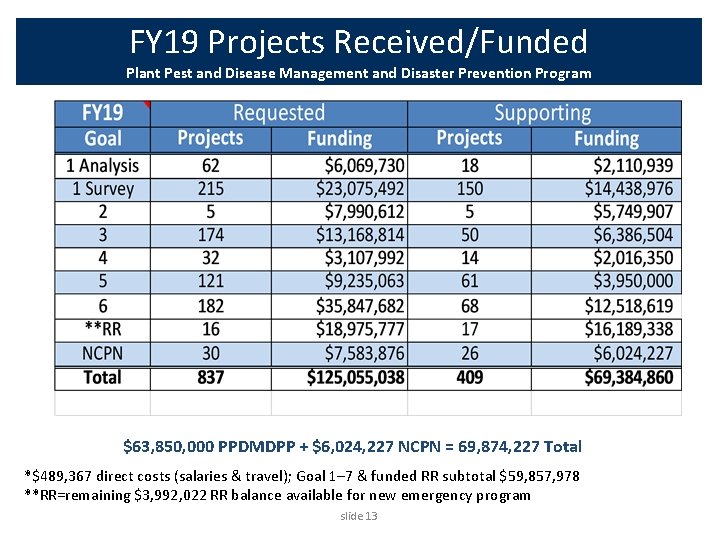
FY 19 Projects Received/Funded Plant Pest and Disease Management and Disaster Prevention Program $63, 850, 000 PPDMDPP + $6, 024, 227 NCPN = 69, 874, 227 Total *$489, 367 direct costs (salaries & travel); Goal 1– 7 & funded RR subtotal $59, 857, 978 **RR=remaining $3, 992, 022 RR balance available for new emergency program slide 13
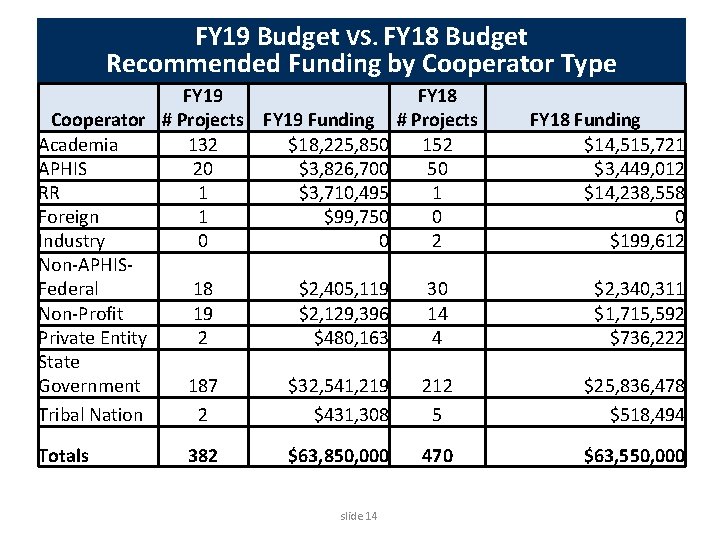
FY 19 Budget VS. FY 18 Budget Recommended Funding by Cooperator Type FY 19 FY 18 Cooperator # Projects FY 19 Funding # Projects Academia 132 $18, 225, 850 152 APHIS 20 $3, 826, 700 50 RR 1 $3, 710, 495 1 Foreign 1 $99, 750 0 Industry 0 0 2 Non-APHISFederal 18 $2, 405, 119 30 Non-Profit 19 $2, 129, 396 14 Private Entity 2 $480, 163 4 State Government 187 $32, 541, 219 212 Tribal Nation 2 $431, 308 5 Totals 382 $63, 850, 000 slide 14 470 FY 18 Funding $14, 515, 721 $3, 449, 012 $14, 238, 558 0 $199, 612 $2, 340, 311 $1, 715, 592 $736, 222 $25, 836, 478 $518, 494 $63, 550, 000
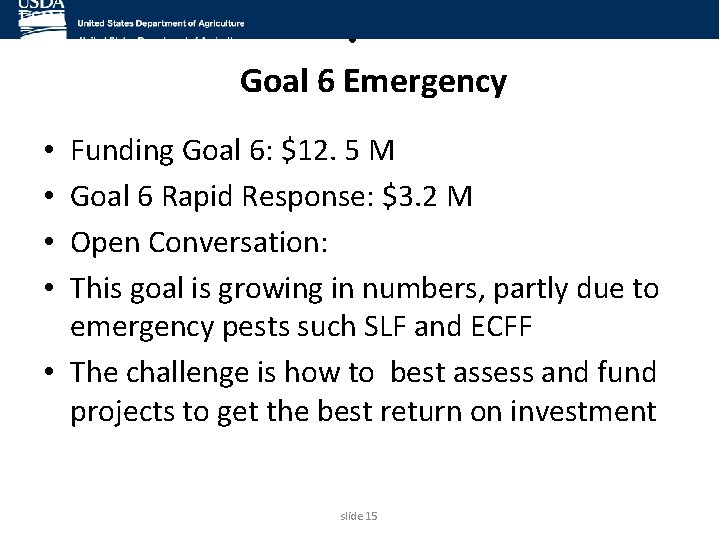
• Goal 6 Emergency Funding Goal 6: $12. 5 M Goal 6 Rapid Response: $3. 2 M Open Conversation: This goal is growing in numbers, partly due to emergency pests such SLF and ECFF • The challenge is how to best assess and fund projects to get the best return on investment • • slide 15
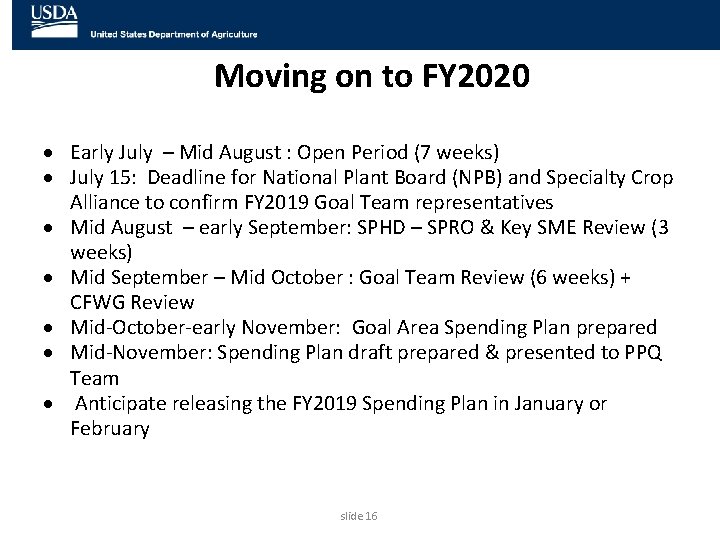
Moving on to FY 2020 Early July – Mid August : Open Period (7 weeks) July 15: Deadline for National Plant Board (NPB) and Specialty Crop Alliance to confirm FY 2019 Goal Team representatives Mid August – early September: SPHD – SPRO & Key SME Review (3 weeks) Mid September – Mid October : Goal Team Review (6 weeks) + CFWG Review Mid-October-early November: Goal Area Spending Plan prepared Mid-November: Spending Plan draft prepared & presented to PPQ Team Anticipate releasing the FY 2019 Spending Plan in January or February slide 16
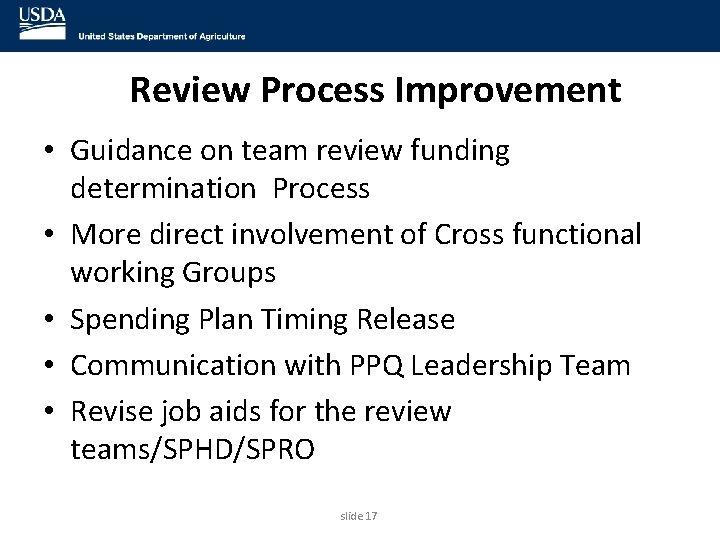
Review Process Improvement • Guidance on team review funding determination Process • More direct involvement of Cross functional working Groups • Spending Plan Timing Release • Communication with PPQ Leadership Team • Revise job aids for the review teams/SPHD/SPRO slide 17
Advance PPA Cycle Activities • Lessons learned session • Develop Implementation Plan • Communicate with NPB, Specialty Crops for representation • Establish Goal teams • Prepare webinar documents • Work With LPA to reach out to congress, Stakeholders, media slide 18
Post Announcement PPA Activities • Prepare individual state allocations • Communicate with funded /unfunded suggestors through ADODRs & PPA Team • Provide feedback to the internal and external stakeholders on funding/program update & requirements through Regional and National Plant Board meeting • Begin discussion on new implementation Plan- -We welcome comments on how to improve slide 19