PostMerger Integration Assessment PRITCHETT LP 800 992 5922
- Slides: 21
Post-Merger Integration Assessment ©PRITCHETT, LP 800 -992 -5922
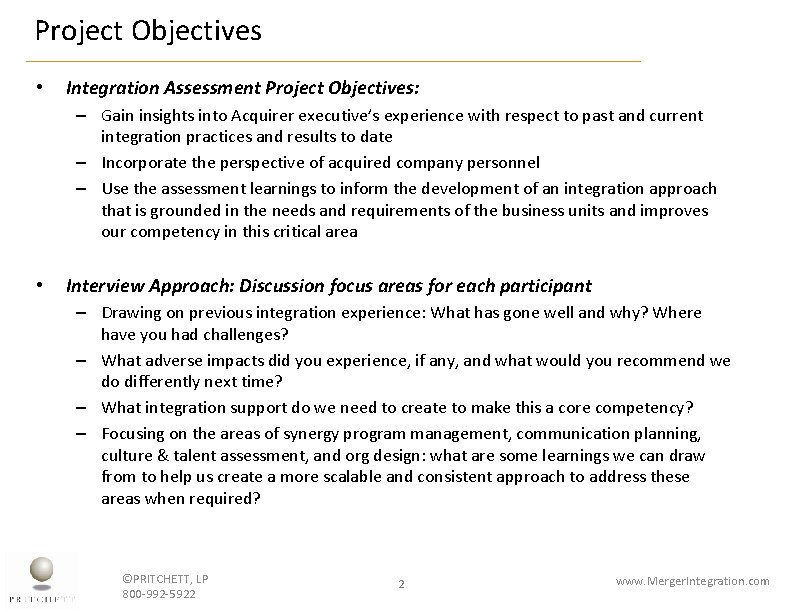
Project Objectives • Integration Assessment Project Objectives: – Gain insights into Acquirer executive’s experience with respect to past and current integration practices and results to date – Incorporate the perspective of acquired company personnel – Use the assessment learnings to inform the development of an integration approach that is grounded in the needs and requirements of the business units and improves our competency in this critical area • Interview Approach: Discussion focus areas for each participant – Drawing on previous integration experience: What has gone well and why? Where have you had challenges? – What adverse impacts did you experience, if any, and what would you recommend we do differently next time? – What integration support do we need to create to make this a core competency? – Focusing on the areas of synergy program management, communication planning, culture & talent assessment, and org design: what are some learnings we can draw from to help us create a more scalable and consistent approach to address these areas when required? ©PRITCHETT, LP 800 -992 -5922 2 www. Merger. Integration. com
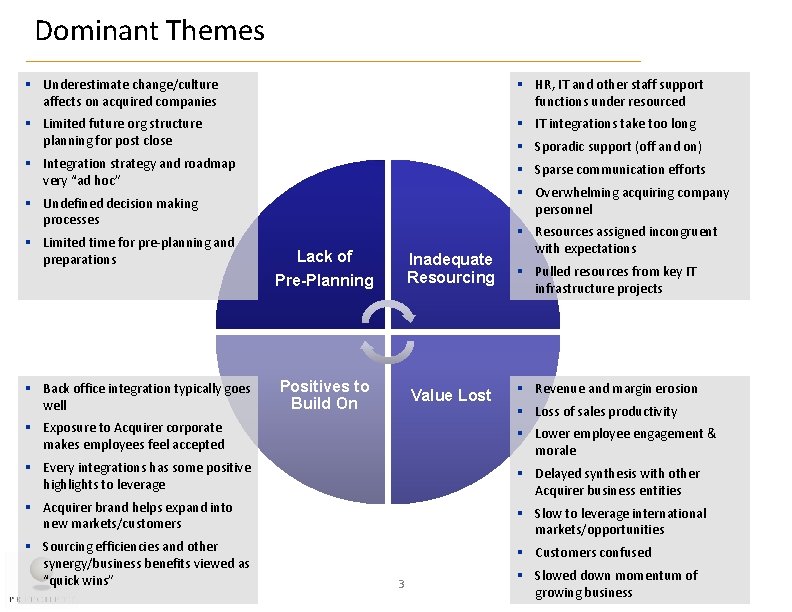
Dominant Themes § Underestimate change/culture affects on acquired companies § HR, IT and other staff support functions under resourced § Limited future org structure planning for post close § IT integrations take too long § Integration strategy and roadmap very “ad hoc” § Sparse communication efforts § Sporadic support (off and on) § Overwhelming acquiring company personnel § Undefined decision making processes § Limited time for pre-planning and preparations § Back office integration typically goes well Lack of Pre-Planning Inadequate Resourcing Positives to Build On Value Lost § Exposure to Acquirer corporate makes employees feel accepted § Pulled resources from key IT infrastructure projects § Revenue and margin erosion § Loss of sales productivity § Lower employee engagement & morale § Every integrations has some positive highlights to leverage § Delayed synthesis with other Acquirer business entities § Acquirer brand helps expand into new markets/customers § Sourcing efficiencies and other synergy/business benefits viewed as “quick wins” § Resources assigned incongruent with expectations § Slow to leverage international markets/opportunities § Customers confused 3 § Slowed down momentum of growing business .
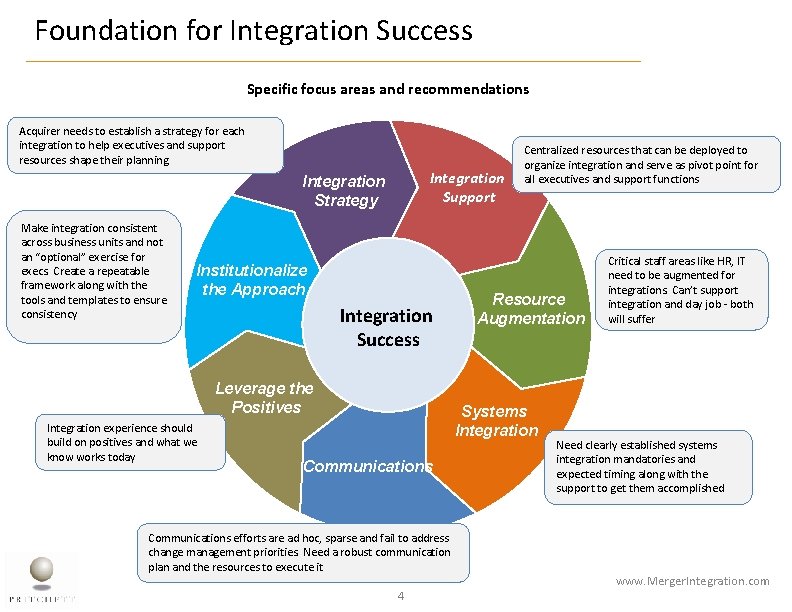
Foundation for Integration Success Specific focus areas and recommendations Acquirer needs to establish a strategy for each integration to help executives and support resources shape their planning Integration Support Integration Strategy Make integration consistent across business units and not an “optional” exercise for execs. Create a repeatable framework along with the tools and templates to ensure consistency Institutionalize the Approach Integration Success Leverage the Positives Integration experience should build on positives and what we know works today Centralized resources that can be deployed to organize integration and serve as pivot point for all executives and support functions Resource Augmentation Systems Integration Communications efforts are ad hoc, sparse and fail to address change management priorities. Need a robust communication plan and the resources to execute it 4 Critical staff areas like HR, IT need to be augmented for integrations. Can’t support integration and day job - both will suffer Need clearly established systems integration mandatories and expected timing along with the support to get them accomplished www. Merger. Integration. com
Stakeholder Feedback ©PRITCHETT, LP 800 -992 -5922
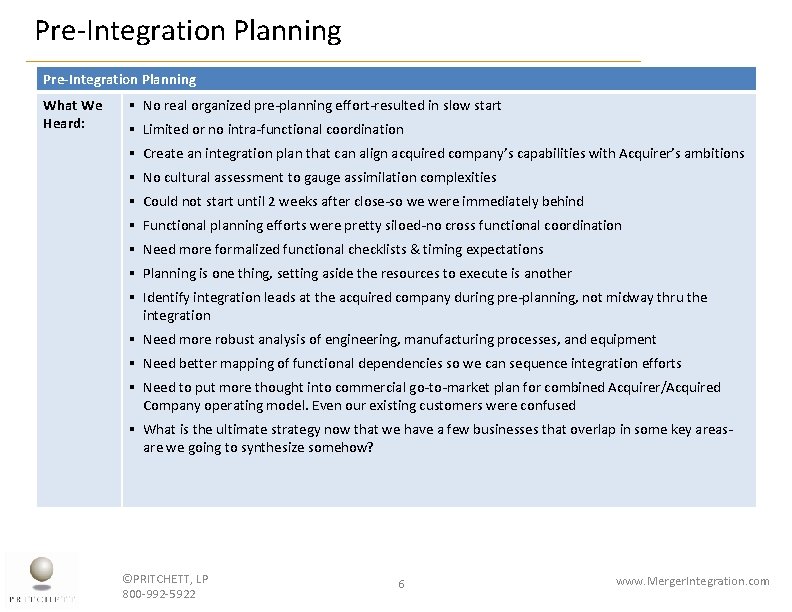
Pre-Integration Planning What We Heard: § No real organized pre-planning effort-resulted in slow start § Limited or no intra-functional coordination § Create an integration plan that can align acquired company’s capabilities with Acquirer’s ambitions § No cultural assessment to gauge assimilation complexities § Could not start until 2 weeks after close-so we were immediately behind § Functional planning efforts were pretty siloed-no cross functional coordination § Need more formalized functional checklists & timing expectations § Planning is one thing, setting aside the resources to execute is another § Identify integration leads at the acquired company during pre-planning, not midway thru the integration § Need more robust analysis of engineering, manufacturing processes, and equipment § Need better mapping of functional dependencies so we can sequence integration efforts § Need to put more thought into commercial go-to-market plan for combined Acquirer/Acquired Company operating model. Even our existing customers were confused § What is the ultimate strategy now that we have a few businesses that overlap in some key areasare we going to synthesize somehow? ©PRITCHETT, LP 800 -992 -5922 6 www. Merger. Integration. com
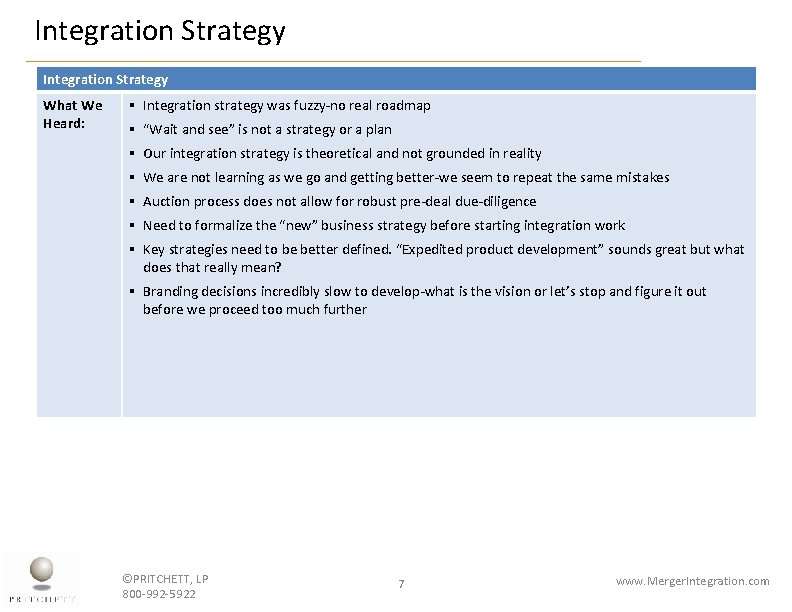
Integration Strategy What We Heard: § Integration strategy was fuzzy-no real roadmap § “Wait and see” is not a strategy or a plan § Our integration strategy is theoretical and not grounded in reality § We are not learning as we go and getting better-we seem to repeat the same mistakes § Auction process does not allow for robust pre-deal due-diligence § Need to formalize the “new” business strategy before starting integration work § Key strategies need to be better defined. “Expedited product development” sounds great but what does that really mean? § Branding decisions incredibly slow to develop-what is the vision or let’s stop and figure it out before we proceed too much further ©PRITCHETT, LP 800 -992 -5922 7 www. Merger. Integration. com
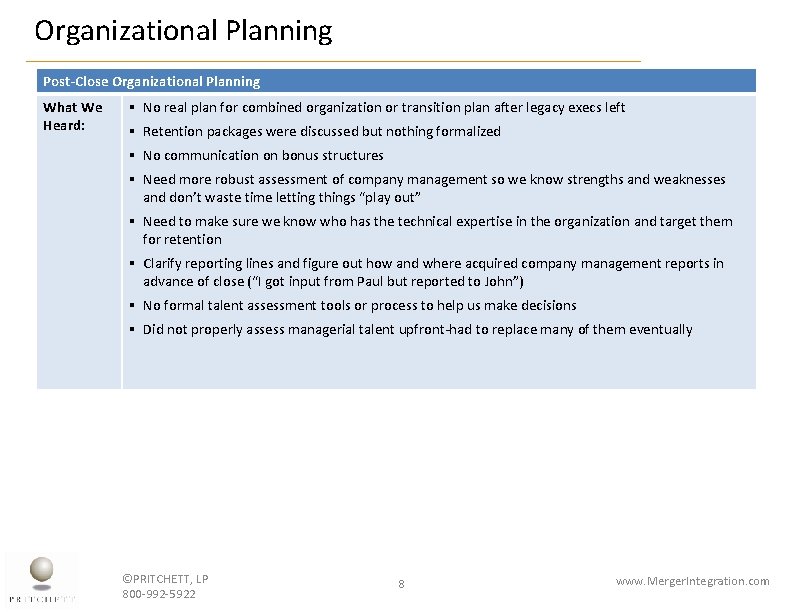
Organizational Planning Post-Close Organizational Planning What We Heard: § No real plan for combined organization or transition plan after legacy execs left § Retention packages were discussed but nothing formalized § No communication on bonus structures § Need more robust assessment of company management so we know strengths and weaknesses and don’t waste time letting things “play out” § Need to make sure we know who has the technical expertise in the organization and target them for retention § Clarify reporting lines and figure out how and where acquired company management reports in advance of close (“I got input from Paul but reported to John”) § No formal talent assessment tools or process to help us make decisions § Did not properly assess managerial talent upfront-had to replace many of them eventually ©PRITCHETT, LP 800 -992 -5922 8 www. Merger. Integration. com
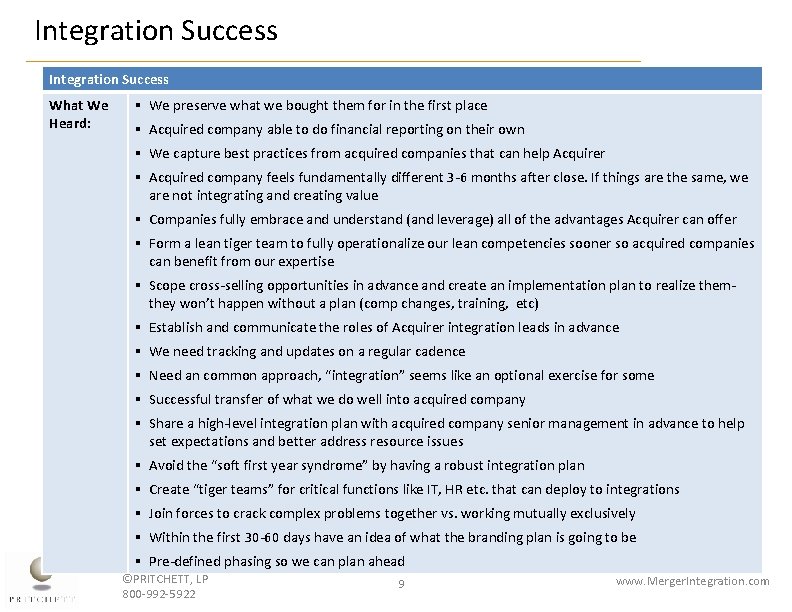
Integration Success What We Heard: § We preserve what we bought them for in the first place § Acquired company able to do financial reporting on their own § We capture best practices from acquired companies that can help Acquirer § Acquired company feels fundamentally different 3 -6 months after close. If things are the same, we are not integrating and creating value § Companies fully embrace and understand (and leverage) all of the advantages Acquirer can offer § Form a lean tiger team to fully operationalize our lean competencies sooner so acquired companies can benefit from our expertise § Scope cross-selling opportunities in advance and create an implementation plan to realize themthey won’t happen without a plan (comp changes, training, etc) § Establish and communicate the roles of Acquirer integration leads in advance § We need tracking and updates on a regular cadence § Need an common approach, “integration” seems like an optional exercise for some § Successful transfer of what we do well into acquired company § Share a high-level integration plan with acquired company senior management in advance to help set expectations and better address resource issues § Avoid the “soft first year syndrome” by having a robust integration plan § Create “tiger teams” for critical functions like IT, HR etc. that can deploy to integrations § Join forces to crack complex problems together vs. working mutually exclusively § Within the first 30 -60 days have an idea of what the branding plan is going to be § Pre-defined phasing so we can plan ahead ©PRITCHETT, LP 800 -992 -5922 9 www. Merger. Integration. com
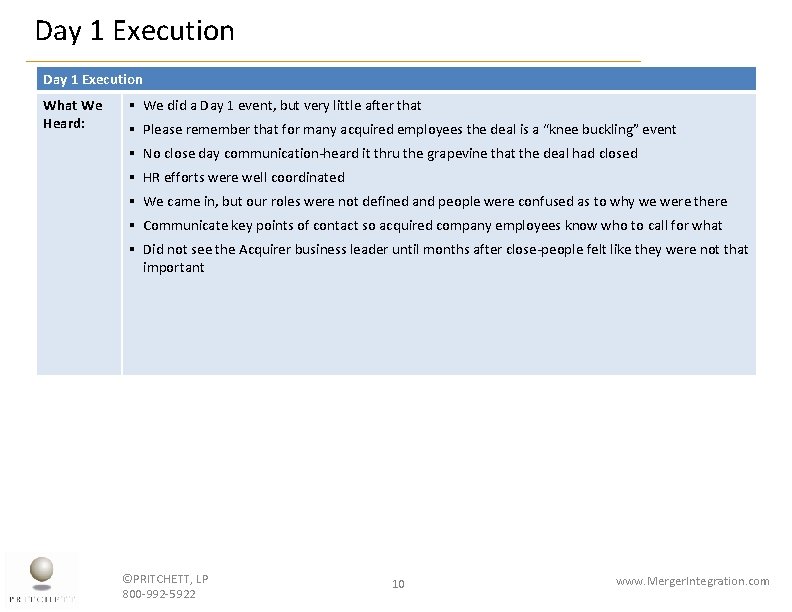
Day 1 Execution What We Heard: § We did a Day 1 event, but very little after that § Please remember that for many acquired employees the deal is a “knee buckling” event § No close day communication-heard it thru the grapevine that the deal had closed § HR efforts were well coordinated § We came in, but our roles were not defined and people were confused as to why we were there § Communicate key points of contact so acquired company employees know who to call for what § Did not see the Acquirer business leader until months after close-people felt like they were not that important ©PRITCHETT, LP 800 -992 -5922 10 www. Merger. Integration. com
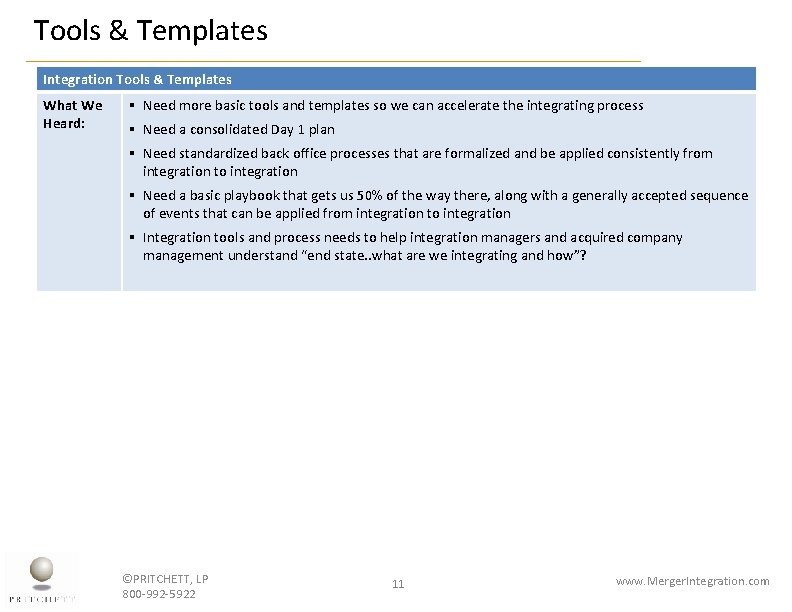
Tools & Templates Integration Tools & Templates What We Heard: § Need more basic tools and templates so we can accelerate the integrating process § Need a consolidated Day 1 plan § Need standardized back office processes that are formalized and be applied consistently from integration to integration § Need a basic playbook that gets us 50% of the way there, along with a generally accepted sequence of events that can be applied from integration to integration § Integration tools and process needs to help integration managers and acquired company management understand “end state. . what are we integrating and how”? ©PRITCHETT, LP 800 -992 -5922 11 www. Merger. Integration. com
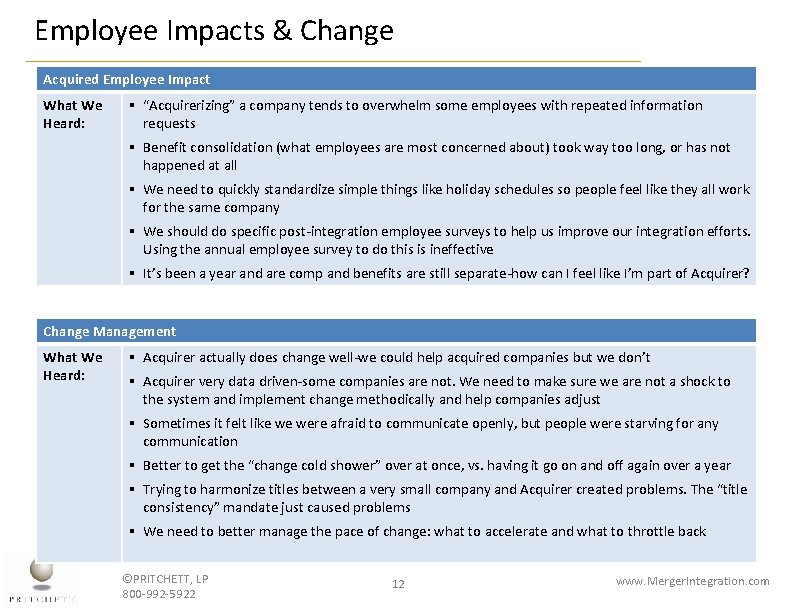
Employee Impacts & Change Acquired Employee Impact What We Heard: § “Acquirerizing” a company tends to overwhelm some employees with repeated information requests § Benefit consolidation (what employees are most concerned about) took way too long, or has not happened at all § We need to quickly standardize simple things like holiday schedules so people feel like they all work for the same company § We should do specific post-integration employee surveys to help us improve our integration efforts. Using the annual employee survey to do this is ineffective § It’s been a year and are comp and benefits are still separate-how can I feel like I’m part of Acquirer? Change Management What We Heard: § Acquirer actually does change well-we could help acquired companies but we don’t § Acquirer very data driven-some companies are not. We need to make sure we are not a shock to the system and implement change methodically and help companies adjust § Sometimes it felt like we were afraid to communicate openly, but people were starving for any communication § Better to get the “change cold shower” over at once, vs. having it go on and off again over a year § Trying to harmonize titles between a very small company and Acquirer created problems. The “title consistency” mandate just caused problems § We need to better manage the pace of change: what to accelerate and what to throttle back ©PRITCHETT, LP 800 -992 -5922 12 www. Merger. Integration. com
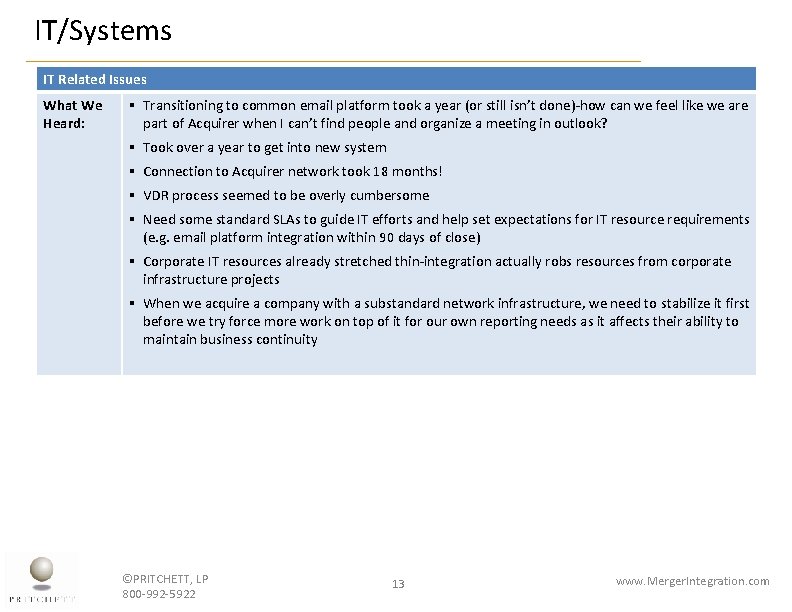
IT/Systems IT Related Issues What We Heard: § Transitioning to common email platform took a year (or still isn’t done)-how can we feel like we are part of Acquirer when I can’t find people and organize a meeting in outlook? § Took over a year to get into new system § Connection to Acquirer network took 18 months! § VDR process seemed to be overly cumbersome § Need some standard SLAs to guide IT efforts and help set expectations for IT resource requirements (e. g. email platform integration within 90 days of close) § Corporate IT resources already stretched thin-integration actually robs resources from corporate infrastructure projects § When we acquire a company with a substandard network infrastructure, we need to stabilize it first before we try force more work on top of it for our own reporting needs as it affects their ability to maintain business continuity ©PRITCHETT, LP 800 -992 -5922 13 www. Merger. Integration. com
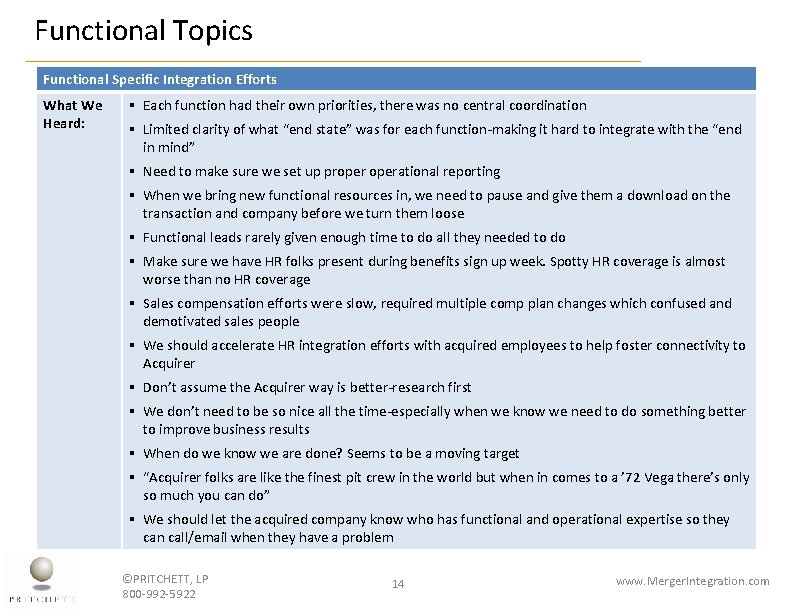
Functional Topics Functional Specific Integration Efforts What We Heard: § Each function had their own priorities, there was no central coordination § Limited clarity of what “end state” was for each function-making it hard to integrate with the “end in mind” § Need to make sure we set up properational reporting § When we bring new functional resources in, we need to pause and give them a download on the transaction and company before we turn them loose § Functional leads rarely given enough time to do all they needed to do § Make sure we have HR folks present during benefits sign up week. Spotty HR coverage is almost worse than no HR coverage § Sales compensation efforts were slow, required multiple comp plan changes which confused and demotivated sales people § We should accelerate HR integration efforts with acquired employees to help foster connectivity to Acquirer § Don’t assume the Acquirer way is better-research first § We don’t need to be so nice all the time-especially when we know we need to do something better to improve business results § When do we know we are done? Seems to be a moving target § “Acquirer folks are like the finest pit crew in the world but when in comes to a ’ 72 Vega there’s only so much you can do” § We should let the acquired company know who has functional and operational expertise so they can call/email when they have a problem ©PRITCHETT, LP 800 -992 -5922 14 www. Merger. Integration. com
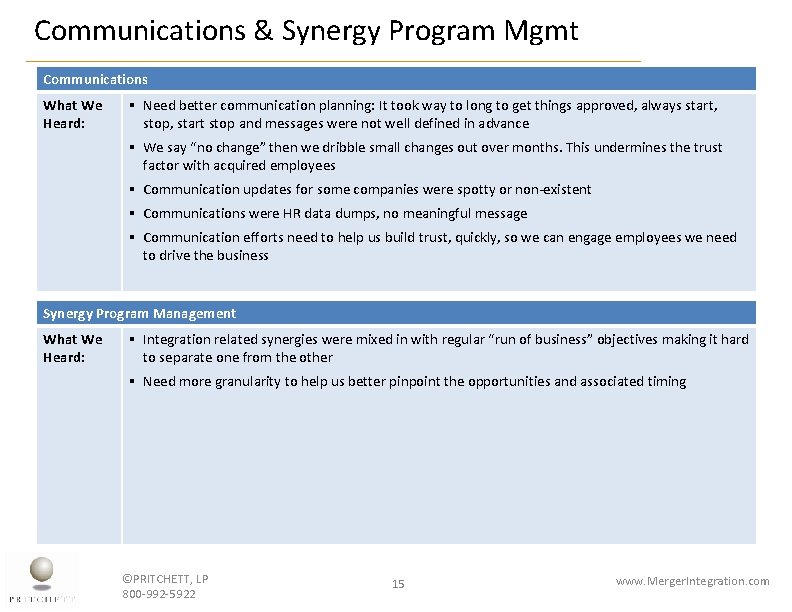
Communications & Synergy Program Mgmt Communications What We Heard: § Need better communication planning: It took way to long to get things approved, always start, stop, start stop and messages were not well defined in advance § We say “no change” then we dribble small changes out over months. This undermines the trust factor with acquired employees § Communication updates for some companies were spotty or non-existent § Communications were HR data dumps, no meaningful message § Communication efforts need to help us build trust, quickly, so we can engage employees we need to drive the business Synergy Program Management What We Heard: § Integration related synergies were mixed in with regular “run of business” objectives making it hard to separate one from the other § Need more granularity to help us better pinpoint the opportunities and associated timing ©PRITCHETT, LP 800 -992 -5922 15 www. Merger. Integration. com
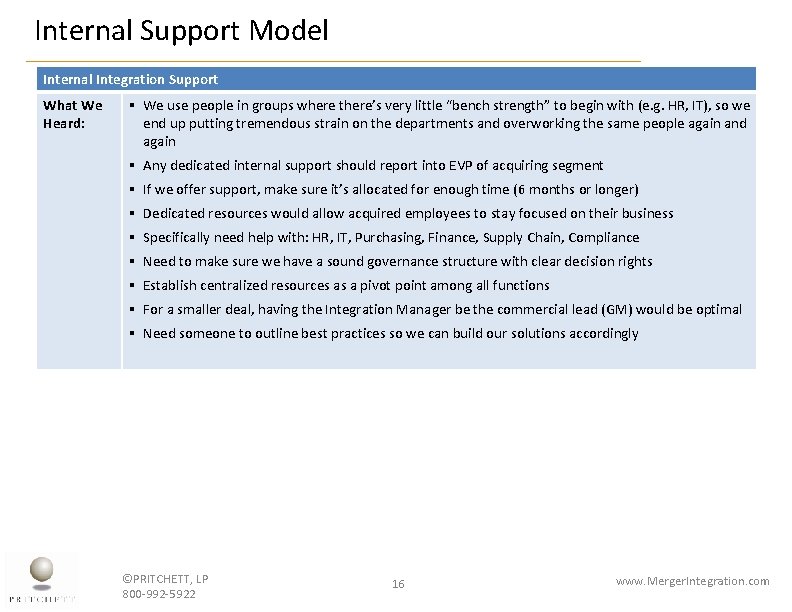
Internal Support Model Internal Integration Support What We Heard: § We use people in groups where there’s very little “bench strength” to begin with (e. g. HR, IT), so we end up putting tremendous strain on the departments and overworking the same people again and again § Any dedicated internal support should report into EVP of acquiring segment § If we offer support, make sure it’s allocated for enough time (6 months or longer) § Dedicated resources would allow acquired employees to stay focused on their business § Specifically need help with: HR, IT, Purchasing, Finance, Supply Chain, Compliance § Need to make sure we have a sound governance structure with clear decision rights § Establish centralized resources as a pivot point among all functions § For a smaller deal, having the Integration Manager be the commercial lead (GM) would be optimal § Need someone to outline best practices so we can build our solutions accordingly ©PRITCHETT, LP 800 -992 -5922 16 www. Merger. Integration. com
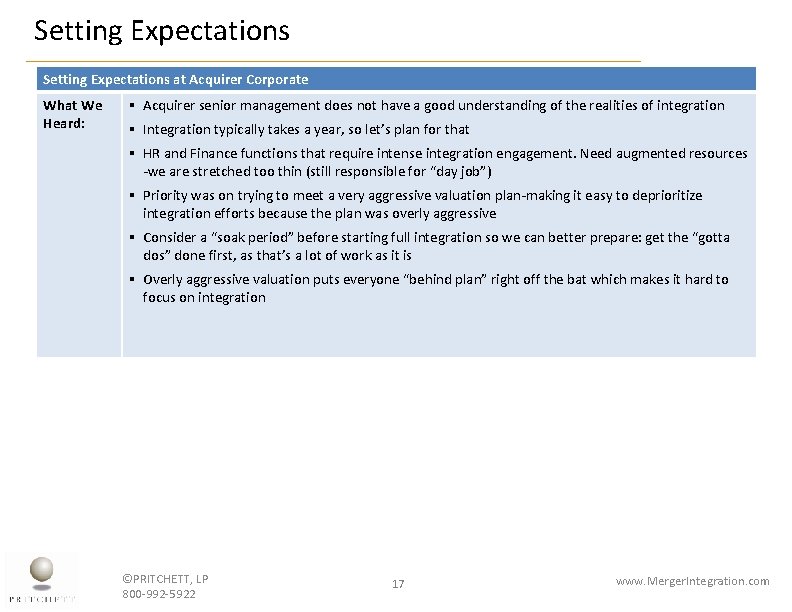
Setting Expectations at Acquirer Corporate What We Heard: § Acquirer senior management does not have a good understanding of the realities of integration § Integration typically takes a year, so let’s plan for that § HR and Finance functions that require intense integration engagement. Need augmented resources -we are stretched too thin (still responsible for “day job”) § Priority was on trying to meet a very aggressive valuation plan-making it easy to deprioritize integration efforts because the plan was overly aggressive § Consider a “soak period” before starting full integration so we can better prepare: get the “gotta dos” done first, as that’s a lot of work as it is § Overly aggressive valuation puts everyone “behind plan” right off the bat which makes it hard to focus on integration ©PRITCHETT, LP 800 -992 -5922 17 www. Merger. Integration. com
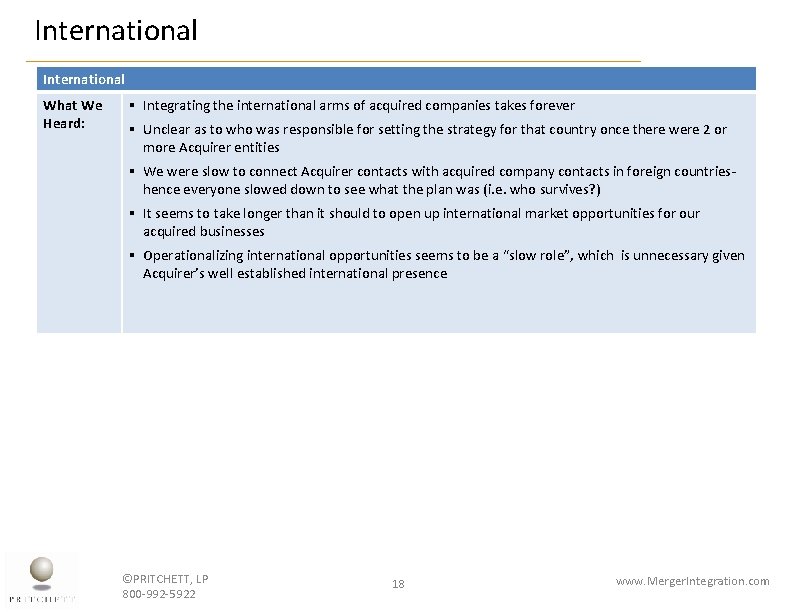
International What We Heard: § Integrating the international arms of acquired companies takes forever § Unclear as to who was responsible for setting the strategy for that country once there were 2 or more Acquirer entities § We were slow to connect Acquirer contacts with acquired company contacts in foreign countrieshence everyone slowed down to see what the plan was (i. e. who survives? ) § It seems to take longer than it should to open up international market opportunities for our acquired businesses § Operationalizing international opportunities seems to be a “slow role”, which is unnecessary given Acquirer’s well established international presence ©PRITCHETT, LP 800 -992 -5922 18 www. Merger. Integration. com
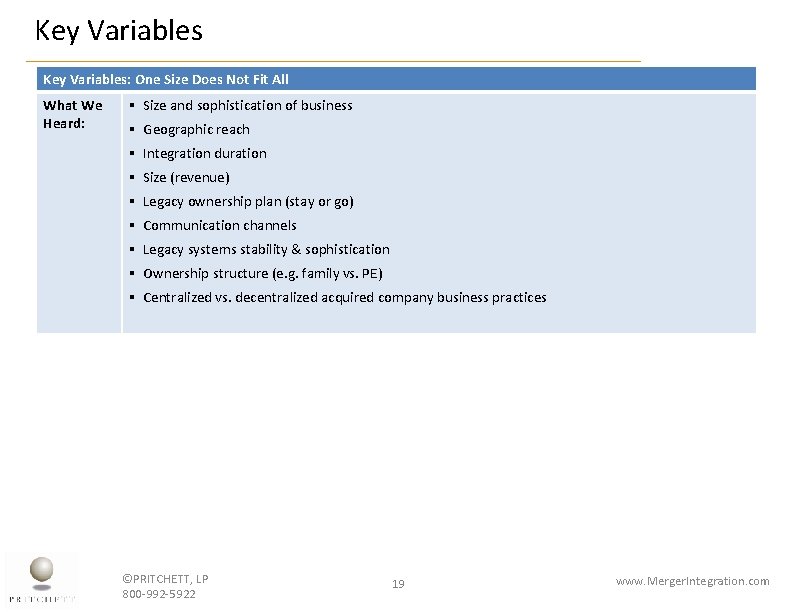
Key Variables: One Size Does Not Fit All What We Heard: § Size and sophistication of business § Geographic reach § Integration duration § Size (revenue) § Legacy ownership plan (stay or go) § Communication channels § Legacy systems stability & sophistication § Ownership structure (e. g. family vs. PE) § Centralized vs. decentralized acquired company business practices ©PRITCHETT, LP 800 -992 -5922 19 www. Merger. Integration. com
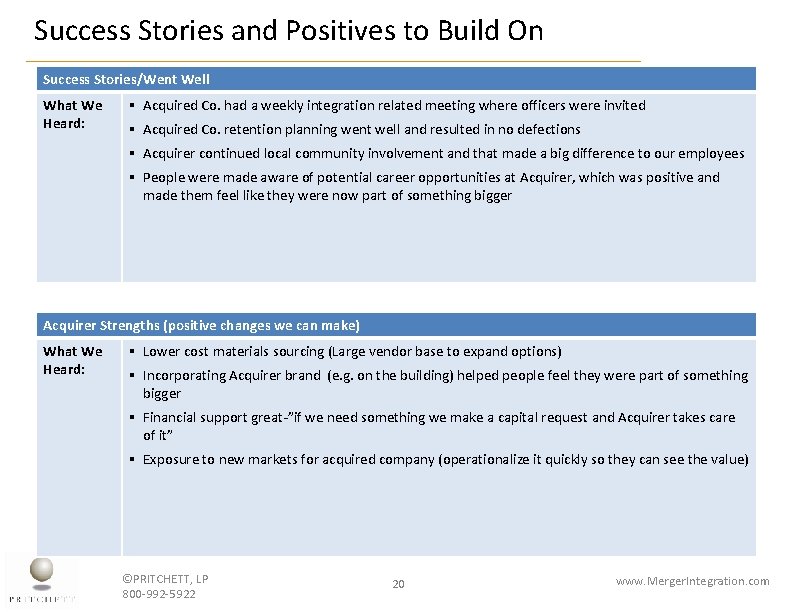
Success Stories and Positives to Build On Success Stories/Went Well What We Heard: § Acquired Co. had a weekly integration related meeting where officers were invited § Acquired Co. retention planning went well and resulted in no defections § Acquirer continued local community involvement and that made a big difference to our employees § People were made aware of potential career opportunities at Acquirer, which was positive and made them feel like they were now part of something bigger Acquirer Strengths (positive changes we can make) What We Heard: § Lower cost materials sourcing (Large vendor base to expand options) § Incorporating Acquirer brand (e. g. on the building) helped people feel they were part of something bigger § Financial support great-”if we need something we make a capital request and Acquirer takes care of it” § Exposure to new markets for acquired company (operationalize it quickly so they can see the value) ©PRITCHETT, LP 800 -992 -5922 20 www. Merger. Integration. com
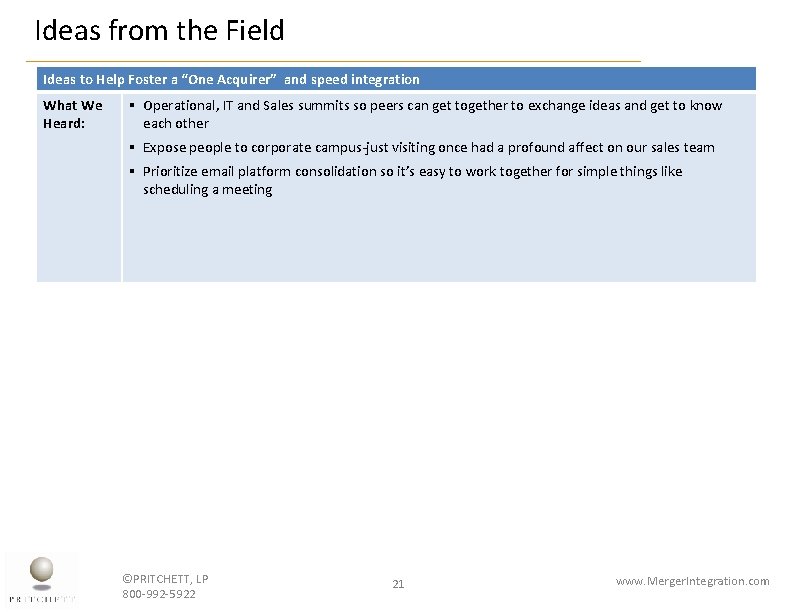
Ideas from the Field Ideas to Help Foster a “One Acquirer” and speed integration What We Heard: § Operational, IT and Sales summits so peers can get together to exchange ideas and get to know each other § Expose people to corporate campus-just visiting once had a profound affect on our sales team § Prioritize email platform consolidation so it’s easy to work together for simple things like scheduling a meeting ©PRITCHETT, LP 800 -992 -5922 21 www. Merger. Integration. com