PMT 360 COURSE OVERVIEW ASSESSMENT March 2019 Version

- Slides: 12
PMT 360 COURSE OVERVIEW & ASSESSMENT March 2019 Version 7. 1, 5 Mar 2019 PMT 360 Course Overview & Assessment, chart 0
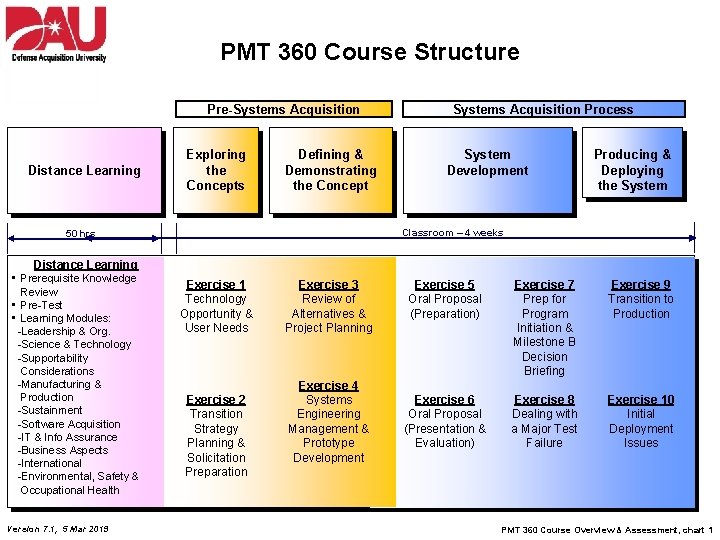
PMT 360 Course Structure Pre-Systems Acquisition Distance Learning Exploring the Concepts Defining & Demonstrating the Concept Version 7. 1, 5 Mar 2019 System Development Producing & Deploying the System Classroom – 4 weeks 50 hrs Distance Learning • Prerequisite Knowledge Review • Pre-Test • Learning Modules: -Leadership & Org. -Science & Technology -Supportability Considerations -Manufacturing & Production -Sustainment -Software Acquisition -IT & Info Assurance -Business Aspects -International -Environmental, Safety & Occupational Health Systems Acquisition Process Exercise 1 Technology Opportunity & User Needs Exercise 2 Transition Strategy Planning & Solicitation Preparation Exercise 3 Review of Alternatives & Project Planning Exercise 4 Systems Engineering Management & Prototype Development Exercise 5 Oral Proposal (Preparation) Exercise 7 Prep for Program Initiation & Milestone B Decision Briefing Exercise 9 Transition to Production Exercise 6 Oral Proposal (Presentation & Evaluation) Exercise 8 Dealing with a Major Test Failure Exercise 10 Initial Deployment Issues PMT 360 Course Overview & Assessment, chart 1
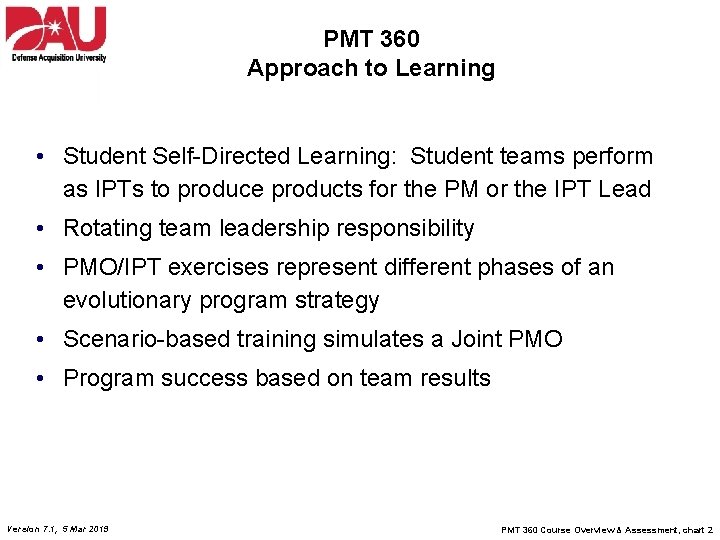
PMT 360 Approach to Learning • Student Self-Directed Learning: Student teams perform as IPTs to produce products for the PM or the IPT Lead • Rotating team leadership responsibility • PMO/IPT exercises represent different phases of an evolutionary program strategy • Scenario-based training simulates a Joint PMO • Program success based on team results Version 7. 1, 5 Mar 2019 PMT 360 Course Overview & Assessment, chart 2
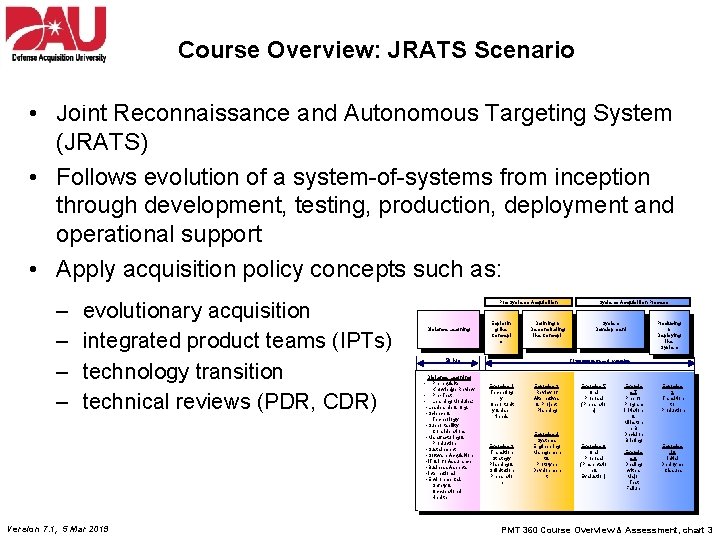
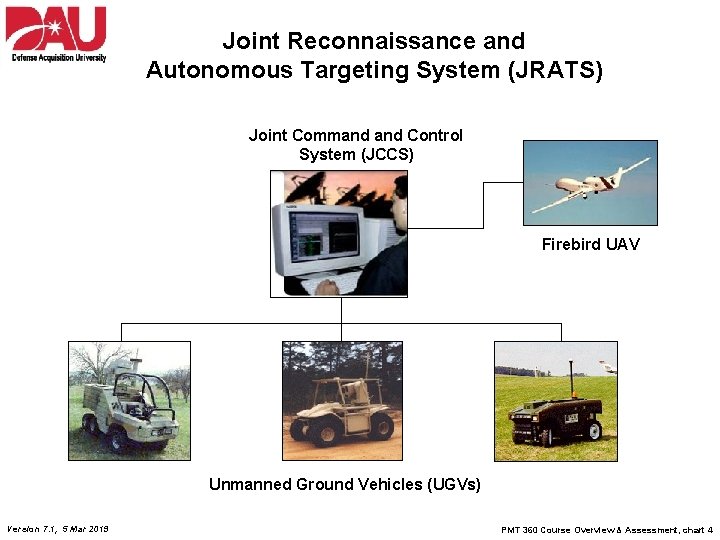
Course Overview: JRATS Scenario • Joint Reconnaissance and Autonomous Targeting System (JRATS) • Follows evolution of a system-of-systems from inception through development, testing, production, deployment and operational support • Apply acquisition policy concepts such as: – – evolutionary acquisition integrated product teams (IPTs) technology transition technical reviews (PDR, CDR) Version 7. 1, 5 Mar 2019 Pre-Systems Acquisition Distance Learning Explorin g the Concept s Defining & Demonstrating the Concept Distance Learning Prerequisite Knowledge Review • Pre-Test • Learning Modules: -Leadership & Org. -Science & Technology -Supportability Considerations -Manufacturing & Production -Sustainment -Software Acquisition -IT & Info Assurance -Business Aspects -International -Environmental, Safety & Occupational Health System Development Producing & Deploying the System Classroom 6 weeks Classroom – 4– weeks 50 hrs • Systems Acquisition Process Exercise 1 Technolog y Opportunit y & User Needs Exercise 2 Transition Strategy Planning & Solicitation Preparatio n Exercise 3 Review of Alternatives & Project Planning Exercise 5 Oral Proposal (Preparatio n) Exercise 4 Systems Engineering Managemen t& Prototype Developmen t Exercise 6 Oral Proposal (Presentatio n& Evaluation) Exercis e 7 Prep for Program Initiation & Mileston e. B Decision Briefing Exercis e 8 Dealing with a Major Test Failure Exercise 9 Transition to Production Exercise 10 Initial Deployme nt Issues PMT 360 Course Overview & Assessment, chart 3
Joint Reconnaissance and Autonomous Targeting System (JRATS) Joint Command Control System (JCCS) Firebird UAV Unmanned Ground Vehicles (UGVs) Version 7. 1, 5 Mar 2019 PMT 360 Course Overview & Assessment, chart 4
Classroom: Graded Assessments • Clear expectations established for success • All assessments completed in class • Students and Instructors can monitor: – Exam results – Exercise Assessment results – Students at risk of failure • Emphasize both content knowledge and leadership abilities • Obvious “point of no return” or failure point • Set a clear, rigorous standard for successful course completion – Rubric ensures consistency of exercise grading Version 7. 1, 5 Mar 2019 PMT 360 Course Overview & Assessment, chart 5
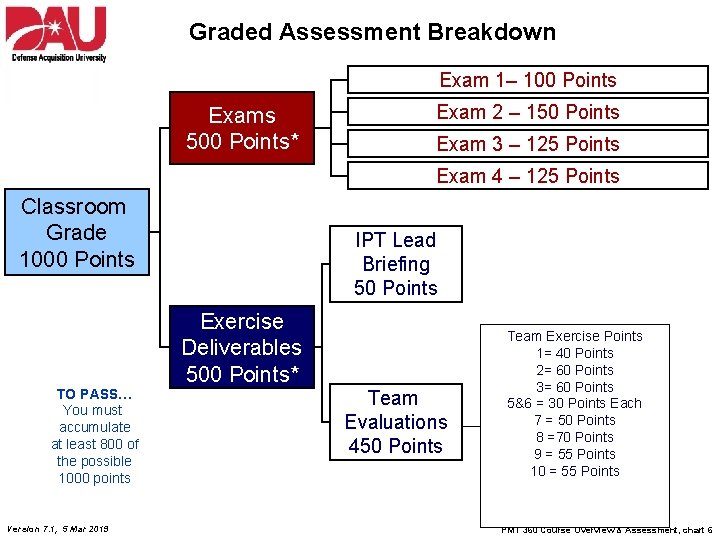
Graded Assessment Breakdown Exam 1– 100 Points Exams 500 Points* Exam 2 – 150 Points Exam 3 – 125 Points Exam 4 – 125 Points Classroom Grade 1000 Points TO PASS… You must accumulate at least 800 of the possible 1000 points Version 7. 1, 5 Mar 2019 IPT Lead Briefing 50 Points Exercise Deliverables 500 Points* Team Evaluations 450 Points Team Exercise Points 1= 40 Points 2= 60 Points 3= 60 Points 5&6 = 30 Points Each 7 = 50 Points 8 =70 Points 9 = 55 Points 10 = 55 Points PMT 360 Course Overview & Assessment, chart 6
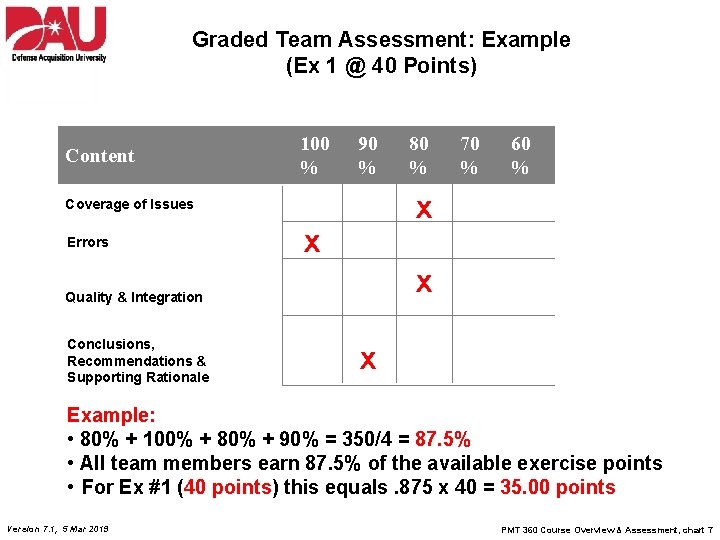
Graded Team Assessment: Example (Ex 1 @ 40 Points) Content 100 % 90 % x 60 % x Quality & Integration Conclusions, Recommendations & Supporting Rationale 70 % x Coverage of Issues Errors 80 % x Example: • 80% + 100% + 80% + 90% = 350/4 = 87. 5% • All team members earn 87. 5% of the available exercise points • For Ex #1 (40 points) this equals. 875 x 40 = 35. 00 points Version 7. 1, 5 Mar 2019 PMT 360 Course Overview & Assessment, chart 7
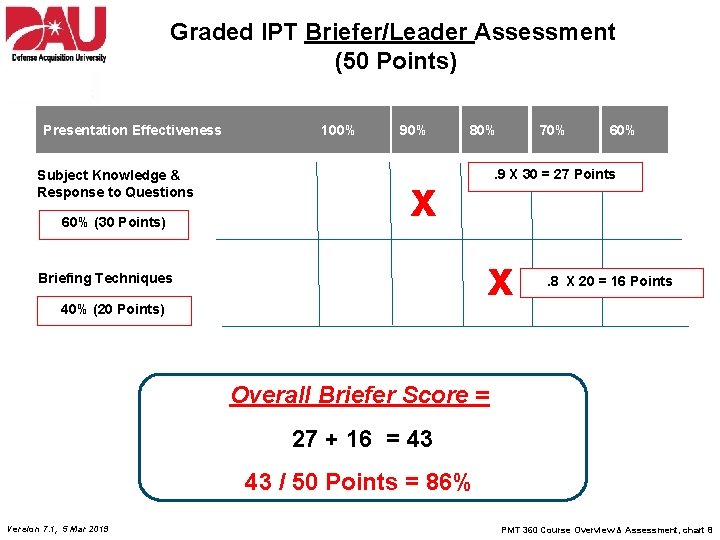
Graded IPT Briefer/Leader Assessment (50 Points) Presentation Effectiveness Subject Knowledge & Response to Questions 60% (30 Points) 100% 90% 80% 70% . 9 X 30 = 27 Points x x Briefing Techniques 40% (20 Points) 60% . 8 X 20 = 16 Points Overall Briefer Score = 27 + 16 = 43 43 / 50 Points = 86% Version 7. 1, 5 Mar 2019 PMT 360 Course Overview & Assessment, chart 8
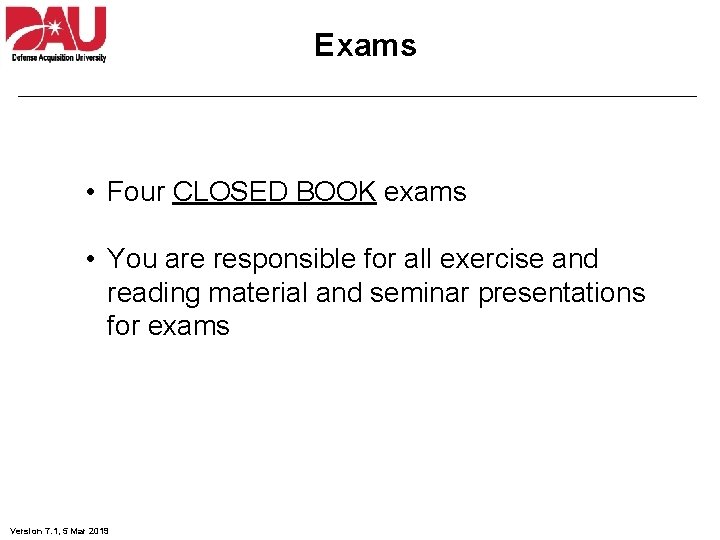
Exams • Four CLOSED BOOK exams • You are responsible for all exercise and reading material and seminar presentations for exams Version 7. 1, 5 Mar 2019
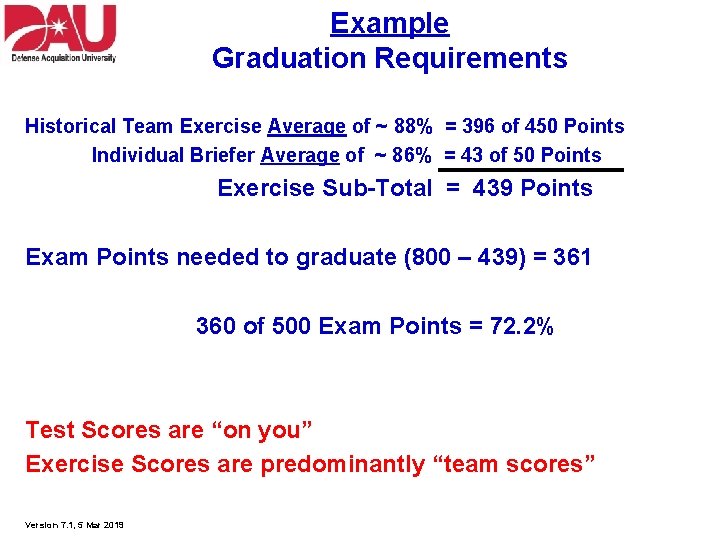
Example Graduation Requirements Historical Team Exercise Average of ~ 88% = 396 of 450 Points Individual Briefer Average of ~ 86% = 43 of 50 Points Exercise Sub-Total = 439 Points Exam Points needed to graduate (800 – 439) = 361 360 of 500 Exam Points = 72. 2% Test Scores are “on you” Exercise Scores are predominantly “team scores” Version 7. 1, 5 Mar 2019
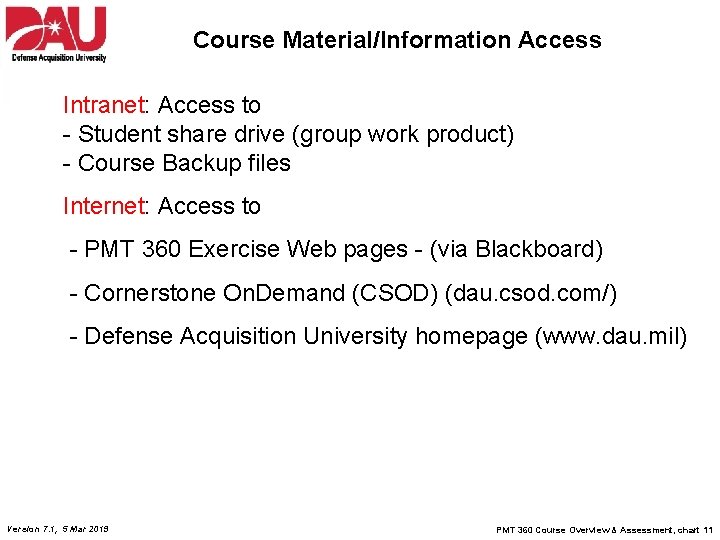
Course Material/Information Access Intranet: Access to - Student share drive (group work product) - Course Backup files Internet: Access to - PMT 360 Exercise Web pages - (via Blackboard) - Cornerstone On. Demand (CSOD) (dau. csod. com/) - Defense Acquisition University homepage (www. dau. mil) Version 7. 1, 5 Mar 2019 PMT 360 Course Overview & Assessment, chart 11