PLC Selection Criteria and Results David Dudley Sep













- Slides: 38
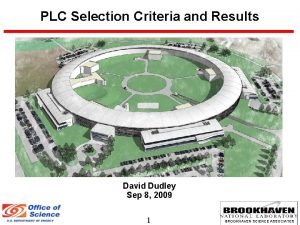
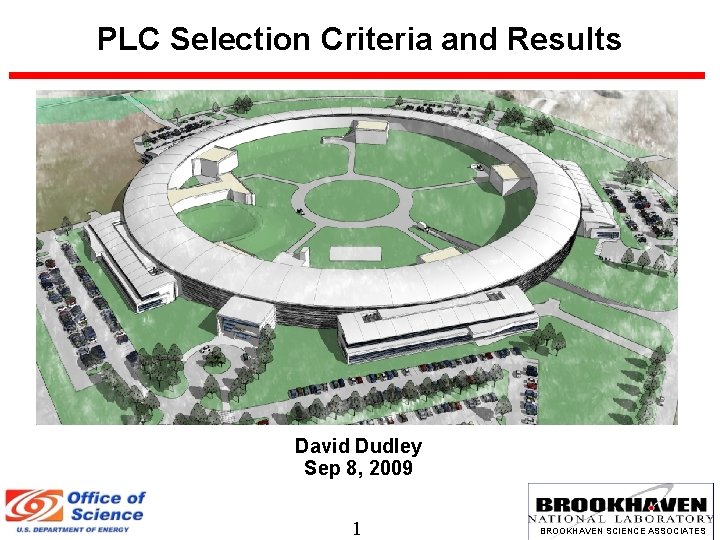
PLC Selection Criteria and Results David Dudley Sep 8, 2009 1 BROOKHAVEN SCIENCE ASSOCIATES
Outline • What are the PLC’s used for. • Which PLC’s were on the short list, and why. • Requirements for PLC integration. • What tests were performed. • Evaluation. • Results. 2 BROOKHAVEN SCIENCE ASSOCIATES
What are the PLC’s used for • Complete control of accelerator operations • Automatically manages control of machine operations under steady state conditions. • Controls access to accelerator facilities. • Provides the Personnel Protection System (PPS) which should prevent exposure to dangerous areas of facility. • Manages the Equipment Protection System (EPS) to prevent damage to equipment during operation. • Most actual control interfaces are linked through the PLC I/O systems. 3 BROOKHAVEN SCIENCE ASSOCIATES
What are the PLC’s used for (cont’d) • Slow and Moderate Speed I/O are linked • through the PLC, which can acquire and time stamp data. Automatic/semi-automatic or manual control of various subsystems used in the accelerator. These systems include: • Control and automatic operations of the Vacuum, RF, Power Supply, and other subsystems. • Almost all equipment monitoring. • Conventional Systems automatic control and monitoring. • HVAC monitoring. 4 BROOKHAVEN SCIENCE ASSOCIATES
What are the PLC’s used for (cont’d) • Provides secure, automatic shutdown in case of personnel intrusion into secure areas. • Protects the user from himself. • Prevents access to hazardous areas during operation. • Monitors radiation hazards in occupied areas. Should dangerous levels occur, takes protective action. • Provides for sequential systematic searching of secured areas before machine operation possible. • Enables machine to operate when all required 5 BROOKHAVEN SCIENCE ASSOCIATES
Which PLC’s were on the short list, and why • Rockwell Automation (Allen Bradley) Control Logic and Compact Logic. • Handles Safety and Normal control systems • Fast, Compact Logix performs 1 k boolean instructions in 0. 08 ms, Control Logix (L 63) in 0. 04 ms. “Typical” instructions in 0. 5 ms/1 k, 0. 25 ms/1 k respectively. • Very popular in the US. • Full complement of functions. • Capable of loading/storing XML program descriptions. • Used by a great variety of customers 6 BROOKHAVEN SCIENCE ASSOCIATES
Which PLC’s were on the short list, and why • Siemens S 7 -300 and S 7 -400. • Used in a variety of control applications, including many accelerators. • Very popular in Europe. • Handles Safety and Normal control systems. • Limited text import/export capabilities. • Full complement of functions. • Fast, S 7 -315 performs 1 k Booleans in 0. 1 ms, S 7317 performs in 0. 05 ms, “Typical” instructions in 2 ms/1 k, 0. 2 ms / 1 k respectively. 7 BROOKHAVEN SCIENCE ASSOCIATES
Which PLC’s were on the short list, and why • Yokogawa FA-M 3 • Extremely fast. 533 Mhz Powerpc. • Very popular in Japan. • Operates as a Ladder Logic CPU (Sequence mode), or as an embedded Linux IOC. • IOC Support was developed at KEK. • Very fast, F 3 SP 67 -6 S performs 1 k boolean operations in 0. 0175 ms, “Typical” instructions in 0. 07 ms / 1 k. • Handles standard EPICS record definition files. 8 BROOKHAVEN SCIENCE ASSOCIATES
Which PLC’s were on the short list, and why • GE Fanuc PACSystems RS 7 i. • VME 64 Based. Up to a 1. 8 Ghz Pentium-M • • processor. VME Crate chassis size would make easy integration. Use worldwide in petrochemical, manufacturing, electrical, and pharmaceutical industry Fast. Booleans 0. 02 ms/1 k, “Typical” 0. 03 ms/1 k. All systems supported 9 by single software BROOKHAVEN SCIENCE ASSOCIATES
Requirements for PLC Integration • All IO is to be defined through the IRMIS • • • system. PLC programming software MUST be able to load and store files created through the IRMIS system that defines I/O and or logic. PLC programming must be available over ethernet. All IOC communications to the PLCs will take place over ethernet. 10 BROOKHAVEN SCIENCE ASSOCIATES
What tests were performed • Simple interface tests to evaluate capability of PLC to integrate with EPICS. • Rockwell (A-B) EPICS response is slow, but it seems the limitations are inherent to the driver. Data size does not seem to affect transfer rate. • Siemens interface is data structure based, and requires PLC programming to build data block and send to host. • Yokogawa interface is register based, and requires a knowledge of which register number contains data required. • GE interface is Modbus based, and has same 11 limitations as the Yokogawa interface. BROOKHAVEN SCIENCE ASSOCIATES
What tests were performed • Data capture tests that evaluated acquiring/storing/timestamping 12 analog values. • Acquired data on timed basis, with one sample each 10 ms (limitation of the Siemens module used). A-B and Yokogawa were capable of performing much faster, with the A-B performing at one sample each 5 ms, and consuming 70 -90 usec. /cycle. Faster hardware is available as well. • Yokogawa IOC module had no problem acquiring data as fast as the scan times available would allow (0. 05 sec, I believe). After additional research, the Yokogawa 12 times could be much BROOKHAVEN SCIENCE ASSOCIATES
What tests were performed • No GE Hardware was tested. • No hardware was available, although research seems to point to the capability of very high performance from the system. • It was decided not to pursue testing with the GE equipment, due to equipment cost and other constraints. 13 BROOKHAVEN SCIENCE ASSOCIATES
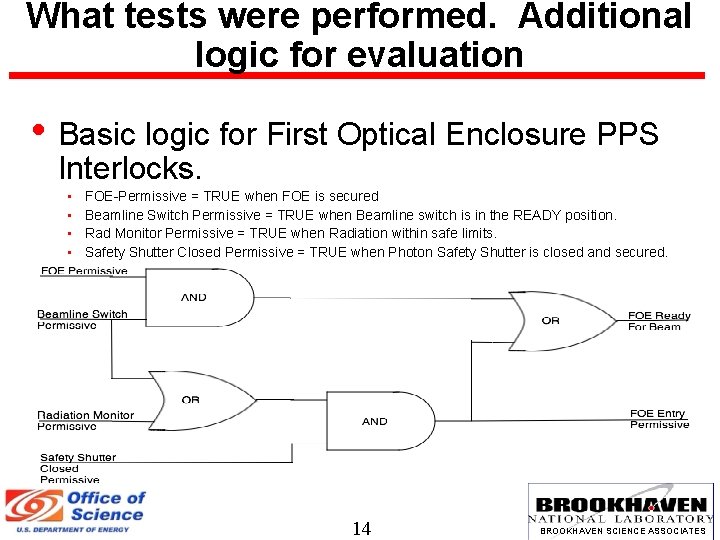
What tests were performed. Additional logic for evaluation • Basic logic for First Optical Enclosure PPS Interlocks. • • FOE-Permissive = TRUE when FOE is secured Beamline Switch Permissive = TRUE when Beamline switch is in the READY position. Rad Monitor Permissive = TRUE when Radiation within safe limits. Safety Shutter Closed Permissive = TRUE when Photon Safety Shutter is closed and secured. 14 BROOKHAVEN SCIENCE ASSOCIATES
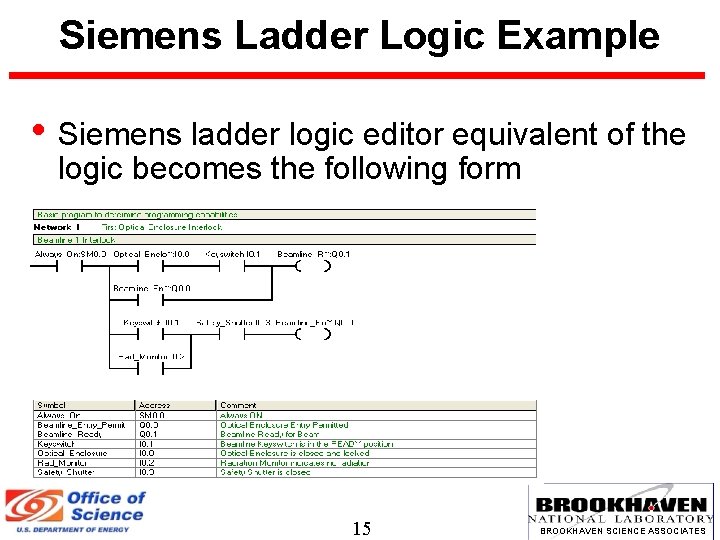
Siemens Ladder Logic Example • Siemens ladder logic editor equivalent of the logic becomes the following form 15 BROOKHAVEN SCIENCE ASSOCIATES
Siemens Ladder Logic Example • Exporting the ladder into a text file produces the following: 16 BROOKHAVEN SCIENCE ASSOCIATES
Siemens Import Example • Loading the text file into the ladder editor provides the following output: 17 BROOKHAVEN SCIENCE ASSOCIATES
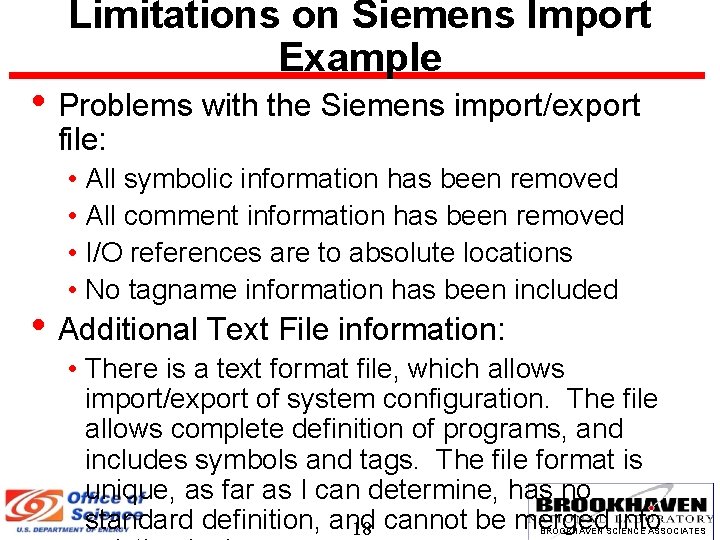
Limitations on Siemens Import Example • Problems with the Siemens import/export file: • All symbolic information has been removed • All comment information has been removed • I/O references are to absolute locations • No tagname information has been included • Additional Text File information: • There is a text format file, which allows import/export of system configuration. The file allows complete definition of programs, and includes symbols and tags. The file format is unique, as far as I can determine, has no standard definition, and 18 cannot be merged into BROOKHAVEN SCIENCE ASSOCIATES
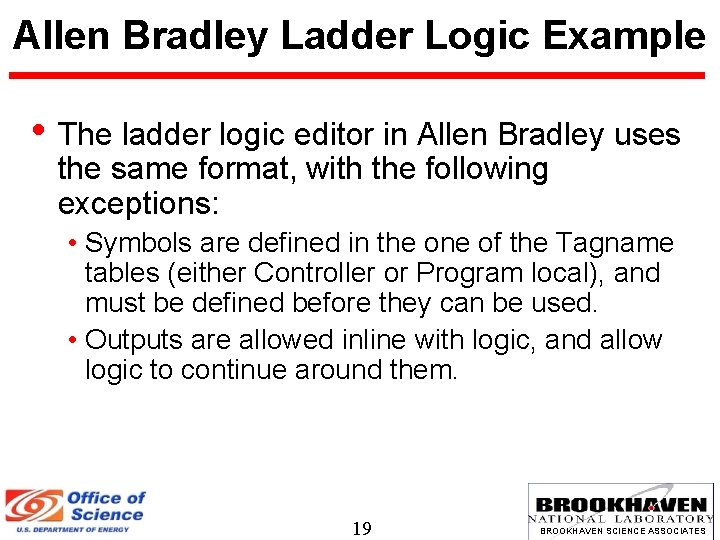
Allen Bradley Ladder Logic Example • The ladder logic editor in Allen Bradley uses the same format, with the following exceptions: • Symbols are defined in the one of the Tagname tables (either Controller or Program local), and must be defined before they can be used. • Outputs are allowed inline with logic, and allow logic to continue around them. 19 BROOKHAVEN SCIENCE ASSOCIATES
Allen Bradley Logic example 20 BROOKHAVEN SCIENCE ASSOCIATES
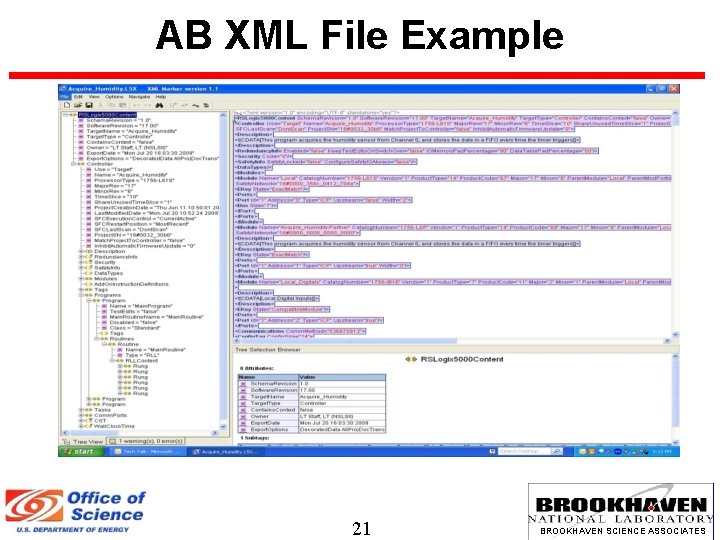
AB XML File Example 21 BROOKHAVEN SCIENCE ASSOCIATES
Allen Bradley Text file import/export • Text file format is XML. • File format is documented (and supported) • • by AB. Sample file text is included, but not shown completely. File includes all information on controller, I/O configuration, Tagnames, and program file definitions. Loading XML file will exactly reproduce the binary image from previous save. Format definitions will allow a programmatic creation of complete 22 program image. Import BROOKHAVEN SCIENCE ASSOCIATES
Yokogawa FA-M 3 • Processor is comparable to the VME cards • • • currently being used. Module executes Linux out of a removable compact flash card. KEK has ported the Linux IOC to the device. A driver has been written that allows direct control and communications with both the I/O hardware installed in the chassis, or a companion CPU that can run either Linux or sequential ladder logic. Up to 4 processor modules can be installed. 23 BROOKHAVEN SCIENCE ASSOCIATES
Yokogawa FA-M 3 (contd) • Sequence CPU • Logic program software is called Wide. Field 2. • Software cannot load or store any type of nonbinary file describing logic operations. • Software I/O cannot be defined externally, and all logic and I/O must be defined in the software. • Software does allow a cross reference file containing tagnames (symbols) and I/O address information. • EPICS driver is available (“netdev”), however was not evaluated as I did not have access to the sequence CPU programming software. 24 BROOKHAVEN SCIENCE ASSOCIATES
Yokogawa FA-M 3 • Linux CPU • IOC interfaces with I/O using Linux kernel module driver, which is closed source. • Hardware performance is outstanding, and far exceeds any of the other systems evaluated. • Hardware support includes 64 channel digital input and output modules, but analog modules are limited to 8 channels maximum. • Can directly communicate with sequence CPU installed in same chassis. • Not the desired target for reliability/flexibility. 25 BROOKHAVEN SCIENCE ASSOCIATES
GE Fanuc Pac. Systems RS 7 i • Based on VME 64 Chassis. • Chassis sizes vary from 10 slots to 18 slots, with both front and rear I/O access. Supports both standard and redundant configurations. • Memory capacities from 10 Mb to 64 Mb on processor card. • Capable of using high density I/O cards. • Digital inputs and outputs capable of 64 channels on a card. • Analog inputs capable of 64 channels on a card, 16 bit accuracy. 26 BROOKHAVEN SCIENCE ASSOCIATES
GE Fanuc Pac. Systems RS 7 i • I/O performance is well within requirements, • exceeding the required performance for the Time stamped I/O, and providing much better analog performance in general. Does not meet or exceed capabilities of the Yokogawa FA-M 3, but exceeds capabilities of other PLCs in comparison. 27 BROOKHAVEN SCIENCE ASSOCIATES
PLC Selection Advantages/Disadvantages • Allen Bradley and GE are US Companies, • • • and qualify for the US company incentives. Siemens has been used successfully in a number of accelerators, including NSLS. Yokogawa is being successfully used by KEK. GE is known for reliability and capability worldwide. Yokogawa can be a self-contained IOC. AB, Siemens, and GE will all require IOC’s to communicate with EPICS. 28 BROOKHAVEN SCIENCE ASSOCIATES
PLC Selection Advantages/Disadvantages • AB directly supports complete text file configuration and programming. • It is XML standard, documented, and considered a standard program storage format. • Siemens supports text I/O and logic configuration. • Text file is custom format, and apparently not documented. • GE states they have text file capability, but • have not seen it operate. Yokogawa Sequence (LADDER) PLCs support I/O configuration through text files, 29 BROOKHAVEN SCIENCE ASSOCIATES
PLC Selection Advantages/Disadvantages • Yokogawa Linux IOC supports direct control • • of hardware, or direct communications to Yokogawa Sequence PLC in same chassis. Yokogawa runs IOC under Linux (advantage). Yokogawa runs IOC under Linux (disadvantage). All PLC units support I/O updates on “polled” or “interrupt” basis. All PLC units (except Yokogawa IOC) must be “polled” by IOC in 30 order to retrieve data. BROOKHAVEN SCIENCE ASSOCIATES
Sample Configurations • First requirements set is based on • • information from Russ O’Brian and the Conventional Facilities group. Second requirement set is based on information provided by Bob and Huijuan Vacuum control and monitoring systems. Requirements were developed to provide unbiased design requirements for comparative analysis. These requirements take into account only the required I/O for a particular application, and not the 31 BROOKHAVEN SCIENCE ASSOCIATES
Sample Configurations (contd) • Conventional Facilities sample. • Based on requirements for LINAC/Booster • Cooling Skid, as per Russ O’Brian (6/18/09 design). Requirements include: • CPU w/ >512 k ladder logic memory. • Ethernet port. • 16 Digital Inputs. • 16 Digital Outputs. • 4 Analog Inputs (16 bit resolution). • 5 Analog RTD inputs (16 bit resolution). 32 BROOKHAVEN SCIENCE ASSOCIATES
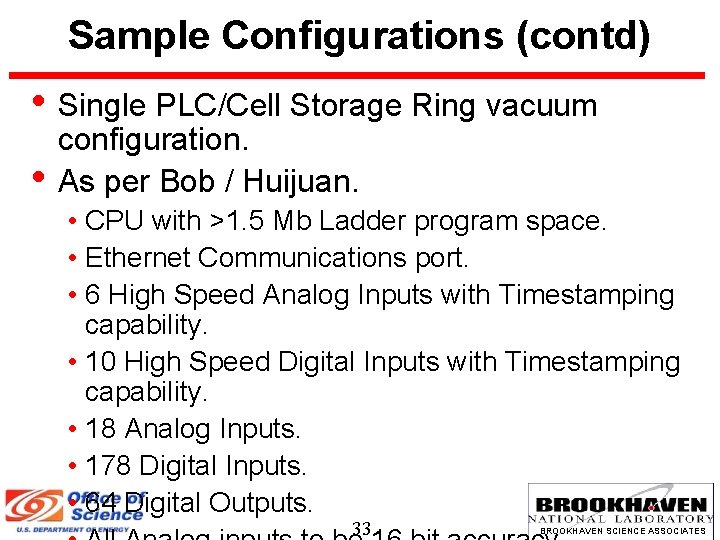
Sample Configurations (contd) • Single PLC/Cell Storage Ring vacuum • configuration. As per Bob / Huijuan. • CPU with >1. 5 Mb Ladder program space. • Ethernet Communications port. • 6 High Speed Analog Inputs with Timestamping capability. • 10 High Speed Digital Inputs with Timestamping capability. • 18 Analog Inputs. • 178 Digital Inputs. • 64 Digital Outputs. 33 BROOKHAVEN SCIENCE ASSOCIATES
Sample Configurations (contd) • Requests were sent to each vendor, to supply priced quotation for a system that met the requirement. • All documentation on each system to be available through internet, or supplied with quote from vendor. • In addition, due to high I/O count possibilities, both Yokogawa and GE were requested to provide quotes for a single system capable of providing control/monitoring for a complete cell. This included the Storage 34 Ring, 2 Insertion BROOKHAVEN SCIENCE ASSOCIATES
PLC Comparison Matrix PLC Manufacturer Performance Per 1 k Boolean Instructions Time Stamping Capabilities Fastest ADC and channel count Network Capabilities AB, Compact. Logix 0. 04 ms – 0. 08 ms Software supported, ~1 ms accuracy expected 4 @. 1 ms/ch Yes, CIP, Ethernet are easily supported. Siemens, S 7 -300 0. 05 ms – 0. 10 ms Hardware support, <10 ms accuracy 4 @. 1 ms/ch Yes, Profibus and Profinet require special network components GE, RS 7 i 0. 02 ms – 0. 04 ms Hardware or Software, h/w 1 ms accuracy 64 @ 1 ms/ all ch, Faster w / special VME Yes, supports several standard Ethernet protocols Yokogawa FA-M 3 Linux CPU or Sequence CPU 0. 02 ms – 0. 04 ms Software support, EPICS compatible Software support ~1 ms accuracy 4 simultaneous channels @ 50 us/4 8 simultaneous channels @ 500 us/8 Yes, standard EPICS channel access, Yes, but capabilities unknown. 35 BROOKHAVEN SCIENCE ASSOCIATES
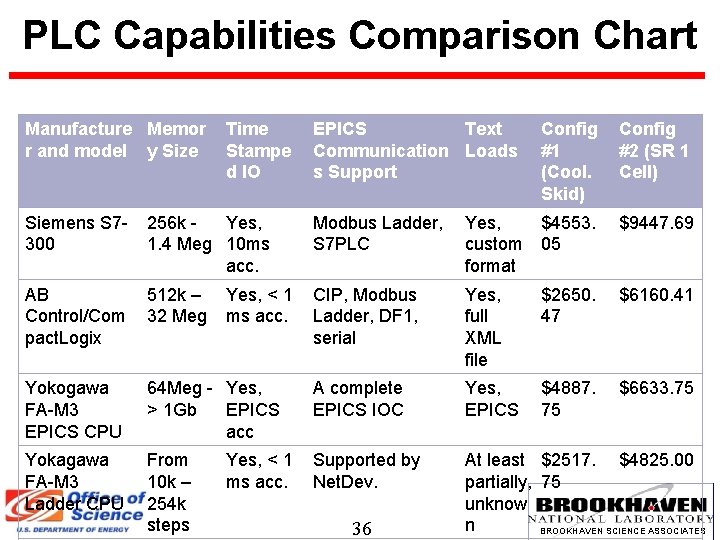
PLC Capabilities Comparison Chart Manufacture Memor r and model y Size Time Stampe d IO EPICS Text Communication Loads s Support Config #1 (Cool. Skid) Config #2 (SR 1 Cell) Siemens S 7300 256 k Yes, 1. 4 Meg 10 ms acc. Modbus Ladder, S 7 PLC Yes, custom format $4553. 05 $9447. 69 AB Control/Com pact. Logix 512 k – 32 Meg CIP, Modbus Ladder, DF 1, serial Yes, full XML file $2650. 47 $6160. 41 Yokogawa FA-M 3 EPICS CPU 64 Meg - Yes, > 1 Gb EPICS acc A complete EPICS IOC Yes, EPICS $4887. 75 $6633. 75 Yokagawa FA-M 3 Ladder CPU From 10 k – 254 k steps Supported by Net. Dev. At least $2517. $4825. 00 partially, 75 unknow n BROOKHAVEN SCIENCE ASSOCIATES Yes, < 1 ms acc. 36
Results Selection Criteria Weig ht Rockwell (A-B) Siemens Yokogawa GE Customer Support 2 + Yes - Not known Wide Hardware Selection 3 + Yes - Somewhat limited + Yes Safety Support 3 + Yes - No + Yes Ease of EPICS Interfacing 3 + Very, uses tagname accesses. - Possible, uses data structure and PLC software - Yes, register number based TEXT import File style 3 + XML defined structure - Text file, very verbose - Only form symbols and I/O addresses - Unknown Text Import of Tagnames and I/O Symbols 3 + Yes - Unknown Text Import of Program Logic 2 + Yes, very detailed - No - Unknown TEXT import form documented and supported 2 + Yes, is standard form for import/export - Unknown Ability to merge Input files 2 + Yes, supports partial merges as well. - No + Yes, for symbols and I/O addresses - Unknown Cost Comparison, Config #1 5 -1 4 3 2+5 = 7 1 Cost Comparison, Config #2 5 -1 4 2 3+5 = 8 1 US Company 1 + Yes - No + Yes Evaluation Totals 34 +32 +18 +22 +9 37 BROOKHAVEN SCIENCE ASSOCIATES
Recommendation • 1. Limit selection to one, or two vendors. • 2. Preferred selection is Rockwell (A-B) hardware. • All levels of hardware supported under Ethernet/IP and CIP, and allow direct access by tagname. • 3. Alternate selection is Siemens S 7 -300 family. • S 7 -200 cannot communicate with EPICS, and is unusable for anything requiring access to EPICS without substantial additional configuration and hardware/software. • S 7 -200 programming 38 software has additional BROOKHAVEN SCIENCE ASSOCIATES