Climate Change Prof Dudley Shallcross and Tim Harrison

- Slides: 1
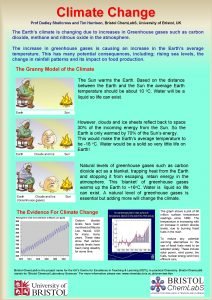
Climate Change Prof Dudley Shallcross and Tim Harrison, Bristol Chem. Lab. S, University of Bristol, UK The Earth’s climate is changing due to increases in Greenhouse gases such as carbon dioxide, methane and nitrous oxide in the atmosphere. The increase in greenhouse gases is causing an increase in the Earth’s average temperature. This has many potential consequences, including; rising sea levels, the change in rainfall patterns and its impact on food production. The Granny Model of the Climate The Sun warms the Earth. Based on the distance between the Earth and the Sun the average Earth o temperature should be about 10 C. Water will be a liquid so life can exist. Earth Sun However, clouds and ice sheets reflect back to space 30% of the incoming energy from the Sun. So the Earth is only warmed by 70% of the Sun’s energy. This would make the Earth’s average temperature to o be -18 C. Water would be a solid so very little life on Earth! Earth Clouds and Ice (Greenhouse gases) Sun Natural levels of greenhouse gases such as carbon dioxide act as a blanket, trapping heat from the Earth and stopping it from escaping. retain energy in the atmosphere. This ‘blanket’ of greenhouse gases o warms up the Earth to ~16 C. Water is liquid so life can exist. A natural level of greenhouse gases is essential but adding more will change the climate. The Evidence For Climate Change Carbon dioxide levels have been monitored at Mauna Loa, Hawaii, USA for many, many years. These data show that carbon dioxide levels have been rising steadily for some time. The graph shows a plot of 60 million surface temperature readings since 1860. The temperature is increasing with an increase in carbon dioxide levels, due to burning fossil fuels in the main. To reduce any potential warming alternatives to the use of fossil fuels need to be adopted widely, These include solar power, wind power, bio fuels, nuclear energy and more efficient cars, Bristol Chem. Lab. S is the project name for the UK’s Centre for Excellence in Teaching & Learning (CETL) in practical Chemistry. Bristol Chem. Lab. S stands for 'Bristol Chemical Laboratory Sciences'. For more information please see: www. chemlabs. bris. ac. uk/overview. htm