Plant Structure Growth and Development Concept 35 1
- Slides: 34
Plant Structure, Growth, and Development
Concept 35. 1: Plants have a hierarchical organization consisting of organs, tissues, and cells • Plants have organs composed of different tissues, which in turn are composed of different cell types • A tissue is a group of cells consisting of one or more cell types that together perform a specialized function • An organ consists of several types of tissues that together carry out particular functions © 2011 Pearson Education, Inc.
The Three Basic Plant Organs: Roots, Stems, and Leaves • Basic morphology of vascular plants reflects their evolution as organisms that draw nutrients from below ground above ground • Plants take up water and minerals from below ground • Plants take up CO 2 and light from above ground © 2011 Pearson Education, Inc.
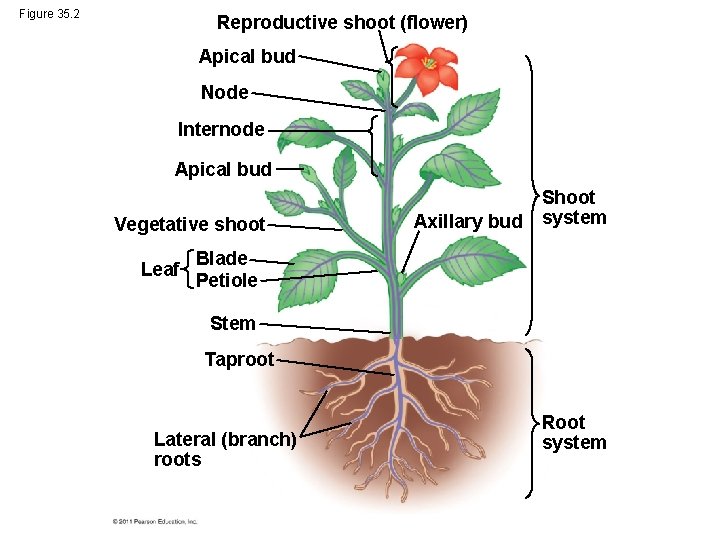
• Three basic organs evolved: roots, stems, and leaves • They are organized into a root system and a shoot system © 2011 Pearson Education, Inc.
Figure 35. 2 Reproductive shoot (flower) Apical bud Node Internode Apical bud Vegetative shoot Leaf Axillary bud Shoot system Blade Petiole Stem Taproot Lateral (branch) roots Root system
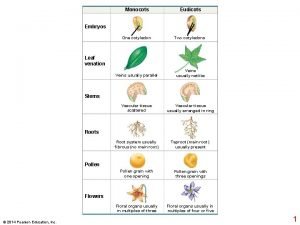
• Roots rely on sugar produced by photosynthesis in the shoot system, and shoots rely on water and minerals absorbed by the root system • Monocots and eudicots are the two major groups of angiosperms © 2011 Pearson Education, Inc.
Roots • A root is an organ with important functions: – Anchoring the plant – Absorbing minerals and water – Storing carbohydrates © 2011 Pearson Education, Inc.
• Most eudicots and gymnosperms have a taproot system, which consists of: – A taproot, the main vertical root – Lateral roots, or branch roots, that arise from the taproot • Most monocots have a fibrous root system, which consists of: – Adventitious roots that arise from stems or leaves – Lateral roots that arise from the adventitious roots © 2011 Pearson Education, Inc.
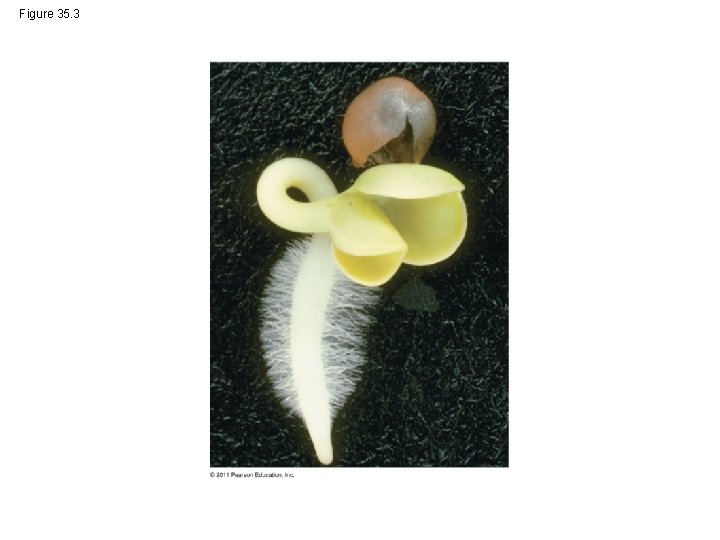
• In most plants, absorption of water and minerals occurs near the root hairs, where vast numbers of tiny root hairs increase the surface area © 2011 Pearson Education, Inc.
Figure 35. 3
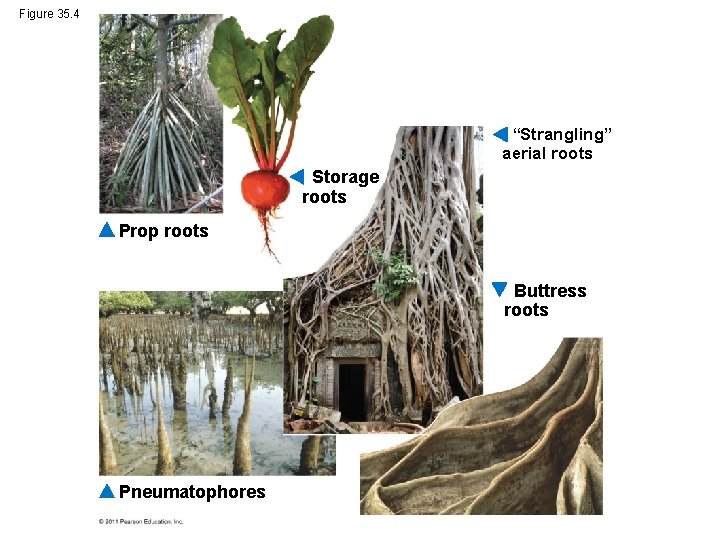
• Many plants have root adaptations with specialized functions © 2011 Pearson Education, Inc.
Figure 35. 4 “Strangling” aerial roots Storage roots Prop roots Buttress roots Pneumatophores
Stems • A stem is an organ consisting of – An alternating system of nodes, the points at which leaves are attached – Internodes, the stem segments between nodes © 2011 Pearson Education, Inc.
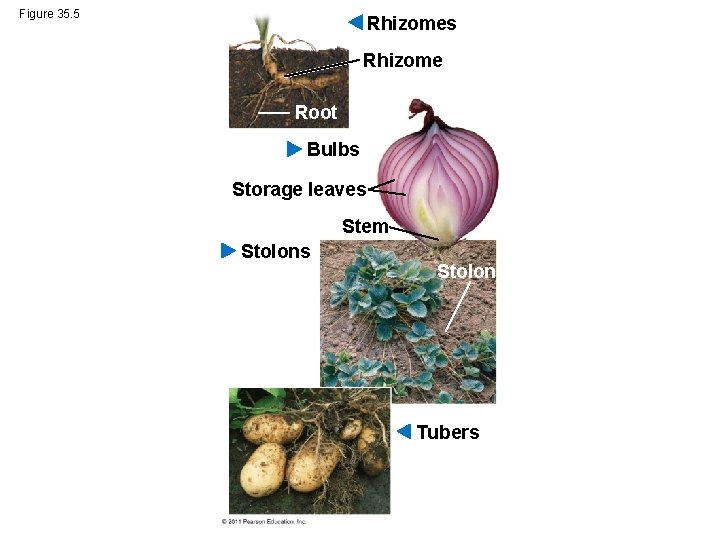
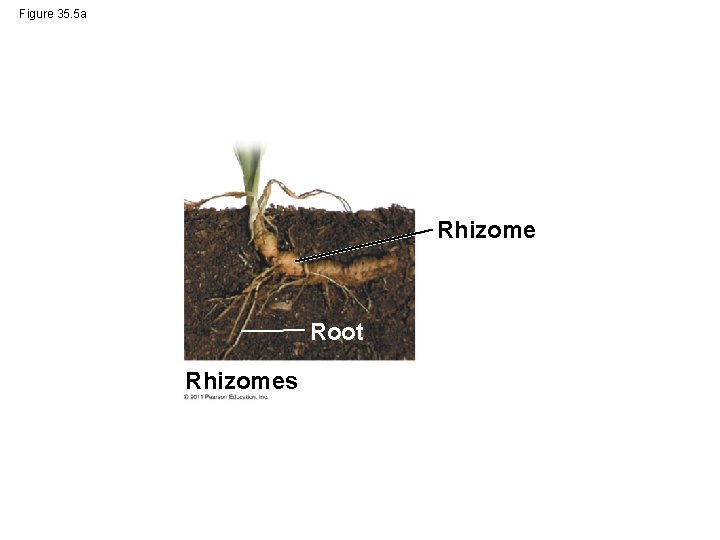
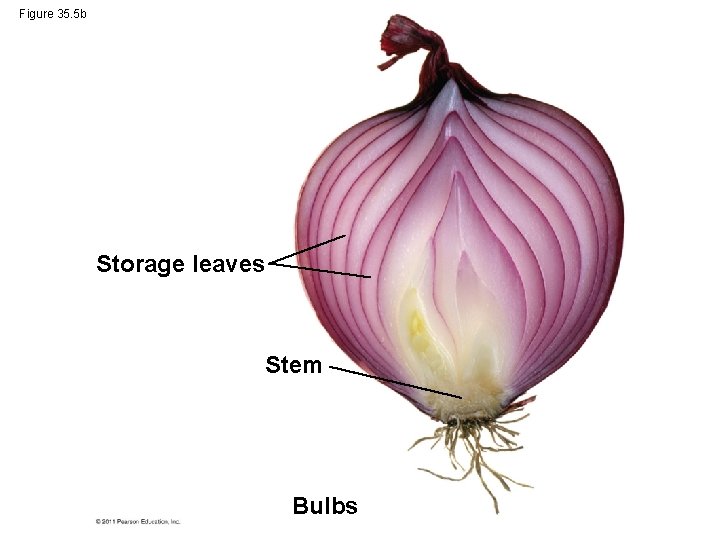
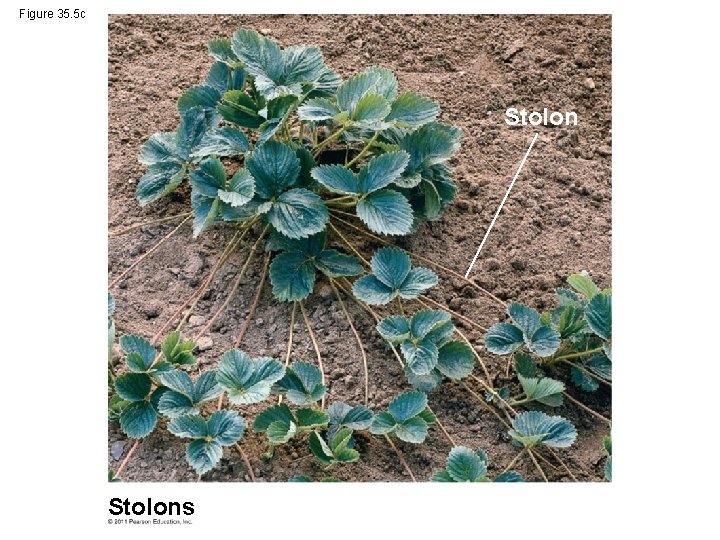
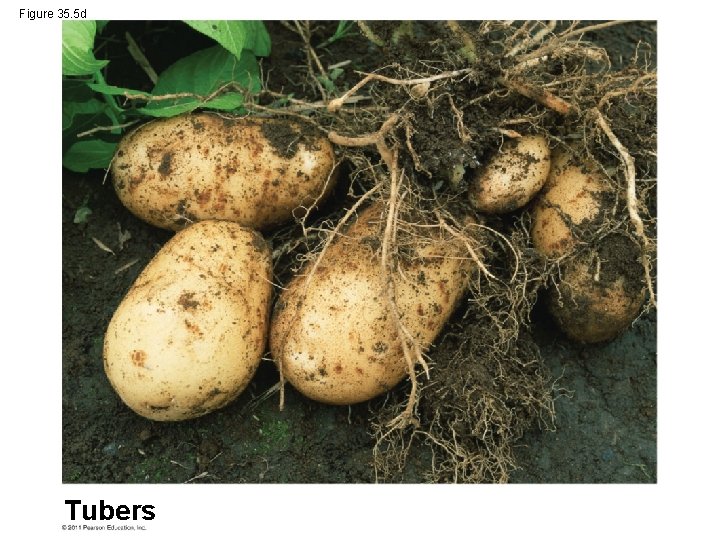
• An axillary bud is a structure that has the potential to form a lateral shoot, or branch • An apical bud, or terminal bud, is located near the shoot tip and causes elongation of a young shoot • Apical dominance helps to maintain dormancy in most axillary buds • Many plants have modified stems (e. g. , rhizomes, bulbs, stolons, tubers) © 2011 Pearson Education, Inc.
Figure 35. 5 Rhizomes Rhizome Root Bulbs Storage leaves Stem Stolons Stolon Tubers
Figure 35. 5 a Rhizome Root Rhizomes
Figure 35. 5 b Storage leaves Stem Bulbs
Figure 35. 5 c Stolons
Figure 35. 5 d Tubers
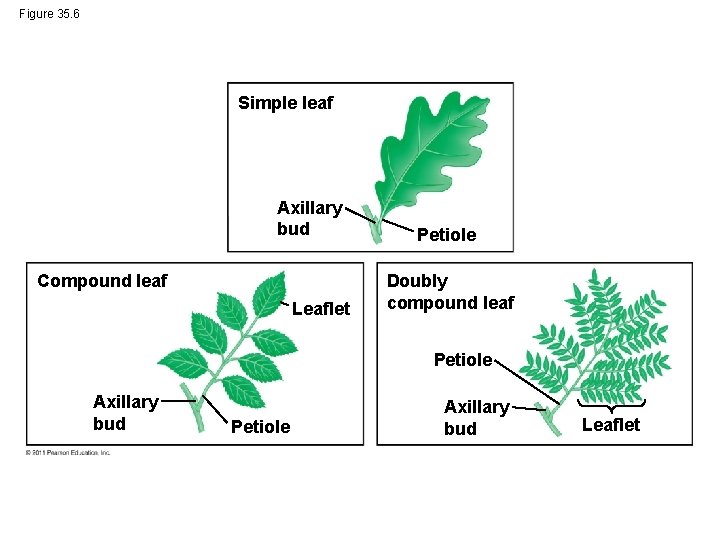
Leaves • The leaf is the main photosynthetic organ of most vascular plants • Leaves generally consist of a flattened blade and a stalk called the petiole, which joins the leaf to a node of the stem © 2011 Pearson Education, Inc.
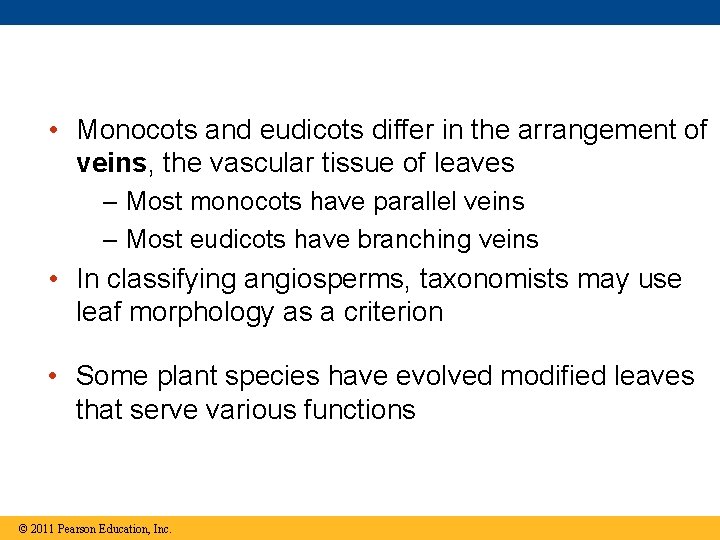
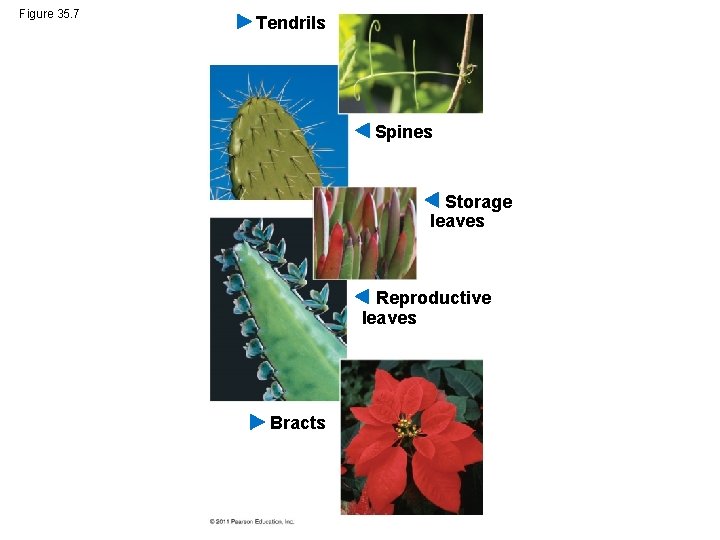
• Monocots and eudicots differ in the arrangement of veins, the vascular tissue of leaves – Most monocots have parallel veins – Most eudicots have branching veins • In classifying angiosperms, taxonomists may use leaf morphology as a criterion • Some plant species have evolved modified leaves that serve various functions © 2011 Pearson Education, Inc.
Figure 35. 6 Simple leaf Axillary bud Compound leaf Leaflet Petiole Doubly compound leaf Petiole Axillary bud Leaflet
Figure 35. 7 Tendrils Spines Storage leaves Reproductive leaves Bracts
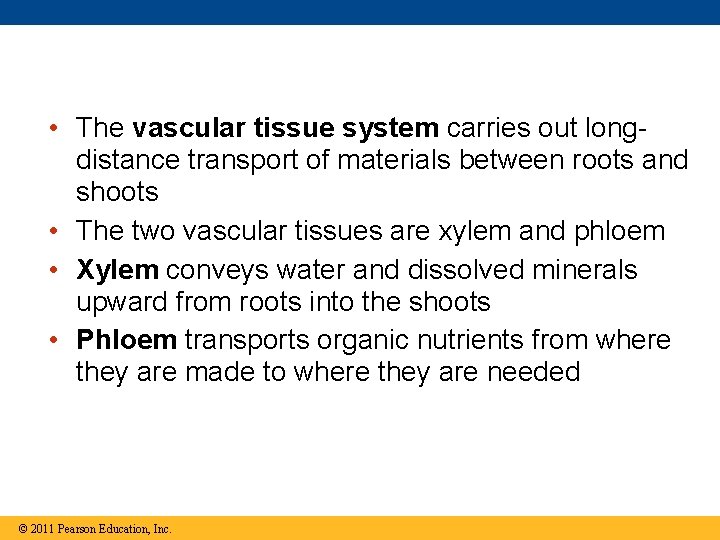
• The vascular tissue system carries out longdistance transport of materials between roots and shoots • The two vascular tissues are xylem and phloem • Xylem conveys water and dissolved minerals upward from roots into the shoots • Phloem transports organic nutrients from where they are made to where they are needed © 2011 Pearson Education, Inc.
Common Types of Plant Cells • Like any multicellular organism, a plant is characterized by cellular differentiation, the specialization of cells in structure and function • The major types of plant cells are: – – – Parenchyma Collenchyma Sclerenchyma Water-conducting cells of the xylem Sugar-conducting cells of the phloem © 2011 Pearson Education, Inc.
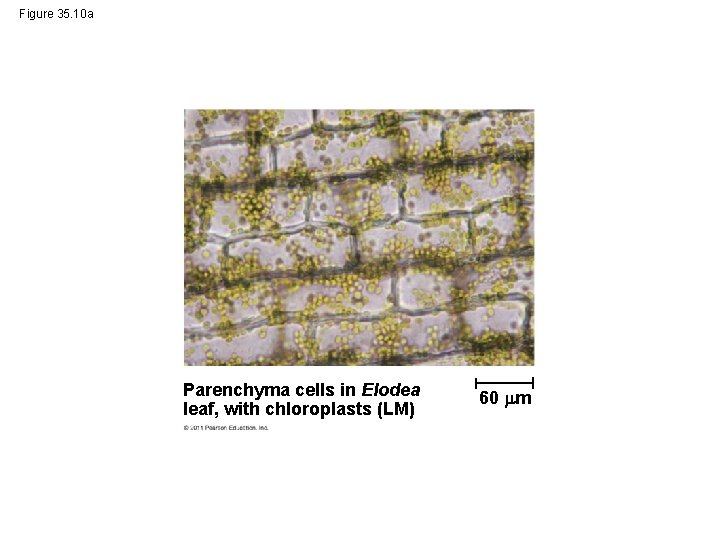
Parenchyma Cells • Mature parenchyma cells – – – Have thin and flexible primary walls Lack secondary walls Are the least specialized Perform the most metabolic functions Retain the ability to divide and differentiate © 2011 Pearson Education, Inc.
Figure 35. 10 a Parenchyma cells in Elodea leaf, with chloroplasts (LM) 60 m
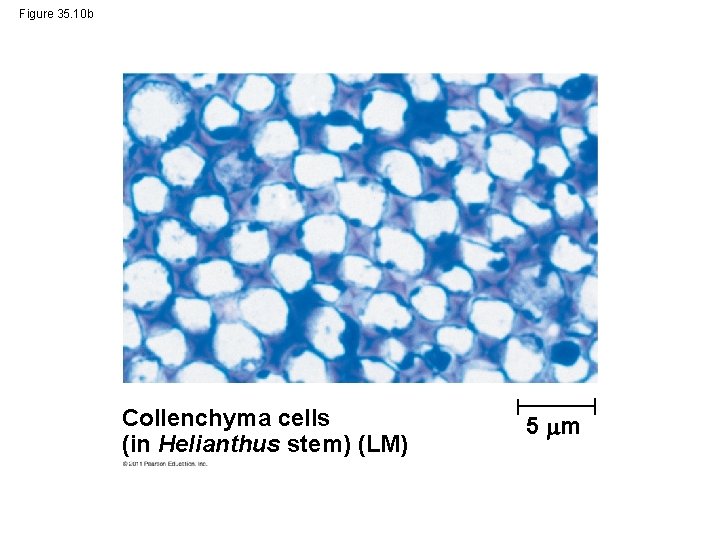
Collenchyma Cells • Collenchyma cells are grouped in strands and help support young parts of the plant shoot • They have thicker and uneven cell walls • They lack secondary walls • These cells provide flexible support without restraining growth © 2011 Pearson Education, Inc.
Figure 35. 10 b Collenchyma cells (in Helianthus stem) (LM) 5 m
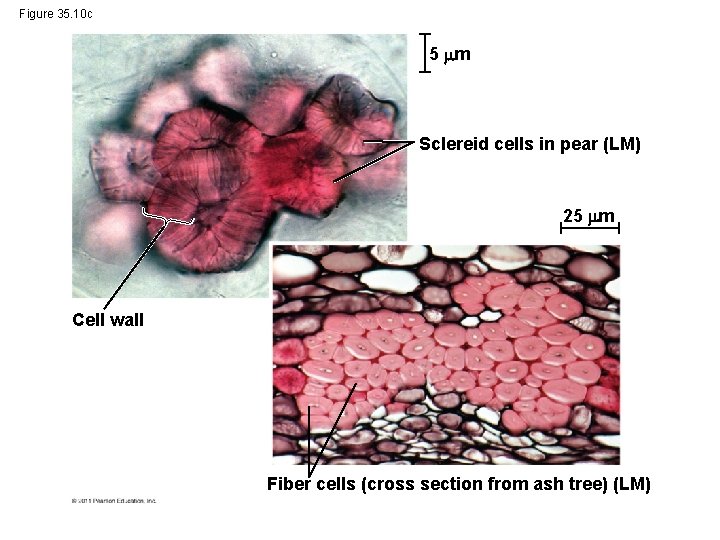
Sclerenchyma Cells • Sclerenchyma cells are rigid because of thick secondary walls strengthened with lignin • They are dead at functional maturity • There are two types: – Sclereids are short and irregular in shape and have thick lignified secondary walls – Fibers are long and slender and arranged in threads © 2011 Pearson Education, Inc.
Figure 35. 10 c 5 m Sclereid cells in pear (LM) 25 m Cell wall Fiber cells (cross section from ash tree) (LM)
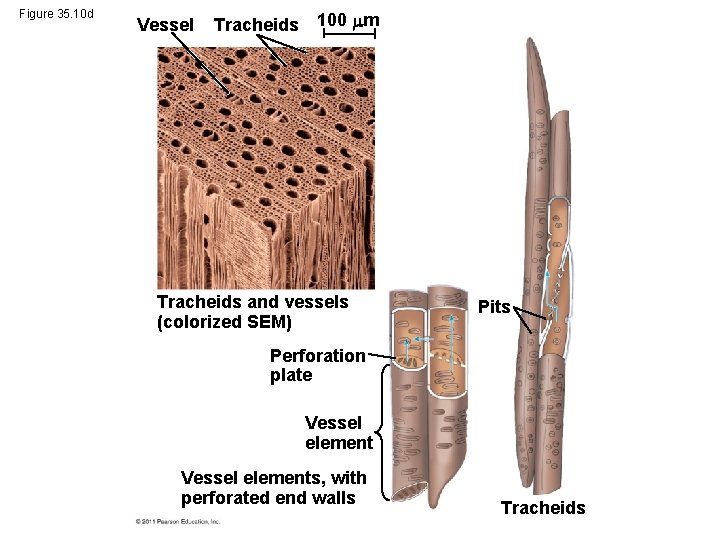
Water-Conducting Cells of the Xylem • The two types of water-conducting cells, tracheids and vessel elements, are dead at maturity • Tracheids are found in the xylem of all vascular plants • Vessel elements are common to most angiosperms and a few gymnosperms • Vessel elements align end to form long micropipes called vessels © 2011 Pearson Education, Inc.
Figure 35. 10 d Vessel Tracheids 100 m Tracheids and vessels (colorized SEM) Pits Perforation plate Vessel elements, with perforated end walls Tracheids
Sugar-Conducting Cells of the Phloem • Sieve-tube elements are alive at functional maturity, though they lack organelles • Sieve plates are the porous end walls that allow fluid to flow between cells along the sieve tube • Each sieve-tube element has a companion cell whose nucleus and ribosomes serve both cells © 2011 Pearson Education, Inc.