PKCS 1 RSA Cryptography Standard Jessica Staddon RSA
- Slides: 24
PKCS #1 : RSA Cryptography Standard Jessica Staddon RSA Laboratories PKCS Workshop October 7, 1998 RSA Data Security, Inc.
Outline • • Update on status of v 2. 0 Overview of v 2. 0 content Technical highlights of v 2. 0 Possibilities for 2. x ! © RSA 1998
Status of v 2. 0 • v 2. 0 was posted for 30 -day review on 7/14/98 • v 2. 0 was submitted as an Internet-Draft to the IETF on 8/6/98 • a few comments were received…and the final document was posted on 9/4 © RSA 1998
Overview of v 2. 0 • Encryption schemes: – OAEP-based encryption (Bellare. Rogaway) – v 1. 5 encryption, for backward compatibility • v 1. 5 signature scheme with appendix • ASN. 1 syntax – new OIDs for the OAEP-based scheme © RSA 1998
Technical Highlights • Style • RSAES-OAEP • Auxiliary functions • ASN. 1 RSA Data Security, Inc.
Style and terminology of v 2. 0 is similar to IEEE P 1363: • Primitives – encryption and decryption – signature and verification – data conversion • Encryption and signature schemes • Encoding methods – for encryption and signatures w/ appendix • Auxiliary functions © RSA 1998
Primitives • Basic mathematical operations • Primitives are used in schemes e. g. RSAEP( (n, e), m): 1. If m is not between 0 and n-1, output “message representative out of range” and stop. 2. Let c = me mod n. 3. Output c. © RSA 1998
Schemes Combine primitives and other techniques (e. g. encoding methods) to achieve a particular security goal. © RSA 1998
RSAES-OAEP (Section 7. 1) Within the random oracle model: • Provably secure – can tie security to the RSA function • Plaintext-aware – “can’t” generate valid ciphertext w/o the plaintext – chosen-ciphertext attacks are ineffective © RSA 1998
RSAES-OAEP • Encrypt (public key, M, P): – EM = EME-OAEP-Encode (M, P) – C = RSAEP (public key, EM) • Decrypt (private key, C, P): – EM = RSADP (private key, C) – M = EME-OAEP-Decode (EM, P) • M, C bounded, P arbitrary length © RSA 1998
EME-OAEP-Encode(M, P, em. Len) (Section 9. 1. 1. 1) Options: Hash output length h. Len Input: MGF mask generation function M length at most em. Len-1 -2 h. Len P encoding parameters em. Len length of output Output: encoded message, EM (length em. Len) or, “message too long”, or “parameter string too long” RSAES-OAEP-Encrypt calls this with em. Len = k -1 © RSA 1998
EME-OAEP-Encode © RSA 1998
Auxiliary Functions (Section 10) • Hash functions – deterministic functions, variable length input, fixed length output – collision resistance important to deter forgery of v 1. 5 signatures – SHA-1 is recommended for EME-OAEP – MD 2, MD 5 and SHA-1 are recommended for all other encoding methods © RSA 1998
• Mask generation functions – deterministic functions – take variable length input and output string of any predetermined length – v 2. 0 defines an MGF based on a hash function, MGF 1 – SHA-1 is the recommended hash function for MGF 1 © RSA 1998
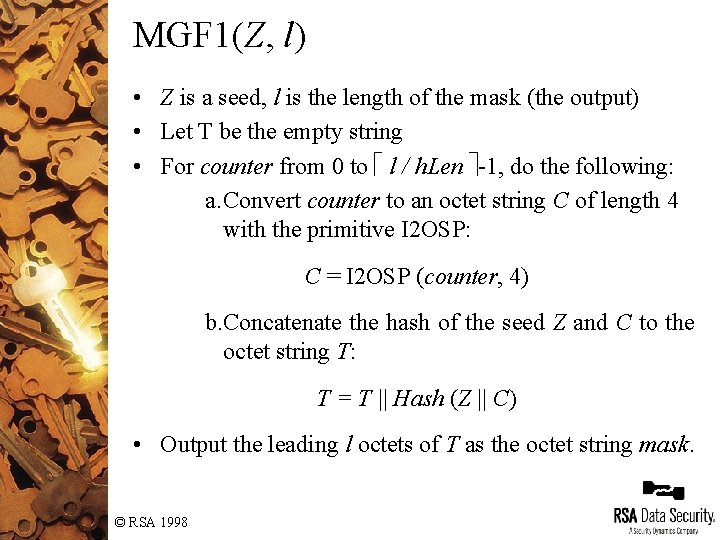
MGF 1(Z, l) • Z is a seed, l is the length of the mask (the output) • Let T be the empty string • For counter from 0 to l / h. Len -1, do the following: a. Convert counter to an octet string C of length 4 with the primitive I 2 OSP: C = I 2 OSP (counter, 4) b. Concatenate the hash of the seed Z and C to the octet string T: T = T || Hash (Z || C) • Output the leading l octets of T as the octet string mask. © RSA 1998
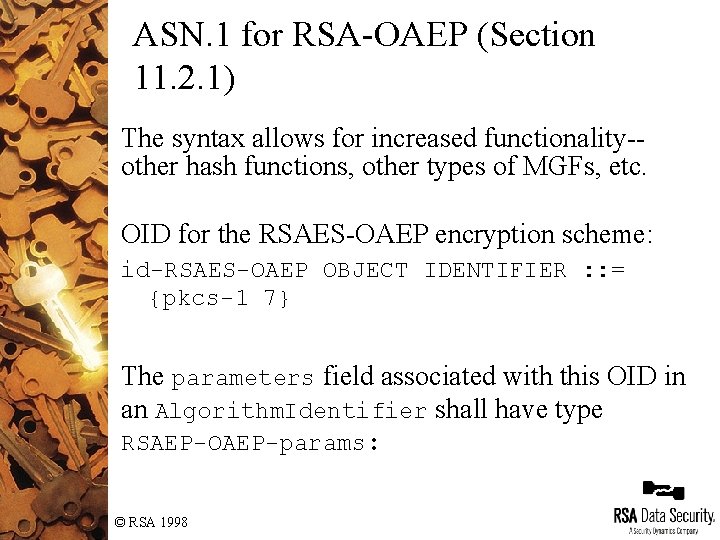
ASN. 1 for RSA-OAEP (Section 11. 2. 1) The syntax allows for increased functionality-other hash functions, other types of MGFs, etc. OID for the RSAES-OAEP encryption scheme: id-RSAES-OAEP OBJECT IDENTIFIER : : = {pkcs-1 7} The parameters field associated with this OID in an Algorithm. Identifier shall have type RSAEP-OAEP-params: © RSA 1998
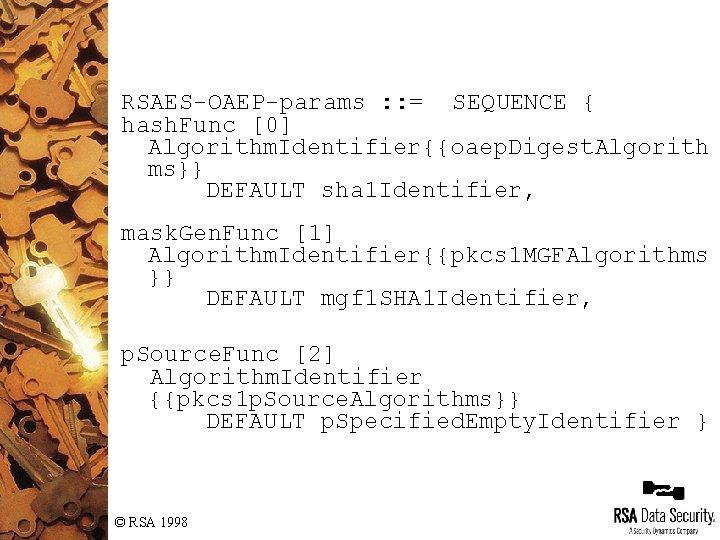
RSAES-OAEP-params : : = SEQUENCE { hash. Func [0] Algorithm. Identifier{{oaep. Digest. Algorith ms}} DEFAULT sha 1 Identifier, mask. Gen. Func [1] Algorithm. Identifier{{pkcs 1 MGFAlgorithms }} DEFAULT mgf 1 SHA 1 Identifier, p. Source. Func [2] Algorithm. Identifier {{pkcs 1 p. Source. Algorithms}} DEFAULT p. Specified. Empty. Identifier } © RSA 1998
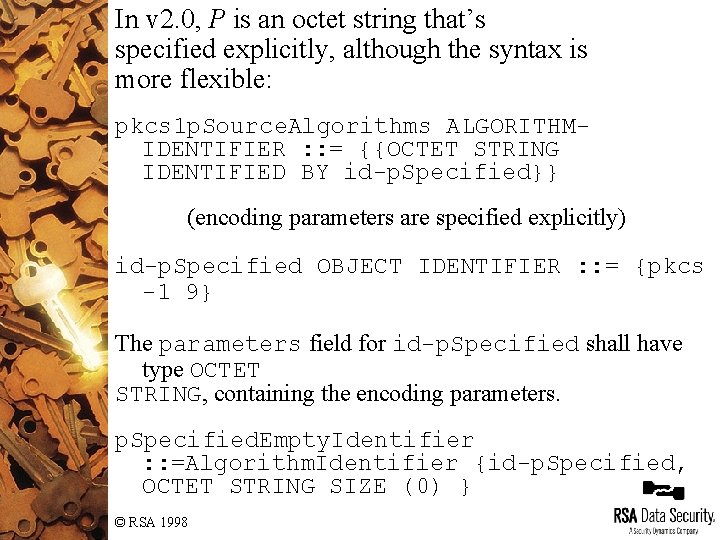
In v 2. 0, P is an octet string that’s specified explicitly, although the syntax is more flexible: pkcs 1 p. Source. Algorithms ALGORITHMIDENTIFIER : : = {{OCTET STRING IDENTIFIED BY id-p. Specified}} (encoding parameters are specified explicitly) id-p. Specified OBJECT IDENTIFIER : : = {pkcs -1 9} The parameters field for id-p. Specified shall have type OCTET STRING, containing the encoding parameters. p. Specified. Empty. Identifier : : =Algorithm. Identifier {id-p. Specified, OCTET STRING SIZE (0) } © RSA 1998
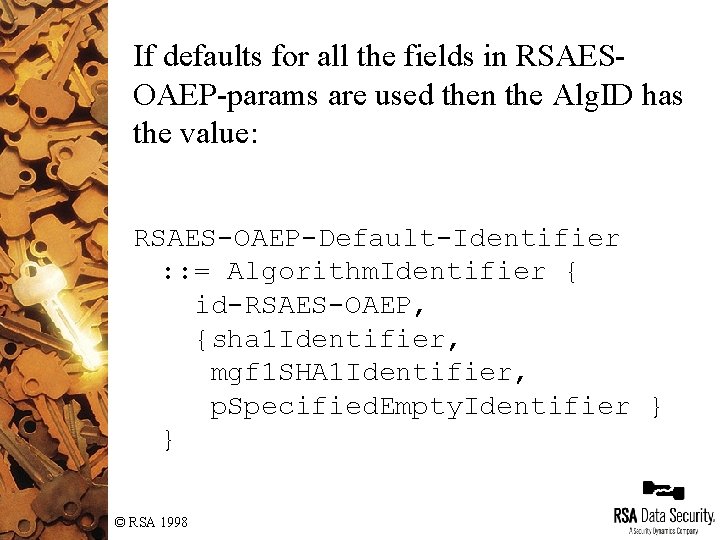
If defaults for all the fields in RSAESOAEP-params are used then the Alg. ID has the value: RSAES-OAEP-Default-Identifier : : = Algorithm. Identifier { id-RSAES-OAEP, {sha 1 Identifier, mgf 1 SHA 1 Identifier, p. Specified. Empty. Identifier } } © RSA 1998
Possibilities for v 2. x • Signature schemes – provable security (PSS) – message recovery (PSS-R, ISO/IEC 9796) – other options (X 9. 31…) • Key generation methods • Key validation methods © RSA 1998
ISO/IEC 9796 • An international standard for signatures with message recovery • Process involves padding, extending and adding redundancy to messages • Not provably secure © RSA 1998
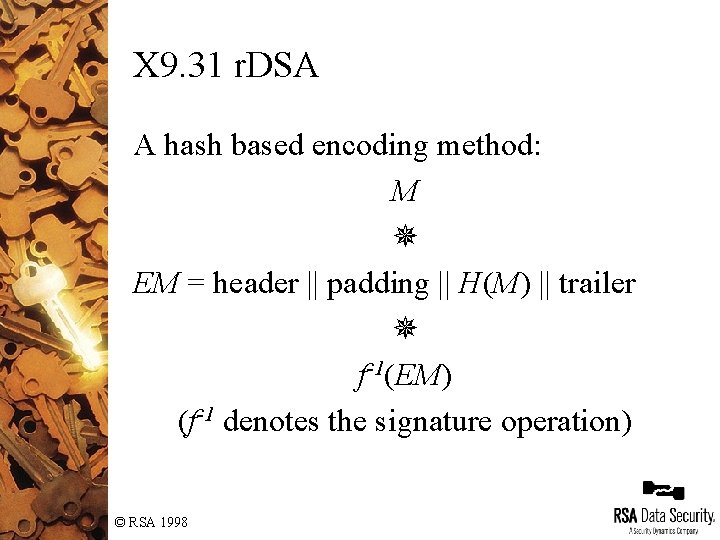
X 9. 31 r. DSA A hash based encoding method: M EM = header || padding || H(M) || trailer f-1(EM) (f-1 denotes the signature operation) © RSA 1998
Key generation methods • Prime generation methods from ANSI draft X 9. 79: Prime Number Generation and Validation Methods? • Sieving procedures? • Primality tests (probabilistic/deterministic)? © RSA 1998
Key validation methods • Still an area of research… • Some possibilities. . . – methods for showing n is product of two primes – method of Liskov and Silverman for showing that the two factors of n are nearly equal © RSA 1998