
INCS 741 Cryptography Data Encryption Standard DES Dr

- Slides: 70
INCS 741: Cryptography Data Encryption Standard (DES) Dr. Monther Aldwairi New York Institute of Technology. Amman Campus 10/18/2010 10/18/2009 Dr. Monther Aldwairi 1
Block Ciphers 10/4/2009 Dr. Monther Aldwairi 2
Block Ciphers § Stream ciphers process messages a bit or byte at a time when en/decrypting ‒ Vigenère Cipher ‒ Caeser Cipher § Block ciphers process messages in blocks ‒ Block are en/decrypted like a substitution on very big characters 64 -bits or more ‒ Hill Cipher block size 2 ‒ DES block size 64 bits 10/4/2009 Dr. Monther Aldwairi 3
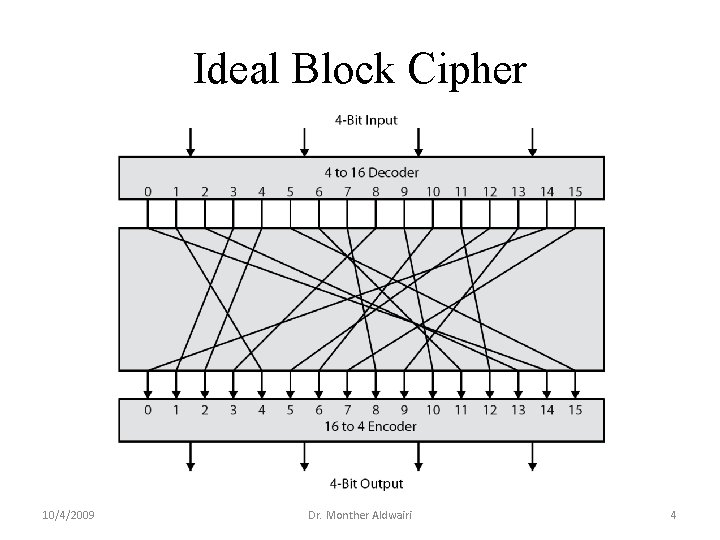
Ideal Block Cipher 10/4/2009 Dr. Monther Aldwairi 4
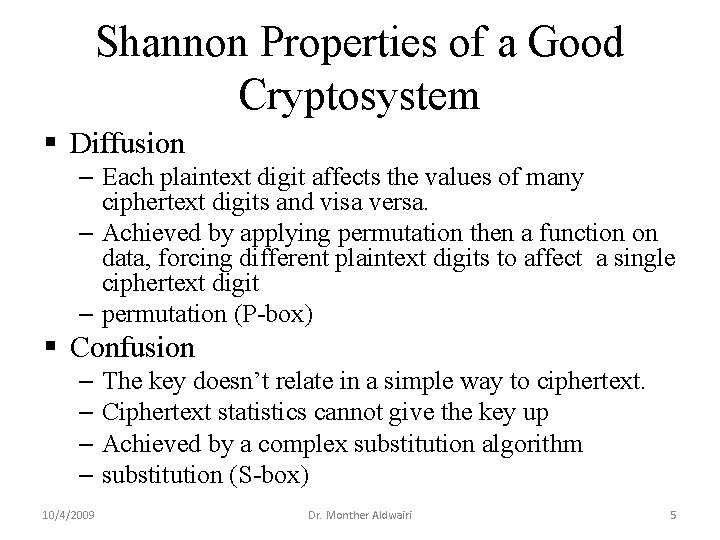
Shannon Properties of a Good Cryptosystem § Diffusion – Each plaintext digit affects the values of many ciphertext digits and visa versa. – Achieved by applying permutation then a function on data, forcing different plaintext digits to affect a single ciphertext digit – permutation (P-box) § Confusion – The key doesn’t relate in a simple way to ciphertext. – Ciphertext statistics cannot give the key up – Achieved by a complex substitution algorithm – substitution (S-box) 10/4/2009 Dr. Monther Aldwairi 5
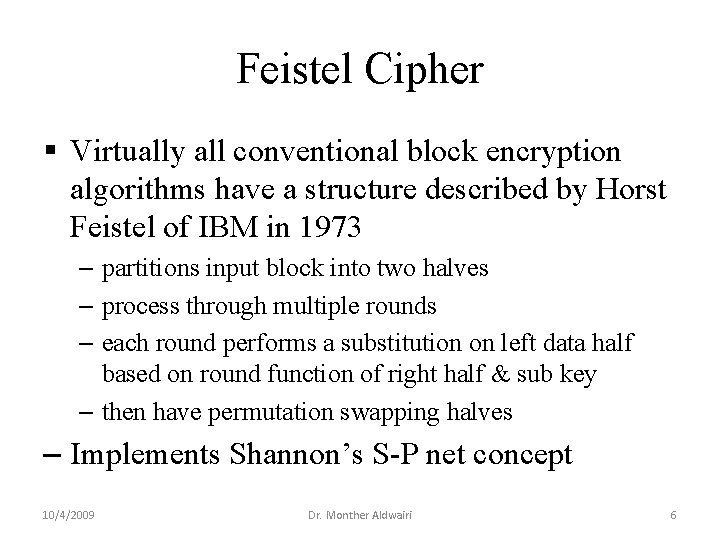
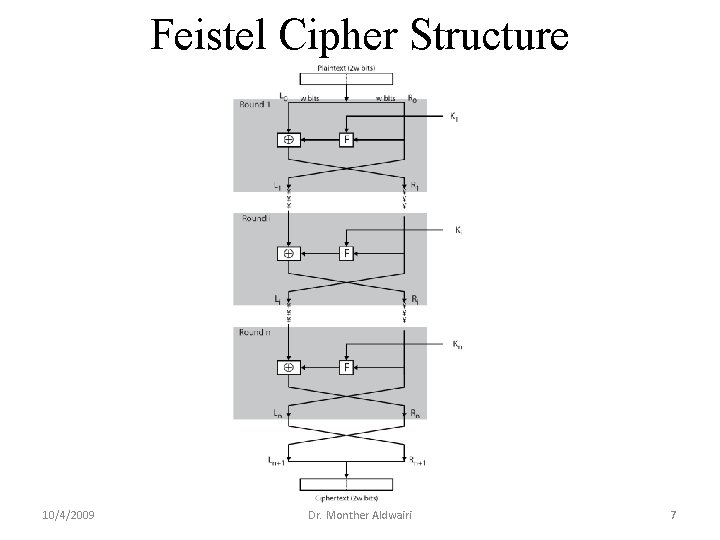
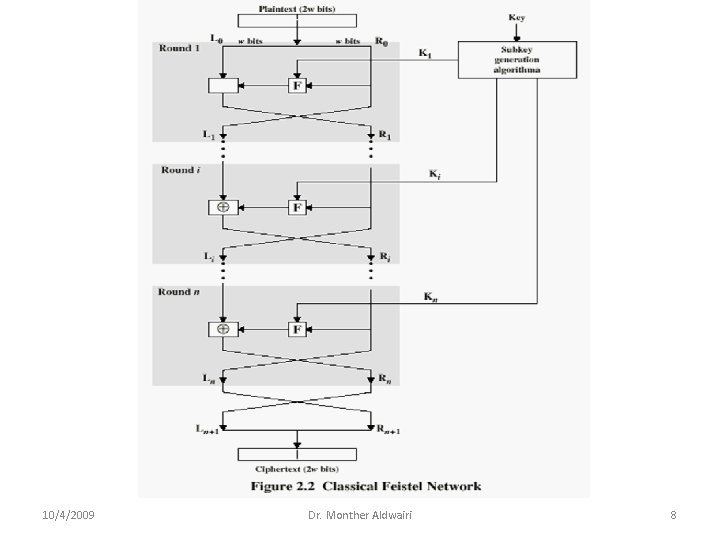
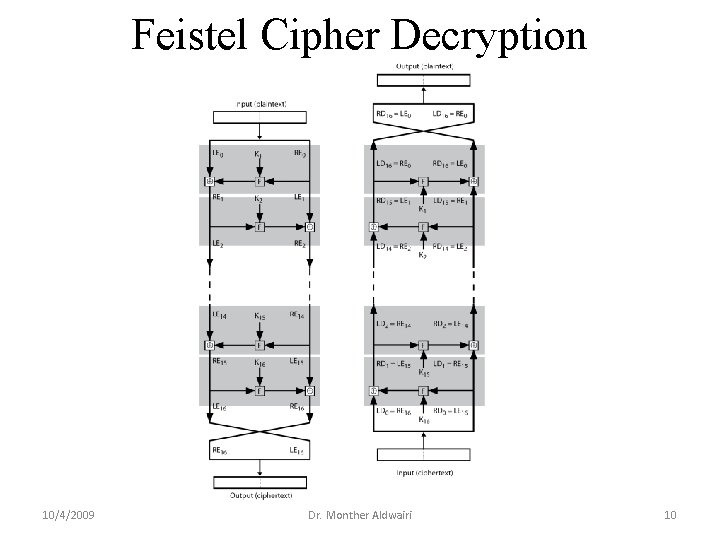
Feistel Cipher § Virtually all conventional block encryption algorithms have a structure described by Horst Feistel of IBM in 1973 – partitions input block into two halves – process through multiple rounds – each round performs a substitution on left data half based on round function of right half & sub key – then have permutation swapping halves – Implements Shannon’s S-P net concept 10/4/2009 Dr. Monther Aldwairi 6
Feistel Cipher Structure 10/4/2009 Dr. Monther Aldwairi 7
10/4/2009 Dr. Monther Aldwairi 8
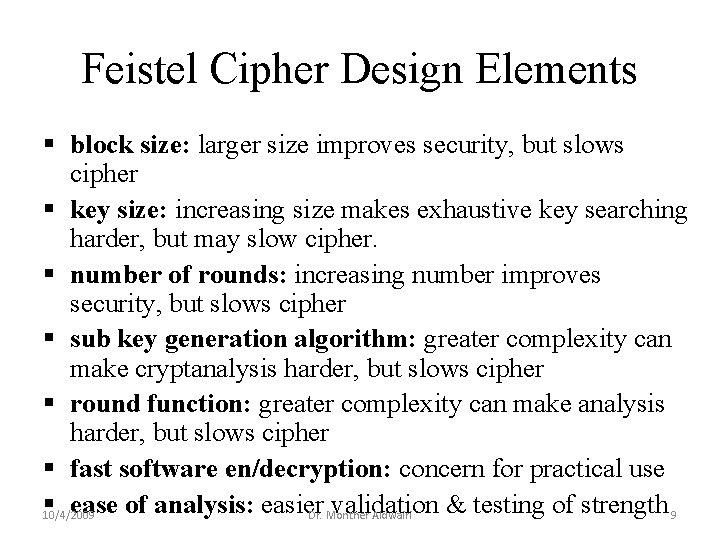
Feistel Cipher Design Elements § block size: larger size improves security, but slows cipher § key size: increasing size makes exhaustive key searching harder, but may slow cipher. § number of rounds: increasing number improves security, but slows cipher § sub key generation algorithm: greater complexity can make cryptanalysis harder, but slows cipher § round function: greater complexity can make analysis harder, but slows cipher § fast software en/decryption: concern for practical use § ease of analysis: easier validation & testing of strength 9 10/4/2009 Dr. Monther Aldwairi
Feistel Cipher Decryption 10/4/2009 Dr. Monther Aldwairi 10
Data Encryption Standard (DES) 10/4/2009 Dr. Monther Aldwairi 11
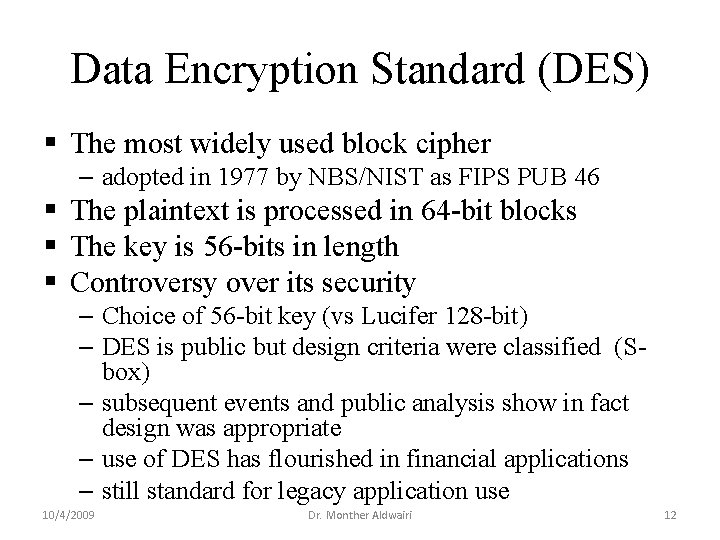
Data Encryption Standard (DES) § The most widely used block cipher – adopted in 1977 by NBS/NIST as FIPS PUB 46 § The plaintext is processed in 64 -bit blocks § The key is 56 -bits in length § Controversy over its security – Choice of 56 -bit key (vs Lucifer 128 -bit) – DES is public but design criteria were classified (Sbox) – subsequent events and public analysis show in fact design was appropriate – use of DES has flourished in financial applications – still standard for legacy application use 10/4/2009 Dr. Monther Aldwairi 12
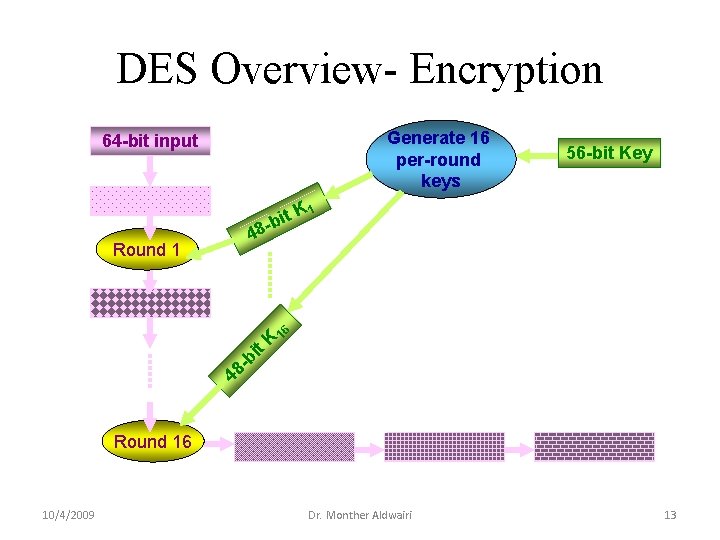
DES Overview- Encryption Generate 16 per-round keys 64 -bit input Initial Permutation t. K -bi Dr. Monther Aldwairi K it 48 -b Final Permutation 10/4/2009 Swap left and right halves Round 16 1 48 16 Round 1 56 -bit Key 13
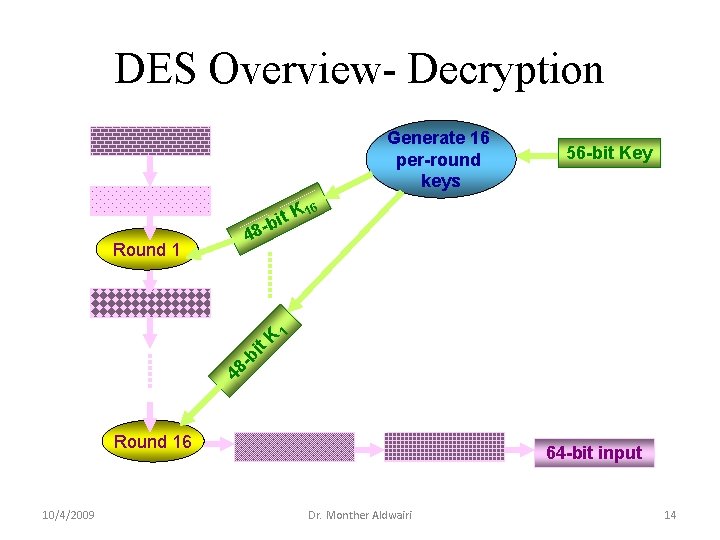
DES Overview- Decryption Generate 16 per-round keys Initial Permutation K it 48 -b 10/4/2009 Final Permutation Round 16 16 Swap left and right halves 1 Round 1 t. K i b 48 56 -bit Key 64 -bit input Dr. Monther Aldwairi 14
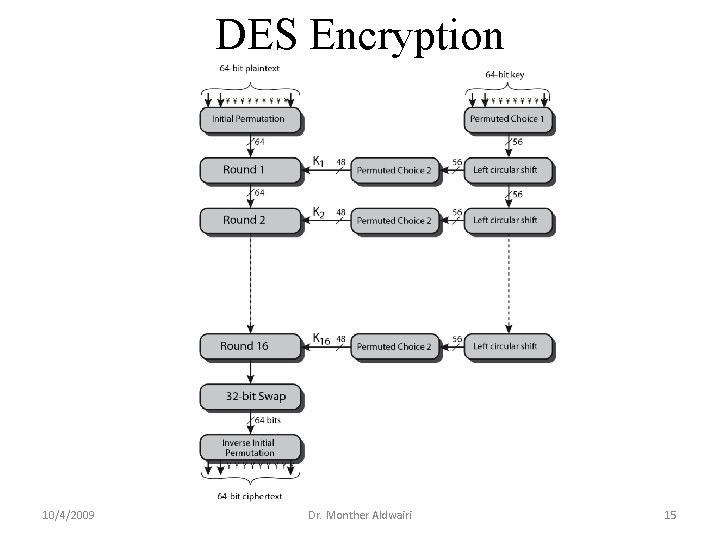
DES Encryption 10/4/2009 Dr. Monther Aldwairi 15
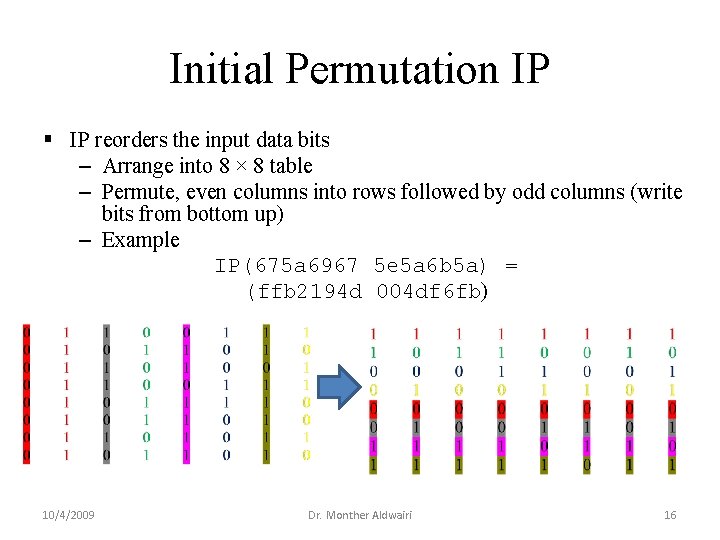
Initial Permutation IP § IP reorders the input data bits – Arrange into 8 × 8 table – Permute, even columns into rows followed by odd columns (write bits from bottom up) – Example IP(675 a 6967 5 e 5 a 6 b 5 a) = (ffb 2194 d 004 df 6 fb) 10/4/2009 Dr. Monther Aldwairi 16
10/4/2009 Dr. Monther Aldwairi 17
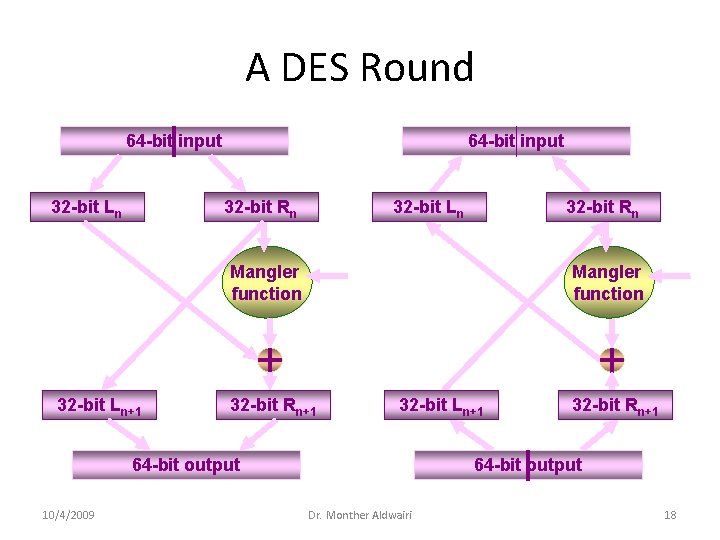
A DES Round 64 -bit input 32 -bit Ln 64 -bit input 32 -bit Rn 32 -bit Ln Mangler function 32 -bit Ln+1 Mangler function Kn 32 -bit Rn+1 32 -bit Ln+1 Kn 32 -bit Rn+1 64 -bit output 10/4/2009 32 -bit Rn Dr. Monther Aldwairi 18
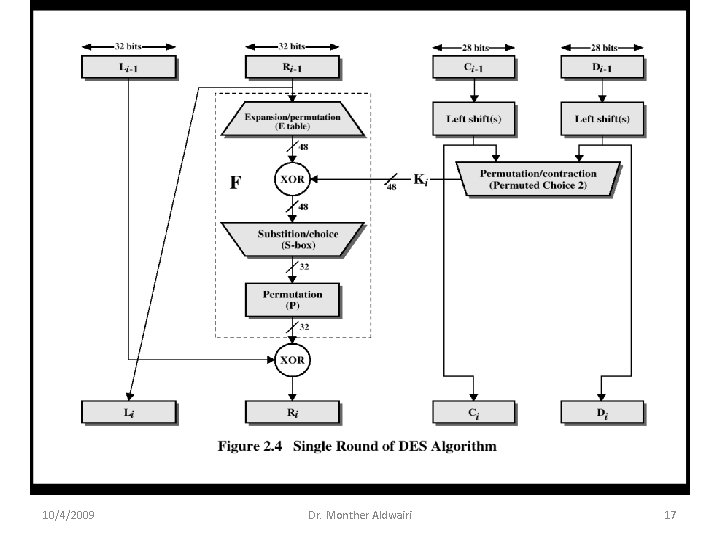
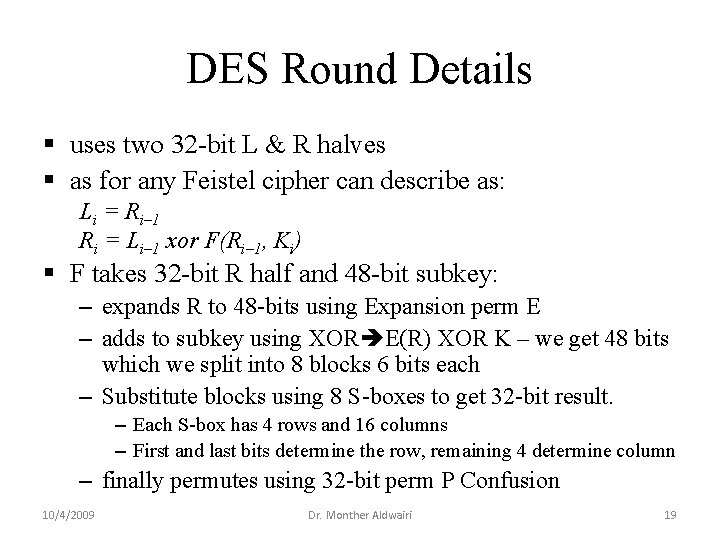
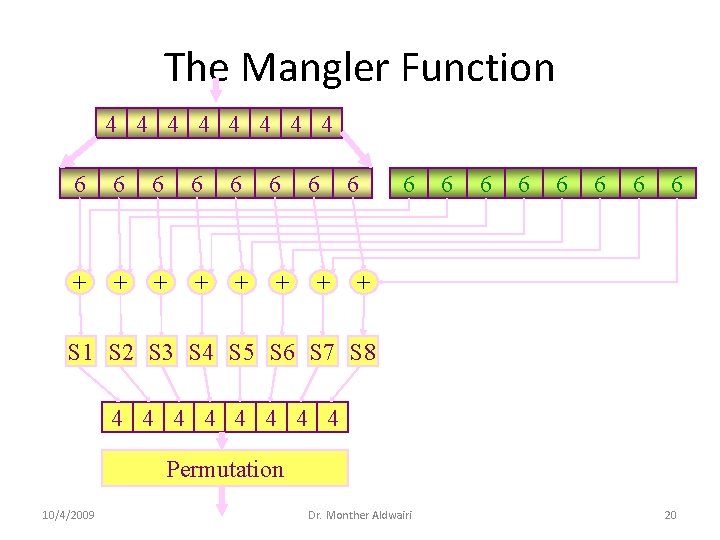
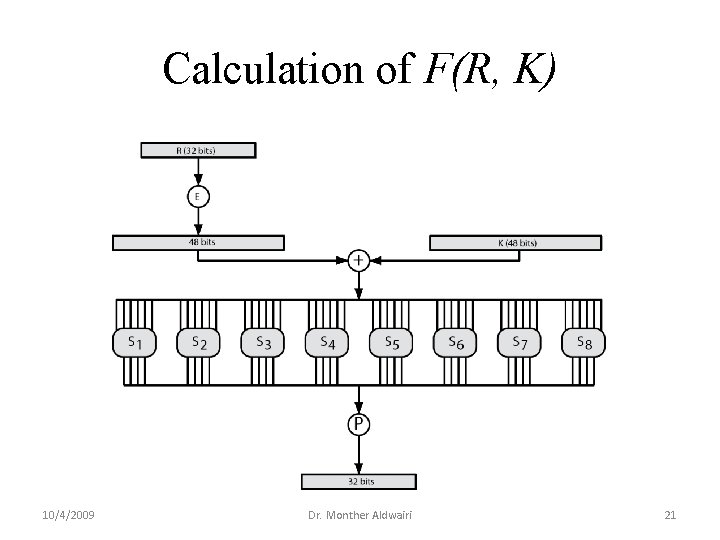
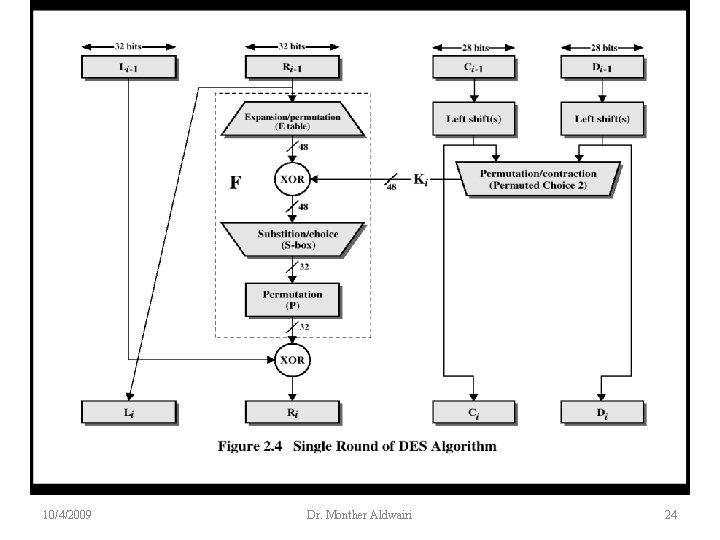
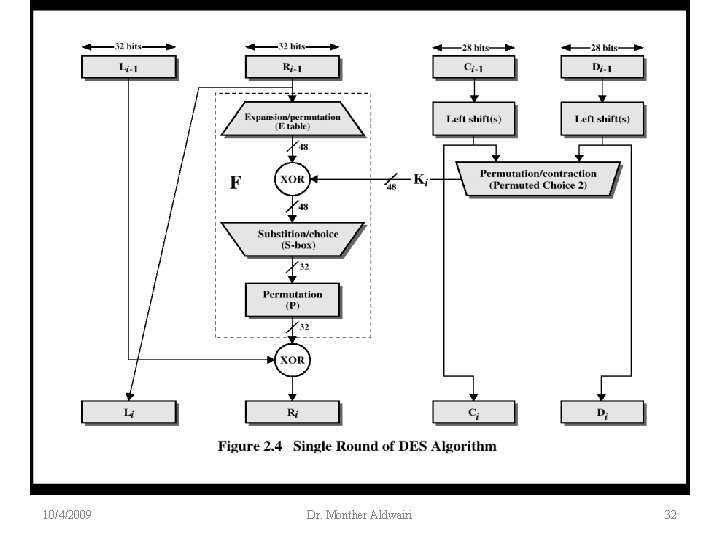
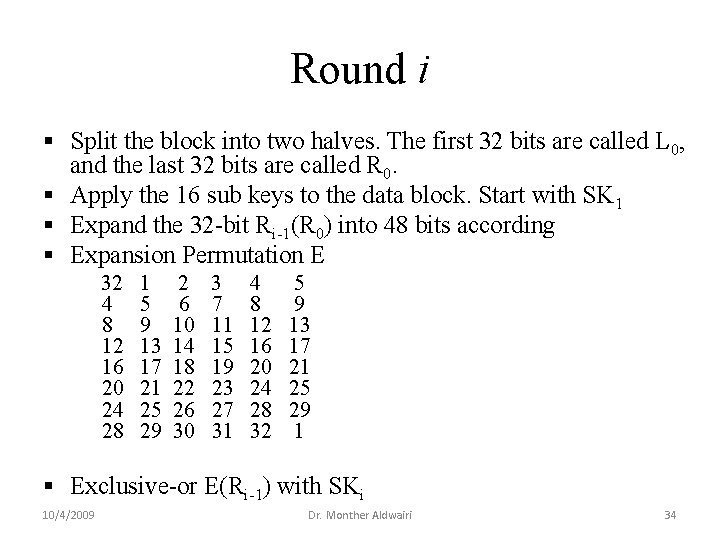
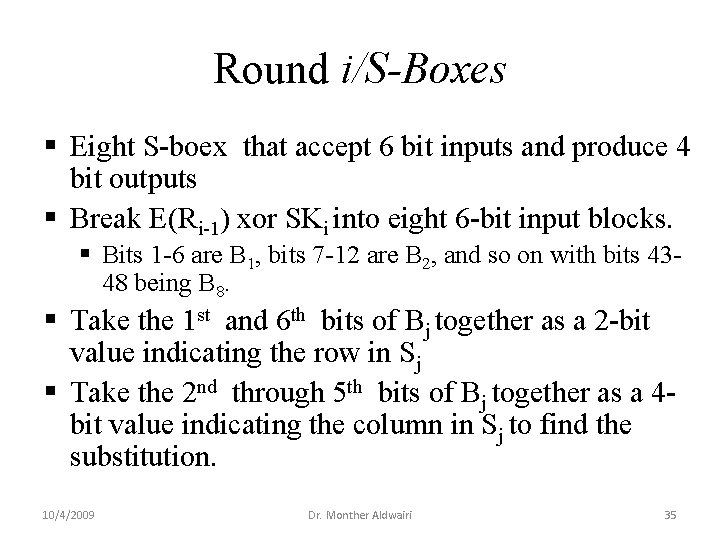
DES Round Details § uses two 32 -bit L & R halves § as for any Feistel cipher can describe as: Li = Ri– 1 Ri = Li– 1 xor F(Ri– 1, Ki) § F takes 32 -bit R half and 48 -bit subkey: – expands R to 48 -bits using Expansion perm E – adds to subkey using XOR E(R) XOR K – we get 48 bits which we split into 8 blocks 6 bits each – Substitute blocks using 8 S-boxes to get 32 -bit result. – Each S-box has 4 rows and 16 columns – First and last bits determine the row, remaining 4 determine column – finally permutes using 32 -bit perm P Confusion 10/4/2009 Dr. Monther Aldwairi 19
The Mangler Function 4 4 4 4 6 6 6 + + + 6 + 6 6 6 6 6 + S 1 S 2 S 3 S 4 S 5 S 6 S 7 S 8 4 4 4 4 Permutation 10/4/2009 Dr. Monther Aldwairi 20
Calculation of F(R, K) 10/4/2009 Dr. Monther Aldwairi 21
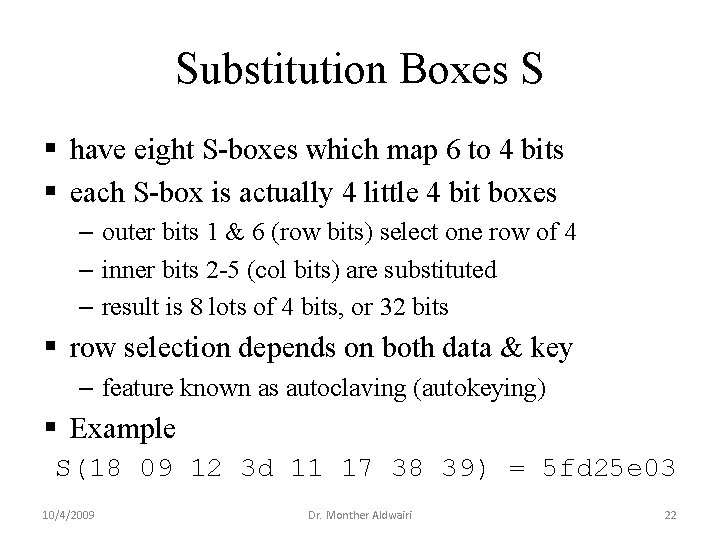
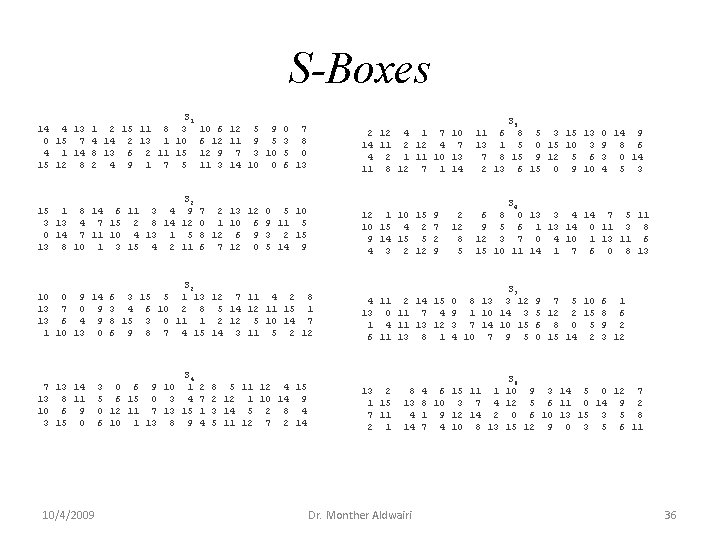
Substitution Boxes S § have eight S-boxes which map 6 to 4 bits § each S-box is actually 4 little 4 bit boxes – outer bits 1 & 6 (row bits) select one row of 4 – inner bits 2 -5 (col bits) are substituted – result is 8 lots of 4 bits, or 32 bits § row selection depends on both data & key – feature known as autoclaving (autokeying) § Example S(18 09 12 3 d 11 17 38 39) = 5 fd 25 e 03 10/4/2009 Dr. Monther Aldwairi 22
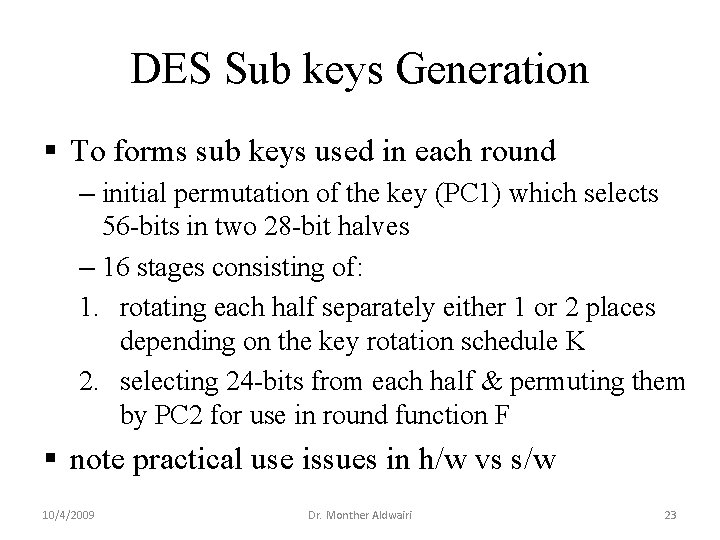
DES Sub keys Generation § To forms sub keys used in each round – initial permutation of the key (PC 1) which selects 56 -bits in two 28 -bit halves – 16 stages consisting of: 1. rotating each half separately either 1 or 2 places depending on the key rotation schedule K 2. selecting 24 -bits from each half & permuting them by PC 2 for use in round function F § note practical use issues in h/w vs s/w 10/4/2009 Dr. Monther Aldwairi 23
DES Example 10/4/2009 Dr. Monther Aldwairi 24
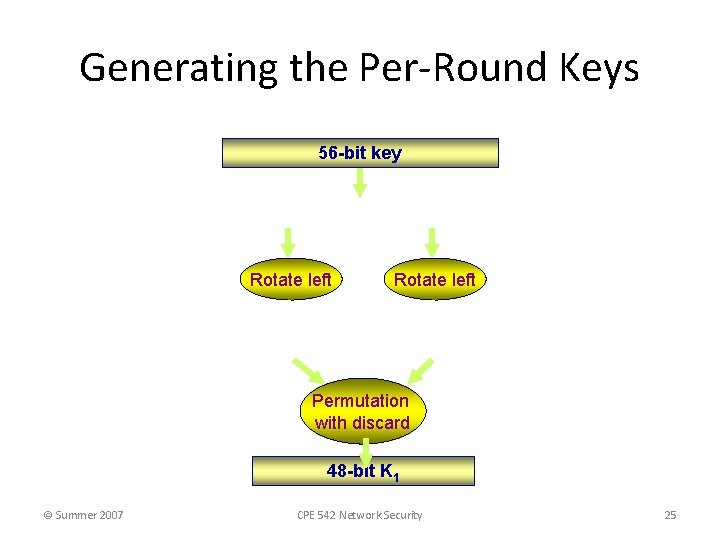
Generating the Per-Round Keys 56 -bit key C 0 Initial Permutation 57 49 41 33 25 17 9 1 58 50 42 10 2 19 60 52 44 36 Permutation to obtain the left-half of Ki 14 17 11 24 1 5 3 28 15 6 21 10 23 19 12 4 26 8 16 7 27 20 13 2 © Summer 2007 C 0 D 0 63 55 47 39 31 23 15 7 34 26 18 59 51 43 35 19 11 3 D 0 Rotate left C 1 D 1 Permutation with discard 48 -bit K 1 CPE 542 Network Security 62 54 46 38 30 22 14 6 61 53 21 13 5 28 20 12 45 37 29 4 Permutation to obtain the right-half of Ki 41 52 31 37 47 55 30 40 51 45 33 48 44 49 39 56 34 53 46 42 50 36 29 32 25
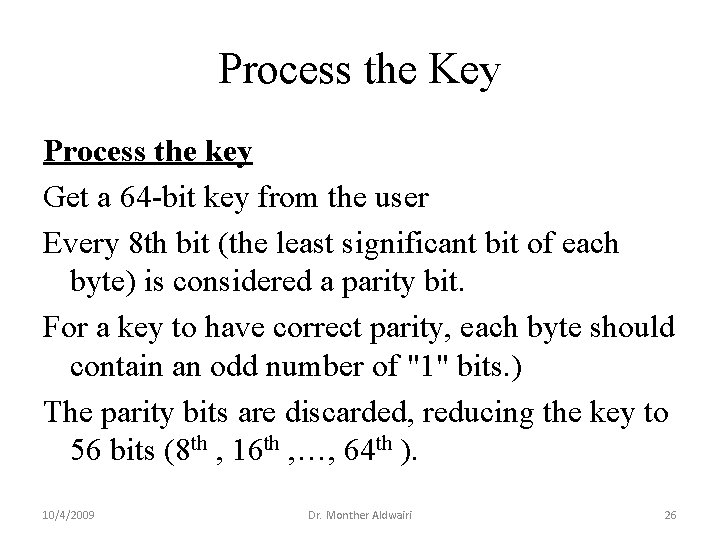
Process the Key Process the key Get a 64 -bit key from the user Every 8 th bit (the least significant bit of each byte) is considered a parity bit. For a key to have correct parity, each byte should contain an odd number of "1" bits. ) The parity bits are discarded, reducing the key to 56 bits (8 th , 16 th , …, 64 th ). 10/4/2009 Dr. Monther Aldwairi 26
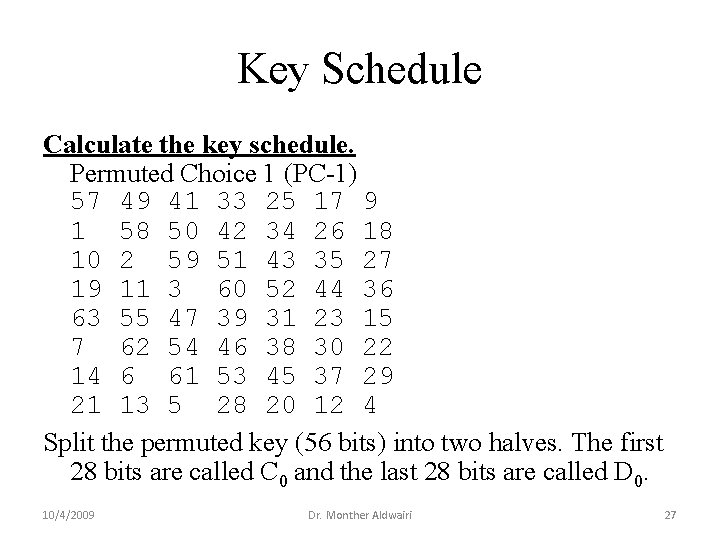
Key Schedule Calculate the key schedule. Permuted Choice 1 (PC-1) 57 49 41 33 25 17 9 1 58 50 42 34 26 18 10 2 59 51 43 35 27 19 11 3 60 52 44 36 63 55 47 39 31 23 15 7 62 54 46 38 30 22 14 6 61 53 45 37 29 21 13 5 28 20 12 4 Split the permuted key (56 bits) into two halves. The first 28 bits are called C 0 and the last 28 bits are called D 0. 10/4/2009 Dr. Monther Aldwairi 27
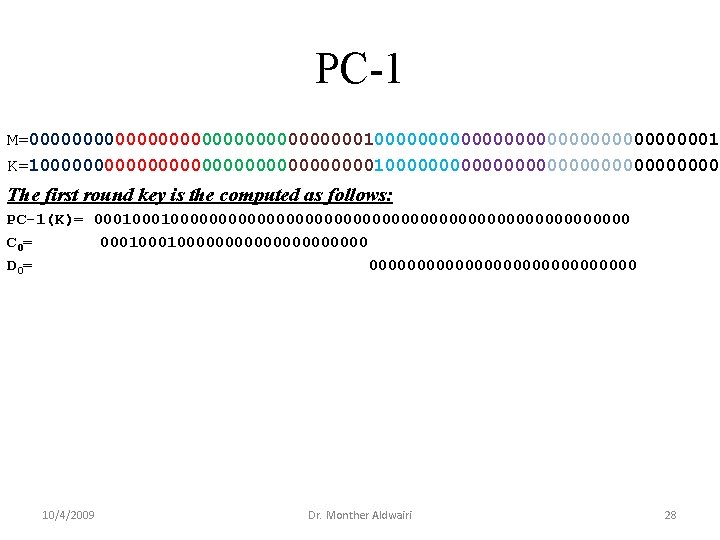
PC-1 M=00000000000000000000000000000001 K=10000000000000000000000000000000 The first round key is the computed as follows: PC-1(K)= 0001000000000000000000000000 C 0 = 00010000000000 D 0 = 00000000000000 10/4/2009 Dr. Monther Aldwairi 28
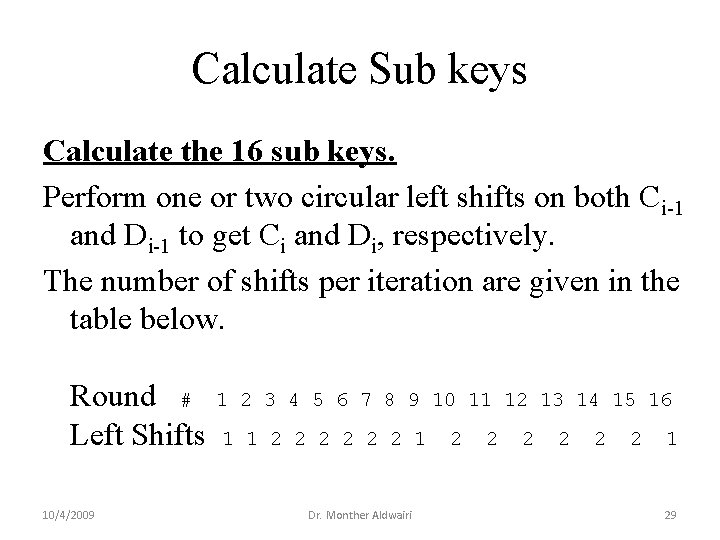
Calculate Sub keys Calculate the 16 sub keys. Perform one or two circular left shifts on both Ci-1 and Di-1 to get Ci and Di, respectively. The number of shifts per iteration are given in the table below. Round # 1 2 3 4 5 6 7 8 9 10 11 12 13 14 15 16 Left Shifts 1 1 2 2 2 1 10/4/2009 Dr. Monther Aldwairi 29
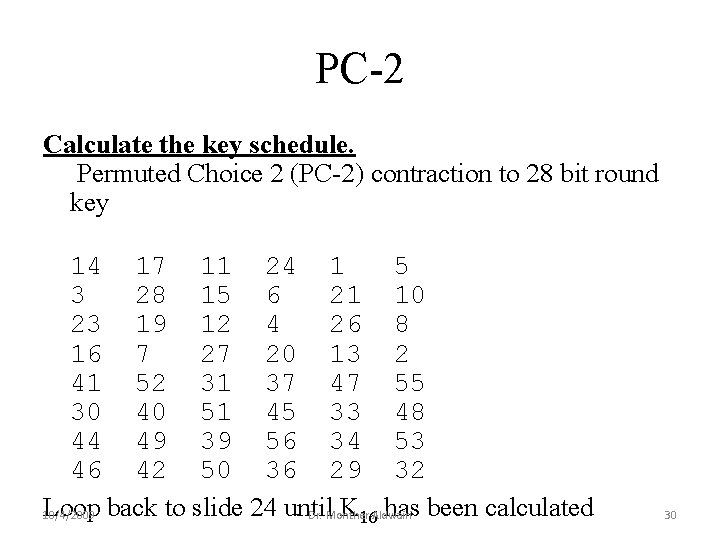
PC-2 Calculate the key schedule. Permuted Choice 2 (PC-2) contraction to 28 bit round key 14 17 11 24 1 5 3 28 15 6 21 10 23 19 12 4 26 8 16 7 27 20 13 2 41 52 31 37 47 55 30 40 51 45 33 48 44 49 39 56 34 53 46 42 50 36 29 32 Loop back to slide 24 until K 16 Aldwairi has been calculated 10/4/2009 Dr. Monther 30
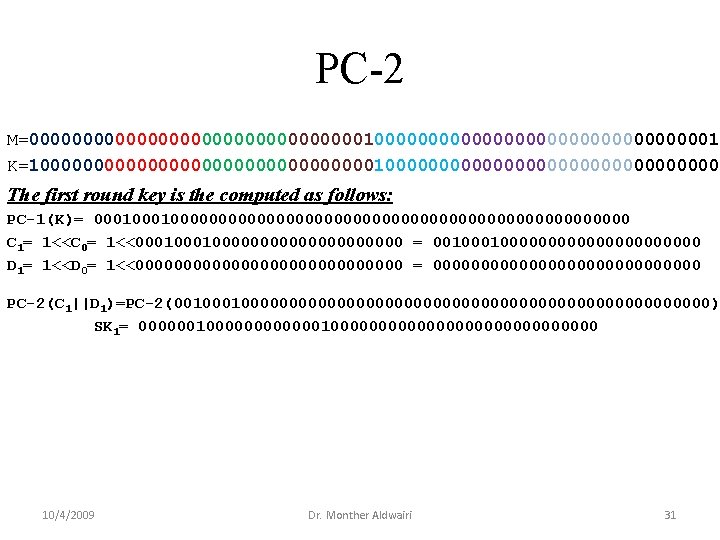
PC-2 M=00000000000000000000000000000001 K=10000000000000000000000000000000 The first round key is the computed as follows: PC-1(K)= 0001000000000000000000000000 C 1= 1<<C 0= 1<<00010000000000 = 00100000000000 D 1= 1<<D 0= 1<<00000000000000 = 00000000000000 PC-2(C 1||D 1)=PC-2(0010000000000000000000000000) SK 1= 000000100000000000000000 10/4/2009 Dr. Monther Aldwairi 31
DES Example 10/4/2009 Dr. Monther Aldwairi 32
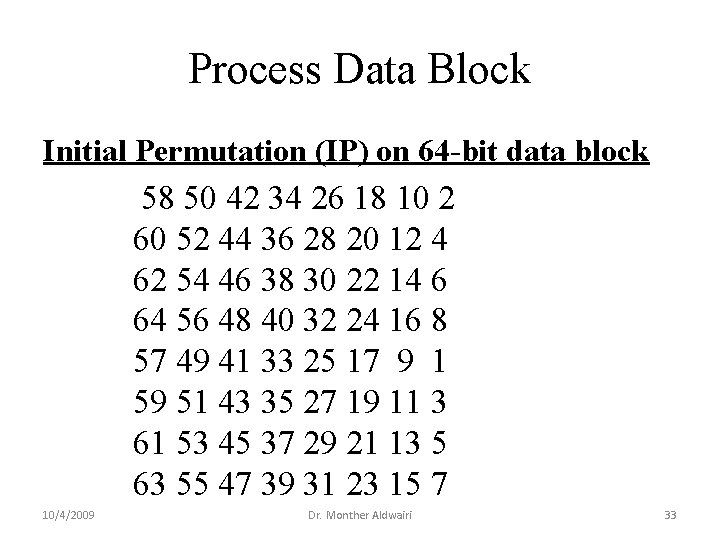
Process Data Block Initial Permutation (IP) on 64 -bit data block 58 50 42 34 26 18 10 2 60 52 44 36 28 20 12 4 62 54 46 38 30 22 14 6 64 56 48 40 32 24 16 8 57 49 41 33 25 17 9 1 59 51 43 35 27 19 11 3 61 53 45 37 29 21 13 5 63 55 47 39 31 23 15 7 10/4/2009 Dr. Monther Aldwairi 33
Round i § Split the block into two halves. The first 32 bits are called L 0, and the last 32 bits are called R 0. § Apply the 16 sub keys to the data block. Start with SK 1 § Expand the 32 -bit Ri-1(R 0) into 48 bits according § Expansion Permutation E 32 4 8 12 16 20 24 28 1 5 9 13 17 21 25 29 2 6 10 14 18 22 26 30 3 7 11 15 19 23 27 31 4 8 12 16 20 24 28 32 5 9 13 17 21 25 29 1 § Exclusive-or E(Ri-1) with SKi 10/4/2009 Dr. Monther Aldwairi 34
Round i/S-Boxes § Eight S-boex that accept 6 bit inputs and produce 4 bit outputs § Break E(Ri-1) xor SKi into eight 6 -bit input blocks. § Bits 1 -6 are B 1, bits 7 -12 are B 2, and so on with bits 4348 being B 8. § Take the 1 st and 6 th bits of Bj together as a 2 -bit value indicating the row in Sj § Take the 2 nd through 5 th bits of Bj together as a 4 bit value indicating the column in Sj to find the substitution. 10/4/2009 Dr. Monther Aldwairi 35
S-Boxes S 1 14 4 13 1 2 15 11 8 3 0 15 7 4 14 2 13 1 10 4 1 14 8 13 6 2 11 15 15 12 8 2 4 9 1 7 5 10 6 12 5 9 0 7 6 12 11 9 5 3 8 12 9 7 3 10 5 0 11 3 14 10 0 6 13 2 12 4 1 7 10 14 11 2 12 4 7 4 2 1 11 10 13 11 8 12 7 1 14 S 5 11 6 8 5 3 15 13 13 1 5 0 15 10 3 7 8 15 9 12 5 6 2 13 6 15 0 9 10 S 2 15 1 8 14 6 11 3 4 9 3 13 4 7 15 2 8 14 12 0 14 7 11 10 4 13 1 5 13 8 10 1 3 15 4 2 11 7 2 13 12 0 5 10 0 1 10 6 9 11 5 8 12 6 9 3 2 15 6 7 12 0 5 14 9 12 1 10 15 4 2 9 14 15 5 4 3 2 12 S 6 6 8 0 13 3 4 14 7 5 11 9 5 6 1 13 14 0 11 3 8 12 3 7 0 4 10 1 13 11 6 15 10 11 14 1 7 6 0 8 13 S 3 10 0 9 14 6 3 15 5 1 13 12 7 11 4 2 8 13 7 0 9 3 4 6 10 2 8 5 14 12 11 15 1 13 6 4 9 8 15 3 0 11 1 2 12 5 10 14 7 1 10 13 0 6 9 8 7 4 15 14 3 11 5 2 12 7 13 14 13 8 11 10 6 9 3 15 0 10/4/2009 S 4 3 0 6 9 10 1 2 5 6 15 0 3 4 7 0 12 11 7 13 15 1 6 10 1 13 8 9 4 8 5 11 12 4 15 2 12 1 10 14 9 3 14 5 2 8 4 5 11 12 7 2 14 9 7 2 9 2 12 8 5 0 14 9 9 8 6 3 0 14 4 5 3 S 7 4 11 2 14 15 0 8 13 3 12 9 7 5 10 6 1 13 0 11 7 4 9 1 10 14 3 5 12 2 15 8 6 1 4 11 13 12 3 7 14 10 15 6 8 0 5 9 2 6 11 13 8 1 4 10 7 9 5 0 15 14 2 3 12 13 2 1 15 7 11 2 1 8 13 4 14 Dr. Monther Aldwairi S 8 4 6 15 11 1 10 9 3 14 5 0 12 7 8 10 3 7 4 12 5 6 11 0 14 9 2 1 9 12 14 2 0 6 10 13 15 3 5 8 7 4 10 8 13 15 12 9 0 3 5 6 11 36
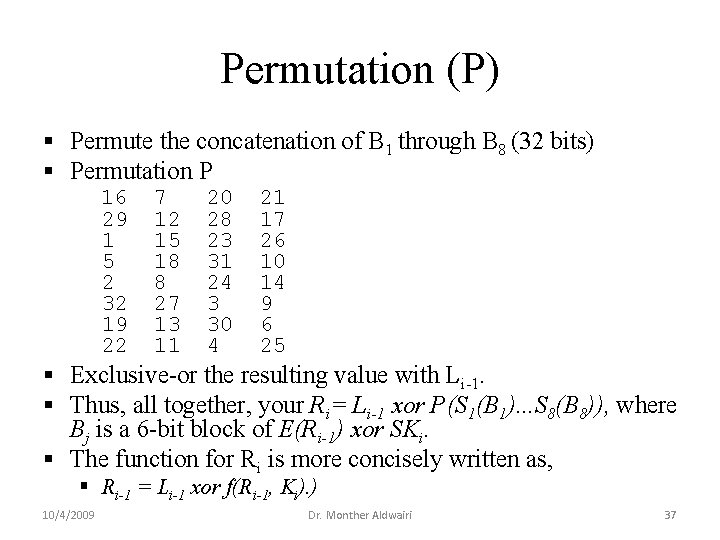
Permutation (P) § Permute the concatenation of B 1 through B 8 (32 bits) § Permutation P 16 29 1 5 2 32 19 22 7 12 15 18 8 27 13 11 20 28 23 31 24 3 30 4 21 17 26 10 14 9 6 25 § Exclusive-or the resulting value with Li-1. § Thus, all together, your Ri= Li-1 xor P(S 1(B 1). . . S 8(B 8)), where Bj is a 6 -bit block of E(Ri-1) xor SKi. § The function for Ri is more concisely written as, § Ri-1 = Li-1 xor f(Ri-1, Ki). ) 10/4/2009 Dr. Monther Aldwairi 37
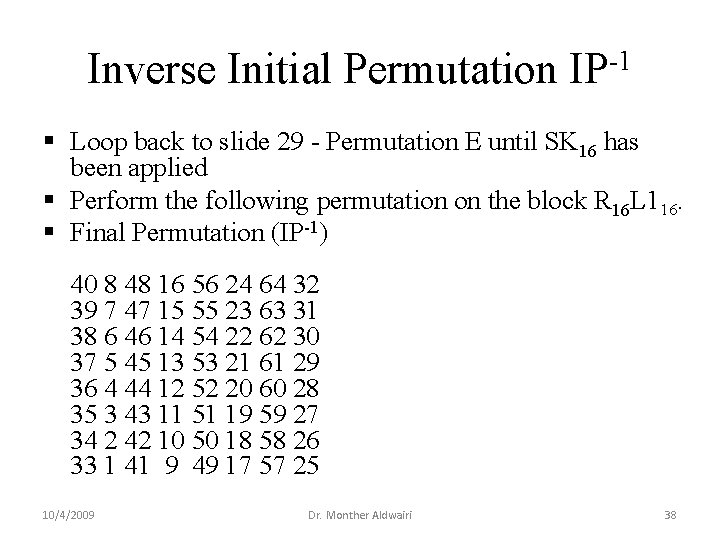
Inverse Initial Permutation IP-1 § Loop back to slide 29 - Permutation E until SK 16 has been applied § Perform the following permutation on the block R 16 L 116. § Final Permutation (IP-1) 40 8 48 16 56 24 64 32 39 7 47 15 55 23 63 31 38 6 46 14 54 22 62 30 37 5 45 13 53 21 61 29 36 4 44 12 52 20 60 28 35 3 43 11 51 19 59 27 34 2 42 10 50 18 58 26 33 1 41 9 49 17 57 25 10/4/2009 Dr. Monther Aldwairi 38
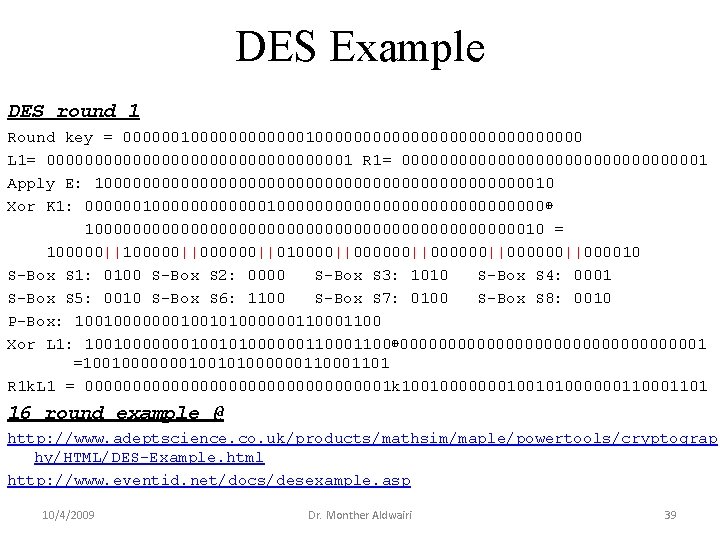
DES Example DES round 1 Round key = 000000100000000000000000 L 1= 00000000000000001 R 1= 00000000000000001 Apply E: 10000000000000000000000010 Xor K 1: 000000100000000000000000⊕ 10000000000000000000000010 = 100000||000000||010000||000000||000010 S-Box S 1: 0100 S-Box S 2: 0000 S-Box S 3: 1010 S-Box S 4: 0001 S-Box S 5: 0010 S-Box S 6: 1100 S-Box S 7: 0100 S-Box S 8: 0010 P-Box: 100100000001001010000001100 Xor L 1: 100100000001001010000001100⊕ 00000000000000001 =100100000001001010000001101 R 1 k. L 1 = 00000000000000001 k 100100000001001010000001101 16 round example @ http: //www. adeptscience. co. uk/products/mathsim/maple/powertools/cryptograp hy/HTML/DES-Example. html http: //www. eventid. net/docs/desexample. asp 10/4/2009 Dr. Monther Aldwairi 39
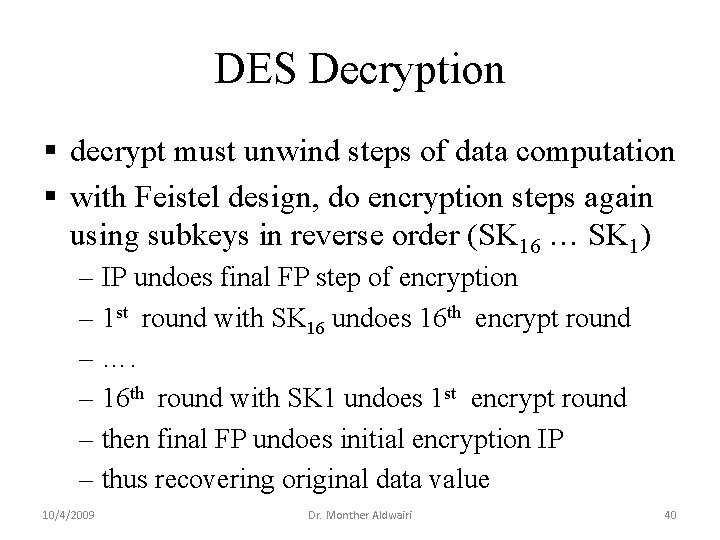
DES Decryption § decrypt must unwind steps of data computation § with Feistel design, do encryption steps again using subkeys in reverse order (SK 16 … SK 1) ‒ IP undoes final FP step of encryption ‒ 1 st round with SK 16 undoes 16 th encrypt round ‒ …. ‒ 16 th round with SK 1 undoes 1 st encrypt round ‒ then final FP undoes initial encryption IP ‒ thus recovering original data value 10/4/2009 Dr. Monther Aldwairi 40
Avalanche Effect § key desirable property of encryption algorithm § where a change of one input or key bit results in changing approx half output bits § making attempts to “home-in” by guessing keys impossible § DES exhibits strong avalanche § Permutation E 10/4/2009 Dr. Monther Aldwairi 41
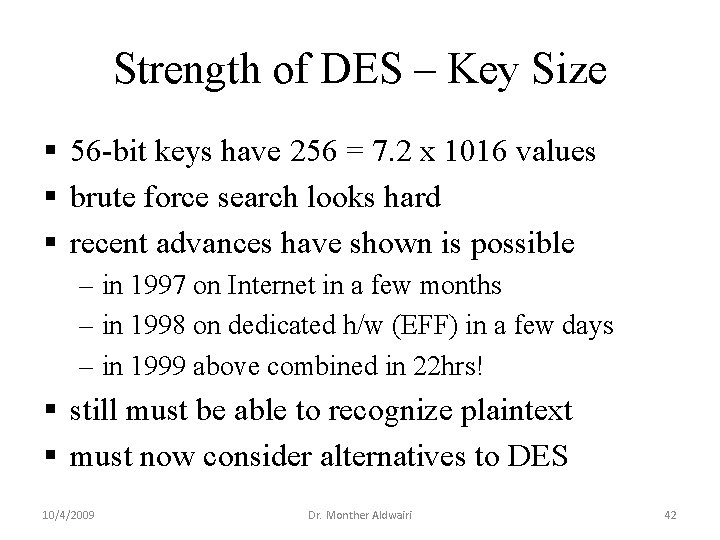
Strength of DES – Key Size § 56 -bit keys have 256 = 7. 2 x 10¹⁶ values § brute force search looks hard § recent advances have shown is possible ‒ in 1997 on Internet in a few months ‒ in 1998 on dedicated h/w (EFF) in a few days ‒ in 1999 above combined in 22 hrs! § still must be able to recognize plaintext § must now consider alternatives to DES 10/4/2009 Dr. Monther Aldwairi 42
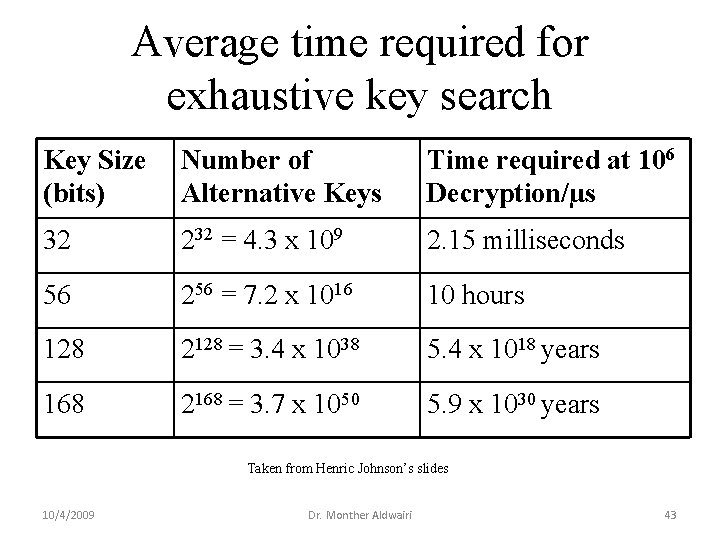
Average time required for exhaustive key search Key Size (bits) Number of Alternative Keys Time required at 106 Decryption/µs 32 232 = 4. 3 x 10⁹ 2. 15 milliseconds 56 256 = 7. 2 x 10¹⁶ 10 hours 128 2128 = 3. 4 x 1038 5. 4 x 10¹⁸ years 168 2168 = 3. 7 x 1050 5. 9 x 1030 years Taken from Henric Johnson’s slides 10/4/2009 Dr. Monther Aldwairi 43
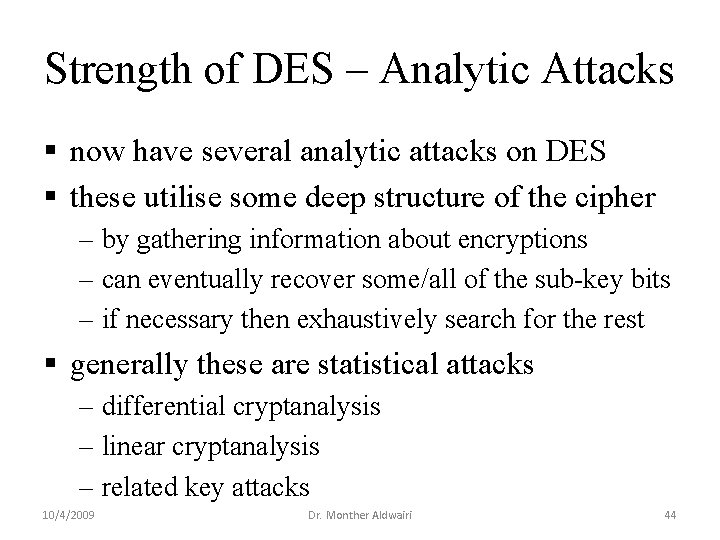
Strength of DES – Analytic Attacks § now have several analytic attacks on DES § these utilise some deep structure of the cipher ‒ by gathering information about encryptions ‒ can eventually recover some/all of the sub-key bits ‒ if necessary then exhaustively search for the rest § generally these are statistical attacks ‒ differential cryptanalysis ‒ linear cryptanalysis ‒ related key attacks 10/4/2009 Dr. Monther Aldwairi 44
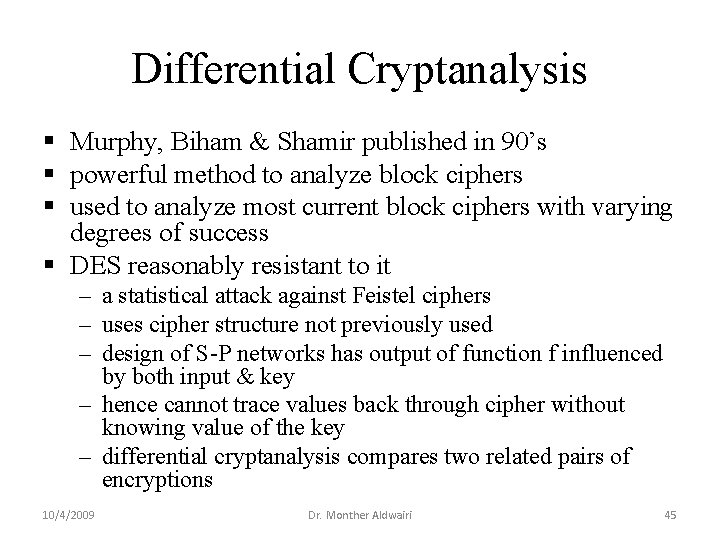
Differential Cryptanalysis § Murphy, Biham & Shamir published in 90’s § powerful method to analyze block ciphers § used to analyze most current block ciphers with varying degrees of success § DES reasonably resistant to it ‒ a statistical attack against Feistel ciphers ‒ uses cipher structure not previously used ‒ design of S-P networks has output of function f influenced by both input & key ‒ hence cannot trace values back through cipher without knowing value of the key ‒ differential cryptanalysis compares two related pairs of encryptions 10/4/2009 Dr. Monther Aldwairi 45
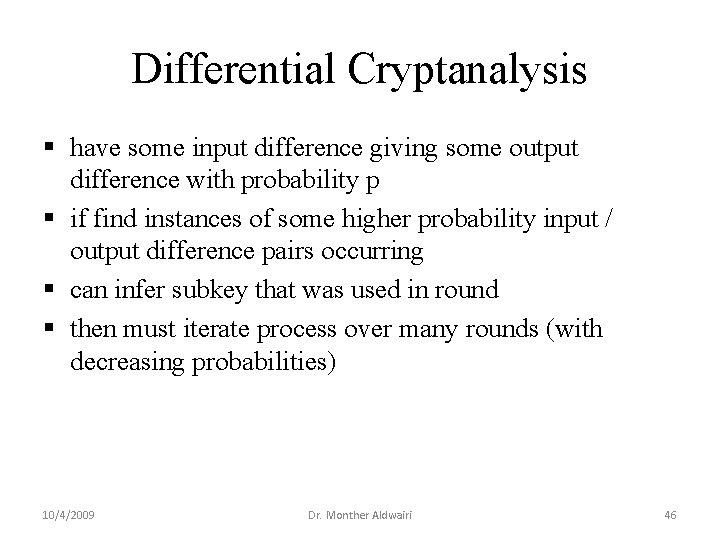
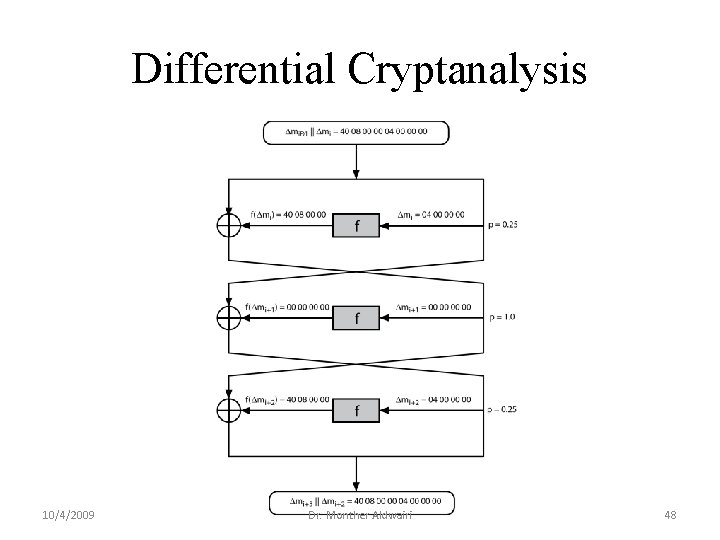
Differential Cryptanalysis § have some input difference giving some output difference with probability p § if find instances of some higher probability input / output difference pairs occurring § can infer subkey that was used in round § then must iterate process over many rounds (with decreasing probabilities) 10/4/2009 Dr. Monther Aldwairi 46
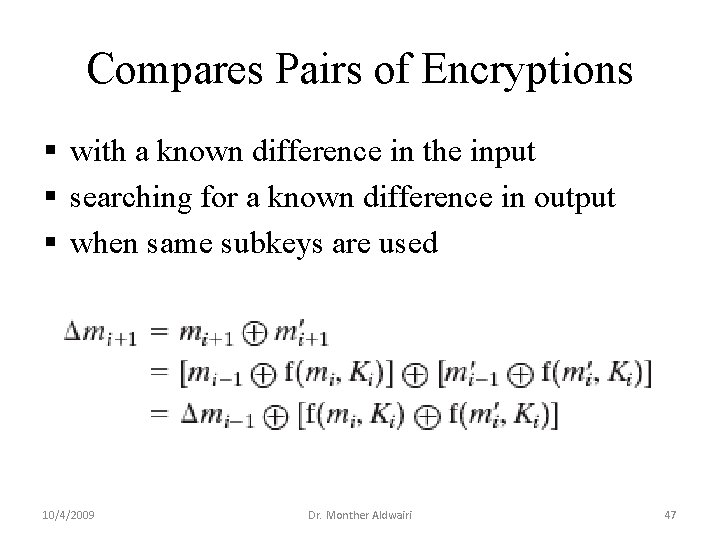
Compares Pairs of Encryptions § with a known difference in the input § searching for a known difference in output § when same subkeys are used 10/4/2009 Dr. Monther Aldwairi 47
Differential Cryptanalysis 10/4/2009 Dr. Monther Aldwairi 48
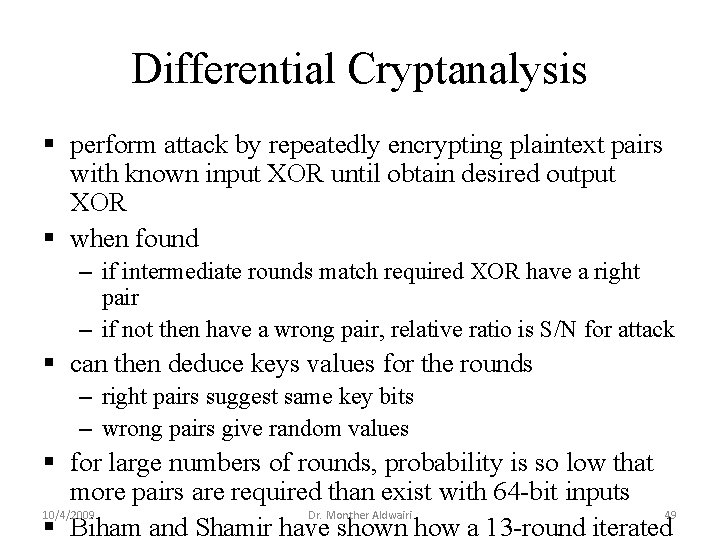
Differential Cryptanalysis § perform attack by repeatedly encrypting plaintext pairs with known input XOR until obtain desired output XOR § when found – if intermediate rounds match required XOR have a right pair – if not then have a wrong pair, relative ratio is S/N for attack § can then deduce keys values for the rounds – right pairs suggest same key bits – wrong pairs give random values § for large numbers of rounds, probability is so low that more pairs are required than exist with 64 -bit inputs 10/4/2009 Dr. Monther Aldwairi 49 § Biham and Shamir have shown how a 13 -round iterated
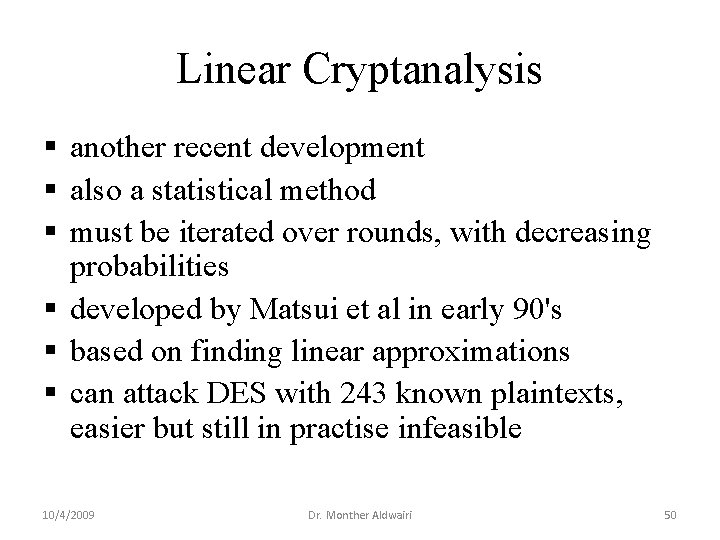
Linear Cryptanalysis § another recent development § also a statistical method § must be iterated over rounds, with decreasing probabilities § developed by Matsui et al in early 90's § based on finding linear approximations § can attack DES with 243 known plaintexts, easier but still in practise infeasible 10/4/2009 Dr. Monther Aldwairi 50
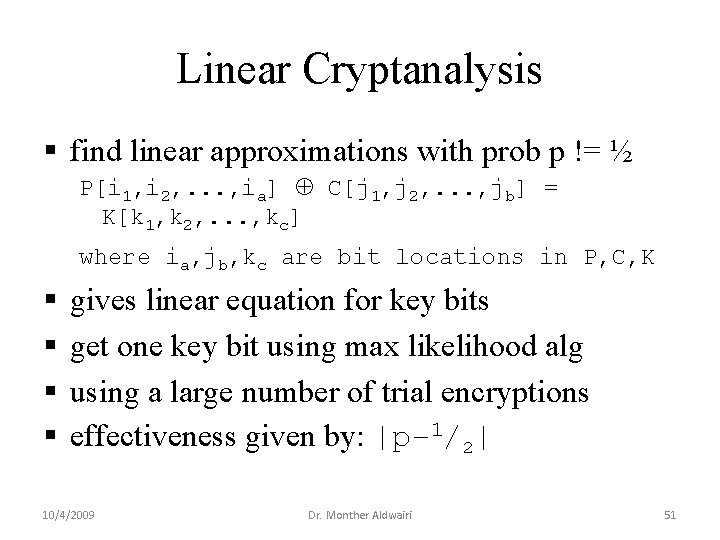
Linear Cryptanalysis § find linear approximations with prob p != ½ P[i 1, i 2, . . . , ia] C[j 1, j 2, . . . , jb] = K[k 1, k 2, . . . , kc] where ia, jb, kc are bit locations in P, C, K § § gives linear equation for key bits get one key bit using max likelihood alg using a large number of trial encryptions effectiveness given by: |p– 1/2| 10/4/2009 Dr. Monther Aldwairi 51
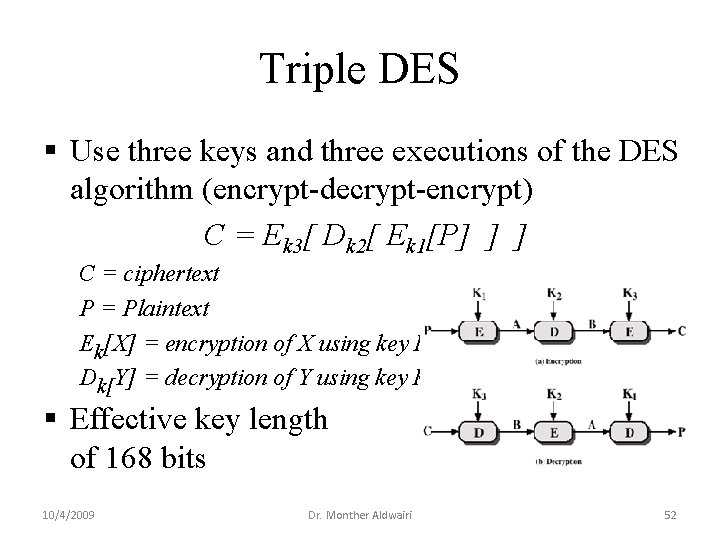
Triple DES § Use three keys and three executions of the DES algorithm (encrypt-decrypt-encrypt) C = Ek 3[ Dk 2[ Ek 1[P] ] ] C = ciphertext P = Plaintext Ek[X] = encryption of X using key K Dk[Y] = decryption of Y using key K § Effective key length of 168 bits 10/4/2009 Dr. Monther Aldwairi 52
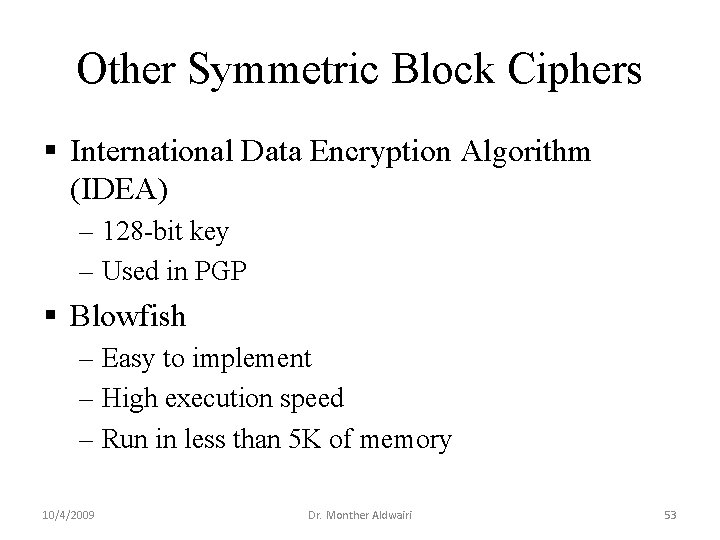
Other Symmetric Block Ciphers § International Data Encryption Algorithm (IDEA) ‒ 128 -bit key ‒ Used in PGP § Blowfish ‒ Easy to implement ‒ High execution speed ‒ Run in less than 5 K of memory 10/4/2009 Dr. Monther Aldwairi 53
Other Symmetric Block Ciphers § RC 5 ‒ ‒ ‒ ‒ Suitable for hardware and software Fast, simple Adaptable to processors of different word lengths Variable number of rounds Variable-length key Low memory requirement High security Data-dependent rotations § Cast-128 ‒ Key size from 40 to 128 bits ‒ The round function differs from round to round Blowfish 10/4/2009 Dr. Monther Aldwairi 54
Modes of Operation § block ciphers encrypt fixed size blocks § eg. DES encrypts 64 -bit blocks, with 56 -bit key § need way to use in practise, given usually have arbitrary amount of information to encrypt § Four standard modes were defined for DES § Extended to five later, and they can be used with other block ciphers: 3 DES and AES. 10/4/2009 Dr. Monther Aldwairi 55
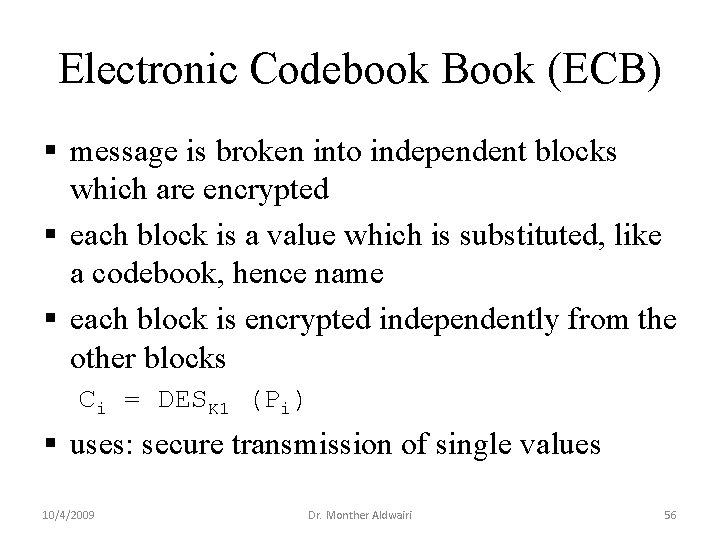
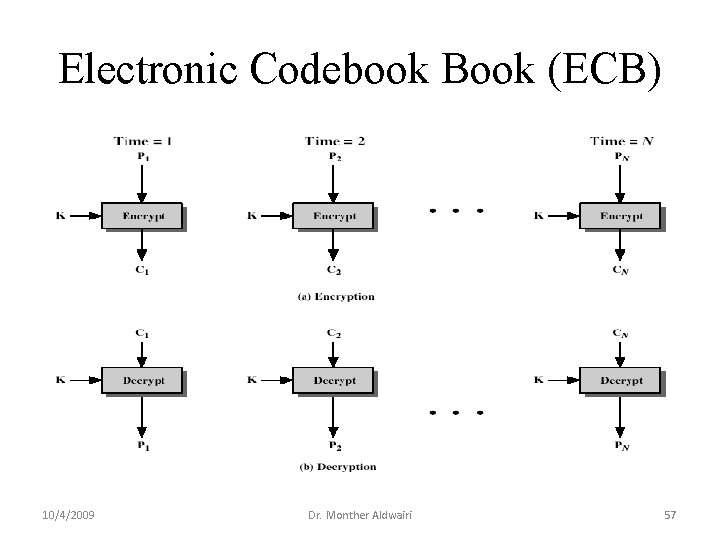
Electronic Codebook Book (ECB) § message is broken into independent blocks which are encrypted § each block is a value which is substituted, like a codebook, hence name § each block is encrypted independently from the other blocks Ci = DESK 1 (Pi) § uses: secure transmission of single values 10/4/2009 Dr. Monther Aldwairi 56
Electronic Codebook Book (ECB) 10/4/2009 Dr. Monther Aldwairi 57
Advantages and Limitations of ECB § repetitions in message may show in ciphertext – if aligned with message block – with messages that change very little, which become a code-book analysis problem § weakness due to encrypted message blocks being independent § main use is sending a few blocks of data 10/4/2009 Dr. Monther Aldwairi 58
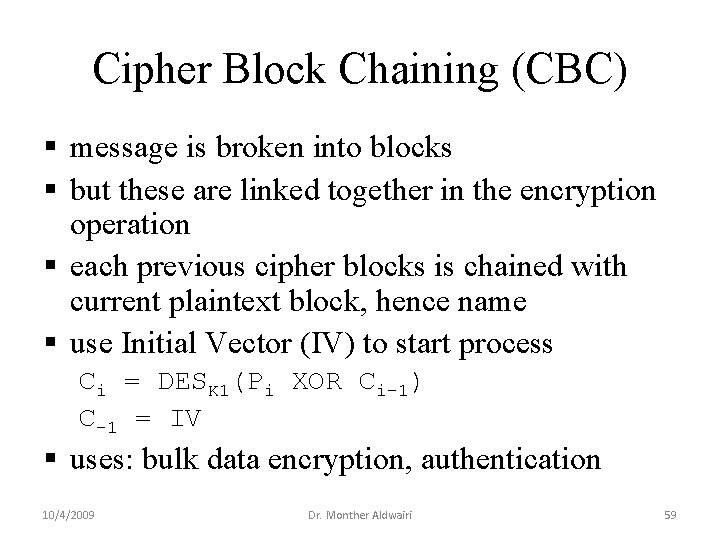
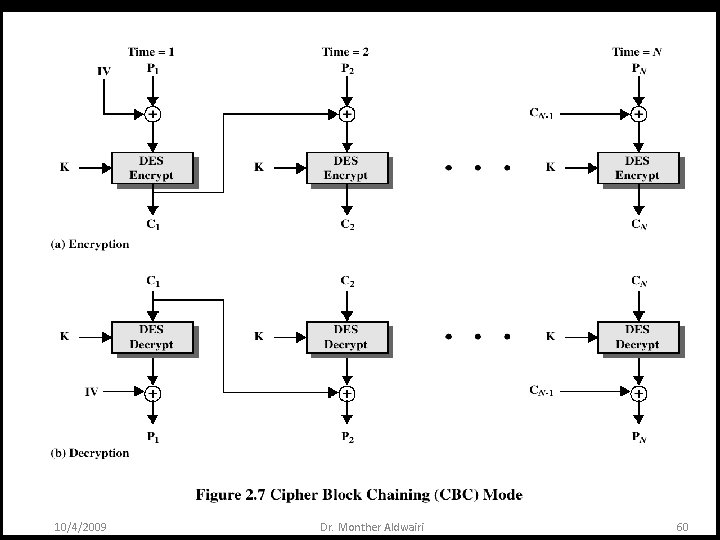
Cipher Block Chaining (CBC) § message is broken into blocks § but these are linked together in the encryption operation § each previous cipher blocks is chained with current plaintext block, hence name § use Initial Vector (IV) to start process Ci = DESK 1(Pi XOR Ci-1) C-1 = IV § uses: bulk data encryption, authentication 10/4/2009 Dr. Monther Aldwairi 59
Cipher Block Modes of Operation § Cipher Block Chaining Mode (CBC) ‒ The input to the encryption algorithm is the XOR of the current plaintext block and the preceding ciphertext block. ‒ Repeating pattern of 64 -bits are not exposed 10/4/2009 Dr. Monther Aldwairi 60 60
Advantages and Limitations of CBC § each ciphertext block depends on all message blocks § thus a change in the message affects all ciphertext blocks after the change as well as the original block § need Initial Value (IV) known to sender & receiver – however if IV is sent in the clear, an attacker can change bits of the first block, and change IV to compensate – hence either IV must. Dr. be a fixed value or it must be sent 61 10/4/2009 Monther Aldwairi encrypted in ECB mode before rest of message
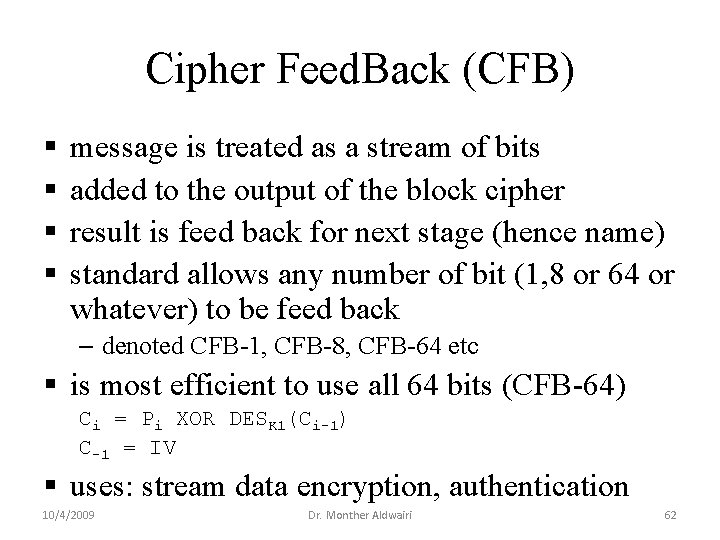
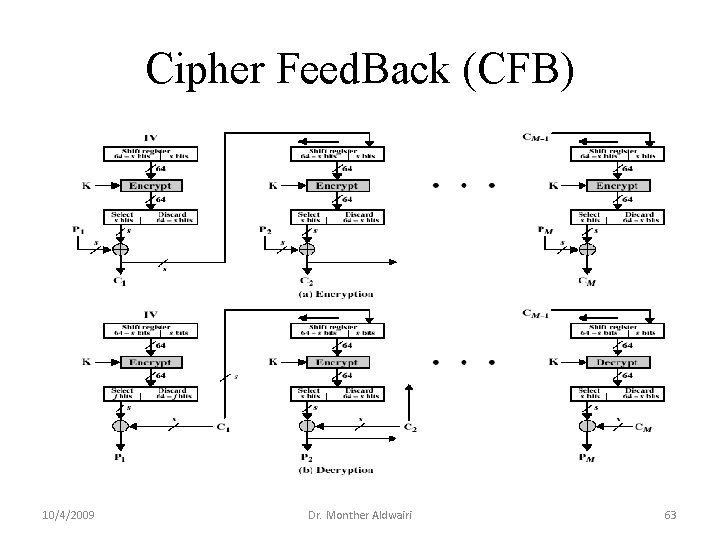
Cipher Feed. Back (CFB) § § message is treated as a stream of bits added to the output of the block cipher result is feed back for next stage (hence name) standard allows any number of bit (1, 8 or 64 or whatever) to be feed back – denoted CFB-1, CFB-8, CFB-64 etc § is most efficient to use all 64 bits (CFB-64) Ci = Pi XOR DESK 1(Ci-1) C-1 = IV § uses: stream data encryption, authentication 10/4/2009 Dr. Monther Aldwairi 62
Cipher Feed. Back (CFB) 10/4/2009 Dr. Monther Aldwairi 63
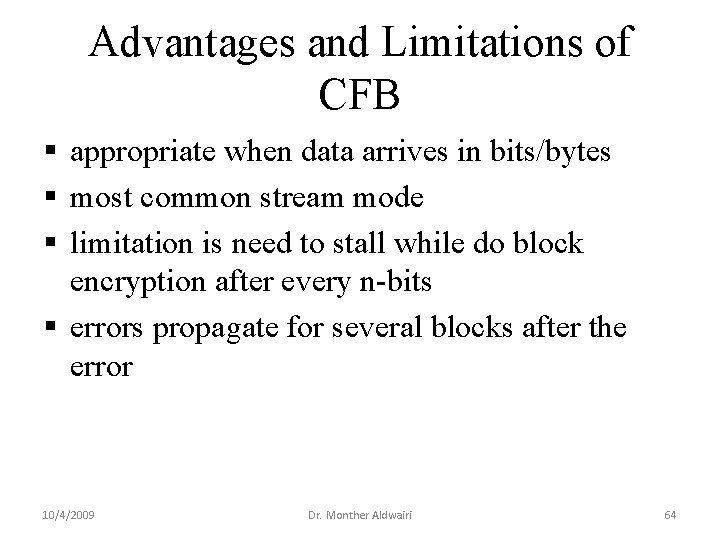
Advantages and Limitations of CFB § appropriate when data arrives in bits/bytes § most common stream mode § limitation is need to stall while do block encryption after every n-bits § errors propagate for several blocks after the error 10/4/2009 Dr. Monther Aldwairi 64
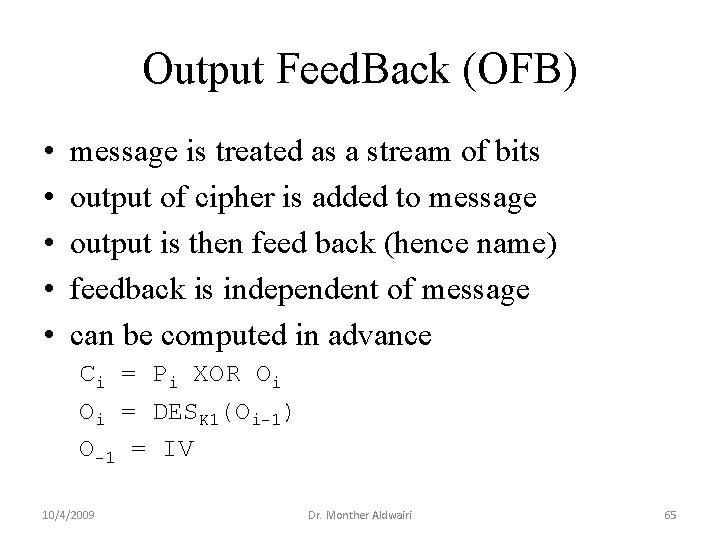
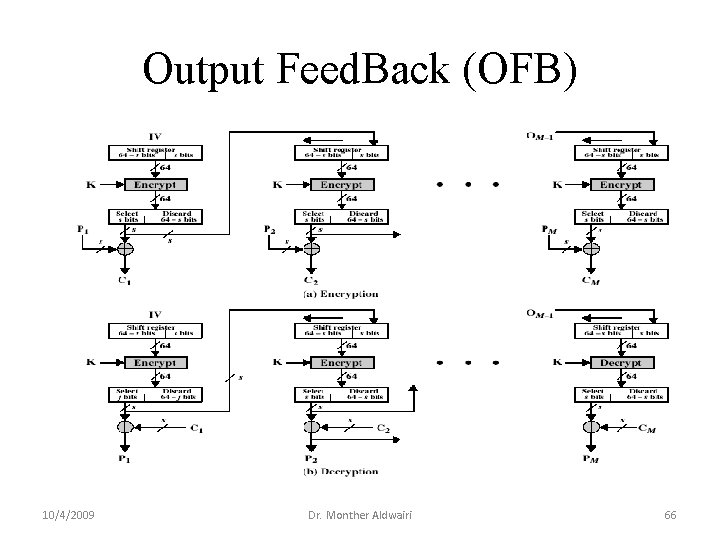
Output Feed. Back (OFB) • • • message is treated as a stream of bits output of cipher is added to message output is then feed back (hence name) feedback is independent of message can be computed in advance Ci = Pi XOR Oi Oi = DESK 1(Oi-1) O-1 = IV 10/4/2009 Dr. Monther Aldwairi 65
Output Feed. Back (OFB) 10/4/2009 Dr. Monther Aldwairi 66
Advantages and Limitations of OFB § used when error feedback a problem or where need to encryptions before message is available § superficially similar to CFB § but feedback is from the output of cipher and is independent of message § sender and receiver must remain in sync, and some recovery method is needed to ensure this occurs § originally specified with m-bit feedback in the standards § subsequent research has shown that only OFB-64 should ever be used 10/4/2009 Dr. Monther Aldwairi 67
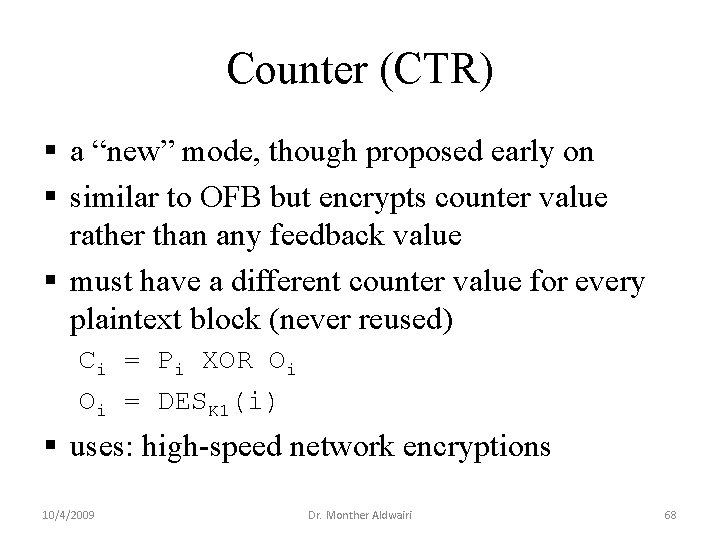
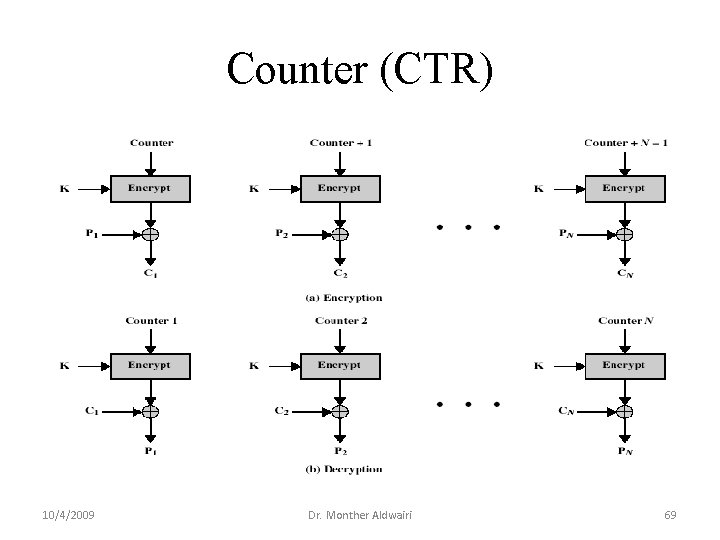
Counter (CTR) § a “new” mode, though proposed early on § similar to OFB but encrypts counter value rather than any feedback value § must have a different counter value for every plaintext block (never reused) Ci = Pi XOR Oi Oi = DESK 1(i) § uses: high-speed network encryptions 10/4/2009 Dr. Monther Aldwairi 68
Counter (CTR) 10/4/2009 Dr. Monther Aldwairi 69
Advantages and Limitations of CTR § efficiency – can do parallel encryptions § random access to encrypted data blocks § provable security (good as other modes) § but must ensure never reuse key/counter values, otherwise could break (cf OFB) 10/4/2009 Dr. Monther Aldwairi 70