
Cryptography Cryptanalysis and Cryptology Cryptography refer to the

- Slides: 12
Cryptography, Cryptanalysis and Cryptology Cryptography refer to the way of Protection information by prevent unauthorized people to access this information. Also it means hidden writing. Cryptography deals with methods to encrypt and decrypt information. �Cryptanalysis is an attempt to convert ciphertext to plaintext. Cryptanalysis deals with analyzing and breaking encryption information. Cryptology consists of two subfields, Cryptography and Cryptanalysis.
Terminology • Encryption is the process of encoding a message so that its meaning is not obvious. Other name for Encryption are (encoding, encipher). • Decryption is transforming an encrypted message back into its normal. . (other name for Decryption are (decoding, decipher). • System for encryption and decryption is called a cryptosystem. • The cryptosystem involves a set of rules for how to encrypt the plaintext and how to decrypt the ciphertext. The encryption and decryption rules, called algorithms. • Plaintext: original form of a message. Plaintext is the message to be transmitted or stored. • Ciphertext: the encrypted form.
• Encode is the process of convert the message into a representation in a standard alphabet. • Decode is the process of convert the encoded message back to its original alphabet and original form.
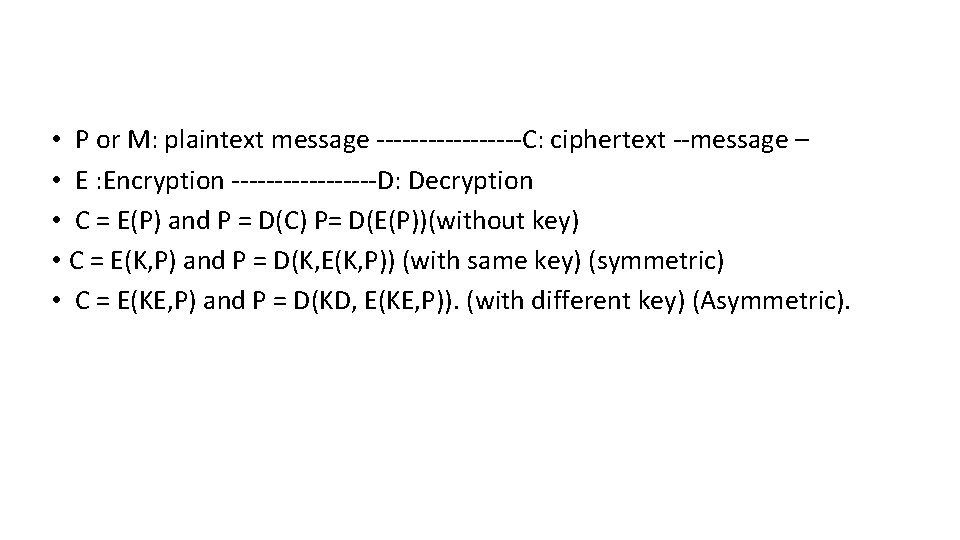
• P or M: plaintext message ---------C: ciphertext --message – • E : Encryption ---------D: Decryption • C = E(P) and P = D(C) P= D(E(P))(without key) • C = E(K, P) and P = D(K, E(K, P)) (with same key) (symmetric) • C = E(KE, P) and P = D(KD, E(KE, P)). (with different key) (Asymmetric).
• Breakable Encryption An encryption algorithm is called breakable when, given enough time and data, an analyst can determine the algorithm. • Cryptanalysis refers to the study of ciphertext , or cryptosystems with a view to finding weaknesses in them that will allow retrieval of the plaintext from the ciphertext , without necessarily knowing the key or the algorithm.
Cryptanalyst can attempt to do any or all of six different things: 1) Break a single message. 2) Recognize patterns in encrypted messages, to be able to break subsequent ones by applying a straightforward decryption algorithm. 3) Find general weaknesses in an encryption algorithm without necessarily having intercepted any messages.
Types of cryptanalytic attack 1) Ciphertext-only attack: Only know algorithm and ciphertext. 2) Known-plaintext attack: know algorithm, ciphertext and plaintext for some parts of the ciphertext. 3) Chosen-plaintext attack: know algorithm, ciphertext and various cipher text corresponding to an arbitrary set of plaintext. 4) Chosen Cipher text: know algorithm , ciphertext and various plaintext corresponding to an arbitrary set of ciphertext.
• Substitution Ciphers Substitution technique is one in which the letters of plaintext are replaced by other letters or by numbers or symbols. There are two types of substitution cipher which are monoalphabetic cipher and polyalphabetic. monoalphabetic cipher or simple substitution
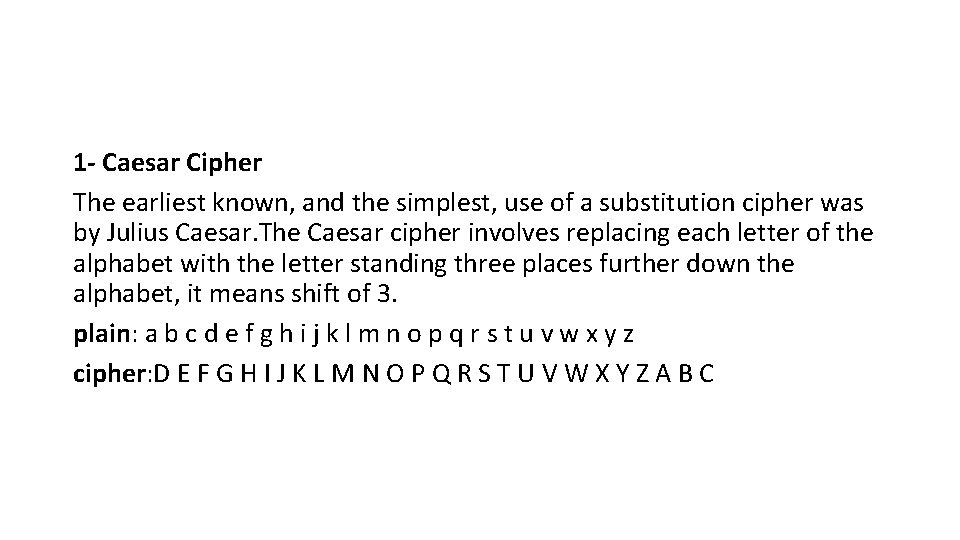
1 - Caesar Cipher The earliest known, and the simplest, use of a substitution cipher was by Julius Caesar. The Caesar cipher involves replacing each letter of the alphabet with the letter standing three places further down the alphabet, it means shift of 3. plain: a b c d e f g h i j k l m n o p q r s t u v w x y z cipher: D E F G H I J K L M N O P Q R S T U V W X Y Z A B C
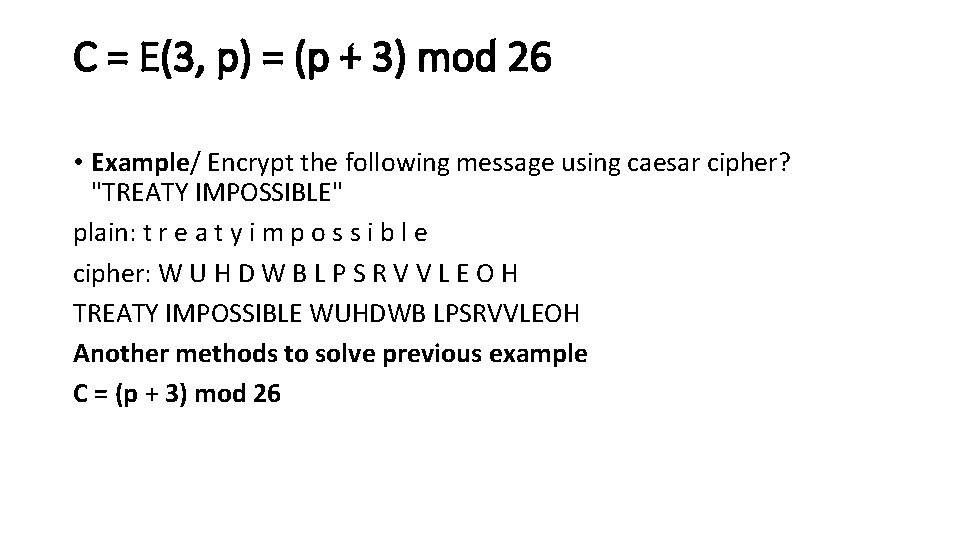
C = E(3, p) = (p + 3) mod 26 • Example/ Encrypt the following message using caesar cipher? "TREATY IMPOSSIBLE" plain: t r e a t y i m p o s s i b l e cipher: W U H D W B L P S R V V L E O H TREATY IMPOSSIBLE WUHDWB LPSRVVLEOH Another methods to solve previous example C = (p + 3) mod 26
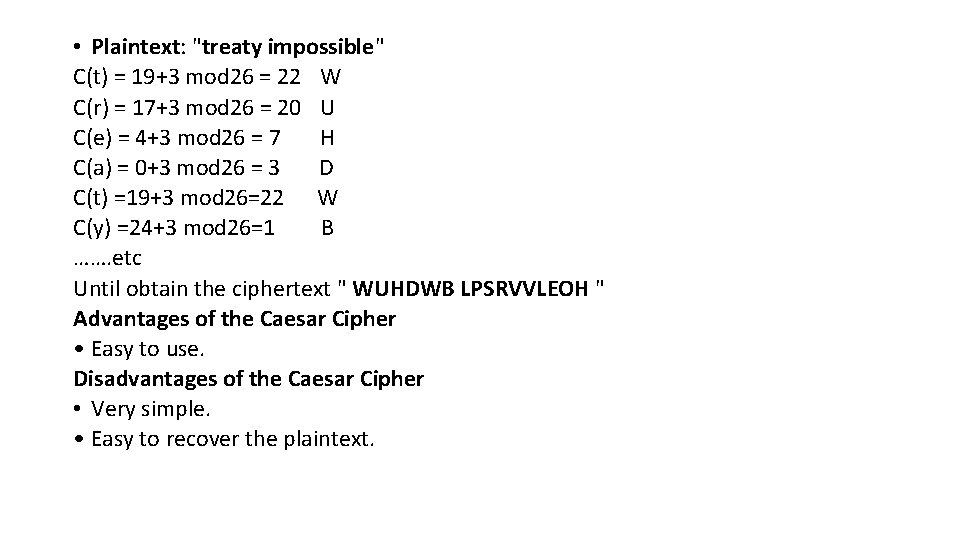
• Plaintext: "treaty impossible" C(t) = 19+3 mod 26 = 22 W C(r) = 17+3 mod 26 = 20 U C(e) = 4+3 mod 26 = 7 H C(a) = 0+3 mod 26 = 3 D C(t) =19+3 mod 26=22 W C(y) =24+3 mod 26=1 B ……. etc Until obtain the ciphertext " WUHDWB LPSRVVLEOH " Advantages of the Caesar Cipher • Easy to use. Disadvantages of the Caesar Cipher • Very simple. • Easy to recover the plaintext.
Any question