PHOTOS MC Event Generator Simulating QED radiative correction

- Slides: 21
PHOTOS MC Event Generator Simulating QED radiative correction in decays 徐庆君 Xu Qingjun 杭州师范大学理学院 Collaboration with Z. Was 中国高能物理学会第十次会议,2010年 4月19日,南昌 MC Event Generator, 徐庆君
Outline Introduction PHOTOS MC Event Generator Recent Development of PHOTOS MC Summary and Outlook MC Event Generator, 徐庆君 2
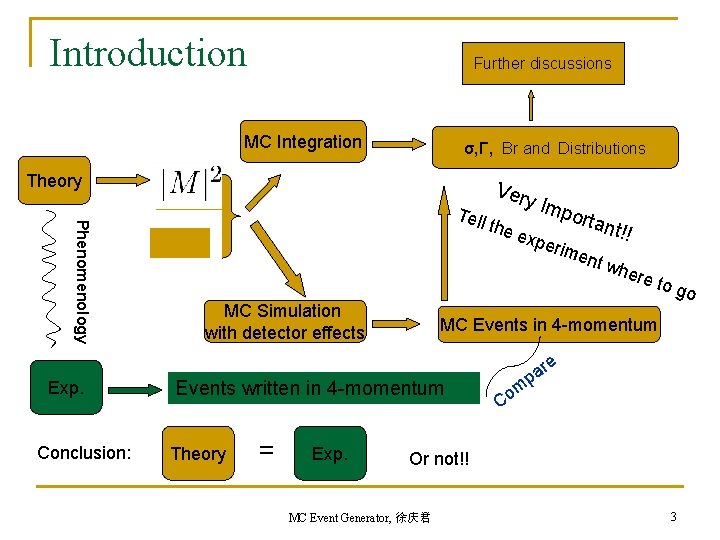
Introduction Further discussions MC Integration σ, Γ, Br and Distributions Theory Phenomenology Tell MC Simulation with detector effects Ver the y Im port exp erim ant! ! ent whe re to go MC Events in 4 -momentum e Exp. Conclusion: Events written in 4 -momentum Theory = Exp. r pa m o C Or not!! MC Event Generator, 徐庆君 3
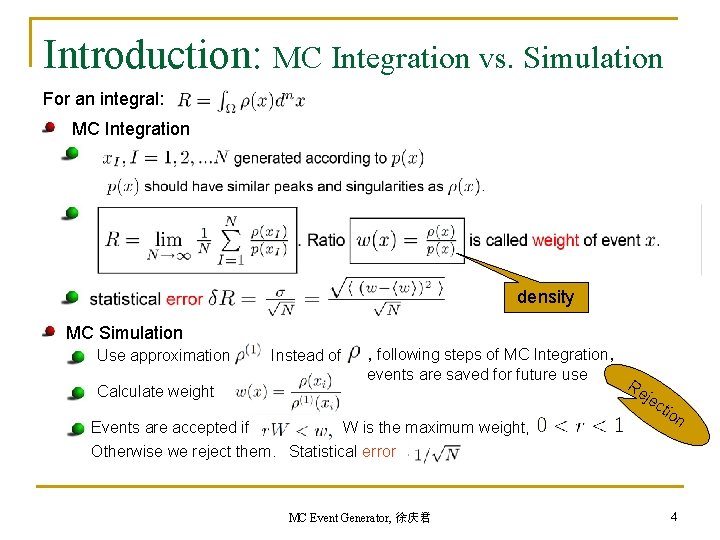
Introduction: MC Integration vs. Simulation For an integral: MC Integration density MC Simulation Use approximation Calculate weight Instead of , following steps of MC Integration, events are saved for future use Re jec Events are accepted if W is the maximum weight, Otherwise we reject them. Statistical error MC Event Generator, 徐庆君 tio n 4
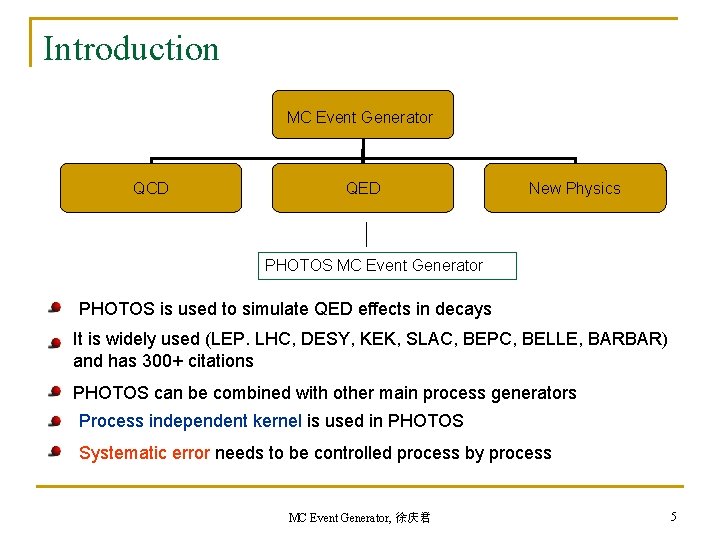
Introduction MC Event Generator QCD QED New Physics PHOTOS MC Event Generator PHOTOS is used to simulate QED effects in decays It is widely used (LEP. LHC, DESY, KEK, SLAC, BEPC, BELLE, BARBAR) and has 300+ citations PHOTOS can be combined with other main process generators Process independent kernel is used in PHOTOS Systematic error needs to be controlled process by process MC Event Generator, 徐庆君 5
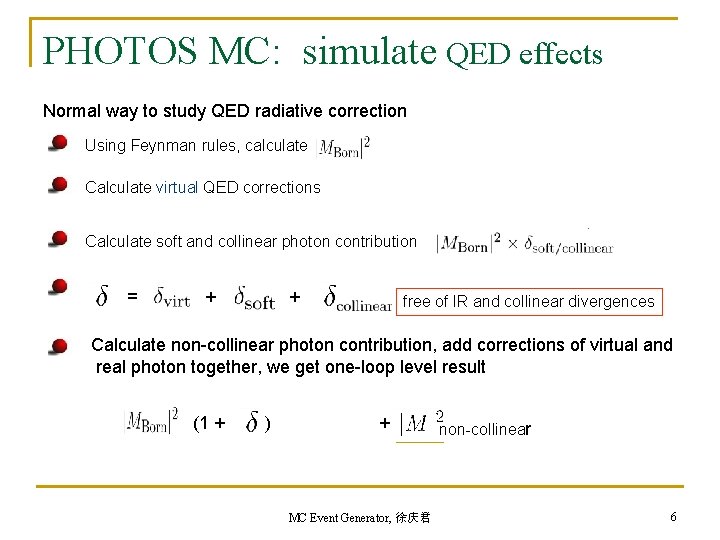
PHOTOS MC: simulate QED effects Normal way to study QED radiative correction Using Feynman rules, calculate Calculate virtual QED corrections Calculate soft and collinear photon contribution = + + free of IR and collinear divergences Calculate non-collinear photon contribution, add corrections of virtual and real photon together, we get one-loop level result (1 + ) + MC Event Generator, 徐庆君 non-collinear 6
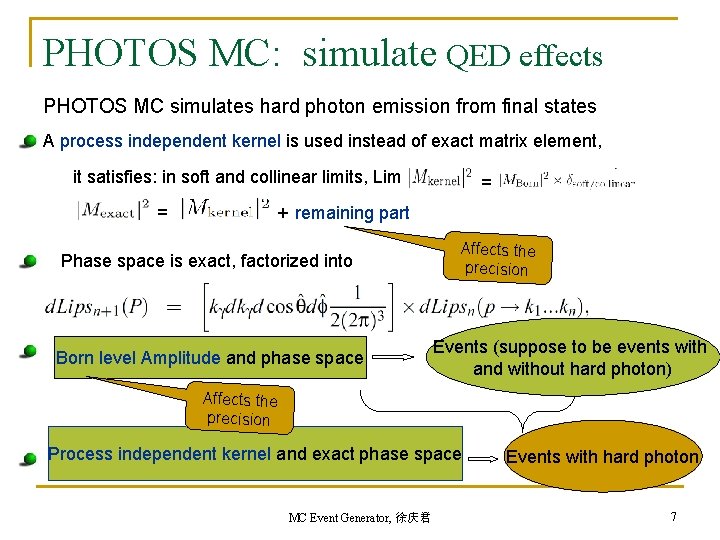
PHOTOS MC: simulate QED effects PHOTOS MC simulates hard photon emission from final states A process independent kernel is used instead of exact matrix element, it satisfies: in soft and collinear limits, Lim = = + remaining part Phase space is exact, factorized into Born level Amplitude and phase space Affects the precision Events (suppose to be events with and without hard photon) Affects the precision Process independent kernel and exact phase space MC Event Generator, 徐庆君 Events with hard photon 7
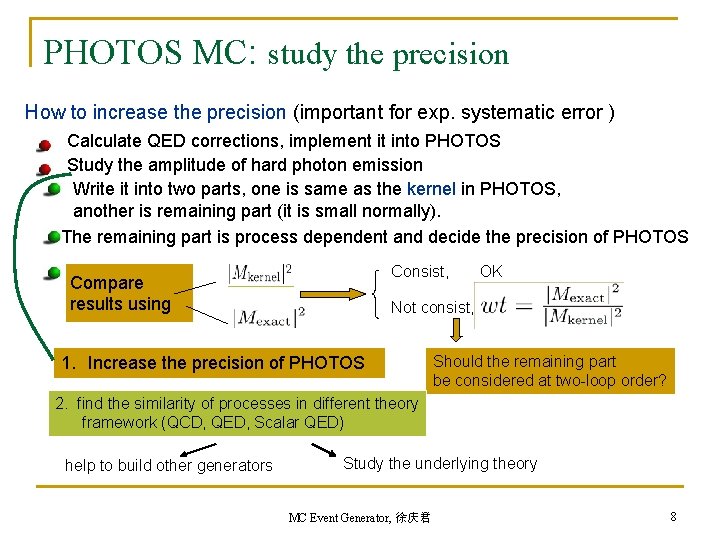
PHOTOS MC: study the precision How to increase the precision (important for exp. systematic error ) Calculate QED corrections, implement it into PHOTOS Study the amplitude of hard photon emission Write it into two parts, one is same as the kernel in PHOTOS, another is remaining part (it is small normally). The remaining part is process dependent and decide the precision of PHOTOS Consist, Compare results using OK Not consist, 1. Increase the precision of PHOTOS Should the remaining part be considered at two-loop order? 2. find the similarity of processes in different theory framework (QCD, QED, Scalar QED) help to build other generators Study the underlying theory MC Event Generator, 徐庆君 8
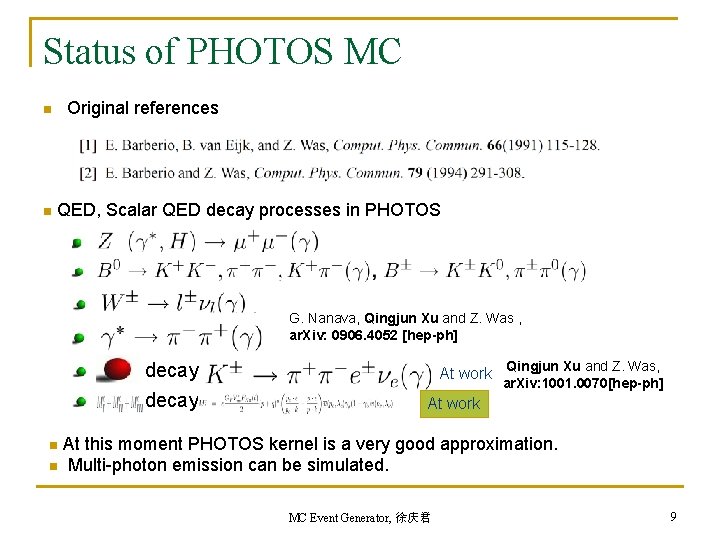
Status of PHOTOS MC Original references n n QED, Scalar QED decay processes in PHOTOS G. Nanava, Qingjun Xu and Z. Was , ar. Xiv: 0906. 4052 [hep-ph] decay At work Qingjun Xu and Z. Was, ar. Xiv: 1001. 0070[hep-ph] At work At this moment PHOTOS kernel is a very good approximation. n Multi-photon emission can be simulated. n MC Event Generator, 徐庆君 9
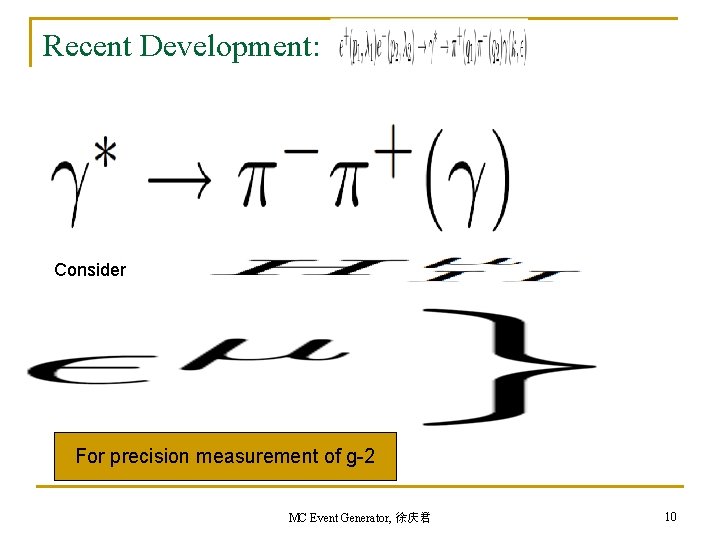
Recent Development: Consider For precision measurement of g-2 MC Event Generator, 徐庆君 10
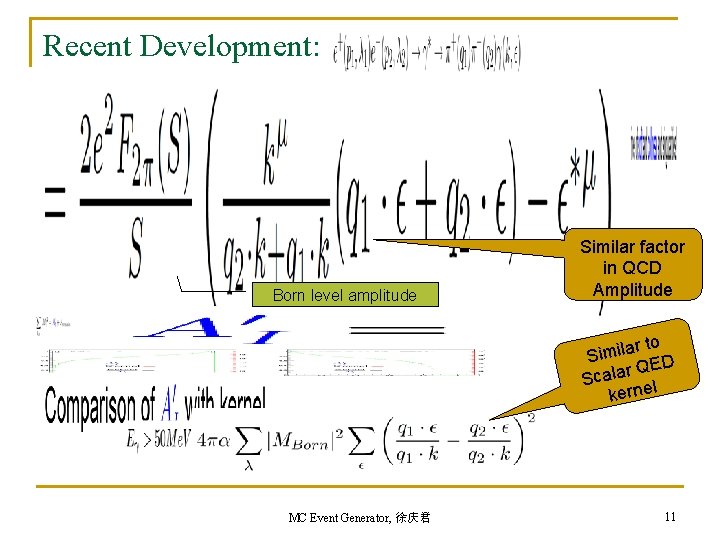
Recent Development: Born level amplitude Similar factor in QCD Amplitude r to Simila ED r. Q Scala l kerne MC Event Generator, 徐庆君 11
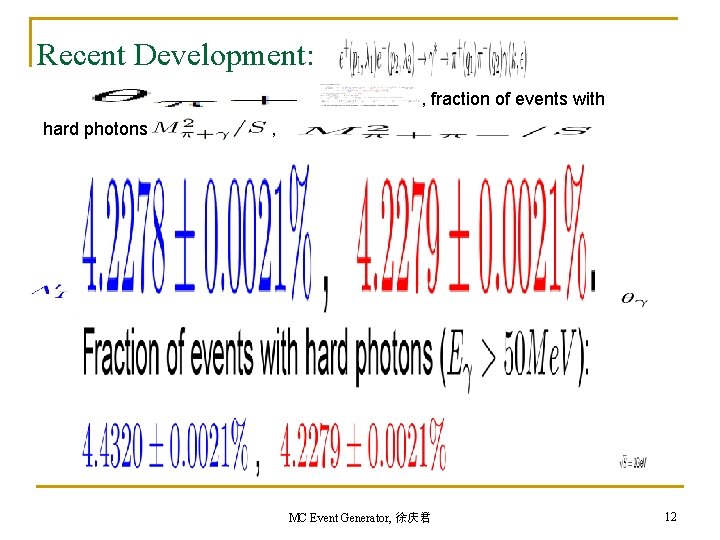
Recent Development: , fraction of events with hard photons , MC Event Generator, 徐庆君 12
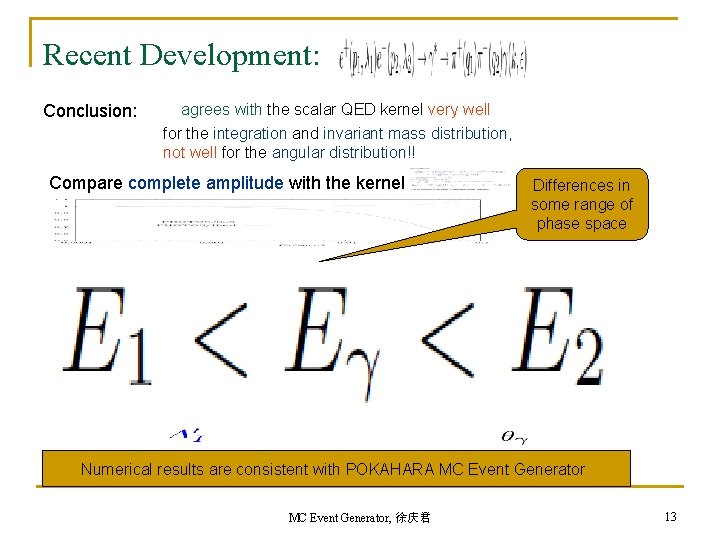
Recent Development: Conclusion: agrees with the scalar QED kernel very well for the integration and invariant mass distribution, not well for the angular distribution!! Compare complete amplitude with the kernel Differences in some range of phase space Numerical results are consistent with POKAHARA MC Event Generator, 徐庆君 13
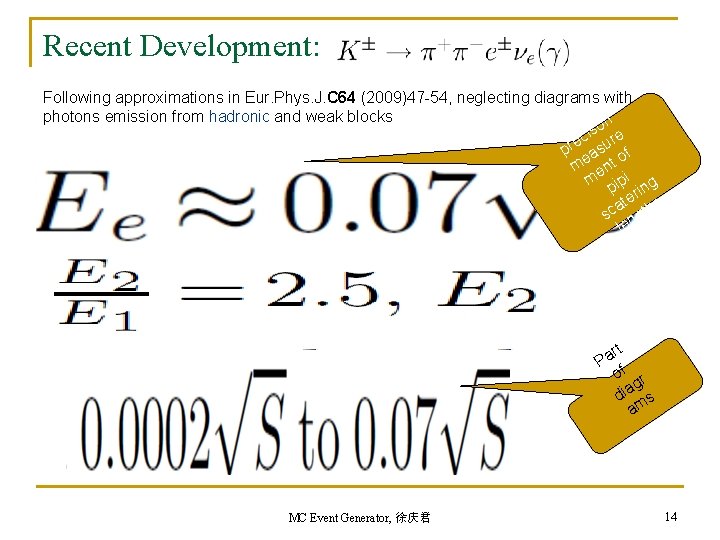
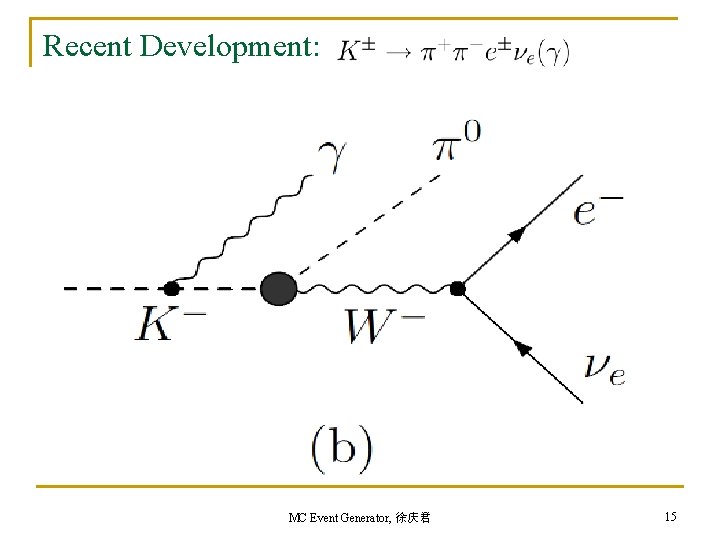
Recent Development: Following approximations in Eur. Phys. J. C 64 (2009)47 -54, neglecting diagrams with r photons emission from hadronic and weak blocks Fo son ci ure e r p as of me ent m pipi g rin e t s a sc ngth le rt a P f o r g dia s am MC Event Generator, 徐庆君 14
Recent Development: MC Event Generator, 徐庆君 15
Recent Development: MC Event Generator, 徐庆君 16
Recent Development: Implement QED correction to PHOTOS MC, compare it with Coulomb correction used by CERN NA 48 (K meson experiment) Solid line: Coulomb correction Dashed line: QED correction Difference of Coulomb correction and QED correction MC Event Generator, 徐庆君 17
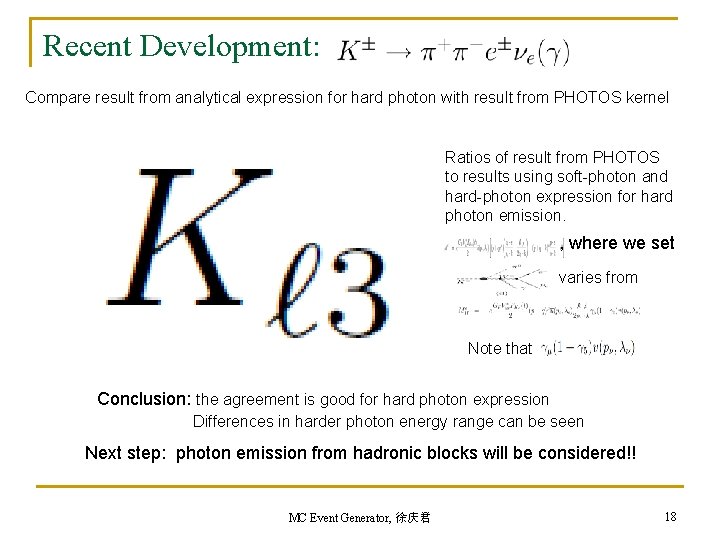
Recent Development: Compare result from analytical expression for hard photon with result from PHOTOS kernel Ratios of result from PHOTOS to results using soft-photon and hard-photon expression for hard photon emission. , where we set varies from Note that Conclusion: the agreement is good for hard photon expression Differences in harder photon energy range can be seen Next step: photon emission from hadronic blocks will be considered!! MC Event Generator, 徐庆君 18
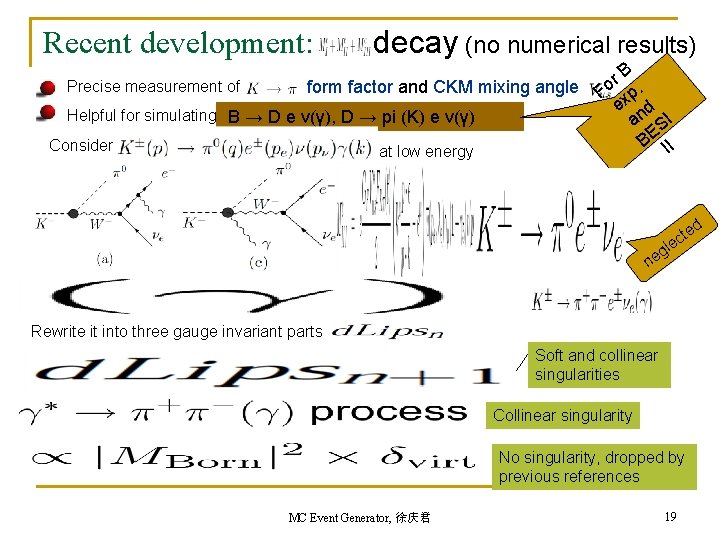
Recent development: Precise measurement of decay (no numerical results) form factor and CKM mixing angle Helpful for simulating B → D e ν(γ), D → pi (K) e ν(γ) Consider at low energy r. B. o F xp e nd a SI BE II d cte le g ne Rewrite it into three gauge invariant parts Soft and collinear singularities Collinear singularity No singularity, dropped by previous references MC Event Generator, 徐庆君 19
Summary and Outlook PHOTOS is a widely used MC event generator which simulates QED radiative correction in decays Controlling the precision is necessary and important process at work, simulating B and D meson semileptonic decays Future work: D, J/Ψ , Ψ(2 s) semileptonic decays Exchange Idea and Code If you have a new idea and/or find something very interesting, it is better to simulate your process and send the code to the experimentalist directly. MC Event Generator, 徐庆君 20
MC Event Generator, 徐庆君 21