Phonetics and Phonology fontiks and fonlogi Weeks 2

- Slides: 28
Phonetics and Phonology [fonЄtiks and fonƆlogi] Weeks 2 -4 [wiks tu to for]
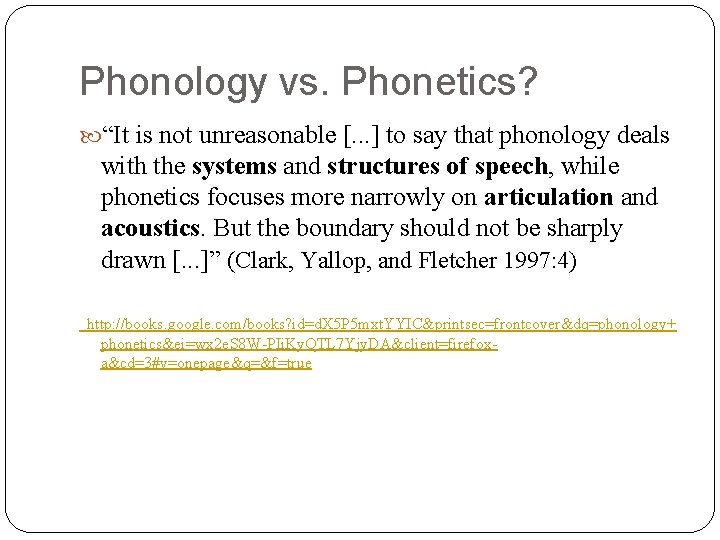
Phonology vs. Phonetics? “It is not unreasonable [. . . ] to say that phonology deals with the systems and structures of speech, while phonetics focuses more narrowly on articulation and acoustics. But the boundary should not be sharply drawn [. . . ]” (Clark, Yallop, and Fletcher 1997: 4) http: //books. google. com/books? id=d. X 5 P 5 mxt. YYIC&printsec=frontcover&dq=phonology+ phonetics&ei=wx 2 e. S 8 W-PIi. Ky. QTL 7 Yjy. DA&client=firefoxa&cd=3#v=onepage&q=&f=true
A Descriptive (not prescriptive) science Speakers are concerned with speaking/(and meaning), the linguist is concerned with how it is said. Concerned with the details, the structure, the rules.
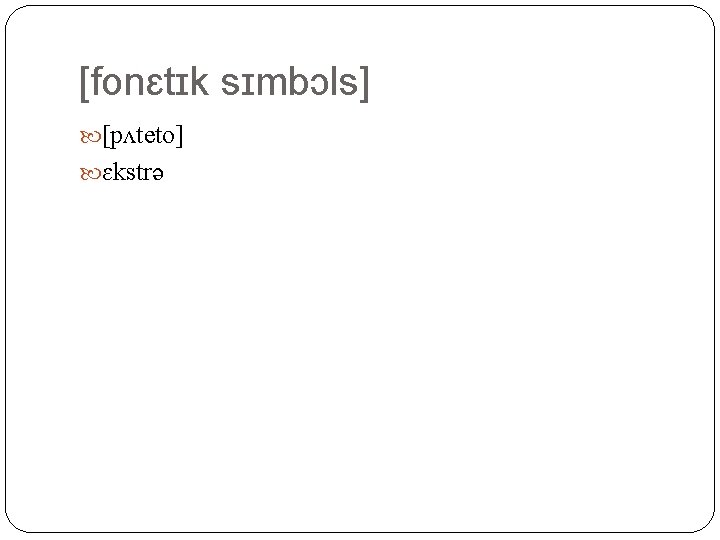
[fonɛtɪk sɪmbɔls] [pʌteto] ɛkstrə
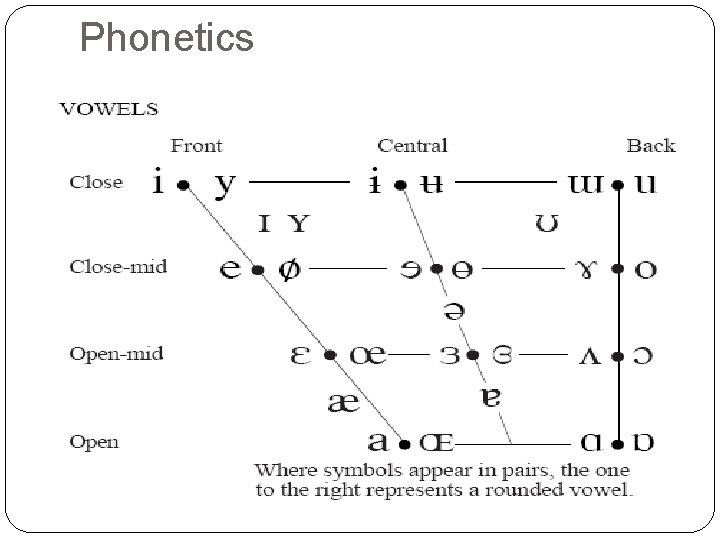
Phonetics
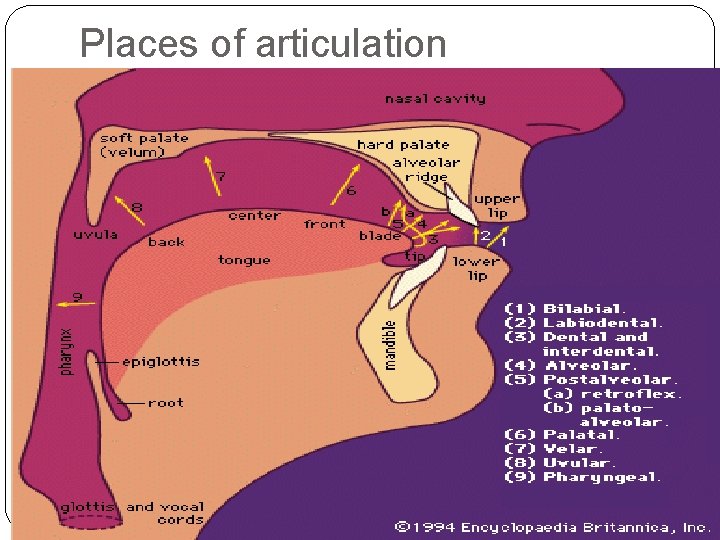
Places of articulation
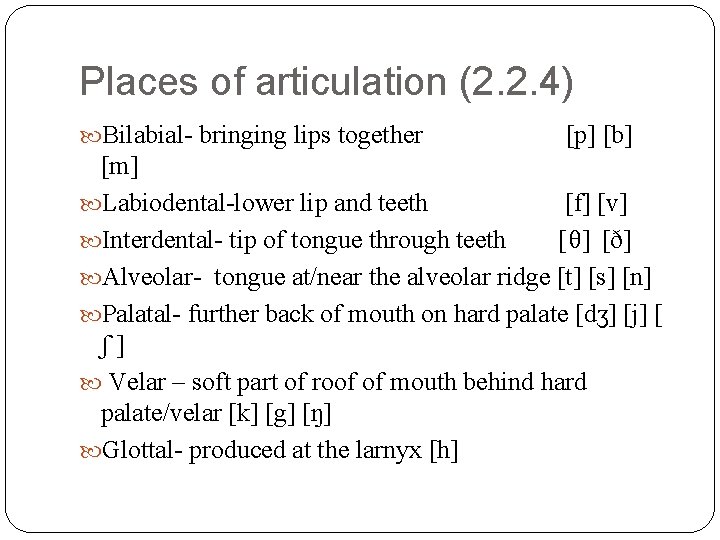
Places of articulation (2. 2. 4) Bilabial- bringing lips together [p] [b] [m] Labiodental-lower lip and teeth [f] [v] Interdental- tip of tongue through teeth [θ] [ð] Alveolar- tongue at/near the alveolar ridge [t] [s] [n] Palatal- further back of mouth on hard palate [dʒ] [j] [ ʃ ] Velar – soft part of roof of mouth behind hard palate/velar [k] [g] [ŋ] Glottal- produced at the larnyx [h]
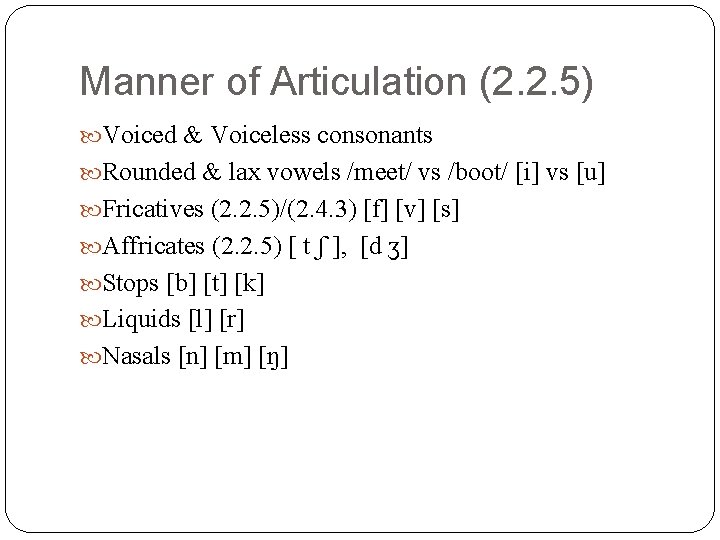
Manner of Articulation (2. 2. 5) Voiced & Voiceless consonants Rounded & lax vowels /meet/ vs /boot/ [i] vs [u] Fricatives (2. 2. 5)/(2. 4. 3) [f] [v] [s] Affricates (2. 2. 5) [ t ʃ ], [d ʒ] Stops [b] [t] [k] Liquids [l] [r] Nasals [n] [m] [ŋ]
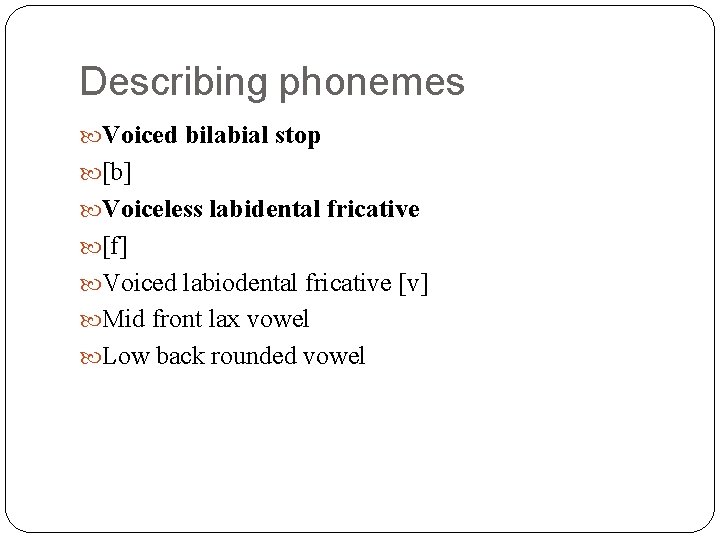
Describing phonemes Voiced bilabial stop [b] Voiceless labidental fricative [f] Voiced labiodental fricative [v] Mid front lax vowel Low back rounded vowel
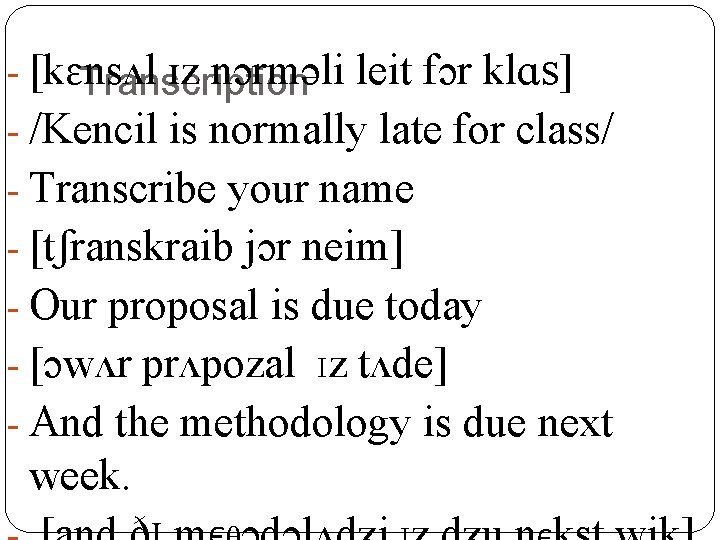
- [kɛnsʌl ɪz nɔrməli leit fɔr klɑ s] Transcription - /Kencil is normally late for class/ - Transcribe your name - [tʃranskraib jɔr neim] - Our proposal is due today - [ɔwʌr prʌpozal Iz tʌde] - And the methodology is due next week.
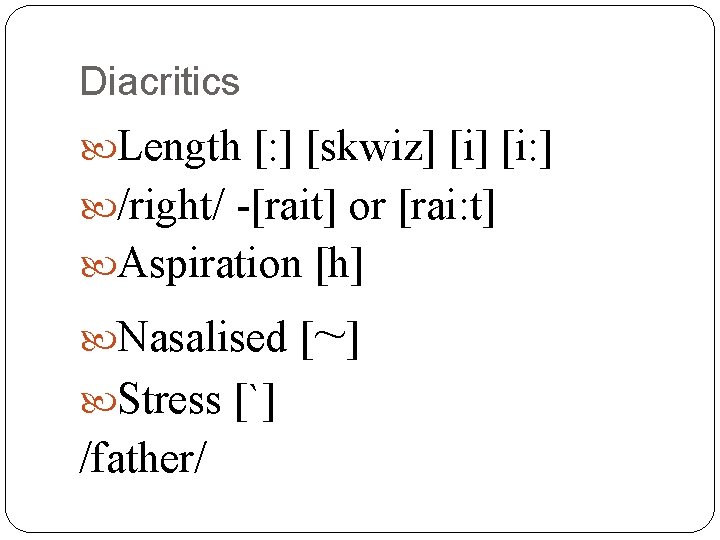
Diacritics Length [: ] [skwiz] [i: ] /right/ -[rait] or [rai: t] Aspiration [h] Nasalised [~] Stress [`] /father/
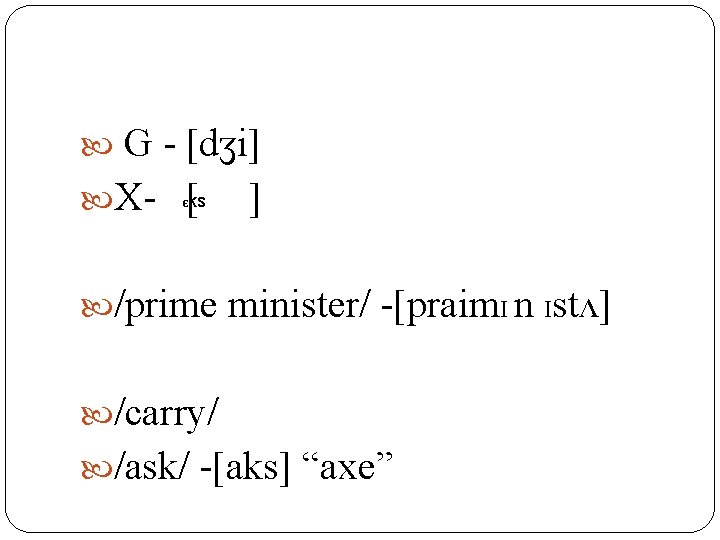
G - [dʒi] ks X- [ ] Є /prime minister/ -[praim. I n Istʌ] /carry/ /ask/ -[aks] “axe”
Phonology [fonƆləgi]
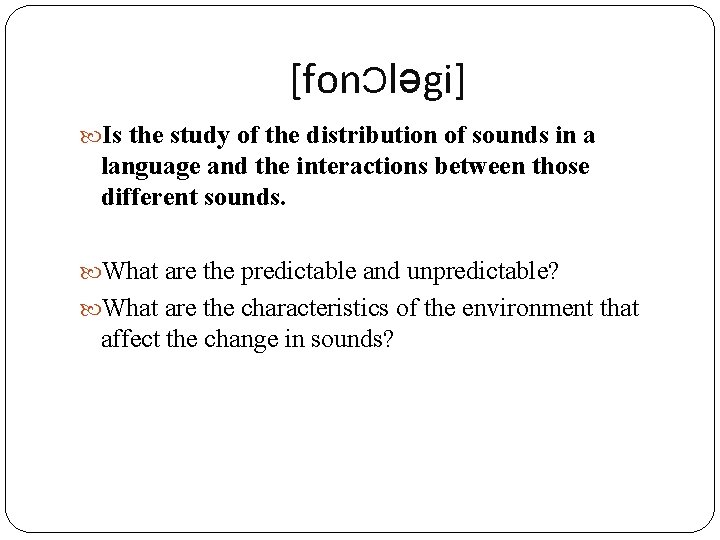
[fonƆləgi] Is the study of the distribution of sounds in a language and the interactions between those different sounds. What are the predictable and unpredictable? What are the characteristics of the environment that affect the change in sounds?
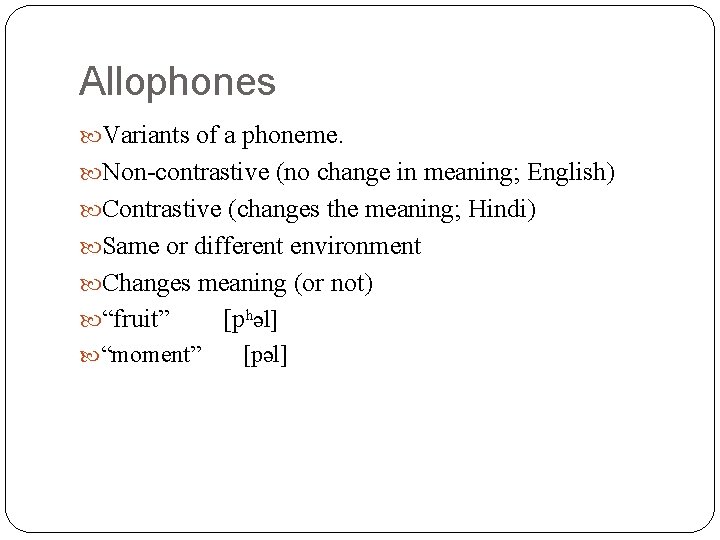
Allophones Variants of a phoneme. Non-contrastive (no change in meaning; English) Contrastive (changes the meaning; Hindi) Same or different environment Changes meaning (or not) “fruit” [pʰəl] “moment” [pəl]
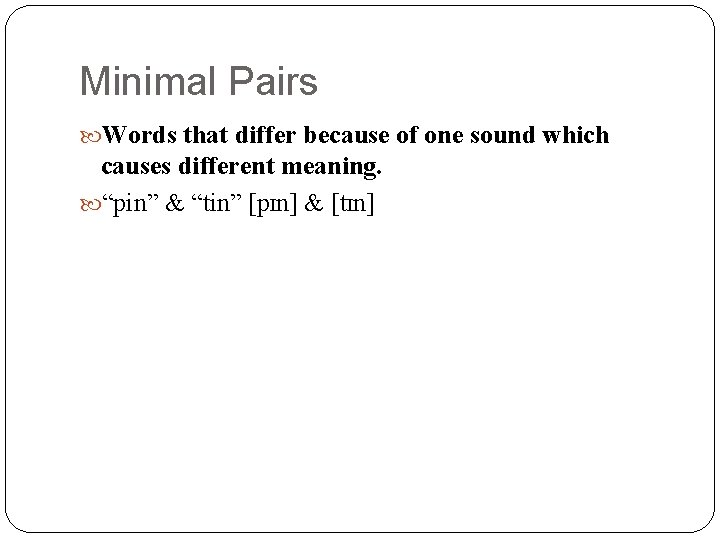
Minimal Pairs Words that differ because of one sound which causes different meaning. “pin” & “tin” [p. In] & [t. In]
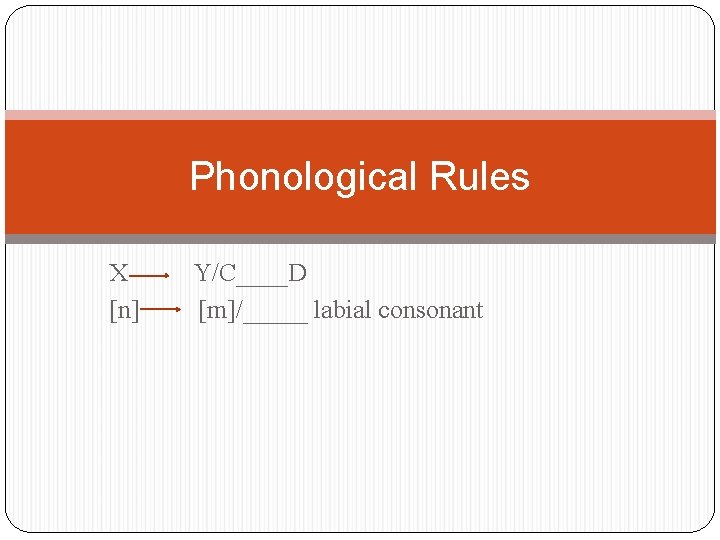
Phonological Rules X Y/C____D [n] [m]/_____ labial consonant
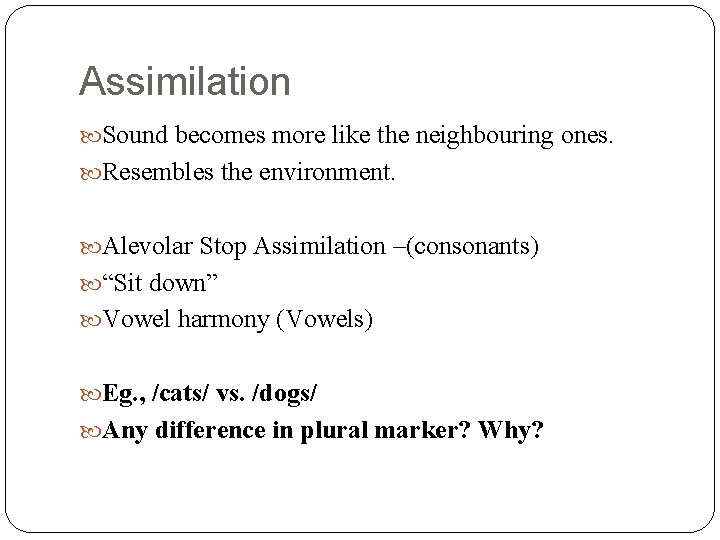
Assimilation Sound becomes more like the neighbouring ones. Resembles the environment. Alevolar Stop Assimilation –(consonants) “Sit down” Vowel harmony (Vowels) Eg. , /cats/ vs. /dogs/ Any difference in plural marker? Why?
Dissimilation
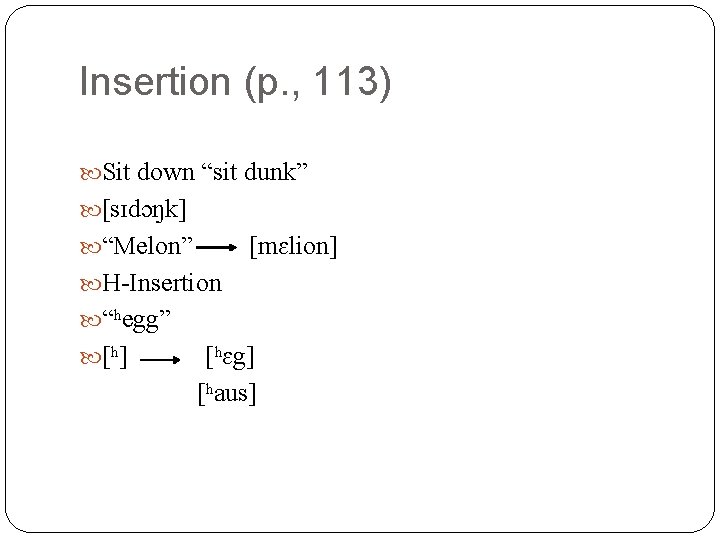
Insertion (p. , 113) Sit down “sit dunk” [sɪdɔŋk] “Melon” [mɛlion] H-Insertion “ʰegg” [ʰ] [ʰɛg] [ʰaus]
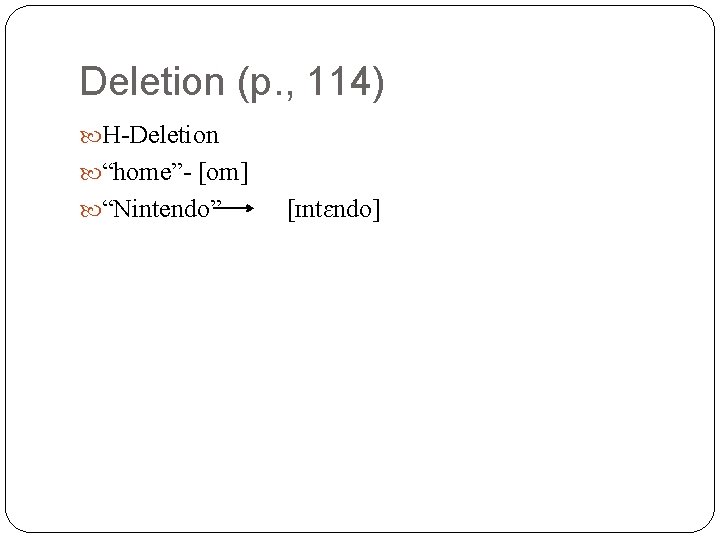
Deletion (p. , 114) H-Deletion “home”- [om] “Nintendo” [ɪntɛndo]
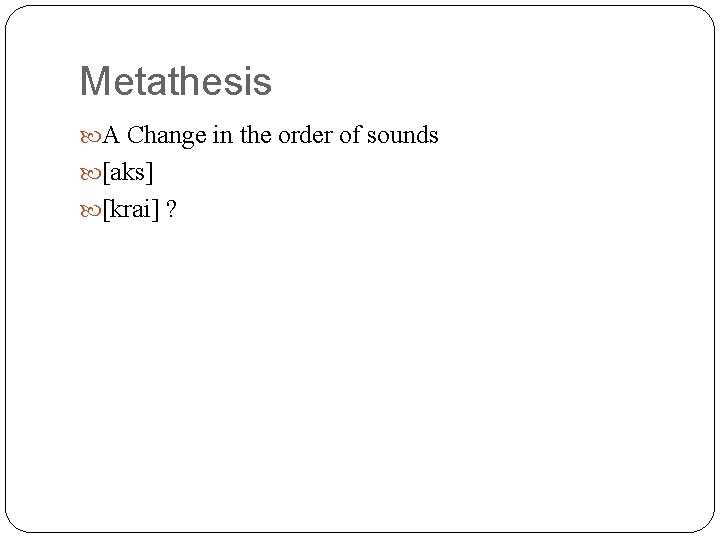
Metathesis A Change in the order of sounds [aks] [krai] ?
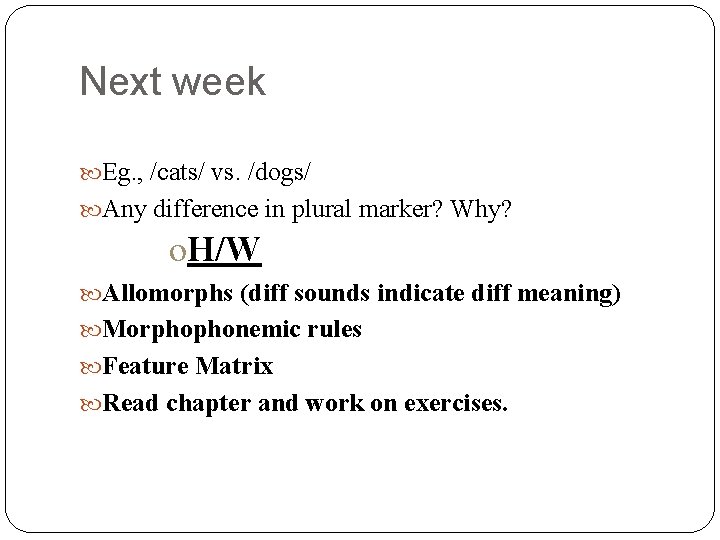
Next week Eg. , /cats/ vs. /dogs/ Any difference in plural marker? Why? o. H/W Allomorphs (diff sounds indicate diff meaning) Morphophonemic rules Feature Matrix Read chapter and work on exercises.
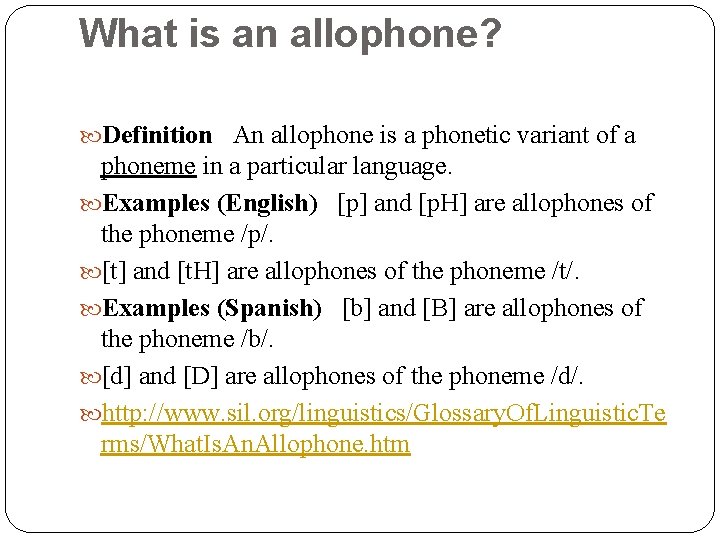
What is an allophone? Definition An allophone is a phonetic variant of a phoneme in a particular language. Examples (English) [p] and [p. H] are allophones of the phoneme /p/. [t] and [t. H] are allophones of the phoneme /t/. Examples (Spanish) [b] and [B] are allophones of the phoneme /b/. [d] and [D] are allophones of the phoneme /d/. http: //www. sil. org/linguistics/Glossary. Of. Linguistic. Te rms/What. Is. An. Allophone. htm
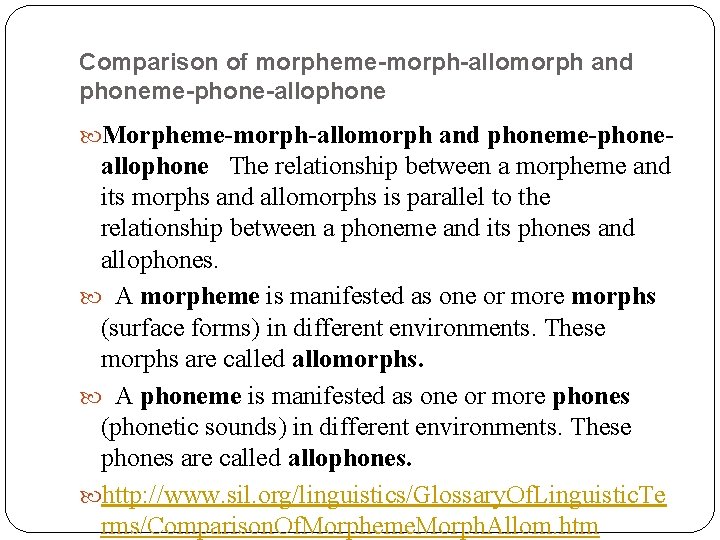
Comparison of morpheme-morph-allomorph and phoneme-phone-allophone Morpheme-morph-allomorph and phoneme-phone- allophone The relationship between a morpheme and its morphs and allomorphs is parallel to the relationship between a phoneme and its phones and allophones. A morpheme is manifested as one or more morphs (surface forms) in different environments. These morphs are called allomorphs. A phoneme is manifested as one or more phones (phonetic sounds) in different environments. These phones are called allophones. http: //www. sil. org/linguistics/Glossary. Of. Linguistic. Te rms/Comparison. Of. Morpheme. Morph. Allom. htm
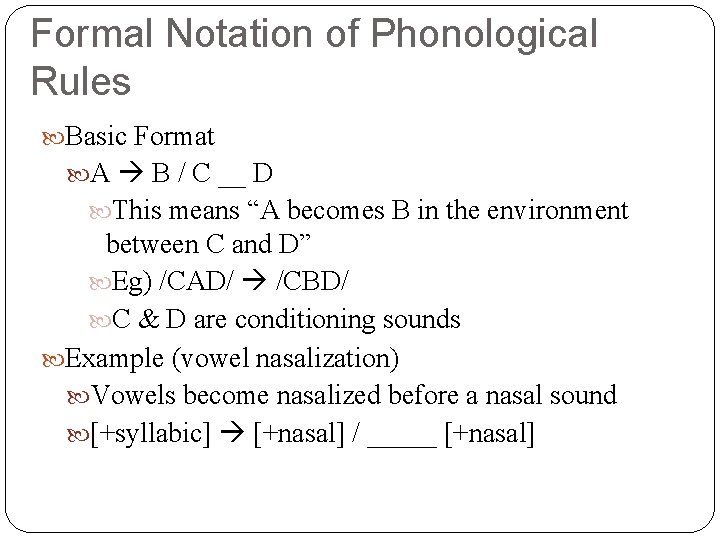
Formal Notation of Phonological Rules Basic Format A B / C __ D This means “A becomes B in the environment between C and D” Eg) /CAD/ /CBD/ C & D are conditioning sounds Example (vowel nasalization) Vowels become nasalized before a nasal sound [+syllabic] [+nasal] / _____ [+nasal]
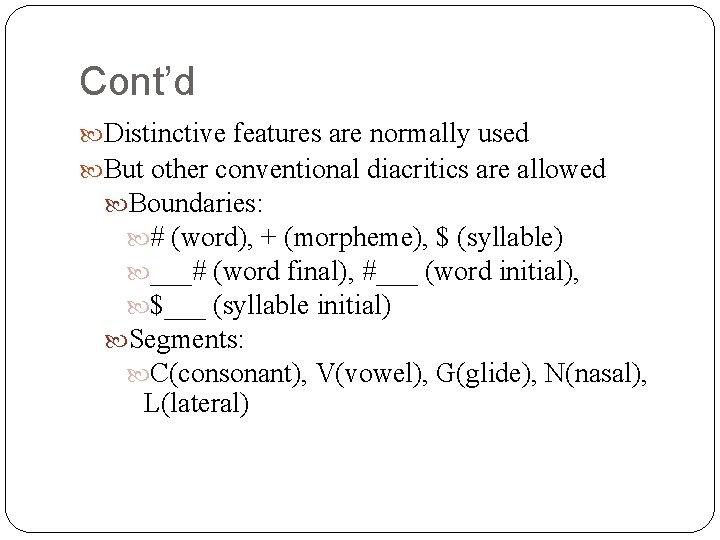
Cont’d Distinctive features are normally used But other conventional diacritics are allowed Boundaries: # (word), + (morpheme), $ (syllable) ___# (word final), #___ (word initial), $___ (syllable initial) Segments: C(consonant), V(vowel), G(glide), N(nasal), L(lateral)