Pharmacy Level 2 Animal Nursing Assistant Recap quiz



- Slides: 37
Pharmacy Level 2 Animal Nursing Assistant
Recap quiz Anatomy and Physiology
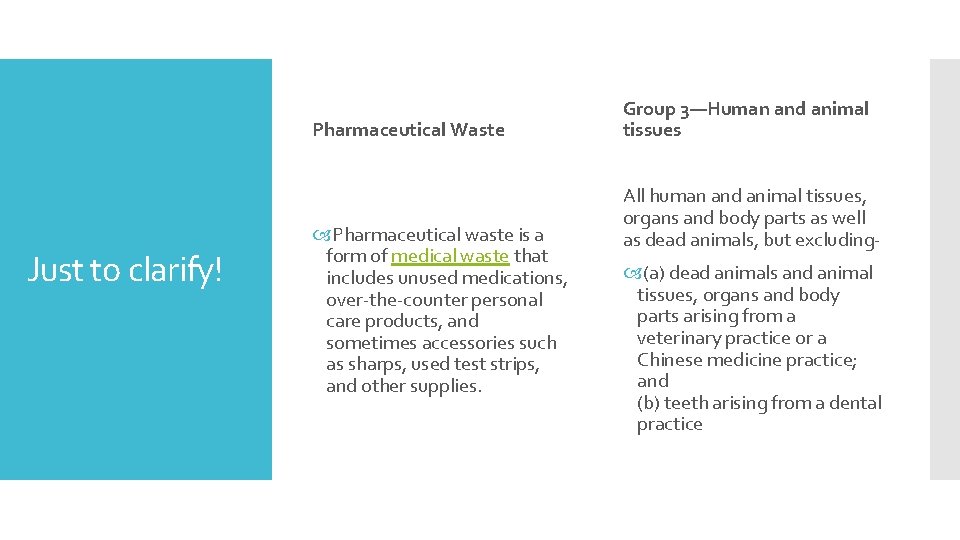
Pharmaceutical Waste Just to clarify! Pharmaceutical waste is a form of medical waste that includes unused medications, over-the-counter personal care products, and sometimes accessories such as sharps, used test strips, and other supplies. Group 3—Human and animal tissues All human and animal tissues, organs and body parts as well as dead animals, but excluding- (a) dead animals and animal tissues, organs and body parts arising from a veterinary practice or a Chinese medicine practice; and (b) teeth arising from a dental practice
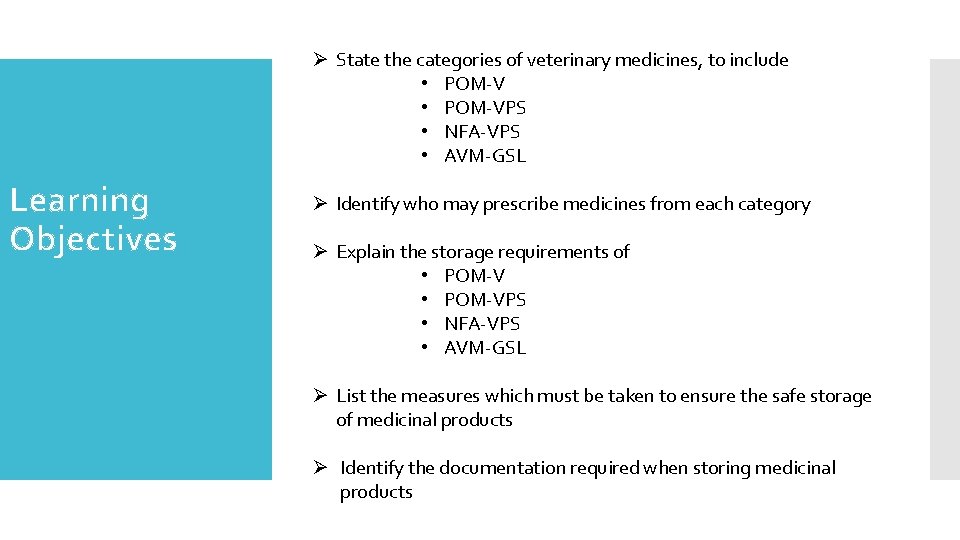
Ø State the categories of veterinary medicines, to include • POM-VPS • NFA-VPS • AVM-GSL Learning Objectives Ø Identify who may prescribe medicines from each category Ø Explain the storage requirements of • POM-VPS • NFA-VPS • AVM-GSL Ø List the measures which must be taken to ensure the safe storage of medicinal products Ø Identify the documentation required when storing medicinal products
Licensing, prescribing and dispensing There are two main pieces of legislation governing the use of drugs in veterinary practice: - The Veterinary Medicines Regulations 2005 - The Misuse of Drugs Act 1971
Who can prescribe medicinal products in a veterinary practice?
Medicines
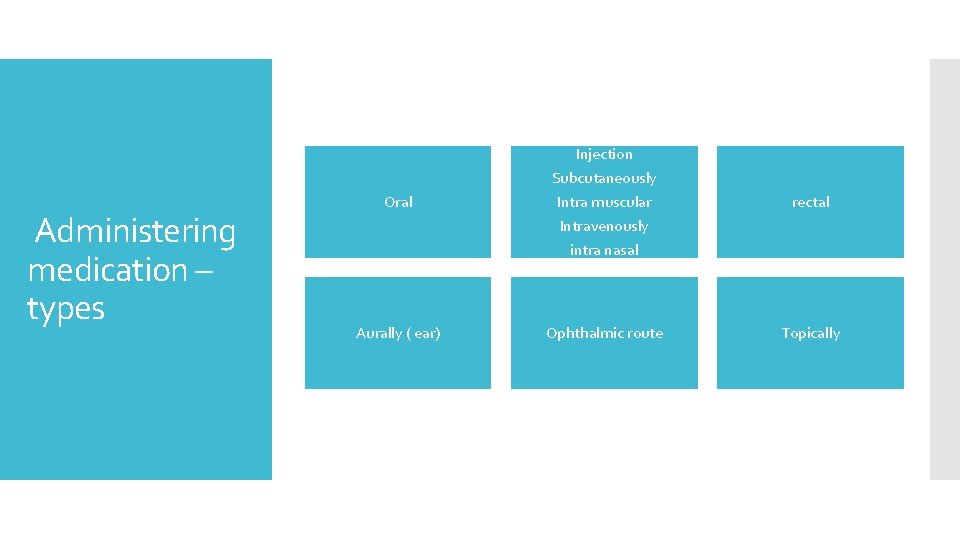
Injection Administering medication – types Oral Subcutaneously Intra muscular Intravenously rectal intra nasal Aurally ( ear) Ophthalmic route Topically
Who can prescribe? MRCVS (Member of the Royal College of Veterinary Surgeons) SQP (Suitably Qualified Person) Pharmacist
The Veterinary Medicines Regulations 2005 The Misuse of Drugs Act 1971
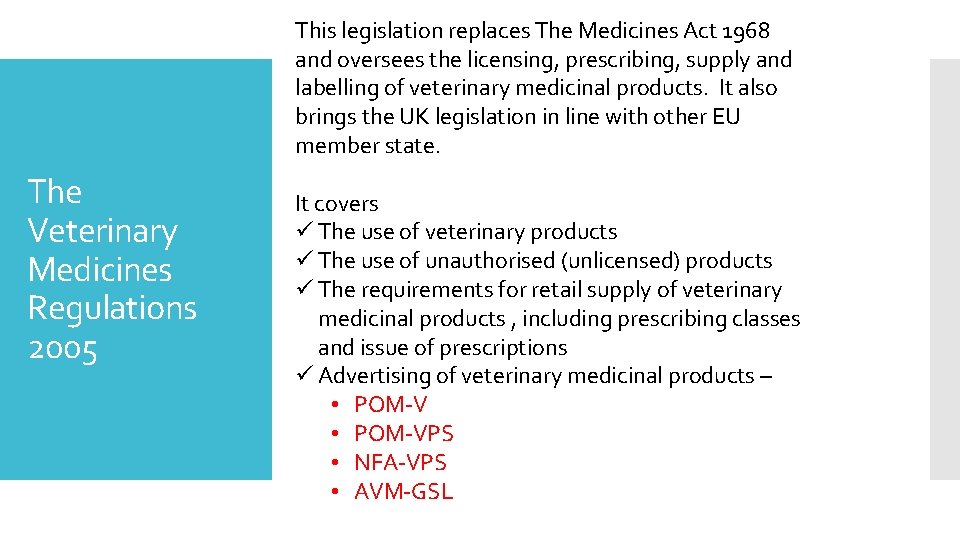
This legislation replaces The Medicines Act 1968 and oversees the licensing, prescribing, supply and labelling of veterinary medicinal products. It also brings the UK legislation in line with other EU member state. The Veterinary Medicines Regulations 2005 It covers ü The use of veterinary products ü The use of unauthorised (unlicensed) products ü The requirements for retail supply of veterinary medicinal products , including prescribing classes and issue of prescriptions ü Advertising of veterinary medicinal products – • POM-VPS • NFA-VPS • AVM-GSL
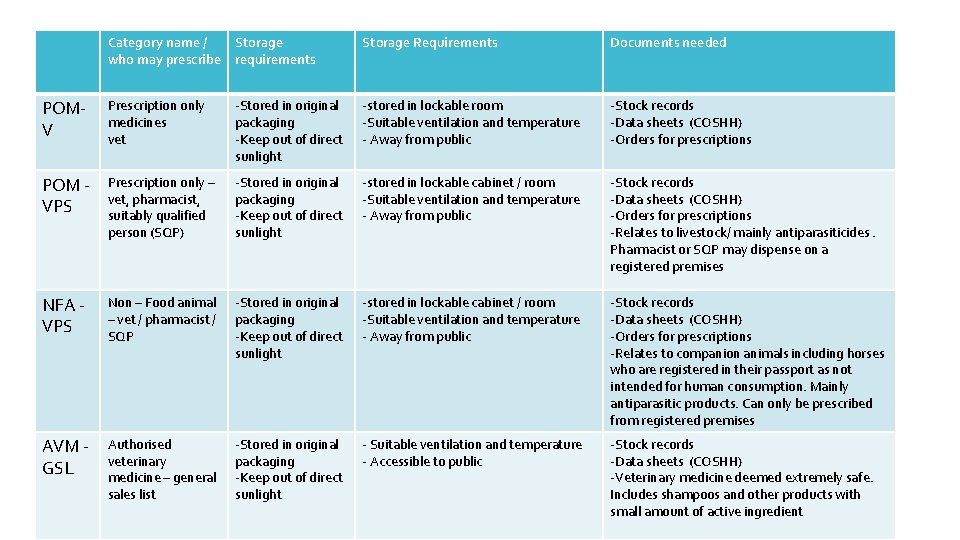
Category name / who may prescribe Storage requirements Storage Requirements Documents needed POMV Prescription only medicines vet -Stored in original packaging -Keep out of direct sunlight -stored in lockable room -Suitable ventilation and temperature - Away from public -Stock records -Data sheets (COSHH) -Orders for prescriptions POM - VPS Prescription only – vet, pharmacist, suitably qualified person (SQP) -Stored in original packaging -Keep out of direct sunlight -stored in lockable cabinet / room -Suitable ventilation and temperature - Away from public -Stock records -Data sheets (COSHH) -Orders for prescriptions -Relates to livestock/ mainly antiparasiticides. Pharmacist or SQP may dispense on a registered premises NFA - VPS Non – Food animal – vet / pharmacist / SQP -Stored in original packaging -Keep out of direct sunlight -stored in lockable cabinet / room -Suitable ventilation and temperature - Away from public -Stock records -Data sheets (COSHH) -Orders for prescriptions -Relates to companion animals including horses who are registered in their passport as not intended for human consumption. Mainly antiparasitic products. Can only be prescribed from registered premises AVM - GSL Authorised veterinary medicine – general sales list -Stored in original packaging -Keep out of direct sunlight - Suitable ventilation and temperature - Accessible to public -Stock records -Data sheets (COSHH) -Veterinary medicine deemed extremely safe. Includes shampoos and other products with small amount of active ingredient
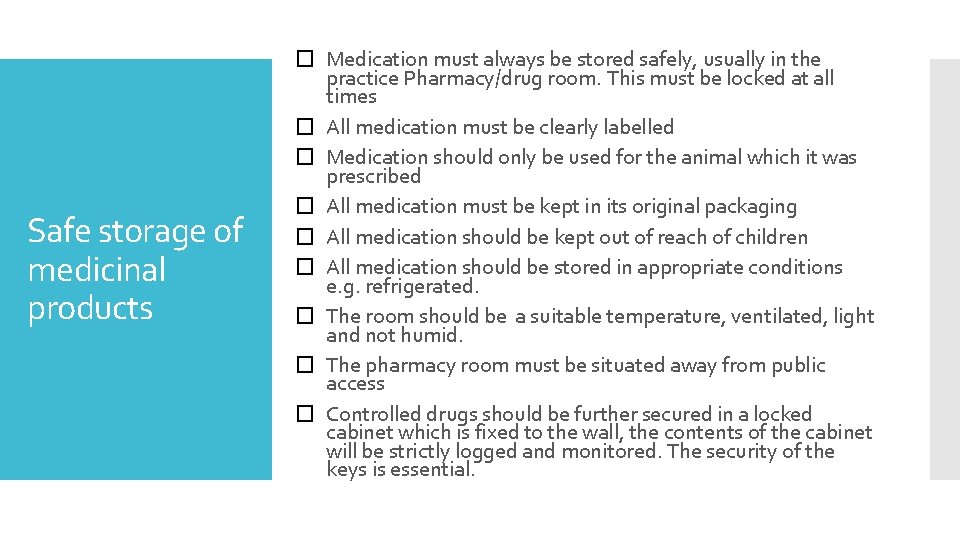
Storage of Medication Safe storage of medicinal products � Medication must always be stored safely, usually in the practice Pharmacy/drug room. This must be locked at all times � All medication must be clearly labelled � Medication should only be used for the animal which it was prescribed � All medication must be kept in its original packaging � All medication should be kept out of reach of children � All medication should be stored in appropriate conditions e. g. refrigerated. � The room should be a suitable temperature, ventilated, light and not humid. � The pharmacy room must be situated away from public access � Controlled drugs should be further secured in a locked cabinet which is fixed to the wall, the contents of the cabinet will be strictly logged and monitored. The security of the keys is essential.
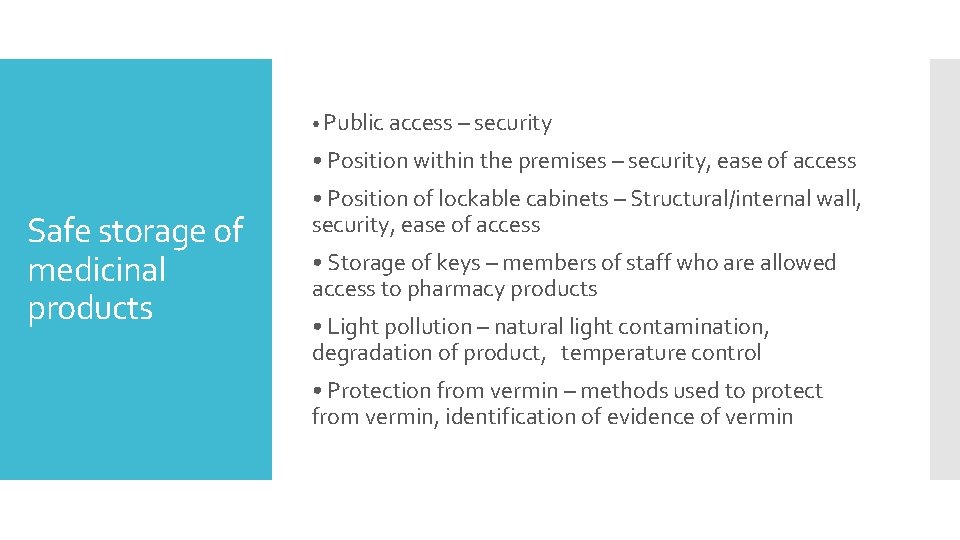
• Public access – security • Position within the premises – security, ease of access Safe storage of medicinal products • Position of lockable cabinets – Structural/internal wall, security, ease of access • Storage of keys – members of staff who are allowed access to pharmacy products • Light pollution – natural light contamination, degradation of product, temperature control • Protection from vermin – methods used to protect from vermin, identification of evidence of vermin
Identify the documentation required when storing medicinal products Stock control data Controlled drug usage chart/log (Prescriber, drug, patient, amount, date) Controlled drug orders and prescriptions COSHH data sheets/ Medicinal information
Correctly identify pharmacy medication Task
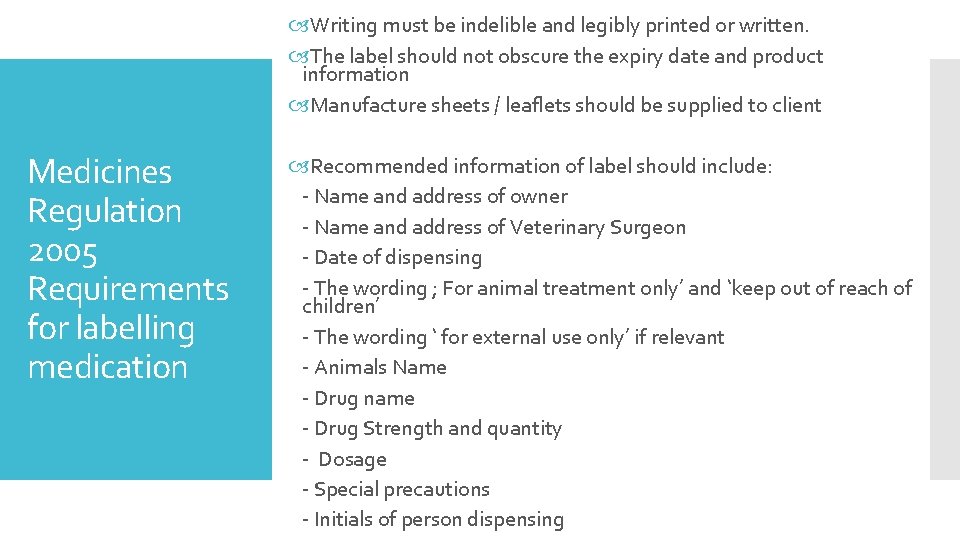
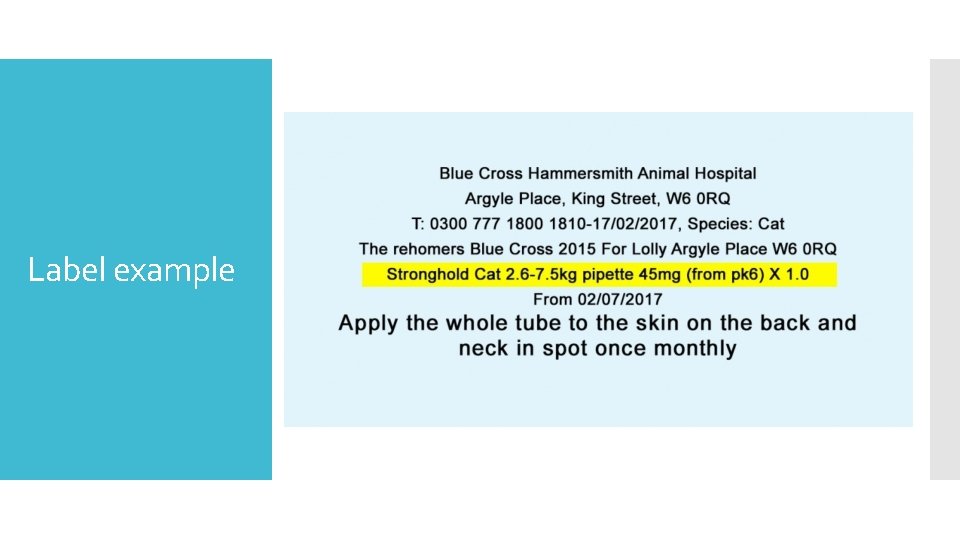
Writing must be indelible and legibly printed or written. The label should not obscure the expiry date and product information Manufacture sheets / leaflets should be supplied to client Medicines Regulation 2005 Requirements for labelling medication Recommended information of label should include: - Name and address of owner - Name and address of Veterinary Surgeon - Date of dispensing - The wording ; For animal treatment only’ and ‘keep out of reach of children’ - The wording ‘ for external use only’ if relevant - Animals Name - Drug name - Drug Strength and quantity - Dosage - Special precautions - Initials of person dispensing
Label example
Create a label for Otodex Ear Drops
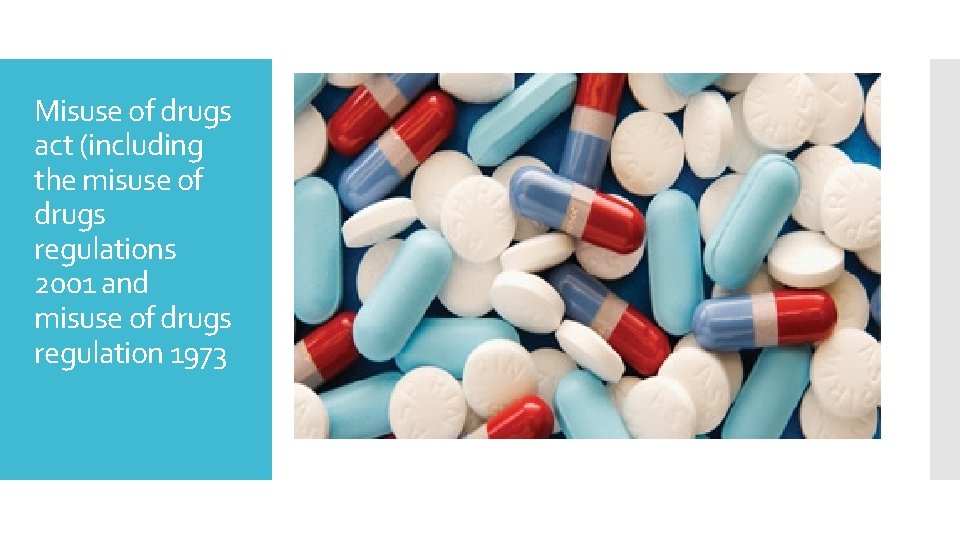
Misuse of drugs act (including the misuse of drugs regulations 2001 and misuse of drugs regulation 1973
Misuse of drugs act (including the misuse of drugs regulations 2001 and misuse of drugs regulation 1973 Controls the production, supply, possession and storage of dangerous drugs Deals with controlled drugs (CD’s) ; a special category of POM-V medicines – which are locked and recorded in a drugs cabinet. Refers to ‘classes’ of drug, ie Class A, Class B, Class C – these classes are not referred to in veterinary medicine. Also promotes education and research into drug dependency and addiction.
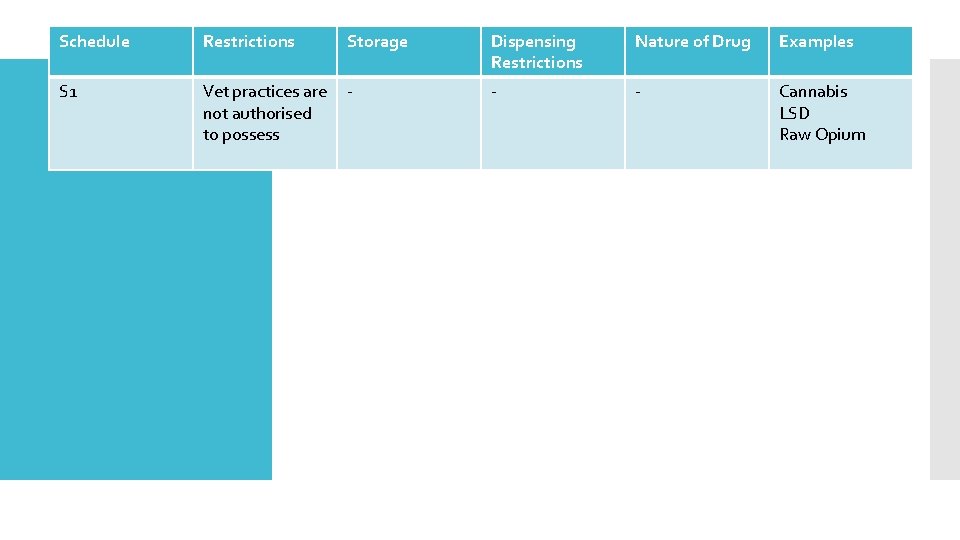
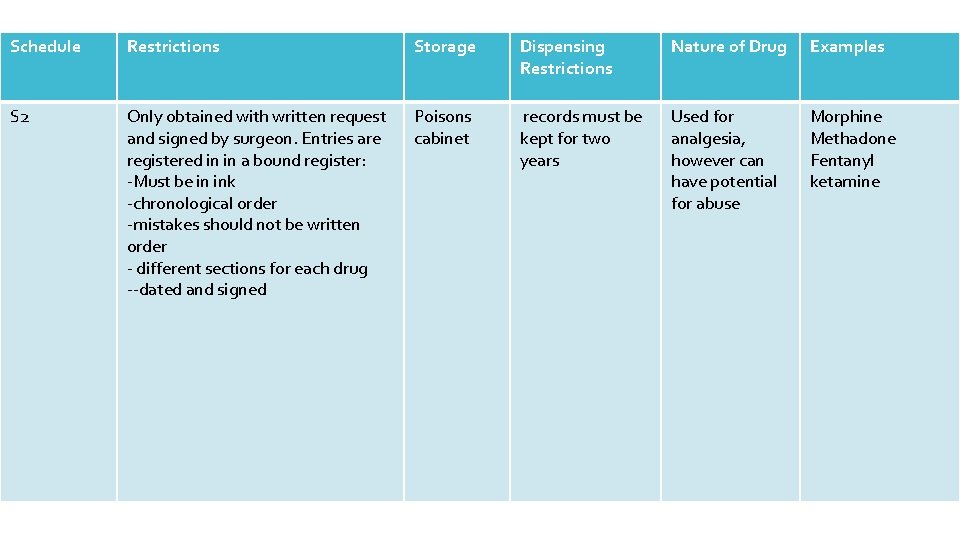
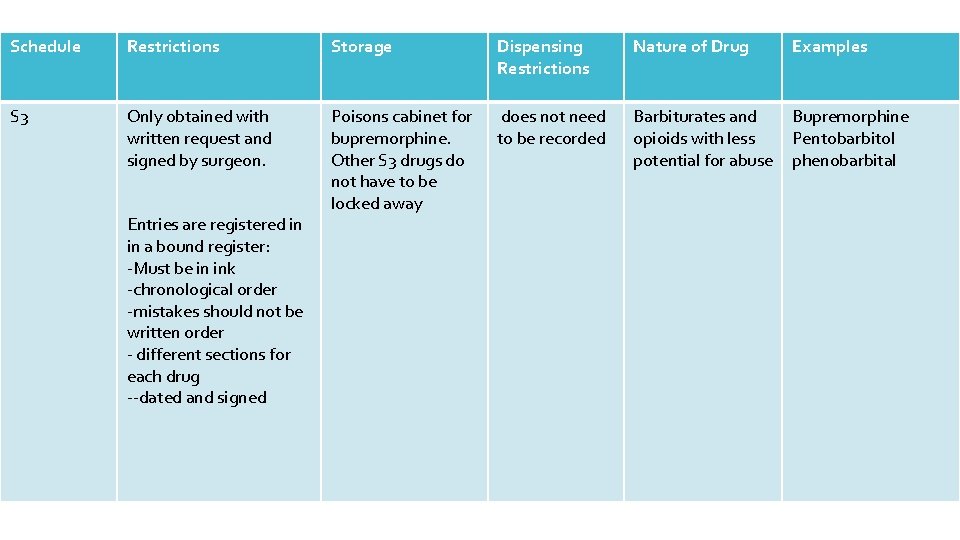
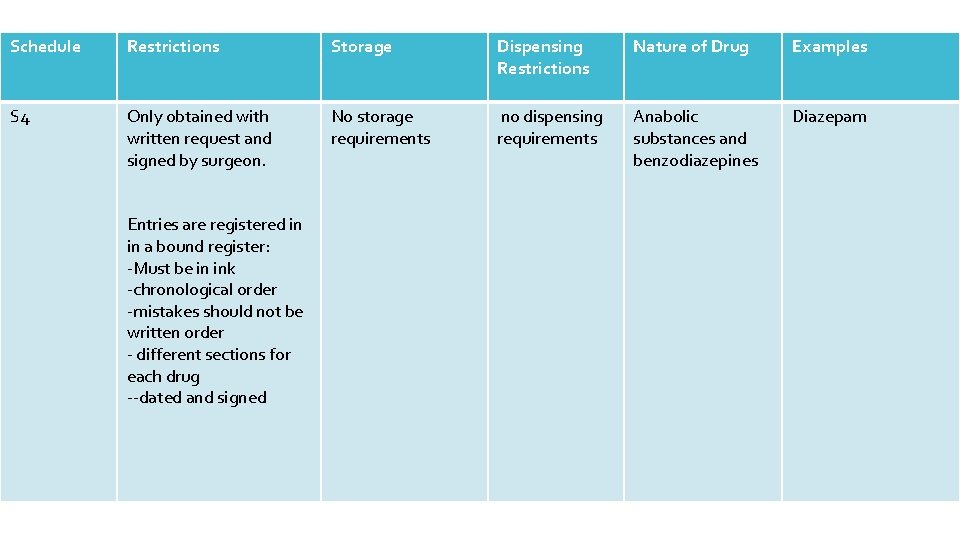
Controlled drugs Drugs have a potential for abuse are placed in a sub category of POM-v’s, known as controlled drugs (CD). There are five schedules of Controlled Drugs which have controls that decrease in their stringency. These are named: - Schedule 1 – Canabis/ LSD/ Raw Opium - Schedule 2 – Morphine/ Methadone / Fentayl / Pethidine - Schedule 3 – Bupremorphine, phenobarbitoal , pentobarbitone - Schedule 4 - Diazapam - Schedule 5 - codeine
Schedule Restrictions Storage S 1 Vet practices are not authorised to possess Dispensing Restrictions Nature of Drug Examples - - Cannabis LSD Raw Opium
Schedule Restrictions Storage Dispensing Restrictions Nature of Drug Examples S 2 Only obtained with written request and signed by surgeon. Entries are registered in in a bound register: -Must be in ink -chronological order -mistakes should not be written order - different sections for each drug --dated and signed Poisons cabinet records must be kept for two years Used for analgesia, however can have potential for abuse Morphine Methadone Fentanyl ketamine
Schedule Restrictions Storage Dispensing Restrictions Nature of Drug Examples S 3 Only obtained with written request and signed by surgeon. Poisons cabinet for bupremorphine. Other S 3 drugs do not have to be locked away does not need to be recorded Barbiturates and opioids with less potential for abuse Bupremorphine Pentobarbitol phenobarbital Entries are registered in in a bound register: -Must be in ink -chronological order -mistakes should not be written order - different sections for each drug --dated and signed
Schedule Restrictions Storage Dispensing Restrictions Nature of Drug Examples S 4 Only obtained with written request and signed by surgeon. No storage requirements no dispensing requirements Anabolic substances and benzodiazepines Diazepam Entries are registered in in a bound register: -Must be in ink -chronological order -mistakes should not be written order - different sections for each drug --dated and signed
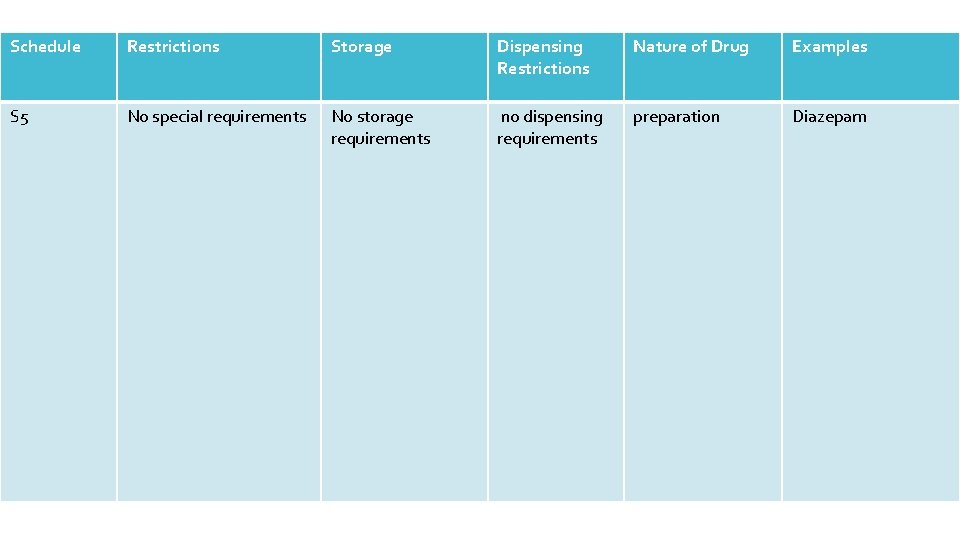
Schedule Restrictions Storage Dispensing Restrictions Nature of Drug Examples S 5 No special requirements No storage requirements no dispensing requirements preparation Diazepam
Pharmacologic al Terminology Latin words are commonly used when writing up prescriptions because they save time and are understood by pharmacists / and health professionals
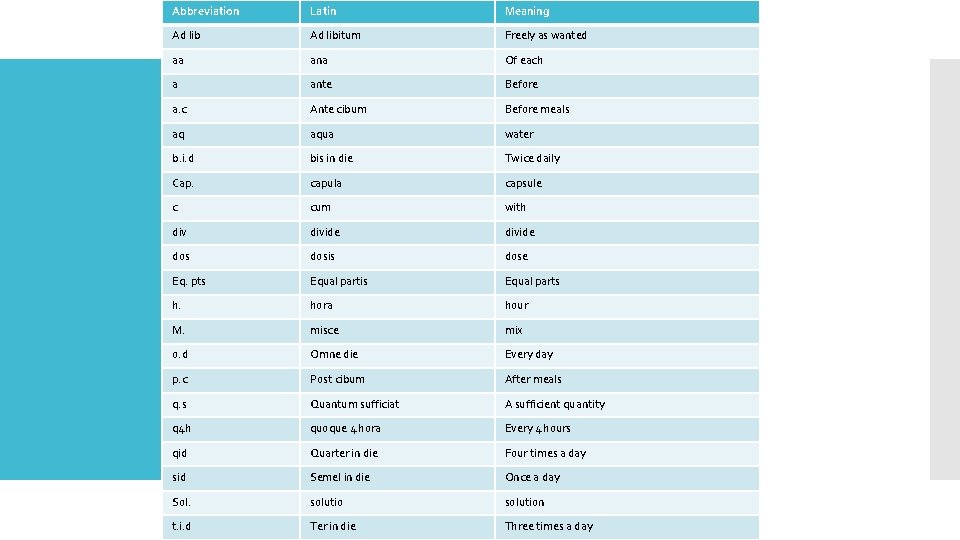
Abbreviation Latin Meaning Ad libitum Freely as wanted aa ana Of each a ante Before a. c Ante cibum Before meals aq aqua water b. i. d bis in die Twice daily Cap. capula capsule c cum with divide dosis dose Eq. pts Equal partis Equal parts h. hora hour M. misce mix o. d Omne die Every day p. c Post cibum After meals q. s Quantum sufficiat A sufficient quantity q 4 h quoque 4 hora Every 4 hours qid Quarter in die Four times a day sid Semel in die Once a day Sol. solution t. i. d Ter in die Three times a day
routes of administrating methods and medication; safe storage; handling
administration of medication Oral- pills/capsules/pastes/powders Topical – shampoo/ cream/lotion/powder/sprats/ spot on Parenteral / by injection – Subcutaneous / intravenous / intramuscular/ intra peritoneal / intra osseous
Contraindicati ons A contraindication is a specific situation in which a drug, procedure, or surgery should not be used because it may be harmful to the patient.
Adverse Effects undesired effects that my be unpleasant or even dangerous toxic effects, lethal doses, storage, handling Reasons for adverse drug reactions to occur 1) the drug may have other effect on the body besides therapeutic effect 2) the patient is sensitive to the drug being given 4) the patient is taking too much or too little of the drug Types of Drug Allergies 1) anaphylactic reaction 2) cytotoxic reaction 4) delayed allergic reaction
Adverse effects Examples: Anticoagulants (e. g. , wafarin, heparin) – bleeding Antihypertensives (e. g. . α 1 -antagonists) – hypotension Antidiabetics (e. g. insulin) - hypoglycemia 1 -blockers (e. g. metoprolol) Symptomatic heart failure inpatients with previous systolic dysfunction Bronchoconstriction in patients with COPD Antiepileptics blocking Na+ channel (e. g. , phenytoin) – neurological symptoms - vertigo, ataxia, confusion Intervention – dose reduction in most cases, use of antagonist in serious circumstances
Therapeutic Index The margin of safety that exists between the dose needed for the desired effect and the dose that produces unwanted and possibly dangerous side effects It is important to make sure that you are giving out the correct dose and drug to each patient. Always check medication strength.
Toxic Effect an adverse effect of a drug produced by an exaggeration of therapeutic dose ( over dose).
Any Questions?