Pediatric Psychology Coping with Medical Stressors Melissa Stern
- Slides: 29
Pediatric Psychology: Coping with Medical Stressors Melissa Stern PSY 4930 November 21, 2006
Medical Stressors Injections Blood draws (venipunctures) Other painful/uncomfortable procedures: n n Chemotherapy Lumbar punctures Hospitalization Chronic Illness
How common are medical stressors? By the age of 5=10 preventative injections 5 million medical procedures/yr 2 million children < 15 are hospitalized/yr. 12. 6 million children have a chronic illness
What affects a child’s ability to cope? Developmental factors n n n Age Cognitive maturity Emotional maturity Coping style n n n Sensitizers vs. repressors Primary vs. secondary coping Changes over time Family variables Illness/Treatment characteristics
Developmental Considerations Infancy/Toddlerhood n n n Separation from parents Interfere with development of attachment, interpersonal trust, self-regulation Show most severe reactions: w w n n Inconsolable crying Apprehension Somatic complaints Regression May delay social development Noncompliant and oppositional behavior w Limit setting
Developmental Considerations Middle Childhood n Most affected in academic or peer contexts w Medical treatments may affect cognition w Frequent school absences w Bullying n Cognitive considerations w Rule-oriented thinking may promote adherence (e. g. , a belief that recovery results from strict adherence)
Developmental Considerations Adolescence n Adolescent concerns may interfere with appropriate coping w Developing autonomy w Peer and romantic relationship w Self-consciousness about appearance n n Adherence decreases Cognitive maturity can be protective w Sophisticated coping strategies
Understanding of Illness Preoperational Stage n n Thinking is based on naïve perception (e. g. , seeing is believing) Believe that illness is caused by external events, objects, or people w Cold is caused by trees or happens when someone stands near you n n May understand the idea of contagion, but do not understand the process Causes and consequences are confused
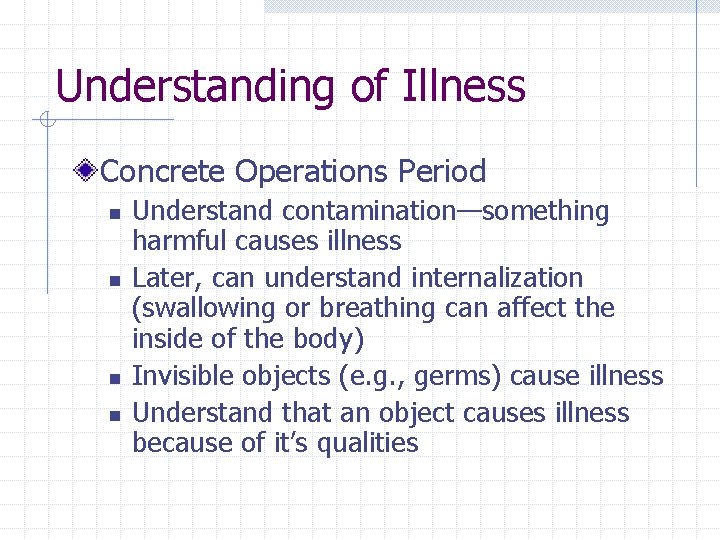
Understanding of Illness Concrete Operations Period n n Understand contamination—something harmful causes illness Later, can understand internalization (swallowing or breathing can affect the inside of the body) Invisible objects (e. g. , germs) cause illness Understand that an object causes illness because of it’s qualities
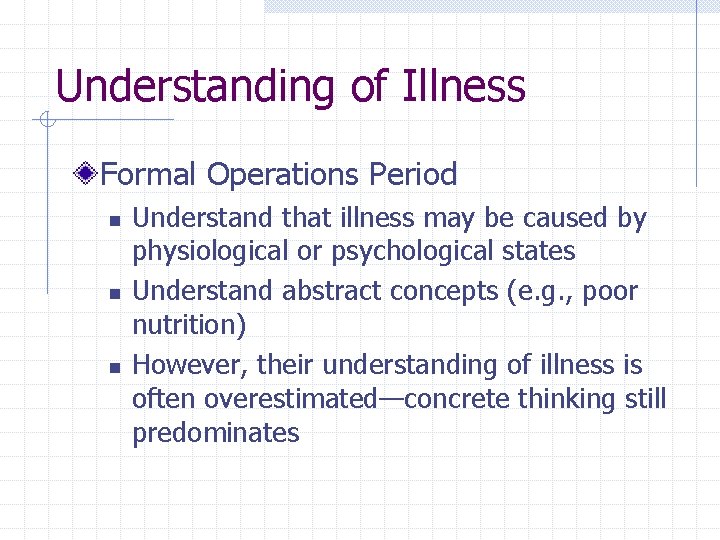
Understanding of Illness Formal Operations Period n n n Understand that illness may be caused by physiological or psychological states Understand abstract concepts (e. g. , poor nutrition) However, their understanding of illness is often overestimated—concrete thinking still predominates
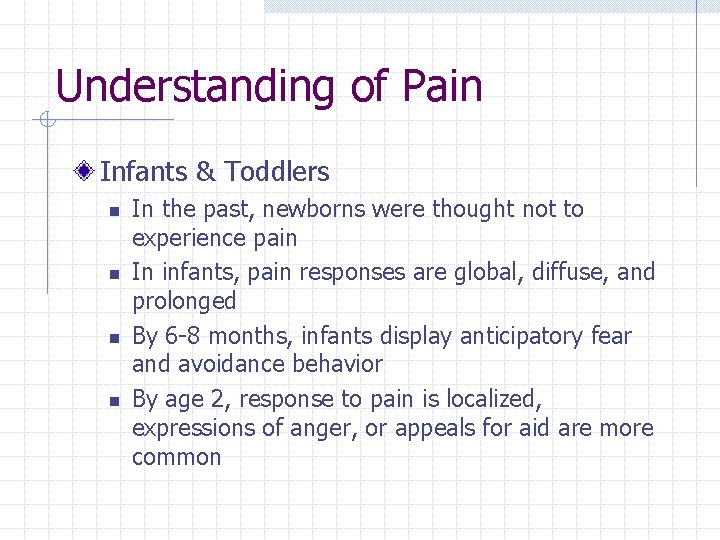
Understanding of Pain Infants & Toddlers n n In the past, newborns were thought not to experience pain In infants, pain responses are global, diffuse, and prolonged By 6 -8 months, infants display anticipatory fear and avoidance behavior By age 2, response to pain is localized, expressions of anger, or appeals for aid are more common
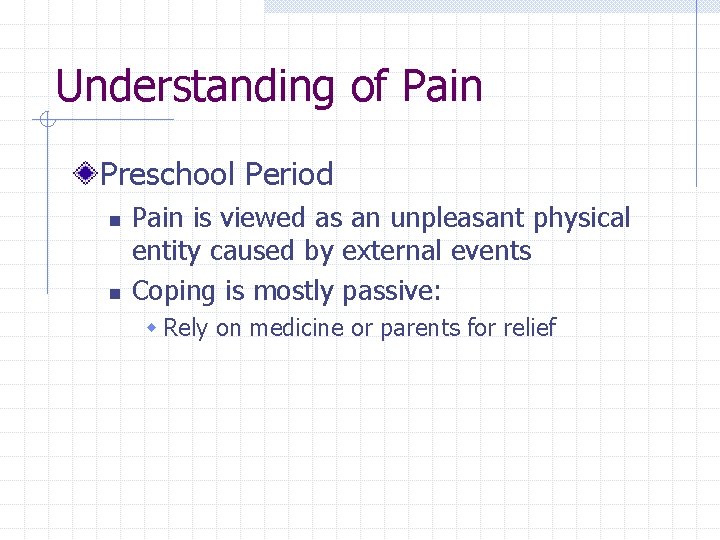
Understanding of Pain Preschool Period n n Pain is viewed as an unpleasant physical entity caused by external events Coping is mostly passive: w Rely on medicine or parents for relief
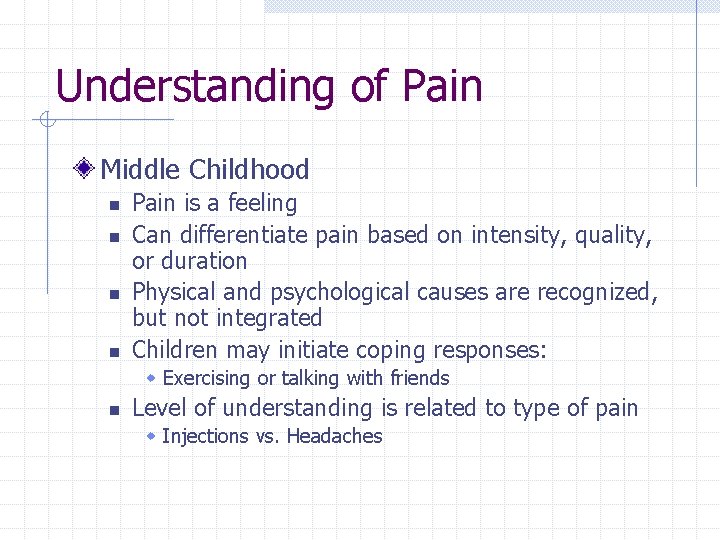
Understanding of Pain Middle Childhood n n Pain is a feeling Can differentiate pain based on intensity, quality, or duration Physical and psychological causes are recognized, but not integrated Children may initiate coping responses: w Exercising or talking with friends n Level of understanding is related to type of pain w Injections vs. Headaches
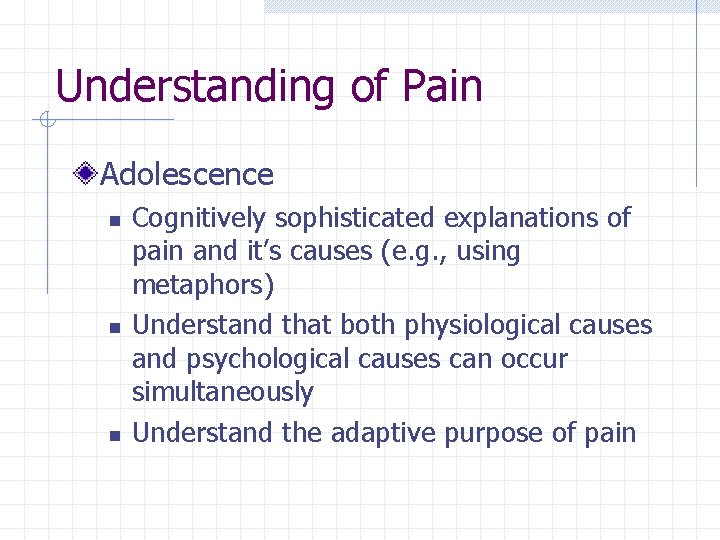
Understanding of Pain Adolescence n n n Cognitively sophisticated explanations of pain and it’s causes (e. g. , using metaphors) Understand that both physiological causes and psychological causes can occur simultaneously Understand the adaptive purpose of pain
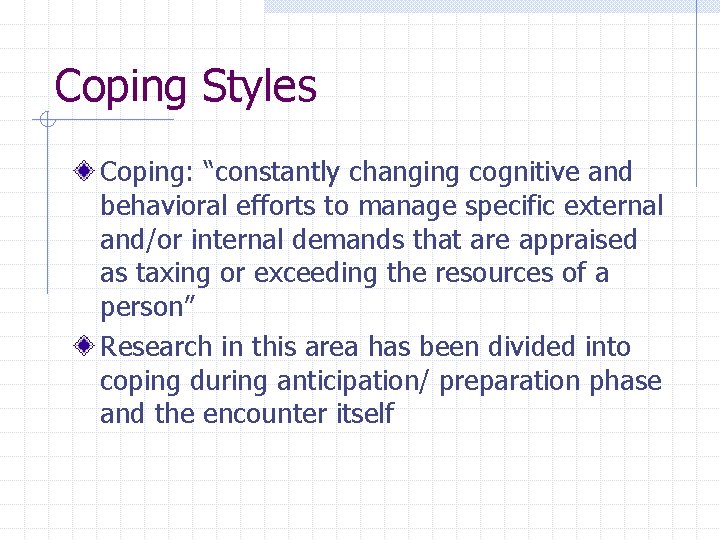
Coping Styles Coping: “constantly changing cognitive and behavioral efforts to manage specific external and/or internal demands that are appraised as taxing or exceeding the resources of a person” Research in this area has been divided into coping during anticipation/ preparation phase and the encounter itself
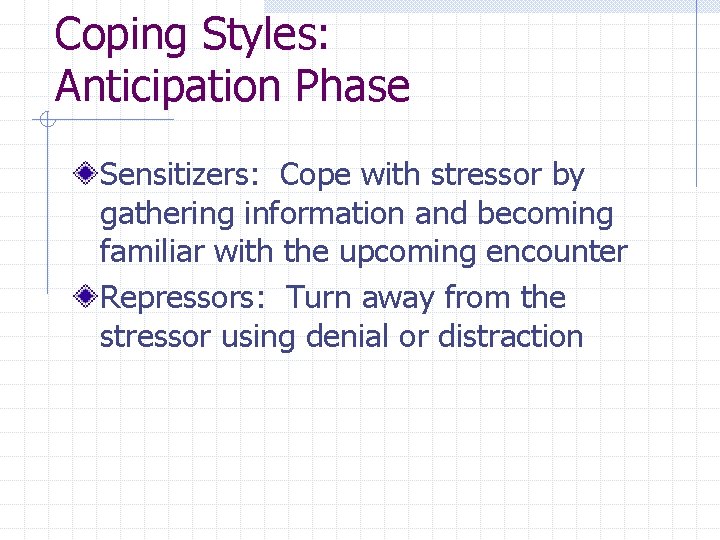
Coping Styles: Anticipation Phase Sensitizers: Cope with stressor by gathering information and becoming familiar with the upcoming encounter Repressors: Turn away from the stressor using denial or distraction
Coping Styles: Anticipation Phase Primary control: Coping style that involves attempts to modify external conditions Secondary control: Style that attempts to modify internal events (oneself) Secondary is most effective with uncontrollable stressors Primary is best with controllable stressors
Interventions to Promote Coping Primary goals n n n Encourage positive relationships Emotional support Age appropriate information Types of Interventions n Education, Modeling, Coping Skills Training
Coping Interventions Educational interventions n n Include using dolls to explain procedures, written materials for parents, videotapes Have been shown to be efficacious with a variety of medical procedures w Fewer distress behaviors w Higher parental satisfaction w Less parental anxiety n Developmentally appropriate information is crucial
Coping Intervention Modeling interventions n n Based on social learning theory Involve an educational component and a modeling component w Model may be a peer (live or videotaped), doll, or puppet w Model is shown to engage in positive coping skills n Participant modeling vs. Symbolic modeling
Coping Interventions Coping skills training n n May include both education and modeling, but focuses on teaching coping techniques Coping strategies taught include w Relaxation, imagery, distraction
Other considerations Children undergoing repeated medical procedures do not respond as well to interventions n Post-traumatic reactions Behavioral techniques may be used to reduce anxiety n Operant techniques, systematic desensitization
Other considerations Mixed results regarding parental participation n n Parental presence is usually helpful, unless the parent is anxious Usually is most helpful during preparation for medical procedures
Health Policy Less than half of surveyed hospitals used preparation-focused interventions (e. g. , education, modeling, or coping skills) Most use narrative preparation, tours, play therapy, or printed material n These have not been supported empirically
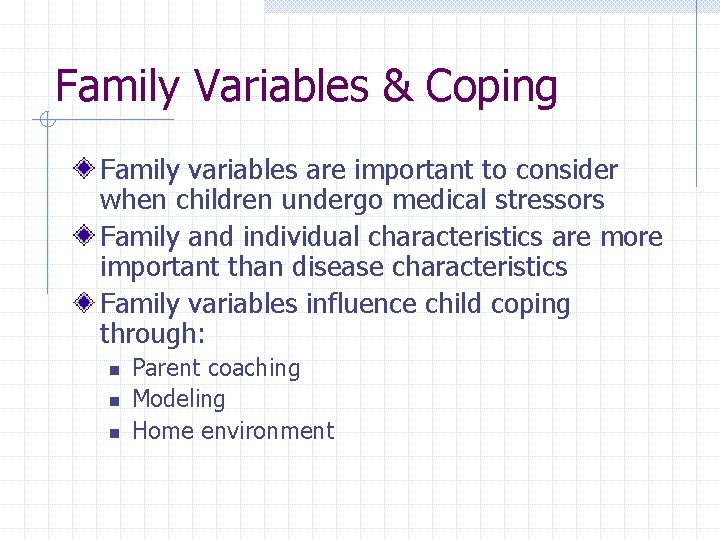
Family Variables & Coping Family variables are important to consider when children undergo medical stressors Family and individual characteristics are more important than disease characteristics Family variables influence child coping through: n n n Parent coaching Modeling Home environment
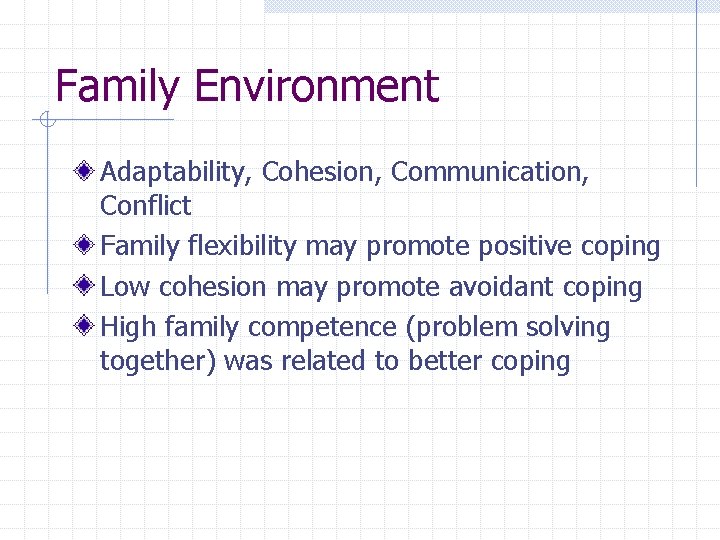
Family Environment Adaptability, Cohesion, Communication, Conflict Family flexibility may promote positive coping Low cohesion may promote avoidant coping High family competence (problem solving together) was related to better coping
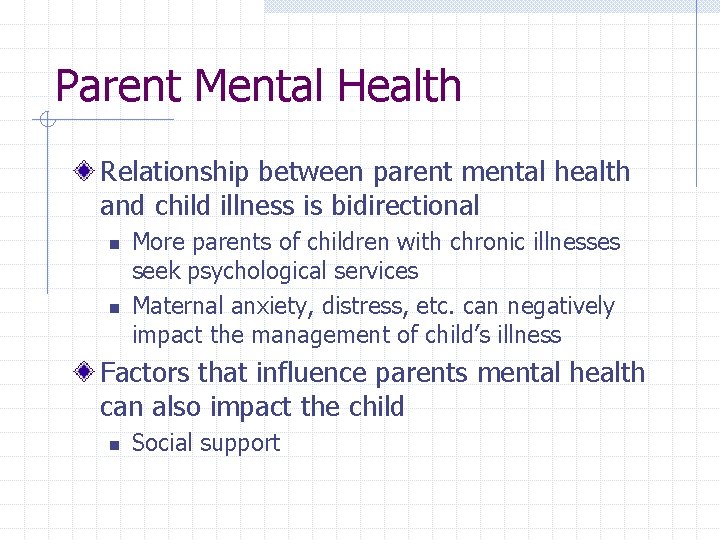
Parent Mental Health Relationship between parent mental health and child illness is bidirectional n n More parents of children with chronic illnesses seek psychological services Maternal anxiety, distress, etc. can negatively impact the management of child’s illness Factors that influence parents mental health can also impact the child n Social support
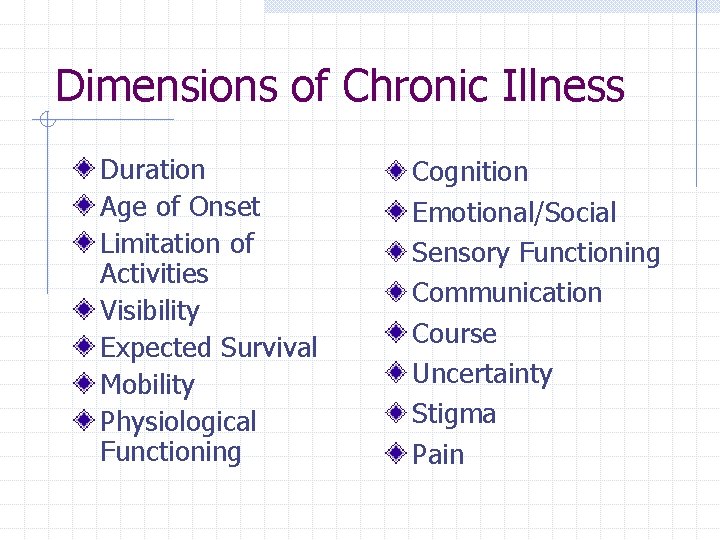
Dimensions of Chronic Illness Duration Age of Onset Limitation of Activities Visibility Expected Survival Mobility Physiological Functioning Cognition Emotional/Social Sensory Functioning Communication Course Uncertainty Stigma Pain
Happy Thanksgiving!!