Patient safety the undergraduate curriculum Dr Rona Patey

- Slides: 19
Patient safety: the undergraduate curriculum Dr Rona Patey Head of Division of Medical and Dental Education / Consultant Anaesthetist
Outline • Background / context • WHO Patient Safety Curriculum Guide for Medical Schools & evaluation • A case study and some personal experience www. abdn. ac. uk
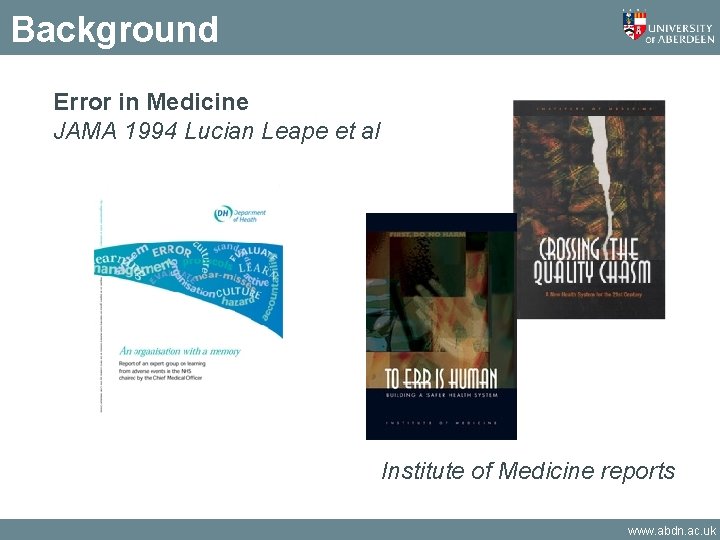
Background Error in Medicine Background: Identification of JAMA 1994 Lucian Leape et al the patient safety problem UK Dept of Health 2000 Institute of Medicine reports www. abdn. ac. uk
www. abdn. ac. uk
Patient safety education • New • Spans a number of disciplines & fields • Contains new knowledge & considers new aspects of performance • Links to traditional subjects www. abdn. ac. uk
www. abdn. ac. uk
Curriculum Guide • A flexible curriculum to suit local needs • Targeted at global audience • Easy to understand • Compatible with wide range of contexts / curricula • Build capacity for curriculum change • Teachers guide as well as curriculum materials • Based on learning in a safe and supportive environment www. abdn. ac. uk
11 stand alone topics • What is patient safety? • What is human factors & why is it important to patient safety? • Understanding systems and the impact of complexity on patient care • Being an effective team player • Understanding and learning from errors • Understanding and managing clinical risk • Introduction to quality improvement • Engaging with patients and carers • Minimizing infection through improved infection control • Patient safety and invasive procedures • Improving medication safety www. abdn. ac. uk
Topic structure • Topic title • Rationale • Learning outcomes • Knowledge requirements • Performance requirements • Options to teach the topic • Strategies & activities • Tools & resources • How to assess the topic • How to evaluate the teaching www. abdn. ac. uk
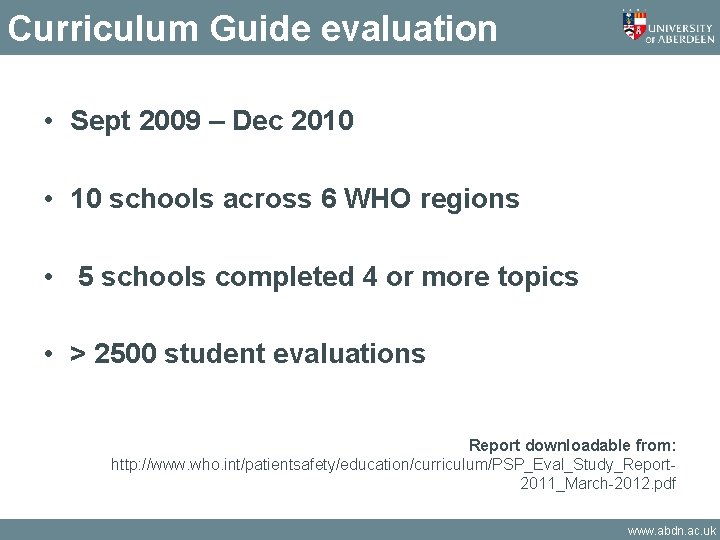
Curriculum Guide evaluation • Sept 2009 – Dec 2010 • 10 schools across 6 WHO regions • 5 schools completed 4 or more topics • > 2500 student evaluations Report downloadable from: http: //www. who. int/patientsafety/education/curriculum/PSP_Eval_Study_Report 2011_March-2012. pdf www. abdn. ac. uk
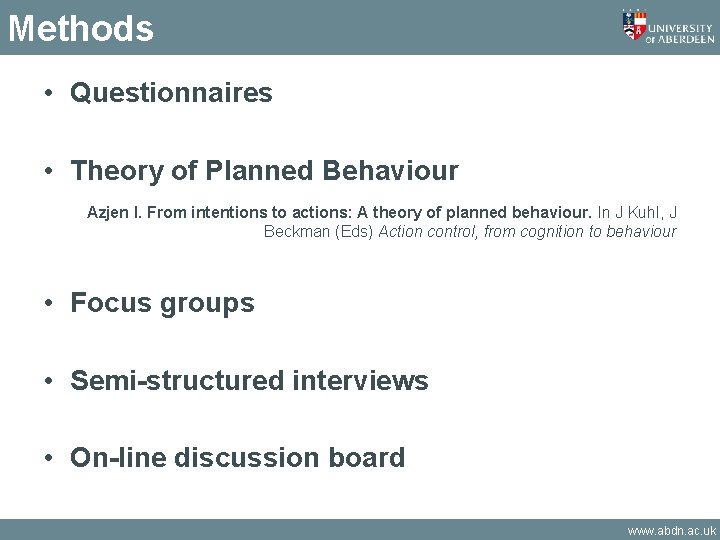
Methods • Questionnaires • Theory of Planned Behaviour Azjen I. From intentions to actions: A theory of planned behaviour. In J Kuhl, J Beckman (Eds) Action control, from cognition to behaviour • Focus groups • Semi-structured interviews • On-line discussion board www. abdn. ac. uk
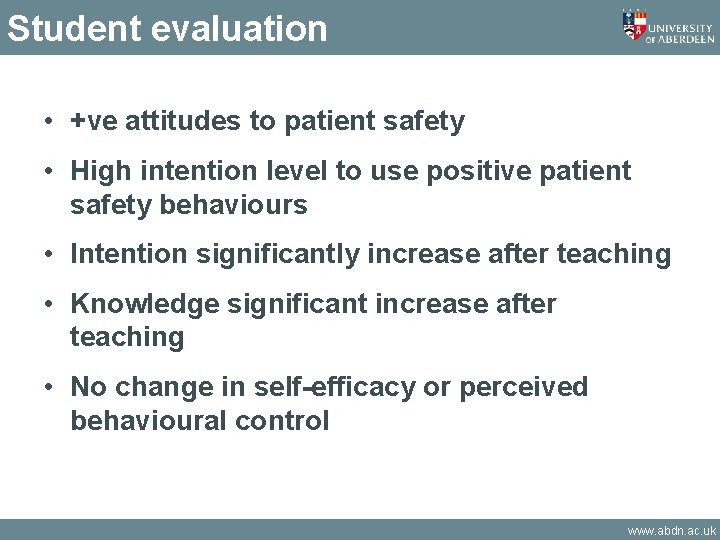
Student evaluation • +ve attitudes to patient safety • High intention level to use positive patient safety behaviours • Intention significantly increase after teaching • Knowledge significant increase after teaching • No change in self-efficacy or perceived behavioural control www. abdn. ac. uk
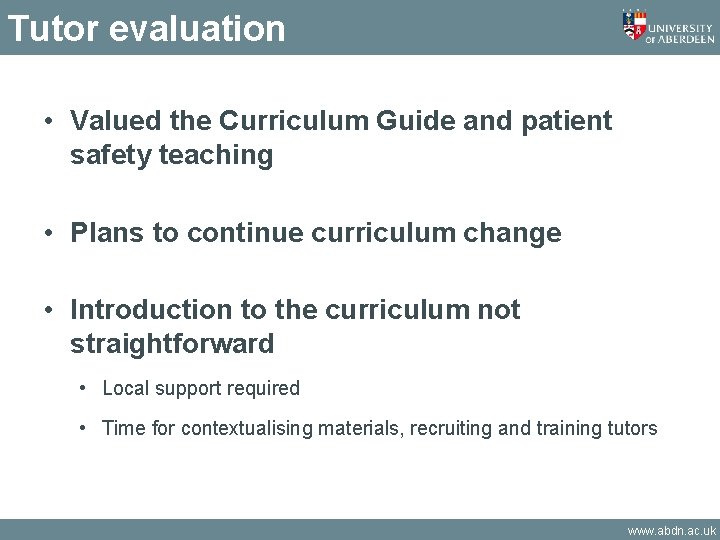
Tutor evaluation • Valued the Curriculum Guide and patient safety teaching • Plans to continue curriculum change • Introduction to the curriculum not straightforward • Local support required • Time for contextualising materials, recruiting and training tutors www. abdn. ac. uk
Limitations • Long-term follow up • Small numbers for some topics • Evaluation tools in English • Before / after comparisons between groups www. abdn. ac. uk
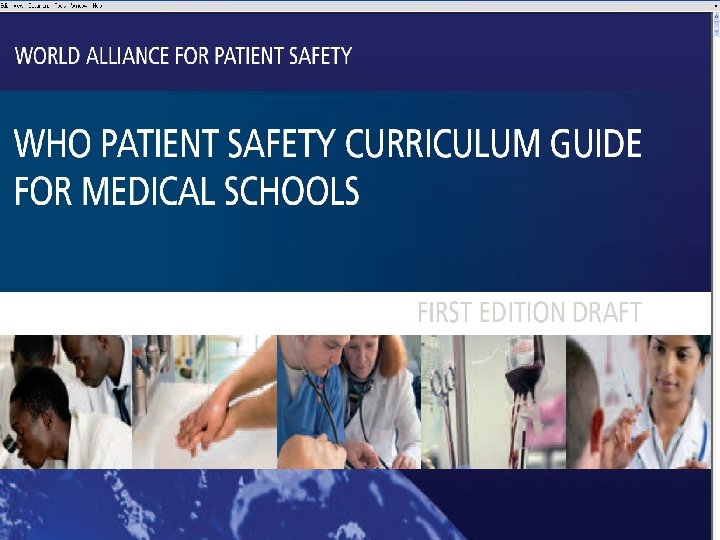
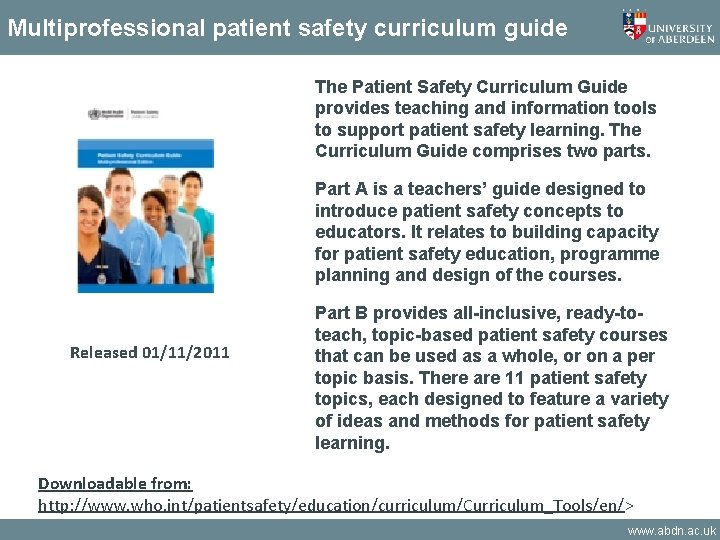
Multiprofessional patient safety curriculum guide The Patient Safety Curriculum Guide provides teaching and information tools to support patient safety learning. The Curriculum Guide comprises two parts. Part A is a teachers’ guide designed to introduce patient safety concepts to educators. It relates to building capacity for patient safety education, programme planning and design of the courses. Released 01/11/2011 Part B provides all-inclusive, ready-toteach, topic-based patient safety courses that can be used as a whole, or on a per topic basis. There are 11 patient safety topics, each designed to feature a variety of ideas and methods for patient safety learning. Downloadable from: http: //www. who. int/patientsafety/education/curriculum/Curriculum_Tools/en/> www. abdn. ac. uk
University of Aberdeen • Understanding error in healthcare • Stand alone small group 5 hour module, Y 5 • Overview of error • Size of the problem in healthcare • Error reporting and analysis • What to do in the aftermath of an adverse event • Speaking up and Disclosure Helping medical students understand error in healthcare. QSHC 2007; 16: 256 -259 www. abdn. ac. uk
University of Aberdeen • Human Factors and non-technical skills – Y 5 • Whole class seminar • Primer on human factors & NTS • Observation and identification of NTS in expert clinicians • Moderated on line discussion • Review of own NTS from acute care simulation • Clinical risk and understanding systems – Y 5 • Small group analysis error • What is patient safety – Y 1 • Whole class seminar www. abdn. ac. uk
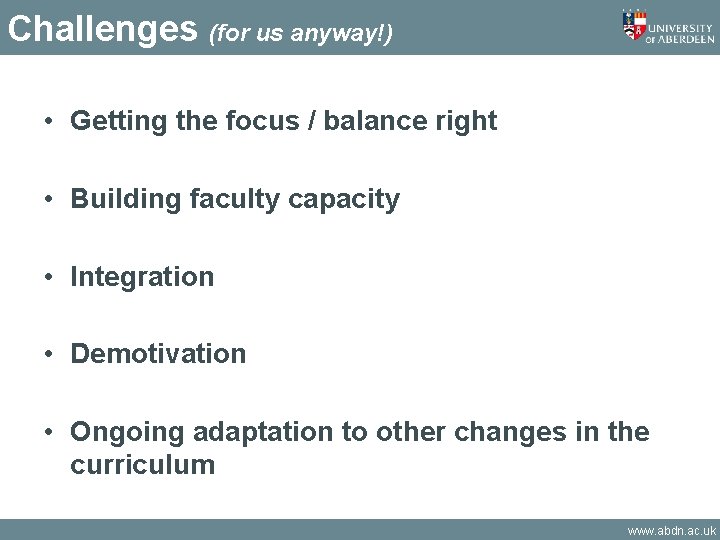
Challenges (for us anyway!) • Getting the focus / balance right • Building faculty capacity • Integration • Demotivation • Ongoing adaptation to other changes in the curriculum www. abdn. ac. uk
Questions / clarification r. patey@abdn. ac. uk