P What Katie Endres PAC Where I started









- Slides: 33
+ P What? Katie Endres PA-C
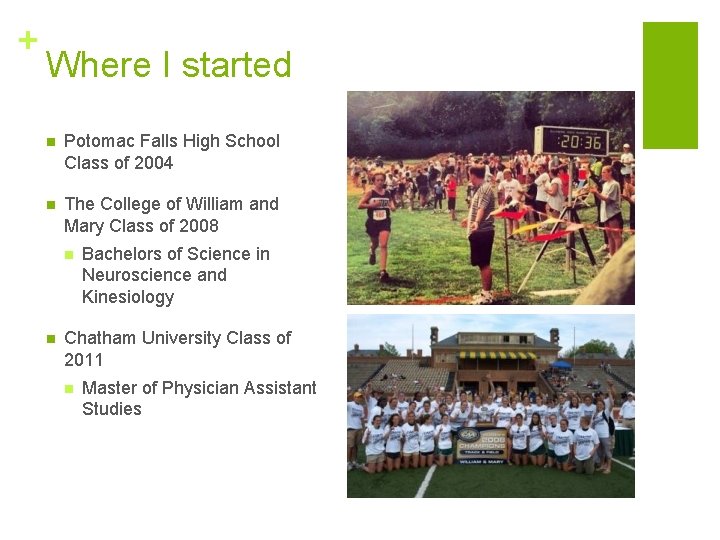
+ Where I started n Potomac Falls High School Class of 2004 n The College of William and Mary Class of 2008 n n Bachelors of Science in Neuroscience and Kinesiology Chatham University Class of 2011 n Master of Physician Assistant Studies
+ What is a Physician Assistant? n A PA is a nationally certified and state-licensed medical professional n PA’s practice medicine with physician supervision in every state, specialty, and setting n There are more than 90, 000 certified PA’s practicing in the US today
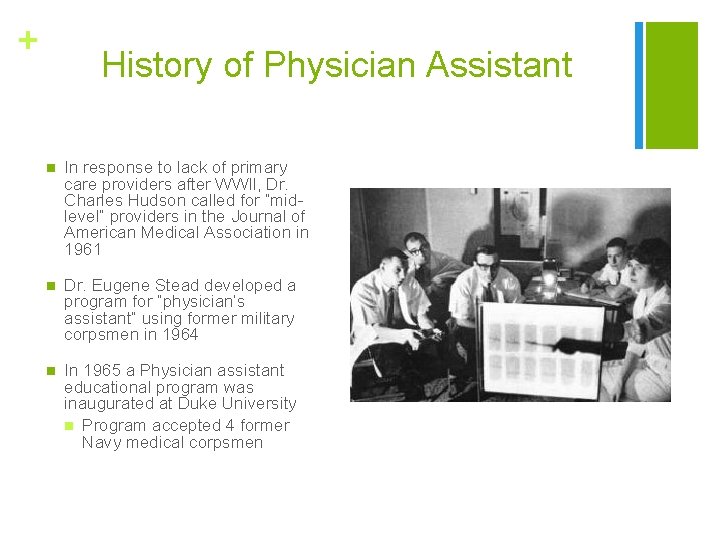
+ History of Physician Assistant n In response to lack of primary care providers after WWII, Dr. Charles Hudson called for “midlevel” providers in the Journal of American Medical Association in 1961 n Dr. Eugene Stead developed a program for “physician’s assistant” using former military corpsmen in 1964 n In 1965 a Physician assistant educational program was inaugurated at Duke University n Program accepted 4 former Navy medical corpsmen
+ Becoming a PA Prerequisites Healthcare Experience n Chemistry n Medical Assistant n Physiology n EMT n Paramedic n Lab Assistant/Phlebotomist n Registered Nurse n ER Tech n Surgical Tech n CNA n n Anatomy Microbiology n Biology n GRE/MCAT
+ Becoming a PA n Over 170 Accredited Educational Programs n Apply using CASPA n n n Similar to Common Application Programs range from 24 months to 27 months n 1 st Year-Classroom instruction n 2 nd Year-Clinical Rotations Graduate with a master’s degree
+ Becoming a PA Classroom Instruction-1 st Year n Anatomy n Physiology n Biochemistry n Pharmacology Rotations-2 nd Year n Family Medicine n Internal Medicine n Obstetrics and Gynecology n Pediatrics n General Surgery n Emergency Medicine n Physical Diagnosis n Pathophysiology n Microbiology n Clinical Laboratory Science n Psychiatry n Behavioral Science n Orthopedics n Medical Ethics n Cardiology
+ Becoming Certified n Once graduating from an accredited PA program you are eligible to take the PANCE n Physician Assistant National Certifying Exam n 5 -Hour Exam n 300 multiple-choice questions n To Maintain certification n Complete PANRE every 10 years n Complete 100 hours of continuing medical education [CME] every 2 years
+ Becoming Certified n CAQ’s n Specialty Certificates of Added Qualifications n To Qualify 1. Current PA-C certification 2. Possession of a license to practice 3. 2 years of experience 4. 100 hours of specialty specific CME’s 5. Procedures and patient case experience n Types of CAQ’s n Cardiovascular/Thoracic Surgery n Emergency Medicine n Hospital Medicine n Nephrology n Orthopedic Surgery n Pediatrics n Psychiatry
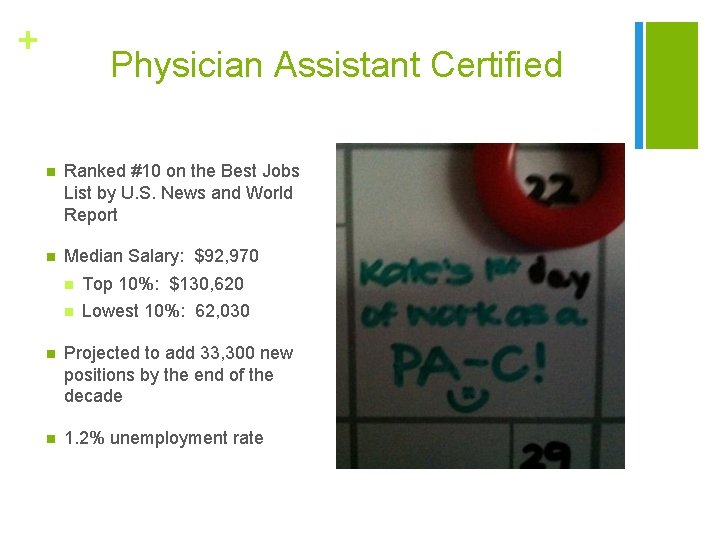
+ Physician Assistant Certified n Ranked #10 on the Best Jobs List by U. S. News and World Report n Median Salary: $92, 970 n Top 10%: $130, 620 n Lowest 10%: 62, 030 n Projected to add 33, 300 new positions by the end of the decade n 1. 2% unemployment rate
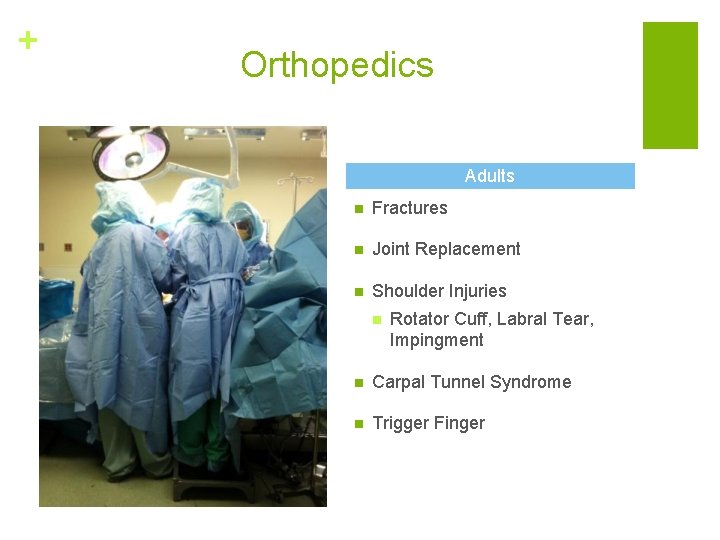
+ Orthopedics Adults n Fractures n Joint Replacement n Shoulder Injuries n Rotator Cuff, Labral Tear, Impingment n Carpal Tunnel Syndrome n Trigger Finger
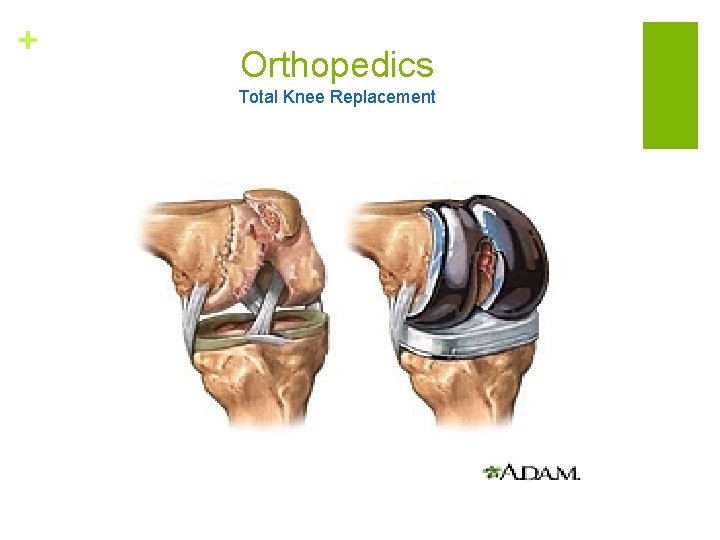
+ Orthopedics Total Knee Replacement
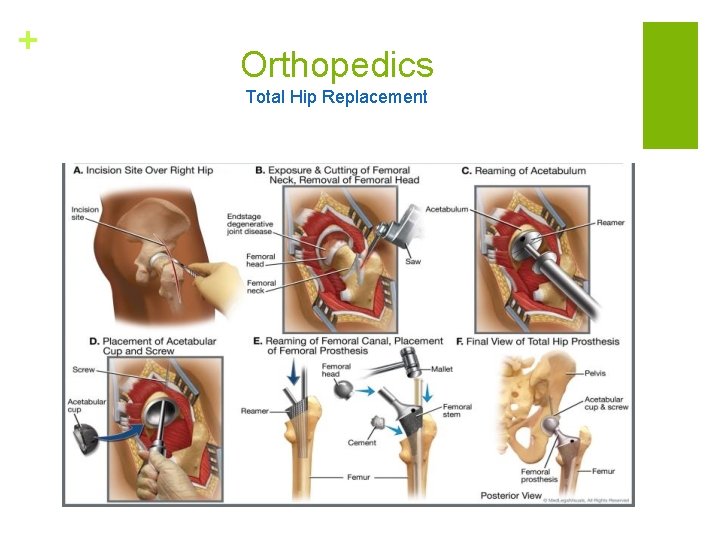
+ Orthopedics Total Hip Replacement
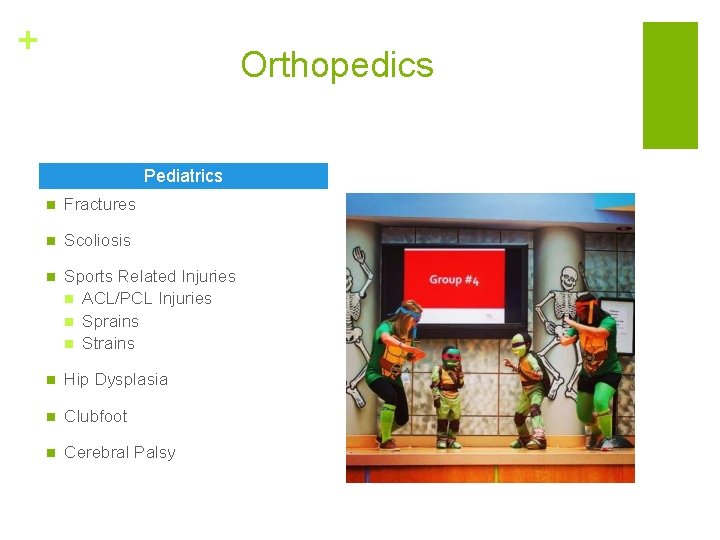
+ Orthopedics Pediatrics n Fractures n Scoliosis n Sports Related Injuries n ACL/PCL Injuries n Sprains n Strains n Hip Dysplasia n Clubfoot n Cerebral Palsy
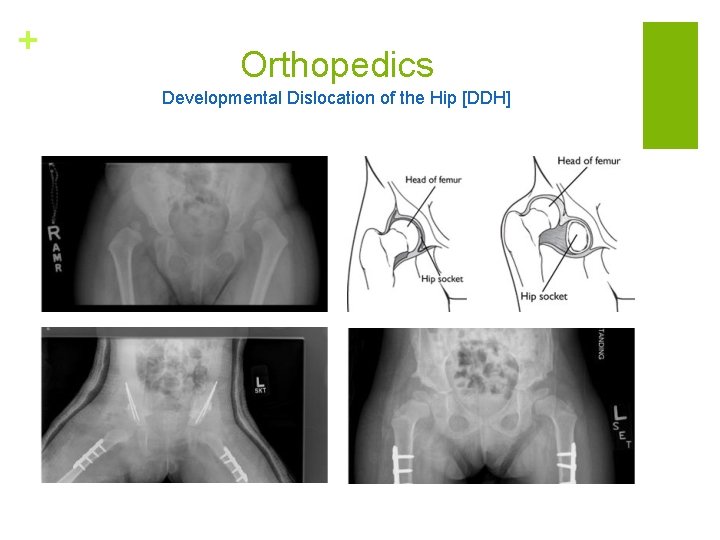
+ Orthopedics Developmental Dislocation of the Hip [DDH]
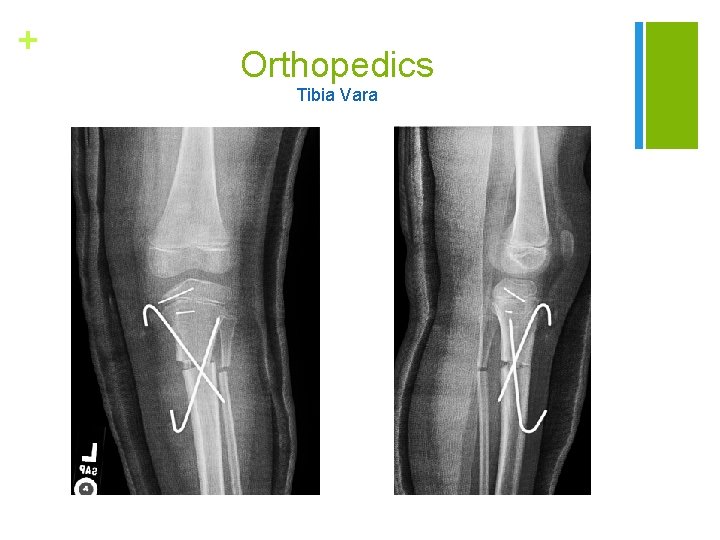
+ Orthopedics Tibia Vara n Blount’s Disease n Growth plate shuts down causing legs to bow outwards n 3 Types 1. Infantile [<3 years old] 2. Juvenile [4 -10 years old] 3. Adolescent [>11 years old] n Treatment n Non-Surgical-bracing n Surgical-osteotomy vs. external fixation
+ Orthopedics Tibia Vara
+ Orthopedics Tibia Vara
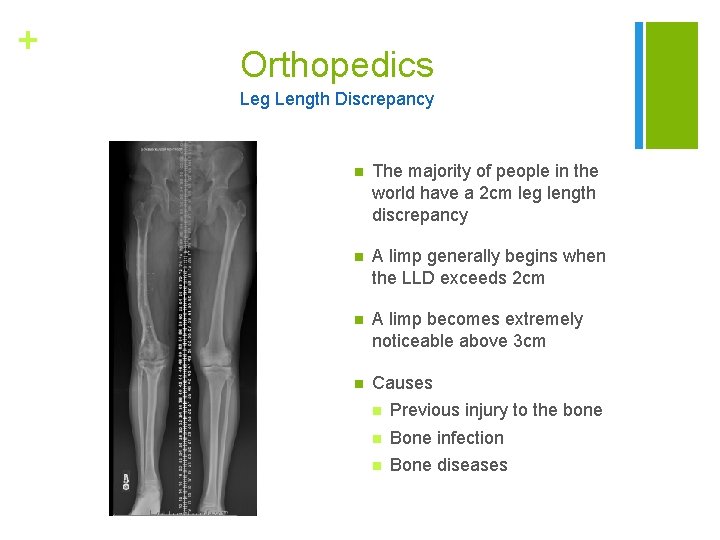
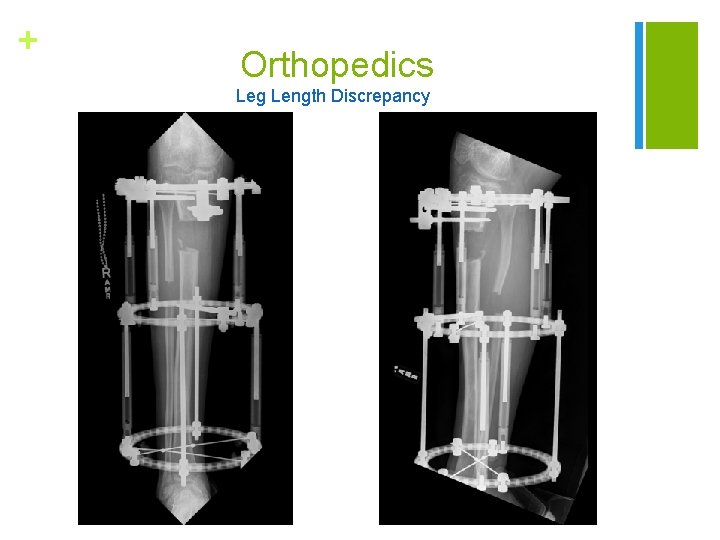
+ Orthopedics Leg Length Discrepancy n The majority of people in the world have a 2 cm leg length discrepancy n A limp generally begins when the LLD exceeds 2 cm n A limp becomes extremely noticeable above 3 cm n Causes n Previous injury to the bone n Bone infection n Bone diseases
+ Orthopedics Leg Length Discrepancy
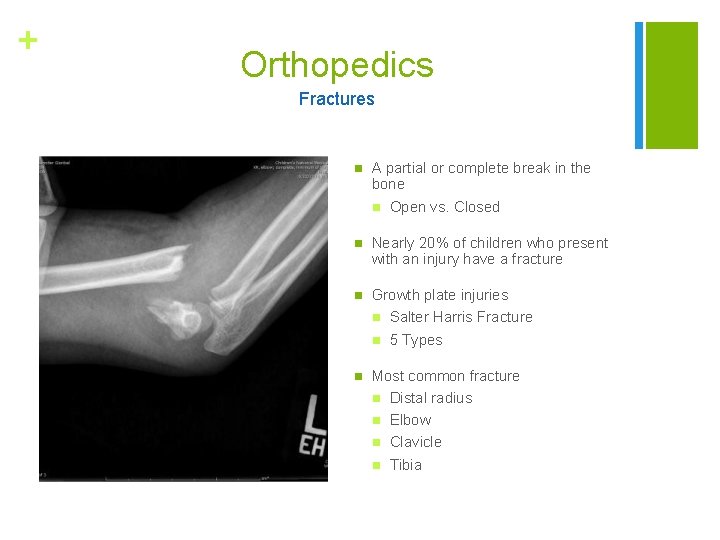
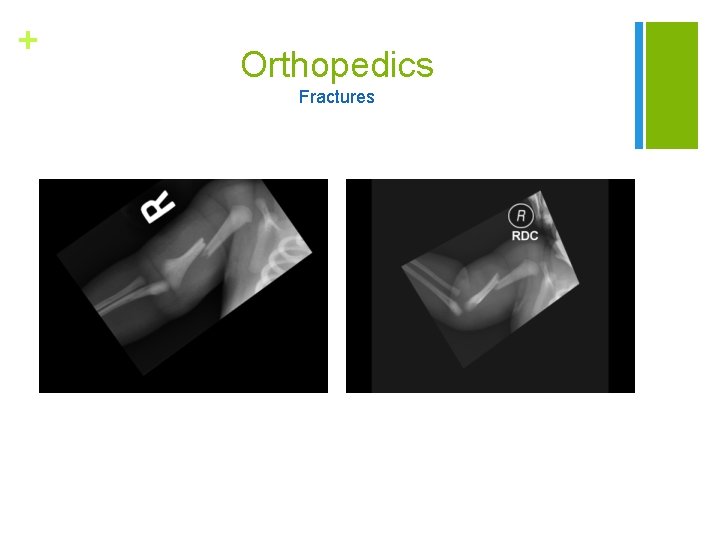
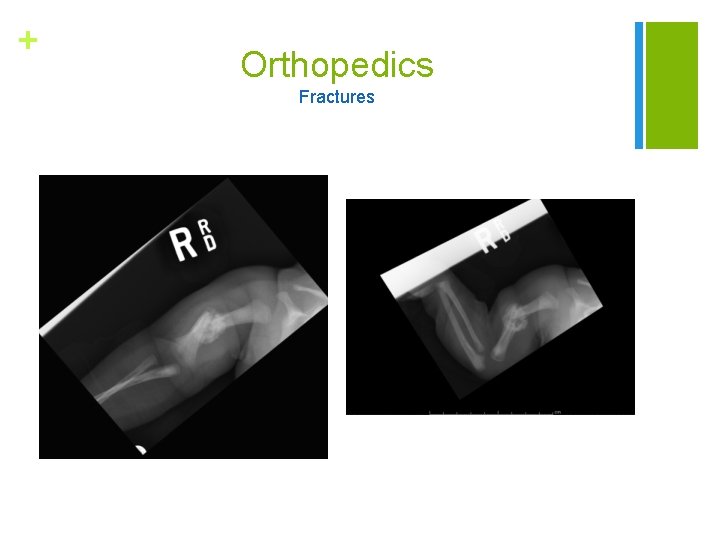
+ Orthopedics Fractures n A partial or complete break in the bone n Open vs. Closed n Nearly 20% of children who present with an injury have a fracture n Growth plate injuries n Salter Harris Fracture n 5 Types n Most common fracture n Distal radius n Elbow n Clavicle n Tibia
+ Orthopedics Fractures n Supracondylar Humerus Fracture n 10% of all fractures in children n Three types n Type 1: non-displaced n Type 2: displaced n Type 3: displaced with no contact of fragments
+ Orthopedics Fractures
+ Orthopedics Fractures
+ Orthopedics Legg-Calve-Perthes Disease
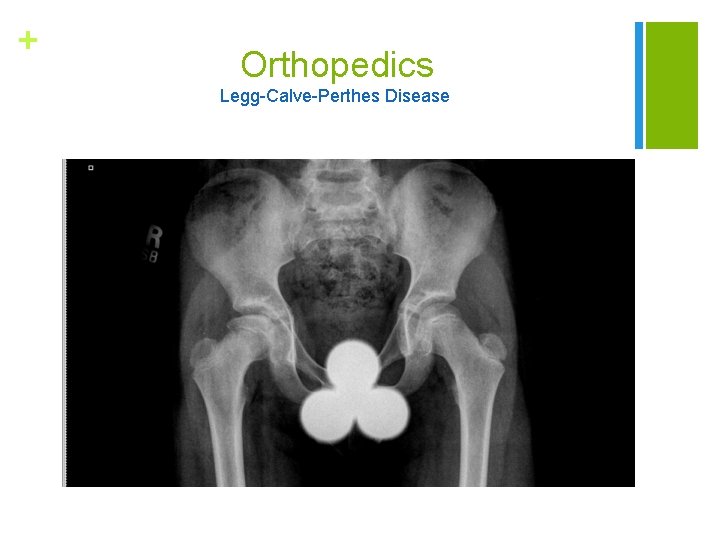
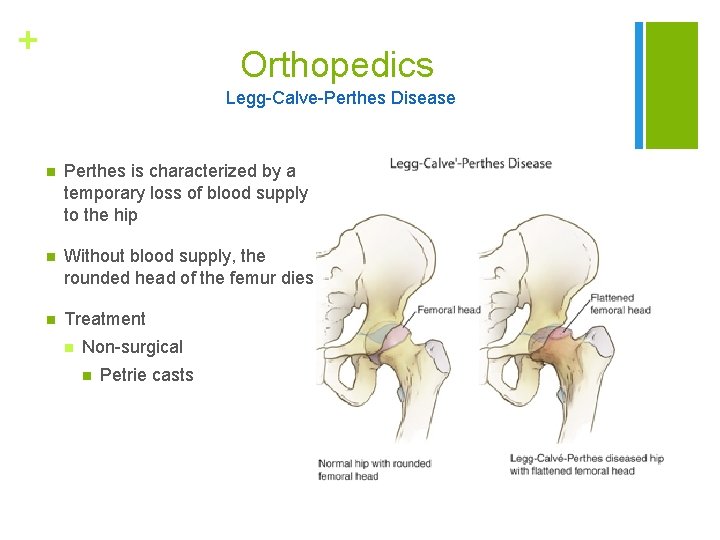
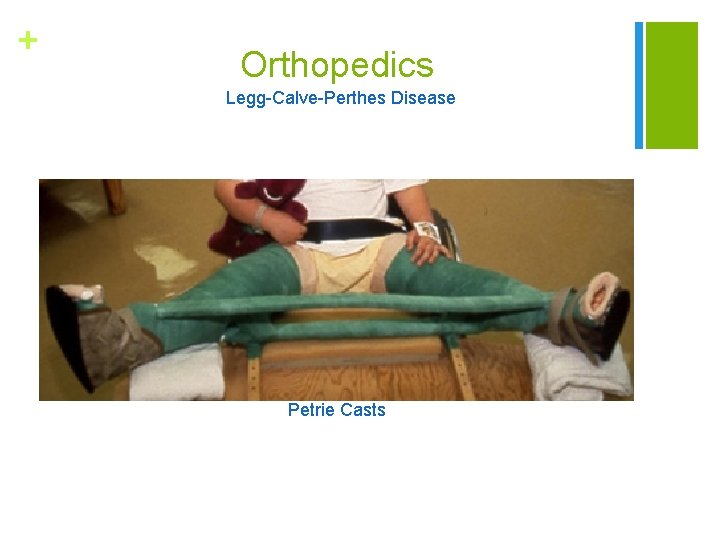
+ Orthopedics Legg-Calve-Perthes Disease n Perthes is characterized by a temporary loss of blood supply to the hip n Without blood supply, the rounded head of the femur dies n Treatment n Non-surgical n Petrie casts
+ Orthopedics Legg-Calve-Perthes Disease Petrie Casts
+ Orthopedics Legg-Calve-Perthes Disease n Surgical n Establishes proper alignment of the bones of the hip n Head of the femur is placed deep within the socket n Alignment kept in place with screws and a plate
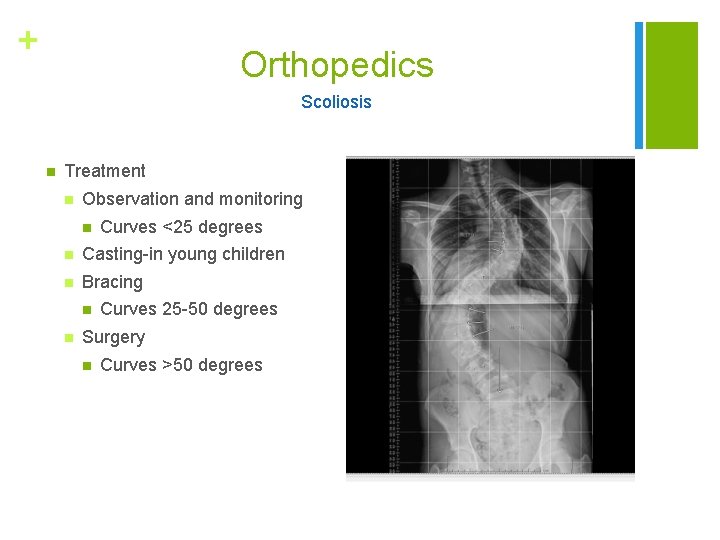
+ Orthopedics Scoliosis n An abnormal side-to-side “S” or “C” shaped curve n Curve greater than 10 degrees n Mainly affects girls n Three to five out of every 1, 000 children develop spinal curves n Three Types n Idiopathic: most common n Neuromuscular: cerebral palsy n Congenital: present at birth, failure of vertebrae to form normally
+ Orthopedics Scoliosis n Signs and Symptoms n Uneven shoulder heights n Head not centered with the rest of the body n Uneven hip heights n Uneven shoulder blade heights n When bending forward, the left and right sides of the back are asymmetrical
+ Orthopedics Scoliosis n Treatment n Observation and monitoring n Curves <25 degrees n Casting-in young children n Bracing n n Curves 25 -50 degrees Surgery n Curves >50 degrees
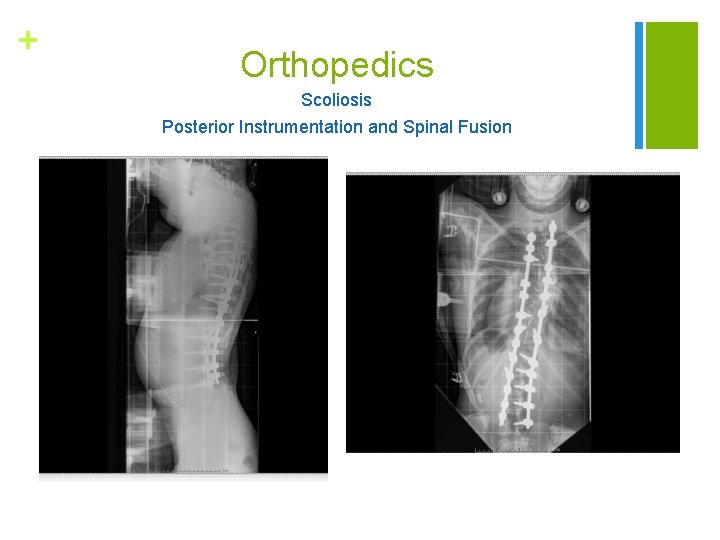
+ Orthopedics Scoliosis Posterior Instrumentation and Spinal Fusion
+ Questions?