Othello ACT 2 Act 2 synopsis The action




- Slides: 29
“Othello” ACT 2
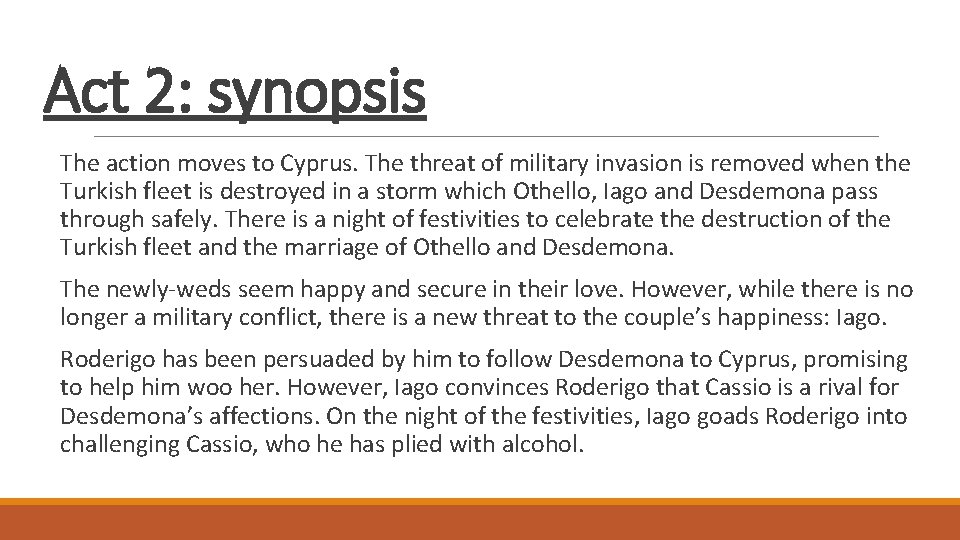
Act 2: synopsis The action moves to Cyprus. The threat of military invasion is removed when the Turkish fleet is destroyed in a storm which Othello, Iago and Desdemona pass through safely. There is a night of festivities to celebrate the destruction of the Turkish fleet and the marriage of Othello and Desdemona. The newly-weds seem happy and secure in their love. However, while there is no longer a military conflict, there is a new threat to the couple’s happiness: Iago. Roderigo has been persuaded by him to follow Desdemona to Cyprus, promising to help him woo her. However, Iago convinces Roderigo that Cassio is a rival for Desdemona’s affections. On the night of the festivities, Iago goads Roderigo into challenging Cassio, who he has plied with alcohol.
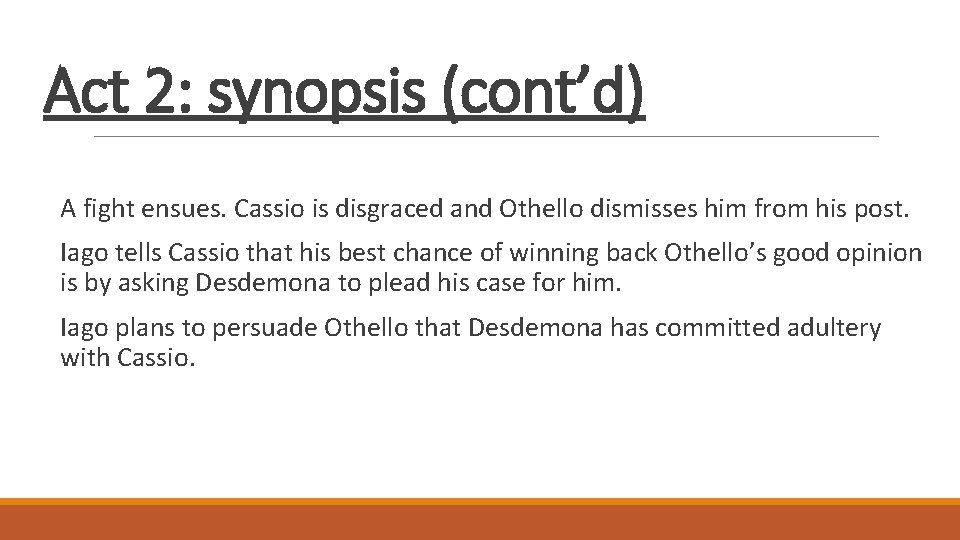
Act 2: synopsis (cont’d) A fight ensues. Cassio is disgraced and Othello dismisses him from his post. Iago tells Cassio that his best chance of winning back Othello’s good opinion is by asking Desdemona to plead his case for him. Iago plans to persuade Othello that Desdemona has committed adultery with Cassio.
Act 2 Scene 1 ANALYSIS AND EVALUATION 2. 1
Things to focus on: Try to identify dramatic techniques that have been used • Iago’s opinion of women. • Iago’s manipulation, scheming and duplicity • How Othello responds when he is reunited with Desdemona and what it reveals about him
Iago’s opinion of women
“you rise to play and go to bed to work” (113) Suggesting that all women are prostitutes, sexually promiscuous. Reflects the views of the time period that women should not have the same sexual desires as men, that women should be pure, innocent and chaste. Reflects male fears about female sexuality and their worries that their women have sexual thoughts about other men.
“Sir, she would give you so much of her lips as of her tongue she oft bestows on me” (100 -101) Iago is implying that Emilia is a nag and that she talks far too much for his liking. As she talks too much, she does not know her place and is talking out of turn, without his permission. This reflects the prevailing view of the time period that women should be silent: seen and not heard. They should keep quiet unless given permission to speak by their husbands/fathers.
Teacher’s notes Overall, Iago has a very misogynistic opinion of women, as demonstrated through his conversation with Emilia and Desdemona which, ostensibly, is humourous and playful banter but, in reality, is cruel, vindictive and malicious. It could be argued that Iago’s opinion of women reflects the patriarchal view of females which prevailed in the early 17 th century in England.
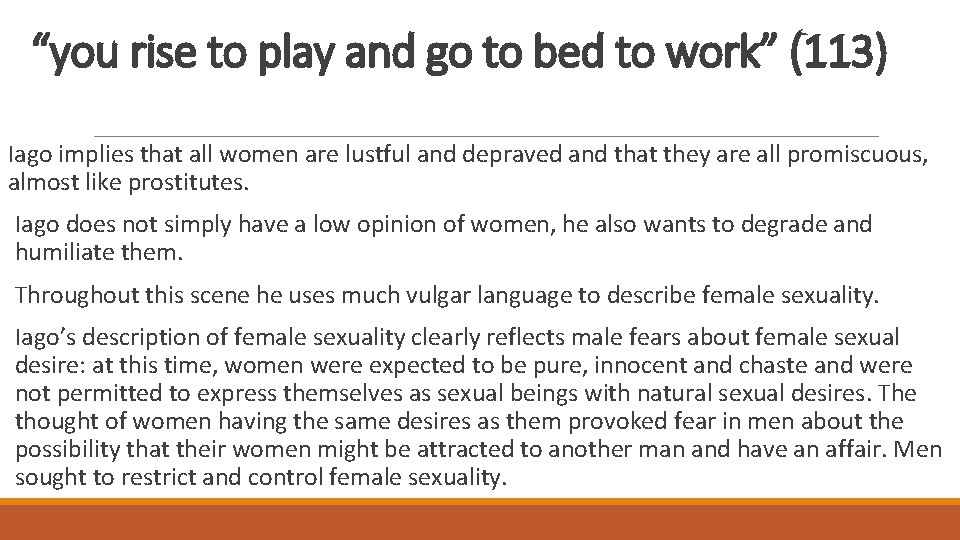
“you rise to play and go to bed to work” (113) Iago implies that all women are lustful and depraved and that they are all promiscuous, almost like prostitutes. Iago does not simply have a low opinion of women, he also wants to degrade and humiliate them. Throughout this scene he uses much vulgar language to describe female sexuality. Iago’s description of female sexuality clearly reflects male fears about female sexual desire: at this time, women were expected to be pure, innocent and chaste and were not permitted to express themselves as sexual beings with natural sexual desires. The thought of women having the same desires as them provoked fear in men about the possibility that their women might be attracted to another man and have an affair. Men sought to restrict and control female sexuality.
Techniques ØCharacterisation ØDialogue
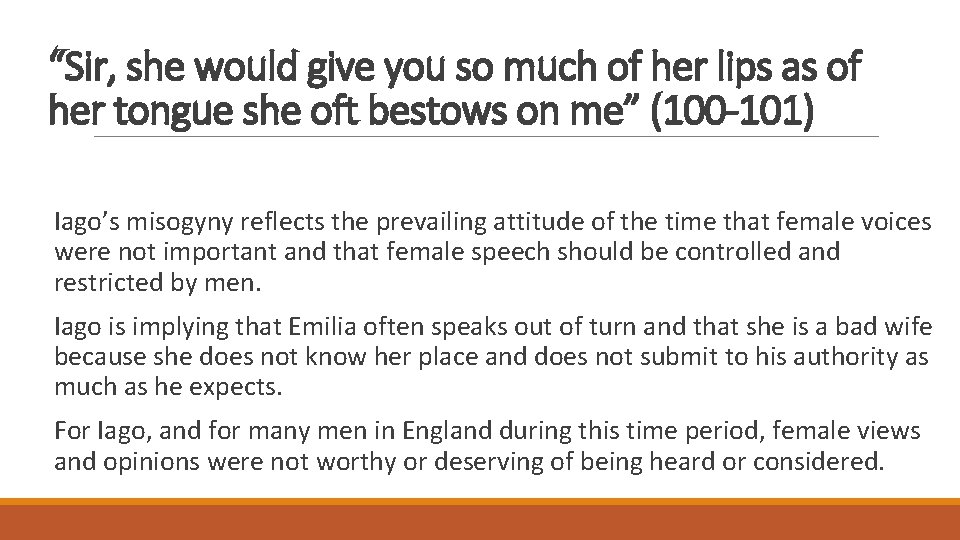
“Sir, she would give you so much of her lips as of her tongue she oft bestows on me” (100 -101) Iago’s misogyny reflects the prevailing attitude of the time that female voices were not important and that female speech should be controlled and restricted by men. Iago is implying that Emilia often speaks out of turn and that she is a bad wife because she does not know her place and does not submit to his authority as much as he expects. For Iago, and for many men in England during this time period, female views and opinions were not worthy or deserving of being heard or considered.
Techniques ØCharacterisation ØDialogue
Iago’s manipulation
“With as little a web as this I will ensnare as great a fly as Cassio” (165) Iago is not only focused on destroying Othello, he is also intending to ruin Cassio as Cassio is undeserving of his promotion. Iago is filled with jealousy and resentment towards Cassio. Iago speaks about how he intends to trap Cassio by setting him up and thus turn Othello against him.
“Desdemona is directly in love with him” (216) Iago is talking to Roderigo, attempting to convince him that Desdemona is in love with Cassio. He is deceiving Roderigo, tricking him. Roderigo believes every word that Iago says due to the amount of control and power Iago has over him. Iago is attempting to make Roderigo angry and jealous, trying to provoke him to take action against Cassio. Iago is using Roderigo as a puppet in order to achieve his villainous goals.
Teacher’s notes
“With as little a web as this I will ensnare as great a fly as Cassio” (165) Even while he is having “playful banter” with Desdemona and Emilia, Iago is actively plotting how to invent an affair between Cassio and Desdemona. Through an aside, Iago reveals to the audience his intricate plans to trap Cassio and use his good looks, charm and friendship with Desdemona to ensure his downfall. Cassio has no idea that his intelligence, fine manners and courtesy around Desdemona are being closely observed by Iago and that he intends to use his innocent behaviour to make him look guilty of betraying his friend, Othello.
Techniques ØAside ØMetaphor ØDialogue ØCharacterisation Throughout this scene, Shakespeare uses a number of asides to give the audience an insight into Iago’s malicious, malevolent and vengeful thoughts and reveal to us how Iago is manoeuvring and manipulating the other characters in order for him to gain his revenge against Othello and Cassio
“Make the Moor thank me, love me, and reward me for making him egregiously an ass” (234) In this soliloquy, Iago reveals how he intends to utilise Roderigo and Cassio in order to gain his revenge against Othello. Iago seems to be obsessed with the idea that Othello slept with Emilia and it is tormenting him. He will not be satisfied until he gets even with him by convincing Othello that Desdemona is an adulteress and thus destroy his marriage, his happiness and his life with jealousy. He wants Othello to feel the same torment and humiliation. He takes advantage of Roderigo’s love for Desdemona by convincing him that she is having an affair with Cassio and persuading him to confront Cassio and provoke him into disgracing himself. Iago will then manipulate Othello into dismissing Cassio as his lieutenant.
Techniques ØSoliloquy ØDialogue ØCharacterisation
Othello’s love for Desdemona An important aspect of Othello’s character development that we must consider is how the language that he uses to speak of Desdemona and his love for her changes after Act 2 when Iago’s manipulation begins to pollute his mind. In Act 2 Scene 1, we clearly see the strength of Othello’s love for Desdemona and the affection he shows towards her. He is overjoyed to see her and is blissfully happy and delighted to be married to her.
“If it were now to die, t’were now to be most happy” (187 -188) Othello states that he is so happy at this moment that if he dies now he will die a happy man. We feel a sense of foreboding as we realise that things cannot get any better for him, they can only get worse. He will never be as happy again as he is now. His mention of death foreshadows the tragic end of the play where he murders Desdemona and then kills himself.
“O my fair warrior” (176) He is not afraid to show his feelings for Desdemona publicly. He acknowledges her strength and bravery in the presence of his men. He refers to her beauty but also shows due regard to her personal qualities. Contrast between his view of women and Iago’s opinions? ? ?
Teacher’s notes
“I fear my soul hath her content so absolute that not another comfort like to this succeeds in unknown fate” (188 -191) When Othello and Desdemona are reunited on Cyprus after the storm he states that he is at the height of his happiness and that if he were to die at that moment he’d be completely happy as he’d probably never be as happy again in his life. His mention of an “unknown fate” is an example of foreshadowing as it hints towards the tragic manner in which his marriage to Desdemona ends in jealousy, murder and suicide.
Techniques ØDialogue ØCharacterisation
“If after every tempest come such calms, may the winds blow until they have wakened death” (185186) Othello’s overwhelming and powerful feelings of love and devotion for Desdemona are clearly illustrated here as he suggests that he would be prepared to come through terrible dangers as long as he had Desdemona to greet him afterwards. This is dramatic irony as, later in the play, Othello is unable to cope with the danger posed by Iago’s lies and manipulation and he succumbs to obsession and jealousy.
Techniques ØDialogue ØCharacterisation ØMetaphor ØDramatic irony