
Act 2 Scene 1 AO 1 What happens

- Slides: 30
Act 2, Scene 1 AO 1: What happens in this scene? Look at your notes and quickly summarise.
Recapping events of Act 2 Scene 1 • The Turkish fleet is destroyed by the storm • Cassio arrives in Cyprus, followed shortly after by Iago, Desdemona, Emilia and Roderigo. • Iago notices the little courtesy of Cassio taking Desdemona’s hand (enough of a web to “ensnare as great a fly as Cassio”. ) • Othello arrives = speaks of his love for Desdemona. • Iago convinces Roderigo to provoke Cassio into losing his temper later that evening, in an attempt to force Othello to remove Cassio from his position as lieutenant. • Iago is left alone onstage at the end of the scene to offer further insight into his motives and his desire for revenge on Othello, Cassio and Desdemona.
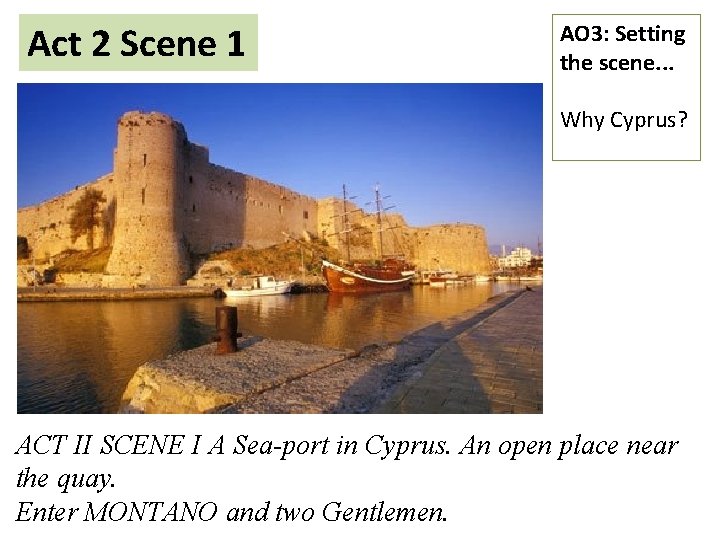
Act 2 Scene 1 AO 3: Setting the scene. . . Why Cyprus? ACT II SCENE I A Sea-port in Cyprus. An open place near the quay. Enter MONTANO and two Gentlemen.
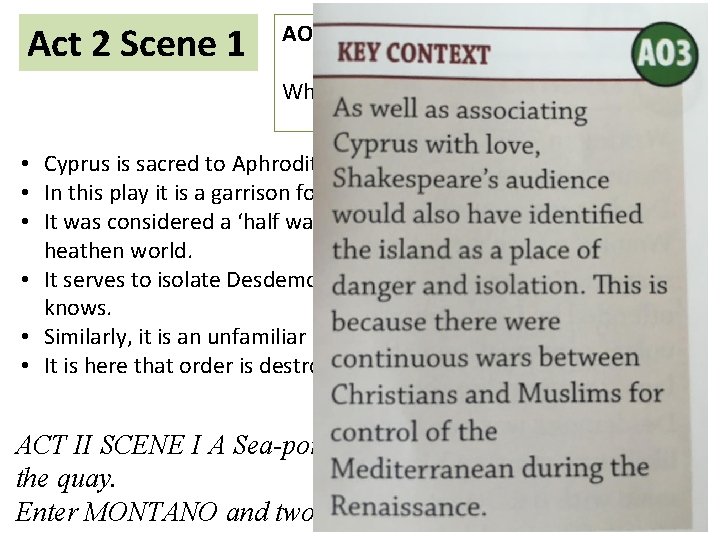
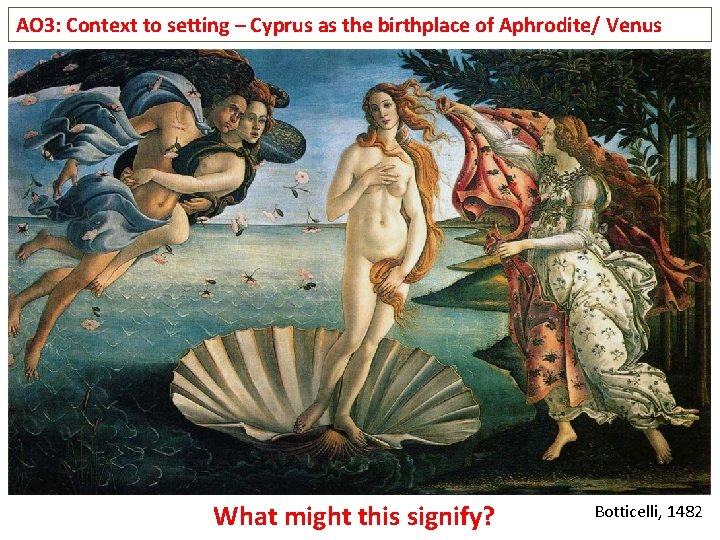
Act 2 Scene 1 AO 3: Setting the scene. . . Why Cyprus? • Cyprus is sacred to Aphrodite/Venus, the goddess of love. • In this play it is a garrison for the war against the Turks. • It was considered a ‘half way house’ between civilisation and the heathen world. • It serves to isolate Desdemona from everything and everyone she knows. • Similarly, it is an unfamiliar setting for Othello. • It is here that order is destroyed. ACT II SCENE I A Sea-port in Cyprus. An open place near the quay. Enter MONTANO and two Gentlemen.
The chidden billow seems to pelt the clouds; The wind-shaked surge, with high and monstrous mane, seems to cast water on the burning bear, And quench the guards of the ever-fixed pole 12 What is the significance of the storm? Does is act as a metaphor? How? Possible points: – the storm is a symbol of unrest about to be seen in the play (the trouble brewing for Othello, Desdemona, etc. ) – The storm marks the end of the peaceful part of the play, and is an act of fate, marking the replacement of the external threat (attack from the Turks) with an internal threat (Iago) – Might the storm represent Iago and be a metaphor for his violent desires? Or perhaps Othello and his violent emotions? – Does his arrival before the others signify that Iago will be in charge of the ‘storm’ in this Cyprus setting? – The storm mirrors the chaos of Act 1 Scene 1
AO 3: Context to setting – Cyprus as the birthplace of Aphrodite/ Venus What might this signify? Botticelli, 1482
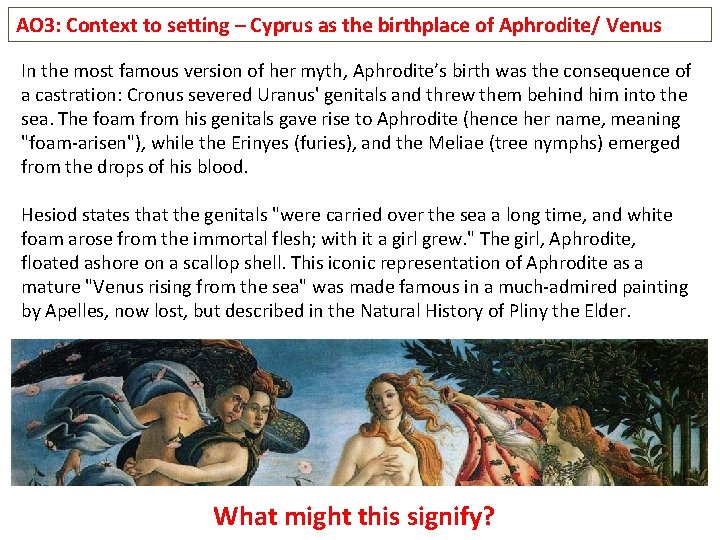
AO 3: Context to setting – Cyprus as the birthplace of Aphrodite/ Venus In the most famous version of her myth, Aphrodite’s birth was the consequence of a castration: Cronus severed Uranus' genitals and threw them behind him into the sea. The foam from his genitals gave rise to Aphrodite (hence her name, meaning "foam-arisen"), while the Erinyes (furies), and the Meliae (tree nymphs) emerged from the drops of his blood. Hesiod states that the genitals "were carried over the sea a long time, and white foam arose from the immortal flesh; with it a girl grew. " The girl, Aphrodite, floated ashore on a scallop shell. This iconic representation of Aphrodite as a mature "Venus rising from the sea" was made famous in a much-admired painting by Apelles, now lost, but described in the Natural History of Pliny the Elder. What might this signify?
Character Development: What do these lines tell us about Iago? While they anxiously await Othello’s arrival, Iago jokes with Desdemona and Emilia. AO 2 Lines 110 -13: “Come on, come on; you are pictures out of doors, Bells in your parlours, wild-cats in your kitchens, Saints in your injuries, devils being offended, Players in your housewifery, and housewives' in your beds. ” Line 116: “You rise to play and go to bed to work. ” What does his language suggest?
Character Development: What do these lines tell us about Iago? While they anxiously await Othello’s arrival, Iago jokes with Desdemona and Emilia. AO 2 Lines 110 -13: “Come on, come on; you are pictures out of doors, Bells in your parlours, wild-cats in your kitchens, Saints in your injuries, devils being offended, Players in your housewifery, and housewives' in your beds. ” Line 116: “You rise to play and go to bed to work. ” Iago has a very low opinion of women. His language is crudely sexual and he describes them as false, inferior creatures. Ironically, the sentiments he expresses when joking around are close to the misogynistic opinions he offers in his soliloquies. The other characters, then, may not take him seriously – Desdemona and Emilia seem amused by him – but the audience does. We see Iago’s views about women influence other male characters throughout the play.
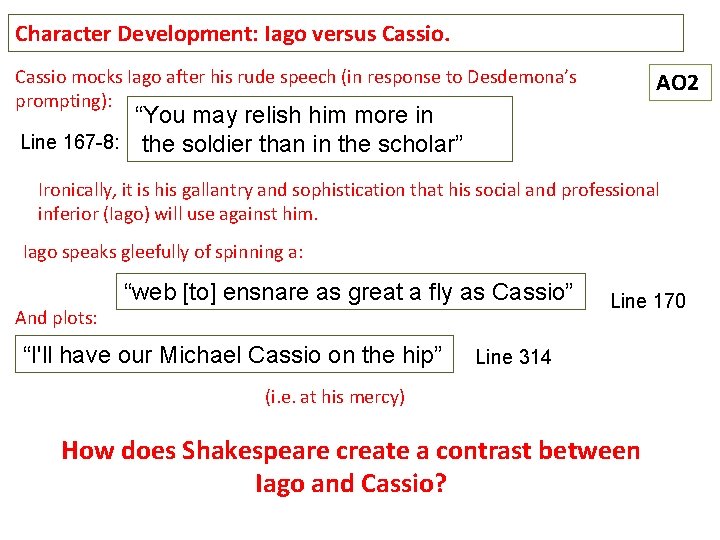
Character Development: Iago versus Cassio mocks Iago after his rude speech (in response to Desdemona’s prompting): AO 2 “You may relish him more in Line 167 -8: the soldier than in the scholar” Ironically, it is his gallantry and sophistication that his social and professional inferior (Iago) will use against him. Iago speaks gleefully of spinning a: And plots: “web [to] ensnare as great a fly as Cassio” “I'll have our Michael Cassio on the hip” Line 170 Line 314 (i. e. at his mercy) How does Shakespeare create a contrast between Iago and Cassio?
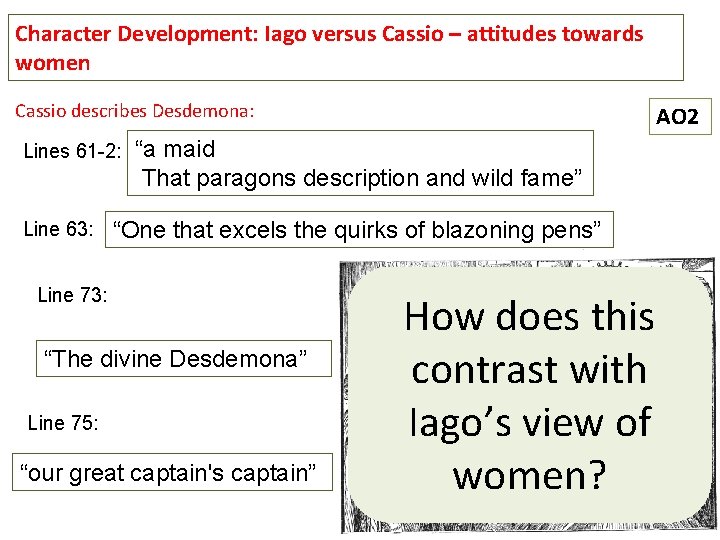
Character Development: Iago versus Cassio – attitudes towards women Cassio describes Desdemona: Lines 61 -2: Line 63: AO 2 “a maid That paragons description and wild fame” “One that excels the quirks of blazoning pens” Line 73: “The divine Desdemona” Line 75: “our great captain's captain” How does this contrast with Iago’s view of women?
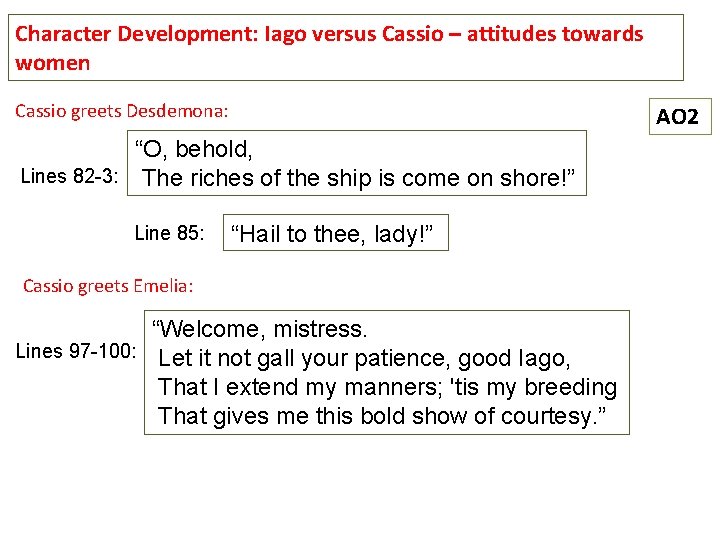
Character Development: Iago versus Cassio – attitudes towards women Cassio greets Desdemona: AO 2 “O, behold, Lines 82 -3: The riches of the ship is come on shore!” Line 85: “Hail to thee, lady!” Cassio greets Emelia: “Welcome, mistress. Lines 97 -100: Let it not gall your patience, good Iago, That I extend my manners; 'tis my breeding That gives me this bold show of courtesy. ”
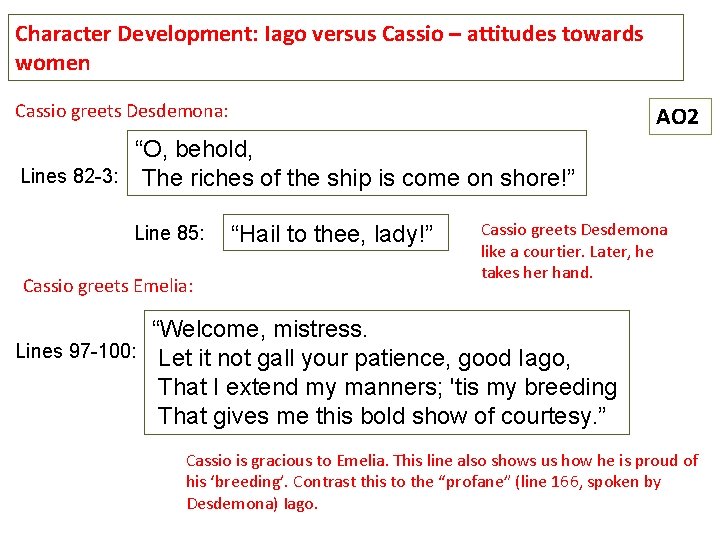
Character Development: Iago versus Cassio – attitudes towards women Cassio greets Desdemona: AO 2 “O, behold, Lines 82 -3: The riches of the ship is come on shore!” Line 85: Cassio greets Emelia: “Hail to thee, lady!” Cassio greets Desdemona like a courtier. Later, he takes her hand. “Welcome, mistress. Lines 97 -100: Let it not gall your patience, good Iago, That I extend my manners; 'tis my breeding That gives me this bold show of courtesy. ” Cassio is gracious to Emelia. This line also shows us how he is proud of his ‘breeding’. Contrast this to the “profane” (line 166, spoken by Desdemona) Iago.
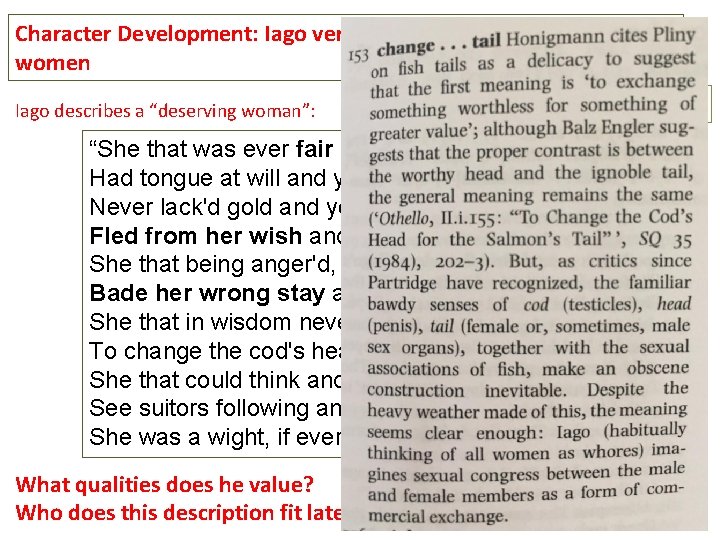
Character Development: Iago versus Cassio – attitudes towards women Iago describes a “deserving woman”: Lines 148 -159: “She that was ever fair and never proud, Had tongue at will and yet was never loud, Never lack'd gold and yet went never gay, Fled from her wish and yet said 'Now I may, ' She that being anger'd, her revenge being nigh, Bade her wrong stay and her displeasure fly, She that in wisdom never was so frail To change the cod's head for the salmon's tail; She that could think and ne'er disclose her mind, See suitors following and not look behind, She was a wight, if ever such wight were, --!” What qualities does he value? Who does this description fit later on in the play? AO 2
Character Development: Iago versus Cassio – attitudes towards women “She that was ever fair and never proud, Had tongue at will and yet was never loud, Never lack'd gold and yet went never gay, Fled from her wish and yet said 'Now I may, ' She that being anger'd, her revenge being nigh, Bade her wrong stay and her displeasure fly, She that in wisdom never was so frail To change the cod's head for the salmon's tail; She that could think and ne'er disclose her mind, See suitors following and not look behind, She was a wight, if ever such wight were, --!” Lines 103 -4: DESDEMONA Alas, she has no speech. IAGO In faith, too much Irony: at the end of the play, Iago’s villainy is revealed when Emelia refuses to be silent. Iago’s ideal woman is fair, humble, not a show off, passive, cautious, silent and unaware. These qualities can be seen in Desdemona when she plays a submissive role later on in the play. Is she like this now?
Character Development: What do these lines tell us about Desdemona? AO 2 Desdemona’s response to Iago’s jokes: Line 132: Line 135: “Well praised! How if she be black and witty? ” “Worse and worse. ” Lines 138 -40: “These are old fond paradoxes to make fools laugh i' the alehouse. What miserable praise hast thou for her that's foul and foolish? ” Line 143: “O heavy ignorance! thou praisest the worst best. ” Line 161: “O most lame and impotent conclusion!”
Character Development: What do these lines tell us about Desdemona? AO 2 Desdemona’s response to Iago’s jokes: Line 132: Line 135: “Well praised! How if she be black and witty? ” “Worse and worse. ” Lines 138 -40: “These are old fond paradoxes to make fools laugh i' the alehouse. What miserable praise hast thou for her that's foul and foolish? ” Line 143: “O heavy ignorance! thou praisest the worst best. ” Line 161: “O most lame and impotent conclusion!” She is speaking wittily, displaying playful sexuality. She is also speaking in prose.
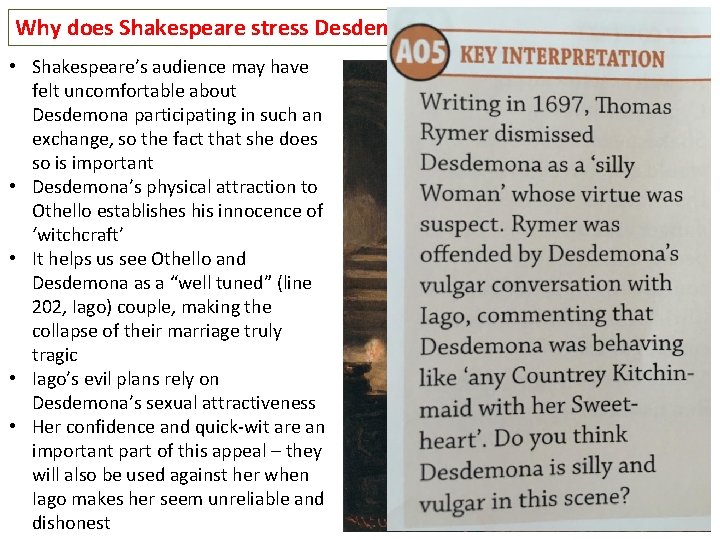
Why does Shakespeare stress Desdemona’s sexuality? • Shakespeare’s audience may have felt uncomfortable about Desdemona participating in such an exchange, so the fact that she does so is important • Desdemona’s physical attraction to Othello establishes his innocence of ‘witchcraft’ • It helps us see Othello and Desdemona as a “well tuned” (line 202, Iago) couple, making the collapse of their marriage truly tragic • Iago’s evil plans rely on Desdemona’s sexual attractiveness • Her confidence and quick-wit are an important part of this appeal – they will also be used against her when Iago makes her seem unreliable and dishonest AO 2
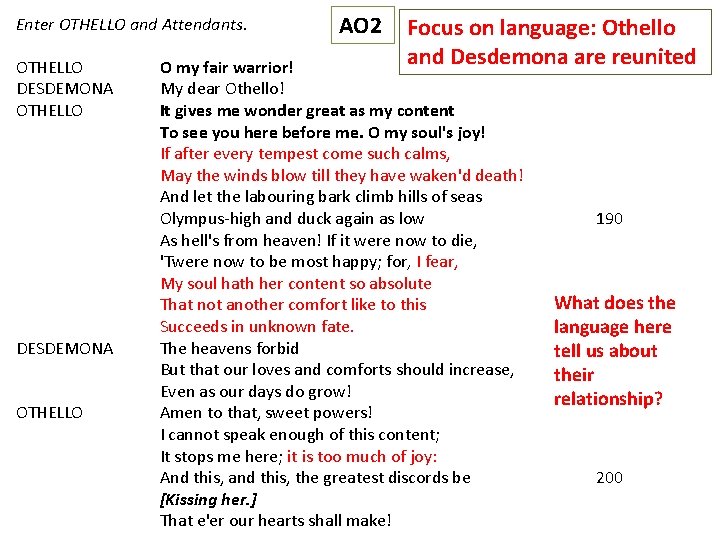
Enter OTHELLO and Attendants. OTHELLO DESDEMONA OTHELLO AO 2 Focus on language: Othello and Desdemona are reunited O my fair warrior! My dear Othello! It gives me wonder great as my content To see you here before me. O my soul's joy! If after every tempest come such calms, May the winds blow till they have waken'd death! And let the labouring bark climb hills of seas Olympus-high and duck again as low As hell's from heaven! If it were now to die, 'Twere now to be most happy; for, I fear, My soul hath her content so absolute That not another comfort like to this Succeeds in unknown fate. The heavens forbid But that our loves and comforts should increase, Even as our days do grow! Amen to that, sweet powers! I cannot speak enough of this content; It stops me here; it is too much of joy: And this, and this, the greatest discords be [Kissing her. ] That e'er our hearts shall make! 190 What does the language here tell us about their relationship? 200
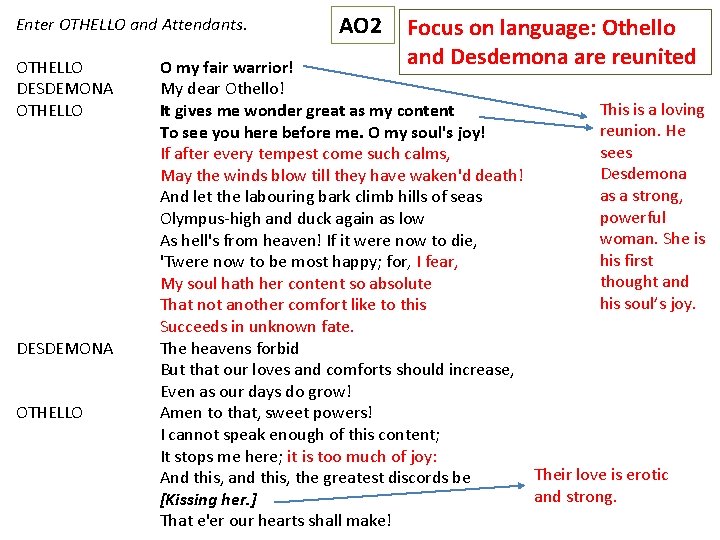
Enter OTHELLO and Attendants. OTHELLO DESDEMONA OTHELLO AO 2 Focus on language: Othello and Desdemona are reunited O my fair warrior! My dear Othello! This is a loving It gives me wonder great as my content reunion. He To see you here before me. O my soul's joy! sees If after every tempest come such calms, Desdemona May the winds blow till they have waken'd death! as a strong, And let the labouring bark climb hills of seas powerful Olympus-high and duck again as low woman. She is As hell's from heaven! If it were now to die, his first 'Twere now to be most happy; for, I fear, thought and My soul hath her content so absolute his soul’s joy. That not another comfort like to this Succeeds in unknown fate. The heavens forbid But that our loves and comforts should increase, Even as our days do grow! Amen to that, sweet powers! I cannot speak enough of this content; It stops me here; it is too much of joy: Their love is erotic And this, and this, the greatest discords be and strong. [Kissing her. ] That e'er our hearts shall make!
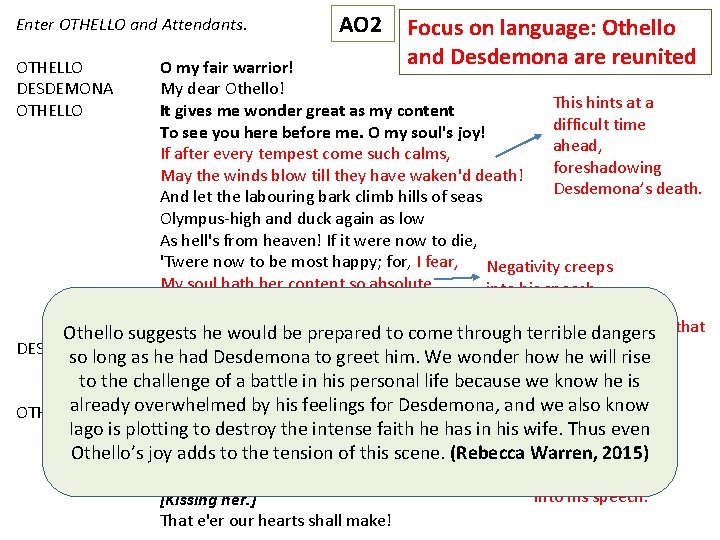
Enter OTHELLO and Attendants. OTHELLO DESDEMONA OTHELLO AO 2 Focus on language: Othello and Desdemona are reunited O my fair warrior! My dear Othello! This hints at a It gives me wonder great as my content difficult time To see you here before me. O my soul's joy! ahead, If after every tempest come such calms, foreshadowing May the winds blow till they have waken'd death! Desdemona’s death. And let the labouring bark climb hills of seas Olympus-high and duck again as low As hell's from heaven! If it were now to die, 'Twere now to be most happy; for, I fear, Negativity creeps My soul hath her content so absolute into his speech. That not another comfort like to this Succeeds in unknown fate. This terrible hints at the tragedy that Othello suggests he would be prepared to come through dangers DESDEMONA Thehad heavens forbid to greet him. We wonder awaits them. so long as he Desdemona how he will rise But that our loves and comforts should increase, to the challenge of a battle in his personal life because we know he is Even as our days do grow! already overwhelmed bysweet his feelings OTHELLO Amen to that, powers!for Desdemona, and we also know Iago is plotting to destroy the intense he has in his wife. Thus even I cannot speak enough of this faith content; Othello’s joy adds me to the tension this of scene. It stops here; it is tooof much joy: (Rebecca Warren, 2015) Negativity creeps And this, and this, the greatest discords be into his speech. [Kissing her. ] That e'er our hearts shall make!
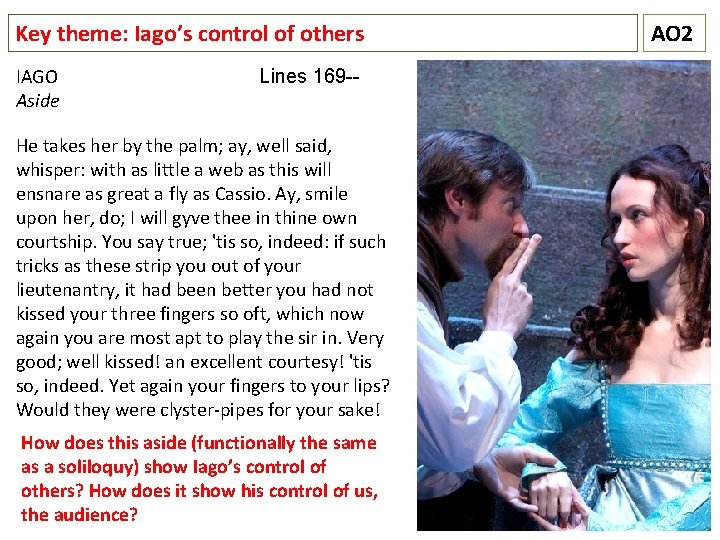
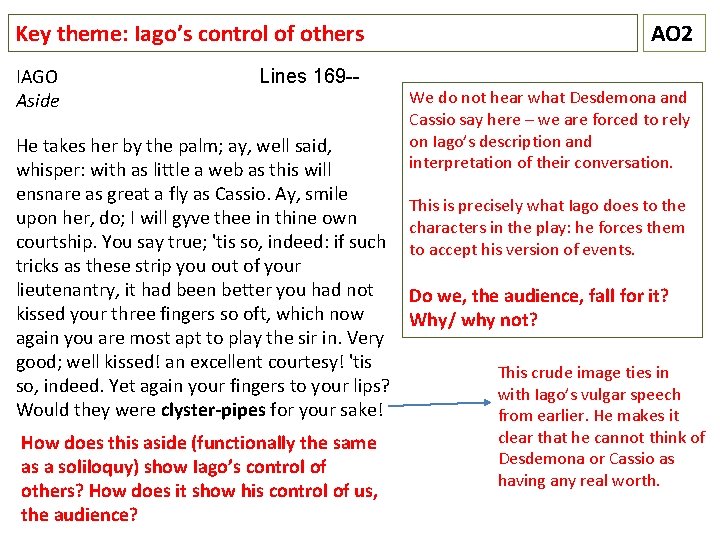
Key theme: Iago’s control of others IAGO Aside Lines 169 -- He takes her by the palm; ay, well said, whisper: with as little a web as this will ensnare as great a fly as Cassio. Ay, smile upon her, do; I will gyve thee in thine own courtship. You say true; 'tis so, indeed: if such tricks as these strip you out of your lieutenantry, it had been better you had not kissed your three fingers so oft, which now again you are most apt to play the sir in. Very good; well kissed! an excellent courtesy! 'tis so, indeed. Yet again your fingers to your lips? Would they were clyster-pipes for your sake! How does this aside (functionally the same as a soliloquy) show Iago’s control of others? How does it show his control of us, the audience? AO 2
Key theme: Iago’s control of others IAGO Aside Lines 169 -- He takes her by the palm; ay, well said, whisper: with as little a web as this will ensnare as great a fly as Cassio. Ay, smile upon her, do; I will gyve thee in thine own courtship. You say true; 'tis so, indeed: if such tricks as these strip you out of your lieutenantry, it had been better you had not kissed your three fingers so oft, which now again you are most apt to play the sir in. Very good; well kissed! an excellent courtesy! 'tis so, indeed. Yet again your fingers to your lips? Would they were clyster-pipes for your sake! How does this aside (functionally the same as a soliloquy) show Iago’s control of others? How does it show his control of us, the audience? AO 2 We do not hear what Desdemona and Cassio say here – we are forced to rely on Iago’s description and interpretation of their conversation. This is precisely what Iago does to the characters in the play: he forces them to accept his version of events. Do we, the audience, fall for it? Why/ why not? This crude image ties in with Iago’s vulgar speech from earlier. He makes it clear that he cannot think of Desdemona or Cassio as having any real worth.
Key theme: Iago’s control of others AO 2 Iago tells Roderigo that Desdemona is in love with Cassio. He doubts this but has his mind changed by Iago’s persuasive speech. What interpretation does he offer of Othello and Desdemona’s relationship? How does it tie in with what we have already seen in this scene? Lines 216 -- “Mark me with what violence she first loved the Moor, but for bragging and telling her fantastical lies: and will she love him still for prating? let not thy discreet heart think it. Her eye must be fed; and what delight shall she have to look on the devil? When the blood is made dull with the act of sport, there should be, again to inflame it and to give satiety a fresh appetite, loveliness in favour, sympathy in years, manners and beauties; all which the Moor is defective in: now, for want of these required conveniences, her delicate tenderness will find itself abused, begin to heave the gorge, disrelish and abhor the Moor; very nature will instruct her in it and compel her to some second choice. Now, sir, this granted, --as it is a most pregnant and unforced position--who stands so eminent in the degree of this fortune as Cassio does? ”
Key theme: Iago’s control of others “Mark me with what violence she first loved the Moor, but for bragging and telling her fantastical lies: and will she love him still for prating? let not thy discreet heart think it. Her eye must be fed; and what delight shall she have to look on the devil? When the blood is made dull with the act of sport, there should be, again to inflame it and to give satiety a fresh appetite, loveliness in favour, sympathy in years, manners and beauties; all which the Moor is defective in: now, for want of these required conveniences, her delicate tenderness will find itself abused, begin to heave the gorge, disrelish and abhor the Moor; very nature will instruct her in it and compel her to some second choice. Now, sir, this granted, --as it is a most pregnant and unforced position--who stands so eminent in the degree of this fortune as Cassio does? ” AO 2 • He assumes Othello’s stories are lies and bragging • He displays racist ideology – it is against “nature” for Desdemona to be with Othello; he is “the devil” and physically “defective” • He shows his misogyny – Desdemona has an “eye [that] must be fed” and she will soon grow bored of the “act of sport” (sex) with someone physically like him; in fact, it will make her physically sick • Desdemona’s love for Othello is so inexplicable that he must dismiss it as lust
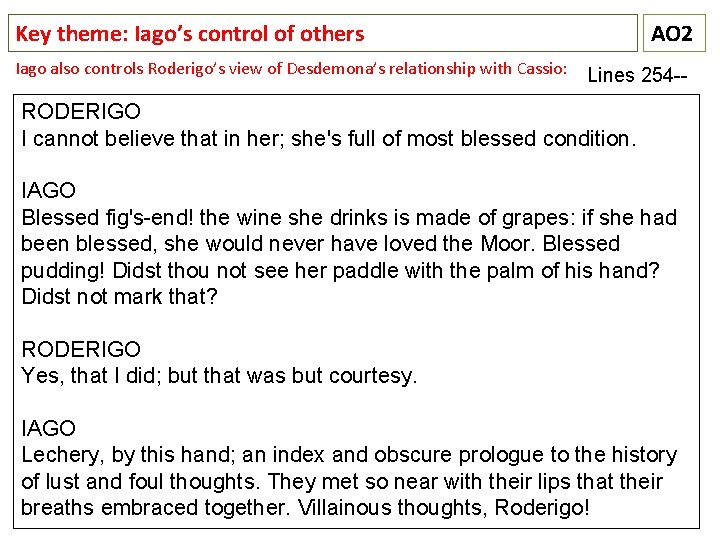
Key theme: Iago’s control of others Iago also controls Roderigo’s view of Desdemona’s relationship with Cassio: AO 2 Lines 254 -- RODERIGO I cannot believe that in her; she's full of most blessed condition. IAGO Blessed fig's-end! the wine she drinks is made of grapes: if she had been blessed, she would never have loved the Moor. Blessed pudding! Didst thou not see her paddle with the palm of his hand? Didst not mark that? RODERIGO Yes, that I did; but that was but courtesy. IAGO Lechery, by this hand; an index and obscure prologue to the history of lust and foul thoughts. They met so near with their lips that their breaths embraced together. Villainous thoughts, Roderigo!
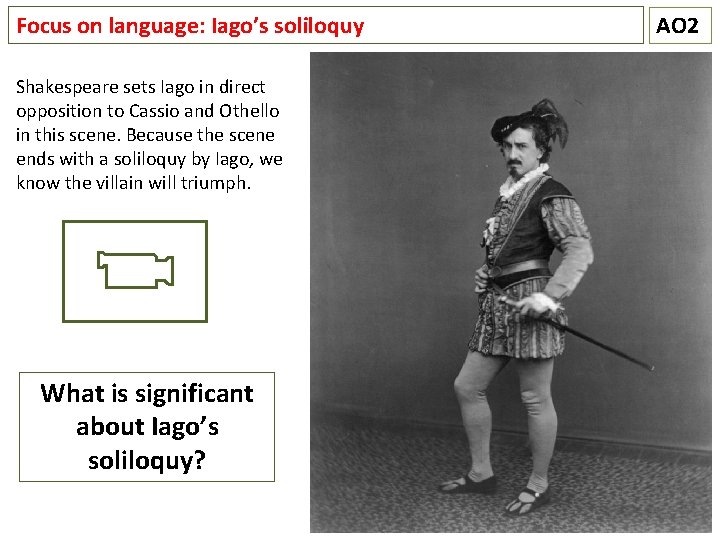
Focus on language: Iago’s soliloquy Shakespeare sets Iago in direct opposition to Cassio and Othello in this scene. Because the scene ends with a soliloquy by Iago, we know the villain will triumph. What is significant about Iago’s soliloquy? AO 2
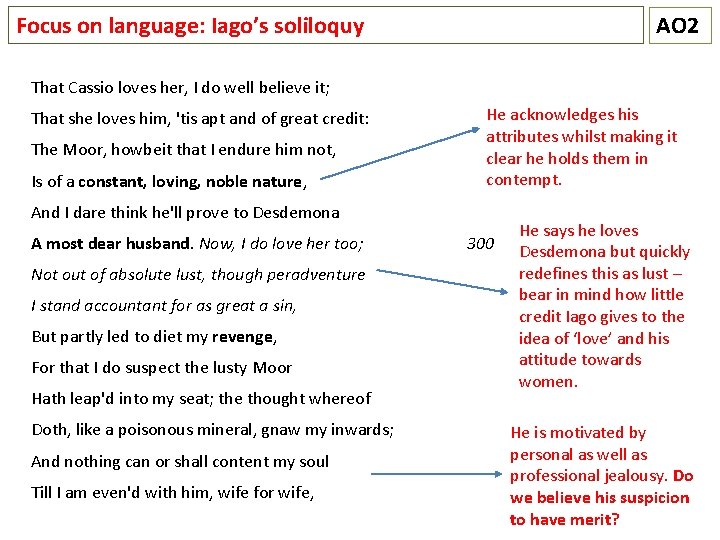
Focus on language: Iago’s soliloquy AO 2 That Cassio loves her, I do well believe it; That she loves him, 'tis apt and of great credit: The Moor, howbeit that I endure him not, Is of a constant, loving, noble nature, He acknowledges his attributes whilst making it clear he holds them in contempt. And I dare think he'll prove to Desdemona A most dear husband. Now, I do love her too; Not out of absolute lust, though peradventure I stand accountant for as great a sin, But partly led to diet my revenge, For that I do suspect the lusty Moor Hath leap'd into my seat; the thought whereof Doth, like a poisonous mineral, gnaw my inwards; And nothing can or shall content my soul Till I am even'd with him, wife for wife, 300 He says he loves Desdemona but quickly redefines this as lust – bear in mind how little credit Iago gives to the idea of ‘love’ and his attitude towards women. He is motivated by personal as well as professional jealousy. Do we believe his suspicion to have merit?
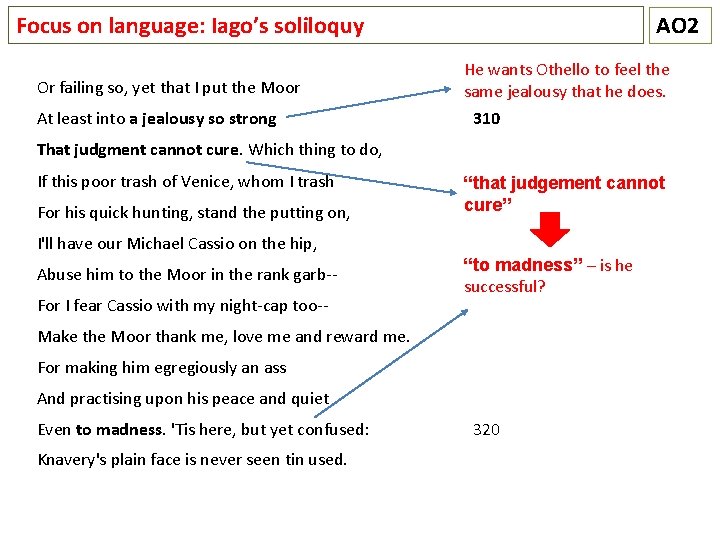
Focus on language: Iago’s soliloquy Or failing so, yet that I put the Moor At least into a jealousy so strong AO 2 He wants Othello to feel the same jealousy that he does. 310 That judgment cannot cure. Which thing to do, If this poor trash of Venice, whom I trash For his quick hunting, stand the putting on, I'll have our Michael Cassio on the hip, Abuse him to the Moor in the rank garb-For I fear Cassio with my night-cap too-- “that judgement cannot cure” “to madness” – is he successful? Make the Moor thank me, love me and reward me. For making him egregiously an ass And practising upon his peace and quiet Even to madness. 'Tis here, but yet confused: Knavery's plain face is never seen tin used. 320
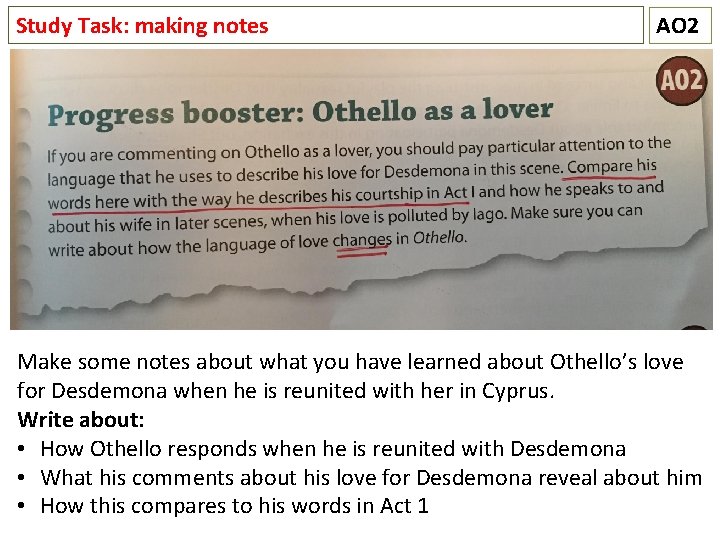
Study Task: making notes AO 2 Make some notes about what you have learned about Othello’s love for Desdemona when he is reunited with her in Cyprus. Write about: • How Othello responds when he is reunited with Desdemona • What his comments about his love for Desdemona reveal about him • How this compares to his words in Act 1