
Optimal Decision Making with CPnets and PCPnets Sibel
Optimal Decision Making with CP-nets and PCP-nets Sibel Adali, Sujoy Sikdar, Lirong Xia
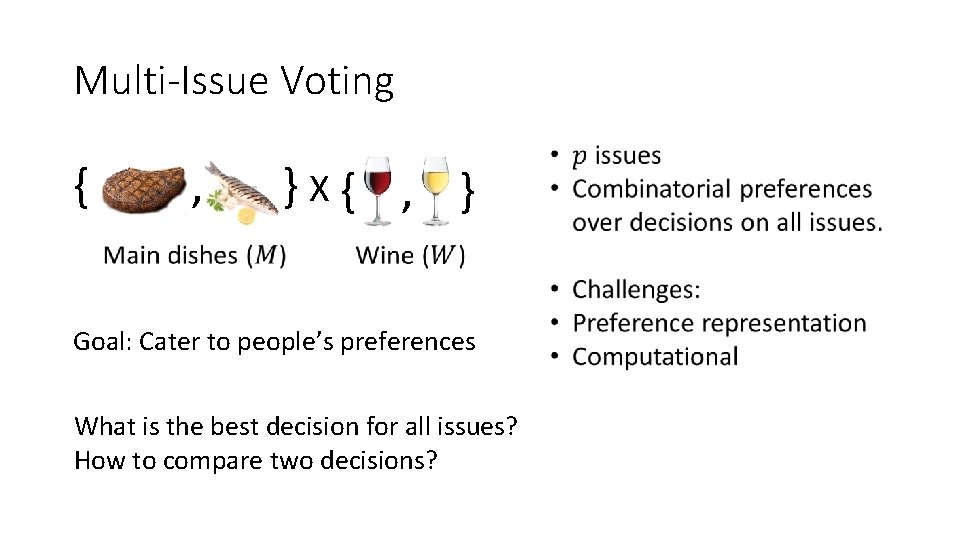
Multi-Issue Voting { , } X { , } Goal: Cater to people’s preferences What is the best decision for all issues? How to compare two decisions?
![Compact Preference Languages and CP-nets [Boutilier et al. ‘ 04] “I prefer red wine](http://slidetodoc.com/presentation_image_h/0a0b0ceb5982200ba2395bdeb0543b48/image-3.jpg "Compact Preference Languages and CP-nets [Boutilier et al. ‘ 04] “I prefer red wine")
Compact Preference Languages and CP-nets [Boutilier et al. ‘ 04] “I prefer red wine to white wine with my meal, ceteris paribus, given that meat is served. ”
Winners are Undominated • No other decision is preferred • Acyclic CP-nets: • Always exists • Unique • Cyclic CP-nets: ? ? ? • Doesn’t always exist • May not be unique
![PCP-nets [Bigot et al. ’ 13, Cornelio et al. ‘ 13]](http://slidetodoc.com/presentation_image_h/0a0b0ceb5982200ba2395bdeb0543b48/image-5.jpg "PCP-nets [Bigot et al. ’ 13, Cornelio et al. ‘ 13]")
PCP-nets [Bigot et al. ’ 13, Cornelio et al. ‘ 13]
PCP-nets are useful • Uncertain preferences [Bigot et al. ’ 13, Cornelio et al. ‘ 13] • Dynamic preferences [Cornelio et al. ‘ 14] • Aggregate CP-net profile as a single PCP-net [Cornelio et al. ‘ 14]
Previous Work • Winner determination • Common assumptions: • Dependencies are acyclic • All preferences have the same structure
Quantitative approach to decision making • Loss Minimization Framework • # (weakly) dominating decisions • Optimal decision = Loss minimizing decision
Main messages • Full generality w. r. t. preferences: • Cyclic dependencies • CP-net and PCP-net profiles • Natural notions of loss • Generalizes previous work • New class of voting rules • And axiomatic properties
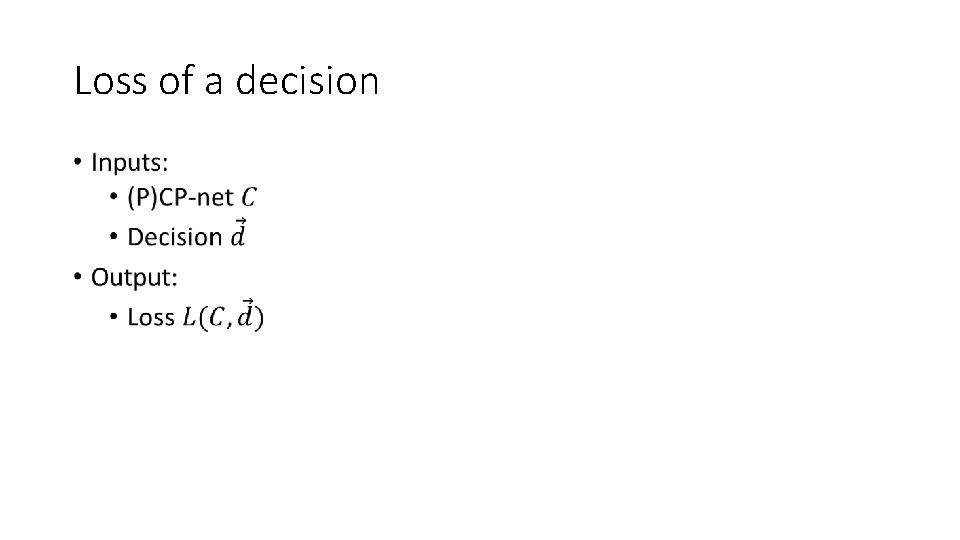
Loss of a decision •
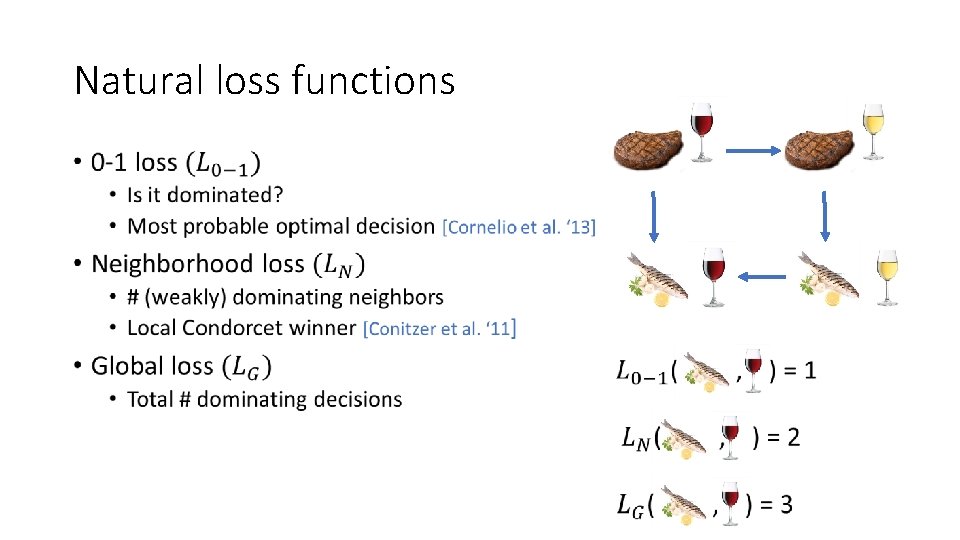
Natural loss functions •
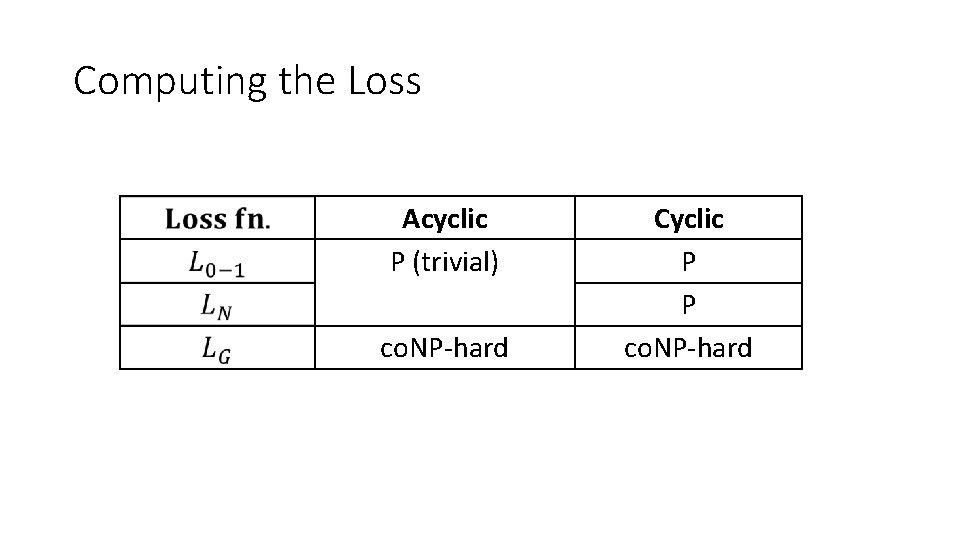
Computing the Loss Acyclic P (trivial) co. NP-hard Cyclic P P co. NP-hard
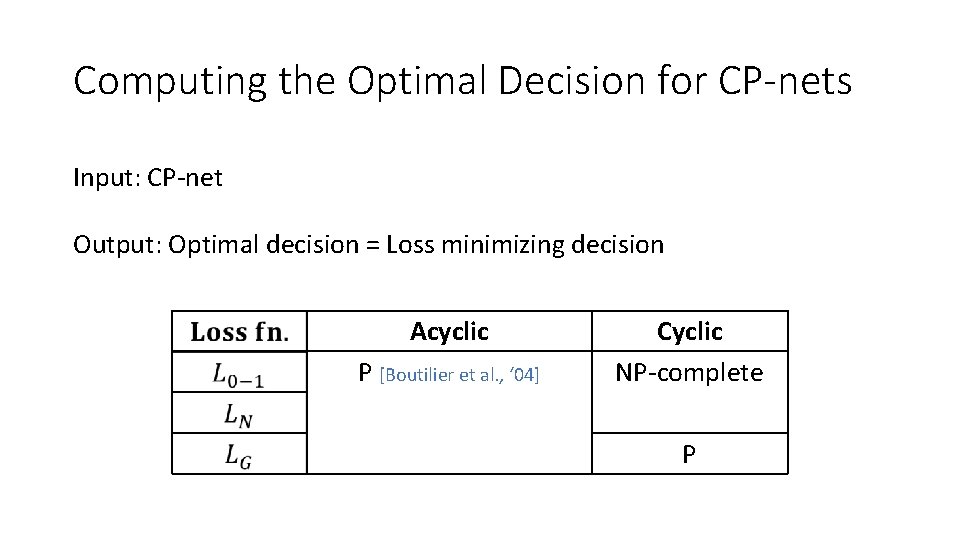
Computing the Optimal Decision for CP-nets Input: CP-net Output: Optimal decision = Loss minimizing decision Acyclic P [Boutilier et al. , ‘ 04] Cyclic NP-complete P
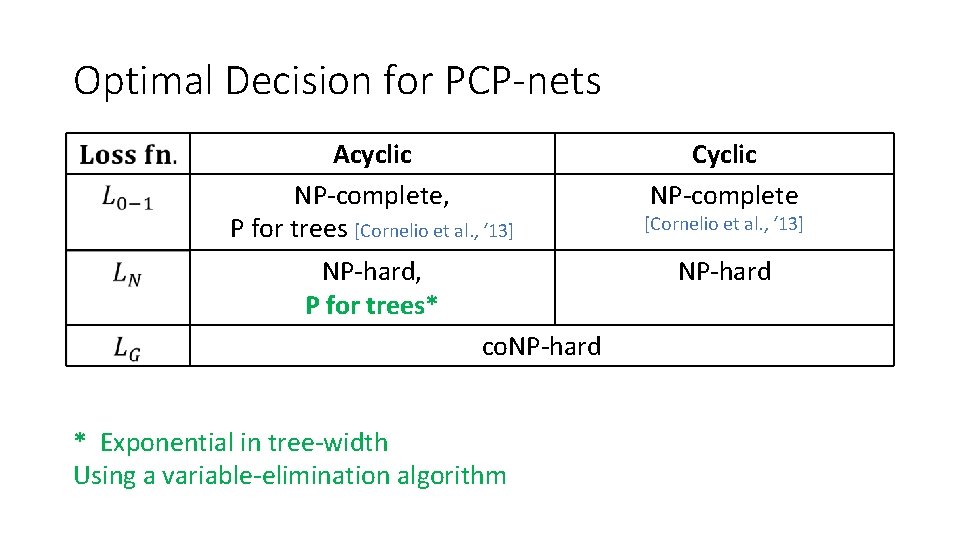
Optimal Decision for PCP-nets Acyclic NP-complete, P for trees [Cornelio et al. , ‘ 13] NP-hard, P for trees* Cyclic NP-complete [Cornelio et al. , ‘ 13] NP-hard co. NP-hard * Exponential in tree-width Using a variable-elimination algorithm
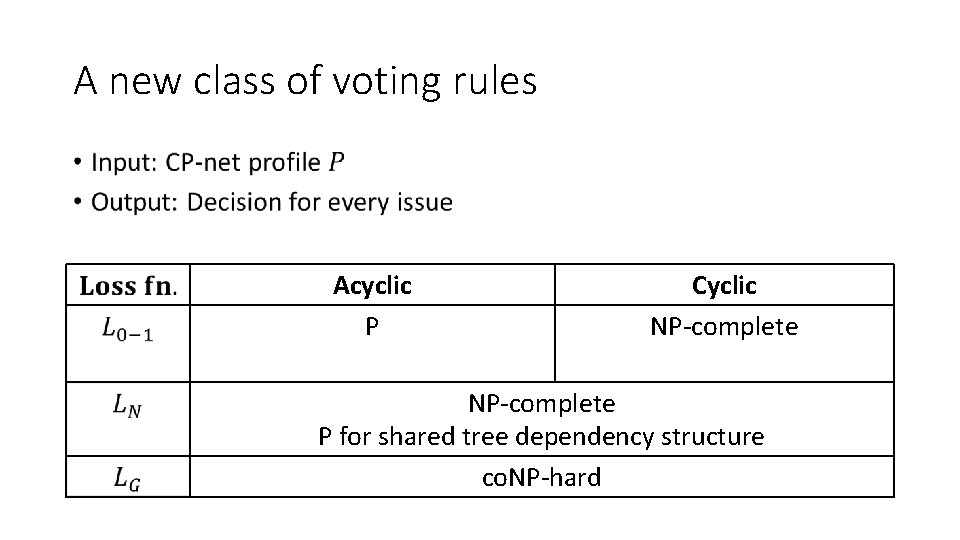
A new class of voting rules • Acyclic P Cyclic NP-complete P for shared tree dependency structure co. NP-hard
Axiomatic Properties • Anonymity • Consistency • Issue-wise neutrality • Weak monotonicity • Satisfied by every rule
Summary and Conclusions • Quantitative approach to multi-issue voting • Fully general: • Cyclic dependencies • CP-net and PCP-net profiles • New loss minimization framework • Natural loss functions • New class of voting rules • Identifying tractable sub-cases for optimal outcome of PCP-nets • Large space of possible loss functions • Good social choice normative properties • Computationally tractable
- Slides: 17