NSERC Information Session for Physics Students Dr Sharon

- Slides: 21
NSERC Information Session for Physics Students Dr. Sharon Morsink Assoc. Chair Grad Studies Department of Physics
Outline • • • What is NSERC? Why apply? How to apply? Adjudication Process What goes into a winning application? Questions & (hopefully) Answers
NSERC • NSERC = Natural Sciences and Engineering Research Council • The main science funding agency in Canada • Professors get their main funding from NSERC, who then use grants to buy equipment, hire students & postdocs • NSERC also directly sponsors undergrads, graduate students & postdocs
MSc NSERC Scholarships • PGSM = Post Grad Scholarship MSc $17, 300/year for 1 year. Scholarship can be taken to any University in Canada or Internationally • CGSM = Canada Grad Schol. MSc $17, 500/year for 1 year. Scholarship can only be held in Canada • There is one application form for both programs NSERC decides which scholarship you get. • Students presently in 4 th year undergrad can get a 1 year scholarship to cover 1 st year of MSc • Students presently in 1 st year MSc can get a 1 year scholarship to cover 2 nd year of MSc • If you are accepted directly into a Ph. D program, you can get the 1 year MSc NSERC scholarship.
Ph. D NSERC Scholarships • PGSD = $21, 000/year for up to 3 years Scholarship can be held in Canada or Internationally • CGSD = $35, 000/year for up to 3 years Scholarship can be held only in Canada • One application for both. NSERC decides which scholarship you get. • Students can apply if they are: – presently in MSc program (or finished MSc). – in 1 st or 2 nd year of Ph. D. – In 3 rd year of Ph. D iff directly BSc->Ph. D program.
Postdoctoral Fellowship • NSERC PDF = $40, 000/year for 2 years • PDF may not be held at the same University where you were a Ph. D student • Strongly recommend that you take fellowship outside of Canada! • Apply directly to NSERC (by Oct. 15)
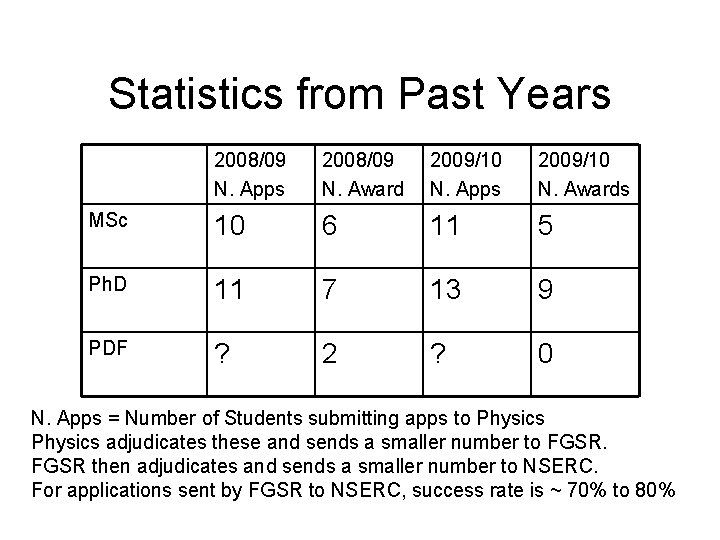
Statistics from Past Years 2008/09 N. Apps 2008/09 N. Award 2009/10 N. Apps 2009/10 N. Awards MSc 10 6 11 5 Ph. D 11 7 13 9 PDF ? 2 ? 0 N. Apps = Number of Students submitting apps to Physics adjudicates these and sends a smaller number to FGSR then adjudicates and sends a smaller number to NSERC. For applications sent by FGSR to NSERC, success rate is ~ 70% to 80%
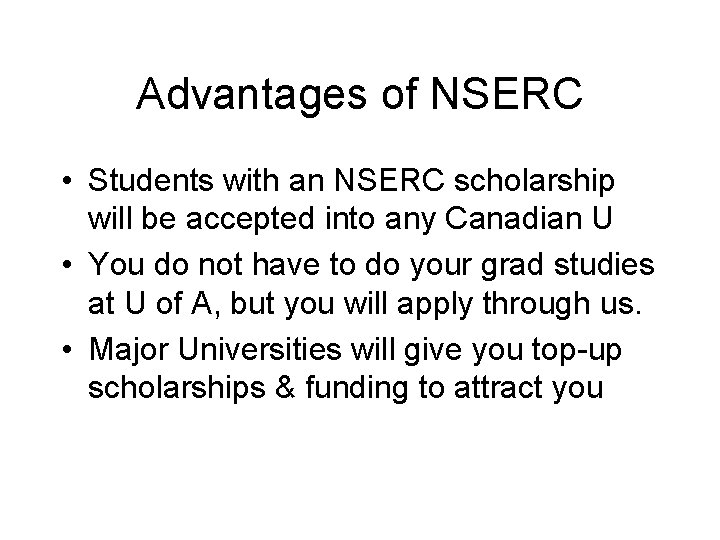
Advantages of NSERC • Students with an NSERC scholarship will be accepted into any Canadian U • You do not have to do your grad studies at U of A, but you will apply through us. • Major Universities will give you top-up scholarships & funding to attract you
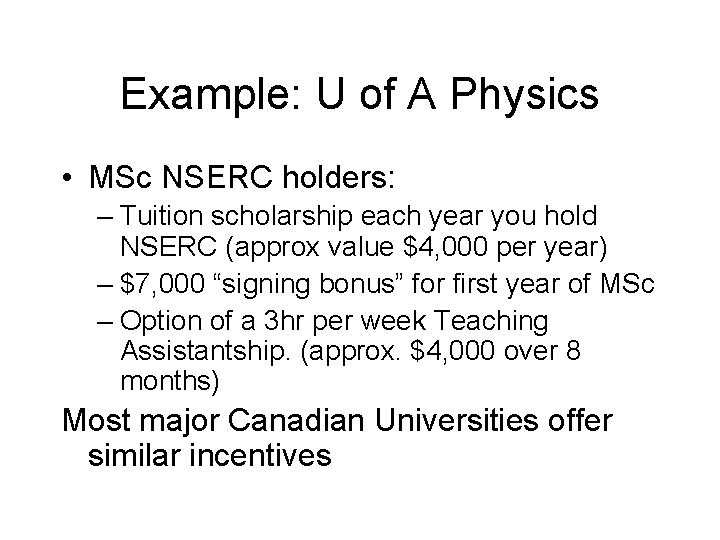
Example: U of A Physics • MSc NSERC holders: – Tuition scholarship each year you hold NSERC (approx value $4, 000 per year) – $7, 000 “signing bonus” for first year of MSc – Option of a 3 hr per week Teaching Assistantship. (approx. $4, 000 over 8 months) Most major Canadian Universities offer similar incentives
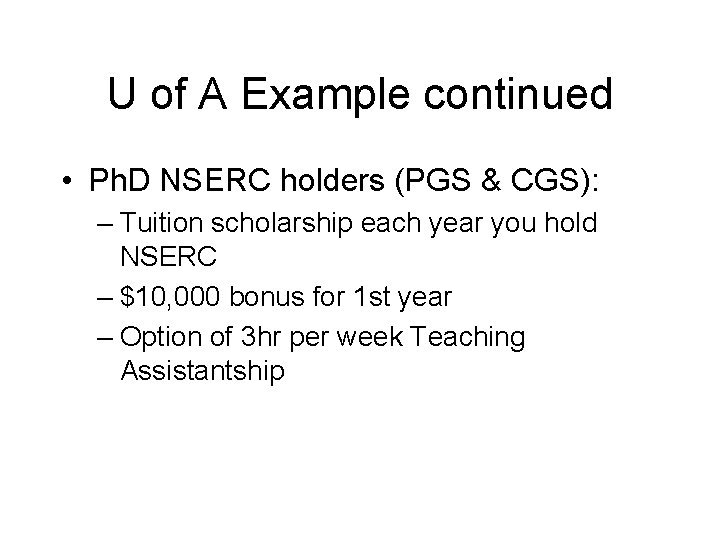
U of A Example continued • Ph. D NSERC holders (PGS & CGS): – Tuition scholarship each year you hold NSERC – $10, 000 bonus for 1 st year – Option of 3 hr per week Teaching Assistantship
NSERC Postdoctoral Fellowship • If offered a NSERC PDF, you can negotiate for extra top-ups or an extra year of funding etc… • Talk to me for advice
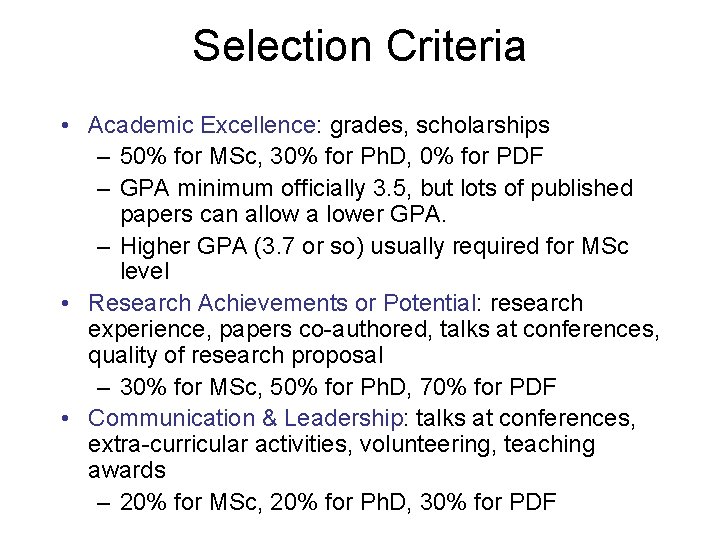
Selection Criteria • Academic Excellence: grades, scholarships – 50% for MSc, 30% for Ph. D, 0% for PDF – GPA minimum officially 3. 5, but lots of published papers can allow a lower GPA. – Higher GPA (3. 7 or so) usually required for MSc level • Research Achievements or Potential: research experience, papers co-authored, talks at conferences, quality of research proposal – 30% for MSc, 50% for Ph. D, 70% for PDF • Communication & Leadership: talks at conferences, extra-curricular activities, volunteering, teaching awards – 20% for MSc, 20% for Ph. D, 30% for PDF
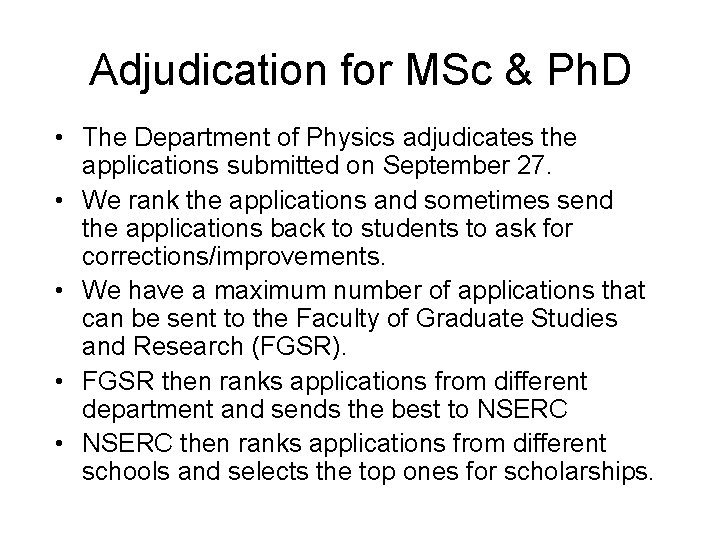
Adjudication for MSc & Ph. D • The Department of Physics adjudicates the applications submitted on September 27. • We rank the applications and sometimes send the applications back to students to ask for corrections/improvements. • We have a maximum number of applications that can be sent to the Faculty of Graduate Studies and Research (FGSR). • FGSR then ranks applications from different department and sends the best to NSERC • NSERC then ranks applications from different schools and selects the top ones for scholarships.
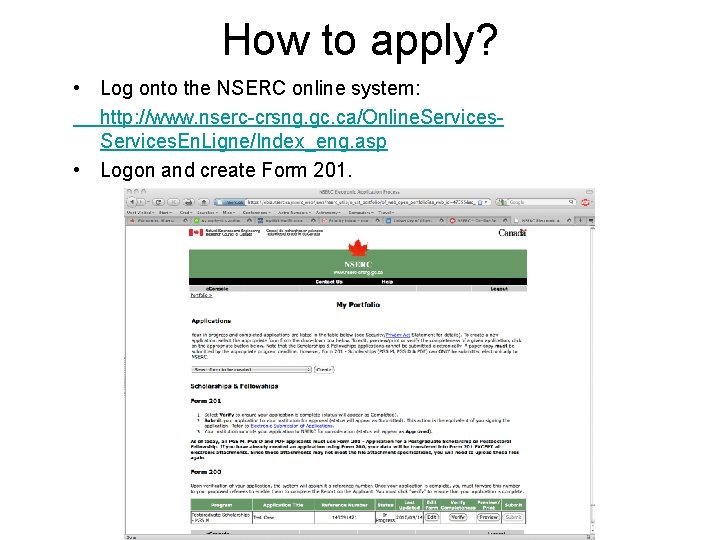
How to apply? • Log onto the NSERC online system: http: //www. nserc-crsng. gc. ca/Online. Services. En. Ligne/Index_eng. asp • Logon and create Form 201.
Form 201 • • • Most of this is easy to do List schools attended and degrees granted List work experience List scholarships Summarize previous thesis (if applicable) only for Ph. D and PDF level • Justification for location of tenure is only for PDF level • MSc & Ph. D level scholarships do not require that you be accepted into a program. • You can put down any University that you might want to attend. The choice is not binding.
Transcripts • Order official paper copies of your transcripts (from all universities that you have attended) and have them mailed to: Sarah Derr, Graduate Student Advisor Room # 2 -38 CEB 11322 -89 th Avenue University of Alberta, Edmonton Alberta, Canada T 6 G 2 G 7 • Uof. A graduate students with transcripts from international universities can talk to Sarah Derr about getting official copies made. • On the page “Transcripts - University” leave the “University Designate” box empty. You will be contacted with the correct name to be added later on.
The Research Proposal • The research proposal is very important • For students who have not yet done research, choose a topic that you find interesting and write a one-page description of the research area. • For more advanced students, write a proposal that is about 1/3 general so that any scientist (outside of physics) could understand it and then go into more details so that any physicist could understand it. Don’t use jargon!!!! • The person reading your proposal might not do research in your specialized field! • Explain the importance of your proposed research in the context of your area of interest • If you have a supervisor, ask him/her to read your proposal and give you comments about what to change. • If you don’t have a supervisor, give me your proposal before Fri. Sept 24. I will read and make comments.
Contributions & Statement 3 parts 1. Contributions to Research & Development = papers*, patents, posters * = If you have a paper that might be submitted soon after the application deadline, tell me the details. 2. Most Significant Contributions Describe importance of 3 most important papers. (for Ph. D & PDF only) Describe your contribution to collaborative work. 3. Applicant’s Statement (next slide)
Applicant’s Statement • (a) Research Experience - Describe relevant experience that is not already listed • (b) Relevant Activities - Describe talks, presentations, extracurricular activities, anything that shows “leadership” and communication abilities • ( c) Special Circumstances - If your grades were low due to illness, etc… • Don’t include ( c) if you don’t have any special circumstances.
Reference Letters • Ask two professors if they can write a reference letter for you. Do this today! • Best if professor knows something about your research. • If a postdoctoral fellow is familiar with your research, you can use the PDF as a reference. • Enter the name and email address of the 2 letter writers. • The NSERC application system will send them emails requesting that they write a letter. • The professors must fill out the on-line form and then print-out a copy and mail, email or fax it to me or Sarah Derr. • Letters are due (in Department of Physics) on Monday Sept 27 for MSc and Ph. D level NSERC
Deadlines • September 27, in Sarah Derr’s Office CEB 238 E for MSc & Ph. D level • You must print out a paper copy of your application and give it to Sarah. • Make sure that Sarah Derr has a copy of your official transcripts. • Do NOT hit “submit” on the on-line NSERC application. Wait until the FGSR (or I) tell you that it is ready to be officially submitted to NSERC. (You can’t make changes once you hit submit!!!!) • Students who graduated before 2010 apply directly to NSERC • PDF applications are sent directly to NSERC by Oct 15. Students apply for a postdoc can give me a paper copy of their application for comments. • This talk (and information sheets) will be posted on my website at: www. ualberta. ca/~morsink