Next homework is 7 due Friday at 11
- Slides: 31
• Next homework is #7– due Friday at 11: 50 am– last one before exam. • Exam #2 is less than two weeks! Friday, November 14 th! • Let’s vote for exam style. • Don’t forget the Icko Iben Lecture on Wednesday. Nov 3, 2003 Astronomy 100 Fall 2003
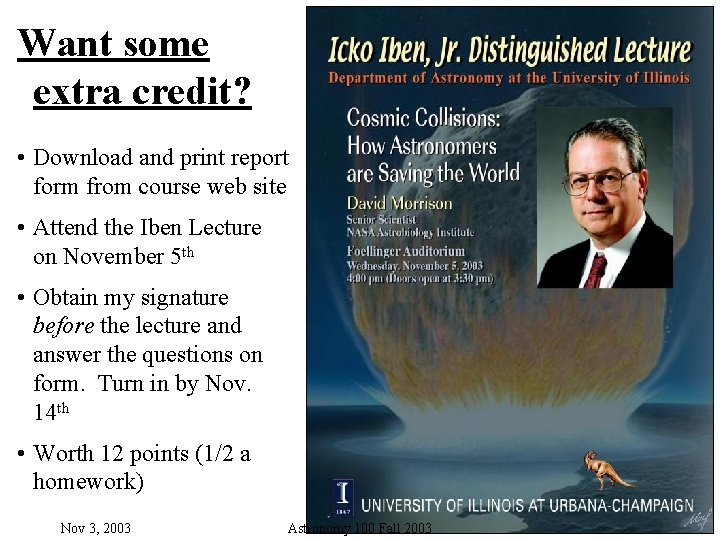
Want some extra credit? • Download and print report form from course web site • Attend the Iben Lecture on November 5 th • Obtain my signature before the lecture and answer the questions on form. Turn in by Nov. 14 th • Worth 12 points (1/2 a homework) Nov 3, 2003 Astronomy 100 Fall 2003
Outline • Finish up summary of star birth. • Birth of a star onto the HR diagram. • Stellar demise depends on the stellar mass. • Higher mass stars– live fast, die hard! • The end of a 1 solar mass star • Main sequence • Red Giant • Planetary nebula and white dwarf Nov 3, 2003 Astronomy 100 Fall 2003
Nov 3, 2003 Astronomy 100 Fall 2003
Nov 3, 2003 Astronomy 100 Fall 2003
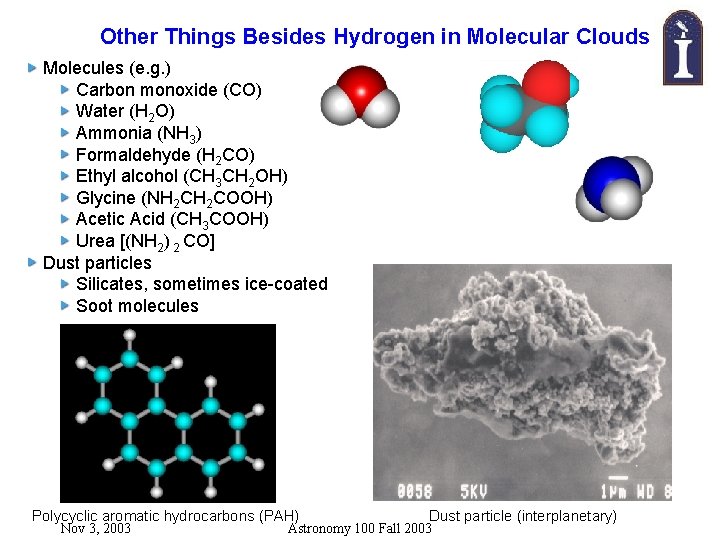
Other Things Besides Hydrogen in Molecular Clouds Molecules (e. g. ) Carbon monoxide (CO) Water (H 2 O) Ammonia (NH 3) Formaldehyde (H 2 CO) Ethyl alcohol (CH 3 CH 2 OH) Glycine (NH 2 COOH) Acetic Acid (CH 3 COOH) Urea [(NH 2) 2 CO] Dust particles Silicates, sometimes ice-coated Soot molecules Polycyclic aromatic hydrocarbons (PAH) Nov 3, 2003 Dust particle (interplanetary) Astronomy 100 Fall 2003
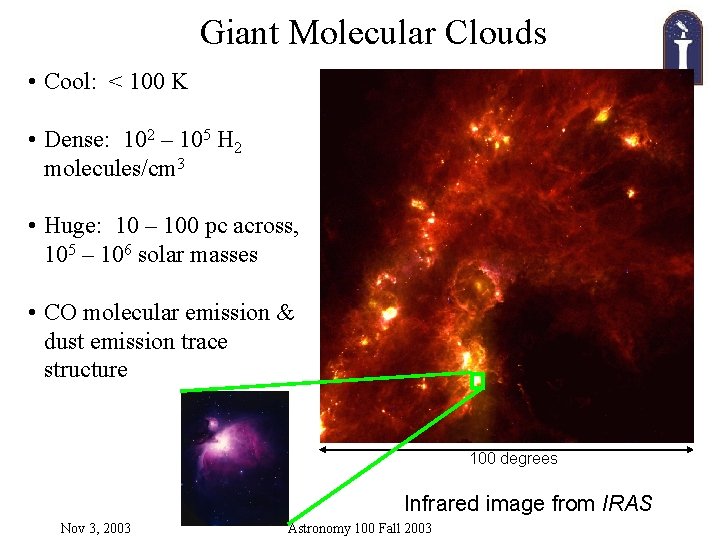
Giant Molecular Clouds • Cool: < 100 K • Dense: 102 – 105 H 2 molecules/cm 3 • Huge: 10 – 100 pc across, 105 – 106 solar masses • CO molecular emission & dust emission trace structure 100 degrees Infrared image from IRAS Nov 3, 2003 Astronomy 100 Fall 2003
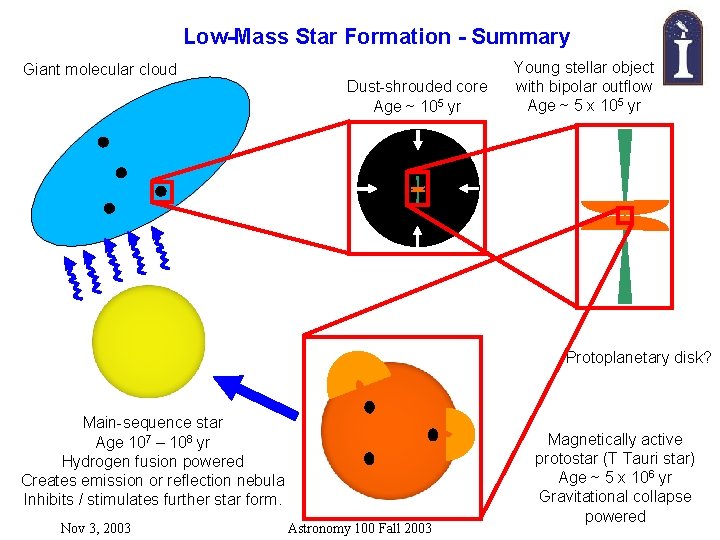
Low-Mass Star Formation - Summary Giant molecular cloud Dust-shrouded core Age ~ 105 yr Young stellar object with bipolar outflow Age ~ 5 x 10⁵ yr Protoplanetary disk? Main-sequence star Age 107 – 108 yr Hydrogen fusion powered Creates emission or reflection nebula Inhibits / stimulates further star form. Nov 3, 2003 Astronomy 100 Fall 2003 Magnetically active protostar (T Tauri star) Age ~ 5 x 10⁶ yr Gravitational collapse powered
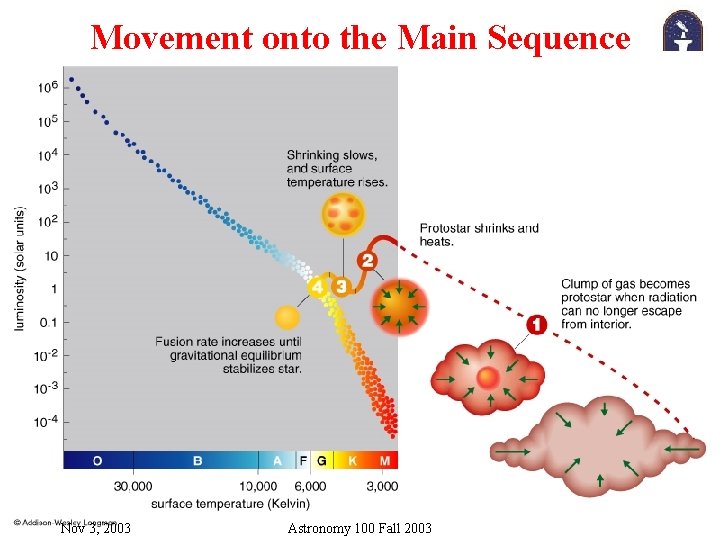
Movement onto the Main Sequence Nov 3, 2003 Astronomy 100 Fall 2003
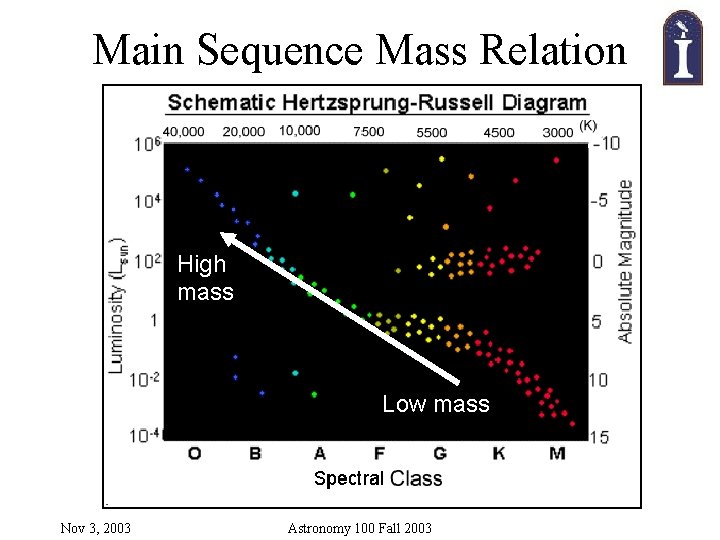
Main Sequence Mass Relation High mass Low mass Nov 3, 2003 Astronomy 100 Fall 2003
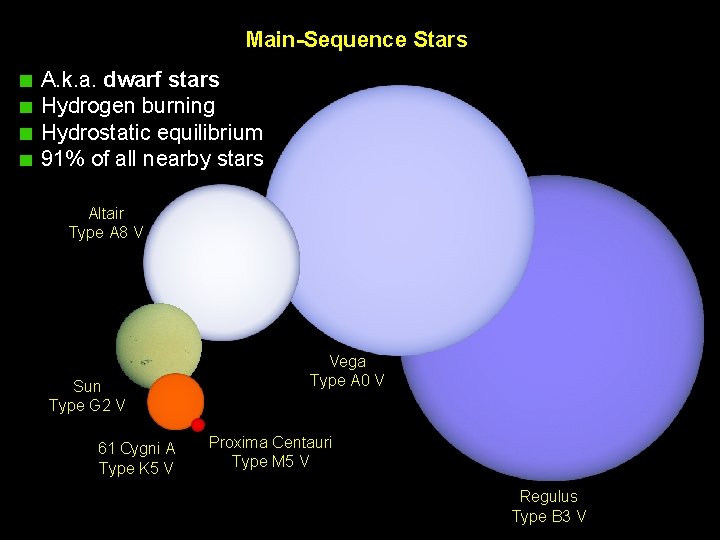
Main-Sequence Stars A. k. a. dwarf stars Hydrogen burning Hydrostatic equilibrium 91% of all nearby stars Altair Type A 8 V Sun Type G 2 V 61 Cygni A Type K 5 V Nov 3, 2003 Vega Type A 0 V Proxima Centauri Type M 5 V Astronomy 100 Fall 2003 Regulus Type B 3 V
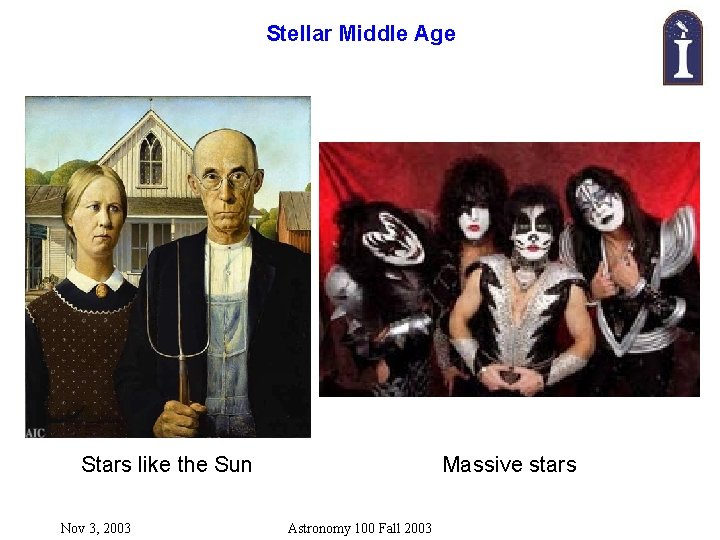
Stellar Middle Age Stars like the Sun Nov 3, 2003 Massive stars Astronomy 100 Fall 2003
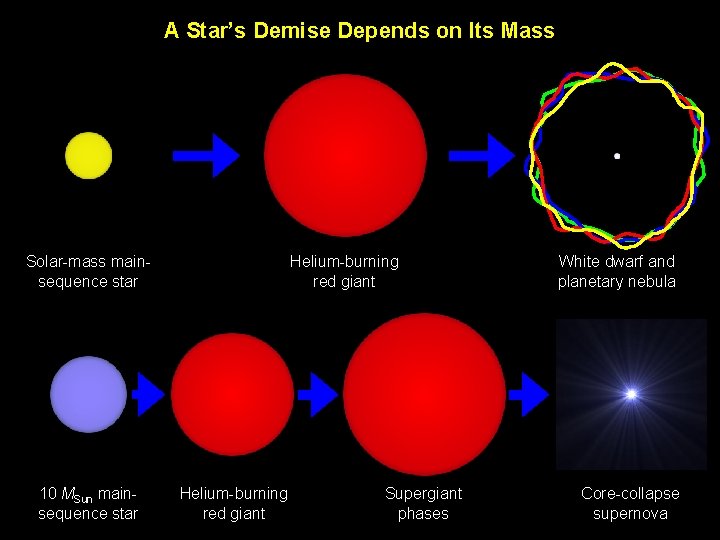
A Star’s Demise Depends on Its Mass Solar-mass mainsequence star 10 MSun mainsequence star Nov 3, 2003 Helium-burning red giant Supergiant phases Astronomy 100 Fall 2003 White dwarf and planetary nebula Core-collapse supernova
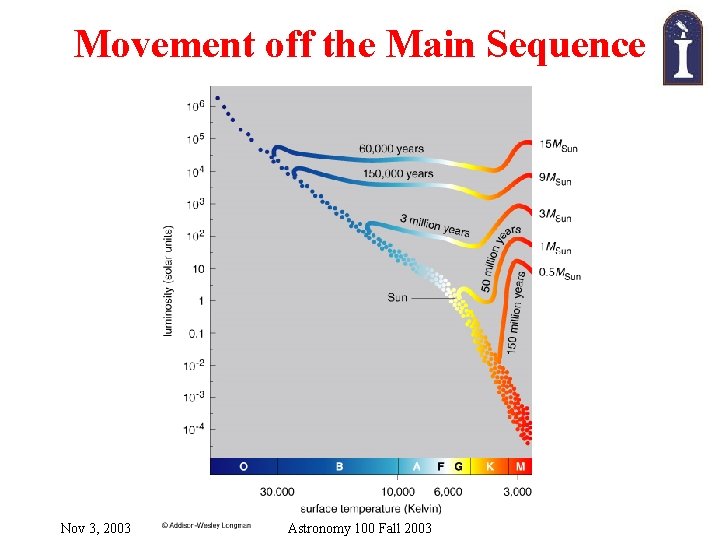
Movement off the Main Sequence Nov 3, 2003 Astronomy 100 Fall 2003
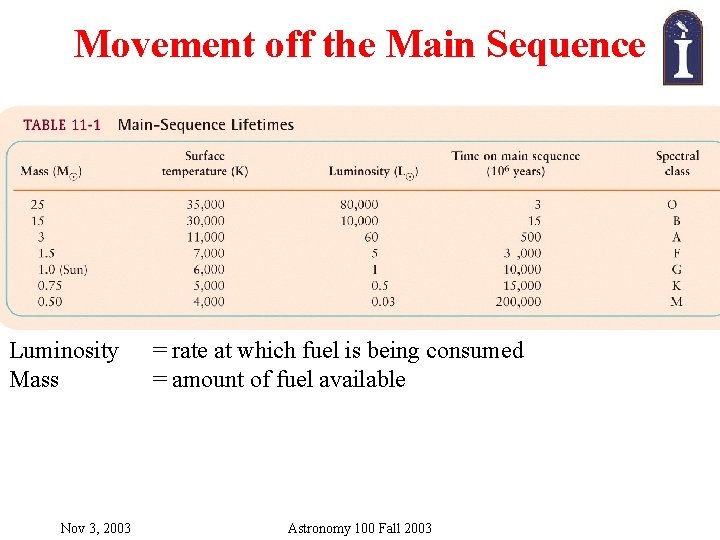
Movement off the Main Sequence Luminosity Mass Nov 3, 2003 = rate at which fuel is being consumed = amount of fuel available Astronomy 100 Fall 2003
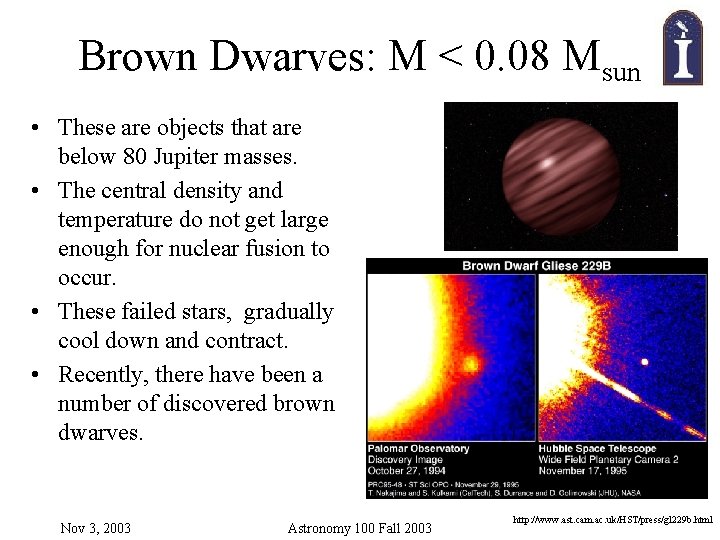
Brown Dwarves: M < 0. 08 Msun • These are objects that are below 80 Jupiter masses. • The central density and temperature do not get large enough for nuclear fusion to occur. • These failed stars, gradually cool down and contract. • Recently, there have been a number of discovered brown dwarves. Nov 3, 2003 Astronomy 100 Fall 2003 http: //www. ast. cam. ac. uk/HST/press/gl 229 b. html
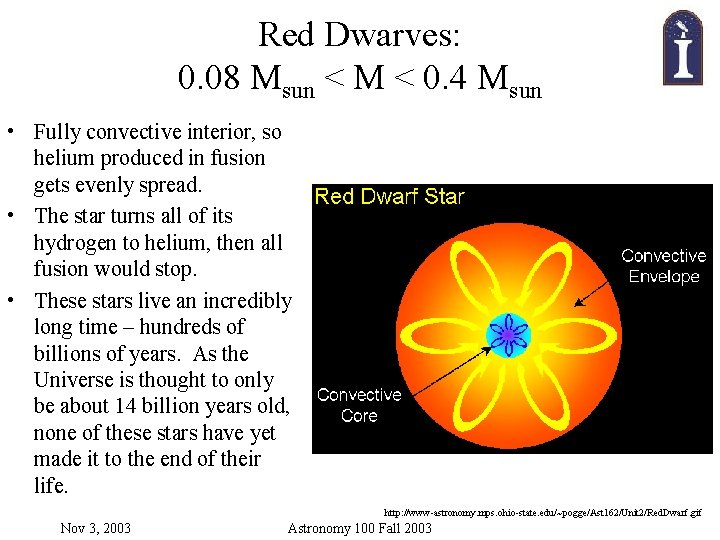
Red Dwarves: 0. 08 Msun < M < 0. 4 Msun • Fully convective interior, so helium produced in fusion gets evenly spread. • The star turns all of its hydrogen to helium, then all fusion would stop. • These stars live an incredibly long time – hundreds of billions of years. As the Universe is thought to only be about 14 billion years old, none of these stars have yet made it to the end of their life. http: //www-astronomy. mps. ohio-state. edu/~pogge/Ast 162/Unit 2/Red. Dwarf. gif Nov 3, 2003 Astronomy 100 Fall 2003
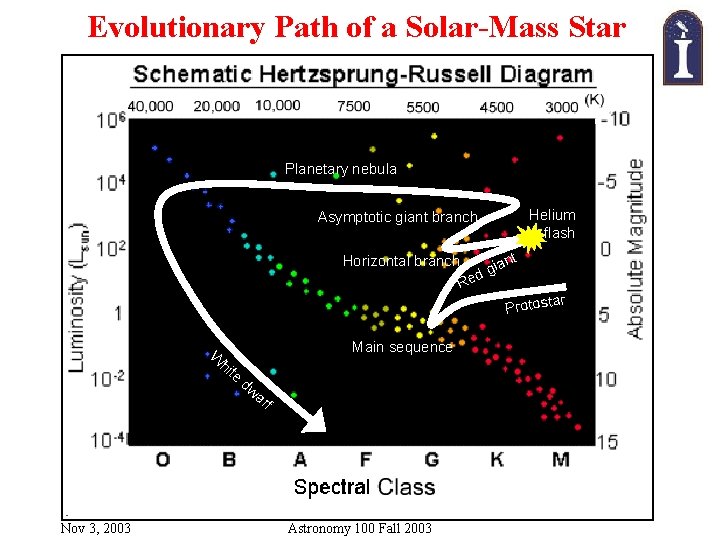
Evolutionary Path of a Solar-Mass Star Planetary nebula Helium flash Asymptotic giant branch nt Horizontal branch ia dg Re r Protosta Main sequence W hi te dw ar f Nov 3, 2003 Astronomy 100 Fall 2003
The Life of a 1 Solar Mass Star: 0. 4 MSun < M < 4 MSun Example of how low mass stars will evolve on the HR Diagram– http: //rainman. astro. uiuc. edu/ddr/stellar/archive/sunt rackson. mpg Nov 3, 2003 Astronomy 100 Fall 2003
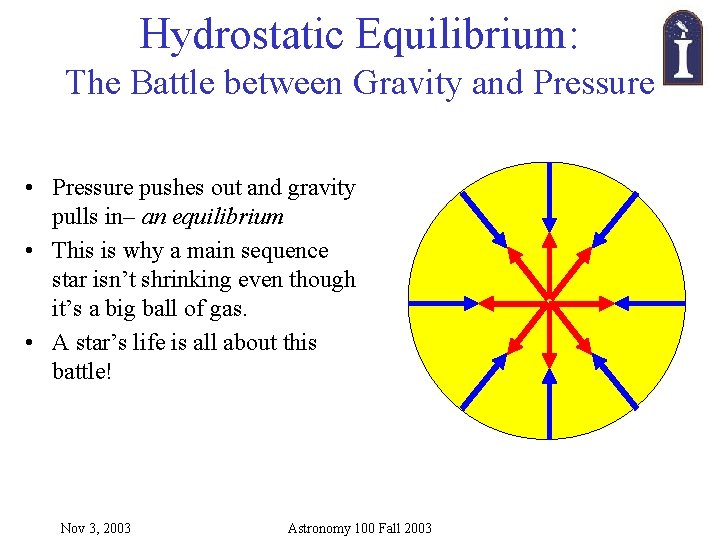
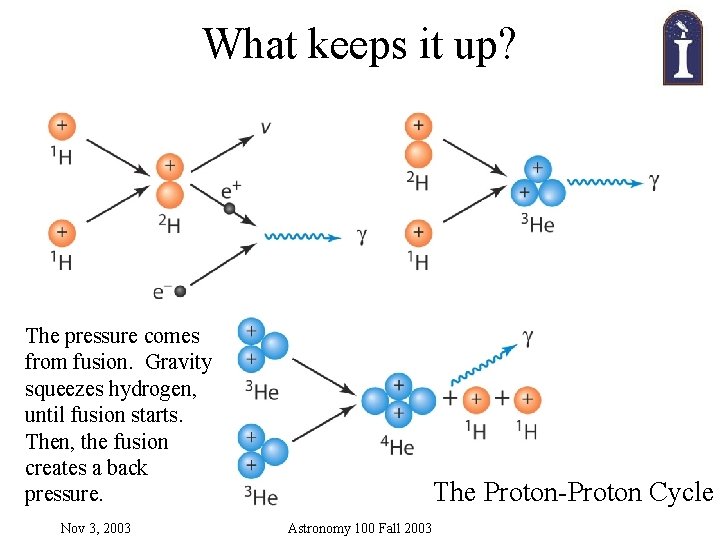
Hydrostatic Equilibrium: The Battle between Gravity and Pressure • Pressure pushes out and gravity pulls in– an equilibrium • This is why a main sequence star isn’t shrinking even though it’s a big ball of gas. • A star’s life is all about this battle! Nov 3, 2003 Astronomy 100 Fall 2003
What keeps it up? The pressure comes from fusion. Gravity squeezes hydrogen, until fusion starts. Then, the fusion creates a back pressure. Nov 3, 2003 The Proton-Proton Cycle Astronomy 100 Fall 2003
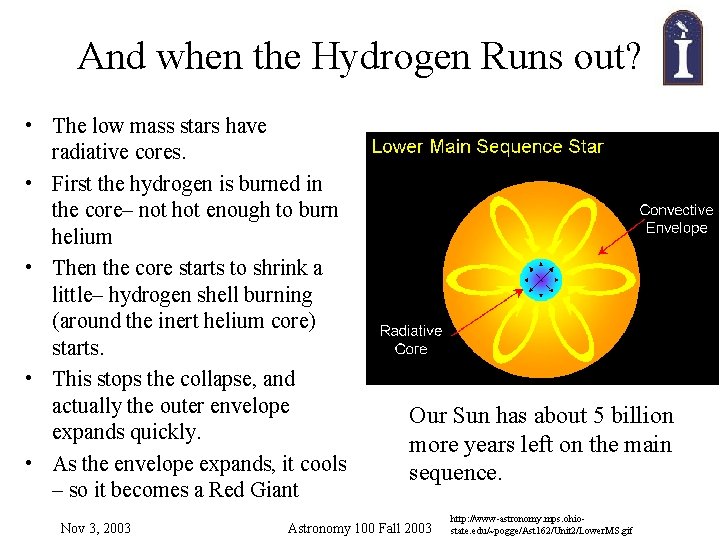
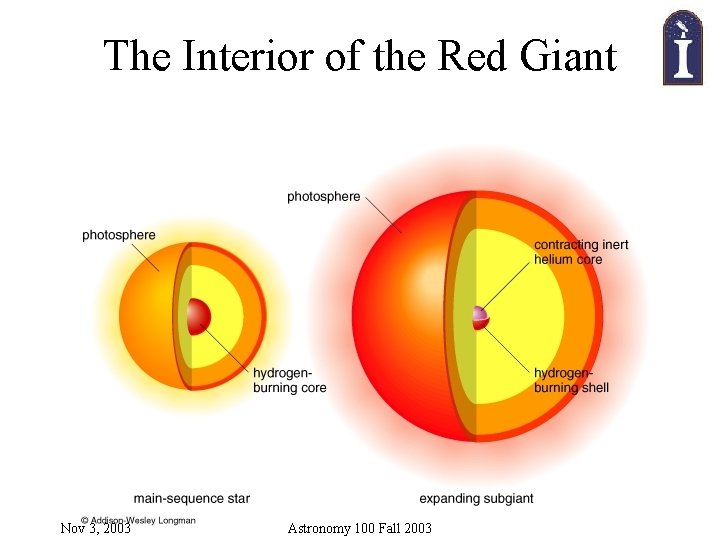
And when the Hydrogen Runs out? • The low mass stars have radiative cores. • First the hydrogen is burned in the core– not hot enough to burn helium • Then the core starts to shrink a little– hydrogen shell burning (around the inert helium core) starts. • This stops the collapse, and actually the outer envelope expands quickly. • As the envelope expands, it cools – so it becomes a Red Giant Nov 3, 2003 Our Sun has about 5 billion more years left on the main sequence. Astronomy 100 Fall 2003 http: //www-astronomy. mps. ohiostate. edu/~pogge/Ast 162/Unit 2/Lower. MS. gif
The Interior of the Red Giant Nov 3, 2003 Astronomy 100 Fall 2003
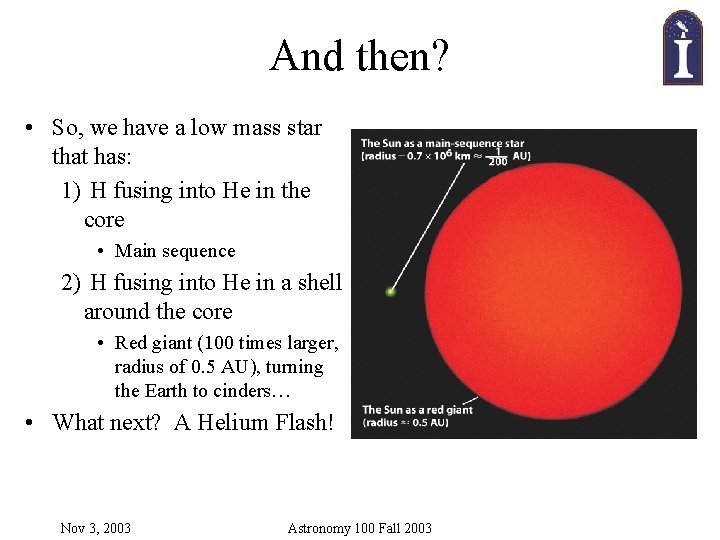
And then? • So, we have a low mass star that has: 1) H fusing into He in the core • Main sequence 2) H fusing into He in a shell around the core • Red giant (100 times larger, radius of 0. 5 AU), turning the Earth to cinders… • What next? A Helium Flash! Nov 3, 2003 Astronomy 100 Fall 2003
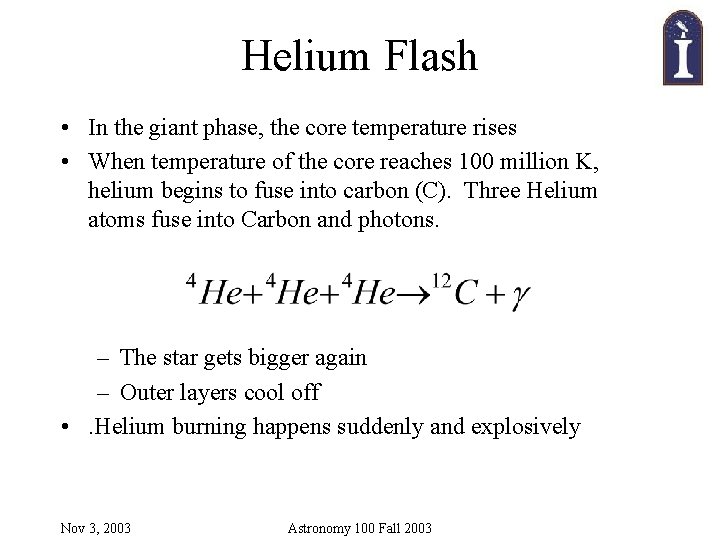
Helium Flash • In the giant phase, the core temperature rises • When temperature of the core reaches 100 million K, helium begins to fuse into carbon (C). Three Helium atoms fuse into Carbon and photons. – The star gets bigger again – Outer layers cool off • . Helium burning happens suddenly and explosively Nov 3, 2003 Astronomy 100 Fall 2003
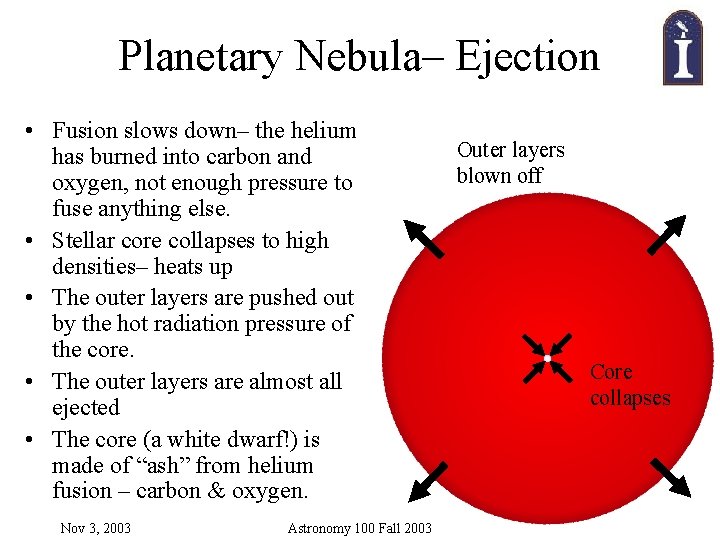
Planetary Nebula– Ejection • Fusion slows down– the helium has burned into carbon and oxygen, not enough pressure to fuse anything else. • Stellar core collapses to high densities– heats up • The outer layers are pushed out by the hot radiation pressure of the core. • The outer layers are almost all ejected • The core (a white dwarf!) is made of “ash” from helium fusion – carbon & oxygen. Nov 3, 2003 Astronomy 100 Fall 2003 Outer layers blown off Core collapses
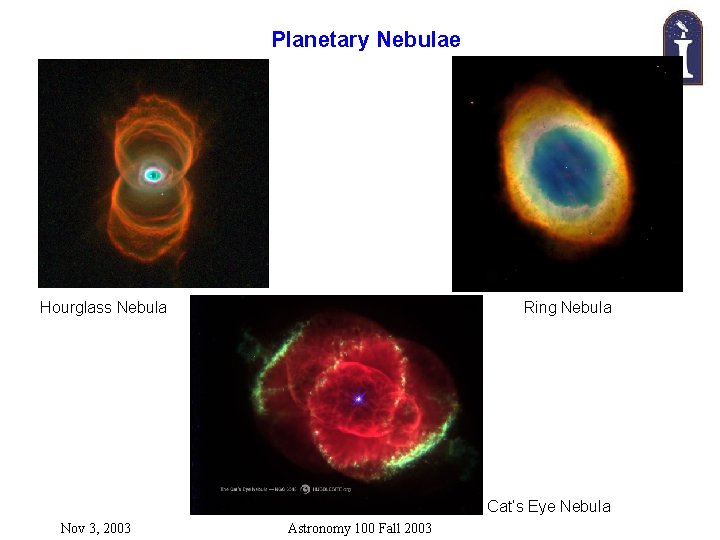
Planetary Nebulae Hourglass Nebula Ring Nebula Cat’s Eye Nebula Nov 3, 2003 Astronomy 100 Fall 2003
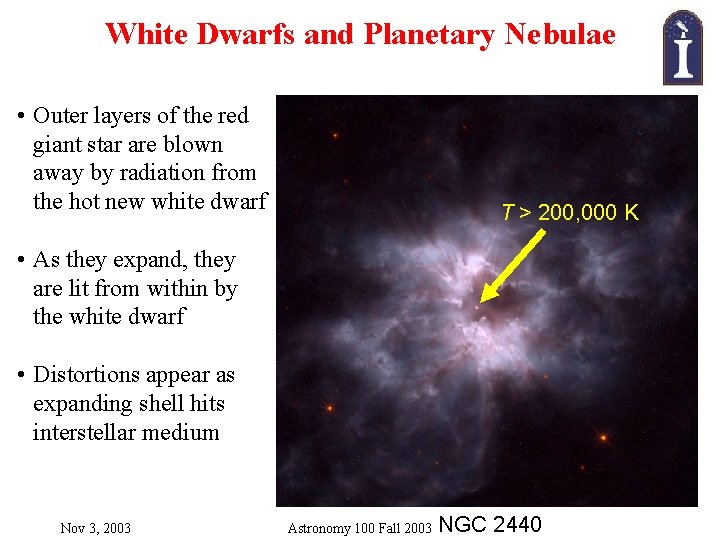
White Dwarfs and Planetary Nebulae • Outer layers of the red giant star are blown away by radiation from the hot new white dwarf T > 200, 000 K • As they expand, they are lit from within by the white dwarf • Distortions appear as expanding shell hits interstellar medium Nov 3, 2003 Astronomy 100 Fall 2003 NGC 2440
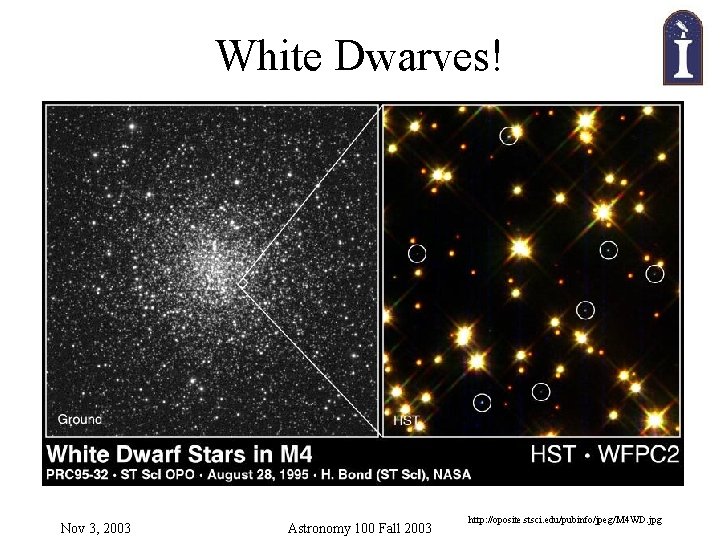
White Dwarves! Nov 3, 2003 Astronomy 100 Fall 2003 http: //oposite. stsci. edu/pubinfo/jpeg/M 4 WD. jpg
What Keeps a White Dwarf up? • The nuclear fusion stopped, and gravity begun to win the battle. • Then, the electrons got so squashed together that they get pushed into degenerate states. • Nearby electrons can not occupy the same energy states. • This electron degeneracy causes pressure to counteract gravity Nov 3, 2003 Astronomy 100 Fall 2003
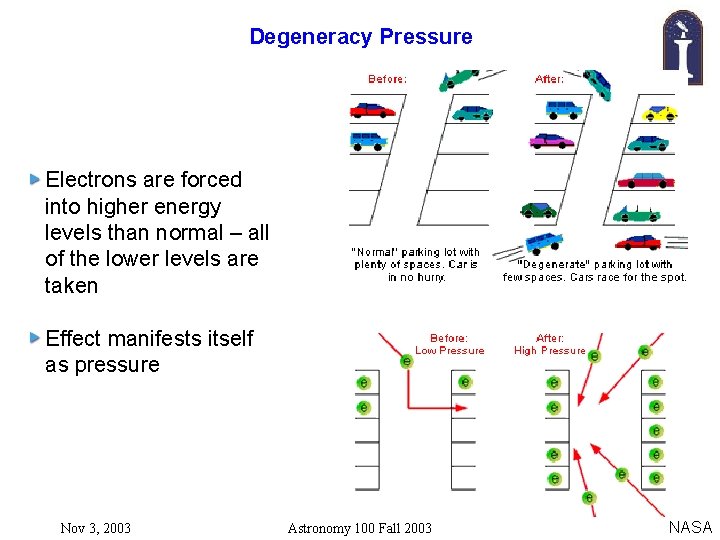
Degeneracy Pressure Electrons are forced into higher energy levels than normal – all of the lower levels are taken Effect manifests itself as pressure Nov 3, 2003 Astronomy 100 Fall 2003 NASA