National Traffic System NTS An Introduction David Maynard

- Slides: 35
National Traffic System (NTS) An Introduction David Maynard, WA 3 EZN OHIO SECTION TRAFFIC MANAGER Don Zickefoose, WB 8 SIQ OSSBN Net Manager ARRL Ohio Section NTS Official Relay Stations ARRL Great Lakes Convention Findlay Hamfest September 11, 2011
National Traffic System (NTS) Messaging Basics Outline • • • What is the National Traffic System? Advantages of NTS Messaging NTS Hierarchy and modes The ARRL Radiogram Form ARL Abbreviated Texts How to Deliver an NTS Message NTS Digital VHF Digital BBS demo Local NTS Contacts & Nets Additional Resources
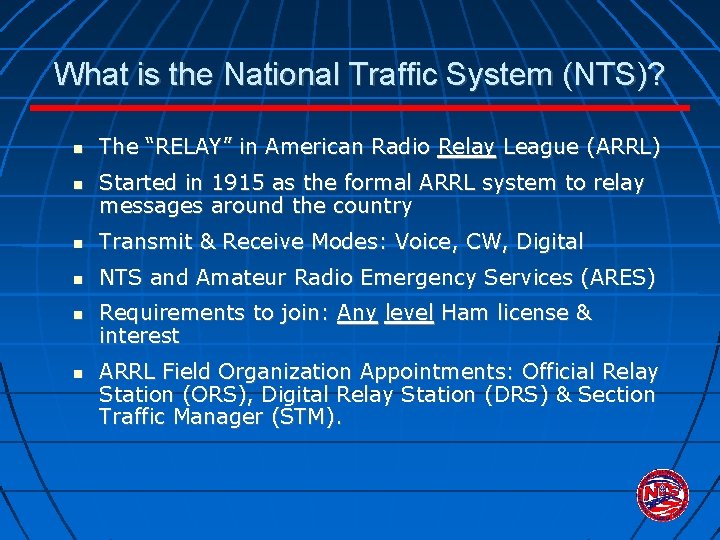
What is the National Traffic System (NTS)? The “RELAY” in American Radio Relay League (ARRL) Started in 1915 as the formal ARRL system to relay messages around the country Transmit & Receive Modes: Voice, CW, Digital NTS and Amateur Radio Emergency Services (ARES) Requirements to join: Any level Ham license & interest ARRL Field Organization Appointments: Official Relay Station (ORS), Digital Relay Station (DRS) & Section Traffic Manager (STM).
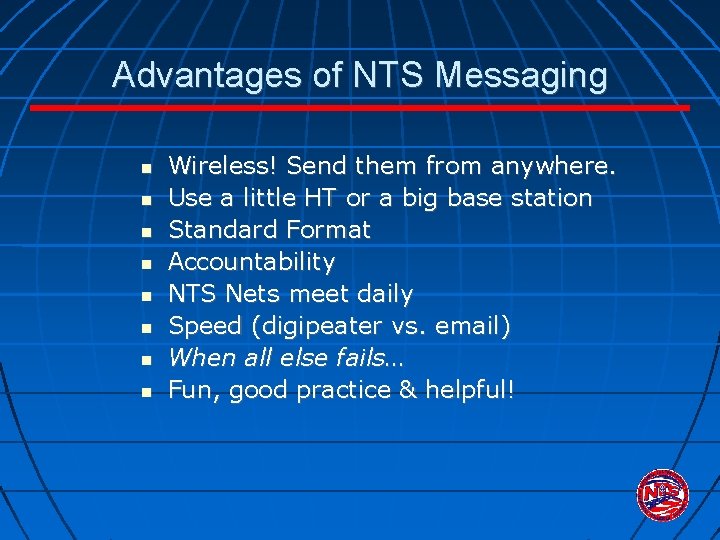
Advantages of NTS Messaging Wireless! Send them from anywhere. Use a little HT or a big base station Standard Format Accountability NTS Nets meet daily Speed (digipeater vs. email) When all else fails… Fun, good practice & helpful!
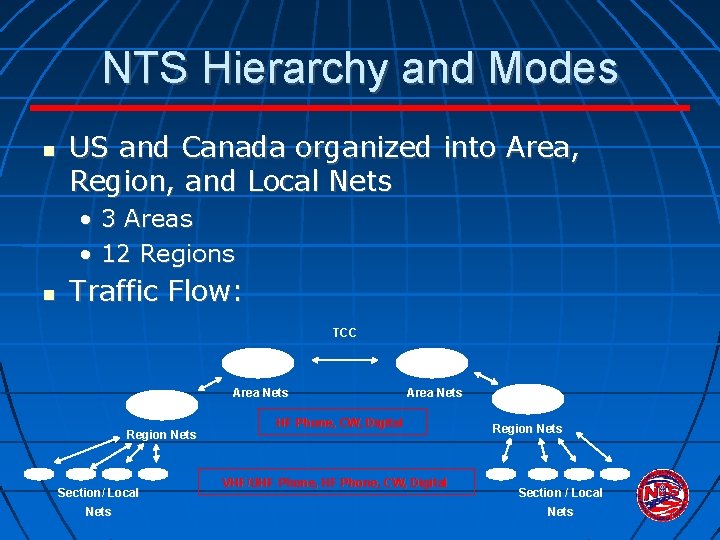
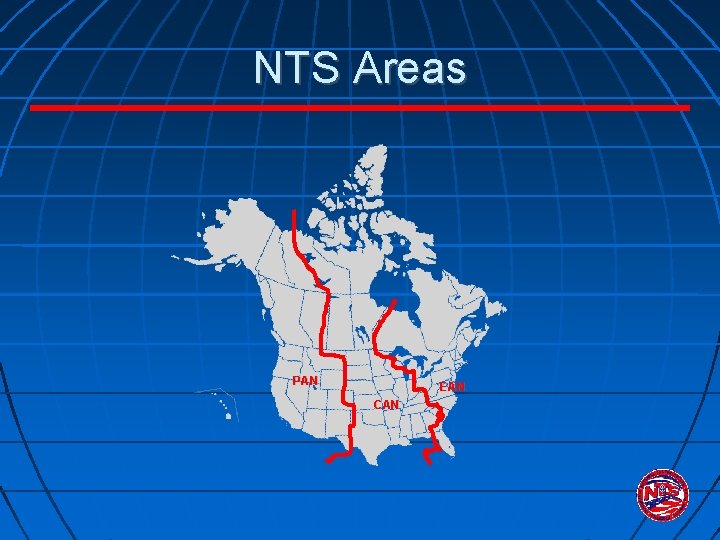
NTS Hierarchy and Modes US and Canada organized into Area, Region, and Local Nets • 3 Areas • 12 Regions Traffic Flow: TCC Area Nets Region Nets Section/ Local Nets Area Nets HF Phone, CW, Digital VHF/UHF Phone, CW, Digital Region Nets Section / Local Nets
NTS Areas PAN EAN CAN
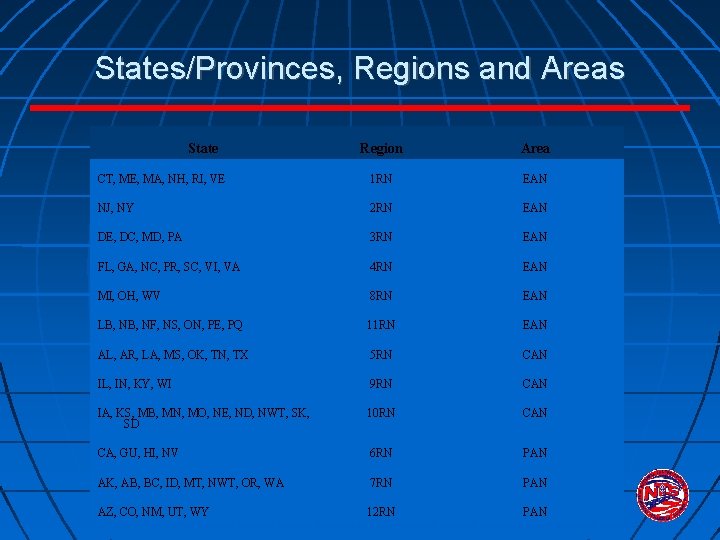
States/Provinces, Regions and Areas State Region Area CT, ME, MA, NH, RI, VE 1 RN EAN NJ, NY 2 RN EAN DE, DC, MD, PA 3 RN EAN FL, GA, NC, PR, SC, VI, VA 4 RN EAN MI, OH, WV 8 RN EAN LB, NF, NS, ON, PE, PQ 11 RN EAN AL, AR, LA, MS, OK, TN, TX 5 RN CAN IL, IN, KY, WI 9 RN CAN IA, KS, MB, MN, MO, NE, ND, NWT, SK, SD 10 RN CA, GU, HI, NV 6 RN PAN AK, AB, BC, ID, MT, NWT, OR, WA 7 RN PAN AZ, CO, NM, UT, WY 12 RN PAN
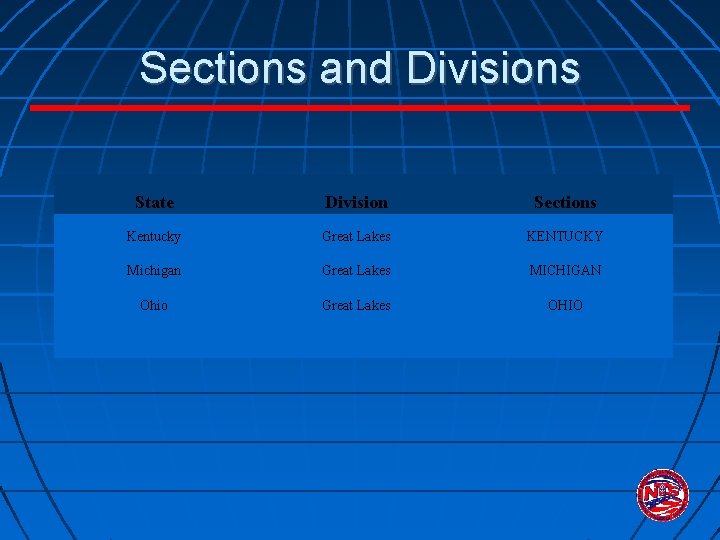
Sections and Divisions State Division Sections Kentucky Great Lakes KENTUCKY Michigan Great Lakes MICHIGAN Ohio Great Lakes OHIO
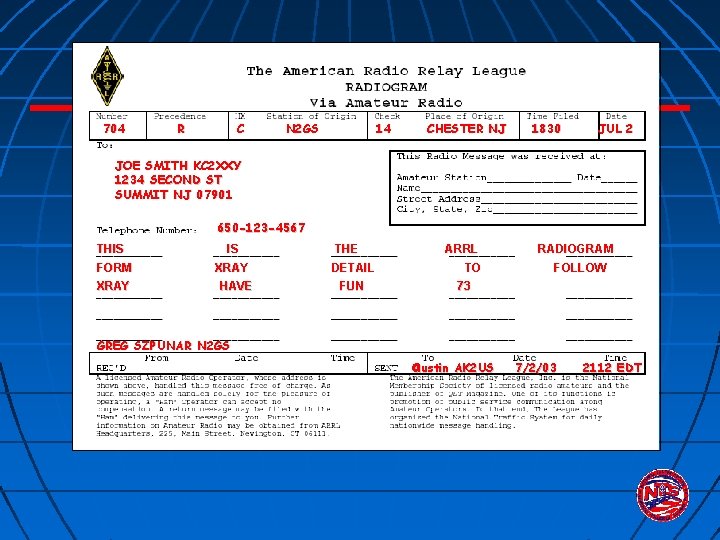
Message Format The ARRL Radiogram
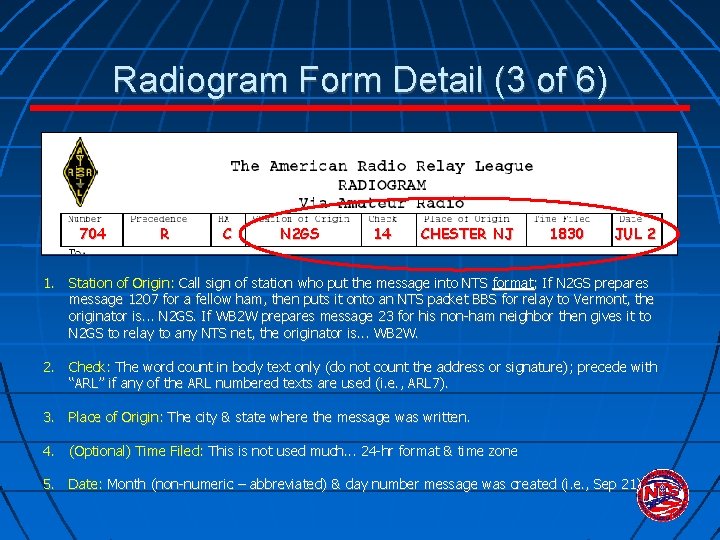
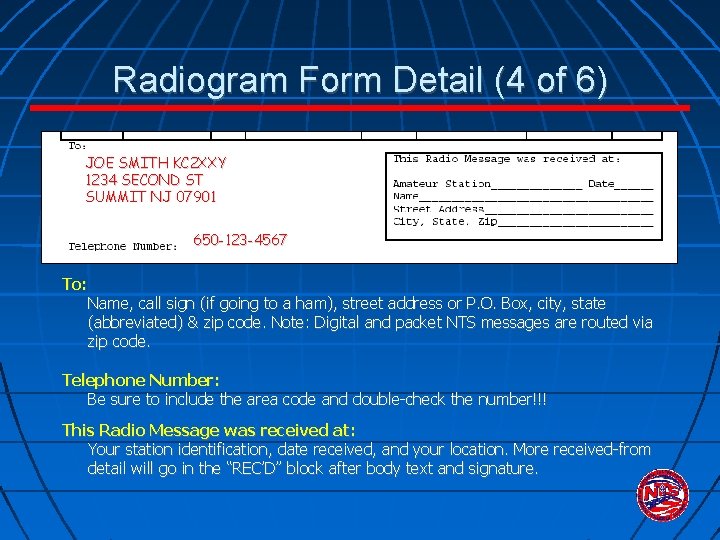
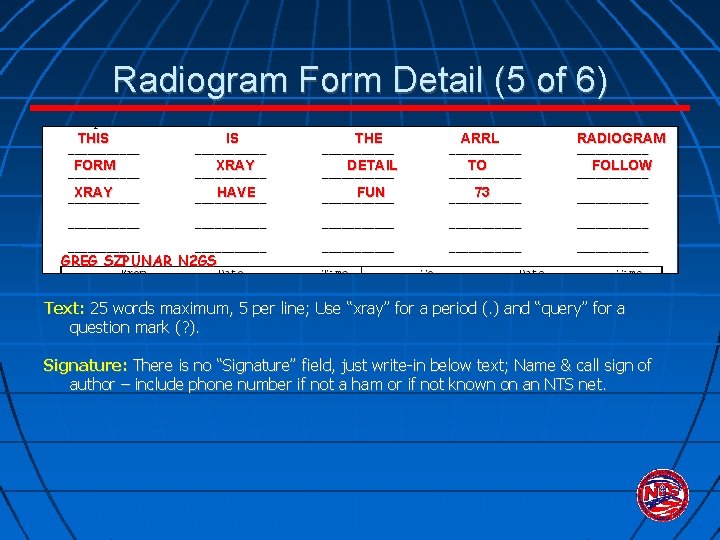
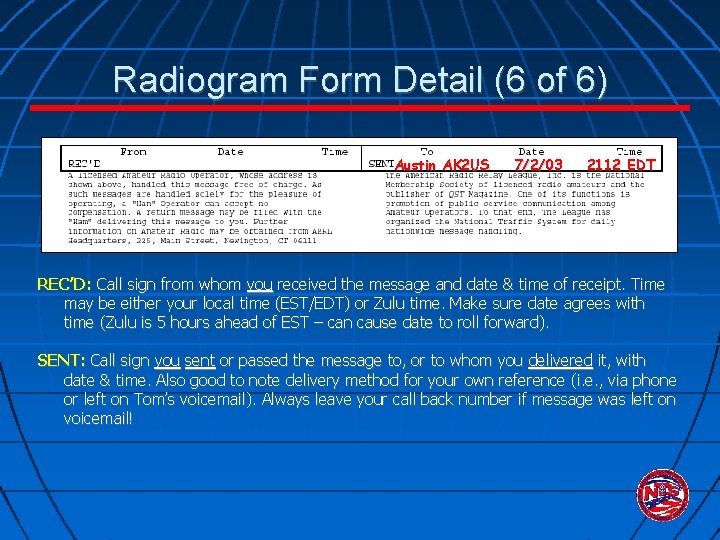
704 R C N 2 GS 14 CHESTER NJ 1830 JUL 2 JOE SMITH KC 2 XXY 1234 SECOND ST SUMMIT NJ 07901 650 -123 -4567 THIS FORM XRAY IS XRAY HAVE GREG SZPUNAR N 2 GS THE DETAIL FUN ARRL TO RADIOGRAM FOLLOW 73 austin AK 2 US 7/2/03 2112 EDT
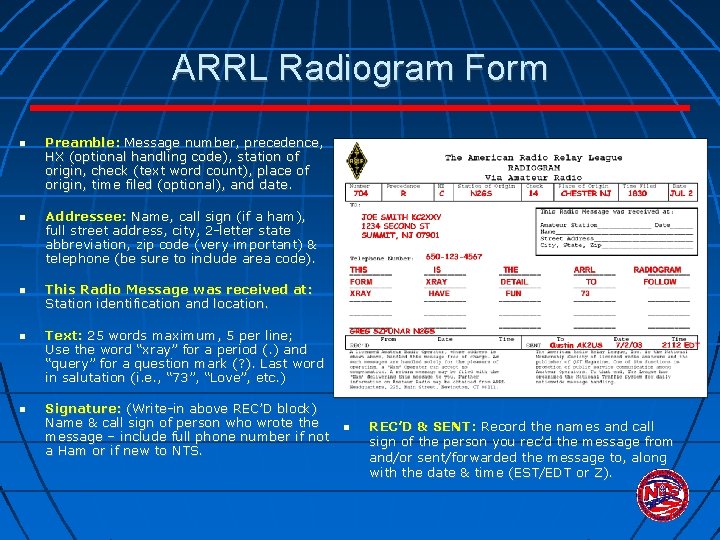
ARRL Radiogram Form Preamble: Message number, precedence, HX (optional handling code), station of origin, check (text word count), place of origin, time filed (optional), and date. Addressee: Name, call sign (if a ham), full street address, city, 2 -letter state abbreviation, zip code (very important) & telephone (be sure to include area code). This Radio Message was received at: Station identification and location. Text: 25 words maximum, 5 per line; Use the word “xray” for a period (. ) and “query” for a question mark (? ). Last word in salutation (i. e. , “ 73”, “Love”, etc. ) Signature: (Write-in above REC’D block) Name & call sign of person who wrote the message – include full phone number if not a Ham or if new to NTS. REC’D & SENT: Record the names and call sign of the person you rec’d the message from and/or sent/forwarded the message to, along with the date & time (EST/EDT or Z).
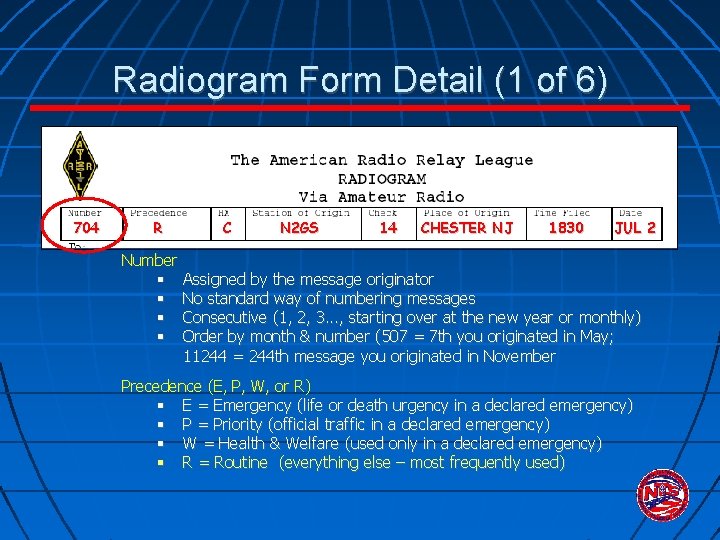
Radiogram Form Detail (1 of 6) 704 R Number C N 2 GS 14 CHESTER NJ 1830 JUL 2 Assigned by the message originator No standard way of numbering messages Consecutive (1, 2, 3. . . , starting over at the new year or monthly) Order by month & number (507 = 7 th you originated in May; 11244 = 244 th message you originated in November Precedence (E, P, W, or R) E = Emergency (life or death urgency in a declared emergency) P = Priority (official traffic in a declared emergency) W = Health & Welfare (used only in a declared emergency) R = Routine (everything else – most frequently used)
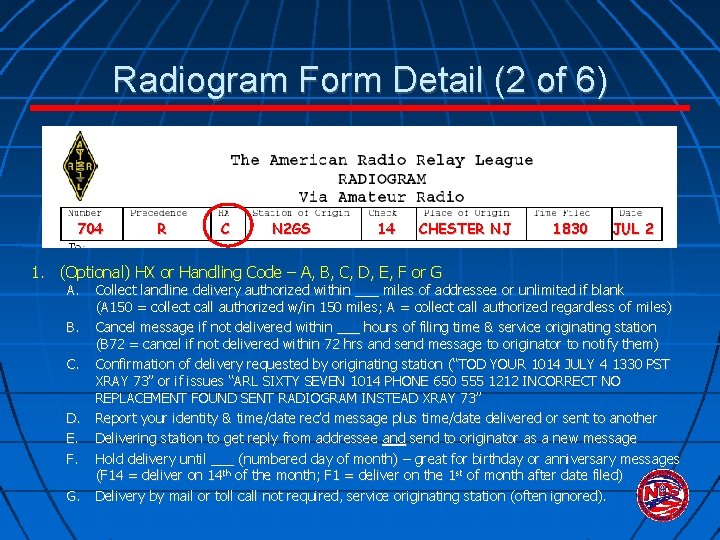
Radiogram Form Detail (2 of 6) 704 R C N 2 GS 14 CHESTER NJ 1. (Optional) HX or Handling Code – A, B, C, D, E, F or G A. 1830 JUL 2 Collect landline delivery authorized within ___ miles of addressee or unlimited if blank (A 150 = collect call authorized w/in 150 miles; A = collect call authorized regardless of miles) B. Cancel message if not delivered within ___ hours of filing time & service originating station (B 72 = cancel if not delivered within 72 hrs and send message to originator to notify them) C. Confirmation of delivery requested by originating station (“TOD YOUR 1014 JULY 4 1330 PST XRAY 73” or if issues “ARL SIXTY SEVEN 1014 PHONE 650 555 1212 INCORRECT NO REPLACEMENT FOUND SENT RADIOGRAM INSTEAD XRAY 73” D. Report your identity & time/date rec’d message plus time/date delivered or sent to another E. Delivering station to get reply from addressee and send to originator as a new message F. Hold delivery until ___ (numbered day of month) – great for birthday or anniversary messages (F 14 = deliver on 14 th of the month; F 1 = deliver on the 1 st of month after date filed) G. Delivery by mail or toll call not required, service originating station (often ignored).
Radiogram Form Detail (3 of 6) 704 R C N 2 GS 14 CHESTER NJ 1830 JUL 2 1. Station of Origin: Call sign of station who put the message into NTS format; If N 2 GS prepares message 1207 for a fellow ham, then puts it onto an NTS packet BBS for relay to Vermont, the originator is. . . N 2 GS. If WB 2 W prepares message 23 for his non-ham neighbor then gives it to N 2 GS to relay to any NTS net, the originator is. . . WB 2 W. 2. Check: The word count in body text only (do not count the address or signature); precede with “ARL” if any of the ARL numbered texts are used (i. e. , ARL 7). 3. Place of Origin: The city & state where the message was written. 4. (Optional) Time Filed: This is not used much. . . 24 -hr format & time zone 5. Date: Month (non-numeric – abbreviated) & day number message was created (i. e. , Sep 21).
Radiogram Form Detail (4 of 6) JOE SMITH KC 2 XXY 1234 SECOND ST SUMMIT NJ 07901 650 -123 -4567 To: Name, call sign (if going to a ham), street address or P. O. Box, city, state (abbreviated) & zip code. Note: Digital and packet NTS messages are routed via zip code. Telephone Number: Be sure to include the area code and double-check the number!!! This Radio Message was received at: Your station identification, date received, and your location. More received-from detail will go in the “REC’D” block after body text and signature.
Radiogram Form Detail (5 of 6) THIS IS THE ARRL RADIOGRAM FORM XRAY DETAIL TO FOLLOW XRAY HAVE FUN 73 GREG SZPUNAR N 2 GS Text: 25 words maximum, 5 per line; Use “xray” for a period (. ) and “query” for a question mark (? ). Signature: There is no “Signature” field, just write-in below text; Name & call sign of author – include phone number if not a ham or if not known on an NTS net.
Radiogram Form Detail (6 of 6) Austin AK 2 US 7/2/03 2112 EDT REC’D: Call sign from whom you received the message and date & time of receipt. Time may be either your local time (EST/EDT) or Zulu time. Make sure date agrees with time (Zulu is 5 hours ahead of EST – can cause date to roll forward). SENT: Call sign you sent or passed the message to, or to whom you delivered it, with date & time. Also good to note delivery method for your own reference (i. e. , via phone or left on Tom’s voicemail). Always leave your call back number if message was left on voicemail!
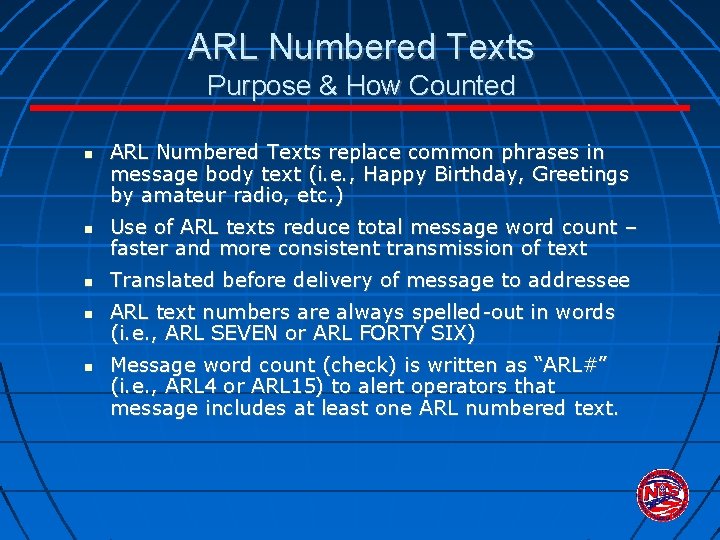
ARL Numbered Texts Purpose & How Counted ARL Numbered Texts replace common phrases in message body text (i. e. , Happy Birthday, Greetings by amateur radio, etc. ) Use of ARL texts reduce total message word count – faster and more consistent transmission of text Translated before delivery of message to addressee ARL text numbers are always spelled-out in words (i. e. , ARL SEVEN or ARL FORTY SIX) Message word count (check) is written as “ARL#” (i. e. , ARL 4 or ARL 15) to alert operators that message includes at least one ARL numbered text.
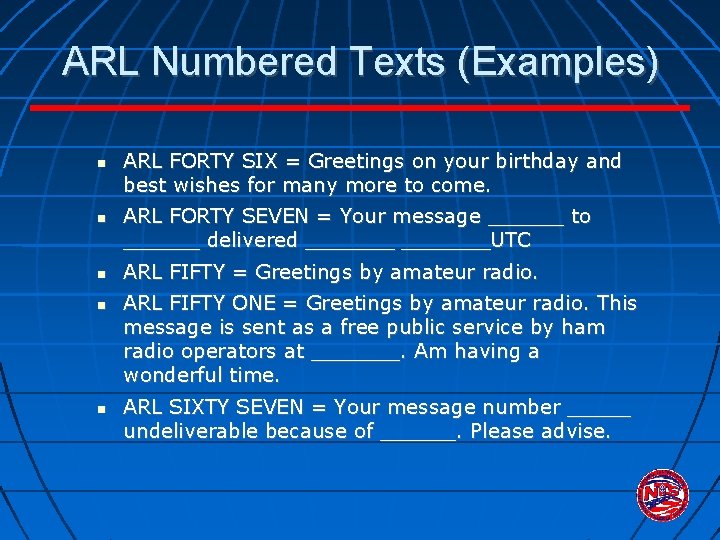
ARL Numbered Texts (Examples) ARL FORTY SIX = Greetings on your birthday and best wishes for many more to come. ARL FORTY SEVEN = Your message ______ to ______ delivered _______UTC ARL FIFTY = Greetings by amateur radio. ARL FIFTY ONE = Greetings by amateur radio. This message is sent as a free public service by ham radio operators at _______. Am having a wonderful time. ARL SIXTY SEVEN = Your message number _____ undeliverable because of ______. Please advise.
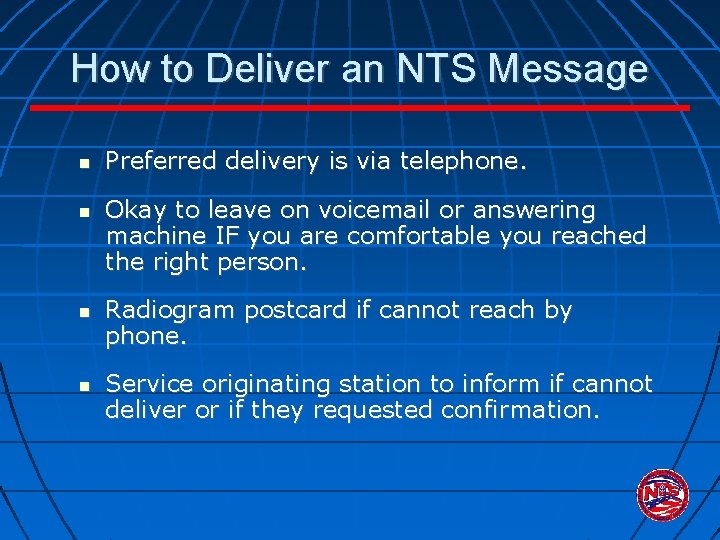
How to Deliver an NTS Message Preferred delivery is via telephone. Okay to leave on voicemail or answering machine IF you are comfortable you reached the right person. Radiogram postcard if cannot reach by phone. Service originating station to inform if cannot deliver or if they requested confirmation.
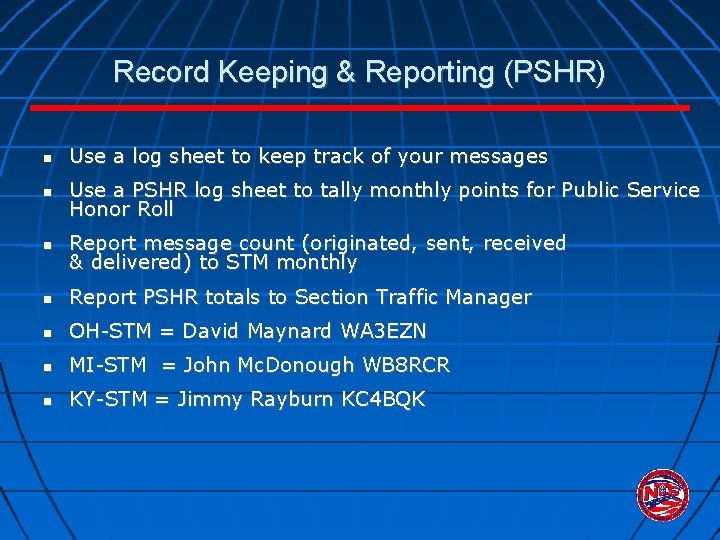
Record Keeping & Reporting (PSHR) Use a log sheet to keep track of your messages Use a PSHR log sheet to tally monthly points for Public Service Honor Roll Report message count (originated, sent, received & delivered) to STM monthly Report PSHR totals to Section Traffic Manager OH-STM = David Maynard WA 3 EZN MI-STM = John Mc. Donough WB 8 RCR KY-STM = Jimmy Rayburn KC 4 BQK
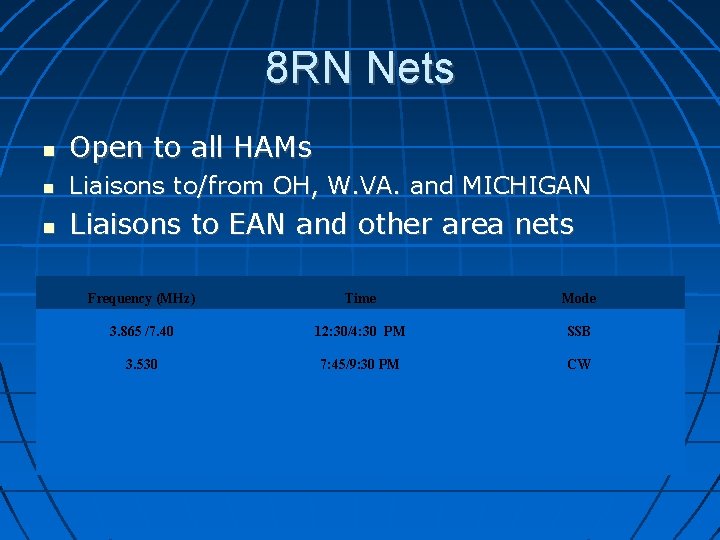
8 RN Nets Open to all HAMs Liaisons to/from OH, W. VA. and MICHIGAN Liaisons to EAN and other area nets Frequency (MHz) Time Mode 3. 865 /7. 40 12: 30/4: 30 PM SSB 3. 530 7: 45/9: 30 PM CW
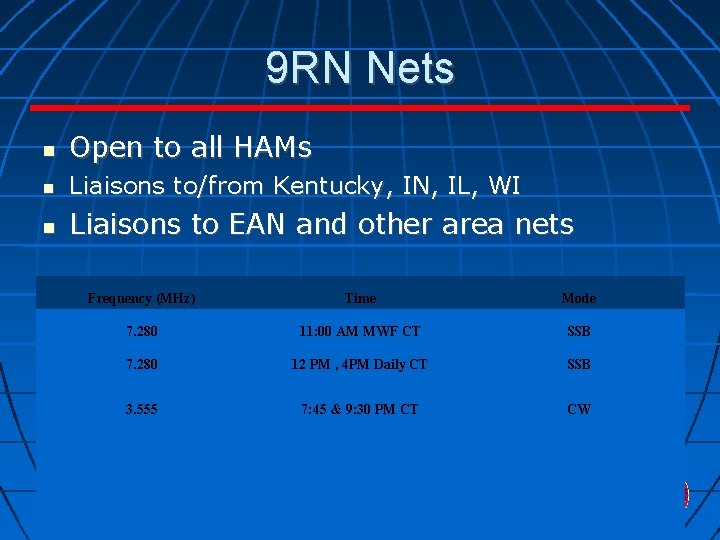
9 RN Nets Open to all HAMs Liaisons to/from Kentucky, IN, IL, WI Liaisons to EAN and other area nets Frequency (MHz) Time Mode 7. 280 11: 00 AM MWF CT SSB 7. 280 12 PM , 4 PM Daily CT SSB 3. 555 7: 45 & 9: 30 PM CT CW
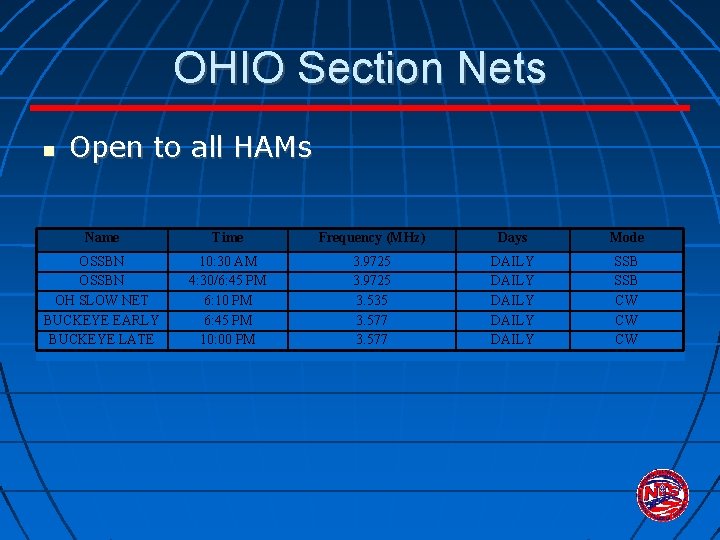
OHIO Section Nets Open to all HAMs Name Time Frequency (MHz) Days Mode OSSBN OH SLOW NET BUCKEYE EARLY BUCKEYE LATE 10: 30 AM 4: 30/6: 45 PM 6: 10 PM 6: 45 PM 10: 00 PM 3. 9725 3. 535 3. 577 DAILY DAILY SSB CW CW CW
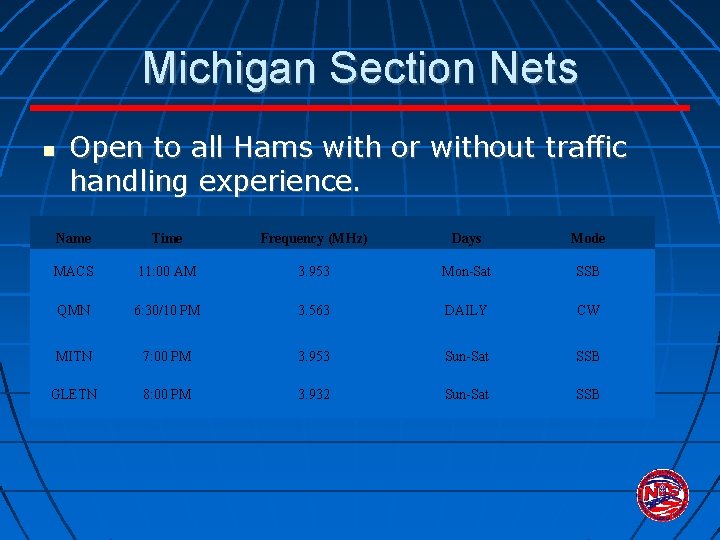
Michigan Section Nets Open to all Hams with or without traffic handling experience. Name Time Frequency (MHz) Days Mode MACS 11: 00 AM 3. 953 Mon-Sat SSB QMN 6: 30/10 PM 3. 563 DAILY CW MITN 7: 00 PM 3. 953 Sun-Sat SSB GLETN 8: 00 PM 3. 932 Sun-Sat SSB
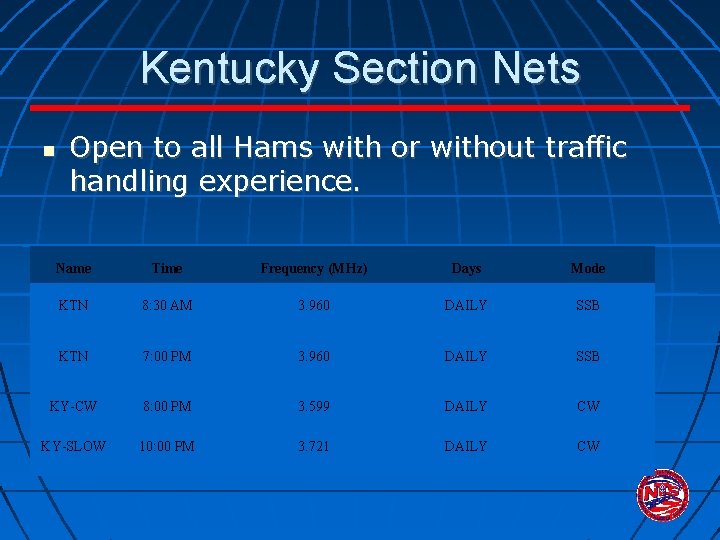
Kentucky Section Nets Open to all Hams with or without traffic handling experience. Name Time Frequency (MHz) Days Mode KTN 8: 30 AM 3. 960 DAILY SSB KTN 7: 00 PM 3. 960 DAILY SSB KY-CW 8: 00 PM 3. 599 DAILY CW KY-SLOW 10: 00 PM 3. 721 DAILY CW
Local Traffic Nets Open to all Hams with or without traffic handling experience. A great place to start and to learn first hand. More information on local nets, times and frequencies in the handouts
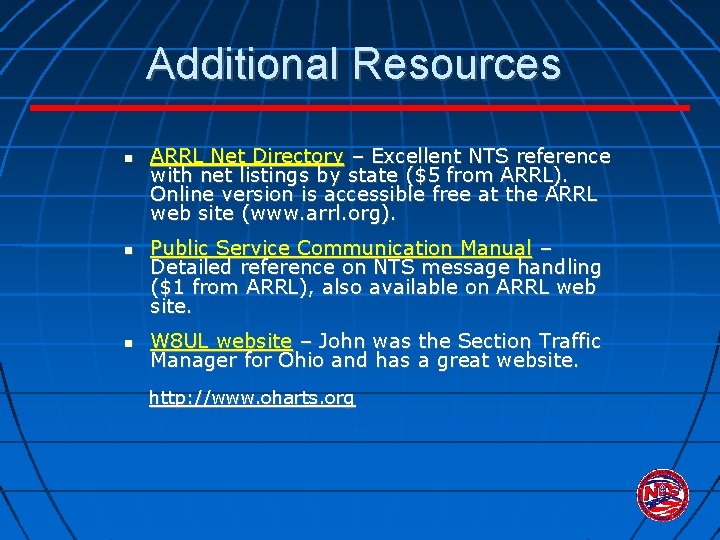
Additional Resources ARRL Net Directory – Excellent NTS reference with net listings by state ($5 from ARRL). Online version is accessible free at the ARRL web site (www. arrl. org). Public Service Communication Manual – Detailed reference on NTS message handling ($1 from ARRL), also available on ARRL web site. W 8 UL website – John was the Section Traffic Manager for Ohio and has a great website. http: //www. oharts. org
Questions?
NTS Digital John Tipka W 8 UL 8 RN Digital MBO Reynoldsburg, OH Former Ohio Section Traffic Manager
Advantages of NTS Digital Available 24/7, 365 days a year Error Free Frequency, Time, Propagation Agile Faster Able to respond adapt quicker to urgent needs like disaster messages Multiple redundant routing paths NTSD exists at and incorporates all levels of traditional NTS from TCC, through Area, Region, Section and Local.
Not to Replace Traditional NTS Complementary system Trained operators always needed for origination and delivery of messages
Digital Mode History RTTY- After WWII, 5 level Baudot code, mechanical teletypewriters, paper tape storage. Noisy Signals subject to selective fading and drop out errors. Equipment relatively available via surplus route Some units as big as a sub-compact car AMTOR- Still 5 bit code, but with limited error correction. Burst mode-requires fast transmit/receive switching
NTSD and Pactor HF NTSD Operates almost exclusively in the automatic control sub -bands 3. 585 - 3. 600 MHz 7. 100 - 7. 105 MHz 10. 140 - 10. 150 MHz 14. 095 - 14. 0995 MHz 14. 1005 - 14. 1120 MHz Using Pactor 1, 2, and very limited use of Pactor 3. • Pactor 2 and 3 are proprietary modes. All pactor connects start out at Pactor 1 and then shift up to higher speed if the equipment at both ends is compatible. Bandwidth for Pactor 1 and 2 is 500 Hz. pactor 3 will expand its bandwidth up to 2. 4 KHz at highest speeds.
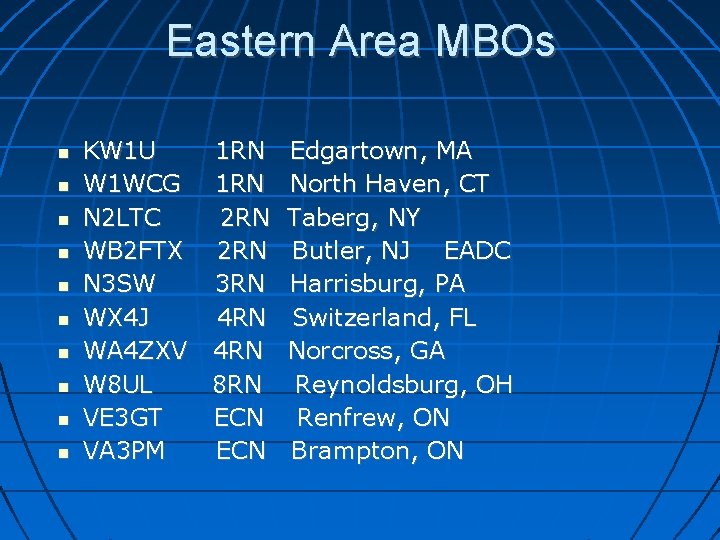
Eastern Area MBOs KW 1 U 1 RN Edgartown, MA W 1 WCG 1 RN North Haven, CT N 2 LTC 2 RN Taberg, NY WB 2 FTX 2 RN Butler, NJ EADC N 3 SW 3 RN Harrisburg, PA WX 4 J 4 RN Switzerland, FL WA 4 ZXV 4 RN Norcross, GA W 8 UL 8 RN Reynoldsburg, OH VE 3 GT ECN Renfrew, ON VA 3 PM ECN Brampton, ON