NAC PHYSOSTIGMINE NEOSTIGMINE THEIR EFFICACY AS ANTIDOTE PREPARED

- Slides: 25
NAC, PHYSOSTIGMINE & NEOSTIGMINE – THEIR EFFICACY AS ANTIDOTE PREPARED BY: VISHNU. R. NAIR, 5 TH YEAR PHARM. D, NATIONAL COLLEGE OF PHARMACY, KERALA.
GENERAL INTRODUCTION: - An antidote is a “drug, chelating substance/ a chemical that counteracts(neutralizes) the effects of another drug/ poison” - Although there are dozens of different antidotes some may counteract only one particular drug; whereas others(like charcoal) may help to reduce the toxicity of numerous drugs. - Most antidotes are not 100% effective, and fatalities may still occur even when an antidote has been given. - Here, I will present the details of antidotes “ACETYLCYSTEINE(NAC)”, “PHYSOSTIGMINE & NEOSTIGMINE”. HAPPY READING!!!
N-ACETYLCYSTEINE AS ANTIDOTE: A DEEP INSIGHT
1. PHARMACOLOGY: - NAC binds to highly reactive electrophilic metabolism intermediates detoxifies them - Drug enhances reduction of toxic intermediate (NAPQI) to parent “Acetaminophen” - Drug reduces severity of liver injury via the following methods : a. Improves blood flow b. Improves oxygen delivery c. Modifies cytokine production d. Scavenges free radicals / O 2
- Drug most effective in preventing acetaminophen-induced liver injury, when given in the EARLY COURSE OF INTOXICATION(8 -10 hours of poison ingestion) 2. INDICATIONS: NAC may be used as antidote in the following conditions: i. Acetaminophen overdose ii. Based on case reports/ investigational reports: a. CCl 4 b. Chloroform c. Acrylonitrile d. Doxorubicin
e. Arsenic f. Gold g. Amanitin mushroom h. CO i. Chromium j. Cyanide k. Nitrofurantoin l. Paraquat m. Phosphide n. Methyl mercury poisoning.
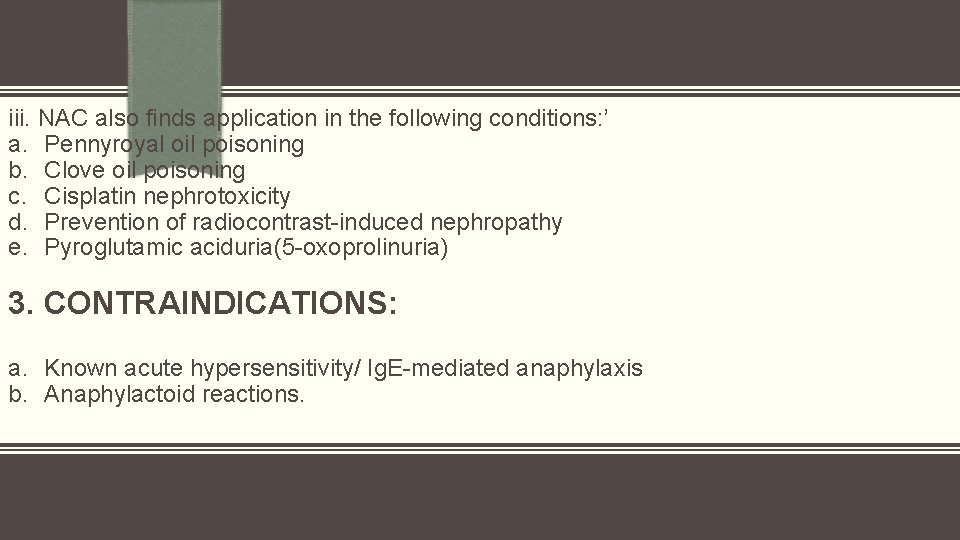
iii. NAC also finds application in the following conditions: ’ a. Pennyroyal oil poisoning b. Clove oil poisoning c. Cisplatin nephrotoxicity d. Prevention of radiocontrast-induced nephropathy e. Pyroglutamic aciduria(5 -oxoprolinuria) 3. CONTRAINDICATIONS: a. Known acute hypersensitivity/ Ig. E-mediated anaphylaxis b. Anaphylactoid reactions.
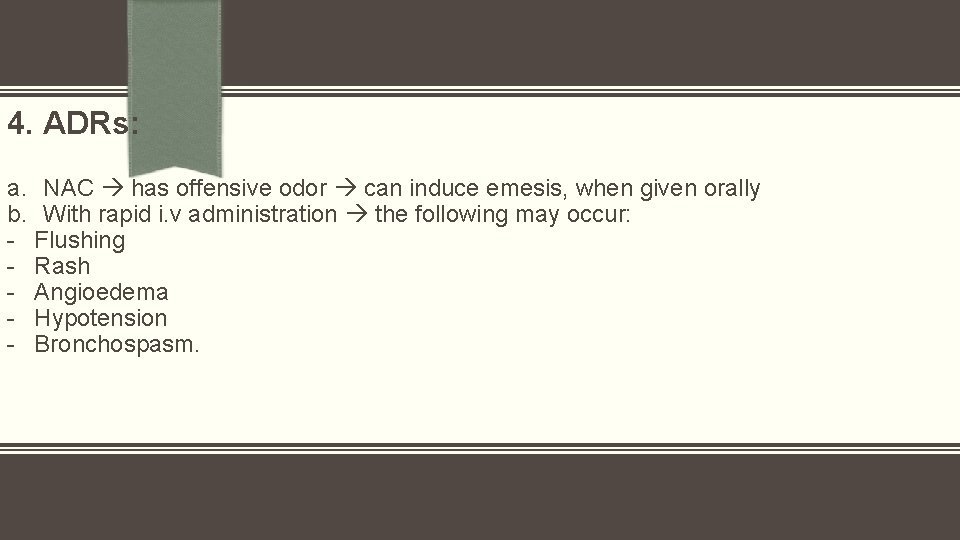
4. ADRs: a. NAC has offensive odor can induce emesis, when given orally b. With rapid i. v administration the following may occur: - Flushing - Rash - Angioedema - Hypotension - Bronchospasm.
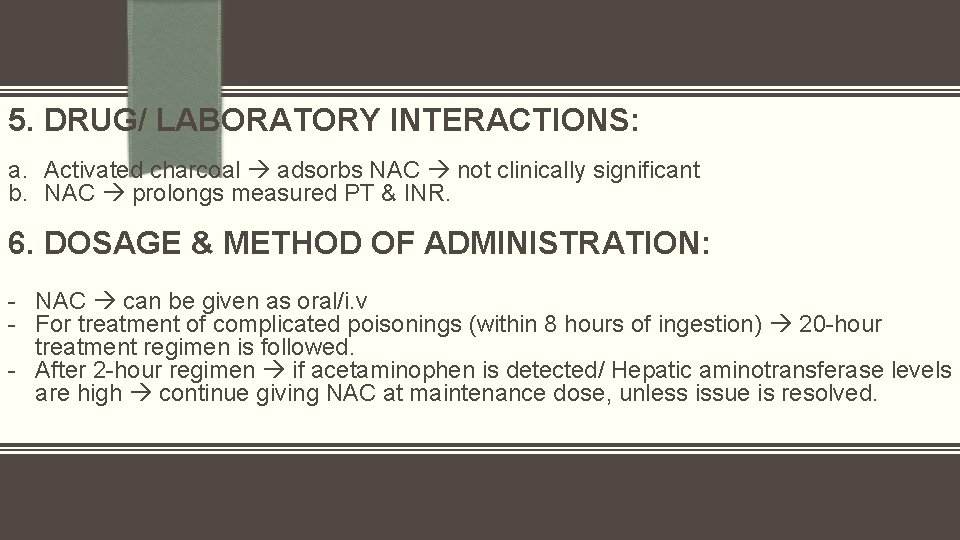
5. DRUG/ LABORATORY INTERACTIONS: a. Activated charcoal adsorbs NAC not clinically significant b. NAC prolongs measured PT & INR. 6. DOSAGE & METHOD OF ADMINISTRATION: - NAC can be given as oral/i. v - For treatment of complicated poisonings (within 8 hours of ingestion) 20 -hour treatment regimen is followed. - After 2 -hour regimen if acetaminophen is detected/ Hepatic aminotransferase levels are high continue giving NAC at maintenance dose, unless issue is resolved.
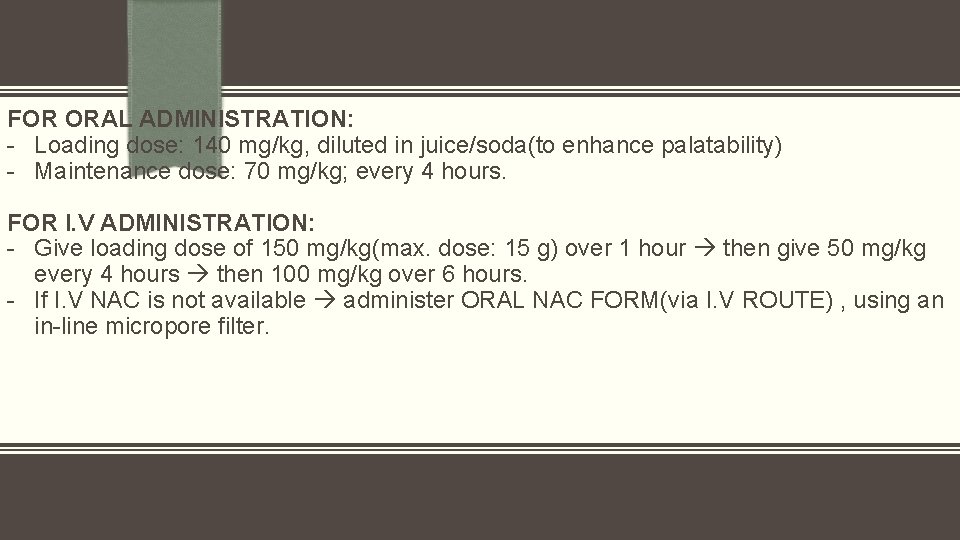
FOR ORAL ADMINISTRATION: - Loading dose: 140 mg/kg, diluted in juice/soda(to enhance palatability) - Maintenance dose: 70 mg/kg; every 4 hours. FOR I. V ADMINISTRATION: - Give loading dose of 150 mg/kg(max. dose: 15 g) over 1 hour then give 50 mg/kg every 4 hours then 100 mg/kg over 6 hours. - If I. V NAC is not available administer ORAL NAC FORM(via I. V ROUTE) , using an in-line micropore filter.
7. SPECIAL NOTES: - If anaphylactoid reactions occur with I. V administration STOP INFUSION IMMEDIATELY Treat with DIPHENHYDRAMINE - Provide EPINEPHRINE for more serious reactions (Shock, bronchoconstriction) - Once symptoms resolve restart the infusion at a slower rate - Patients, with history of asthma may be at a higher risk of developing anaphylactoid reactions - Drug comes under FDA PREGNANCY CATEGORY “B” (No evidence of teratogenicity)
PHYSOSTIGMINE & NEOSTIGMINE : A DEEP INSIGHT
1. PHARMACOLOGY: - PHYSOSTIGMINE & NEOSTIGMINE are carbamates - Drugs reversibly inhibit ACETYLCHOLINESTERASE increase ACh stimulate muscarinic & nicotinic receptors - Physostigmine has TERTIARY AMINE STRUCTURE penetrates BBB exerts cholinergic effects in the CNS - Neostigmine is a QUATERNARY AMMONIUM COMPOUND doesn’t cross BBB - FOR PHYSOSTIGMINE: a. Onset of action: 3 -8 mins b. Duration of action: 30 -90 mins - FOR NEOSTIGMINE: a. Onset of action: 7 -11 mins b. Duration of action: 1 -2 hours.
2. INDICATIONS: a. FOR PHYSOSTIGMINE: To treat the following manifestations of anticholinergic syndromes from BENZTROPINE, ATROPINE, JIMSON WEED(DATURA), DIPHENHYDRAMINE: - Agitated delirium - Urinary retention - Severe sinus tachycardia - Hyperthermia without sweating
Indications, based on ANECDOTAL CASE REPORTS: - GAMMA-HYDROXY BUTYRATE(GHB) - Baclofen - Antipsychotics(olanzapine, clozapine, quetiapine) to treat delirium and coma To diagnostically differentiate between functional psychosis(infectious encephalitis) from anticholinergic delusions. Non-specific uses include arousal in patients with the following toxicities: a. Opioids c. Sedative-hypnotic intoxication b. BZDs d. Ketamine/ Propofol induced sedation. b. FOR NEOSTIGMINE: To reverse effects of non-depolarizing neuromuscular blockers
3. CONTRAINDICATIONS: a. NEVER USE PHYSOSTIGMINE AS AN ANTIDOTE for TCA POISONING !!! may lead to worsening of cardiac conduction disturbances, bradyarrhythmias, asystoles & seizure aggravation. b. NEVER USE ALONG WITH DEPOLARIZING NEUROMUSCULAR BLOCKERS c. Known hypersensitivity to drug, benzyl alcohol/ bisulfite d. Asthma e. Peripheral vascular disease f. Intestinal & bladder blockade g. Parkinsonism h. AV block.
4. ADRs: a. b. c. d. e. f. g. h. i. j. Bradycardia Heart block(AV) Seizures(with rapid administration/ high drug doses) Nausea & vomiting Bronchospasm Diarrhea Bronchorrhea Hypersalivation Fasciculations Muscle weakness.
5. DRUG/ LABORATORY INTERACTIONS: a. Drug potentiate activity of agents metabolized by cholinesterase enzyme (like Depolarizing NMBs, OP, Carbamates, other cholinergic agents, etc) b. Neostigmine inhibits/ reverses actions of non-depolarizing NMBs (pancuronium, vecuronium) c. Drug + TCA / Beta-adrenergic antagonists / calcium antagonist overdoses cause additive cardiac conduction defects.
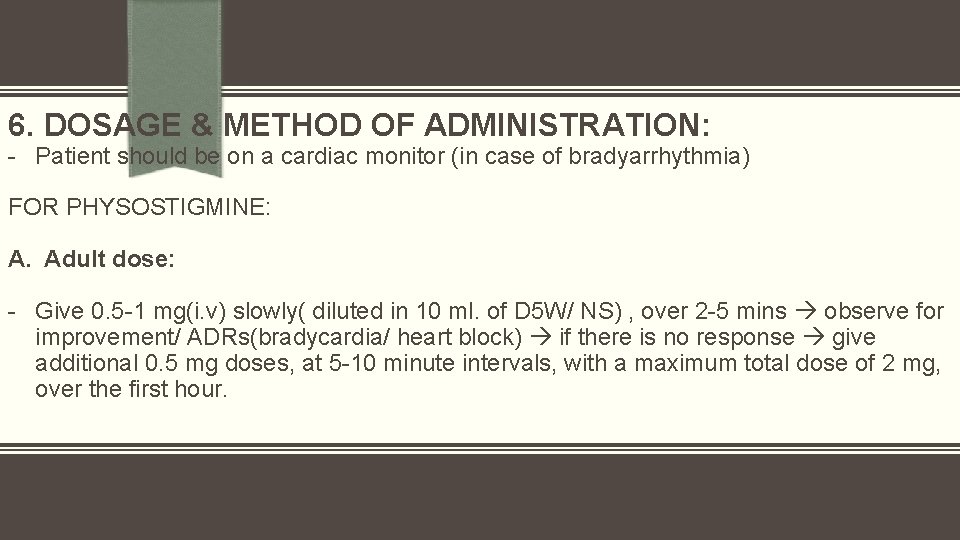
6. DOSAGE & METHOD OF ADMINISTRATION: - Patient should be on a cardiac monitor (in case of bradyarrhythmia) FOR PHYSOSTIGMINE: A. Adult dose: - Give 0. 5 -1 mg(i. v) slowly( diluted in 10 ml. of D 5 W/ NS) , over 2 -5 mins observe for improvement/ ADRs(bradycardia/ heart block) if there is no response give additional 0. 5 mg doses, at 5 -10 minute intervals, with a maximum total dose of 2 mg, over the first hour.
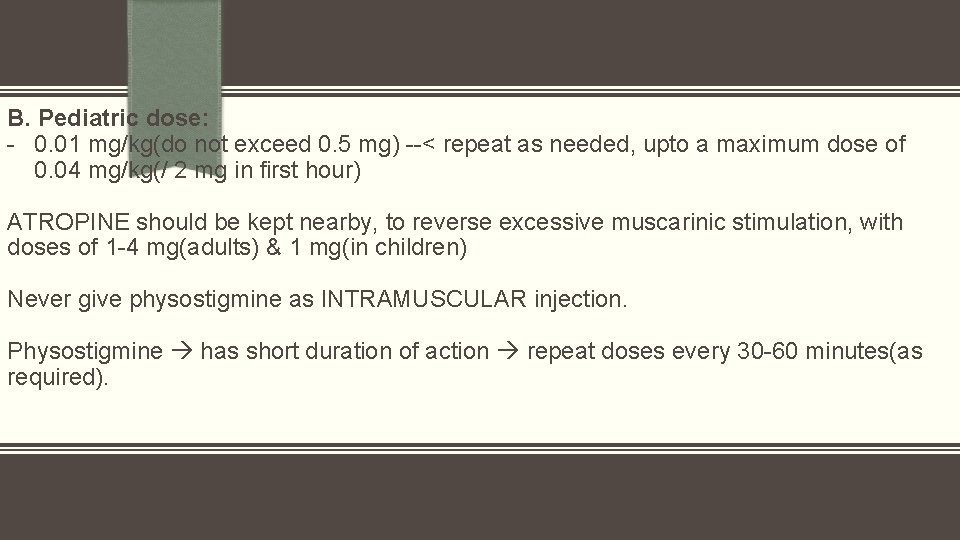
B. Pediatric dose: - 0. 01 mg/kg(do not exceed 0. 5 mg) --< repeat as needed, upto a maximum dose of 0. 04 mg/kg(/ 2 mg in first hour) ATROPINE should be kept nearby, to reverse excessive muscarinic stimulation, with doses of 1 -4 mg(adults) & 1 mg(in children) Never give physostigmine as INTRAMUSCULAR injection. Physostigmine has short duration of action repeat doses every 30 -60 minutes(as required).
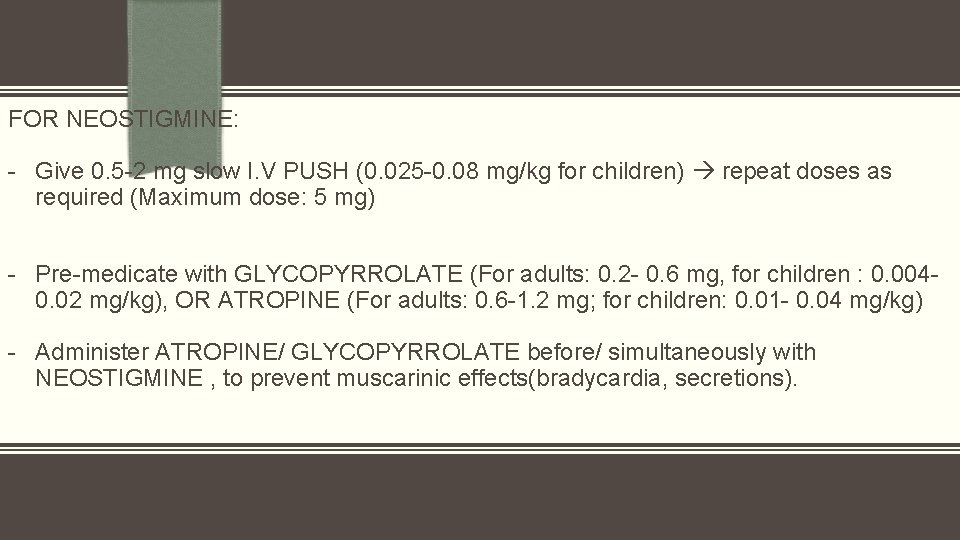
FOR NEOSTIGMINE: - Give 0. 5 -2 mg slow I. V PUSH (0. 025 -0. 08 mg/kg for children) repeat doses as required (Maximum dose: 5 mg) - Pre-medicate with GLYCOPYRROLATE (For adults: 0. 2 - 0. 6 mg, for children : 0. 0040. 02 mg/kg), OR ATROPINE (For adults: 0. 6 -1. 2 mg; for children: 0. 01 - 0. 04 mg/kg) - Administer ATROPINE/ GLYCOPYRROLATE before/ simultaneously with NEOSTIGMINE , to prevent muscarinic effects(bradycardia, secretions).
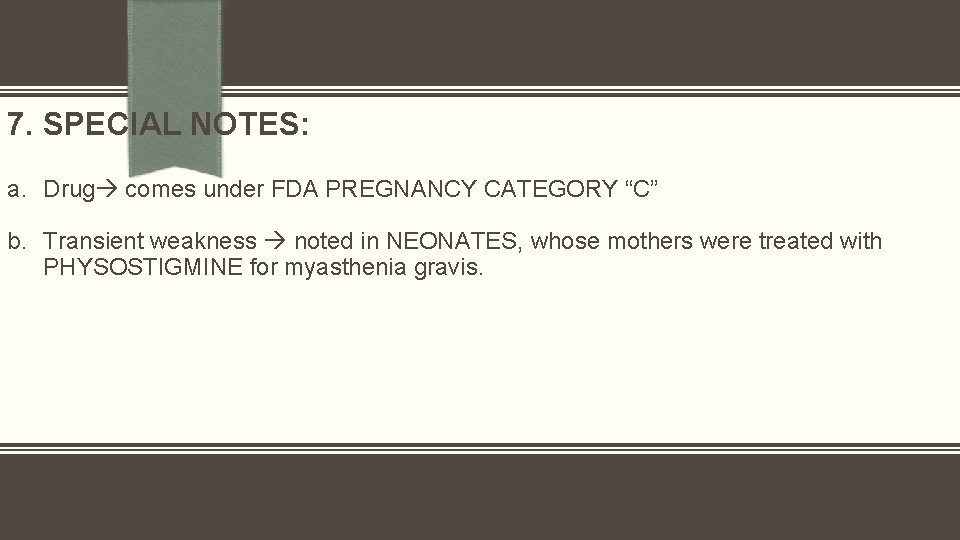
7. SPECIAL NOTES: a. Drug comes under FDA PREGNANCY CATEGORY “C” b. Transient weakness noted in NEONATES, whose mothers were treated with PHYSOSTIGMINE for myasthenia gravis.
REFERENCES/ BIBLIOGRAPHY: 1. Algren DA. Review of N-acetylcysteine for the treatment of acetaminophen(paracetamol) toxicity in pediatrics. Second Meeting of the Subcommittee of the Expert Committee on the Selection and Use of Essential Medicines. Geneva, 2008. 2. http: //www. accessdata. fda. gov/drugsatfda-docs/label/2006/021539 slbl. pdf 3. Schmidt LE. Identification of patients at risk of anaphylactoid reactions to Nacetylcysteine in the treatment of paracetamol overdose. Clin Toxicol 2013; 51(6): 467 -72.
4. Schwartz E, Cohn B. Systematic Review Snapshot: Is intravenous acetylcysteine more effective than oral administration in the prevention of hepatotoxicity in acetaminophen overdose? Ann Emerg Med 2014; 63(1): 79 -80. 5. Burns MJ et al. A Comparison if physostigmine and benzodiazepines for the treatment of anticholinergic poisoning. Ann Emerg Med 2000; 35: 374 -81. 6. Howland MA. “Antidotes in Depth(A 12): Physostigmine Salicylate: . Goldfrank’s Toxicologic Emergencies, Nelson LS et al, editors, 9 th Edition, Mc. Graw-Hill, 2011. Pages 759 -62. 7. Schneir AB et al. Complications of diagnostic physostigmine administration to emergency department patients. Ann Emerg Med 2003; 42: 14 -19. 8. Seifert SA, “Chapter 67: Physostigmine and Pyridostigmine. ” Medical Toxicology 3 rd Edition, Dart RC et al, editors. Philadelphia: Lippincott, Williams & Wilkins, 2004: 232 -36
THANK YOU!!!!!