MUNDYS CHILDREN The Multidisciplinary Network on Dystonia and
- Slides: 28
MUNDYS CHILDREN The Multidisciplinary Network on Dystonia and Spasticity in Children. Presentazione e primi risultati Flavio Giordano, MD Neurochirurgia Ospedale Pediatrico Anna Meyer Firenze
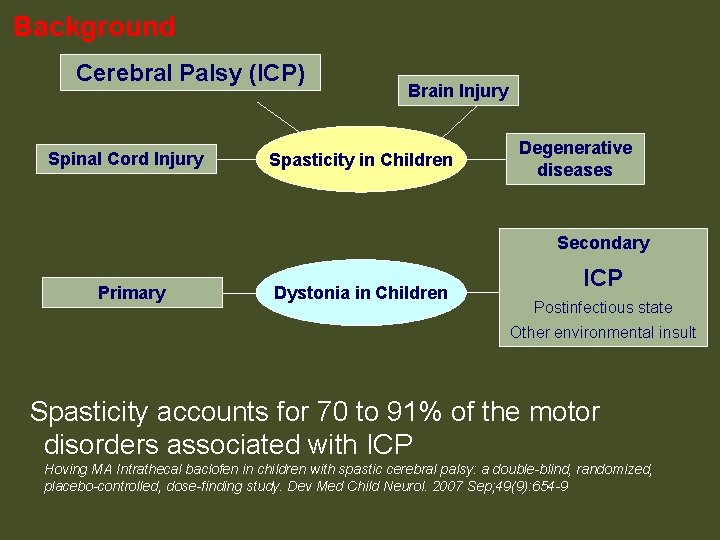
Background Cerebral Palsy (ICP) Spinal Cord Injury Brain Injury Spasticity in Children Degenerative diseases Secondary Primary Dystonia in Children ICP Postinfectious state Other environmental insult Spasticity accounts for 70 to 91% of the motor disorders associated with ICP Hoving MA Intrathecal baclofen in children with spastic cerebral palsy: a double-blind, randomized, placebo-controlled, dose-finding study. Dev Med Child Neurol. 2007 Sep; 49(9): 654 -9
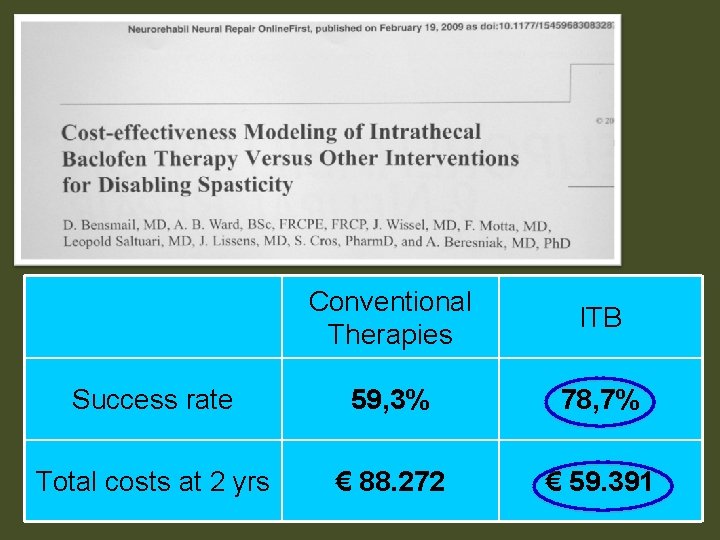
Conventional Therapies ITB Success rate 59, 3% 78, 7% Total costs at 2 yrs € 88. 272 € 59. 391
Perché creare un network per la terapia della spasticità nell’Italia Centrale con particolare attenzione alla ITB ? ?
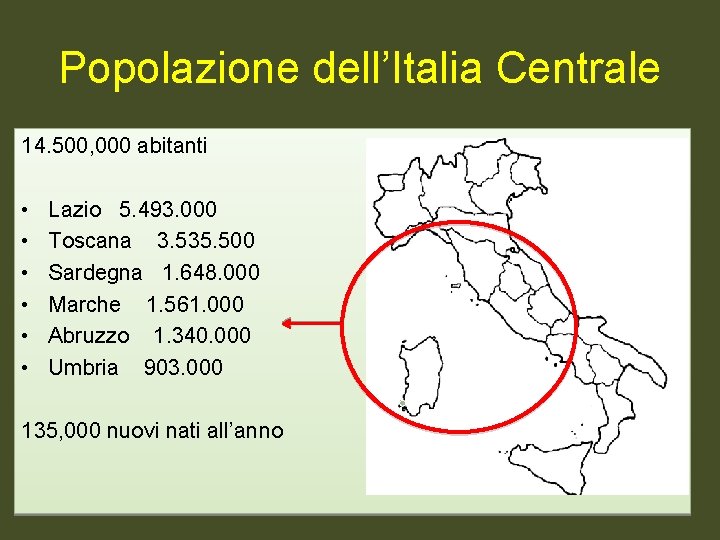
Popolazione dell’Italia Centrale 14. 500, 000 abitanti • • • Lazio 5. 493. 000 Toscana 3. 535. 500 Sardegna 1. 648. 000 Marche 1. 561. 000 Abruzzo 1. 340. 000 Umbria 903. 000 135, 000 nuovi nati all’anno
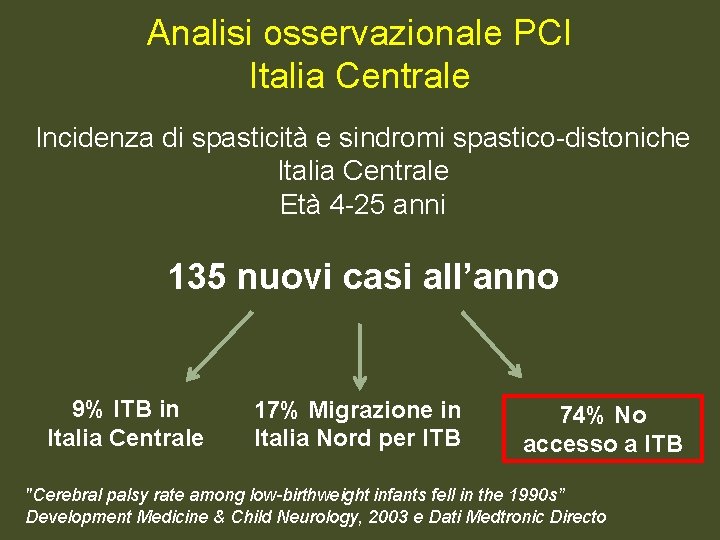
Analisi osservazionale PCI Italia Centrale Incidenza di spasticità e sindromi spastico-distoniche Italia Centrale Età 4 -25 anni 135 nuovi casi all’anno 9% ITB in Italia Centrale 17% Migrazione in Italia Nord per ITB 74% No accesso a ITB "Cerebral palsy rate among low-birthweight infants fell in the 1990 s” Development Medicine & Child Neurology, 2003 e Dati Medtronic Directo
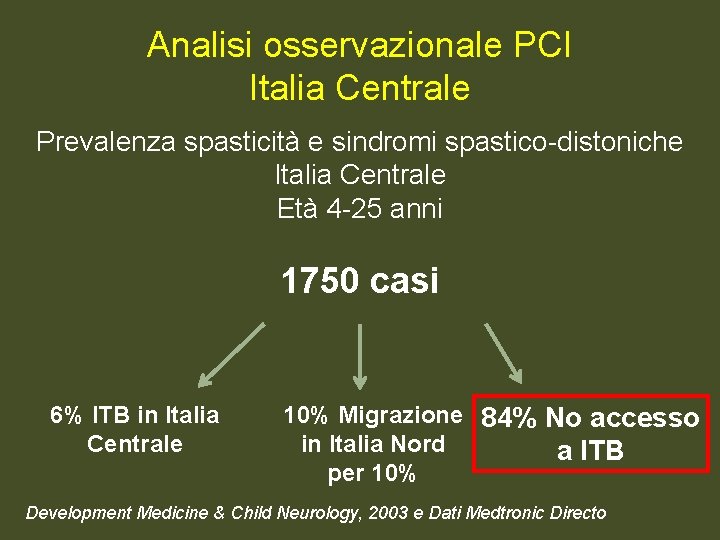
Analisi osservazionale PCI Italia Centrale Prevalenza spasticità e sindromi spastico-distoniche Italia Centrale Età 4 -25 anni 1750 casi 6% ITB in Italia Centrale 10% Migrazione 84% No accesso in Italia Nord a ITB per 10% Development Medicine & Child Neurology, 2003 e Dati Medtronic Directo
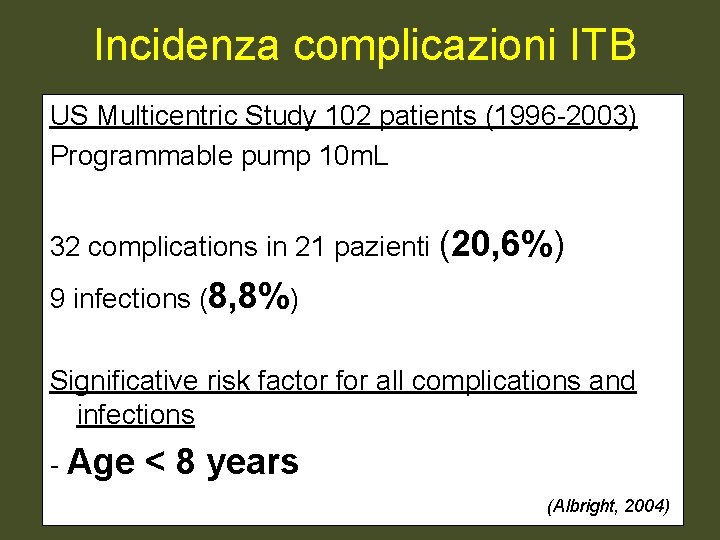
Incidenza complicazioni ITB US Multicentric Study 102 patients (1996 -2003) Programmable pump 10 m. L 32 complications in 21 pazienti (20, 6%) 9 infections (8, 8%) Significative risk factor for all complications and infections - Age < 8 years (Albright, 2004)
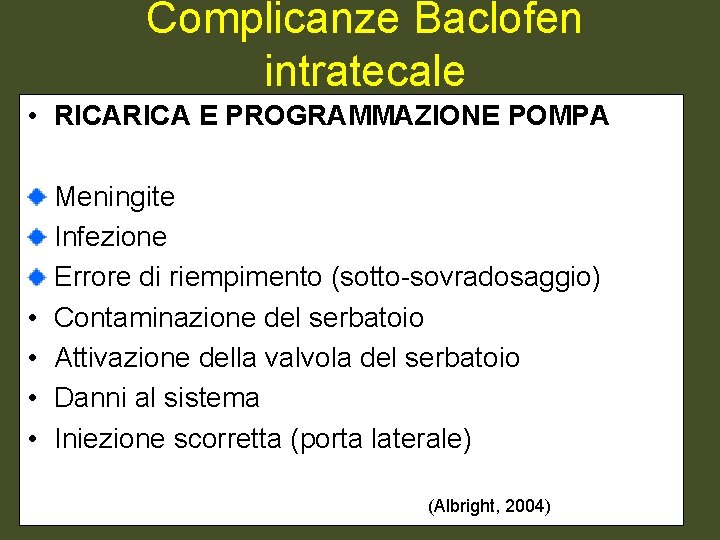
Complicanze Baclofen intratecale • RICA E PROGRAMMAZIONE POMPA • • Meningite Infezione Errore di riempimento (sotto-sovradosaggio) Contaminazione del serbatoio Attivazione della valvola del serbatoio Danni al sistema Iniezione scorretta (porta laterale) (Albright, 2004)
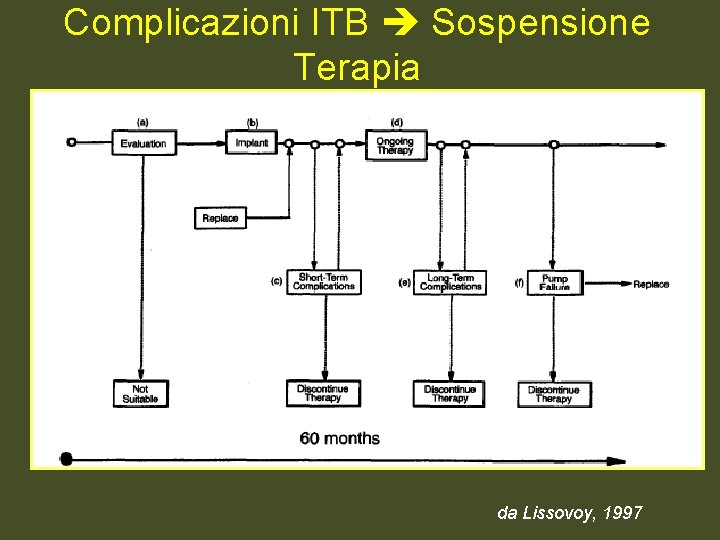
Complicazioni ITB Sospensione Terapia da Lissovoy, 1997
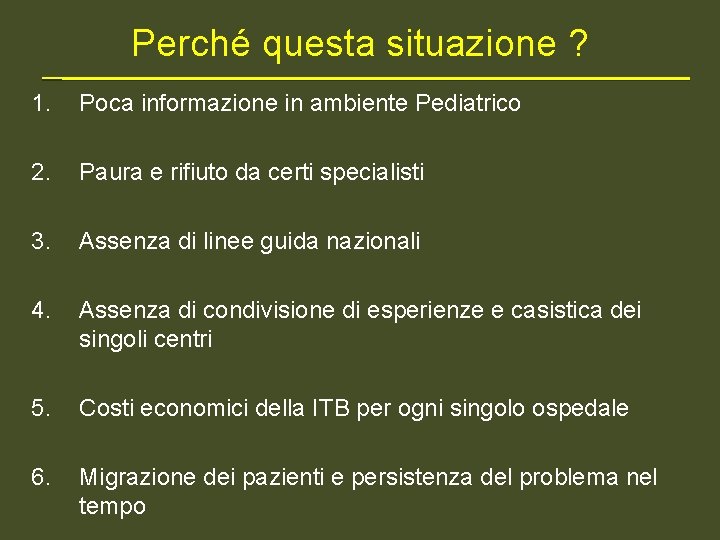
Perché questa situazione ? 1. Poca informazione in ambiente Pediatrico 2. Paura e rifiuto da certi specialisti 3. Assenza di linee guida nazionali 4. Assenza di condivisione di esperienze e casistica dei singoli centri 5. Costi economici della ITB per ogni singolo ospedale 6. Migrazione dei pazienti e persistenza del problema nel tempo
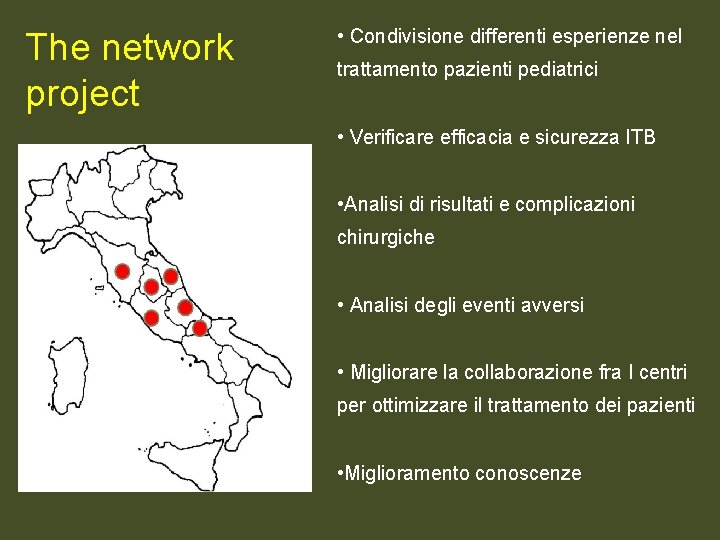
The network project • Condivisione differenti esperienze nel trattamento pazienti pediatrici • Verificare efficacia e sicurezza ITB • Analisi di risultati e complicazioni chirurgiche • Analisi degli eventi avversi • Migliorare la collaborazione fra I centri per ottimizzare il trattamento dei pazienti • Miglioramento conoscenze
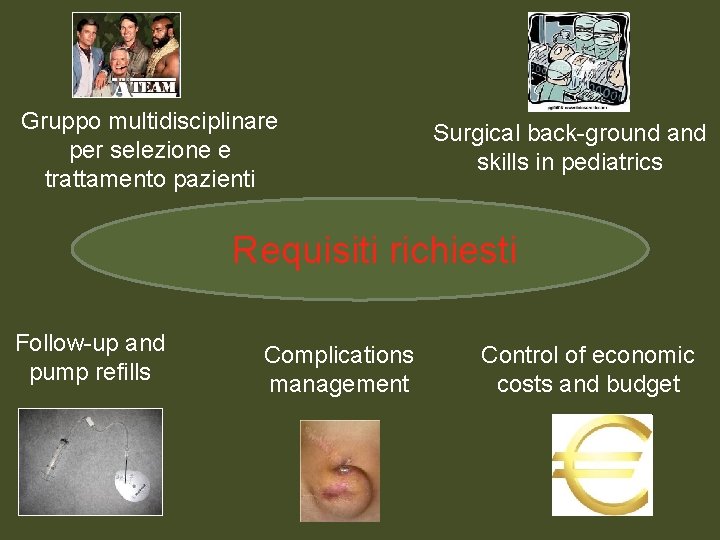
Gruppo multidisciplinare per selezione e trattamento pazienti Surgical back-ground and skills in pediatrics Requisiti richiesti Follow-up and pump refills Complications management Control of economic costs and budget
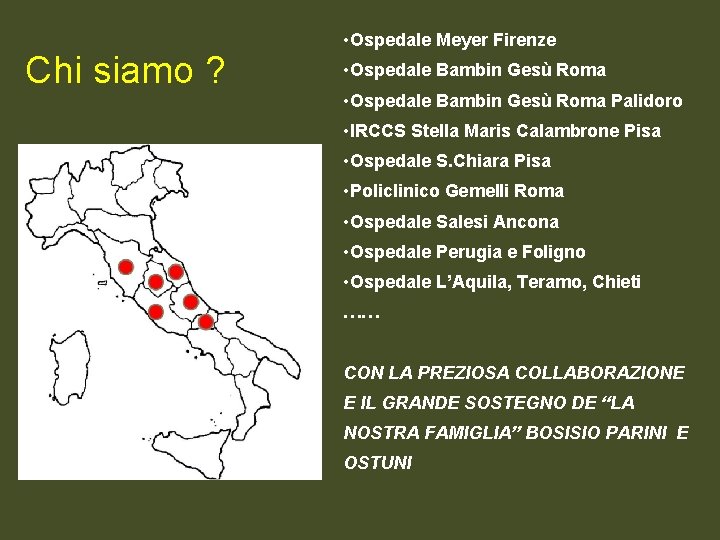
Chi siamo ? • Ospedale Meyer Firenze • Ospedale Bambin Gesù Roma Palidoro • IRCCS Stella Maris Calambrone Pisa • Ospedale S. Chiara Pisa • Policlinico Gemelli Roma • Ospedale Salesi Ancona • Ospedale Perugia e Foligno • Ospedale L’Aquila, Teramo, Chieti …… CON LA PREZIOSA COLLABORAZIONE E IL GRANDE SOSTEGNO DE “LA NOSTRA FAMIGLIA” BOSISIO PARINI E OSTUNI
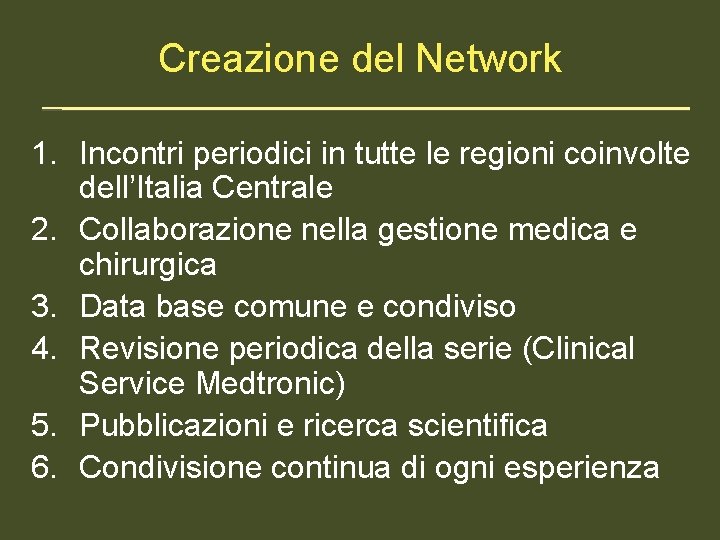
Creazione del Network 1. Incontri periodici in tutte le regioni coinvolte dell’Italia Centrale 2. Collaborazione nella gestione medica e chirurgica 3. Data base comune e condiviso 4. Revisione periodica della serie (Clinical Service Medtronic) 5. Pubblicazioni e ricerca scientifica 6. Condivisione continua di ogni esperienza
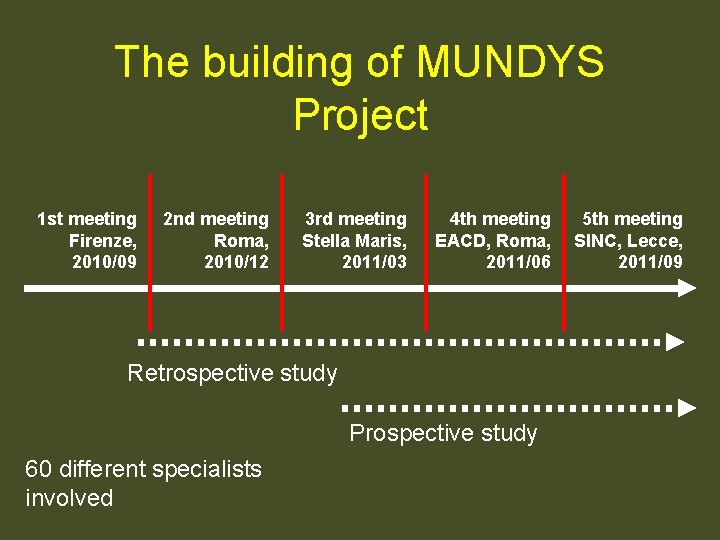
The building of MUNDYS Project 1 st meeting Firenze, 2010/09 2 nd meeting Roma, 2010/12 3 rd meeting Stella Maris, 2011/03 4 th meeting EACD, Roma, 2011/06 Retrospective study Prospective study 60 different specialists involved 5 th meeting SINC, Lecce, 2011/09
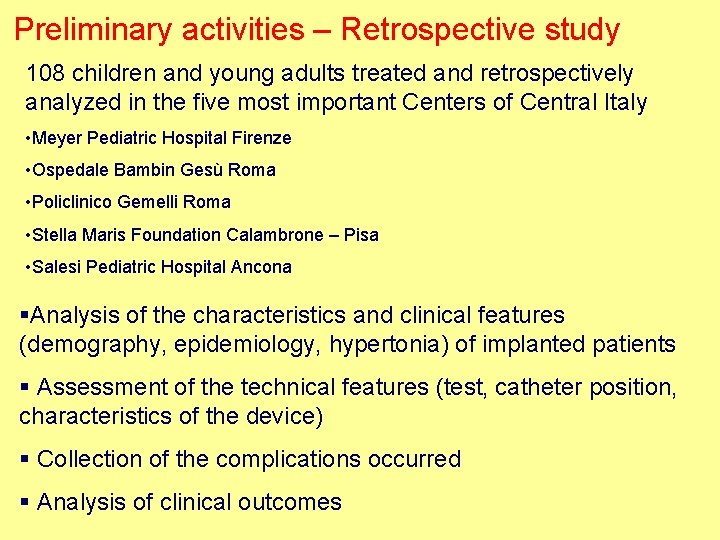
Preliminary activities – Retrospective study 108 children and young adults treated and retrospectively analyzed in the five most important Centers of Central Italy • Meyer Pediatric Hospital Firenze • Ospedale Bambin Gesù Roma • Policlinico Gemelli Roma • Stella Maris Foundation Calambrone – Pisa • Salesi Pediatric Hospital Ancona §Analysis of the characteristics and clinical features (demography, epidemiology, hypertonia) of implanted patients § Assessment of the technical features (test, catheter position, characteristics of the device) § Collection of the complications occurred § Analysis of clinical outcomes
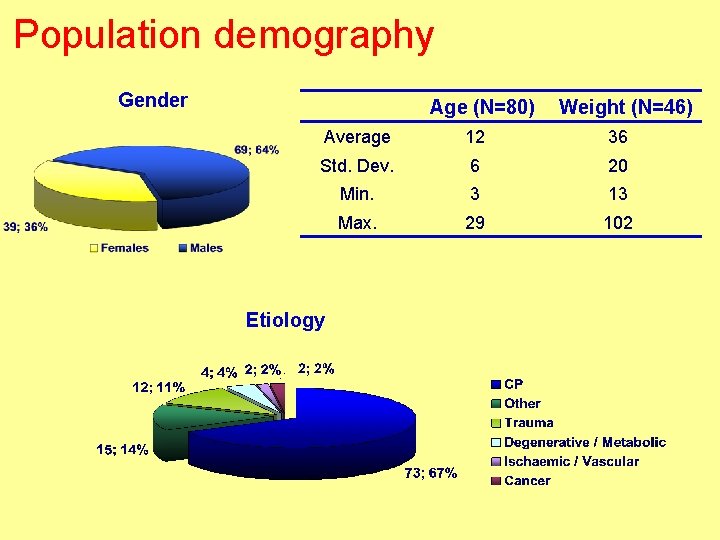
Population demography Gender Age (N=80) Weight (N=46) Average 12 36 Std. Dev. 6 20 Min. 3 13 Max. 29 102 Etiology
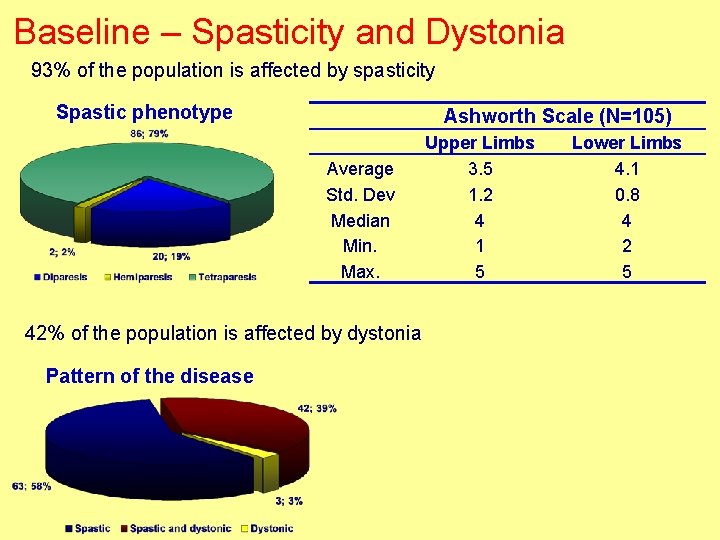
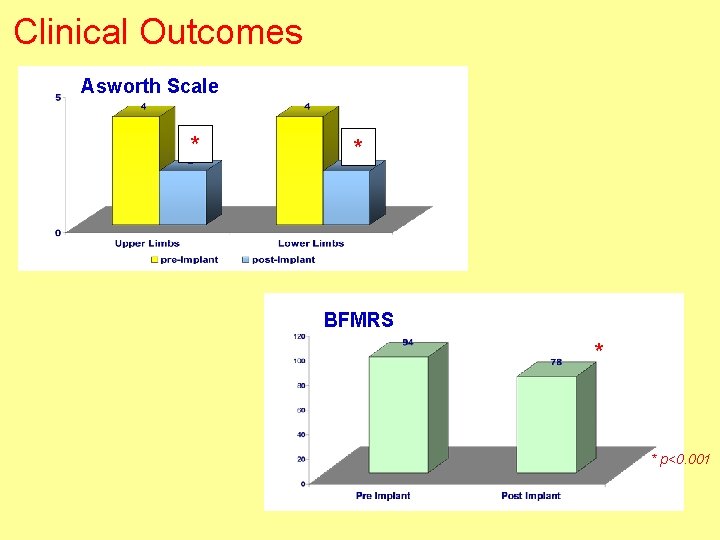
Baseline – Spasticity and Dystonia 93% of the population is affected by spasticity Spastic phenotype Ashworth Scale (N=105) Average Std. Dev Median Min. Max. 42% of the population is affected by dystonia Pattern of the disease Upper Limbs 3. 5 1. 2 4 1 5 Lower Limbs 4. 1 0. 8 4 2 5
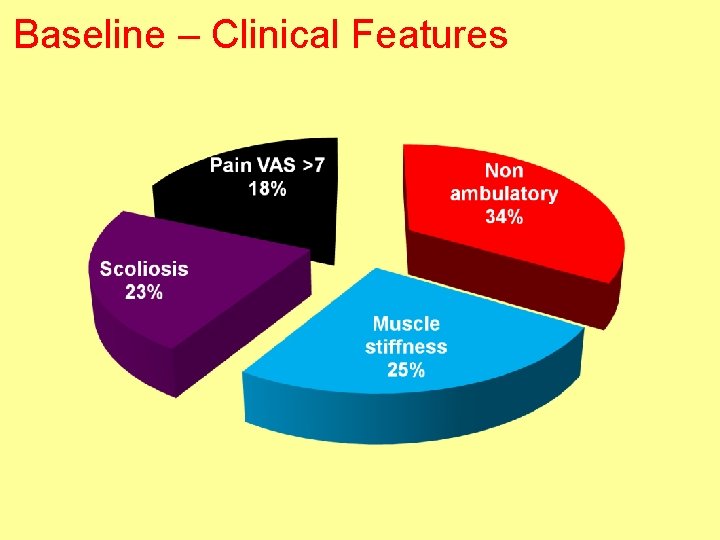
Baseline – Clinical Features
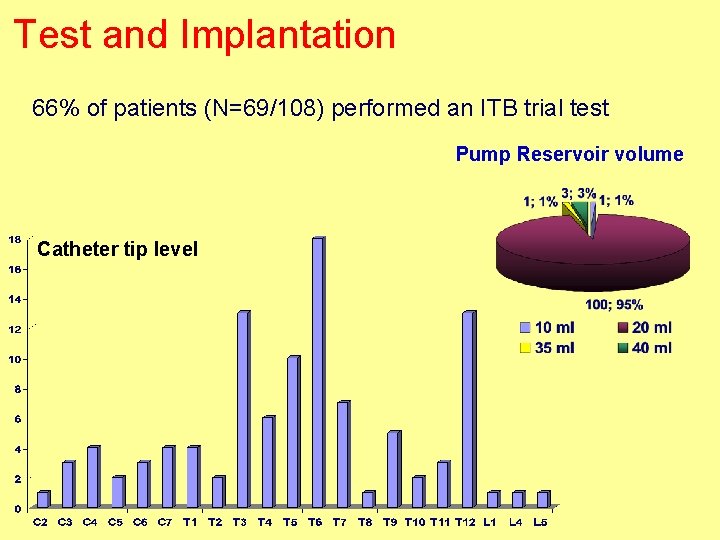
Test and Implantation 66% of patients (N=69/108) performed an ITB trial test Pump Reservoir volume Catheter tip level
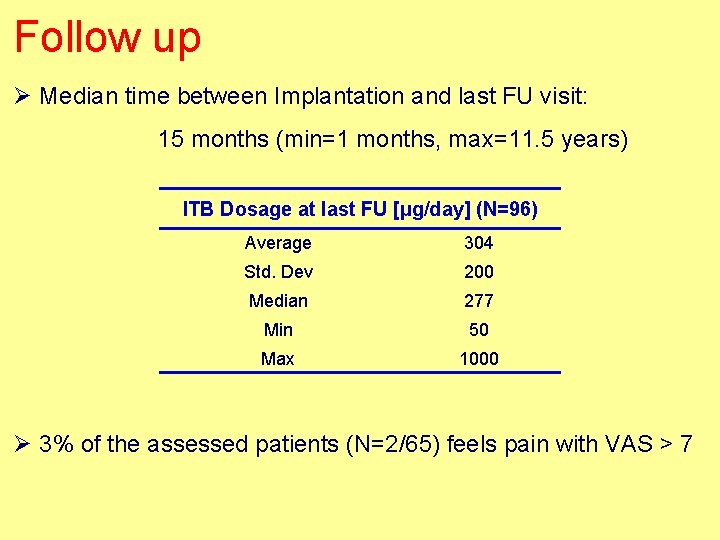
Follow up Ø Median time between Implantation and last FU visit: 15 months (min=1 months, max=11. 5 years) ITB Dosage at last FU [µg/day] (N=96) Average 304 Std. Dev 200 Median 277 Min 50 Max 1000 Ø 3% of the assessed patients (N=2/65) feels pain with VAS > 7
Clinical Outcomes Asworth Scale * * * p<0. 001 BFMRS * * p<0. 001
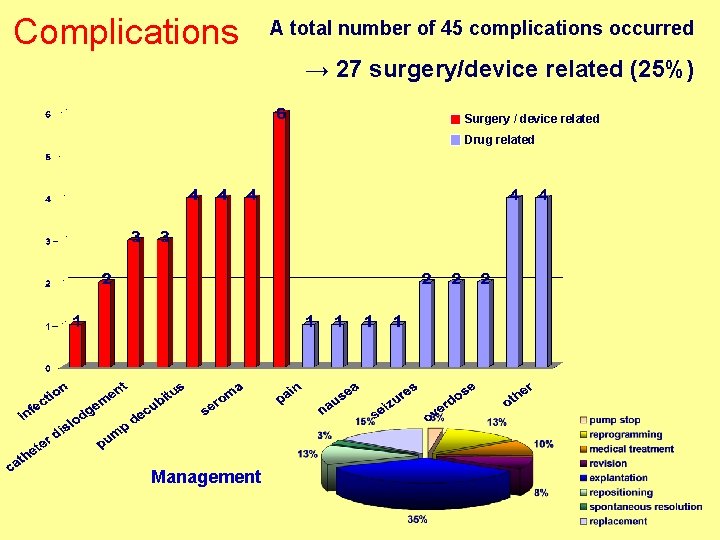
Complications A total number of 45 complications occurred → 27 surgery/device related (25%) Surgery / device related Drug related Management
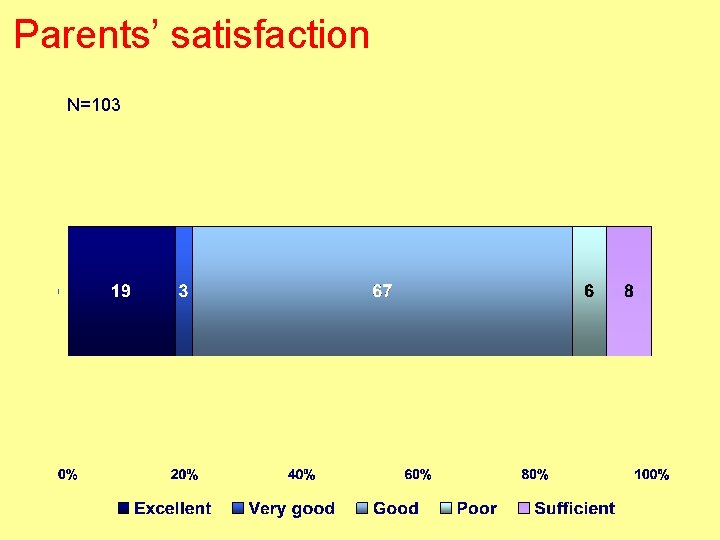
Parents’ satisfaction N=103
Conclusions • In our retrospective study ITB therapy confirms the good results in the management of spastic children with/without secondary dystonia • The number of the collected adverse events is consistent with literature • Complications have been efficiently managed. • The ITB treatment results in an overall good satisfaction in patients’ family. • Prospective analysis will be provided in order to deeply investigate ITB outcomes
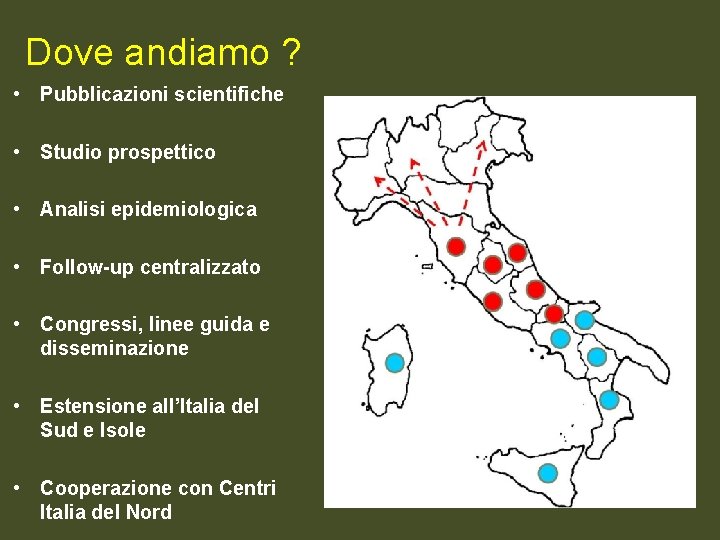
Dove andiamo ? • Pubblicazioni scientifiche • Studio prospettico • Analisi epidemiologica • Follow-up centralizzato • Congressi, linee guida e disseminazione • Estensione all’Italia del Sud e Isole • Cooperazione con Centri Italia del Nord
Drsa Anna Filippini Drsa Silvia Lori Dr Federico Melani Drsa Silvia Paoli Prof Giovanni Cioni Drsa Silvia Perazza Drsa Roberta Battini Drsa Manuela Casarano Prof Aldo Iannelli Prof Enrico Castelli Drsa Michela Armando Dr Francesco Costici Prof Concezio Di Rocco Drsa Beatrice Cioni Dr Luca Massimi Dr Giampiero Tamburrini Drsa Ottavia De Lellis Dr Massimiliano Murgia Dr Pierfrancesco Eugeni Drsa Annalisa Di Loreto Drsa Silvia Cappanera Drsa Liliana Porfiri Dr Guido Camanni Dr Antonio Trabacca Drsa Marilena Cacudi Drsa Lucia Petrara Drsa Leonarda Gennaro Drsa Daniela Morelli Drsa Rosa Russo Drsa Roberta Bombardieri Drsa Roberta Di Pietro Drsa Annalivia Ioizzo Drsa Eliana Compagnone Dr Marco Romeo