
Neurological terms ChunHsiang Tan MD Ph D Gaduate






































- Slides: 100
Neurological terms Chun-Hsiang Tan, MD, Ph. D Gaduate Institute of Clinical Medicine Department of Neurology
Outline • General neurological terms • Terms associated with specific diseases • Cerebrovascular diseases • Movement disorders • Peripheral nervous system
Symptoms and Neurology Terms associated with Not Urology
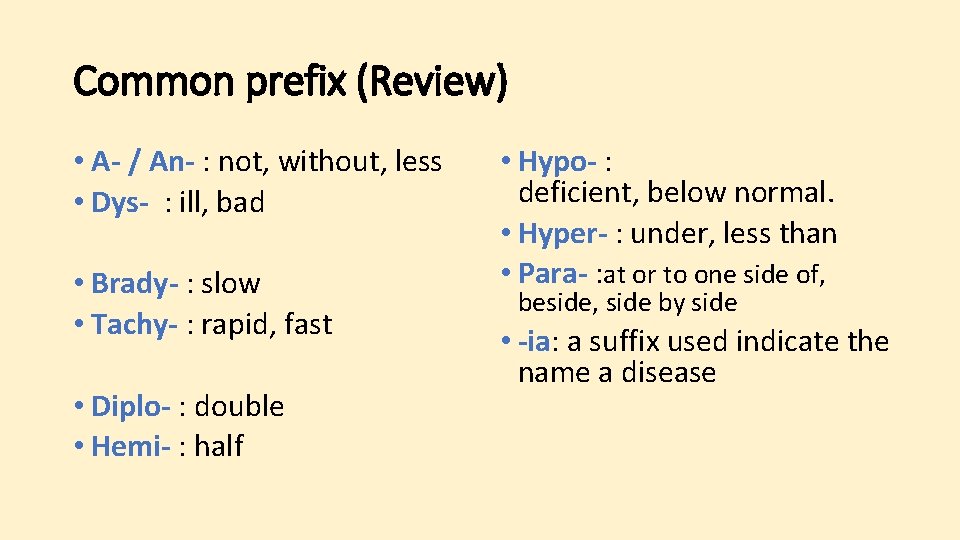
Common prefix (Review) • A- / An- : not, without, less • Dys- : ill, bad • Brady- : slow • Tachy- : rapid, fast • Diplo- : double • Hemi- : half • Hypo- : deficient, below normal. • Hyper- : under, less than • Para- : at or to one side of, beside, side by side • -ia: a suffix used indicate the name a disease
Aphasia
-phasia Etymology • From Ancient Greek φάσις (phásis, “ (phēmí, “ I say”). utterance”), from φημί
Aphasia • Difficulty speaking (expressive aphasia) or understanding what is said (receptive aphasia) or a combination of the two.
-phasia Suffix • Used to form the names of disorders and phenomena relating to words and speech. • Aphasia • Bradyphasia
Dysarthria
-arthria Suffix • meaning a ”condition involving the ability to • Anarthria • Dysarthria articulate”
Dysarthria control the mouth, lips, tongue or breathing, making it very difficult to pronounce words • Weakness in the muscles that
Apraxia
Praxis • In Ancient Greek the word praxis (πρᾶξις) referred to engaged in by free people. Suffix • -praxia: to achieve or to do (perform) activity
Apraxia • The inability to control and co-ordinate movements or carry out complex tasks.
Hemianopia
-opia Etymology • From ancient Greek ōps “eye” • Myopia
Anopia • State or condition of sightlessness.
Hemianopia • The loss of one half of the visual field which results in not being able to see to either the left or right of the field of vision. • It can happen in the right half of each eye known as „right homonymous hemianopia‟ or in the left half called “left homonymous hemianopia”
Paralysis
-lysis Suffix • indicating loosening, decomposition, or breakdown
Paralysis • Complete loss of the ability to move muscles. • After a stroke, paralysis usually happens on one side of the body.
Hemiparesis
paresis • slight or partial paralysis
Hemiparesis • Weakness of one half of the body.
Hemiplegia
-plegia Suffix • paralysis, cessation of motion • Hemiplegia: • paralysis of one side of the body. • It differs from hemiparesis (weakness on one side of the body) as it describes the total loss of ability to move a part of the body. • Monoplegia: • Diplegia: • Quadriplegia: • Paraplegia:
Hemiplegia • Paralysis of one side of the body.
Incontinence
Incontinence • Loss of control of the bladder, bowel, or both.
Agraphia
-graphia Etymology • Latin graphia, Greek graphein meaning “to write”
Agraphia • Inability to express thoughts in writing
Anomia
-nom Etymology • From Latin “name”
Anomia • Inability to recall names of objects
Anosmia
-osm • Greek osmē refers to “sense of smell” • Anosmia: loss of sense of smell
Anosmia • loss of sense of smell
Alexia
-lexia Etymology • From Greek lexis “word, reading” • Dyslexia: a difficulty in reading
Alexia • Inability to read
Agnosia • Failure to recognize familiar objects
Amnesia
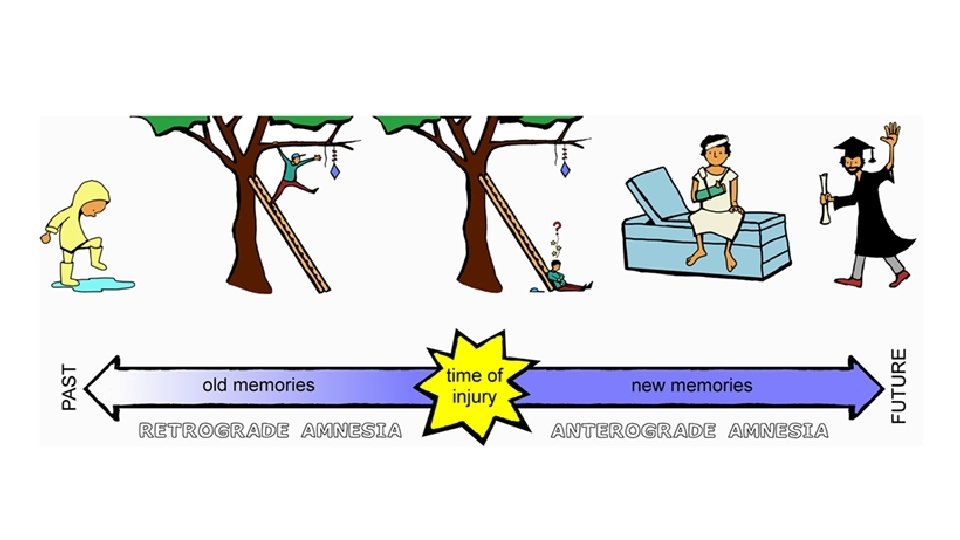
Anterograde Amnesia • Inability to remember ongoing events
Retrograde Amnesia • A loss of memory-access to events that occurred, or information that was learned, before an injury or the onset of a disease
-mnesi. Etymology • From Greek “remembering” • Anterograde Amnesia: inability to remember ongoing events • Retrograde Amnesia: a loss of memory-access to events that occurred, or information that was learned, before an injury or the onset of a disease
Ataxia
Ataxia • Difficulty with muscle coordination
-taxis Etymology • From Greek taxis "arrangement, order” • Ataxia: Difficulty with muscle coordination
Dysmetria
Dysmetria • Inability to stop a movement at the desired point
Diplopia
Diplopia • Seeing two images of a single object: double vision
Dysphagia
-phago Etymology • From Greek phagein “to eat” • Aphagia: inability to swallow
Dysphagia • Swallowing disorder
Cerebrovascular diseases Terms associated with
Hematoma • Hemat-: Blood • -oma: tumor or neoplasm • A blood clot that forms after bleeding from a burst blood vessel.
Hemorrhage • Hemo-: blood • -rrhage: excessive flow • When a blood vessel bursts, causing bleeding into the surrounding tissues
Hemorrhagic stroke • A type of stroke caused by a blood vessel bursting and bleeding within the brain (intracerebral hemorrhage) or onto the surface of the brain (subarachnoid hemorrhage).
Infarct/infarction • An infarction can happen anywhere in the body, but in relation to stroke, it describes an area of brain tissue that has not received its blood supply and as a result it has been damaged.
Ischemia • An inadequate blood supply to an organ or tissue
Ischemic stroke • This type of stroke happens when a clot blocks an artery carrying blood to the brain.
Lacunar stroke/lacunar infarct • A blockage in the tiny blood vessels deep within the brain which causes around 25% of ischaemic strokes.
Stenosis (of an artery) • Stenosis means narrowing.
Thrombosis • A blood clot that forms in an artery.
Embolism • The blockage of a blood vessel by a blood clot or piece of fatty material or other debris in the blood stream.
Anticoagulant
Anticoagulant • A type of medication used to thin the blood.
Antiplatelet drugs • A type of blood-thinning medication. • They stop the platelets in the blood sticking together and forming clots, which reduces the risk of stroke.
Thrombolysis • An early treatment for some types of strokes caused by a blood clot. • Thrombolysis is a procedure that involves being given a drug called recombinant tissue plasminogen activator (rt-PA).
Movement disorders Terms associated with
Athetosis
Athetosis • Athetosis is a • • Slow Continuous Writhing movement of the • • • Limbs Trunk Head Face Tongue
Ballism
Ballism • the movements are more jerk-like • of large amplitude, producing flinging movements of the affected limbs
Chorea
Chorea • Brief • Irregular contractions • although rapid, are not as lightning-like as myoclonic jerks • Sydenham chorea • The movements are neither repetitive nor rhythmic. • Ballism sometimes viewed as a form of chorea
Dystonia
Dystonia • Dystonia is a syndrome of sustained muscle contraction that frequently causes twisting and repetitive movements or abnormal postures. • The spasms may affect • • neck muscles (torticollis) periocular muscles (blepharospasm) facial muscles (Meige syndrome) limb muscles (writer’s cramp)
Myoclonus
Myoclonus • Myoclonus refers to • an ultrabrief, shock-like movement that may arise from sudden muscle contractions • sudden interruption of ongoing muscle contractions with resultant postural lapses (i. e. , negative myoclonus). • The most common form of negative myoclonus is asterixis, • metabolic encephalopathies • transient inhibition of the muscles that maintain posture of those extremities
Tremor
Tremor • Tremors are rhythmic oscillatory movements. • They result either • from alternating contractions of opposing muscle groups • or from simultaneous contractions of agonist and antagonist muscles
Tics
Tics • Tics may be • simple jerks or complex sequences of coordinated movements • that appear suddenly and intermittently • When simple, the movements may resemble a myoclonic jerk.
Akathisia
Akathisia • Akathitic movements commonly accompany the subjective symptom of akathisia • an inner feeling of motor restlessness or the need to move. • Akathisia is most commonly seen as a side effect of antipsychotic drug therapy, either as acute akathisia or tardive akathisia, which often accompanies tardive dyskinesia.
Hyperekplexia
Hyperekplexia • Hyperekplexia (startle disease) consists of dramatic, complex motor responses to sudden tactile or auditory stimuli. • It may be hereditary or sporadic.
Hypokinesia
Hypokinesia • Hypokinesia refers to decreased bodily movement. • Hypokinesia is characterized by a partial or complete loss of muscle movement due to a disruption in the basal ganglia.
Kinesis Etymology • From Greek kinein "to set in motion; to move" • Kinesthesia: sensory awareness of body parts as they move • Dyskinesia: characterized by a diminished ability for voluntary movements, as well as the presence of involuntary movements. • Hypokinesia • Bradykinesia
Bradykinesia
Bradykinesia • Slowness of initiation of voluntary movement with a progressive reduction in speed and range of repetitive actions, such as voluntary finger-tapping. • It occurs in Parkinson’s disease and other disorders of the basal ganglia. It is one of the four key symptoms of parkinsonism, which are bradykinesia, tremor, rigidity, and postural instability
Dyskinesia
Dyskinesia • This is characterized by a diminished ability for voluntary movements, as well as the presence of involuntary movements.
Thank You