MRI new imaging technology with hyperpolarised radiotracers Lina

- Slides: 20
γ-MRI: new imaging technology with hyperpolarised radiotracers Lina Pallada, CERN fellow For the γ-MRI collaboration
Outline Motivation Project description 1 st tests Current status Experiments during CERN LS 2 Summary 2
Outline Motivation Project description 1 st tests Current status Experiments during CERN LS 2 Summary 3
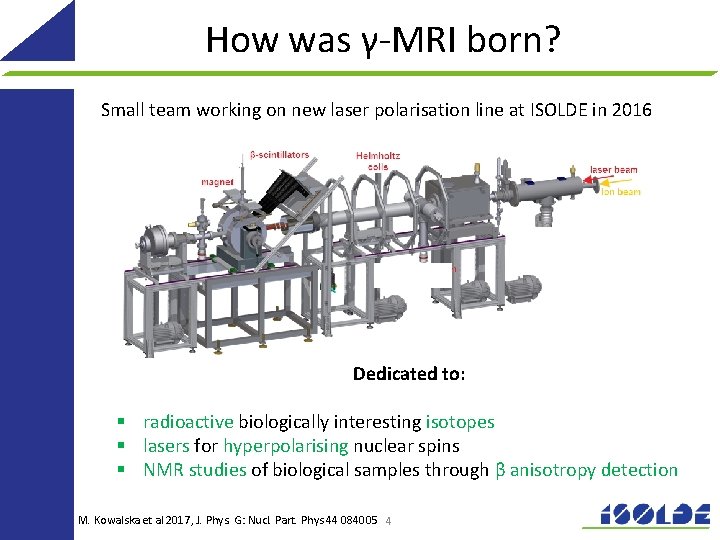
How was γ-MRI born? Small team working on new laser polarisation line at ISOLDE in 2016 Dedicated to: § radioactive biologically interesting isotopes § lasers for hyperpolarising nuclear spins § NMR studies of biological samples through β anisotropy detection M. Kowalska et al 2017, J. Phys. G: Nucl. Part. Phys 44 084005 4
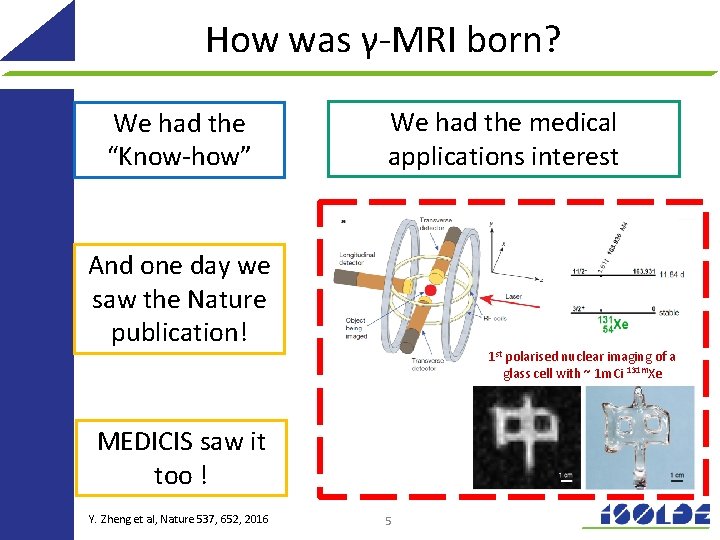
How was γ-MRI born? We had the “Know-how” We had the medical applications interest And one day we saw the Nature publication! 1 st polarised nuclear imaging of a glass cell with ~ 1 m. Ci 131 m. Xe MEDICIS saw it too ! Y. Zheng et al, Nature 537, 652, 2016 5
Outline Motivation Project description 1 st tests Current status Experiments during CERN LS 2 Summary 6
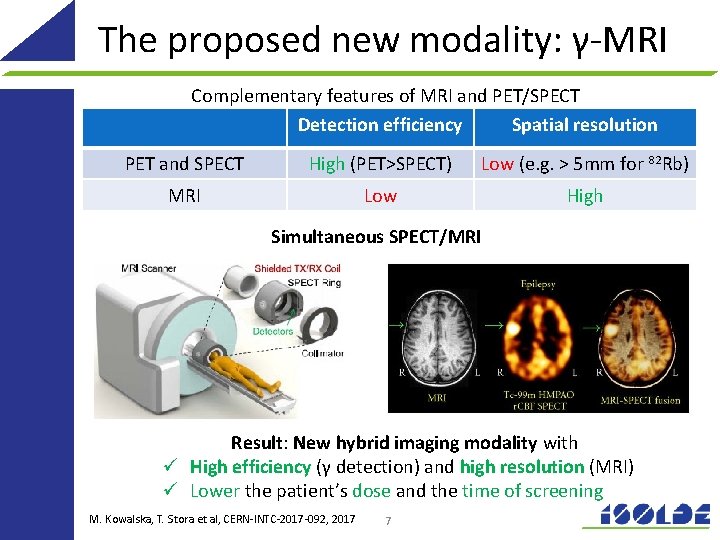
The proposed new modality: γ-MRI Complementary features of MRI and PET/SPECT Detection efficiency Spatial resolution PET and SPECT High (PET>SPECT) Low (e. g. > 5 mm for 82 Rb) MRI Low High Simultaneous SPECT/MRI Result: New hybrid imaging modality with ü High efficiency (γ detection) and high resolution (MRI) ü Lower the patient’s dose and the time of screening M. Kowalska, T. Stora et al, CERN-INTC-2017 -092, 2017 7
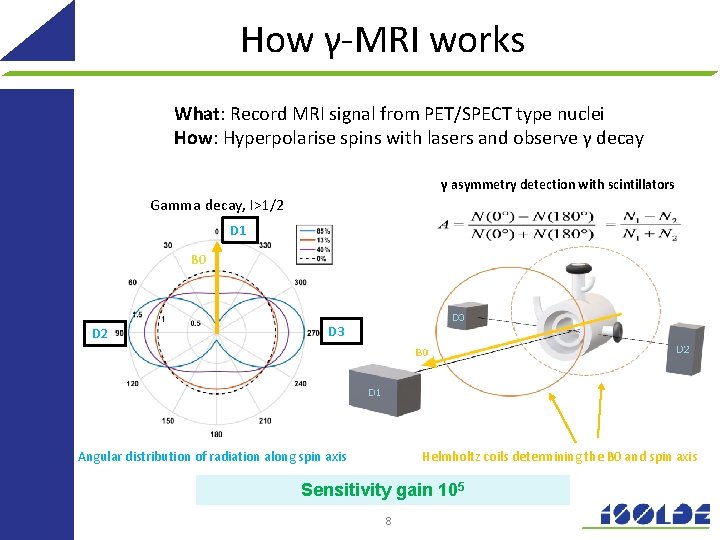
How γ-MRI works What: Record MRI signal from PET/SPECT type nuclei How: Hyperpolarise spins with lasers and observe γ decay γ asymmetry detection with scintillators Gamma decay, I>1/2 D 1 B 0 D 2 D 3 Helmholtz coils determining the B 0 and spin axis Angular distribution of radiation along spin axis Sensitivity gain 105 8
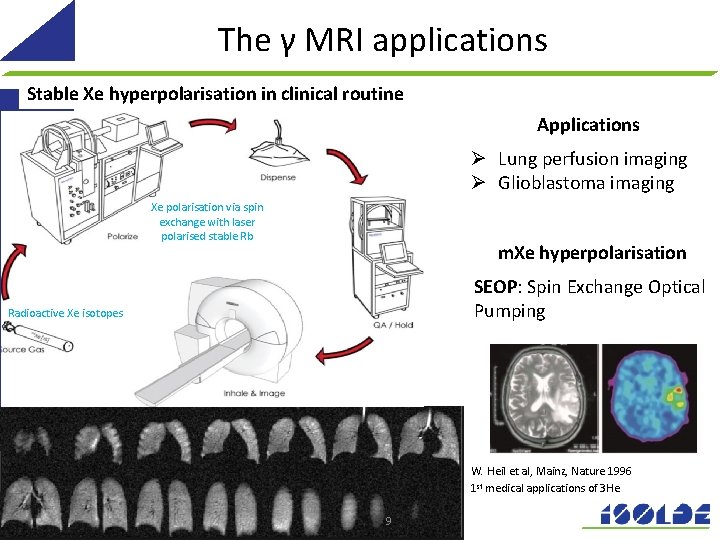
The γ MRI applications Stable Xe hyperpolarisation in clinical routine Applications Ø Lung perfusion imaging Ø Glioblastoma imaging Xe polarisation via spin exchange with laser polarised stable Rb m. Xe hyperpolarisation SEOP: Spin Exchange Optical Pumping Radioactive Xe isotopes W. Heil et al, Mainz, Nature 1996 1 st medical applications of 3 He 9
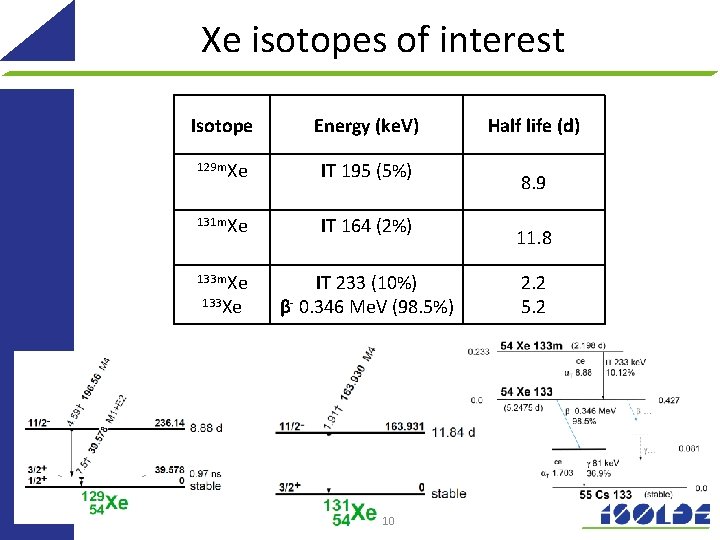
Xe isotopes of interest Isotope Energy (ke. V) 129 m. Xe IT 195 (5%) 131 m. Xe IT 164 (2%) 133 m. Xe IT 233 (10%) β- 0. 346 Me. V (98. 5%) 133 Xe 10 Half life (d) 8. 9 11. 8 2. 2 5. 2
Outline Motivation Project description 1 st tests Current status Experiments during CERN LS 2 Summary 11
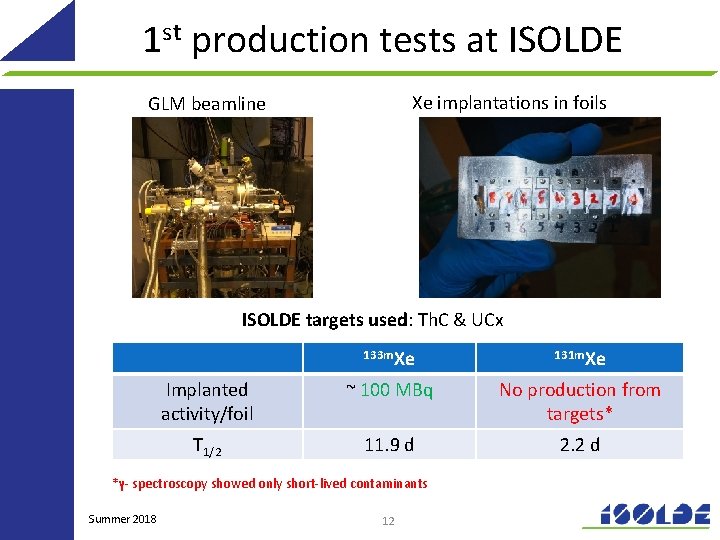
1 st production tests at ISOLDE Xe implantations in foils GLM beamline ISOLDE targets used: Th. C & UCx 133 m. Xe 131 m. Xe Implanted activity/foil ~ 100 MBq No production from targets* T 1/2 11. 9 d 2. 2 d *γ- spectroscopy showed only short-lived contaminants Summer 2018 12
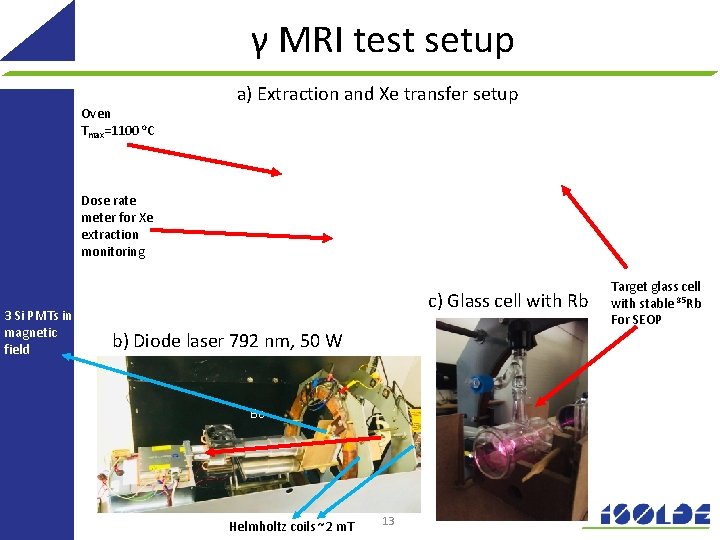
γ MRI test setup Oven Tmax=1100 o. C a) Extraction and Xe transfer setup Dose rate meter for Xe extraction monitoring 3 Si PMTs in magnetic field c) Glass cell with Rb b) Diode laser 792 nm, 50 W Bo Helmholtz coils ~2 m. T 13 Target glass cell with stable 85 Rb For SEOP
Outline Motivation Project description 1 st tests Current status Experiments during CERN LS 2 Summary 14
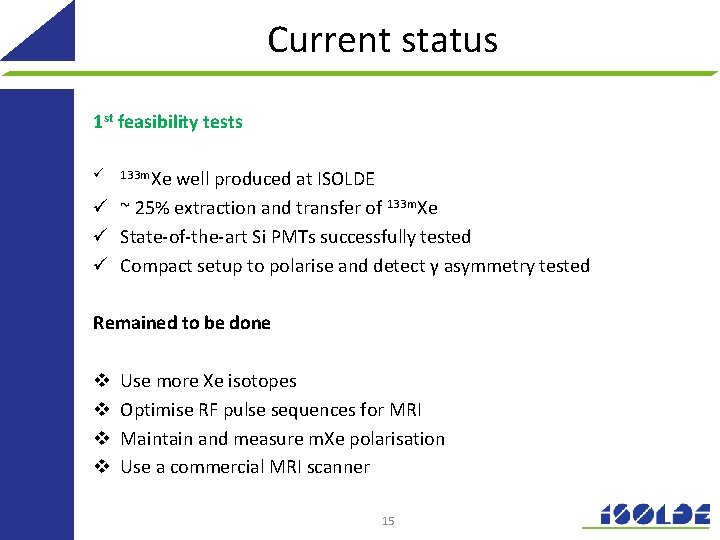
Current status 1 st feasibility tests well produced at ISOLDE ü ~ 25% extraction and transfer of 133 m. Xe ü State-of-the-art Si PMTs successfully tested ü Compact setup to polarise and detect γ asymmetry tested ü 133 m. Xe Remained to be done v v Use more Xe isotopes Optimise RF pulse sequences for MRI Maintain and measure m. Xe polarisation Use a commercial MRI scanner 15
Outline Motivation Project description 1 st tests Current status Experiments during CERN LS 2 Summary 16
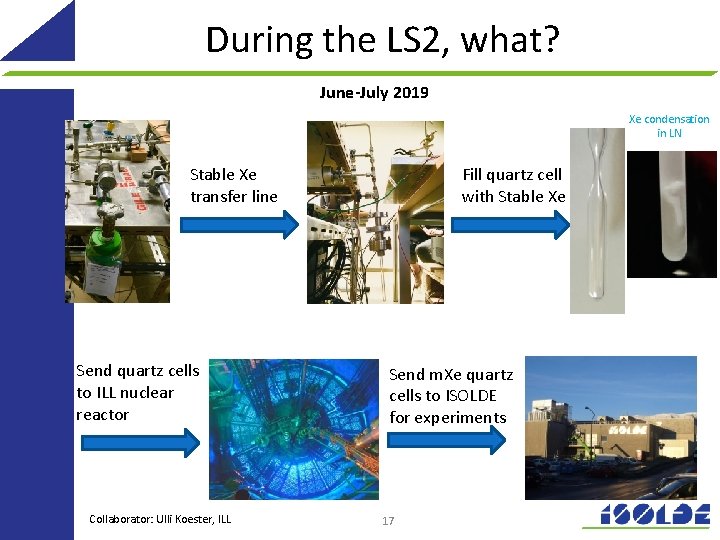
During the LS 2, what? June-July 2019 Xe condensation in LN Fill quartz cell with Stable Xe transfer line Send quartz cells to ILL nuclear reactor Collaborator: Ulli Koester, ILL Send m. Xe quartz cells to ISOLDE for experiments 17
Outline Motivation Project description 1 st tests Current status Experiments during CERN LS 2 Summary 18
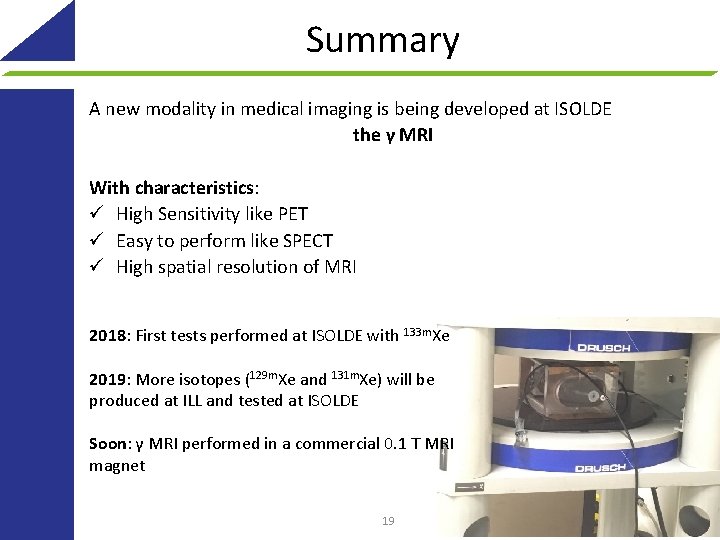
Summary A new modality in medical imaging is being developed at ISOLDE the γ MRI With characteristics: ü High Sensitivity like PET ü Easy to perform like SPECT ü High spatial resolution of MRI 2018: First tests performed at ISOLDE with 133 m. Xe 2019: More isotopes (129 m. Xe and 131 m. Xe) will be produced at ILL and tested at ISOLDE Soon: γ MRI performed in a commercial 0. 1 T MRI magnet 19
Acknowledgements Karolina Kulesz Magdalena Kowalska Luis M. Fraile Jean-Noel Hyacinte Ulli Koester Elise Vinckenbosch Jared Croese Renaud B. Jolivet Jose Manuel Udias Moinelo Thierry Stora Robin Engel Jaime Benito Garcia Victor S. Tembleque Verbo