Nonadherence to oral CML therapies Dr Lina Eliasson
- Slides: 12
Non-adherence to oral CML therapies Dr Lina Eliasson Atlantis Healthcare 1
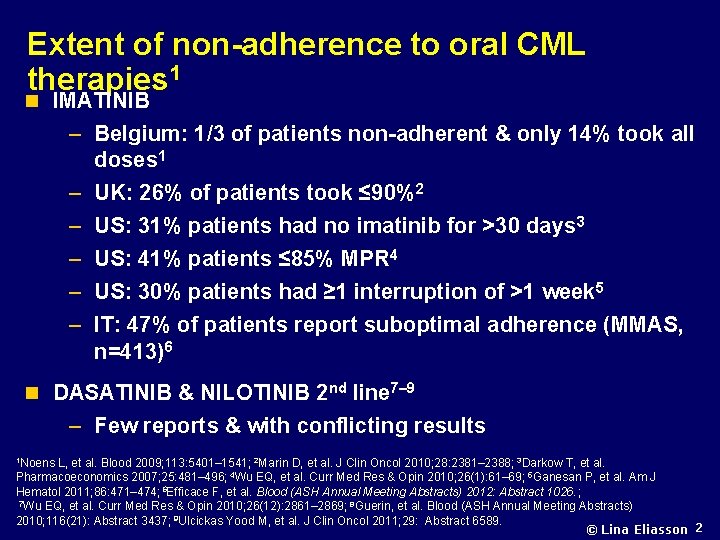
Extent of non-adherence to oral CML therapies 1 n IMATINIB – Belgium: 1/3 of patients non-adherent & only 14% took all doses 1 – UK: 26% of patients took ≤ 90%2 – US: 31% patients had no imatinib for >30 days 3 – US: 41% patients ≤ 85% MPR 4 – US: 30% patients had ≥ 1 interruption of >1 week 5 – IT: 47% of patients report suboptimal adherence (MMAS, n=413)6 n DASATINIB & NILOTINIB 2 nd line 7– 9 – Few reports & with conflicting results 1 Noens L, et al. Blood 2009; 113: 5401– 1541; 2 Marin D, et al. J Clin Oncol 2010; 28: 2381– 2388; 3 Darkow T, et al. Pharmacoeconomics 2007; 25: 481– 496; 4 Wu EQ, et al. Curr Med Res & Opin 2010; 26(1): 61– 69; 5 Ganesan P, et al. Am J Hematol 2011; 86: 471– 474; 6 Efficace F, et al. Blood (ASH Annual Meeting Abstracts) 2012: Abstract 1026. ; 7 Wu EQ, et al. Curr Med Res & Opin 2010; 26(12): 2861– 2869; 8 Guerin, et al. Blood (ASH Annual Meeting Abstracts) 2010; 116(21): Abstract 3437; 9 Ulcickas Yood M, et al. J Clin Oncol 2011; 29: Abstract 6589. © Lina Eliasson 2
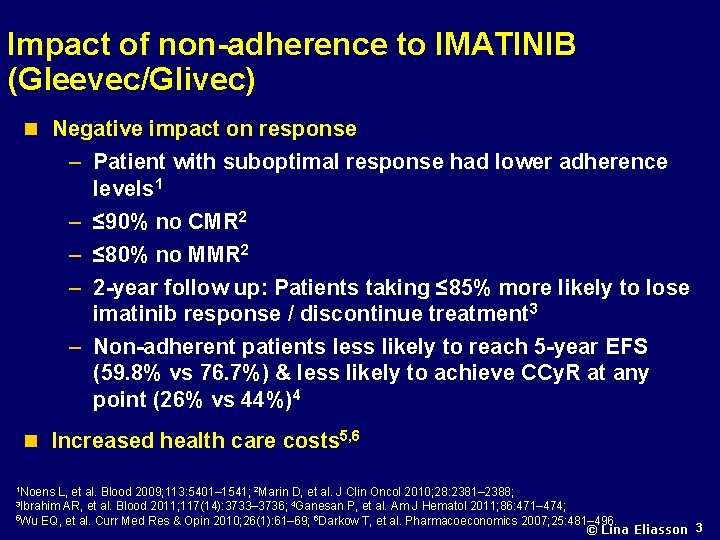
Impact of non-adherence to IMATINIB (Gleevec/Glivec) n Negative impact on response – Patient with suboptimal response had lower adherence levels 1 – ≤ 90% no CMR 2 – ≤ 80% no MMR 2 – 2 -year follow up: Patients taking ≤ 85% more likely to lose imatinib response / discontinue treatment 3 – Non-adherent patients less likely to reach 5 -year EFS (59. 8% vs 76. 7%) & less likely to achieve CCy. R at any point (26% vs 44%)4 n Increased health care costs 5, 6 1 Noens L, et al. Blood 2009; 113: 5401– 1541; 2 Marin D, et al. J Clin Oncol 2010; 28: 2381– 2388; AR, et al. Blood 2011; 117(14): 3733– 3736; 4 Ganesan P, et al. Am J Hematol 2011; 86: 471– 474; 5 Wu EQ, et al. Curr Med Res & Opin 2010; 26(1): 61– 69; 6 Darkow T, et al. Pharmacoeconomics 2007; 25: 481– 496. © Lina Eliasson 3 3 Ibrahim
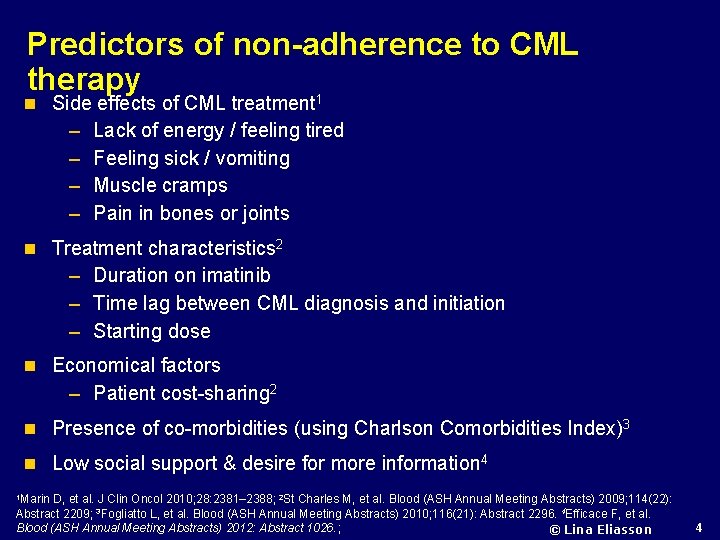
Predictors of non-adherence to CML therapy 1 n Side effects of CML treatment – – Lack of energy / feeling tired Feeling sick / vomiting Muscle cramps Pain in bones or joints n Treatment characteristics 2 – Duration on imatinib – Time lag between CML diagnosis and initiation – Starting dose n Economical factors – Patient cost-sharing 2 n Presence of co-morbidities (using Charlson Comorbidities Index)3 n Low social support & desire for more information 4 1 Marin D, et al. J Clin Oncol 2010; 28: 2381– 2388; 2 St Charles M, et al. Blood (ASH Annual Meeting Abstracts) 2009; 114(22): Abstract 2209; 3 Fogliatto L, et al. Blood (ASH Annual Meeting Abstracts) 2010; 116(21): Abstract 2296. 4 Efficace F, et al. Blood (ASH Annual Meeting Abstracts) 2012: Abstract 1026. ; © Lina Eliasson 4
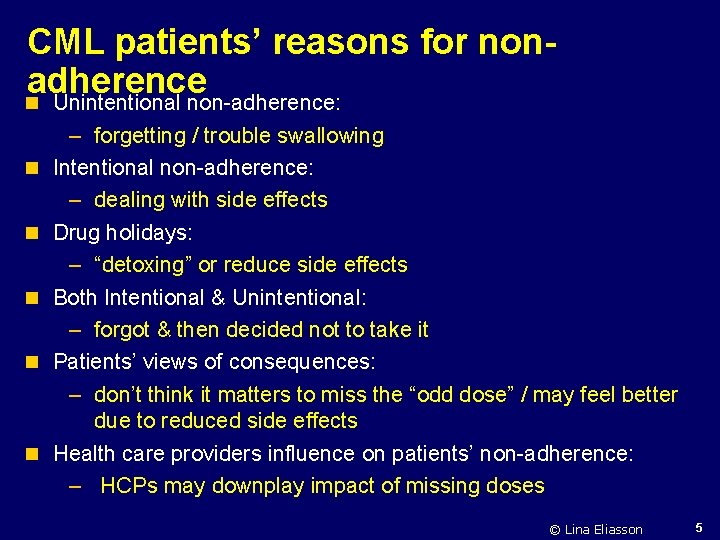
CML patients’ reasons for nonadherence n Unintentional non-adherence: n n n – forgetting / trouble swallowing Intentional non-adherence: – dealing with side effects Drug holidays: – “detoxing” or reduce side effects Both Intentional & Unintentional: – forgot & then decided not to take it Patients’ views of consequences: – don’t think it matters to miss the “odd dose” / may feel better due to reduced side effects Health care providers influence on patients’ non-adherence: – HCPs may downplay impact of missing doses © Lina Eliasson 5
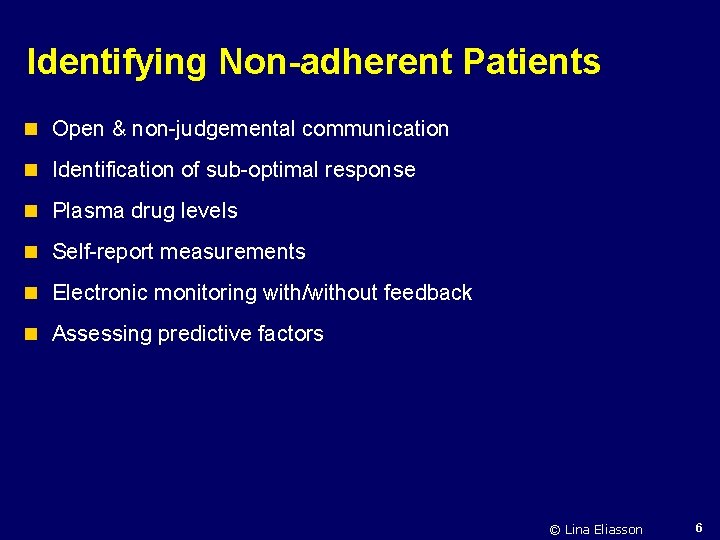
Identifying Non-adherent Patients n Open & non-judgemental communication n Identification of sub-optimal response n Plasma drug levels n Self-report measurements n Electronic monitoring with/without feedback n Assessing predictive factors © Lina Eliasson 6
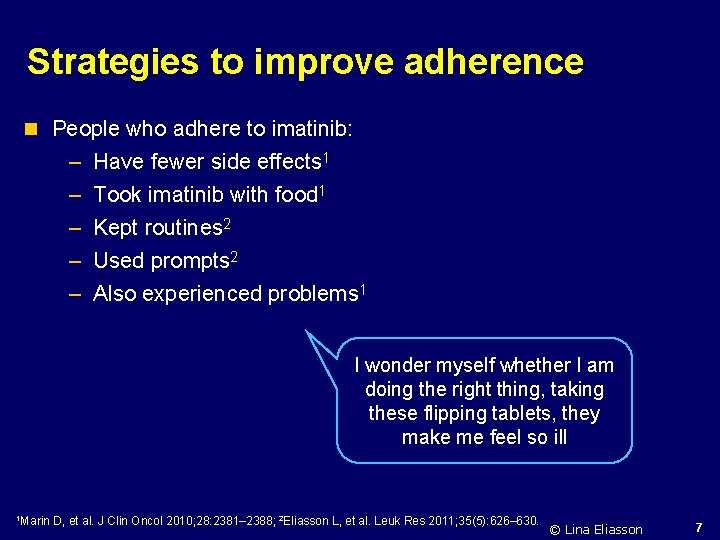
Strategies to improve adherence n People who adhere to imatinib: – – – Have fewer side effects 1 Took imatinib with food 1 Kept routines 2 Used prompts 2 Also experienced problems 1 I wonder myself whether I am doing the right thing, taking these flipping tablets, they make me feel so ill 1 Marin D, et al. J Clin Oncol 2010; 28: 2381– 2388; 2 Eliasson L, et al. Leuk Res 2011; 35(5): 626– 630. © Lina Eliasson 7
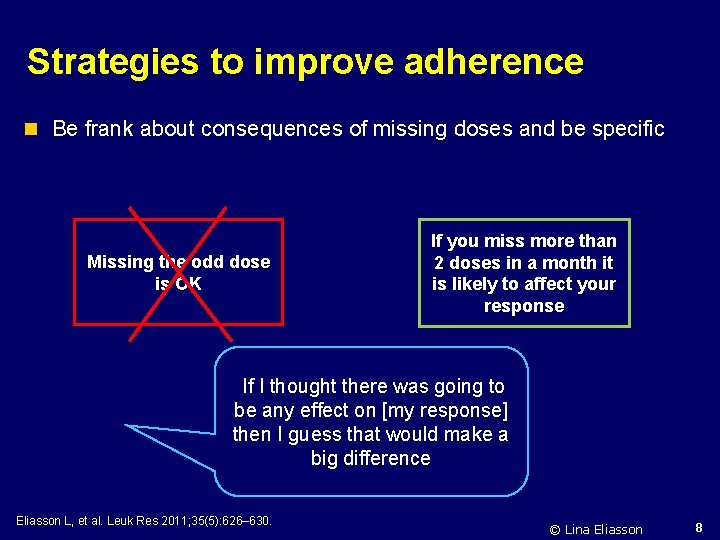
Strategies to improve adherence n Be frank about consequences of missing doses and be specific Missing the odd dose is OK If you miss more than 2 doses in a month it is likely to affect your response If I thought there was going to be any effect on [my response] then I guess that would make a big difference Eliasson L, et al. Leuk Res 2011; 35(5): 626– 630. © Lina Eliasson 8
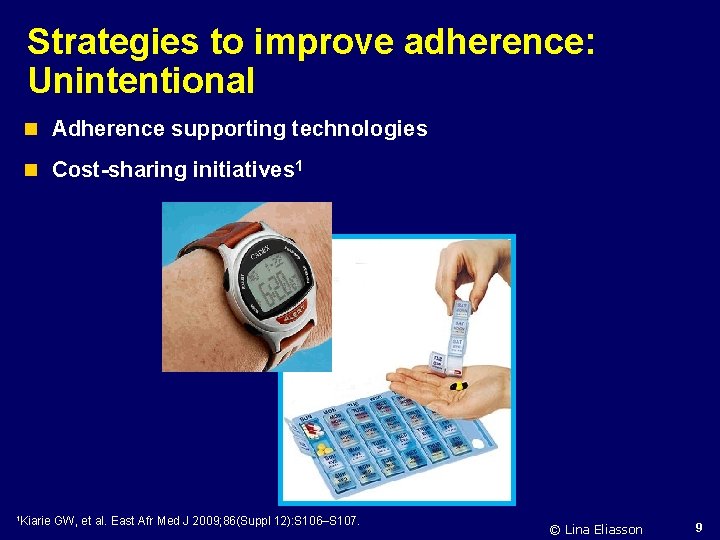
Strategies to improve adherence: Unintentional n Adherence supporting technologies n Cost-sharing initiatives 1 1 Kiarie GW, et al. East Afr Med J 2009; 86(Suppl 12): S 106–S 107. © Lina Eliasson 9
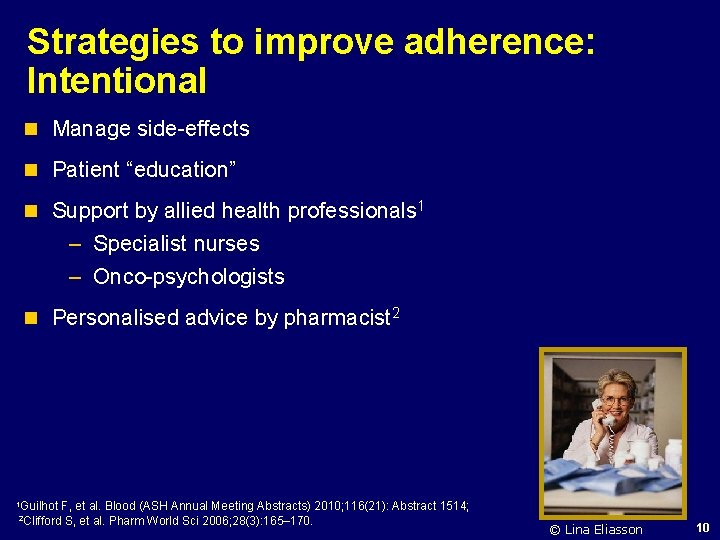
Strategies to improve adherence: Intentional n Manage side-effects n Patient “education” n Support by allied health professionals 1 – Specialist nurses – Onco-psychologists n Personalised advice by pharmacist 2 1 Guilhot F, et al. Blood (ASH Annual Meeting Abstracts) 2010; 116(21): Abstract 1514; S, et al. Pharm World Sci 2006; 28(3): 165– 170. 2 Clifford © Lina Eliasson 10
The right to not adhere should be respected n Everyone has the right to manage their own treatment so it fits their life n Everyone has the right to not take their medication n However, it has to be an informed decision! © Lina Eliasson 11
Non-adherence to oral CML therapies Dr Lina Eliasson Atlantis Healthcare 12