
Lina Bellman Peter hman How authorized property appraisers
Lina Bellman & Peter Öhman How authorized property appraisers perceive information for valuation of commercial properties: a repertory grid study Presentation at the ERES 2015, Istanbul, Turkey
BACKGROUND Behavioural research (Newell and Simon, 1972) Behavioural property research such as: • Anchoring in previous valuation statements (Diaz III & Hansz, 1997; Diaz III & Wolverton, 1998) • Clients’ impact (Levy & Schuck, 1999, 2005) How individuals make assessments and decisions may depend on how they perceive reality and how their thought patterns are constructed.
PURPOSE This study describe and analyze authorized property appraisers’ thought patterns when commercial properties are valued, and compare and draw conclusions about their thinking in terms of complexity, content and homogeneity.
DESIGN/METHODOLOGY/APPROACH Population: 67 of 138 of the authorized property appraisers in Sweden. To map the thought patterns we used: • the repertory grid technique (Kelly, 1955) - a standard set of value-adding-factors and constructs was included in the grid form, used for data collection by face-to-face interviews. For analyse we mainly used: • principal component analysis (Gains & Shaw, 2010)
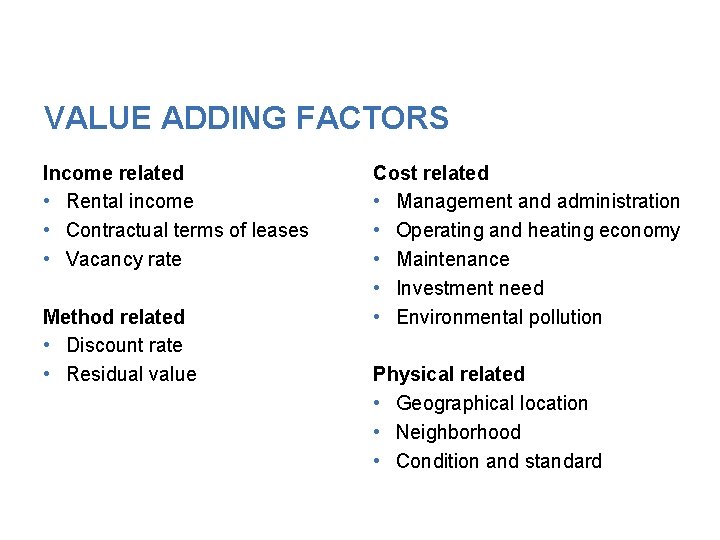
VALUE ADDING FACTORS Income related • Rental income • Contractual terms of leases • Vacancy rate Method related • Discount rate • Residual value Cost related • Management and administration • Operating and heating economy • Maintenance • Investment need • Environmental pollution Physical related • Geographical location • Neighborhood • Condition and standard
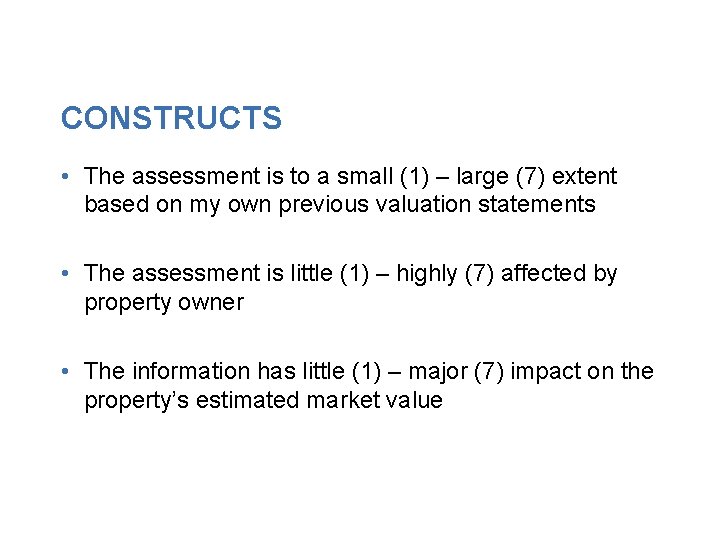
CONSTRUCTS • The assessment is to a small (1) – large (7) extent based on my own previous valuation statements • The assessment is little (1) – highly (7) affected by property owner • The information has little (1) – major (7) impact on the property’s estimated market value
FINDINGS
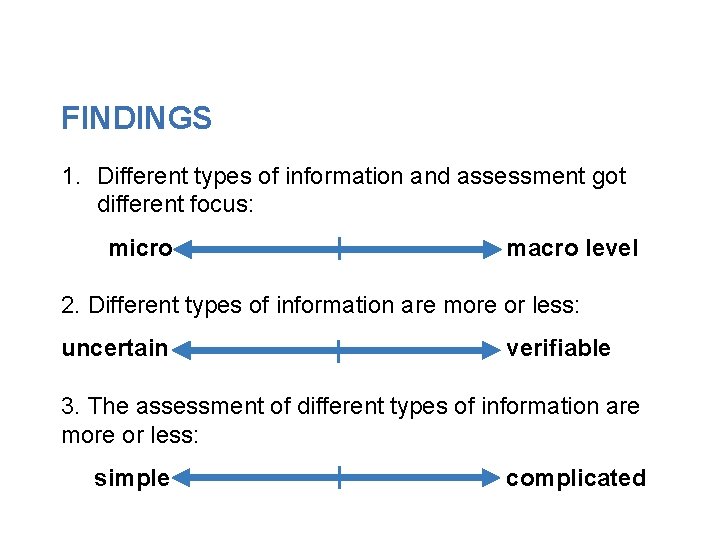
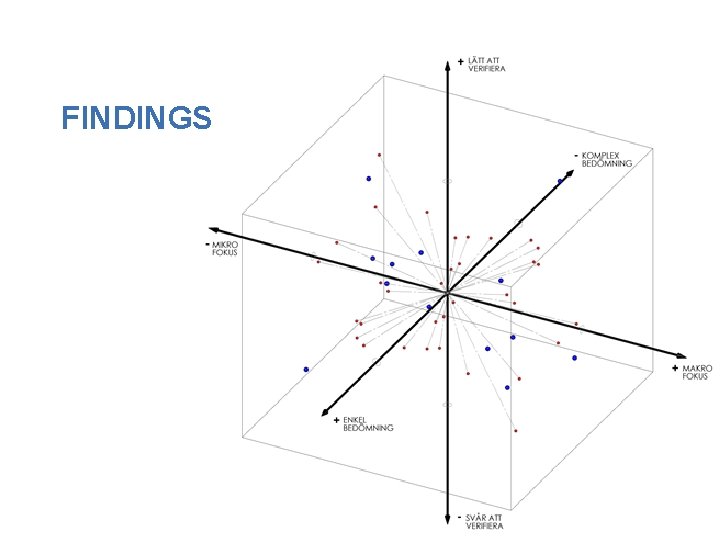
FINDINGS 1. Different types of information and assessment got different focus: micro macro level 2. Different types of information are more or less: uncertain verifiable 3. The assessment of different types of information are more or less: simple complicated
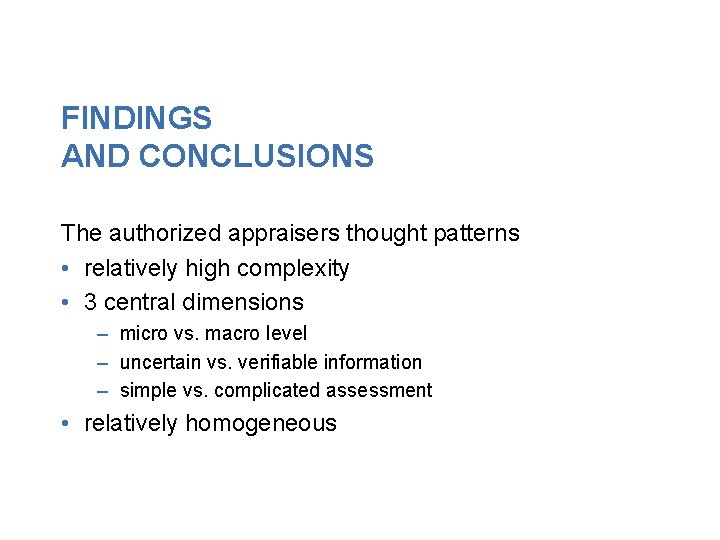
FINDINGS AND CONCLUSIONS The authorized appraisers thought patterns • relatively high complexity • 3 central dimensions – micro vs. macro level – uncertain vs. verifiable information – simple vs. complicated assessment • relatively homogeneous
Thank You for Your Attention! Lina Bellman Centre for research on Economic Relations (CER), Mid Sweden University lina. bellman@miun. se
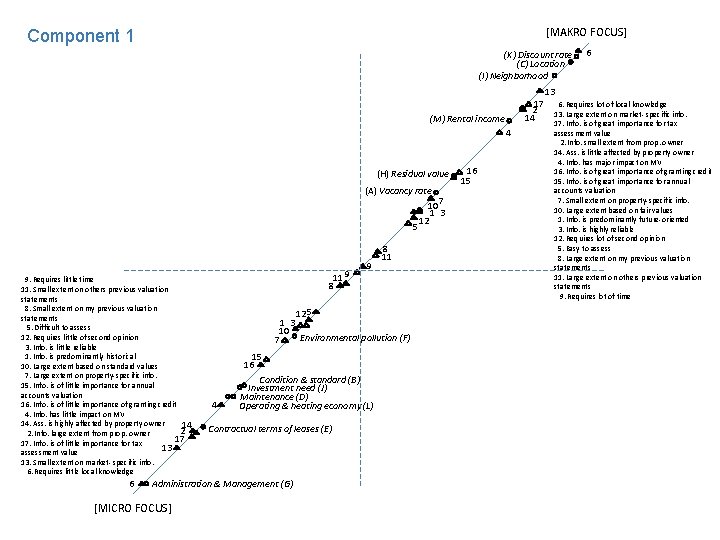
[MAKRO FOCUS] Component 1 (K) Discount rate (C) Location (I) Neighborhood 17 2 14 (M) Rental income 4 (H) Residual value (A) Vacancy rate 5 9. Requires little time 11. Small extent on others previous valuation statements 8. Small extent on my previous valuation statements 5. Difficult to assess 12. Requires little of second opinion 3. Info. is little reliable 1. Info. is predominantly historical 10. Large extent based on standard values 7. Large extent on property-specific info. 15. Info. is of little importance for annual accounts valuation 16. Info. is of little importance of granting credit 4. Info. has little impact on MV 14. Ass. is highly affected by property owner 14 2 2. Info. large extent from prop. owner 17 17. Info. is of little importance for tax 13 assessment value 13. Small extent on market- specific info. 6. Requires little local knowledge 6 11 9 8 12 5 1 3 10 7 Environmental pollution (F) 4 15 16 Condition & standard (B) Investment need (J) Maintenance (D) Operating & heating economy (L) Contractual terms of leases (E) Administration & Management (G) [MICRO FOCUS] 9 8 11 7 10 1 3 12 16 15 6 13 6. Requires lot of local knowledge 13. Large extent on market- specific info. 17. Info. is of great importance for tax assessment value 2. Info. small extent from prop. owner 14. Ass. is little affected by property owner 4. Info. has major impact on MV 16. Info. is of great importance of granting credit 15. Info. is of great importance for annual accounts valuation 7. Small extent on property-specific info. 10. Large extent based on fair values 1. Info. is predominantly future-oriented 3. Info. is highly reliable 12. Requires lot of second opinion 5. Easy to assess 8. Large extent on my previous valuation statements 11. Large extent on others previous valuation statements 9. Requires lot of time
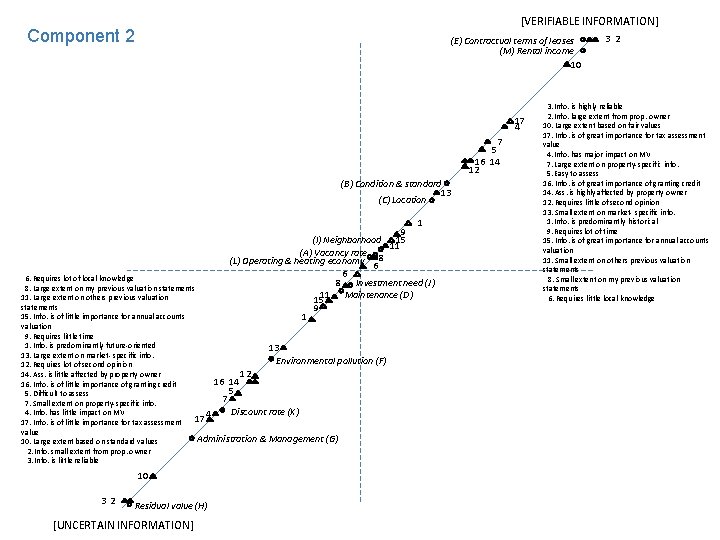
[VERIFIABLE INFORMATION] Component 2 (E) Contractual terms of leases (M) Rental income 10 17 4 7 5 16 14 12 (B) Condition & standard 13 (C) Location 1 9 (I) Neighborhood 15 11 (A) Vacancy rate (L) Operating & heating economy 8 6 6 8 Investment need (J) 11 Maintenance (D) 15 9 1 6. Requires lot of local knowledge 8. Large extent on my previous valuation statements 11. Large extent on others previous valuation statements 15. Info. is of little importance for annual accounts valuation 9. Requires little time 1. Info. is predominantly future-oriented 13 13. Large extent on market- specific info. Environmental pollution (F) 12. Requires lot of second opinion 12 14. Ass. is little affected by property owner 16 14 16. Info. is of little importance of granting credit 5 5. Difficult to assess 7 7. Small extent on property-specific info. Discount rate (K) 4. Info. has little impact on MV 4 17. Info. is of little importance for tax assessment 17 value Administration & Management (G) 10. Large extent based on standard values 2. Info. small extent from prop. owner 3. Info. is little reliable 10 3 2 Residual value (H) [UNCERTAIN INFORMATION] 3 2 3. Info. is highly reliable 2. Info. large extent from prop. owner 10. Large extent based on fair values 17. Info. is of great importance for tax assessment value 4. Info. has major impact on MV 7. Large extent on property-specific info. 5. Easy to assess 16. Info. is of great importance of granting credit 14. Ass. is highly affected by property owner 12. Requires little of second opinion 13. Small extent on market- specific info. 1. Info. is predominantly historical 9. Requires lot of time 15. Info. is of great importance for annual accounts valuation 11. Small extent on others previous valuation statements 8. Small extent on my previous valuation statements 6. Requires little local knowledge
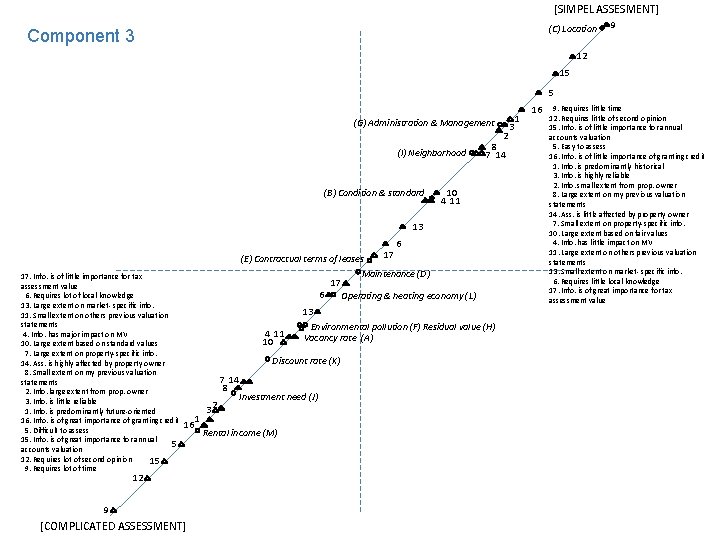
[SIMPEL ASSESMENT] (C) Location Component 3 9 12 15 5 (G) Administration & Management 2 (I) Neighborhood (B) Condition & standard 8 7 14 10 4 11 13 (E) Contractual terms of leases 17. Info. is of little importance for tax assessment value 6. Requires lot of local knowledge 13. Large extent on market- specific info. 11. Small extent on others previous valuation statements 4. Info. has major impact on MV 10. Large extent based on standard values 7. Large extent on property-specific info. 14. Ass. is highly affected by property owner 8. Small extent on my previous valuation statements 2. Info. large extent from prop. owner 3. Info. is little reliable 1. Info. is predominantly future-oriented 16. Info. is of great importance of granting credit 5. Difficult to assess 15. Info. is of great importance for annual 5 accounts valuation 12. Requires lot of second opinion 15 9. Requires lot of time 17 6 Maintenance (D) 17 6 Operating & heating economy (L) 13 4 11 10 Environmental pollution (F) Residual value (H) Vacancy rate (A) Discount rate (K) 16 12 9 [COMPLICATED ASSESSMENT] 1 3 2 7 14 8 Investment need (J) Rental income (M) 3 1 16 9. Requires little time 12. Requires little of second opinion 15. Info. is of little importance for annual accounts valuation 5. Easy to assess 16. Info. is of little importance of granting credit 1. Info. is predominantly historical 3. Info. is highly reliable 2. Info. small extent from prop. owner 8. Large extent on my previous valuation statements 14. Ass. is little affected by property owner 7. Small extent on property-specific info. 10. Large extent based on fair values 4. Info. has little impact on MV 11. Large extent on others previous valuation statements 13. Small extent on market- specific info. 6. Requires little local knowledge 17. Info. is of great importance for tax assessment value
- Slides: 13