Motorcycle Safety Laws Stewart Milner Chief Judge City
- Slides: 46
Motorcycle Safety & Laws Stewart Milner Chief Judge, City of Arlington 1
Who are licensed motorcycle riders? You and Me –Anyone over 15! n Motorcycle sales have increased for the last 11 years. n From 1997 to 2010 motorcycle registrations in the United States have increased by 70%. n 12 million license holders nationwide. n 90% are male. n 2
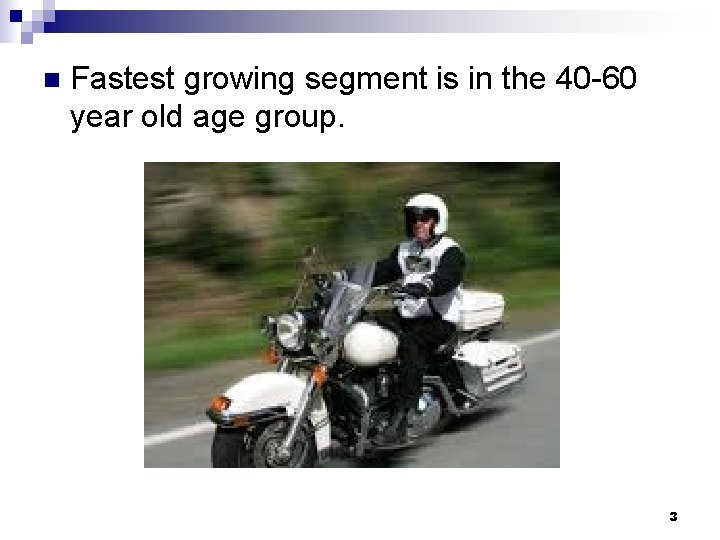
n Fastest growing segment is in the 40 -60 year old age group. 3
Why are more people Riding? n Recreation n Cost Saving n Sport - Thrill 4
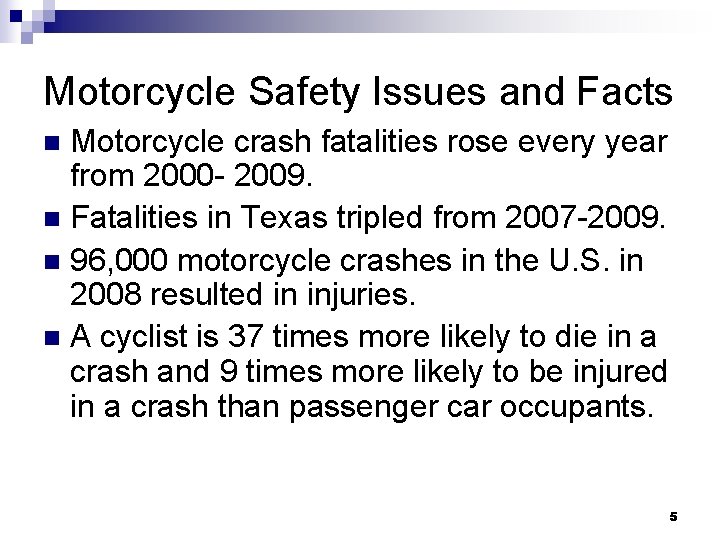
Motorcycle Safety Issues and Facts Motorcycle crash fatalities rose every year from 2000 - 2009. n Fatalities in Texas tripled from 2007 -2009. n 96, 000 motorcycle crashes in the U. S. in 2008 resulted in injuries. n A cyclist is 37 times more likely to die in a crash and 9 times more likely to be injured in a crash than passenger car occupants. n 5
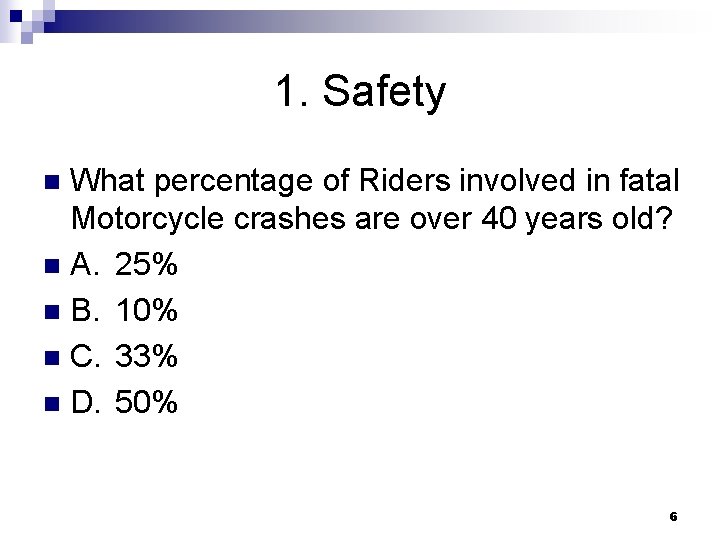
1. Safety What percentage of Riders involved in fatal Motorcycle crashes are over 40 years old? n A. 25% n B. 10% n C. 33% n D. 50% n 6
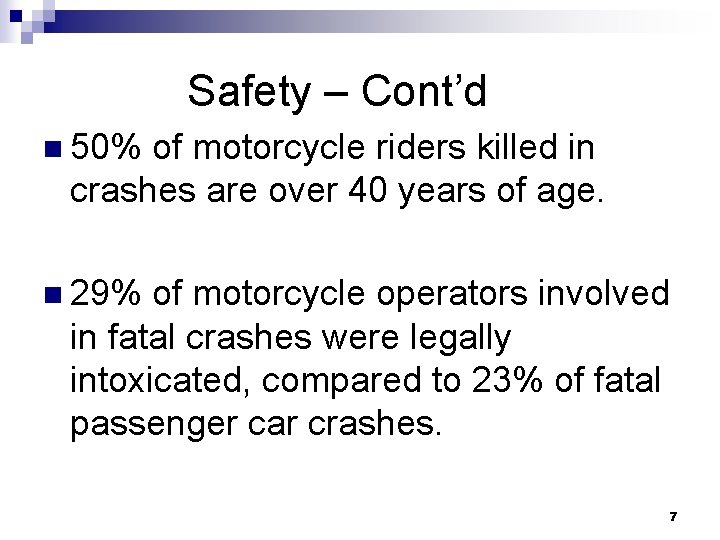
Safety – Cont’d n 50% of motorcycle riders killed in crashes are over 40 years of age. n 29% of motorcycle operators involved in fatal crashes were legally intoxicated, compared to 23% of fatal passenger car crashes. 7
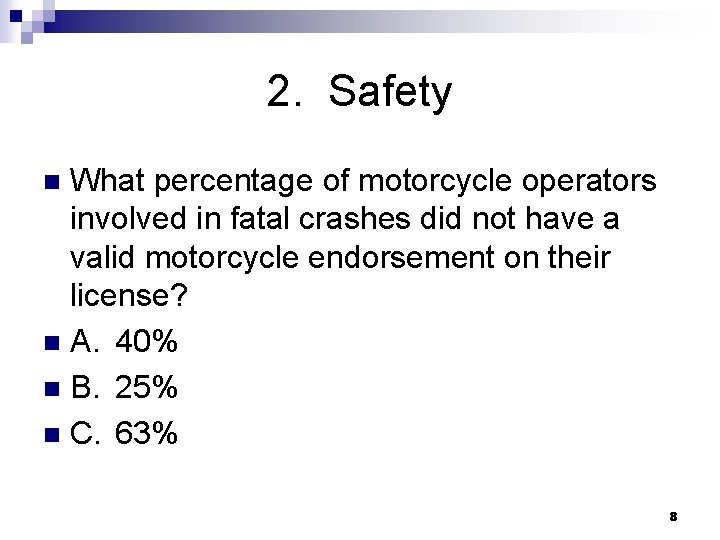
2. Safety What percentage of motorcycle operators involved in fatal crashes did not have a valid motorcycle endorsement on their license? n A. 40% n B. 25% n C. 63% n 8
Safety – Cont’d n 25% of motorcycle operators involved in fatal crashes did not have a valid motorcycle license. n Brain Injuries, Head Trauma were the leading cause of death in motorcycle crashes. 9
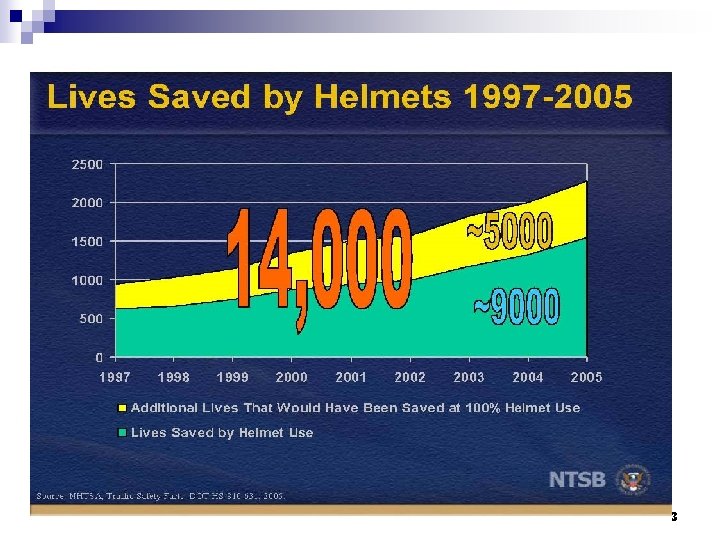
Safety – Cont’d In 2008, 35 percent of all motorcyclists involved in fatal crashes were speeding. n In 2008 motorcycle helmets saved 1, 829 lives. Helmets are believed to be 37 % effective in preventing fatal injuries. n 90% of motorcycle operators killed are male. n 10
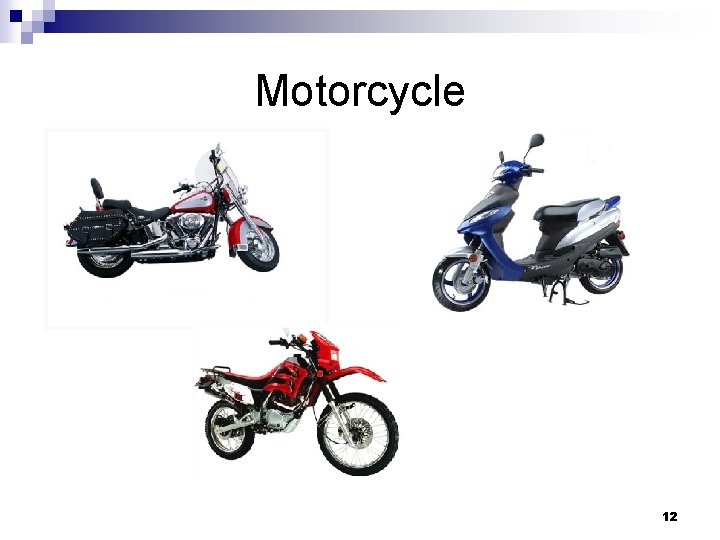
What IS a Motorcycle? It is a motor vehicle designed to propel itself with no more than three wheels in contact with the ground. n It is equipped with a rider’s saddle. n It is a motor driven cycle. (Less than 250 cc’s) n It is a moped. (Transp. Code § 541. 201). n 11
Motorcycle 12
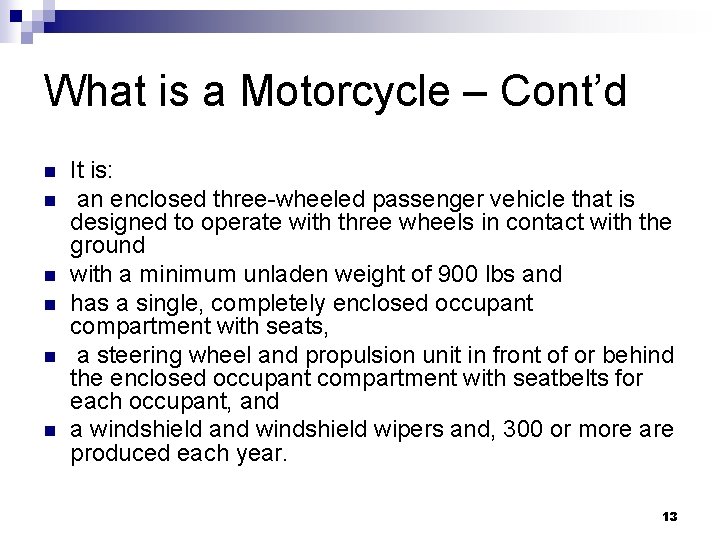
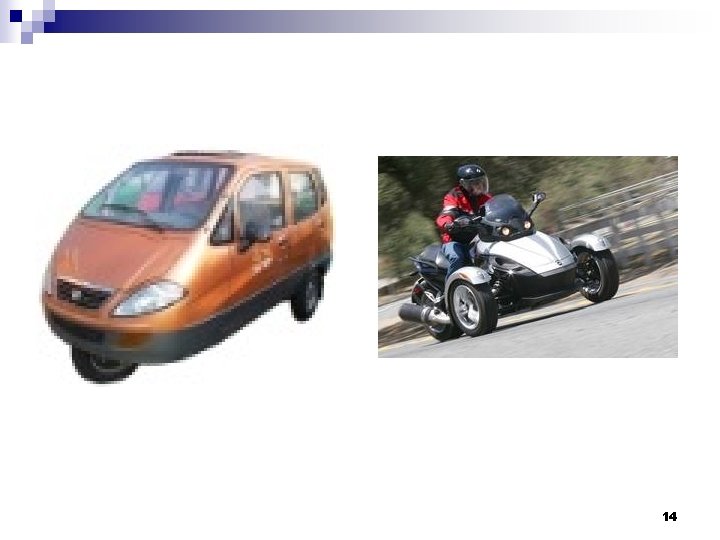
What is a Motorcycle – Cont’d n n n It is: an enclosed three-wheeled passenger vehicle that is designed to operate with three wheels in contact with the ground with a minimum unladen weight of 900 lbs and has a single, completely enclosed occupant compartment with seats, a steering wheel and propulsion unit in front of or behind the enclosed occupant compartment with seatbelts for each occupant, and a windshield and windshield wipers and, 300 or more are produced each year. 13
14
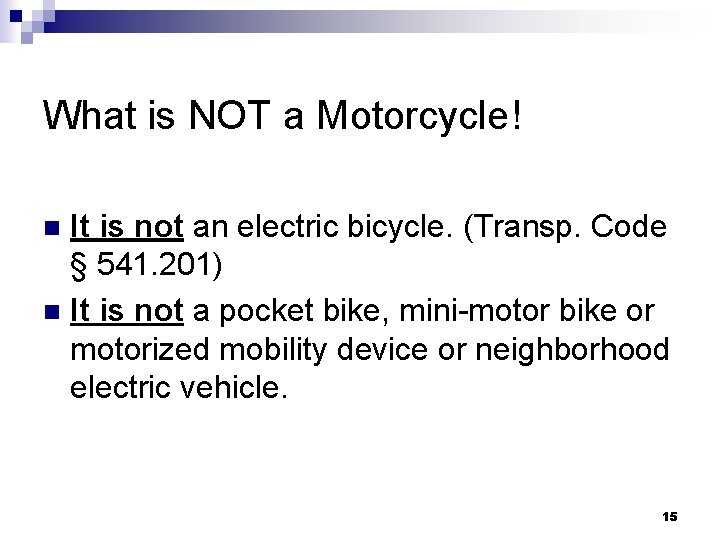
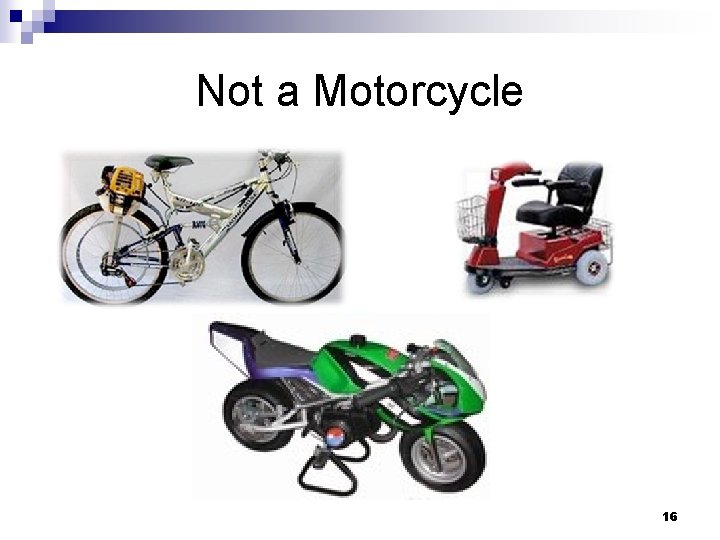
What is NOT a Motorcycle! It is not an electric bicycle. (Transp. Code § 541. 201) n It is not a pocket bike, mini-motor bike or motorized mobility device or neighborhood electric vehicle. n 15
Not a Motorcycle 16
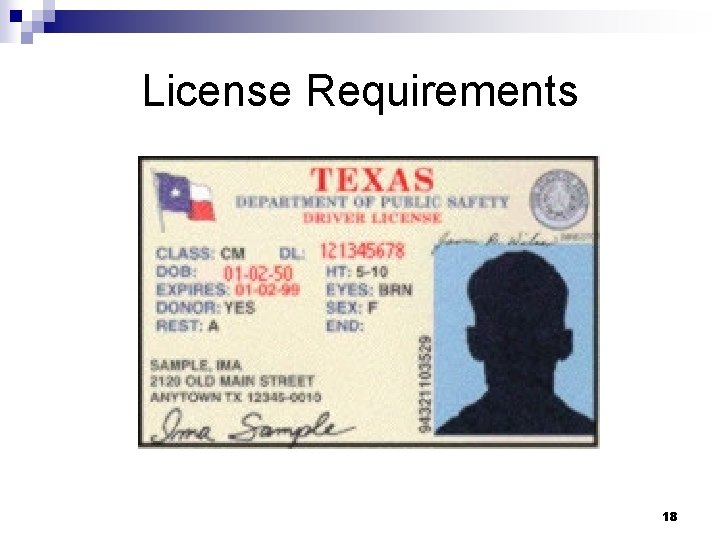
License Requirements A person is required to have a motorcycle license or class M endorsement on their license to operate a motorcycle or moped on public roadways. n There are four types of motorcycle licenses. The most common is an unrestricted Class M. n 17
License Requirements 18
Types of Class M Licenses n n Class M – no restrictions, any type of motorcycle or moped. Class M with restriction code I – any moped or motorcycle with an engine displacement of less than 250 cc. Class M with restriction code K – any moped 50 cc or less with a top speed of 30 m. p. h. Class M with restriction code J – licensed m/c operator over 21 y. o. a. in sight 19
Types of Class M Licenses n n n Class M with restriction code I – any moped or motorcycle with an engine displacement of less than 250 cc. Must be at least 15 year of age or older, Complete and Pass a motorcycle operator training course, Pass a road skills test, but No school enrollment requirement. When license holder turns 16, the 250 cc restriction is lifted. 20
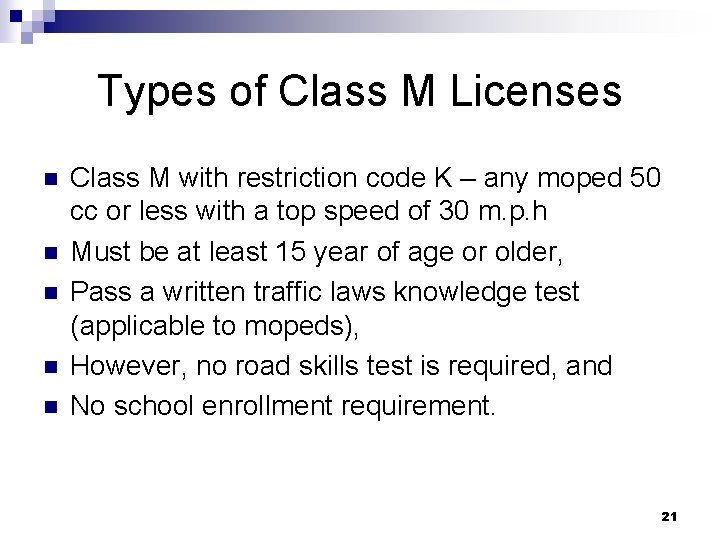
Types of Class M Licenses n n n Class M with restriction code K – any moped 50 cc or less with a top speed of 30 m. p. h Must be at least 15 year of age or older, Pass a written traffic laws knowledge test (applicable to mopeds), However, no road skills test is required, and No school enrollment requirement. 21
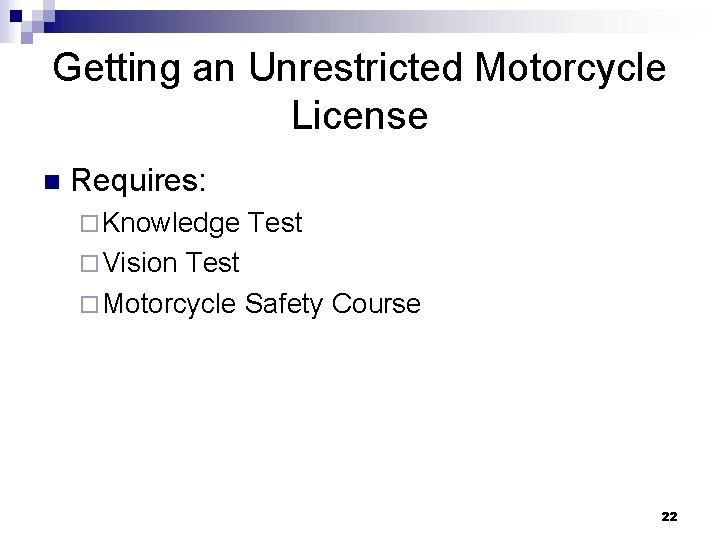
Getting an Unrestricted Motorcycle License n Requires: ¨ Knowledge Test ¨ Vision Test ¨ Motorcycle Safety Course 22
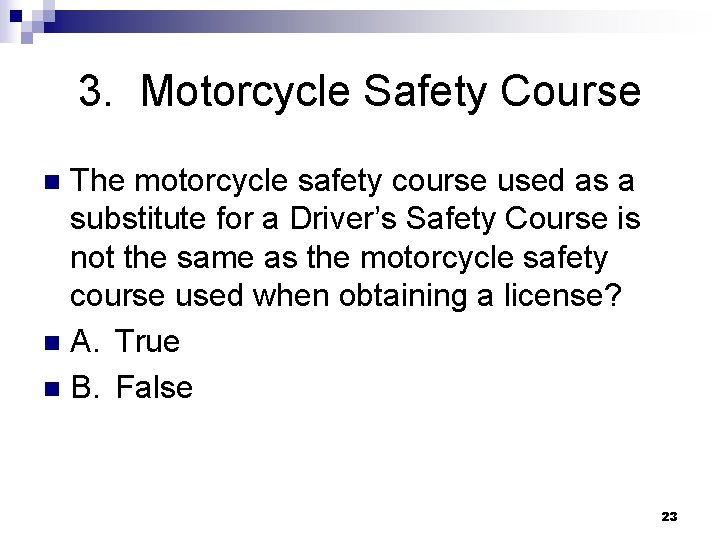
3. Motorcycle Safety Course The motorcycle safety course used as a substitute for a Driver’s Safety Course is not the same as the motorcycle safety course used when obtaining a license? n A. True n B. False n 23
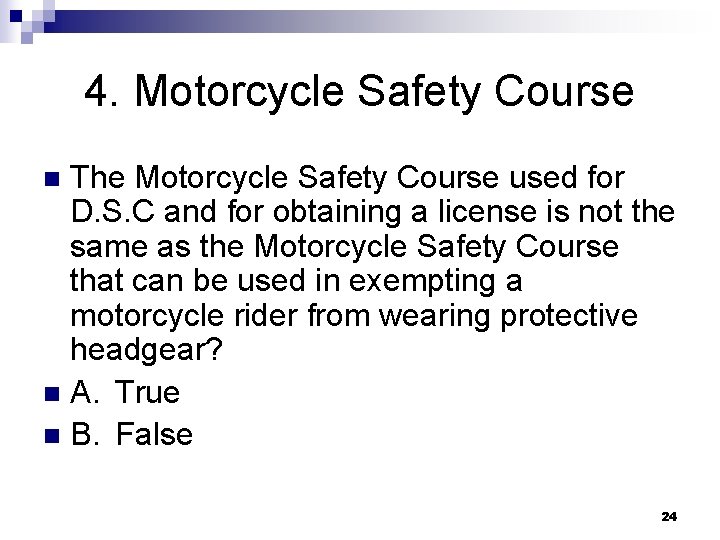
4. Motorcycle Safety Course The Motorcycle Safety Course used for D. S. C and for obtaining a license is not the same as the Motorcycle Safety Course that can be used in exempting a motorcycle rider from wearing protective headgear? n A. True n B. False n 24
Riding Skills Test v. Motorcycle Safety Course n Riding Skills Test ¨ No longer allowed or required – Motorcycle safety course is now required ¨ However, the law authorizing motorcycle road skills test is still there. (Texas Trans. Code Sec. 521. 166) 25
Motorcycle Safety Course n Required to obtain a Class M endorsement n Applicants must complete a Department of Public Safety Approved Basic Motorcycle Operator Training Course. 26
Financial Responsibility n Financial responsibility is required for motorcycles just as it is for other vehicles. 27
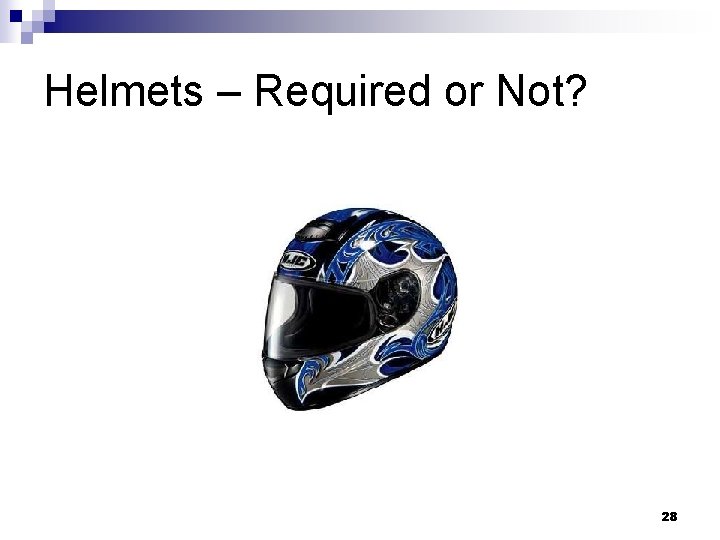
Helmets – Required or Not? 28
5. Helmets – Required or Not? n It is against the law for someone over 21 y. o. a. to ride a motorcycle on a public street in Texas without wearing a helmet? A. True n B. False n 29
Helmets – Required or Not? A person in Texas commits an offense if he operates a motorcycle and doesn’t wear an approved helmet. n Really? n 30
Helmet Law Exceptions n It is an exception to Sec. 661. 003 if: ¨ The person required to wear the helmet, at the time of the offense, was over 21 years of age, and ¨ Had successfully completed a motorcycle operator training and safety course, Or ¨ Had a health insurance policy that provides at least $10, 000. 00 in coverage for injuries sustained as a result of an accident on a motorcycle. 31
Helmets Sticker for helmet exemption no longer required. n NHTSA estimates that motorcycle helmets reduce the likelihood of a crash fatality by 37 percent. n Helmets are 67 percent effective in preventing brain injuries. n 32
33
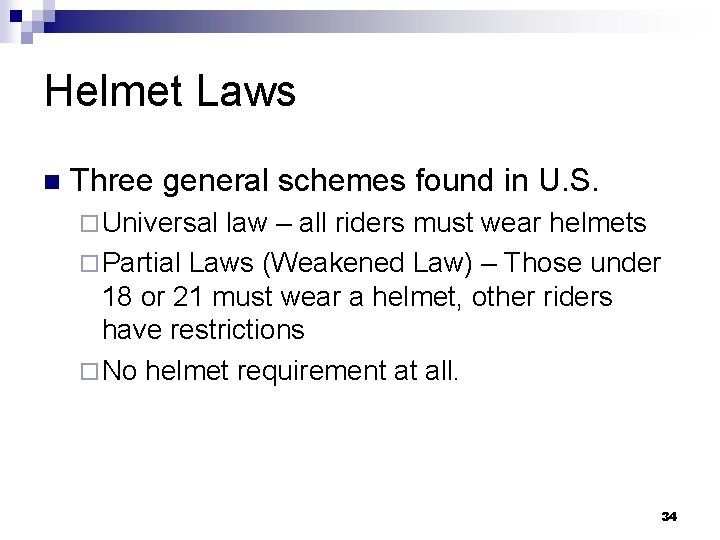
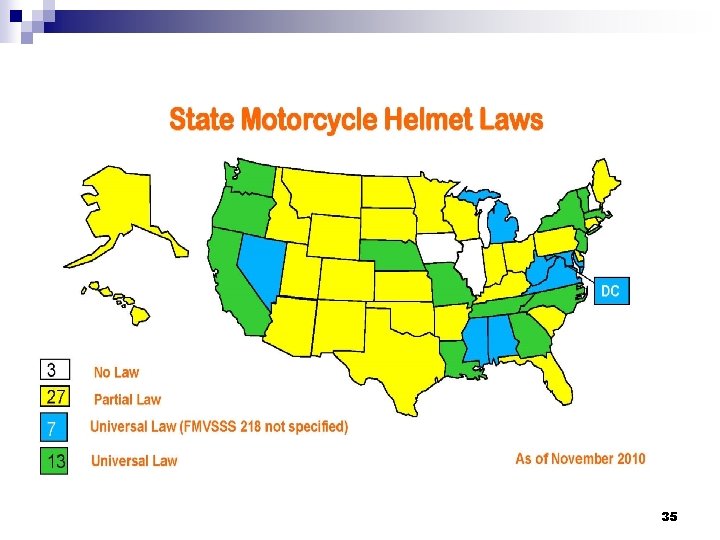
Helmet Laws n Three general schemes found in U. S. ¨ Universal law – all riders must wear helmets ¨ Partial Laws (Weakened Law) – Those under 18 or 21 must wear a helmet, other riders have restrictions ¨ No helmet requirement at all. 34
35
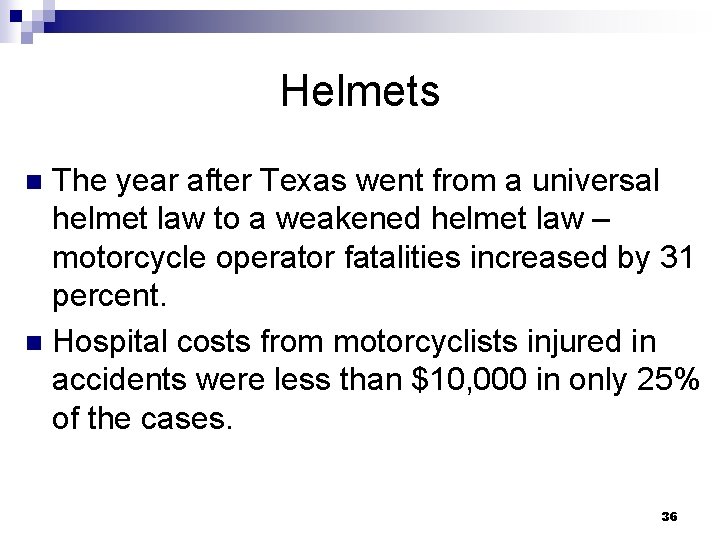
Helmets The year after Texas went from a universal helmet law to a weakened helmet law – motorcycle operator fatalities increased by 31 percent. n Hospital costs from motorcyclists injured in accidents were less than $10, 000 in only 25% of the cases. n 36
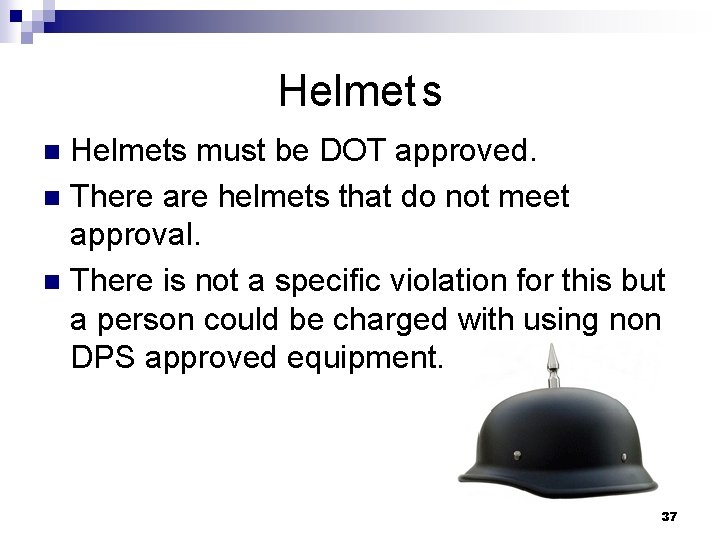
Helmet s Helmets must be DOT approved. n There are helmets that do not meet approval. n There is not a specific violation for this but a person could be charged with using non DPS approved equipment. n 37
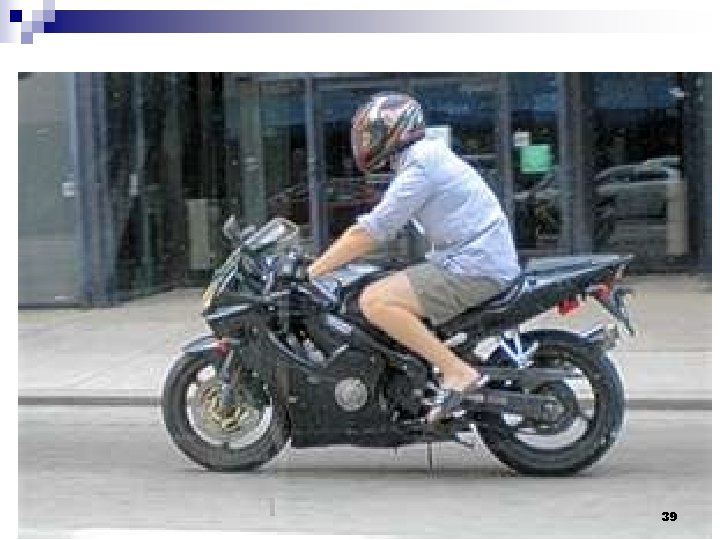
Other Safety Equipment Eye Protection – most states require n Gloves – leather or other non-slip material are best n Jackets and Trousers – Clothing should help in the event or a crash. n Footwear- should afford protection for feet, ankle and lower part of leg n 38
39
Motorcycle Safety & Awareness Class requirements governed by statute. n Class is 16 hours long. n Will substitute for D. S. C. if violation committed while operating motorcycle. n Will allow rider to ride without helmet. n 40
Motorcycle Safety & Awareness Class Provisions, guidelines and requirements for class are found in Chapter 662 of the Texas Transportation Code. n Fee is typically $190. n It is a 16 hour class. n 41
Motorcycle Safety Trends & Innovations n ? 42
Miscellaneous Laws & Rules Have to pay toll but not more than cars. n Motorcycles can use the HOV lanes even if only occupied by the driver. n Passengers must wear helmets unless exemption applies. n Motorcycles must be inspected and registered to operate on a public street. n 43
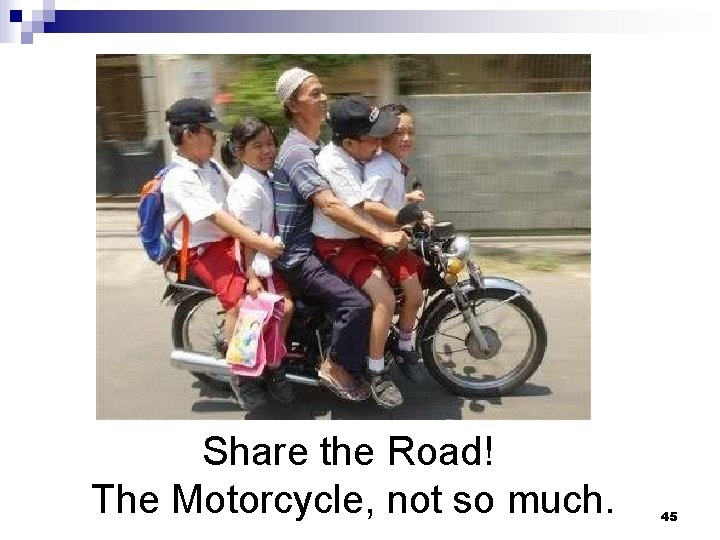
Miscellaneous Laws & Rules n Must be at least 5 years old to ride as a passenger on a motorcycle unless riding in a side car. Fine range $100 to $200. 44
Share the Road! The Motorcycle, not so much. 45
46