Chapter 2 Motion Along a Straight Line Power




- Slides: 26
Chapter 2 Motion Along a Straight Line Power. Point® Lectures for University Physics, Thirteenth Edition – Hugh D. Young and Roger A. Freedman Lectures by Wayne Anderson Copyright © 2012 Pearson Education Inc.
Goals for Chapter 2 • To describe straight-line motion in terms of velocity and acceleration • To distinguish between average and instantaneous velocity and average and instantaneous acceleration • To interpret graphs of position versus time, velocity versus time, and acceleration versus time for straight-line motion • To understand straight-line motion with constant acceleration • To examine freely falling bodies • To analyze straight-line motion when the acceleration is not constant Copyright © 2012 Pearson Education Inc.
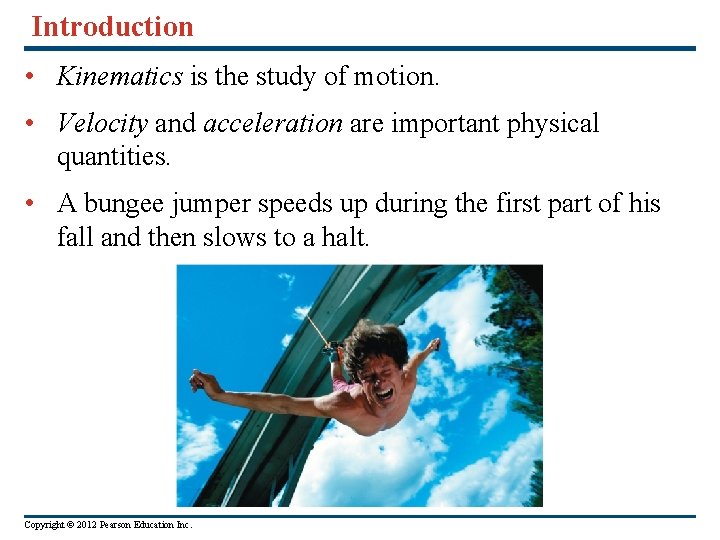
Introduction • Kinematics is the study of motion. • Velocity and acceleration are important physical quantities. • A bungee jumper speeds up during the first part of his fall and then slows to a halt. Copyright © 2012 Pearson Education Inc.
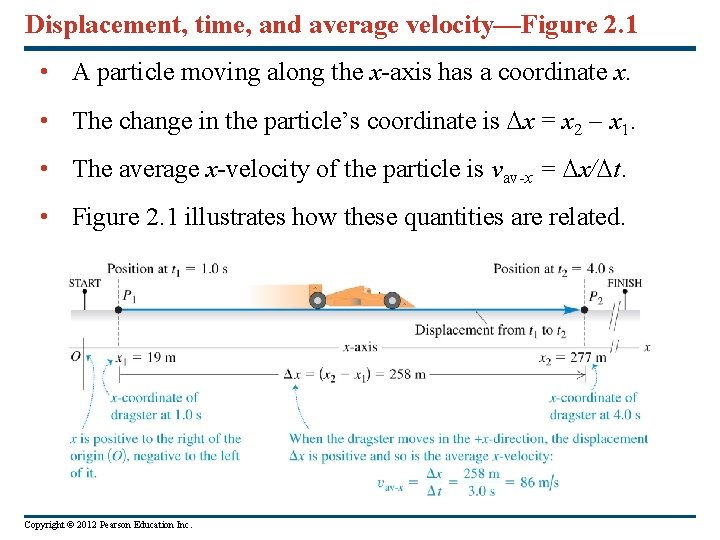
Displacement, time, and average velocity—Figure 2. 1 • A particle moving along the x-axis has a coordinate x. • The change in the particle’s coordinate is x = x 2 x 1. • The average x-velocity of the particle is vav-x = x/ t. • Figure 2. 1 illustrates how these quantities are related. Copyright © 2012 Pearson Education Inc.
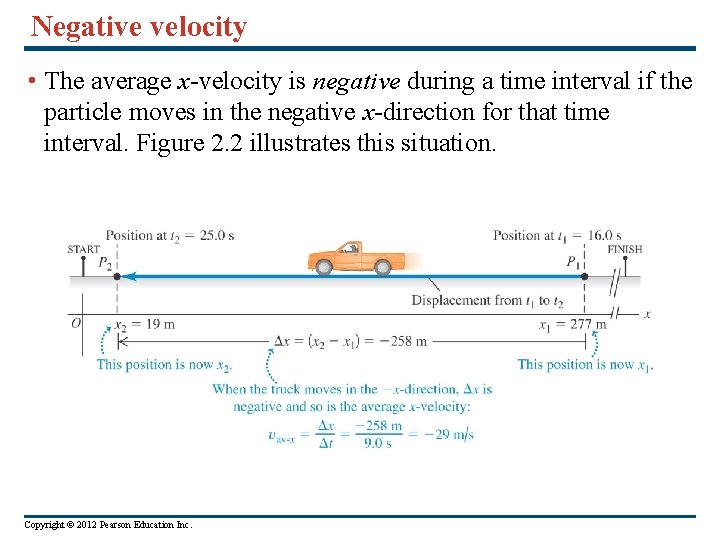
Negative velocity • The average x-velocity is negative during a time interval if the particle moves in the negative x-direction for that time interval. Figure 2. 2 illustrates this situation. Copyright © 2012 Pearson Education Inc.
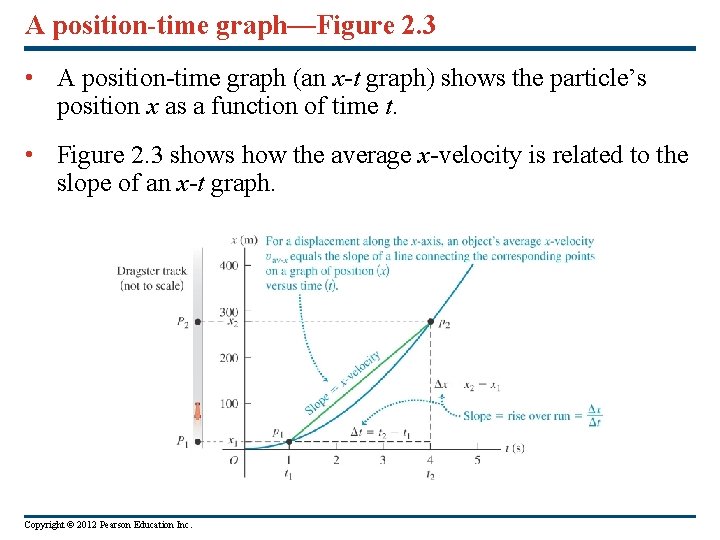
A position-time graph—Figure 2. 3 • A position-time graph (an x-t graph) shows the particle’s position x as a function of time t. • Figure 2. 3 shows how the average x-velocity is related to the slope of an x-t graph. Copyright © 2012 Pearson Education Inc.
Instantaneous velocity—Figure 2. 4 • The instantaneous velocity is the velocity at a specific instant of time or specific point along the path and is given by vx = dx/dt. • The average speed is not the magnitude of the average velocity! Copyright © 2012 Pearson Education Inc.
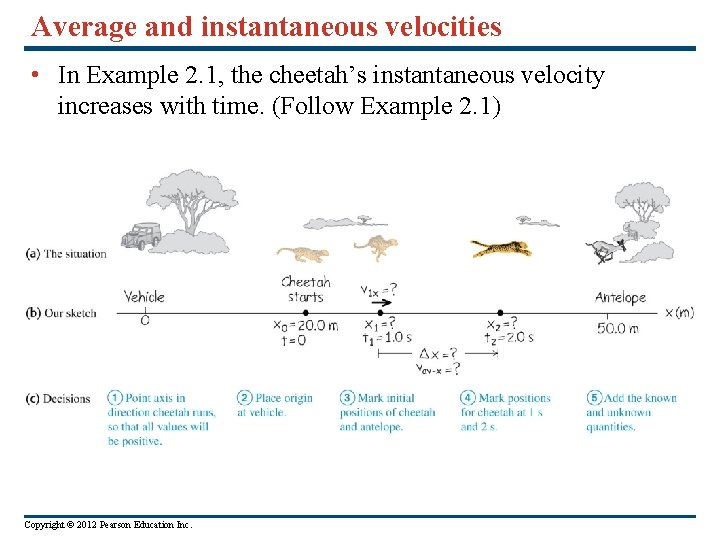
Average and instantaneous velocities • In Example 2. 1, the cheetah’s instantaneous velocity increases with time. (Follow Example 2. 1) Copyright © 2012 Pearson Education Inc.
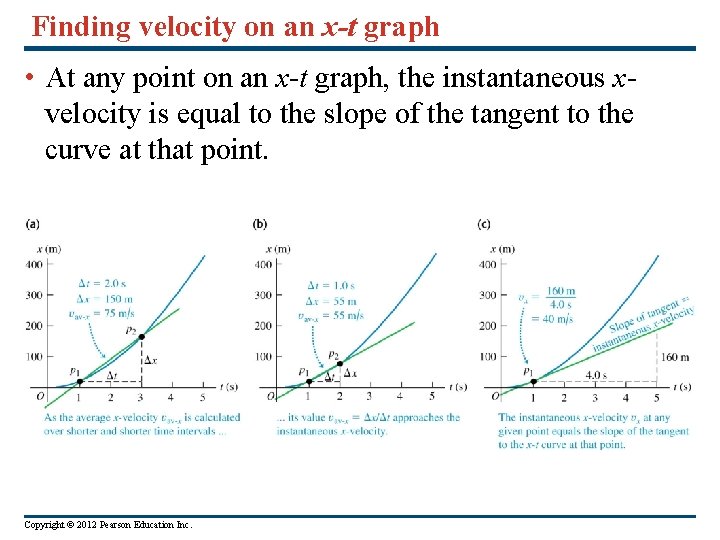
Finding velocity on an x-t graph • At any point on an x-t graph, the instantaneous xvelocity is equal to the slope of the tangent to the curve at that point. Copyright © 2012 Pearson Education Inc.
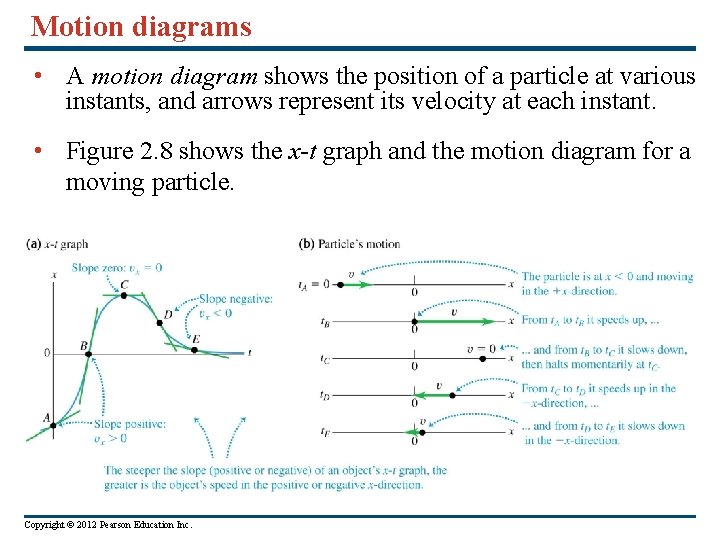
Motion diagrams • A motion diagram shows the position of a particle at various instants, and arrows represent its velocity at each instant. • Figure 2. 8 shows the x-t graph and the motion diagram for a moving particle. Copyright © 2012 Pearson Education Inc.
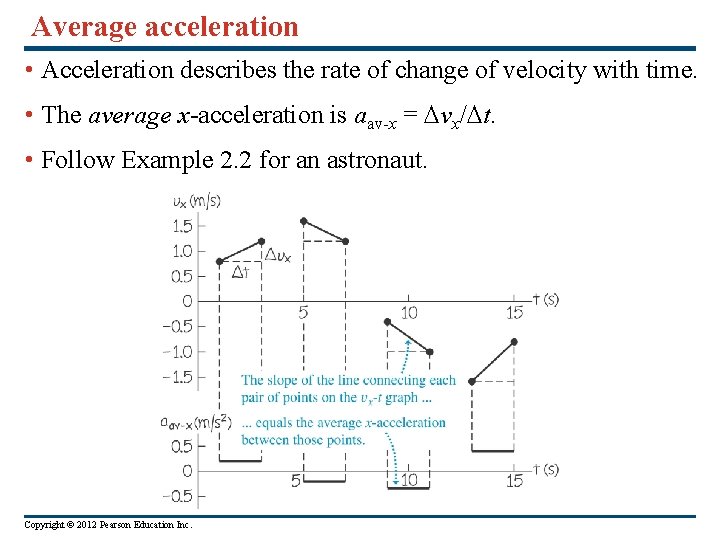
Average acceleration • Acceleration describes the rate of change of velocity with time. • The average x-acceleration is aav-x = vx/ t. • Follow Example 2. 2 for an astronaut. Copyright © 2012 Pearson Education Inc.
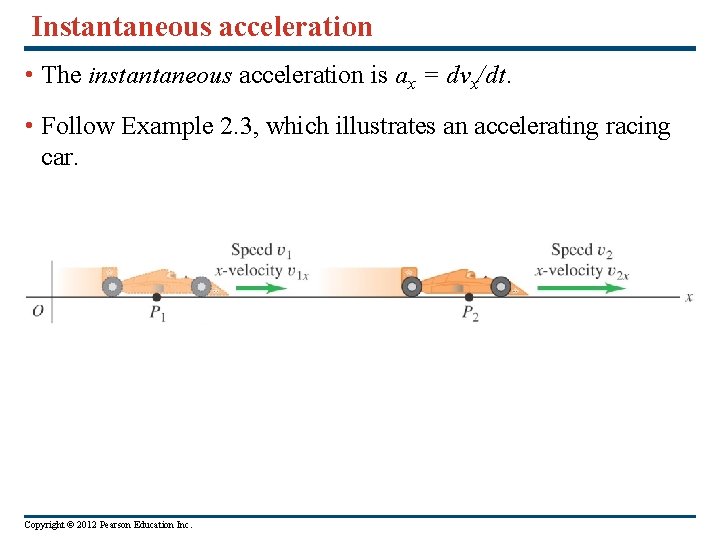
Instantaneous acceleration • The instantaneous acceleration is ax = dvx/dt. • Follow Example 2. 3, which illustrates an accelerating racing car. Copyright © 2012 Pearson Education Inc.
Finding acceleration on a vx-t graph • As shown in Figure 2. 12, the x-t graph may be used to find the instantaneous acceleration and the average acceleration. Copyright © 2012 Pearson Education Inc.
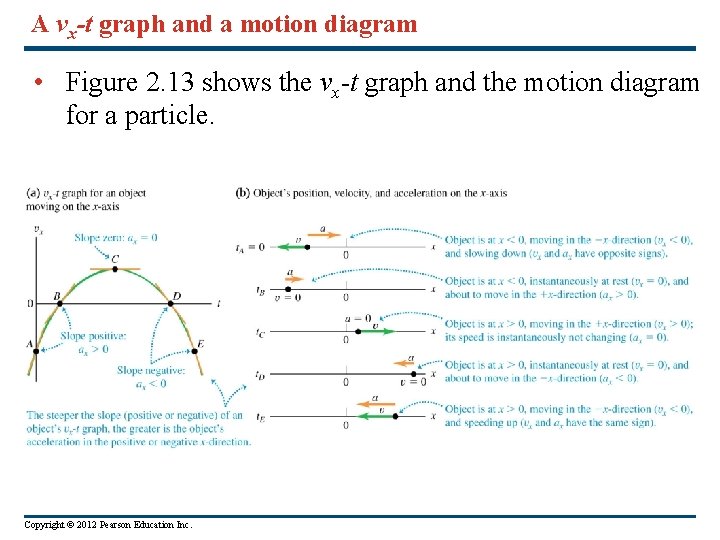
A vx-t graph and a motion diagram • Figure 2. 13 shows the vx-t graph and the motion diagram for a particle. Copyright © 2012 Pearson Education Inc.
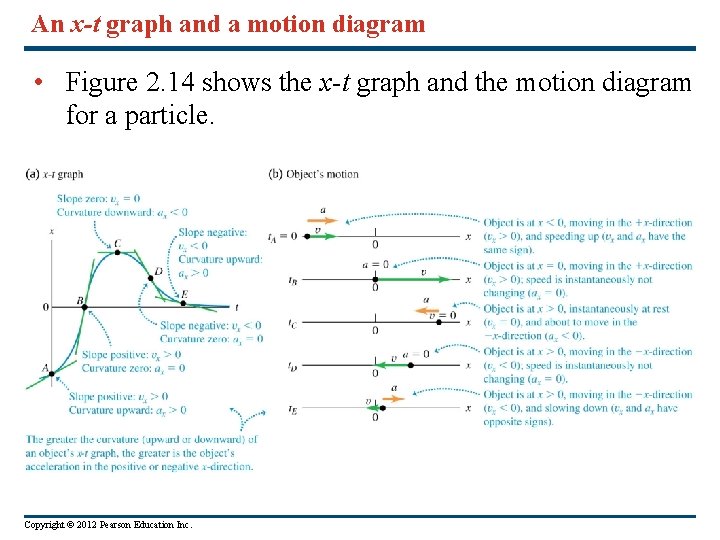
An x-t graph and a motion diagram • Figure 2. 14 shows the x-t graph and the motion diagram for a particle. Copyright © 2012 Pearson Education Inc.
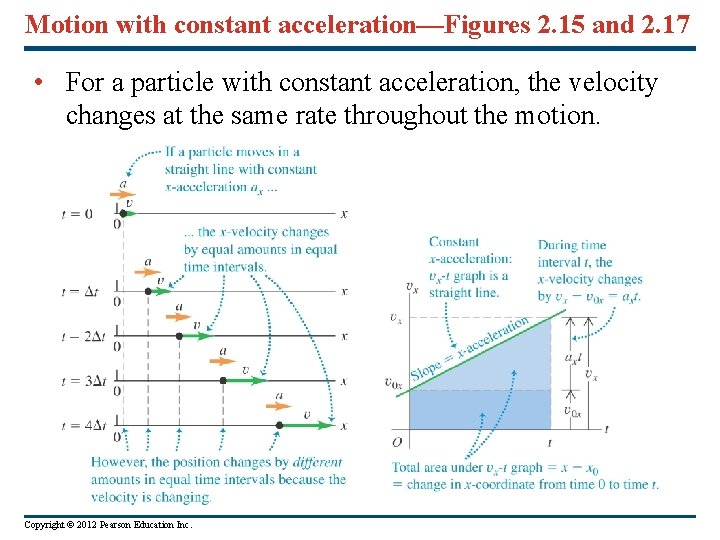
Motion with constant acceleration—Figures 2. 15 and 2. 17 • For a particle with constant acceleration, the velocity changes at the same rate throughout the motion. Copyright © 2012 Pearson Education Inc.
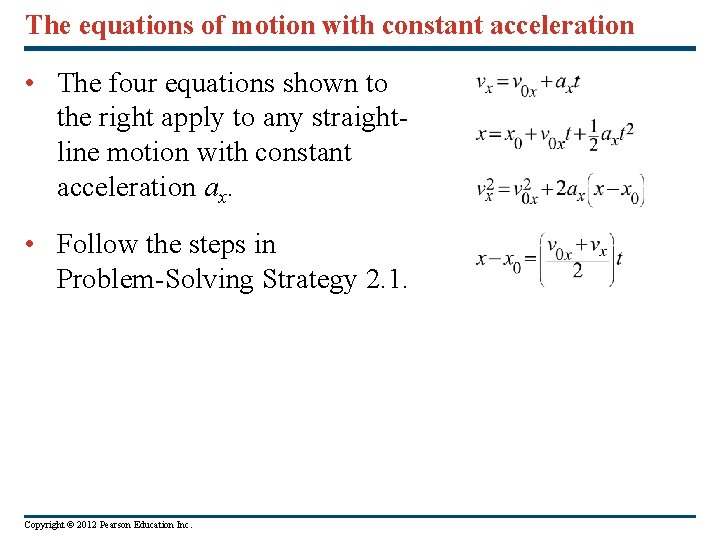
The equations of motion with constant acceleration • The four equations shown to the right apply to any straightline motion with constant acceleration ax. • Follow the steps in Problem-Solving Strategy 2. 1. Copyright © 2012 Pearson Education Inc.
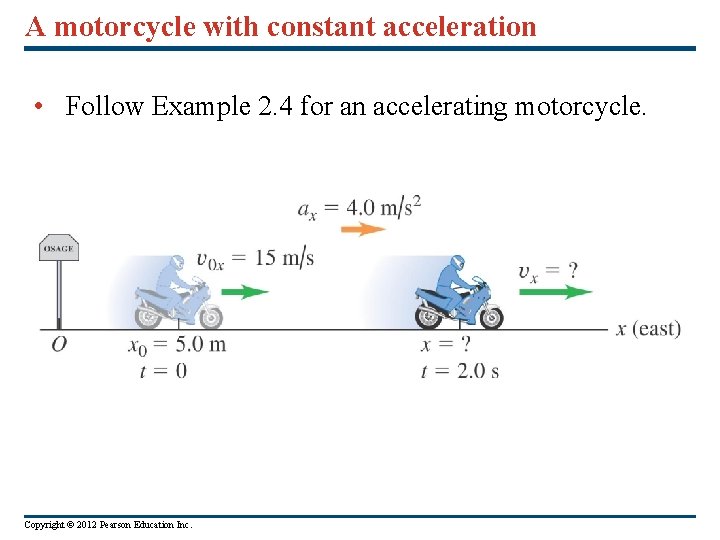
A motorcycle with constant acceleration • Follow Example 2. 4 for an accelerating motorcycle. Copyright © 2012 Pearson Education Inc.
Two bodies with different accelerations • Follow Example 2. 5 in which the police officer and motorist have different accelerations. Copyright © 2012 Pearson Education Inc.
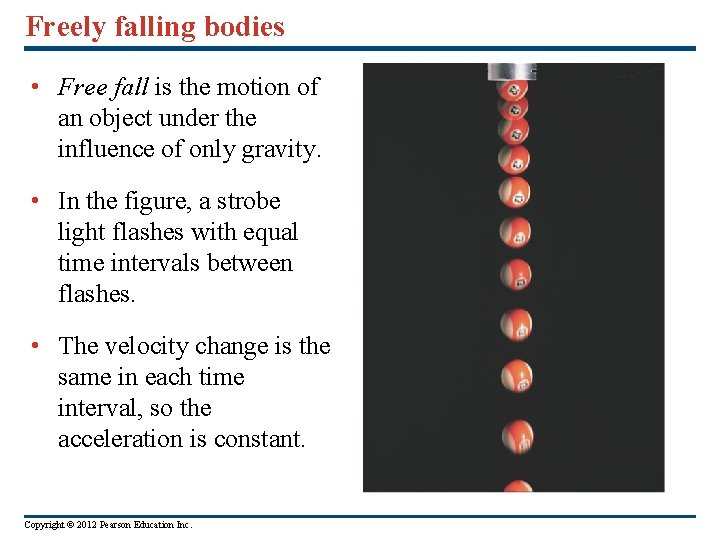
Freely falling bodies • Free fall is the motion of an object under the influence of only gravity. • In the figure, a strobe light flashes with equal time intervals between flashes. • The velocity change is the same in each time interval, so the acceleration is constant. Copyright © 2012 Pearson Education Inc.
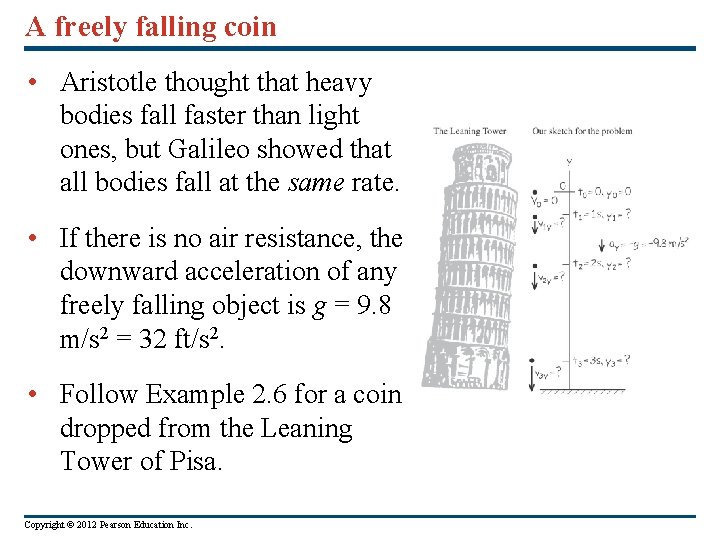
A freely falling coin • Aristotle thought that heavy bodies fall faster than light ones, but Galileo showed that all bodies fall at the same rate. • If there is no air resistance, the downward acceleration of any freely falling object is g = 9. 8 m/s 2 = 32 ft/s 2. • Follow Example 2. 6 for a coin dropped from the Leaning Tower of Pisa. Copyright © 2012 Pearson Education Inc.
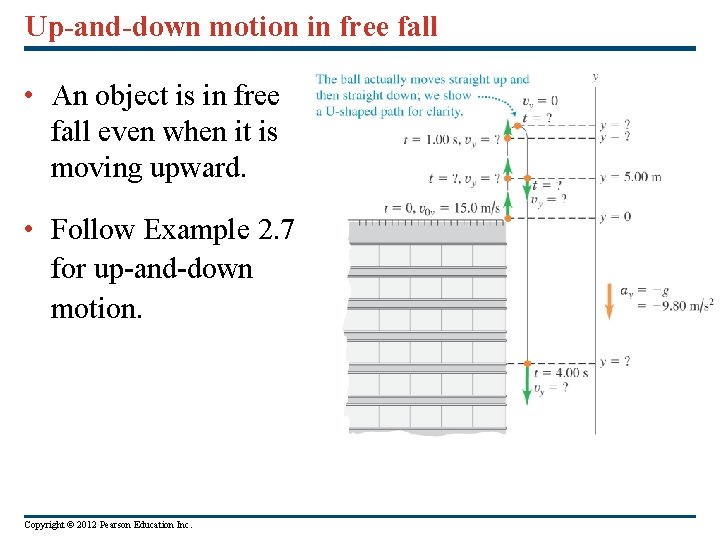
Up-and-down motion in free fall • An object is in free fall even when it is moving upward. • Follow Example 2. 7 for up-and-down motion. Copyright © 2012 Pearson Education Inc.
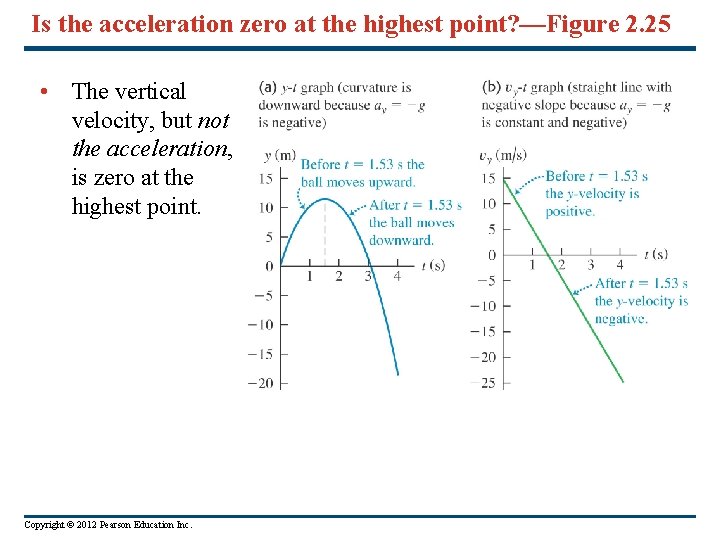
Is the acceleration zero at the highest point? —Figure 2. 25 • The vertical velocity, but not the acceleration, is zero at the highest point. Copyright © 2012 Pearson Education Inc.
Two solutions or one? • We return to the ball in the previous example. • How many solutions make physical sense? • Follow Example 2. 8. Copyright © 2012 Pearson Education Inc.
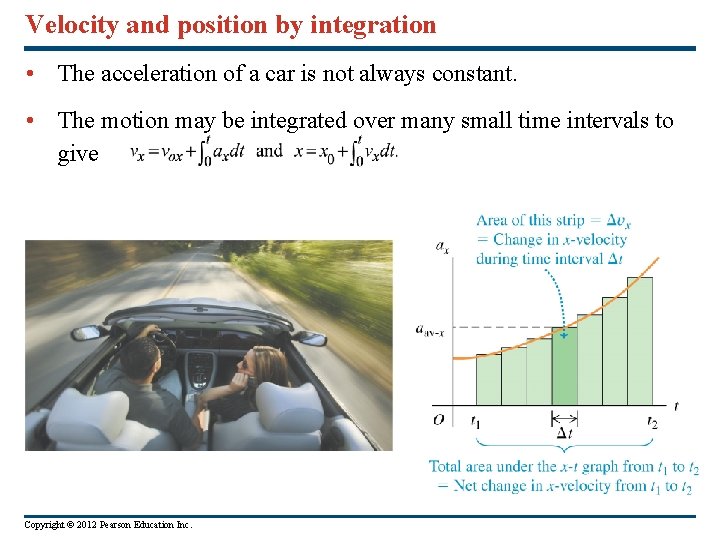
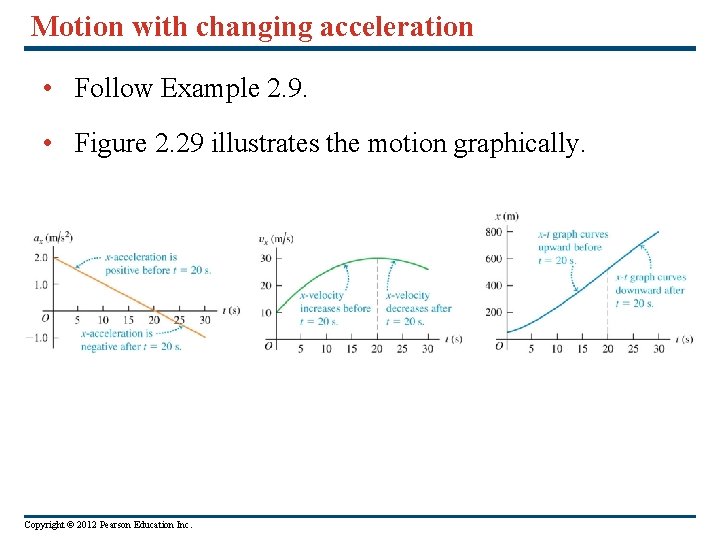
Velocity and position by integration • The acceleration of a car is not always constant. • The motion may be integrated over many small time intervals to give Copyright © 2012 Pearson Education Inc.
Motion with changing acceleration • Follow Example 2. 9. • Figure 2. 29 illustrates the motion graphically. Copyright © 2012 Pearson Education Inc.