Motion in One Dimension Preview Section 1 Displacement

- Slides: 33
Motion in One Dimension Preview Section 1 Displacement and Velocity Section 2 Acceleration Section 3 Falling Objects © Houghton Mifflin Harcourt Publishing Company Section 1
Motion in One Dimension Section 1 What do you think? • Is the book on your instructor’s desk in motion? – Explain your answer. © Houghton Mifflin Harcourt Publishing Company
Motion in One Dimension Section 1 Frame of Reference • Motion – a change in position • Frame of reference – A point against which position is measured • Example: A train traveling between stations – It is in motion when measured against the track. – It is stationary when measured against a seat. © Houghton Mifflin Harcourt Publishing Company
Motion in One Dimension Frame of Reference Click below to watch the Visual Concept © Houghton Mifflin Harcourt Publishing Company Section 1
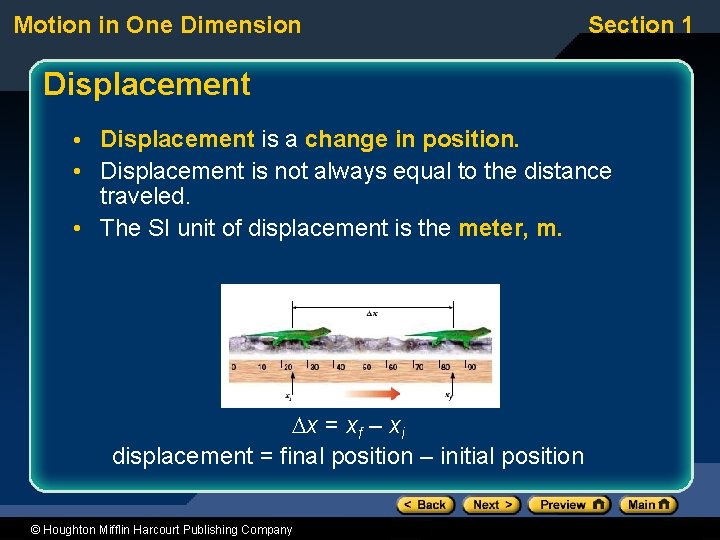
Motion in One Dimension Section 1 Displacement • Displacement is a change in position. • Displacement is not always equal to the distance traveled. • The SI unit of displacement is the meter, m. x = xf – xi displacement = final position – initial position © Houghton Mifflin Harcourt Publishing Company
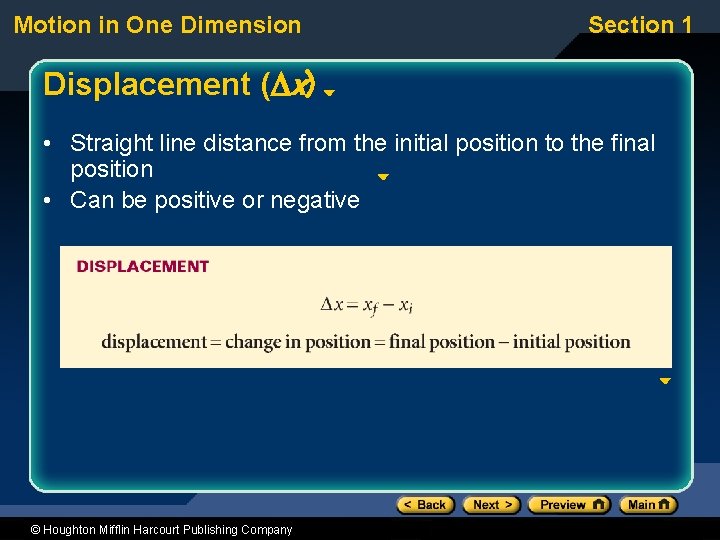
Motion in One Dimension Section 1 Displacement ( x) • Straight line distance from the initial position to the final position • Can be positive or negative © Houghton Mifflin Harcourt Publishing Company
Motion in One Dimension Section 1 Displacement • What is the displacement for the objects shown? • Answer: 9 cm • Answer: -15 cm © Houghton Mifflin Harcourt Publishing Company
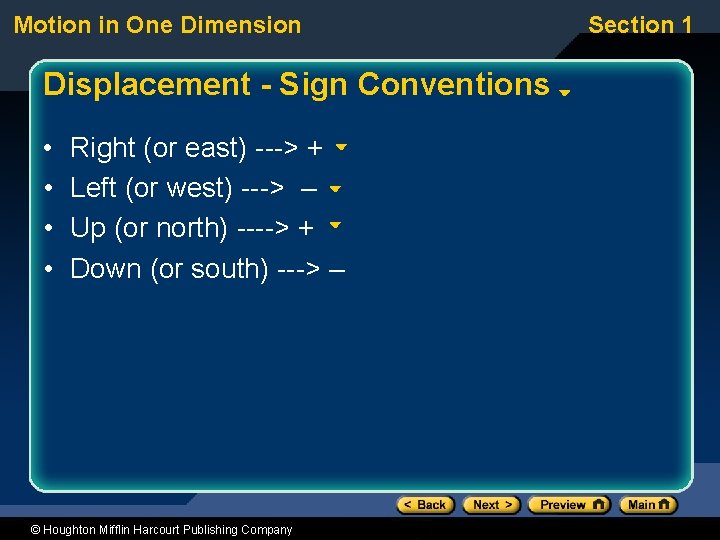
Motion in One Dimension Displacement - Sign Conventions • • Right (or east) ---> + Left (or west) ---> – Up (or north) ----> + Down (or south) ---> – © Houghton Mifflin Harcourt Publishing Company Section 1
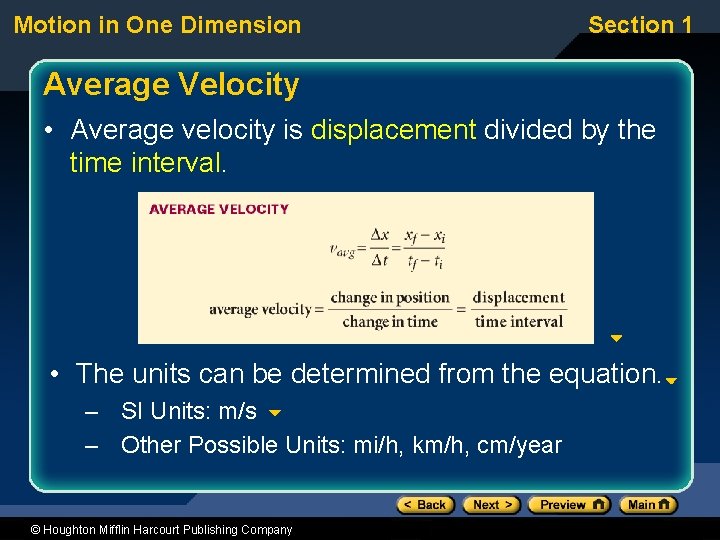
Motion in One Dimension Section 1 Average Velocity • Average velocity is displacement divided by the time interval. • The units can be determined from the equation. – SI Units: m/s – Other Possible Units: mi/h, km/h, cm/year © Houghton Mifflin Harcourt Publishing Company
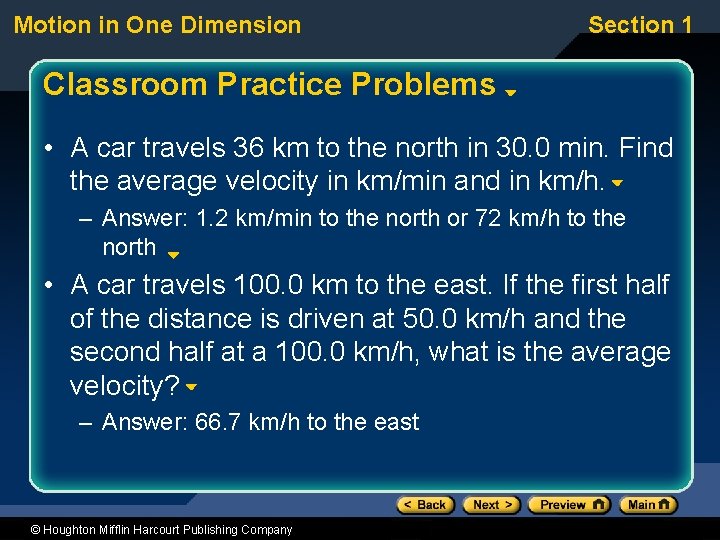
Motion in One Dimension Section 1 Classroom Practice Problems • A car travels 36 km to the north in 30. 0 min. Find the average velocity in km/min and in km/h. – Answer: 1. 2 km/min to the north or 72 km/h to the north • A car travels 100. 0 km to the east. If the first half of the distance is driven at 50. 0 km/h and the second half at a 100. 0 km/h, what is the average velocity? – Answer: 66. 7 km/h to the east © Houghton Mifflin Harcourt Publishing Company
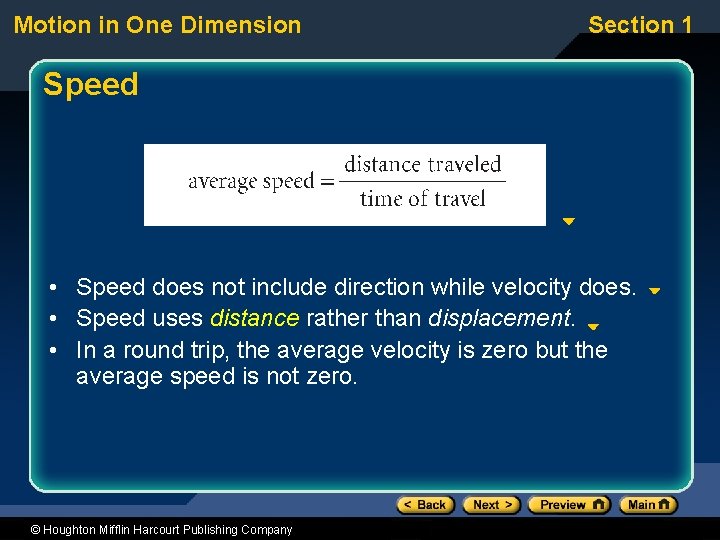
Motion in One Dimension Section 1 Speed • Speed does not include direction while velocity does. • Speed uses distance rather than displacement. • In a round trip, the average velocity is zero but the average speed is not zero. © Houghton Mifflin Harcourt Publishing Company
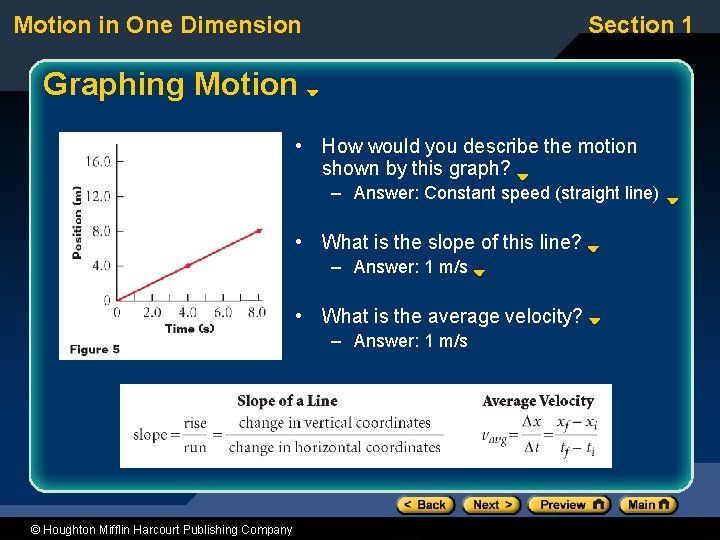
Motion in One Dimension Section 1 Graphing Motion • How would you describe the motion shown by this graph? – Answer: Constant speed (straight line) • What is the slope of this line? – Answer: 1 m/s • What is the average velocity? – Answer: 1 m/s © Houghton Mifflin Harcourt Publishing Company
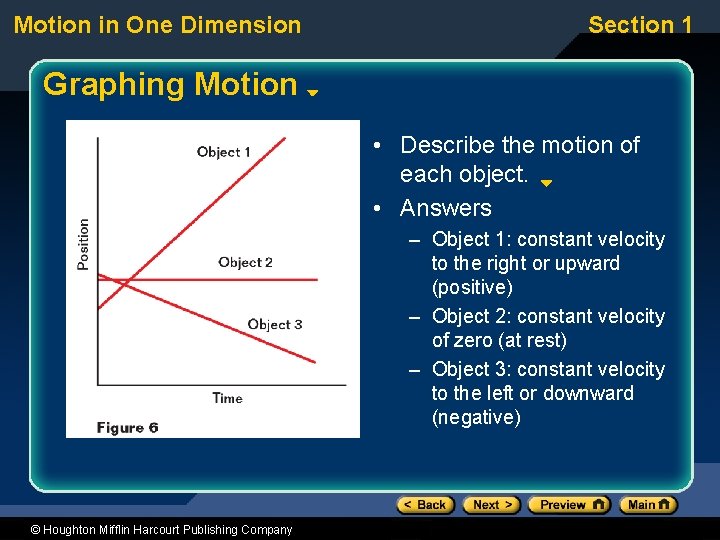
Motion in One Dimension Section 1 Graphing Motion • Describe the motion of each object. • Answers – Object 1: constant velocity to the right or upward (positive) – Object 2: constant velocity of zero (at rest) – Object 3: constant velocity to the left or downward (negative) © Houghton Mifflin Harcourt Publishing Company
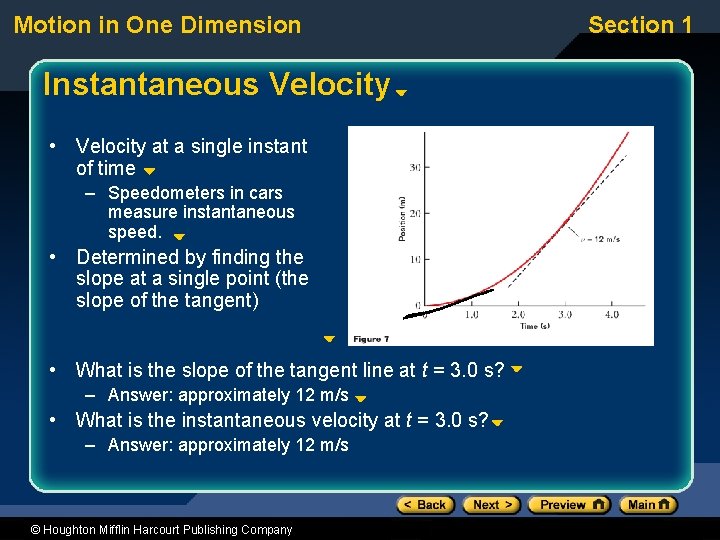
Motion in One Dimension Instantaneous Velocity • Velocity at a single instant of time – Speedometers in cars measure instantaneous speed. • Determined by finding the slope at a single point (the slope of the tangent) • What is the slope of the tangent line at t = 3. 0 s? – Answer: approximately 12 m/s • What is the instantaneous velocity at t = 3. 0 s? – Answer: approximately 12 m/s © Houghton Mifflin Harcourt Publishing Company Section 1
Motion in One Dimension Section 1 Now what do you think? • Is the book on your instructor’s desk in motion? – How does your answer depend on the frame of reference? • What are some common terms used to describe the motion of objects? © Houghton Mifflin Harcourt Publishing Company
Motion in One Dimension Section 2 What do you think? • Which of the following cars is accelerating? – – A car shortly after a stoplight turns green A car approaching a red light A car with the cruise control set at 80 km/h A car turning a curve at a constant speed • Based on your answers, what is your definition of acceleration? © Houghton Mifflin Harcourt Publishing Company
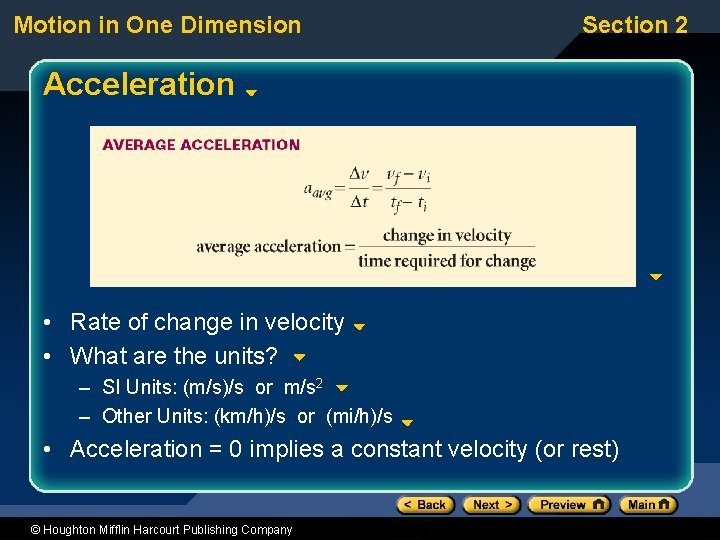
Motion in One Dimension Section 2 Acceleration • Rate of change in velocity • What are the units? – SI Units: (m/s)/s or m/s 2 – Other Units: (km/h)/s or (mi/h)/s • Acceleration = 0 implies a constant velocity (or rest) © Houghton Mifflin Harcourt Publishing Company
Motion in One Dimension Section 2 Classroom Practice Problem • Find the acceleration of an amusement park ride that falls from rest to a velocity of 28 m/s downward in 3. 0 s. – Answer: 9. 3 m/s 2 downward © Houghton Mifflin Harcourt Publishing Company
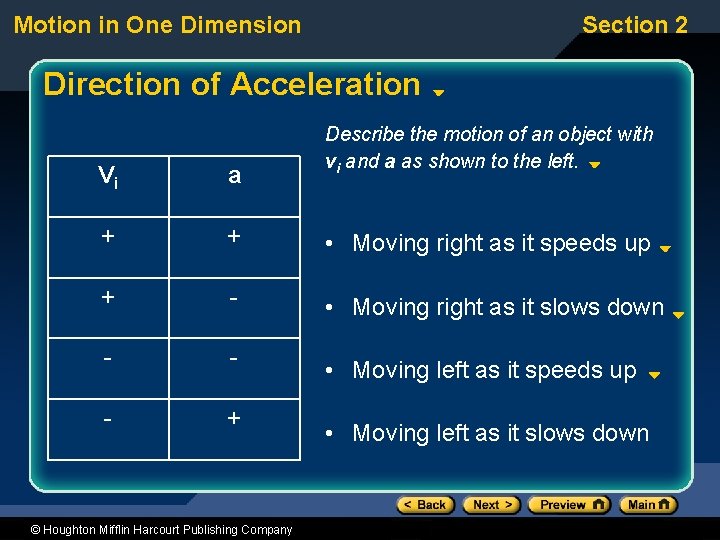
Motion in One Dimension Section 2 Direction of Acceleration Describe the motion of an object with vi and a as shown to the left. Vi a + + • Moving right as it speeds up + - • Moving right as it slows down - - - + © Houghton Mifflin Harcourt Publishing Company • Moving left as it speeds up • Moving left as it slows down
Motion in One Dimension Acceleration Click below to watch the Visual Concept © Houghton Mifflin Harcourt Publishing Company Section 2
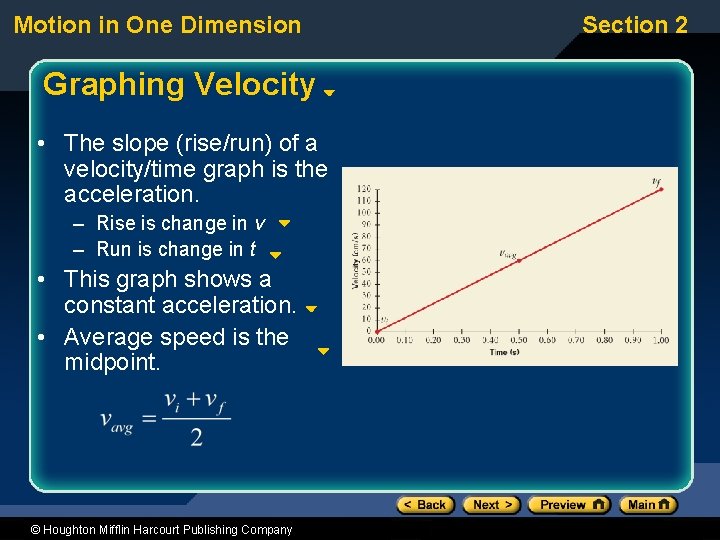
Motion in One Dimension Graphing Velocity • The slope (rise/run) of a velocity/time graph is the acceleration. – Rise is change in v – Run is change in t • This graph shows a constant acceleration. • Average speed is the midpoint. © Houghton Mifflin Harcourt Publishing Company Section 2
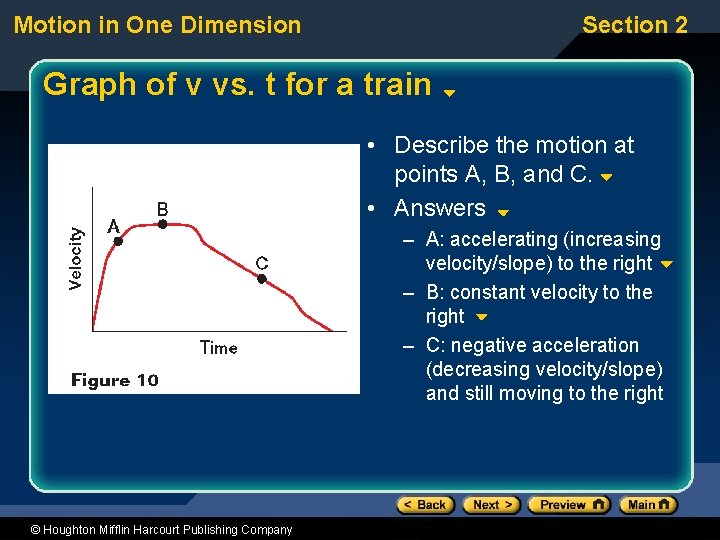
Motion in One Dimension Section 2 Graph of v vs. t for a train • Describe the motion at points A, B, and C. • Answers – A: accelerating (increasing velocity/slope) to the right – B: constant velocity to the right – C: negative acceleration (decreasing velocity/slope) and still moving to the right © Houghton Mifflin Harcourt Publishing Company
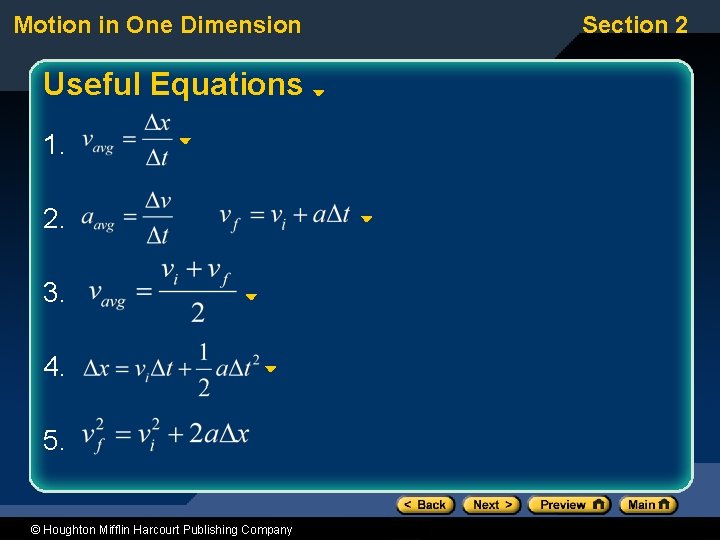
Motion in One Dimension Useful Equations 1. 2. 3. 4. 5. © Houghton Mifflin Harcourt Publishing Company Section 2
Motion in One Dimension Section 2 Classroom Practice Problems • A bicyclist accelerates from 5. 0 m/s to 16 m/s in 8. 0 s. Assuming uniform acceleration, what distance does the bicyclist travel during this time interval? – Answer: 84 m • An aircraft has a landing speed of 83. 9 m/s. The landing area of an aircraft carrier is 195 m long. What is the minimum uniform acceleration required for safe landing? – Answer: -18. 0 m/s 2 © Houghton Mifflin Harcourt Publishing Company
Motion in One Dimension Section 2 Now what do you think? • Which of the following cars is accelerating? – – A car shortly after a stoplight turns green A car approaching a red light A car with the cruise control set at 80 km/h A car turning a curve at a constant speed • Based on your answers, what is the definition of acceleration? • How is acceleration calculated? • What are the SI units for acceleration? © Houghton Mifflin Harcourt Publishing Company
Motion in One Dimension Section 3 What do you think? • Observe a metal ball being dropped from rest. – Describe the motion in words. – Sketch a velocity-time graph for this motion. • Observe the same ball being tossed vertically upward and returning to the starting point. – Describe the motion in words. – Sketch a velocity-time graph for this motion. © Houghton Mifflin Harcourt Publishing Company
Motion in One Dimension Section 3 Free Fall • http: //www. teachertube. com/video/hammer-andfeather-drop-on-moon-41342 • Assumes no air resistance • Acceleration is constant for the entire fall • Acceleration due to gravity (ag or g ) – Has a value of -9. 81 m/s 2 • Negative for downward – Roughly equivalent to -22 (mi/h)/s © Houghton Mifflin Harcourt Publishing Company
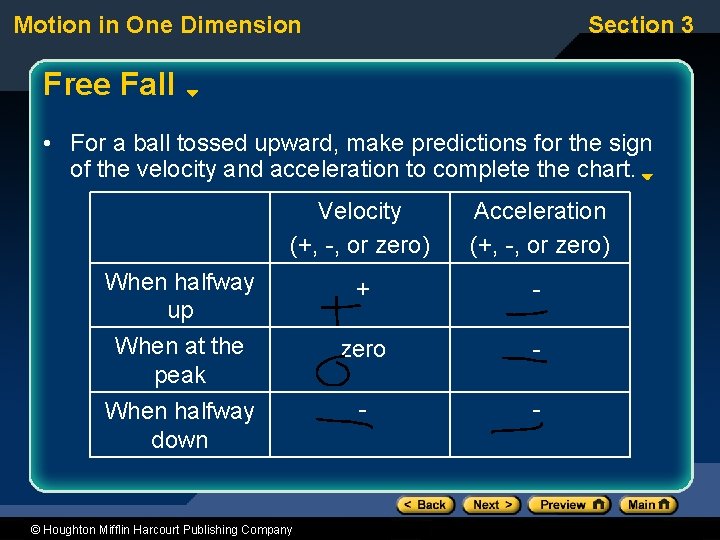
Motion in One Dimension Section 3 Free Fall • For a ball tossed upward, make predictions for the sign of the velocity and acceleration to complete the chart. Velocity (+, -, or zero) Acceleration (+, -, or zero) When halfway up + - When at the peak zero - When halfway down - - © Houghton Mifflin Harcourt Publishing Company
Motion in One Dimension Free Fall Click below to watch the Visual Concept © Houghton Mifflin Harcourt Publishing Company Section 3
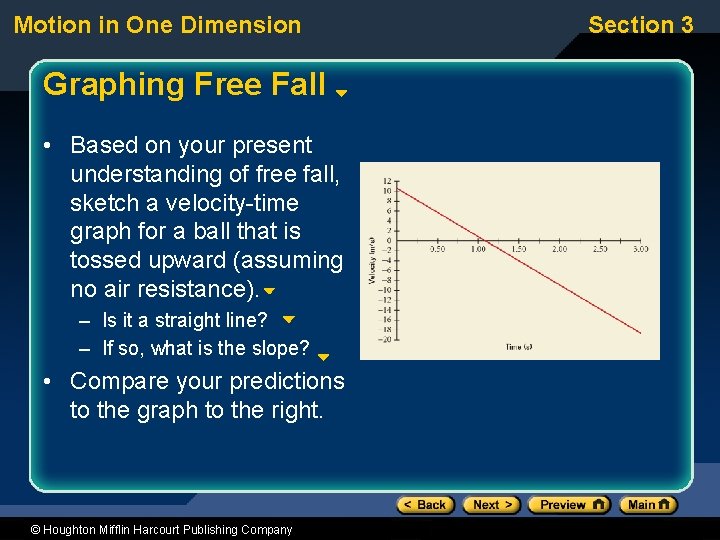
Motion in One Dimension Graphing Free Fall • Based on your present understanding of free fall, sketch a velocity-time graph for a ball that is tossed upward (assuming no air resistance). – Is it a straight line? – If so, what is the slope? • Compare your predictions to the graph to the right. © Houghton Mifflin Harcourt Publishing Company Section 3
Motion in One Dimension Section 3 Velocity and Acceleration of an Object at its High Point Click below to watch the Visual Concept © Houghton Mifflin Harcourt Publishing Company
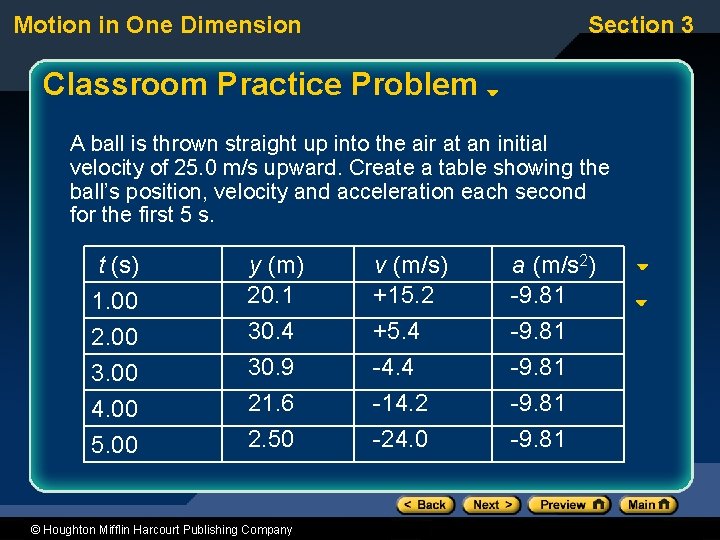
Motion in One Dimension Section 3 Classroom Practice Problem A ball is thrown straight up into the air at an initial velocity of 25. 0 m/s upward. Create a table showing the ball’s position, velocity and acceleration each second for the first 5 s. t (s) 1. 00 2. 00 3. 00 4. 00 5. 00 y (m) 20. 1 30. 4 30. 9 21. 6 2. 50 © Houghton Mifflin Harcourt Publishing Company v (m/s) +15. 2 +5. 4 -4. 4 -14. 2 -24. 0 a (m/s 2) -9. 81
Motion in One Dimension Section 3 Now what do you think? Review the descriptions and graphs you created at the beginning of the presentation. – Do you want to make any modifications? – For the second graph, circle the point representing the highest point of the toss. © Houghton Mifflin Harcourt Publishing Company