Molecular monitoring in AML Impact on Therapy HweiFang

- Slides: 25
Molecular monitoring in AML: Impact on Therapy Hwei-Fang Tien, National Taiwan University Hospital West part of NTUH
Outline • Molecular markers for monitoring • Prognostic implications • Pre-emptive therapy on molecular relapse • Samples and timing for monitoring
Outline • Molecular markers for monitoring • Prognostic implications • Pre-emptive therapy on molecular relapse • Samples and timing for monitoring
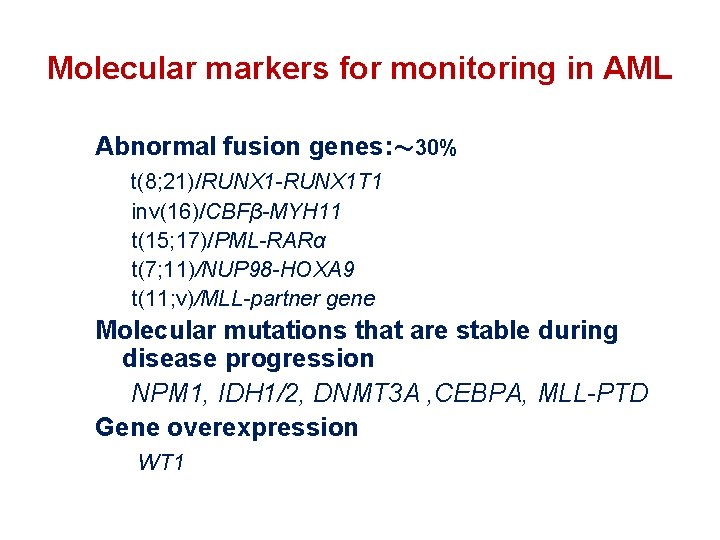
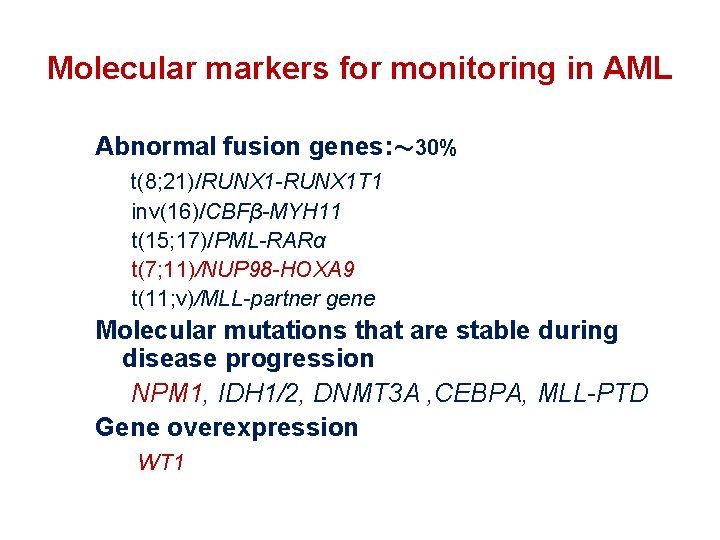
Molecular markers for monitoring in AML Abnormal fusion genes: ~ 30% t(8; 21)/RUNX 1 -RUNX 1 T 1 inv(16)/CBFβ-MYH 11 t(15; 17)/PML-RARα t(7; 11)/NUP 98 -HOXA 9 t(11; v)/MLL-partner gene Molecular mutations that are stable during disease progression NPM 1, IDH 1/2, DNMT 3 A , CEBPA, MLL-PTD Gene overexpression WT 1
Molecular markers for monitoring in AML Abnormal fusion genes: ~ 30% t(8; 21)/RUNX 1 -RUNX 1 T 1 inv(16)/CBFβ-MYH 11 t(15; 17)/PML-RARα t(7; 11)/NUP 98 -HOXA 9 t(11; v)/MLL-partner gene Molecular mutations that are stable during disease progression NPM 1, IDH 1/2, DNMT 3 A , CEBPA, MLL-PTD Gene overexpression WT 1
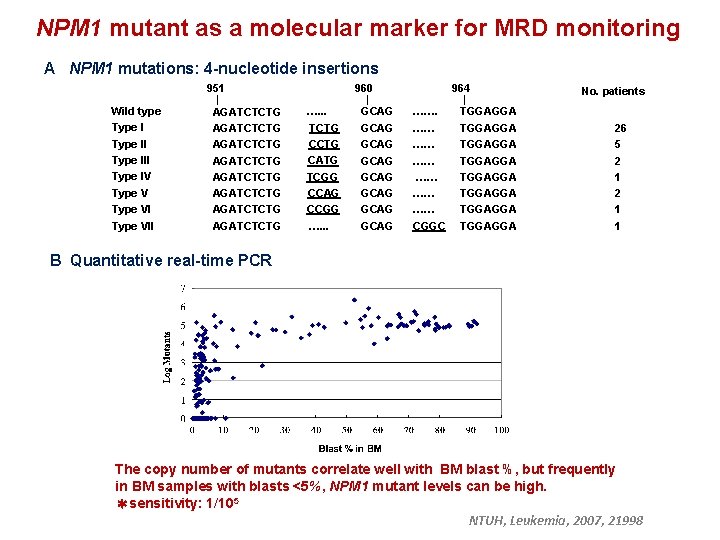
NPM 1 mutant as a molecular marker for MRD monitoring A NPM 1 mutations: 4 -nucleotide insertions 951 Wild type Type III Type IV Type VII AGATCTCTG AGATCTCTG 960 964 …. . . GCAG ……. TGGAGGA TCTG CATG TCGG CCAG CCGG …. . . GCAG GCAG …… …… …… CGGC TGGAGGA TGGAGGA No. patients 26 5 2 1 1 B Quantitative real-time PCR The copy number of mutants correlate well with BM blast %, but frequently in BM samples with blasts <5%, NPM 1 mutant levels can be high. *sensitivity: 1/105 NTUH, Leukemia, 2007, 21998
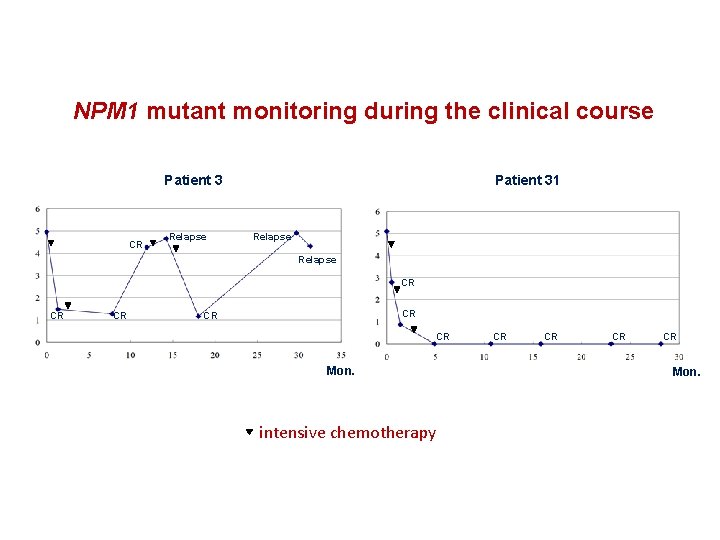
NPM 1 mutant monitoring during the clinical course Patient 3 CR Relapse Patient 31 Relapse CR CR CR Mon. intensive chemotherapy CR CR Mon.
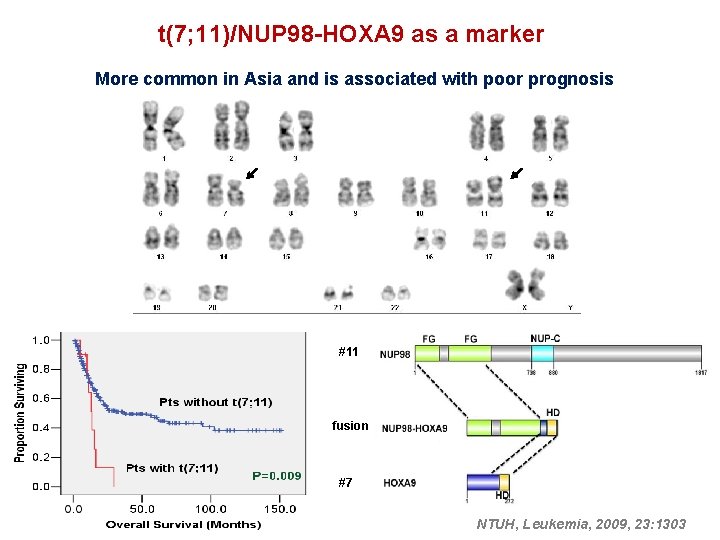
t(7; 11)/NUP 98 -HOXA 9 as a marker More common in Asia and is associated with poor prognosis #11 fusion #7 NTUH, Leukemia, 2009, 23: 1303
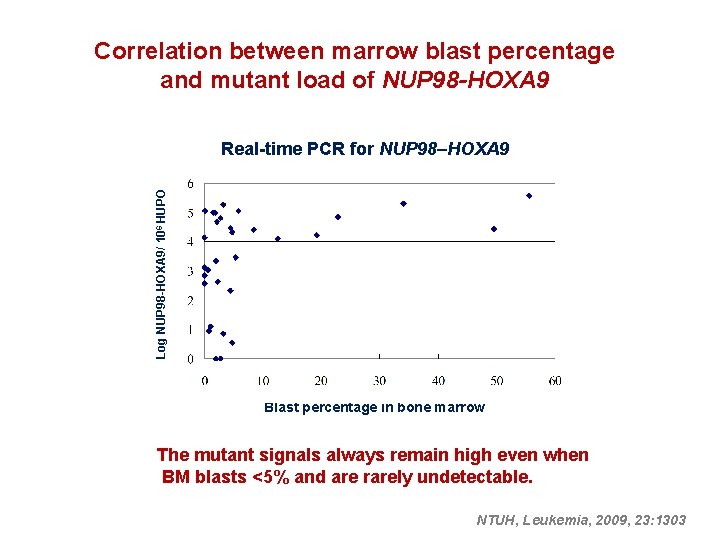
Correlation between marrow blast percentage and mutant load of NUP 98 -HOXA 9 Log NUP 98 -HOXA 9/ 106 HUPO Real-time PCR for NUP 98–HOXA 9 Blast percentage in bone marrow The mutant signals always remain high even when BM blasts <5% and are rarely undetectable. NTUH, Leukemia, 2009, 23: 1303
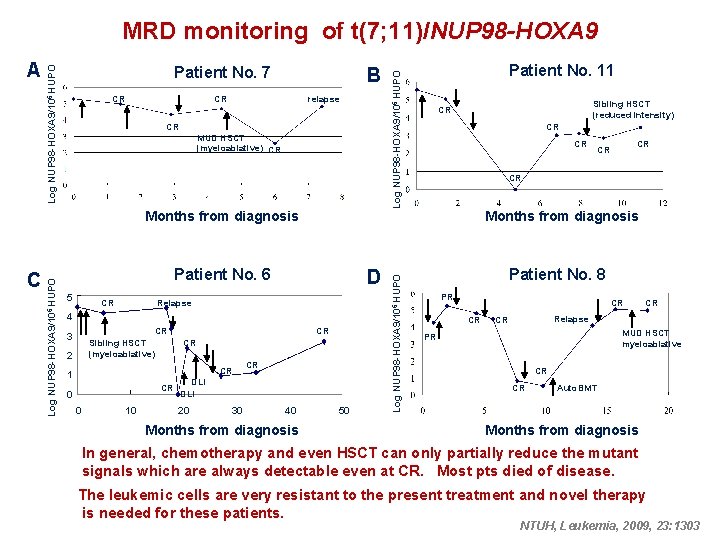
MRD monitoring of t(7; 11)/NUP 98 -HOXA 9 CR relapse CR MUD HSCT (myeloablative) CR C Log NUP 98 -HOXA 9/106 HUPO Months from diagnosis Patient No. 6 5 D Relapse CR 4 CR 3 Sibling HSCT (myeloablative) 2 CR CR CR 1 CR DLI 0 0 10 20 30 40 Months from diagnosis 50 Patient No. 11 Log NUP 98 -HOXA 9/106 HUPO CR B Log NUP 98 -HOXA 9/106 HUPO Patient No. 7 Log NUP 98 -HOXA 9/106 HUPO A Sibling HSCT (reduced intensity) CR CR CR Months from diagnosis Patient No. 8 PR CR CR CR Relapse CR MUD HSCT myeloablative PR CR CR Auto. BMT Months from diagnosis In general, chemotherapy and even HSCT can only partially reduce the mutant signals which are always detectable even at CR. Most pts died of disease. The leukemic cells are very resistant to the present treatment and novel therapy is needed for these patients. NTUH, Leukemia, 2009, 23: 1303
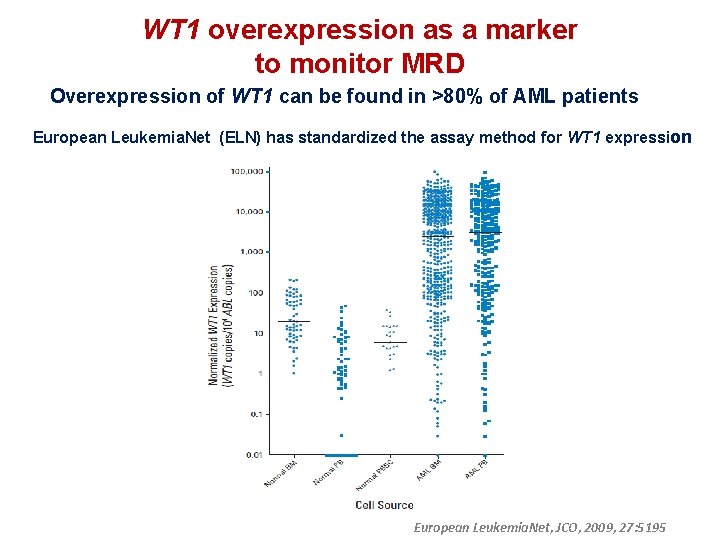
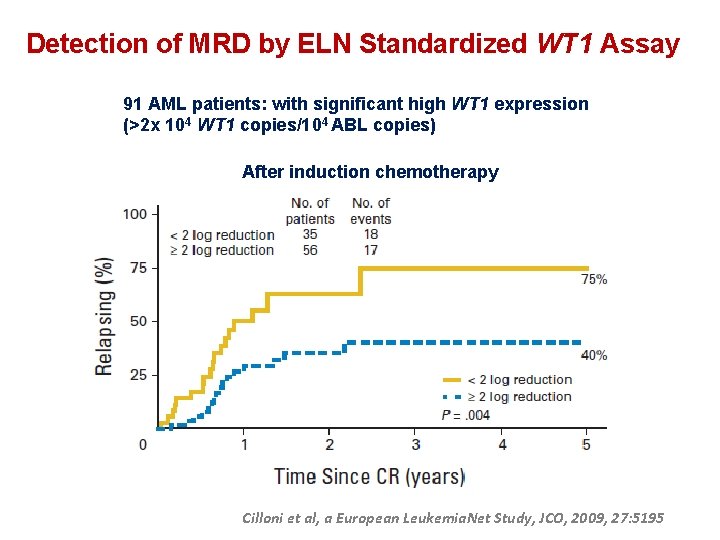
WT 1 overexpression as a marker to monitor MRD Overexpression of WT 1 can be found in >80% of AML patients European Leukemia. Net (ELN) has standardized the assay method for WT 1 expression European Leukemia. Net, JCO, 2009, 27: 5195
Outline • Molecular markers for monitoring • Prognostic implications • Pre-emptive therapy on molecular relapse • Samples and timing for monitoring
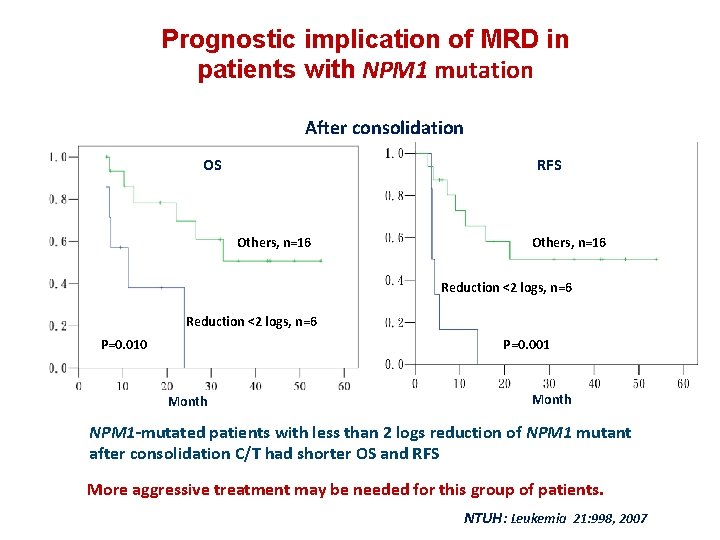
Prognostic implication of MRD in patients with NPM 1 mutation After consolidation OS RFS Others, n=16 Reduction <2 logs, n=6 P=0. 010 P=0. 001 Month NTUH 2006 NPM 1 -mutated patients with less than 2 logs reduction of NPM 1 mutant after consolidation C/T had shorter OS and RFS More aggressive treatment may be needed for this group of patients. NTUH: Leukemia 21: 998, 2007
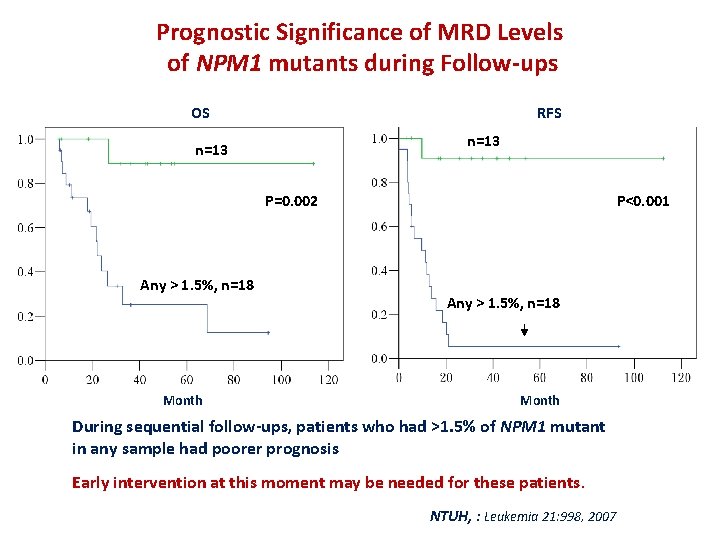
Prognostic Significance of MRD Levels of NPM 1 mutants during Follow-ups OS RFS n=13 P=0. 002 Any > 1. 5%, n=18 Month P<0. 001 Any > 1. 5%, n=18 Month During sequential follow-ups, patients who had >1. 5% of NPM 1 mutant in any sample had poorer prognosis Early intervention at this moment may be needed for these patients. NTUH, : Leukemia 21: 998, 2007
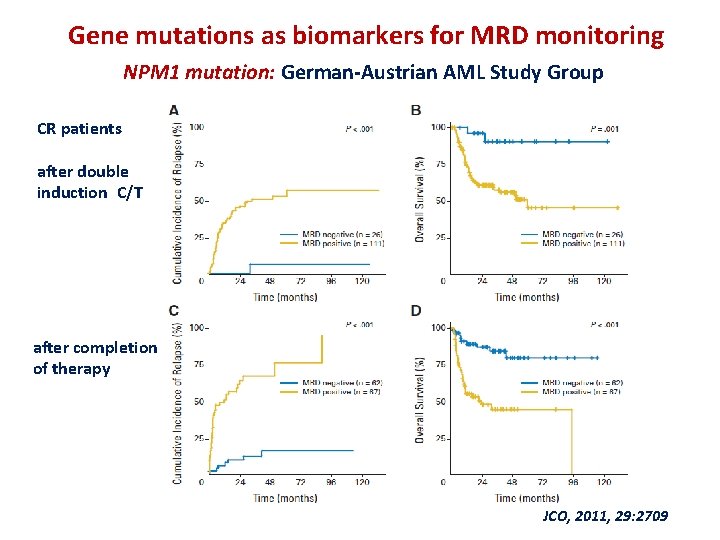
Gene mutations as biomarkers for MRD monitoring NPM 1 mutation: German-Austrian AML Study Group CR patients after double induction C/T after completion of therapy JCO, 2011, 29: 2709
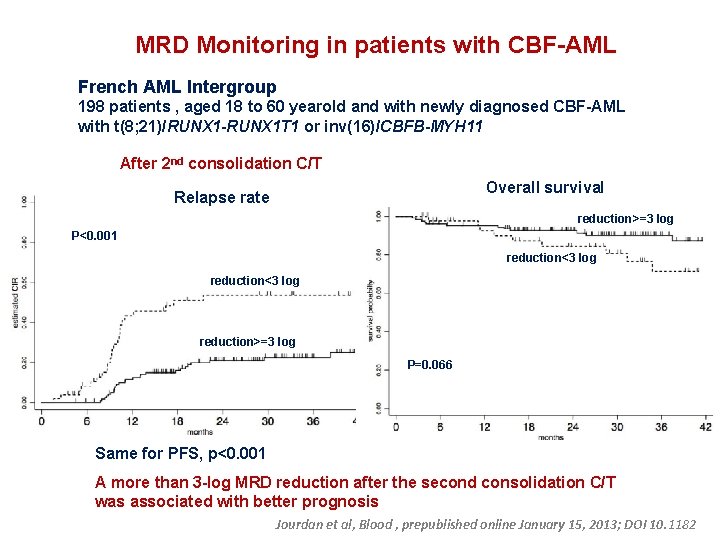
MRD Monitoring in patients with CBF-AML French AML Intergroup 198 patients , aged 18 to 60 yearold and with newly diagnosed CBF-AML with t(8; 21)/RUNX 1 -RUNX 1 T 1 or inv(16)/CBFB-MYH 11 After 2 nd consolidation C/T Overall survival Relapse rate reduction>=3 log P<0. 001 reduction<3 log reduction>=3 log P=0. 066 Same for PFS, p<0. 001 A more than 3 -log MRD reduction after the second consolidation C/T was associated with better prognosis Jourdan et al, Blood , prepublished online January 15, 2013; DOI 10. 1182
Detection of MRD by ELN Standardized WT 1 Assay 91 AML patients: with significant high WT 1 expression (>2 x 10⁴ WT 1 copies/104 ABL copies) After induction chemotherapy Cilloni et al, a European Leukemia. Net Study, JCO, 2009, 27: 5195
Outline • Molecular markers for monitoring • Prognostic implications • Pre-emptive therapy on molecular relapse • Samples and timing for monitoring
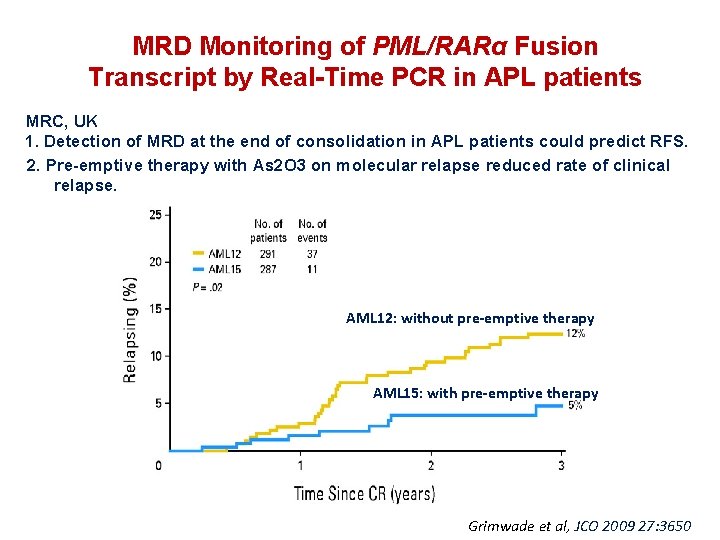
MRD Monitoring of PML/RARα Fusion Transcript by Real-Time PCR in APL patients MRC, UK 1. Detection of MRD at the end of consolidation in APL patients could predict RFS. 2. Pre-emptive therapy with As 2 O 3 on molecular relapse reduced rate of clinical relapse. AML 12: without pre-emptive therapy AML 15: with pre-emptive therapy Grimwade et al, JCO 2009 27: 3650
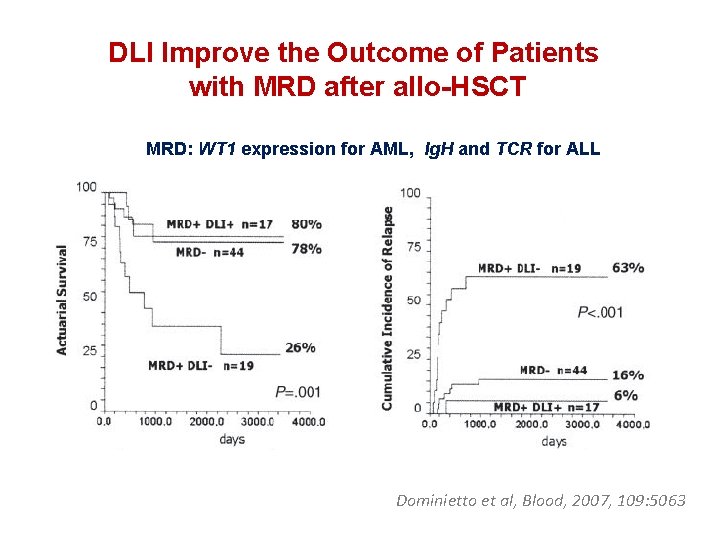
DLI Improve the Outcome of Patients with MRD after allo-HSCT MRD: WT 1 expression for AML, Ig. H and TCR for ALL Dominietto et al, Blood, 2007, 109: 5063
Outline • Molecular markers for monitoring • Prognostic implications • Pre-emptive therapy on molecular relapse • Samples and timing for monitoring
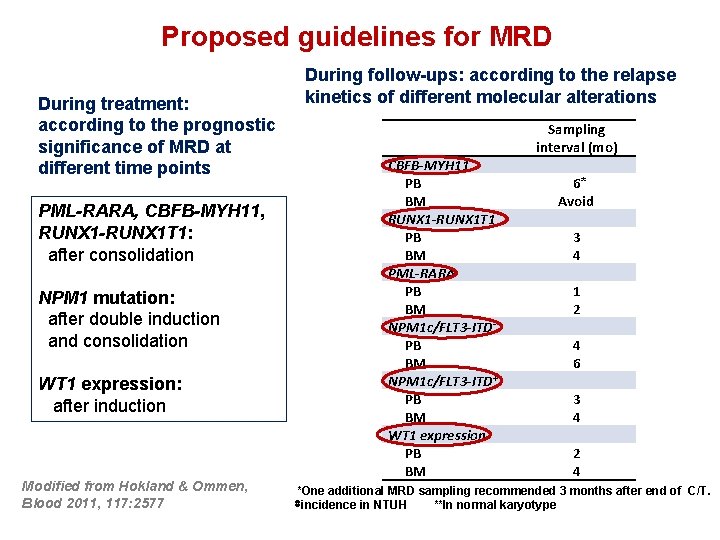
Proposed guidelines for MRD During treatment: according to the prognostic significance of MRD at different time points During follow-ups: according to the relapse kinetics of different molecular alterations CBFB-MYH 11 PB BM RUNX 1 -RUNX 1 T 1 PB BM PML-RARA PB BM NPM 1 c/FLT 3 -ITD+ PB BM WT 1 expression PB BM PML-RARA, CBFB-MYH 11, RUNX 1 -RUNX 1 T 1: after consolidation NPM 1 mutation: after double induction and consolidation WT 1 expression: after induction Modified from Hokland & Ommen, Blood 2011, 117: 2577 Sampling interval (mo) 6* Avoid 3 4 1 2 4 6 3 4 2 4 *One additional MRD sampling recommended 3 months after end of C/T. in NTUH **In normal karyotype #incidence
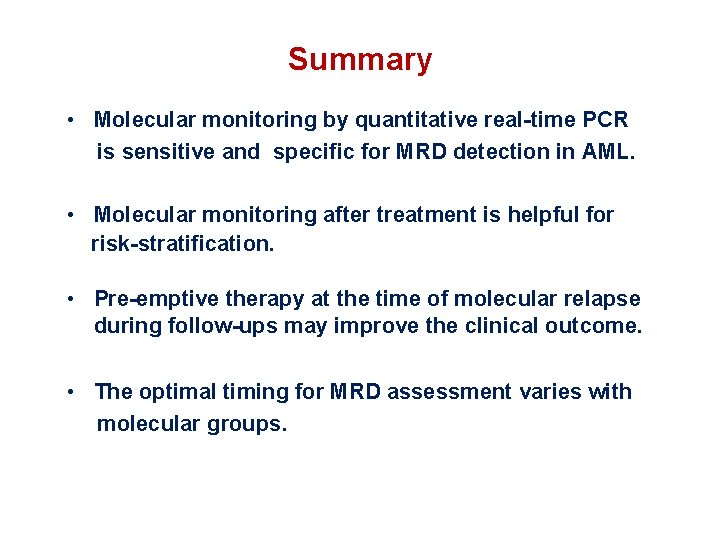
Summary • Molecular monitoring by quantitative real-time PCR is sensitive and specific for MRD detection in AML. • Molecular monitoring after treatment is helpful for risk-stratification. • Pre-emptive therapy at the time of molecular relapse during follow-ups may improve the clinical outcome. • The optimal timing for MRD assessment varies with molecular groups.
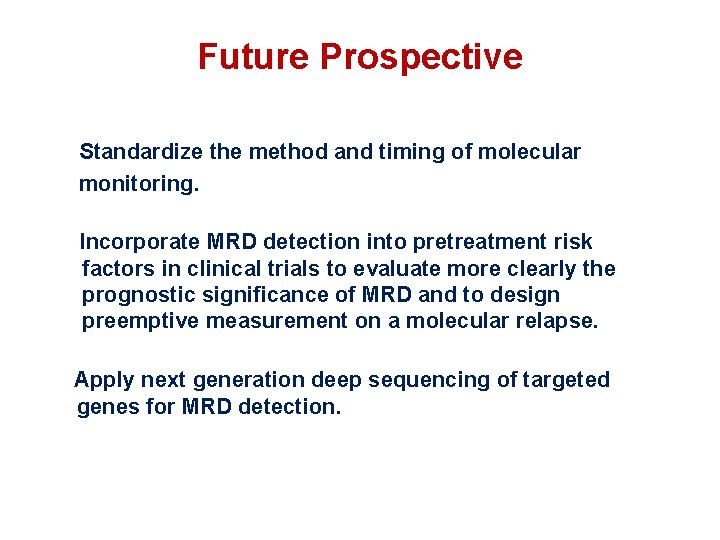
Future Prospective Standardize the method and timing of molecular monitoring. Incorporate MRD detection into pretreatment risk factors in clinical trials to evaluate more clearly the prognostic significance of MRD and to design preemptive measurement on a molecular relapse. Apply next generation deep sequencing of targeted genes for MRD detection.
台灣藍鵲( Formosan Blue Magpie )