MODERNISM ERNEST HEMINGWAY Events and trends that helped

- Slides: 21
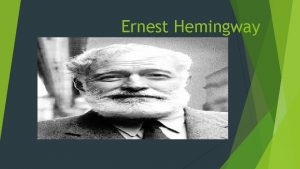
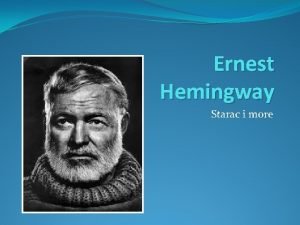
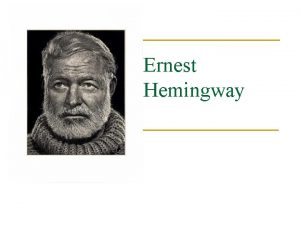
MODERNISM & ERNEST HEMINGWAY Events and trends that helped shape Modernism
History that led to Modernism • World War I 1914 -1918 • First “modern” war • Employed new artillery firepower (machine guns, Howitzers shells, tanks, airplane bombings, and gas) • Approximately 17 million total deaths, 20 million wounded, and many soldiers returning home with shell shock
Results of WWI • Mass destruction led to feelings of disillusionment about the moral improvement and progress of human society.
Sigmund Freud • The invention of psychoanalysis: actions can be explained by unconscious forces
Albert Einstein • The theory of relativity: questions an ordered and stable universe (not everything is fixed and constant)
General facts of Modernism • An explosion of artistic movements that rejected realism, which no longer reflected the new world • Peaked between 1900 -1940 in Europe; 1914 -1945 in America • Emphasized formalism (how well wrought and stylized the work is), autonomy of art, originality/newness • A discontinuity of time (time as discontinuous, overlapping, non-chronological in the way we experience it; a shift from linear time to “moment time” • More emphasis on individual psychology and subjective experience. Concentrate on moments, episodes, or epiphanies.
Modernist writing: plot • From Abrams A Glossary of Literary Terms: modernists “break up the narrative continuity” • In other words, there is a departure from linear plots with climactic turning points and clear resolutions • Instead modernists use discontinuous fragments, “moment time”, a-chronological leaps in time, multiple plots, and open unresolved endings
Modernist writing: character • From Abrams A glossary of literary Terms “depart from standard ways of representing characters” • Or, a disappearance of character summary, of discrete, well-defined characters (think of Dickens) • Instead, the representation of the self as diverse, contradictory, ambiguous
Modernist writing: style • From Abrams A Glossary of Literary Terms: modernists “violate the traditional syntax and coherence of narrative language” • Modernists use “stream of consciousness” (tracing non- linear thought processes), moving by the “logic of the unconscious”; imagistic rather than logical connections.
Modernist writing: point of view • From Abrams A Glossary of Literary Terms: POV thematically represents an ‘immense panorama of futility and anarchy” • Modernists show a rejection of the single, authoritative, omniscient point of view, instead following: • A narrative focused instead through the consciousness of one character whose point of view is limited • Or through several characters who establish relative, multiple points of view • Or through several simultaneously-held positions maintained by the one character • Point of view thematically represents an overwhelming sense of uselessness or ineffectiveness toward life, and social confusion and disorder. (see quote above)
Hemingway’s Modernist traits • As you read, you will notice these characteristics in The Sun Also Rises, A Farewell to Arms, & Short Stories
Subjectivity/experience • “inner reality” over objective experience • Emphasized in modernism with use of limited omniscient or first person narrator whose prejudices or p. o. v. shapes the story.
Elliptical plot • Traditional plot elements (beginnings, climax, resolution) often are deleted or obscured in modernism
Nada concept • “Nothing” is out there for you; universe is indifferent and has no purpose, meaning, or order
Hemingway Hero • Man for whom it is a point of honor to suffer with grace and dignity; he plays the game well, while sensing that defeat is inevitable
A man’s man • Involved in a great deal of drinking, moved from one love affair to another, participated in wild game hunting, enjoyed bullfights, and was involved in all of the so-called “manly’ activities, which the typical American male did not participate in
Hemingway’s Heroic Code • Confront “nada” with dignity (true moral integrity defined by oneself, not society) • Show “grace under pressure” • Accept death as unavoidable, but confront it on his own terms • Be a man of action, but do not talk about his actions • Detest mediocrity • Be devoted to a smaller, intimate group of men who are similar to himself
Anti-Hero • Blind to reality of “nada, ” lives by illusion and false values, and impulses • Can be either stupid, idealistic/deluded, or self-centered and self-destructive
The Lost Generation • Term applied to the generation of young Americans who lived as writers and poets in Paris after WWI (expatriates) • Many had served in combat; no longer believed in values such as glory, honor, or patriotism • Were not interested in politics and many left America to avoid dealing with the increasingly anti-intellectual, conservative tide
Bohemian Lifestyle • Drank too much because it was illegal to drink in the U. S. during Prohibition
New Woman • Bobbed hair, shorter skirts, flat is faddish (as opposed to the buxom, corseted Victorian female) • First generation of American women to drink and smoke publicly, and for whom divorce was a reasonable solution to a bad marriage (Lady Brett Ashley in The Sun Also Rises)