MedicalSurgical Nursing Critical Thinking in Patient Care Fifth

- Slides: 65
Medical-Surgical Nursing Critical Thinking in Patient Care Fifth Edition CHAPTER 5 Nursing Care of Patients Experiencing Loss, Grief, and Death Medical-Surgical Nursing: Critical Thinking in Patient Care, Fifth Edition Priscilla Le. Mone • Karen Burke • Gerene Bauldoff Copyright © 2011 by Pearson Education, Inc. All rights reserved.
Directory • NCLEX-RN® REVIEW Test Questions • Lecture Note Presentation Medical-Surgical Nursing: Critical Thinking in Patient Care, Fifth Edition Priscilla Le. Mone • Karen Burke • Gerene Bauldoff Copyright © 2011 by Pearson Education, Inc. All rights reserved.
NCLEX-RN® REVIEW Test Questions Medical-Surgical Nursing: Critical Thinking in Patient Care, Fifth Edition Priscilla Le. Mone • Karen Burke • Gerene Bauldoff Copyright © 2011 by Pearson Education, Inc. All rights reserved.
NCLEX-RN® REVIEW Test Question 1 1. Which of the following statements best describes loss? 1. It is determined by one’s cultural values. 2. It is largely dependent on support of family and friends. 3. It can be determined only by the person who experiences it. 4. It is the same as grief and mourning. Medical-Surgical Nursing: Critical Thinking in Patient Care, Fifth Edition Priscilla Le. Mone • Karen Burke • Gerene Bauldoff Copyright © 2011 by Pearson Education, Inc. All rights reserved.
NCLEX-RN® REVIEW Test Question 1 Response 1. Which of the following statements best describes loss? 1. It is determined by one’s cultural values. 2. It is largely dependent on support of family and friends. 3. It can be determined only by the person who experiences it. 4. It is the same as grief and mourning. Medical-Surgical Nursing: Critical Thinking in Patient Care, Fifth Edition Priscilla Le. Mone • Karen Burke • Gerene Bauldoff Copyright © 2011 by Pearson Education, Inc. All rights reserved.
NCLEX-RN® REVIEW Test Question 1 Rationale Only the person experiencing loss can evaluate his or her experiences. This is highly individualized and cannot be judged by others. Medical-Surgical Nursing: Critical Thinking in Patient Care, Fifth Edition Priscilla Le. Mone • Karen Burke • Gerene Bauldoff Copyright © 2011 by Pearson Education, Inc. All rights reserved.
NCLEX-RN® REVIEW Test Question 2 2. A newly diagnosed patient states, “I hate this cancer. ” According to Kübler-Ross, what stage of loss is being verbalized? 1. 2. 3. 4. anger bargaining depression denial Medical-Surgical Nursing: Critical Thinking in Patient Care, Fifth Edition Priscilla Le. Mone • Karen Burke • Gerene Bauldoff Copyright © 2011 by Pearson Education, Inc. All rights reserved.
NCLEX-RN® REVIEW Test Question 2 Response 2. A newly diagnosed patient states, “I hate this cancer. ” According to Kübler-Ross, what stage of loss is being verbalized? 1. 2. 3. 4. anger bargaining depression denial Medical-Surgical Nursing: Critical Thinking in Patient Care, Fifth Edition Priscilla Le. Mone • Karen Burke • Gerene Bauldoff Copyright © 2011 by Pearson Education, Inc. All rights reserved.
NCLEX-RN® REVIEW Test Question 2 Rationale Anger is a common response to the diagnosis of a terminal illness. Medical-Surgical Nursing: Critical Thinking in Patient Care, Fifth Edition Priscilla Le. Mone • Karen Burke • Gerene Bauldoff Copyright © 2011 by Pearson Education, Inc. All rights reserved.
NCLEX-RN® REVIEW Test Question 3 3. What is an important factor in the successful resolution of grief? 1. 2. 3. 4. social isolation support systems triggers of grief loss acknowledgement Medical-Surgical Nursing: Critical Thinking in Patient Care, Fifth Edition Priscilla Le. Mone • Karen Burke • Gerene Bauldoff Copyright © 2011 by Pearson Education, Inc. All rights reserved.
NCLEX-RN® REVIEW Test Question 3 Response 3. What is an important factor in the successful resolution of grief? 1. 2. 3. 4. social isolation support systems triggers of grief loss acknowledgement Medical-Surgical Nursing: Critical Thinking in Patient Care, Fifth Edition Priscilla Le. Mone • Karen Burke • Gerene Bauldoff Copyright © 2011 by Pearson Education, Inc. All rights reserved.
NCLEX-RN® REVIEW Test Question 3 Rationale A strong support system of friends and family is extremely important in helping one through the grieving process and to cope with loss. Medical-Surgical Nursing: Critical Thinking in Patient Care, Fifth Edition Priscilla Le. Mone • Karen Burke • Gerene Bauldoff Copyright © 2011 by Pearson Education, Inc. All rights reserved.
NCLEX-RN® REVIEW Test Question 4 4. What element is the primary factor that dictates the rituals of mourning? 1. 2. 3. 4. culture age gender religion Medical-Surgical Nursing: Critical Thinking in Patient Care, Fifth Edition Priscilla Le. Mone • Karen Burke • Gerene Bauldoff Copyright © 2011 by Pearson Education, Inc. All rights reserved.
NCLEX-RN® REVIEW Test Question 4 Response 4. What element is the primary factor that dictates the rituals of mourning? 1. 2. 3. 4. culture age gender religion Medical-Surgical Nursing: Critical Thinking in Patient Care, Fifth Edition Priscilla Le. Mone • Karen Burke • Gerene Bauldoff Copyright © 2011 by Pearson Education, Inc. All rights reserved.
NCLEX-RN® REVIEW Test Question 4 Rationale Culture dictates the rituals of mourning, providing a pathway to express the loss. Medical-Surgical Nursing: Critical Thinking in Patient Care, Fifth Edition Priscilla Le. Mone • Karen Burke • Gerene Bauldoff Copyright © 2011 by Pearson Education, Inc. All rights reserved.
NCLEX-RN® REVIEW Test Question 5 5. A patient says, “I don’t want anything heroic done if I die. Just let me go. ” What document expresses a person’s wishes for life-sustaining treatment in the event of terminal illness or permanent unconsciousness? 1. 2. 3. 4. durable power of attorney living will no-code order healthcare surrogate Medical-Surgical Nursing: Critical Thinking in Patient Care, Fifth Edition Priscilla Le. Mone • Karen Burke • Gerene Bauldoff Copyright © 2011 by Pearson Education, Inc. All rights reserved.
NCLEX-RN® REVIEW Test Question 5 Response 5. A patient says, “I don’t want anything heroic done if I die. Just let me go. ” What document expresses a person’s wishes for life-sustaining treatment in the event of terminal illness or permanent unconsciousness? 1. 2. 3. 4. durable power of attorney living will no-code order healthcare surrogate Medical-Surgical Nursing: Critical Thinking in Patient Care, Fifth Edition Priscilla Le. Mone • Karen Burke • Gerene Bauldoff Copyright © 2011 by Pearson Education, Inc. All rights reserved.
NCLEX-RN® REVIEW Test Question 5 Rationale A living will expresses the exact wishes of a patient regarding expectations for medical care. It addresses what the patient is willing to or not willing to endure to sustain life. Medical-Surgical Nursing: Critical Thinking in Patient Care, Fifth Edition Priscilla Le. Mone • Karen Burke • Gerene Bauldoff Copyright © 2011 by Pearson Education, Inc. All rights reserved.
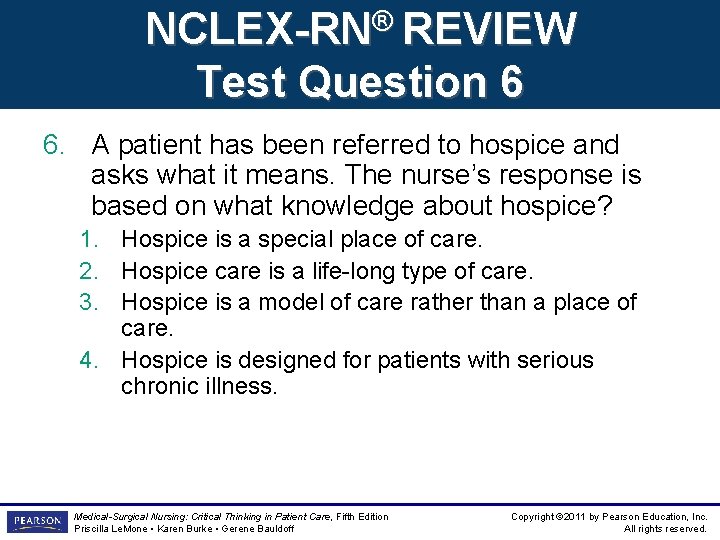
NCLEX-RN® REVIEW Test Question 6 6. A patient has been referred to hospice and asks what it means. The nurse’s response is based on what knowledge about hospice? 1. Hospice is a special place of care. 2. Hospice care is a life-long type of care. 3. Hospice is a model of care rather than a place of care. 4. Hospice is designed for patients with serious chronic illness. Medical-Surgical Nursing: Critical Thinking in Patient Care, Fifth Edition Priscilla Le. Mone • Karen Burke • Gerene Bauldoff Copyright © 2011 by Pearson Education, Inc. All rights reserved.
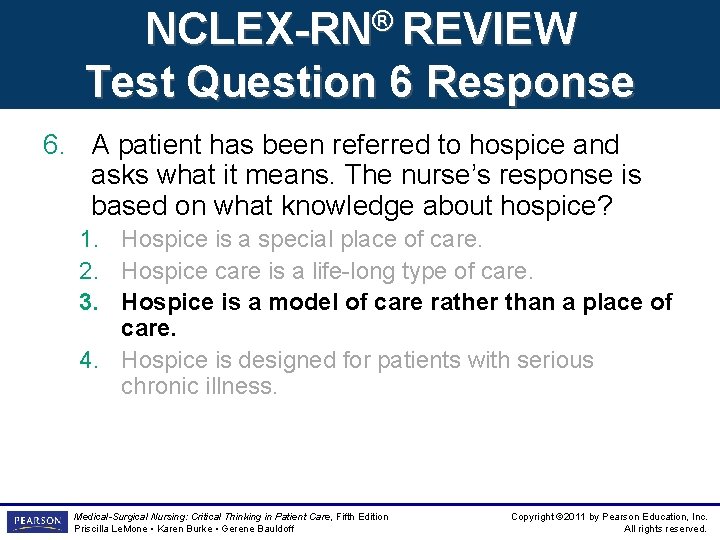
NCLEX-RN® REVIEW Test Question 6 Response 6. A patient has been referred to hospice and asks what it means. The nurse’s response is based on what knowledge about hospice? 1. Hospice is a special place of care. 2. Hospice care is a life-long type of care. 3. Hospice is a model of care rather than a place of care. 4. Hospice is designed for patients with serious chronic illness. Medical-Surgical Nursing: Critical Thinking in Patient Care, Fifth Edition Priscilla Le. Mone • Karen Burke • Gerene Bauldoff Copyright © 2011 by Pearson Education, Inc. All rights reserved.
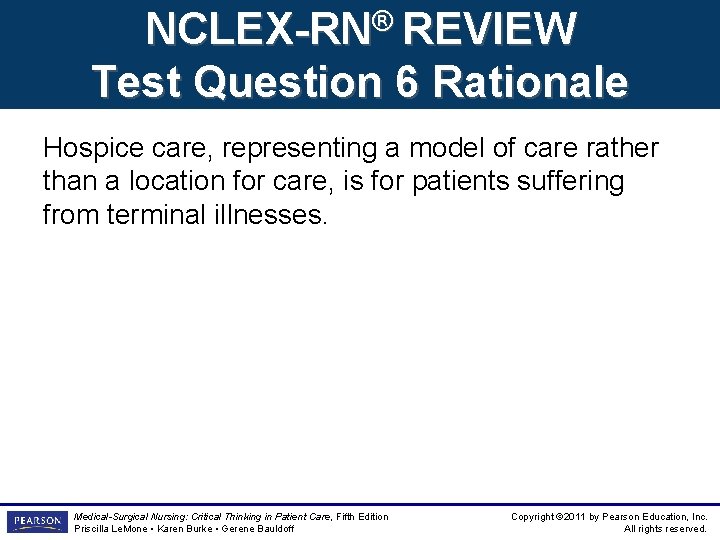
NCLEX-RN® REVIEW Test Question 6 Rationale Hospice care, representing a model of care rather than a location for care, is for patients suffering from terminal illnesses. Medical-Surgical Nursing: Critical Thinking in Patient Care, Fifth Edition Priscilla Le. Mone • Karen Burke • Gerene Bauldoff Copyright © 2011 by Pearson Education, Inc. All rights reserved.
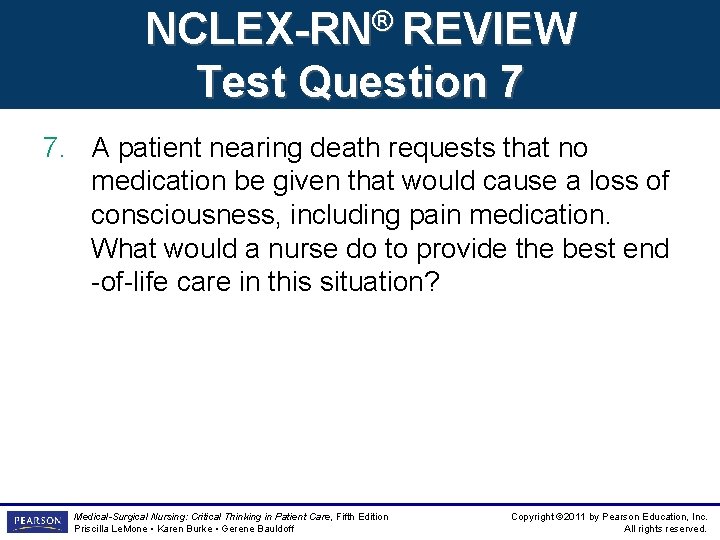
NCLEX-RN® REVIEW Test Question 7 7. A patient nearing death requests that no medication be given that would cause a loss of consciousness, including pain medication. What would a nurse do to provide the best end -of-life care in this situation? Medical-Surgical Nursing: Critical Thinking in Patient Care, Fifth Edition Priscilla Le. Mone • Karen Burke • Gerene Bauldoff Copyright © 2011 by Pearson Education, Inc. All rights reserved.
NCLEX-RN® REVIEW Test Question 7 Choices 1. Give the medication; comfort is the highest priority. 2. Give half the ordered dose to provide compassionate care. 3. Discuss this with family members and follow their wishes. 4. Respect the patient’s wishes and withhold pain medications. Medical-Surgical Nursing: Critical Thinking in Patient Care, Fifth Edition Priscilla Le. Mone • Karen Burke • Gerene Bauldoff Copyright © 2011 by Pearson Education, Inc. All rights reserved.
NCLEX-RN® REVIEW Test Question 7 Response 1. Give the medication; comfort is the highest priority. 2. Give half the ordered dose to provide compassionate care. 3. Discuss this with family members and follow their wishes. 4. Respect the patient’s wishes and withhold pain medications. Medical-Surgical Nursing: Critical Thinking in Patient Care, Fifth Edition Priscilla Le. Mone • Karen Burke • Gerene Bauldoff Copyright © 2011 by Pearson Education, Inc. All rights reserved.
NCLEX-RN® REVIEW Test Question 7 Rationale The nurse would respect the patient’s wishes and withhold pain medications. Medical-Surgical Nursing: Critical Thinking in Patient Care, Fifth Edition Priscilla Le. Mone • Karen Burke • Gerene Bauldoff Copyright © 2011 by Pearson Education, Inc. All rights reserved.
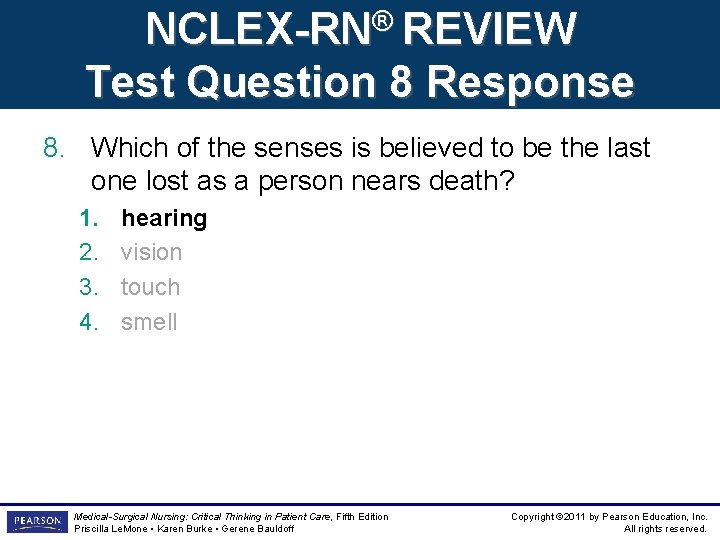
NCLEX-RN® REVIEW Test Question 8 8. Which of the senses is believed to be the last one lost as a person nears death? 1. 2. 3. 4. hearing vision touch smell Medical-Surgical Nursing: Critical Thinking in Patient Care, Fifth Edition Priscilla Le. Mone • Karen Burke • Gerene Bauldoff Copyright © 2011 by Pearson Education, Inc. All rights reserved.
NCLEX-RN® REVIEW Test Question 8 Response 8. Which of the senses is believed to be the last one lost as a person nears death? 1. 2. 3. 4. hearing vision touch smell Medical-Surgical Nursing: Critical Thinking in Patient Care, Fifth Edition Priscilla Le. Mone • Karen Burke • Gerene Bauldoff Copyright © 2011 by Pearson Education, Inc. All rights reserved.
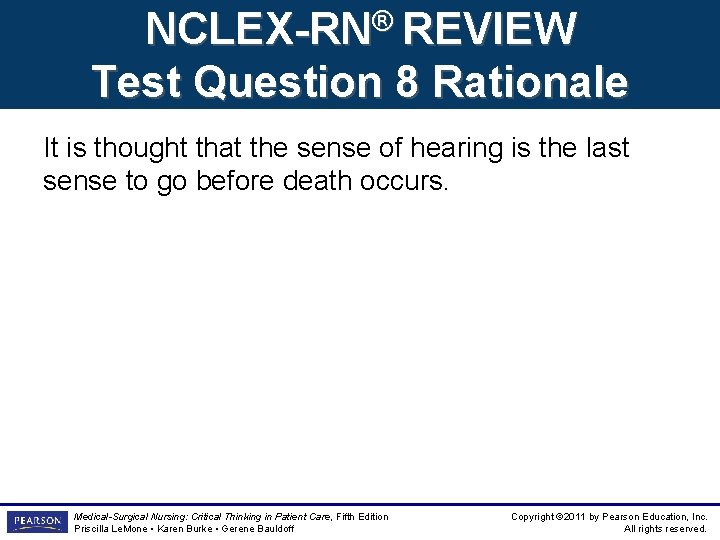
NCLEX-RN® REVIEW Test Question 8 Rationale It is thought that the sense of hearing is the last sense to go before death occurs. Medical-Surgical Nursing: Critical Thinking in Patient Care, Fifth Edition Priscilla Le. Mone • Karen Burke • Gerene Bauldoff Copyright © 2011 by Pearson Education, Inc. All rights reserved.
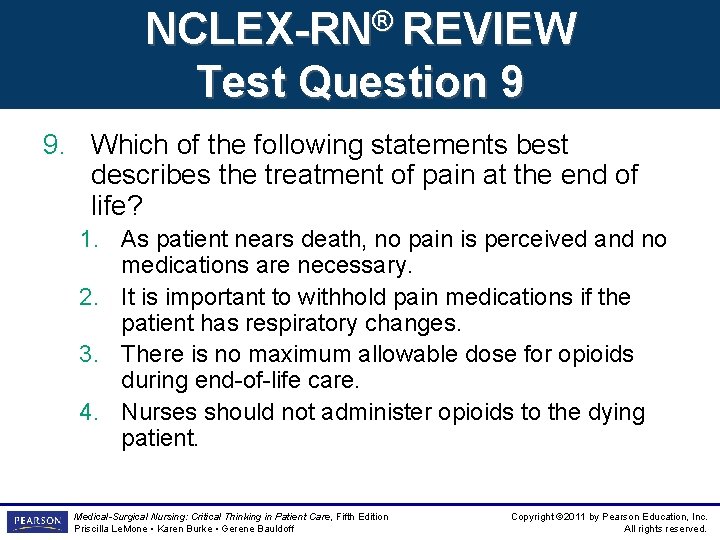
NCLEX-RN® REVIEW Test Question 9 9. Which of the following statements best describes the treatment of pain at the end of life? 1. As patient nears death, no pain is perceived and no medications are necessary. 2. It is important to withhold pain medications if the patient has respiratory changes. 3. There is no maximum allowable dose for opioids during end-of-life care. 4. Nurses should not administer opioids to the dying patient. Medical-Surgical Nursing: Critical Thinking in Patient Care, Fifth Edition Priscilla Le. Mone • Karen Burke • Gerene Bauldoff Copyright © 2011 by Pearson Education, Inc. All rights reserved.
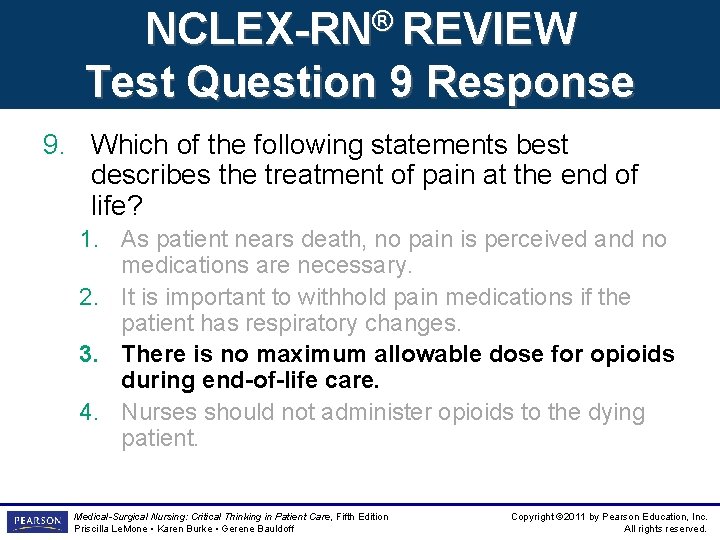
NCLEX-RN® REVIEW Test Question 9 Response 9. Which of the following statements best describes the treatment of pain at the end of life? 1. As patient nears death, no pain is perceived and no medications are necessary. 2. It is important to withhold pain medications if the patient has respiratory changes. 3. There is no maximum allowable dose for opioids during end-of-life care. 4. Nurses should not administer opioids to the dying patient. Medical-Surgical Nursing: Critical Thinking in Patient Care, Fifth Edition Priscilla Le. Mone • Karen Burke • Gerene Bauldoff Copyright © 2011 by Pearson Education, Inc. All rights reserved.
NCLEX-RN® REVIEW Test Question 9 Rationale It is important to continue to manage pain at all times of life, especially in end-of-life care. Medical-Surgical Nursing: Critical Thinking in Patient Care, Fifth Edition Priscilla Le. Mone • Karen Burke • Gerene Bauldoff Copyright © 2011 by Pearson Education, Inc. All rights reserved.
NCLEX-RN® REVIEW Test Question 10 10. A woman, recently widowed, tells the nurse, “I just can’t even get out of bed in the mornings anymore. ” What response by the nurse would be most helpful in resolving the patient’s grief? 1. 2. 3. 4. “I don’t know why you feel that way. ” “This must be a difficult time for you. ” “Why do you think you feel this way? ” “After you get up, you will feel better. ” Medical-Surgical Nursing: Critical Thinking in Patient Care, Fifth Edition Priscilla Le. Mone • Karen Burke • Gerene Bauldoff Copyright © 2011 by Pearson Education, Inc. All rights reserved.
NCLEX-RN® REVIEW Test Question 10 Response 10. A woman, recently widowed, tells the nurse, “I just can’t even get out of bed in the mornings anymore. ” What response by the nurse would be most helpful in resolving the patient’s grief? 1. 2. 3. 4. “I don’t know why you feel that way. ” “This must be a difficult time for you. ” “Why do you think you feel this way? ” “After you get up, you will feel better. ” Medical-Surgical Nursing: Critical Thinking in Patient Care, Fifth Edition Priscilla Le. Mone • Karen Burke • Gerene Bauldoff Copyright © 2011 by Pearson Education, Inc. All rights reserved.
NCLEX-RN® REVIEW Test Question 10 Rationale The open-ended statement of acknowledging to the woman “This must be a difficult time for you” provides an opportunity for her to express her feelings as she recognizes the nurse’s willingness to listen. Medical-Surgical Nursing: Critical Thinking in Patient Care, Fifth Edition Priscilla Le. Mone • Karen Burke • Gerene Bauldoff Copyright © 2011 by Pearson Education, Inc. All rights reserved.
Lecture Note Presentation Medical-Surgical Nursing: Critical Thinking in Patient Care, Fifth Edition Priscilla Le. Mone • Karen Burke • Gerene Bauldoff Copyright © 2011 by Pearson Education, Inc. All rights reserved.
Learning Outcome 1 • Compare and contrast theories of loss and grief. Medical-Surgical Nursing: Critical Thinking in Patient Care, Fifth Edition Priscilla Le. Mone • Karen Burke • Gerene Bauldoff Copyright © 2011 by Pearson Education, Inc. All rights reserved.
Freud’s Psychoanalytic Theory • Grief • Gradually withdraw attachment Medical-Surgical Nursing: Critical Thinking in Patient Care, Fifth Edition Priscilla Le. Mone • Karen Burke • Gerene Bauldoff Copyright © 2011 by Pearson Education, Inc. All rights reserved.
Bowlby’s Attachment Theory • Grief process • 3 Phases: – Protest – Despair – Detachment Medical-Surgical Nursing: Critical Thinking in Patient Care, Fifth Edition Priscilla Le. Mone • Karen Burke • Gerene Bauldoff Copyright © 2011 by Pearson Education, Inc. All rights reserved.
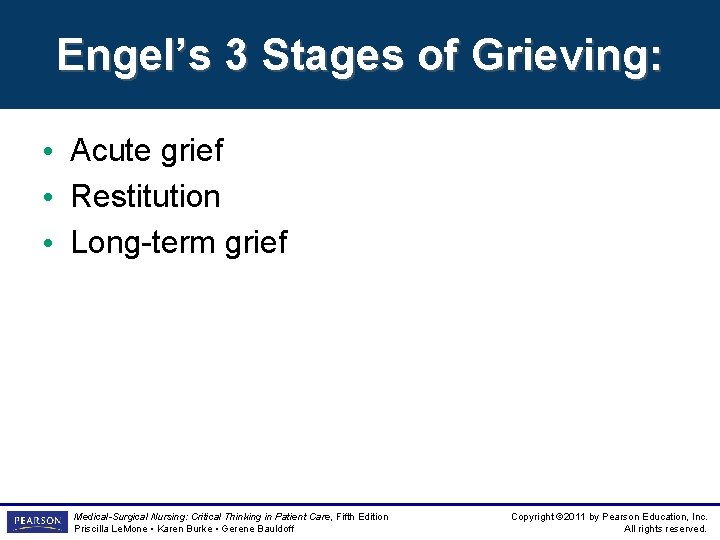
Engel’s 3 Stages of Grieving: • Acute grief • Restitution • Long-term grief Medical-Surgical Nursing: Critical Thinking in Patient Care, Fifth Edition Priscilla Le. Mone • Karen Burke • Gerene Bauldoff Copyright © 2011 by Pearson Education, Inc. All rights reserved.
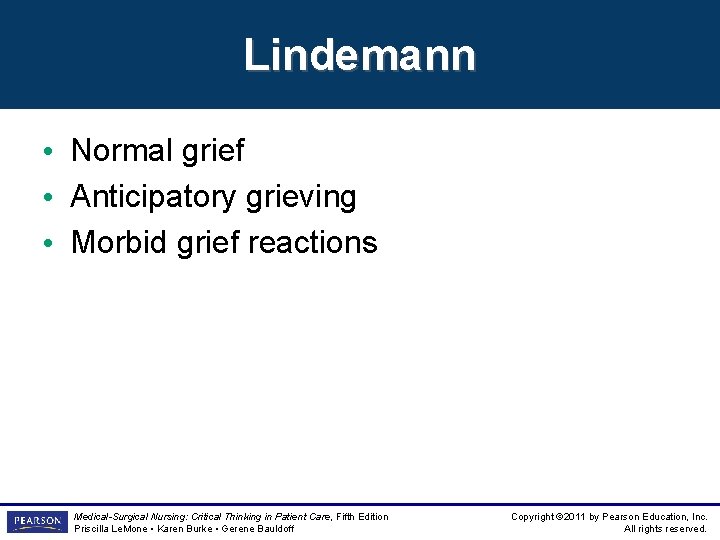
Lindemann • Normal grief • Anticipatory grieving • Morbid grief reactions Medical-Surgical Nursing: Critical Thinking in Patient Care, Fifth Edition Priscilla Le. Mone • Karen Burke • Gerene Bauldoff Copyright © 2011 by Pearson Education, Inc. All rights reserved.
Caplan • Focus expanded beyond bereavement • Other episodes of stress Medical-Surgical Nursing: Critical Thinking in Patient Care, Fifth Edition Priscilla Le. Mone • Karen Burke • Gerene Bauldoff Copyright © 2011 by Pearson Education, Inc. All rights reserved.
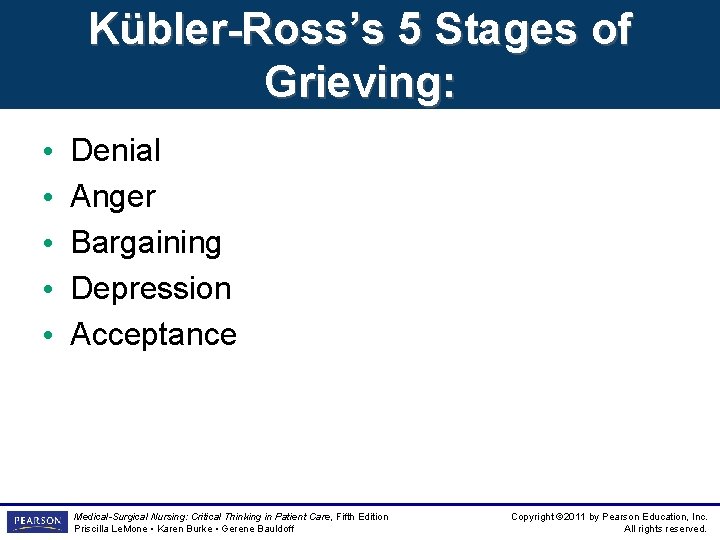
Kübler-Ross’s 5 Stages of Grieving: • • • Denial Anger Bargaining Depression Acceptance Medical-Surgical Nursing: Critical Thinking in Patient Care, Fifth Edition Priscilla Le. Mone • Karen Burke • Gerene Bauldoff Copyright © 2011 by Pearson Education, Inc. All rights reserved.
Learning Outcome 2 • Explain factors affecting responses to loss. Medical-Surgical Nursing: Critical Thinking in Patient Care, Fifth Edition Priscilla Le. Mone • Karen Burke • Gerene Bauldoff Copyright © 2011 by Pearson Education, Inc. All rights reserved.
Factors Affecting Responses to Loss • • • Age Social support Family Culture and spiritual practices Rituals of mourning Medical-Surgical Nursing: Critical Thinking in Patient Care, Fifth Edition Priscilla Le. Mone • Karen Burke • Gerene Bauldoff Copyright © 2011 by Pearson Education, Inc. All rights reserved.
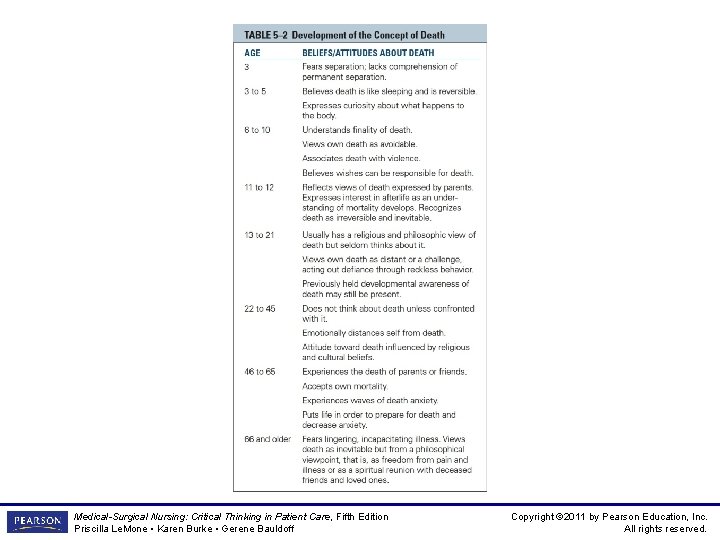
TABLE 5– 2 Development of the Concept of Death Medical-Surgical Nursing: Critical Thinking in Patient Care, Fifth Edition Priscilla Le. Mone • Karen Burke • Gerene Bauldoff Copyright © 2011 by Pearson Education, Inc. All rights reserved.
Social Support Factors • Social support factors can interfere with successful grieving: – Perceived inability to share loss – Lack of social recognition of the loss – Ambivalent relationships prior to the loss – Traumatic circumstances of the loss Medical-Surgical Nursing: Critical Thinking in Patient Care, Fifth Edition Priscilla Le. Mone • Karen Burke • Gerene Bauldoff Copyright © 2011 by Pearson Education, Inc. All rights reserved.
Social Support Factors • Families and the grieving process – Positive impact – Negative impact Medical-Surgical Nursing: Critical Thinking in Patient Care, Fifth Edition Priscilla Le. Mone • Karen Burke • Gerene Bauldoff Copyright © 2011 by Pearson Education, Inc. All rights reserved.
Cultural and Spiritual Beliefs • • • Spirituality and death Question meaning of life Relieve spiritual distress Rituals of mourning celebrate: Progression Loss Medical-Surgical Nursing: Critical Thinking in Patient Care, Fifth Edition Priscilla Le. Mone • Karen Burke • Gerene Bauldoff Copyright © 2011 by Pearson Education, Inc. All rights reserved.
Learning Outcome 3 • Explain the physiologic basis for manifestations associated with the end of life. Medical-Surgical Nursing: Critical Thinking in Patient Care, Fifth Edition Priscilla Le. Mone • Karen Burke • Gerene Bauldoff Copyright © 2011 by Pearson Education, Inc. All rights reserved.
Pain • Subjective experience • Role of nurse Medical-Surgical Nursing: Critical Thinking in Patient Care, Fifth Edition Priscilla Le. Mone • Karen Burke • Gerene Bauldoff Copyright © 2011 by Pearson Education, Inc. All rights reserved.
Symptoms of Dyspnea • Feelings of suffocations • Shortness of breath • Tightness in the chest Medical-Surgical Nursing: Critical Thinking in Patient Care, Fifth Edition Priscilla Le. Mone • Karen Burke • Gerene Bauldoff Copyright © 2011 by Pearson Education, Inc. All rights reserved.
Anorexia • Protective mechanism: ketosis Medical-Surgical Nursing: Critical Thinking in Patient Care, Fifth Edition Priscilla Le. Mone • Karen Burke • Gerene Bauldoff Copyright © 2011 by Pearson Education, Inc. All rights reserved.
Causes of Nausea • Reduced gastric emptying • Constipation • Bowel obstruction Medical-Surgical Nursing: Critical Thinking in Patient Care, Fifth Edition Priscilla Le. Mone • Karen Burke • Gerene Bauldoff Copyright © 2011 by Pearson Education, Inc. All rights reserved.
Causes of Altered Levels of Consciousness • • Decreased cerebral perfusion Hypoxemia Metabolic acidosis Sepsis Accumulation of toxins Medications Disease-related factors Medical-Surgical Nursing: Critical Thinking in Patient Care, Fifth Edition Priscilla Le. Mone • Karen Burke • Gerene Bauldoff Copyright © 2011 by Pearson Education, Inc. All rights reserved.
Hypotension • Cardiac output and intravascular blood volume decrease • Blood pressure decreases • Pulse rapid and irregular Medical-Surgical Nursing: Critical Thinking in Patient Care, Fifth Edition Priscilla Le. Mone • Karen Burke • Gerene Bauldoff Copyright © 2011 by Pearson Education, Inc. All rights reserved.
Learning Outcome 4 • Discuss legal and ethical issues in end-oflife care. Medical-Surgical Nursing: Critical Thinking in Patient Care, Fifth Edition Priscilla Le. Mone • Karen Burke • Gerene Bauldoff Copyright © 2011 by Pearson Education, Inc. All rights reserved.
The Nurse’s Role in End-of-Life Care: • Ensure peaceful death • AACN competencies Medical-Surgical Nursing: Critical Thinking in Patient Care, Fifth Edition Priscilla Le. Mone • Karen Burke • Gerene Bauldoff Copyright © 2011 by Pearson Education, Inc. All rights reserved.
The Dying Person’s Bill of Rights: • Care for sensitive people • Attempt to understand needs • Satisfaction in helping at end of life Medical-Surgical Nursing: Critical Thinking in Patient Care, Fifth Edition Priscilla Le. Mone • Karen Burke • Gerene Bauldoff Copyright © 2011 by Pearson Education, Inc. All rights reserved.
Types of Advance Directives: • Living will • Health care surrogate • Durable power of attorney Medical-Surgical Nursing: Critical Thinking in Patient Care, Fifth Edition Priscilla Le. Mone • Karen Burke • Gerene Bauldoff Copyright © 2011 by Pearson Education, Inc. All rights reserved.
DNR Orders • Written by physician • Based on patient and family’s wishes Medical-Surgical Nursing: Critical Thinking in Patient Care, Fifth Edition Priscilla Le. Mone • Karen Burke • Gerene Bauldoff Copyright © 2011 by Pearson Education, Inc. All rights reserved.
Euthanasia • No DNR order exists • Nurses at center of debate Medical-Surgical Nursing: Critical Thinking in Patient Care, Fifth Edition Priscilla Le. Mone • Karen Burke • Gerene Bauldoff Copyright © 2011 by Pearson Education, Inc. All rights reserved.
Learning Outcome 5 • Describe the philosophy and activities of hospice and palliative care. Medical-Surgical Nursing: Critical Thinking in Patient Care, Fifth Edition Priscilla Le. Mone • Karen Burke • Gerene Bauldoff Copyright © 2011 by Pearson Education, Inc. All rights reserved.
Hospice • Philosophy rather than program • Death with comfort and dignity • Care, not cure Medical-Surgical Nursing: Critical Thinking in Patient Care, Fifth Edition Priscilla Le. Mone • Karen Burke • Gerene Bauldoff Copyright © 2011 by Pearson Education, Inc. All rights reserved.
Hospice Care: • Patients with 6 months or less to live • Variety of settings • 1 year of bereavement care Medical-Surgical Nursing: Critical Thinking in Patient Care, Fifth Edition Priscilla Le. Mone • Karen Burke • Gerene Bauldoff Copyright © 2011 by Pearson Education, Inc. All rights reserved.
Palliative Care: • Patients with incurable illnesses • Prevent and relieve suffering • Used earlier in disease experience than hospice care • All types of health care settings Medical-Surgical Nursing: Critical Thinking in Patient Care, Fifth Edition Priscilla Le. Mone • Karen Burke • Gerene Bauldoff Copyright © 2011 by Pearson Education, Inc. All rights reserved.