MCPS Systemwide Safety Programs Department of Facilities Management

- Slides: 38
MCPS Systemwide Safety Programs Department of Facilities Management Building Service Managers’ Presentation November 21, 2014
Systemwide Safety Programs Staff Peter Park, Team Leader Peter_Park@mcpsmd. org Laurie Lyons, Program Technician Laurie_E_Lyons@mcpsmd. org Office: 240 -314 -1070 Emergencies: 301 -370 -2141 www. montgomeryschoolsmd. org/departments/facilities/safety/in dex. aspx
Systemwide Safety Programs Mission Help establish and maintain a safe, healthful learning and working environment for students, staff, contractors, and visitors.
Systemwide Safety Programs Major Functions Guidance/direction to facilities, offices, departments Oversight of student and employee safety programs Compliance with safety and health regulations Safety training Hazard evaluation, accident investigation Playground renovation
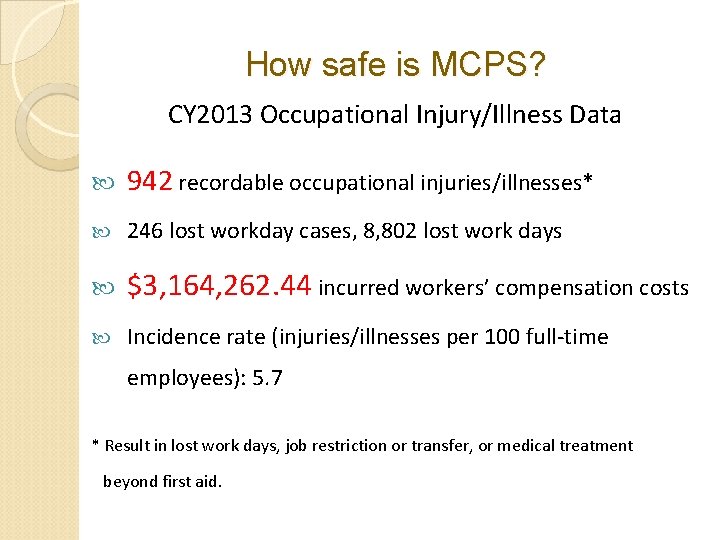
How safe is MCPS? CY 2013 Occupational Injury/Illness Data 942 recordable occupational injuries/illnesses* 246 lost workday cases, 8, 802 lost work days $3, 164, 262. 44 incurred workers’ compensation costs Incidence rate (injuries/illnesses per 100 full-time employees): 5. 7 * Result in lost work days, job restriction or transfer, or medical treatment beyond first aid.
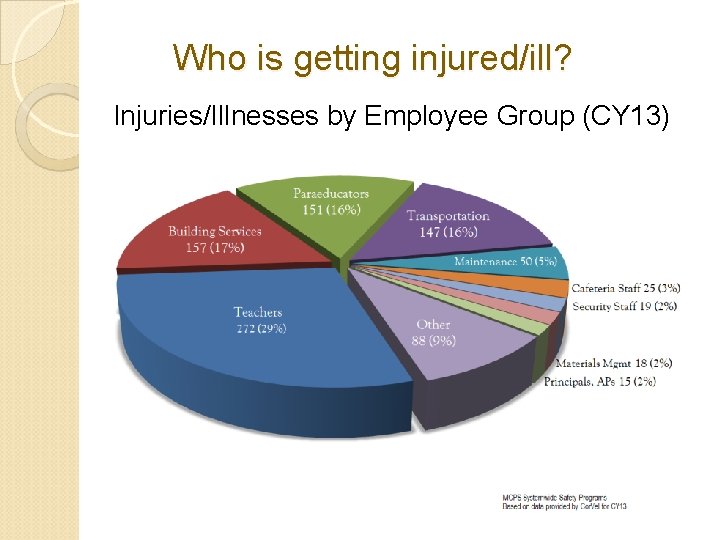
Who is getting injured/ill? Injuries/Illnesses by Employee Group (CY 13)
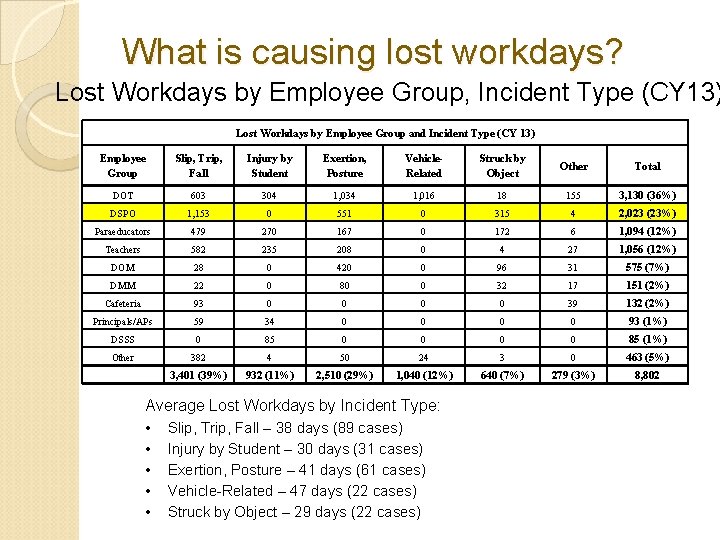
What is causing lost workdays? Lost Workdays by Employee Group, Incident Type (CY 13) Lost Workdays by Employee Group and Incident Type (CY 13) Employee Group Slip, Trip, Fall Injury by Student Exertion, Posture Vehicle. Related Struck by Object Other Total DOT 603 304 1, 034 1, 016 18 155 3, 130 (36%) DSPO 1, 153 0 551 0 315 4 2, 023 (23%) Paraeducators 479 270 167 0 172 6 1, 094 (12%) Teachers 582 235 208 0 4 27 1, 056 (12%) DOM 28 0 420 0 96 31 575 (7%) DMM 22 0 80 0 32 17 151 (2%) Cafeteria 93 0 0 39 132 (2%) Principals/APs 59 34 0 0 93 (1%) DSSS 0 85 0 0 85 (1%) Other 382 4 50 24 3 0 463 (5%) 3, 401 (39%) 932 (11%) 2, 510 (29%) 1, 040 (12%) 640 (7%) 279 (3%) 8, 802 Average Lost Workdays by Incident Type: • Slip, Trip, Fall – 38 days (89 cases) • Injury by Student – 30 days (31 cases) • Exertion, Posture – 41 days (61 cases) • Vehicle-Related – 47 days (22 cases) • Struck by Object – 29 days (22 cases)
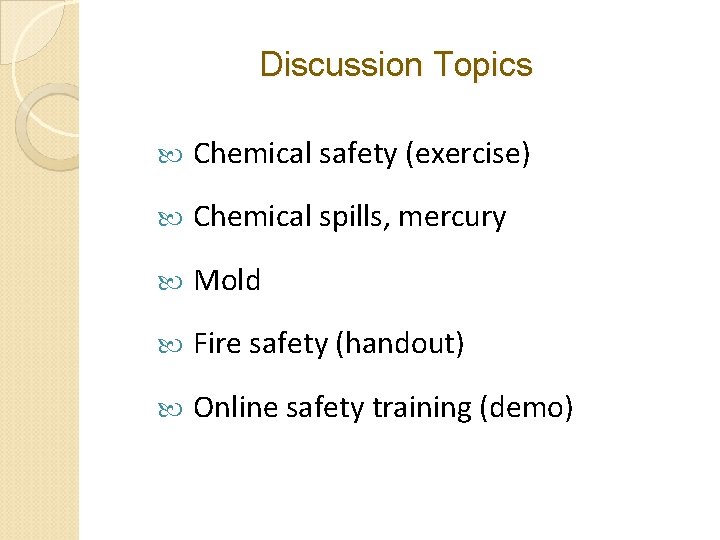
Discussion Topics Chemical safety (exercise) Chemical spills, mercury Mold Fire safety (handout) Online safety training (demo)
Hazardous Chemicals 2 Questions 1. Do MCPS schools have hazardous chemicals? 2. Do you use hazardous chemicals at work?
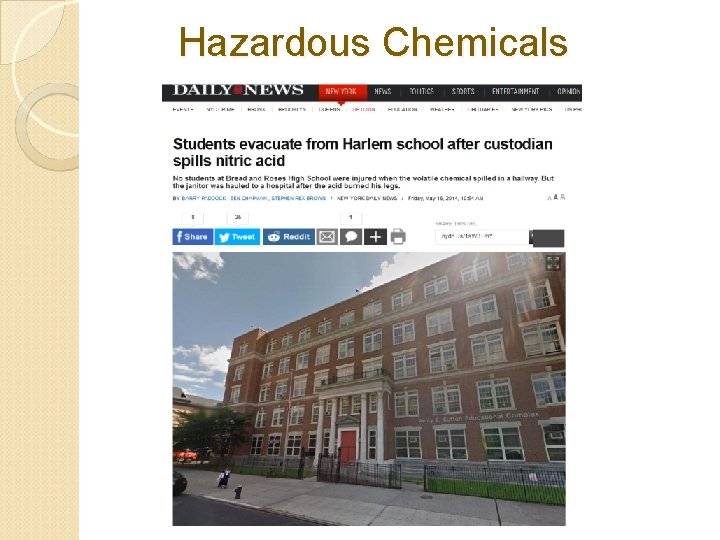
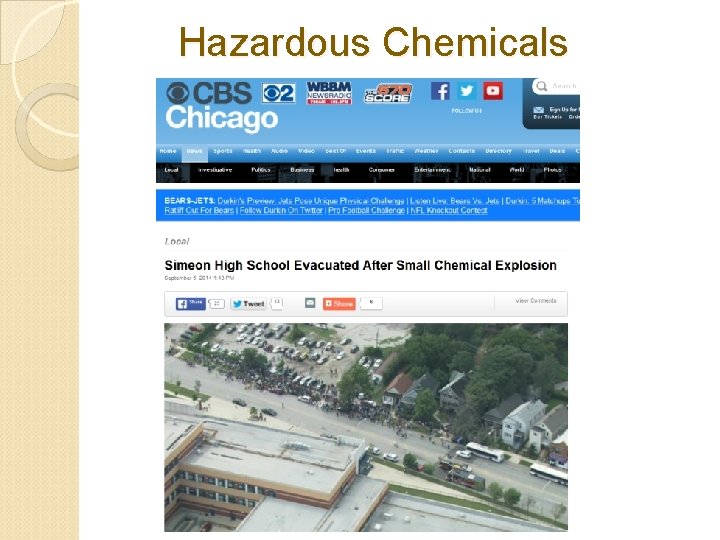
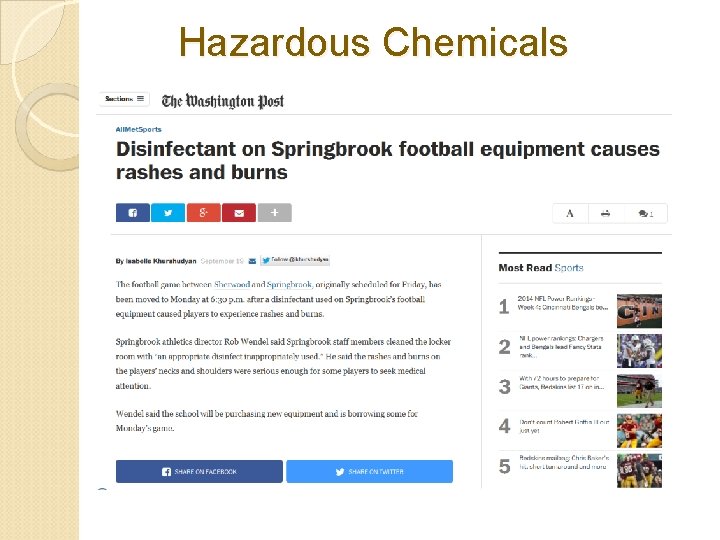
Hazardous Chemicals What makes chemicals “hazardous”? The chemical is a: Physical hazard (gasoline, hand sanitizer) Health hazard (bleach, cleaning chemicals, wood dust) Simple asphyxiant (refrigerants) Combustible dust (wood dust) Pyrophoric gas, or hazard not otherwise classified
Hazardous Chemicals
Hazardous Chemicals
Hazardous Chemicals
Hazardous Chemicals
Hazardous Chemicals
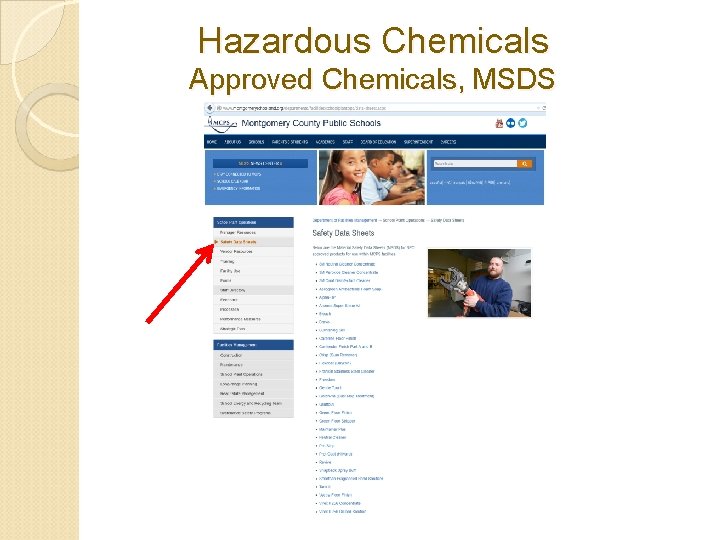
Hazardous Chemicals Approved Chemicals, MSDS
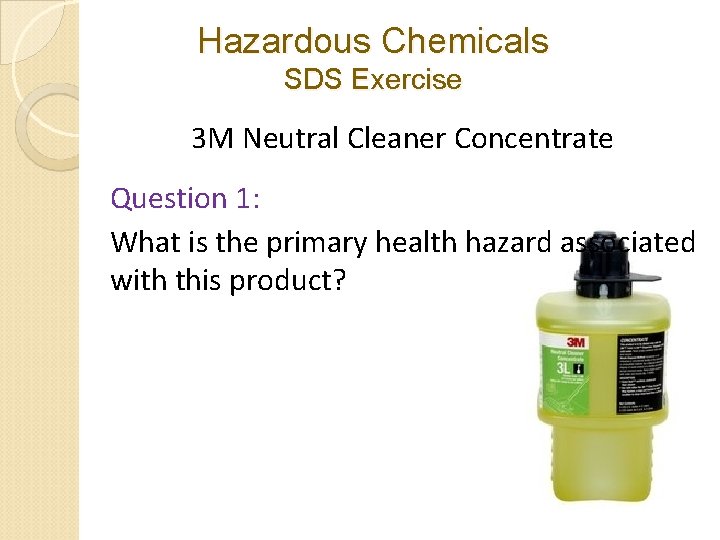
Hazardous Chemicals SDS Exercise 3 M Neutral Cleaner Concentrate Question 1: What is the primary health hazard associated with this product?
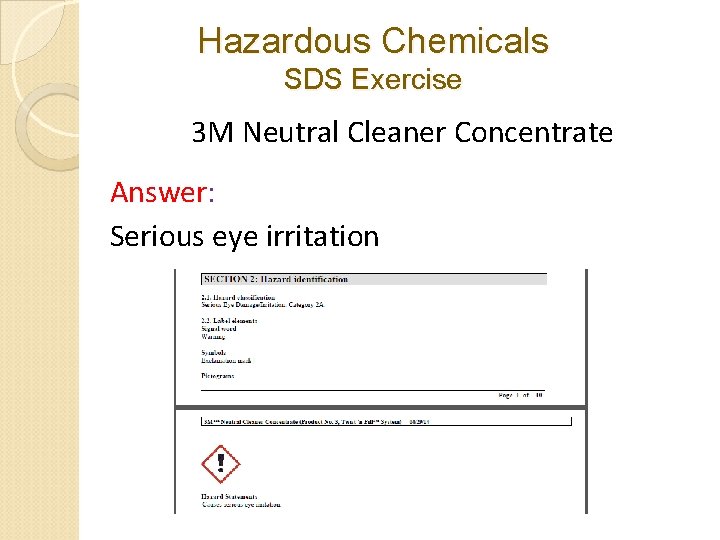
Hazardous Chemicals SDS Exercise 3 M Neutral Cleaner Concentrate Answer: Serious eye irritation
Hazardous Chemicals SDS Exercise 3 M Neutral Cleaner Concentrate Question 2: What other health hazards might result from exposure to this product?
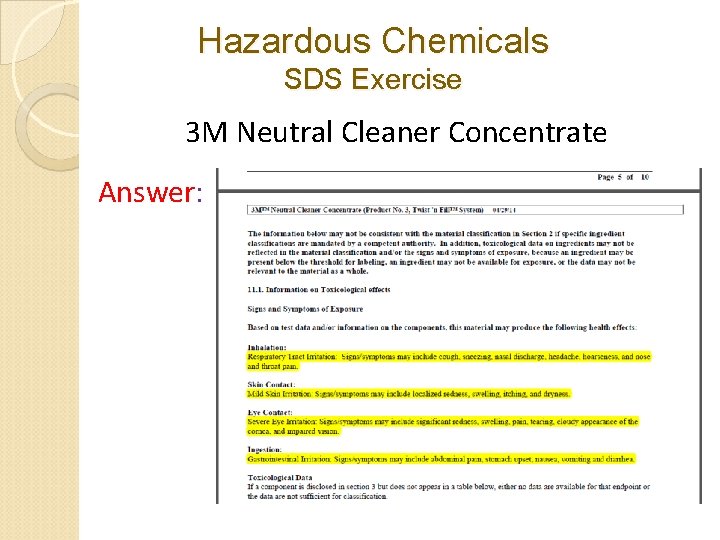
Hazardous Chemicals SDS Exercise 3 M Neutral Cleaner Concentrate Answer:
Hazardous Chemicals SDS Exercise 3 M Neutral Cleaner Concentrate Question 3: Is this product flammable?
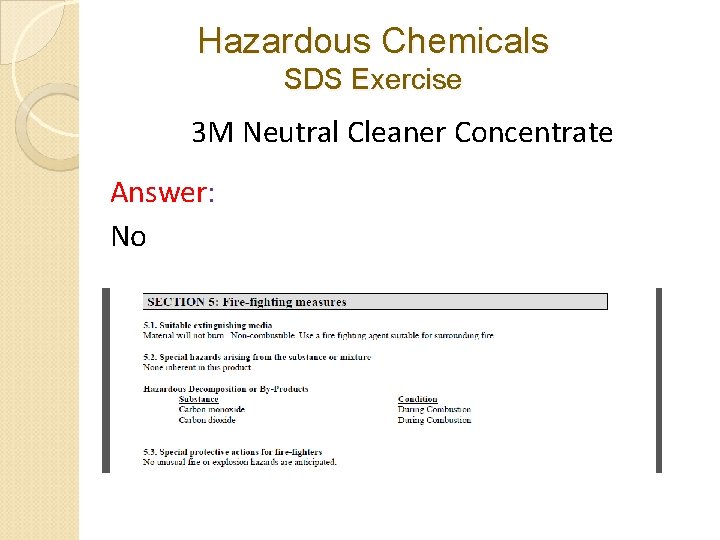
Hazardous Chemicals SDS Exercise 3 M Neutral Cleaner Concentrate Answer: No
Hazardous Chemicals SDS Exercise 3 M Neutral Cleaner Concentrate Question 4: What chemicals should you keep from contacting this product?
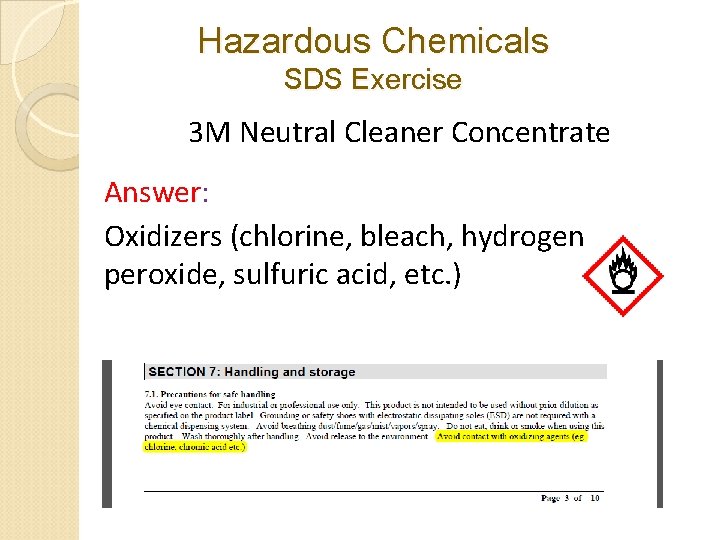
Hazardous Chemicals SDS Exercise 3 M Neutral Cleaner Concentrate Answer: Oxidizers (chlorine, bleach, hydrogen peroxide, sulfuric acid, etc. )
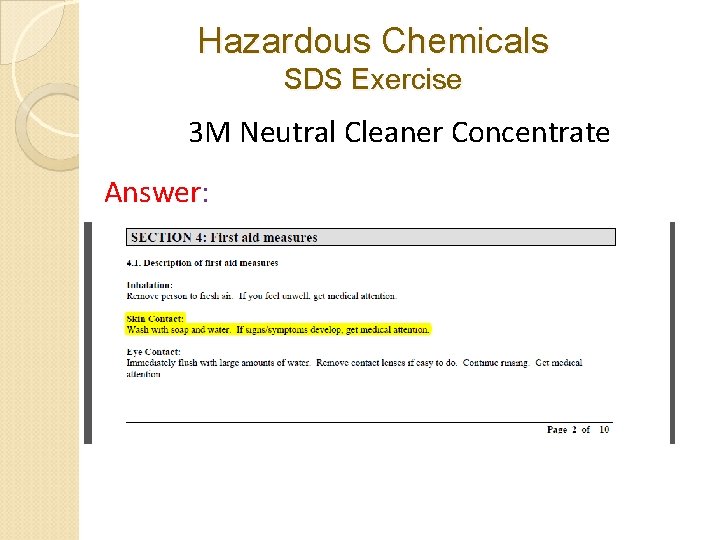
Hazardous Chemicals SDS Exercise 3 M Neutral Cleaner Concentrate Question 5: What does the manufacturer recommend in case of skin contact (first aid)?
Hazardous Chemicals SDS Exercise 3 M Neutral Cleaner Concentrate Answer:
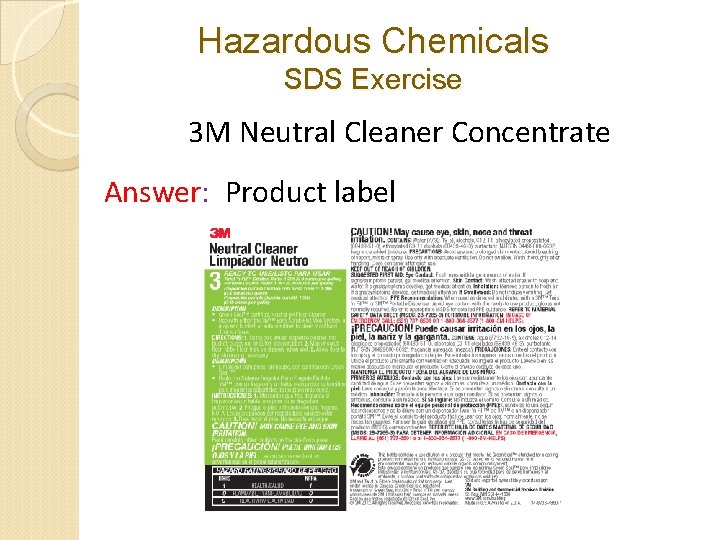
Hazardous Chemicals SDS Exercise 3 M Neutral Cleaner Concentrate Question 6: What can you use, in addition to the MSDS, to find safety and health information about this product?
Hazardous Chemicals SDS Exercise 3 M Neutral Cleaner Concentrate Answer: Product label
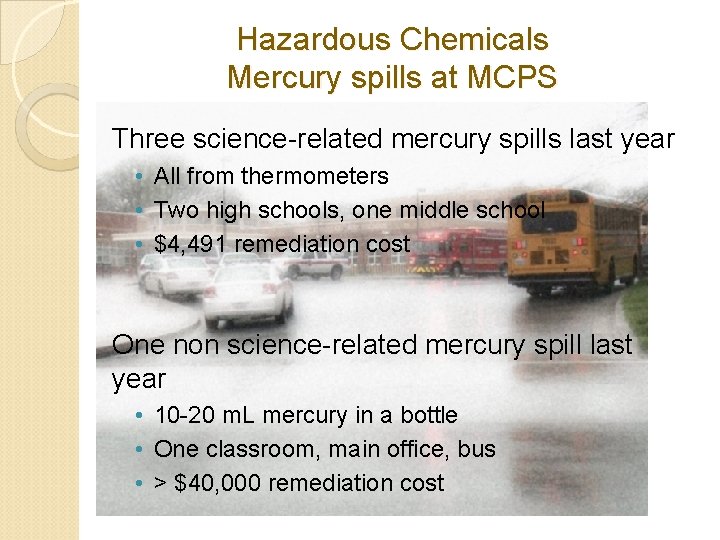
Hazardous Chemicals Mercury spills at MCPS Three science-related mercury spills last year • All from thermometers • Two high schools, one middle school • $4, 491 remediation cost One non science-related mercury spill last year • 10 -20 m. L mercury in a bottle • One classroom, main office, bus • > $40, 000 remediation cost
Hazardous Chemicals How do we manage mercury spills? Open windows and turn off HVAC, if feasible Evacuate the room or immediate area Isolate affected location(s) Contact SSP (240 -314 -1070; 301 -370 -2141) or ES/IAQ (301 -926 -4409) immediately Sequester potentially contaminated materials and occupants in nearby hall or room Implement Shelter In Place, if needed Do not attempt to clean the spill
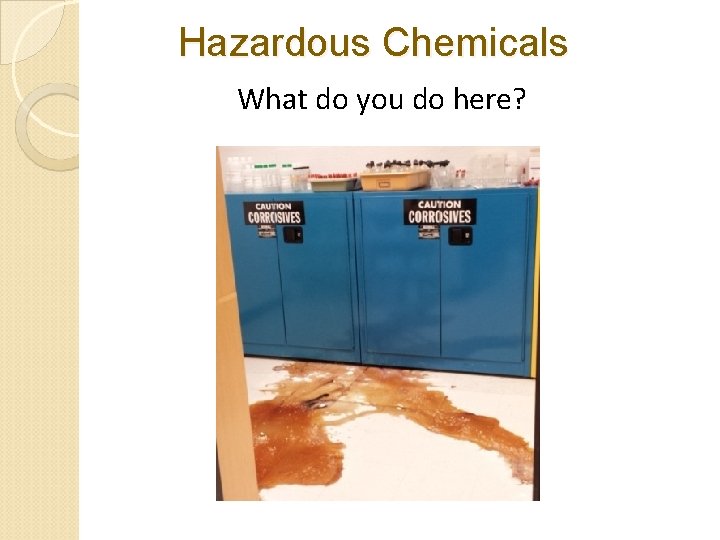
Hazardous Chemicals What do you do here?
Hazardous Chemicals Tips 1. Complete required safety training 2. Only use MCPS-approved products 3. Keep MSDSs at the school 4. Follow directions on labels and MSDSs – Do not use chemicals in ways they are not intended to be used 5. Never mix chemicals! 6. Use proper procedures, equipment, PPE 7. Ask for help, give help
Mold Main Causes Uncontrolled water Ventilation equipment problems Improperation of ventilation equipment, chiller Weather conditions Carpet cleaning (wet methods)
Mold Responsibilities: Building Services Maintain ventilation equipment Monitor operating condition of units Report mechanical problems to Division of Maintenance Replace air filters, as needed Ensure proper thermostat settings
Mold Responsibilities: Building Services Minimize probability for moisture problems Ensure roof drains, condensate drains clear Dry carpets rapidly after shampooing (within 24 hours) – get dehumidifiers from IAQ Report problems to IAQ (301 -926 -4409)
Fire Safety Common fire code violations (handout)* Additional info at: http: //www. montgomeryschoolsmd. org/departments/facilities/safet y/firesafety. aspx * Downloadable at: http: //www. montgomeryschoolsmd. org/uploaded. Files/departments/fac ilities/safety/031014%20 SPO%20 Newsletter%20 -%20 SSP(1). pdf
Online Safety Training Required training for building services (upon hire): Bloodborne Pathogen – Full Course Ladder Safety Personal Protective Equipment (PPE) Hazard Communication: Right to Understand Safety Data Sheets: Globally Harmonized System (GHS) Required training for building services (annually): Bloodborne Pathogen – Annual Refresher Demonstration, handout* *Downloadable at: http: //www. montgomeryschoolsmd. org/uploaded. Files/departments/facilities/safety/Onlin e%20 Safety%20 Training%20 Tutorial. pdf
Questions?