Maximal Flavor Violation Arvind Rajaraman University of California




- Slides: 30
Maximal Flavor Violation Arvind Rajaraman University of California, Irvine based on work in: 1. ar. Xiv/0711. 3193 AR & Shaouly Bar-Shalom 2. ar. Xiv/0803. 3795 AR, Daniel Whiteson, Felix Yu & Shaouly Bar-Shalom
The “New Physics Flavor puzzle” & MFV The hierarchy problem, dark matter, unification, EWSB … The SM is incomplete – need new physics at Te. V scale Þ The NP favor puzzle: given new particles at the Te. V scale, why does the NP not induce LARGE flavor violating dynamics? Traditional solutions: 1. M(new particles) > 10 -100 Te. V (somewhat in conflict with e. g. , the hierarchy problem, dark matter) 2. Impose FV(new particles) very small; e. g. use MFV ansatz.
MFV (Minimal Flavor Violation) All flavor violation is “aligned” with the SM i. e. all sources for FV are governed solely by the SM’s Yukawa interactions and are hence proportional to the small off-diagonal CKM elements (Ambrosio, Giudice, Isidori, Strumia (NPB 645, 2002) )
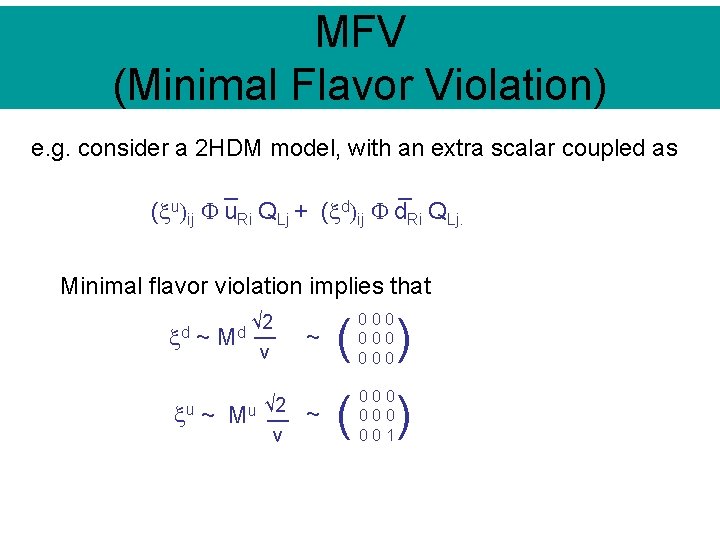
MFV (Minimal Flavor Violation) e. g. consider a 2 HDM model, with an extra scalar coupled as _ _ (xu)ij F u. Ri QLj + (xd)ij F d. Ri QLj. Minimal flavor violation implies that xd xu ~ ~ Md √ 2 __ v Mu √ 2 __ v ~ ( ) 000 000 000 001
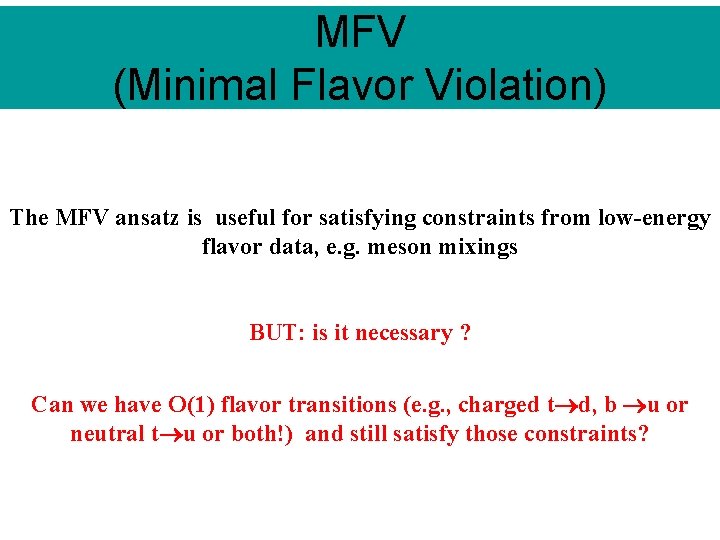
MFV (Minimal Flavor Violation) The MFV ansatz is useful for satisfying constraints from low-energy flavor data, e. g. meson mixings BUT: is it necessary ? Can we have O(1) flavor transitions (e. g. , charged t d, b u or neutral t u or both!) and still satisfy those constraints?
Motivation - Why go beyond MFV • MFV only an ansatz; has not been tested so far except in low-energy FCNC • Should look for all possibilities; may help in constructing models extending the SM • Most important; we may overlook/miss important signals at colliders which are not predicted by MFV models …
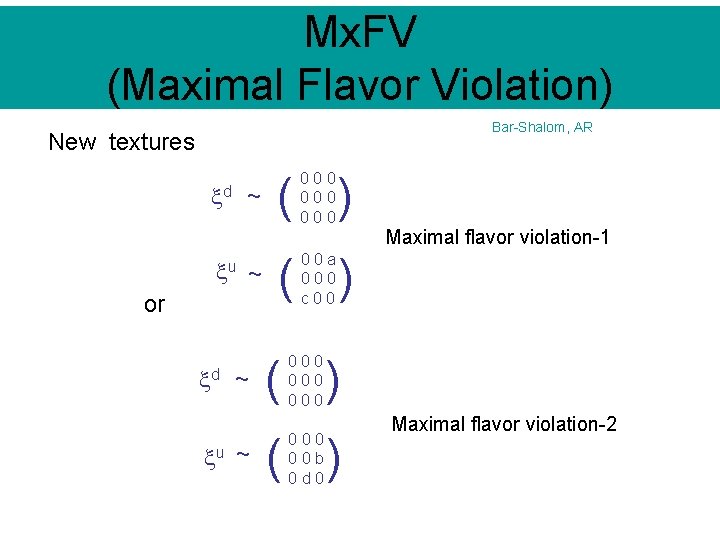
Mx. FV (Maximal Flavor Violation) Bar-Shalom, AR New textures xd ~ xu ~ or xd xu ~ ~ ( ) 000 000 Maximal flavor violation-1 ( ) 00 a 000 c 00 ( ) 000 000 ( ) 000 00 b 0 d 0 Maximal flavor violation-2
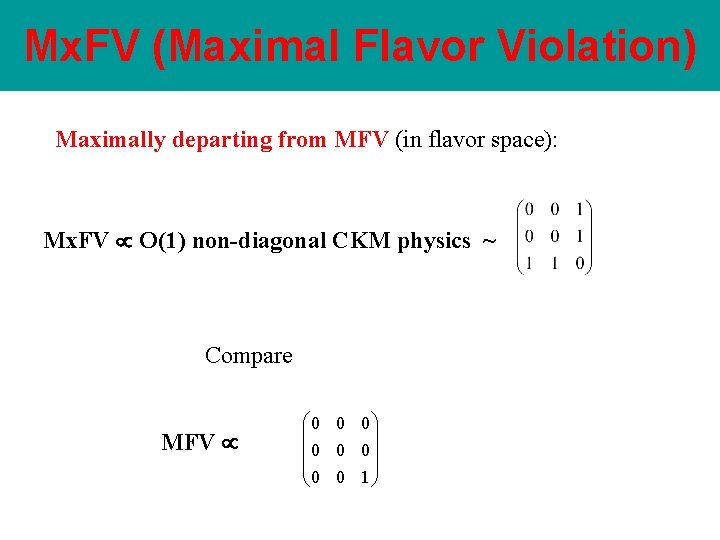
Mx. FV (Maximal Flavor Violation) Maximally departing from MFV (in flavor space): Mx. FV O(1) non-diagonal CKM physics ~ Compare MFV æ 0 0 0ö ç ÷ ç 0 0 0÷ ç 0 0 1÷ è ø
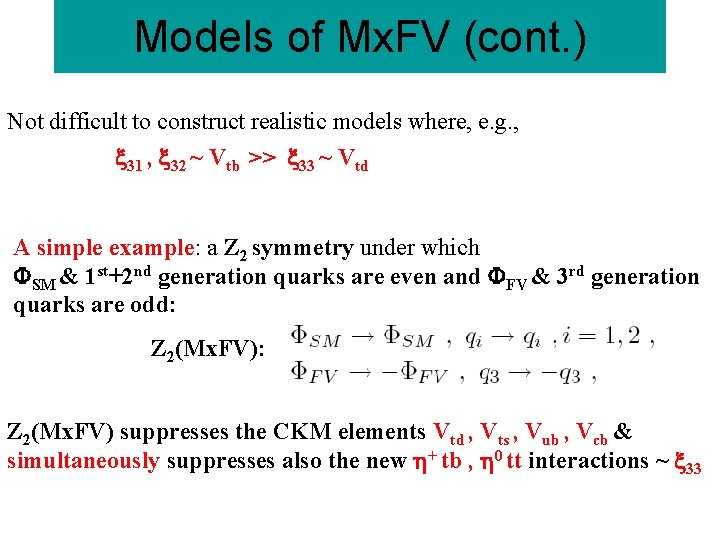
Models of Mx. FV (cont. ) Not difficult to construct realistic models where, e. g. , 31 , 32 ~ Vtb >> 33 ~ Vtd A simple example: a Z 2 symmetry under which SM & 1 st+2 nd generation quarks are even and FV & 3 rd generation quarks are odd: Z 2(Mx. FV) suppresses the CKM elements Vtd , Vts , Vub , Vcb & simultaneously suppresses also the new + tb , 0 tt interactions ~ 33
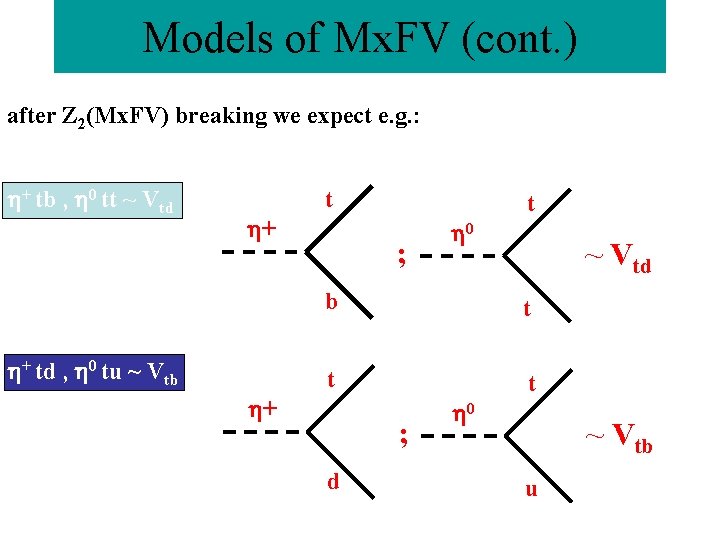
Models of Mx. FV (cont. ) IF Z 2(Mx. FV) is exact then: & with ij ~ Vij ~ O(1) When Z 2(Mx. FV) is weakly broken (as we expect it to be e. g. , by a very small FV condensate or by higher dimensional operators) then a very small value for the CKM elements Vtd , Vts , Vub , Vcb as well as for all zero entries in are generated. We thus expect (after Z 2(Mx. FV) breaking): e. g. 33 ~ Vtd , Vts while maintaining 31 , 32 ~ Vtb ~ O(1)
Models of Mx. FV (cont. ) after Z 2(Mx. FV) breaking we expect e. g. : + td , 0 tu ~ Vtb + tb , 0 tt ~ Vtd t + + td , 0 tu ~ Vtb t ; 0 ~ Vtd b t t t + ; d 0 ~ Vtb u
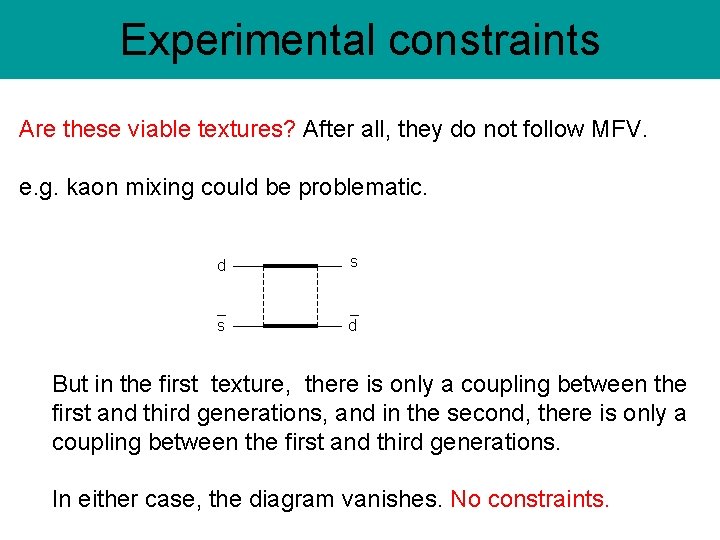
Experimental constraints Are these viable textures? After all, they do not follow MFV. e. g. kaon mixing could be problematic. d s _ d But in the first texture, there is only a coupling between the first and third generations, and in the second, there is only a coupling between the first and third generations. In either case, the diagram vanishes. No constraints.
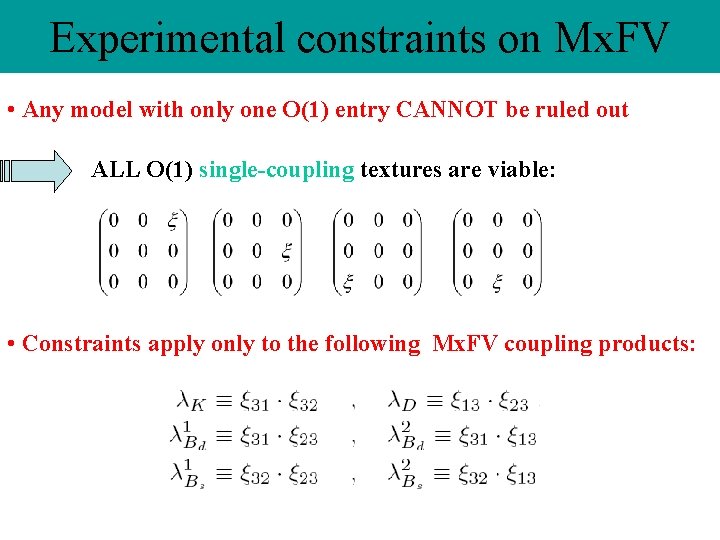
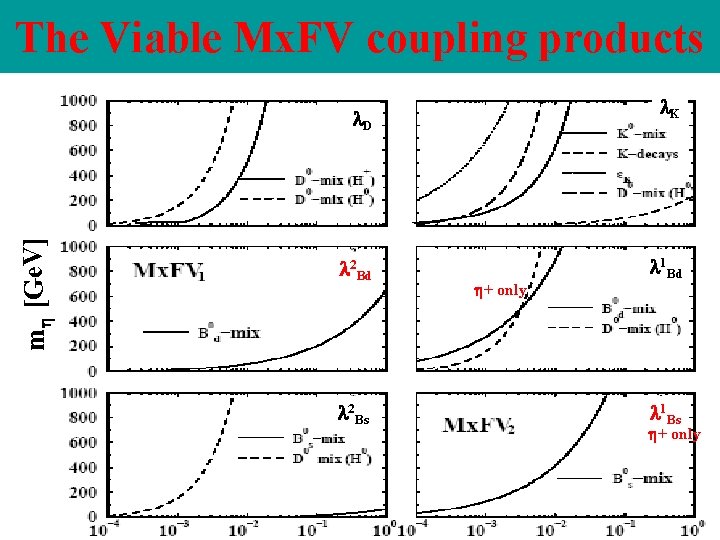
Experimental constraints on Mx. FV • Any model with only one O(1) entry CANNOT be ruled out ALL O(1) single-coupling textures are viable: • Constraints apply only to the following Mx. FV coupling products:
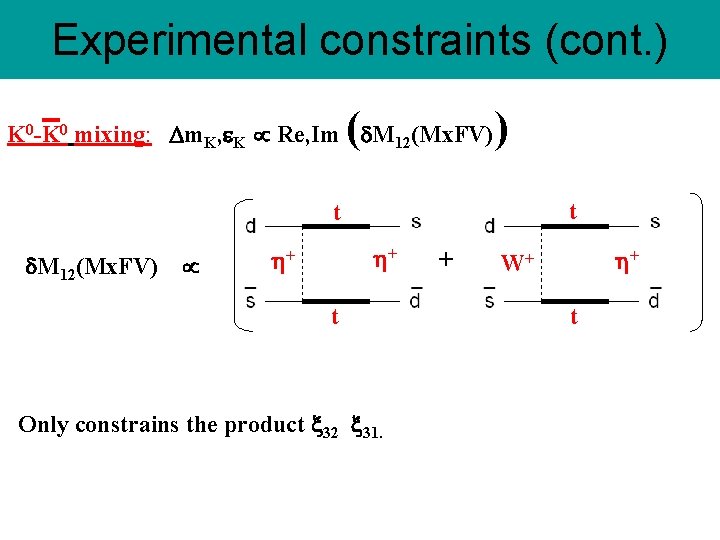
Experimental constraints (cont. ) ( K 0 -K 0 mixing: m. K, K Re, Im M 12(Mx. FV) ) t t M 12(Mx. FV) + + t Only constrains the product 32 31. + + W+ t
The Viable Mx. FV coupling products K m [Ge. V] D 2 Bd 2 Bs + only 1 Bd 1 Bs + only
Collider signatures of Mx. FV 1 t; u i. e. from O(1) + t 0 d; b u Leads to a very well defined set of processes that basically fall into 4 categories: 1. t FV production 2. FV FV production 3. s-channel FV resonance 4. t-channel FV exchanges
1. t FV production: ign e-s m sa top s 2. FV FV production: j = light quark (u or d) jet
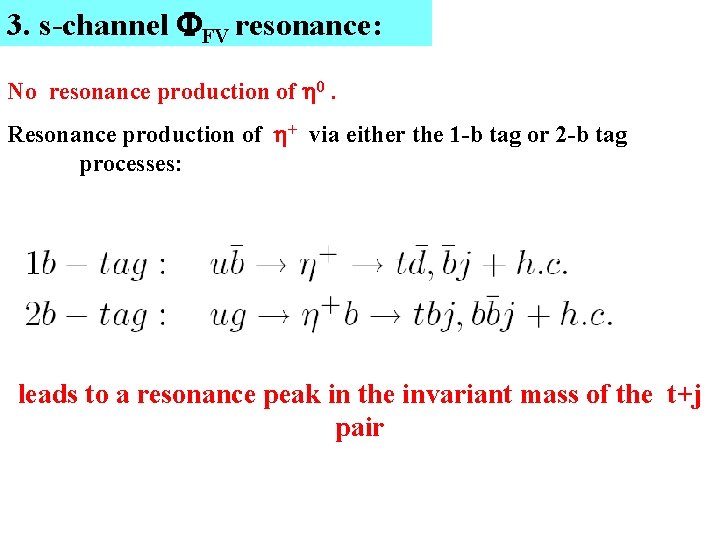
3. s-channel FV resonance: No resonance production of 0. Resonance production of + via either the 1 -b tag or 2 -b tag processes: leads to a resonance peak in the invariant mass of the t+j pair
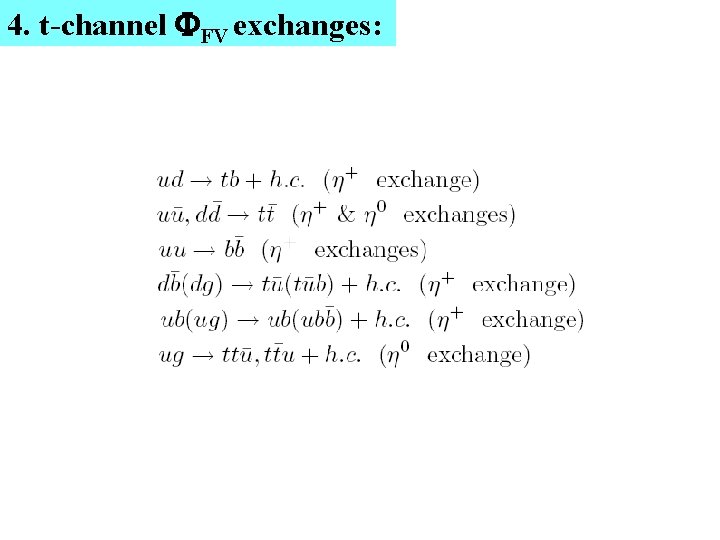
4. t-channel FV exchanges:
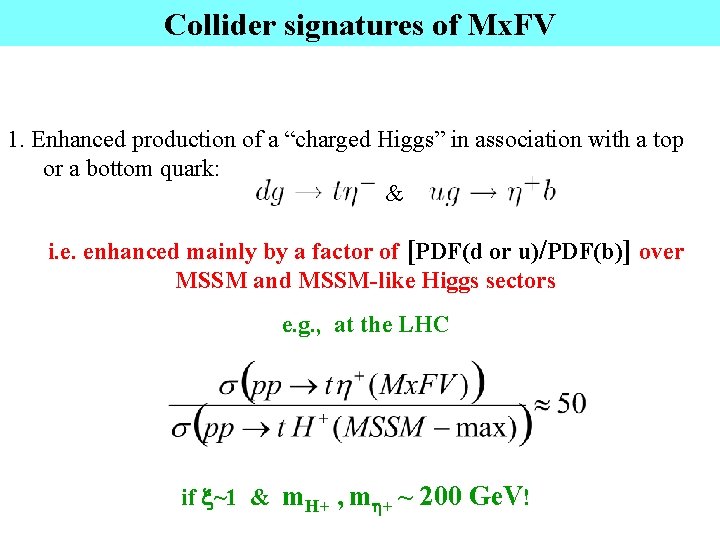
Collider signatures of Mx. FV 1. Enhanced production of a “charged Higgs” in association with a top or a bottom quark: & i. e. enhanced mainly by a factor of [PDF(d or u)/PDF(b)] over MSSM and MSSM-like Higgs sectors e. g. , at the LHC if ~1 & m. H+ , m + ~ 200 Ge. V!
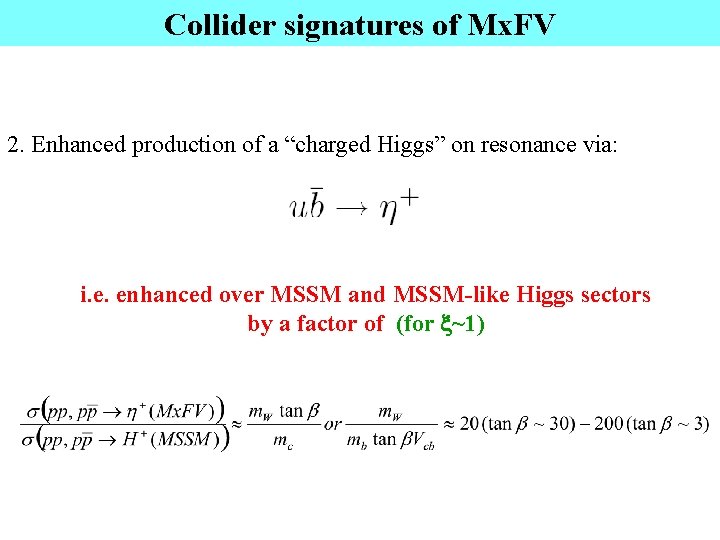
Collider signatures of Mx. FV 2. Enhanced production of a “charged Higgs” on resonance via: i. e. enhanced over MSSM and MSSM-like Higgs sectors by a factor of (for ~1)
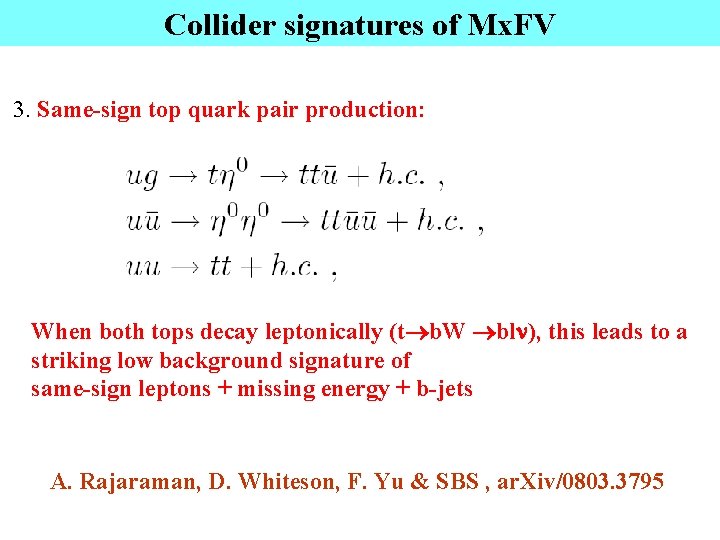
Collider signatures of Mx. FV 3. Same-sign top quark pair production: When both tops decay leptonically (t b. W bl ), this leads to a striking low background signature of same-sign leptons + missing energy + b-jets A. Rajaraman, D. Whiteson, F. Yu & SBS , ar. Xiv/0803. 3795
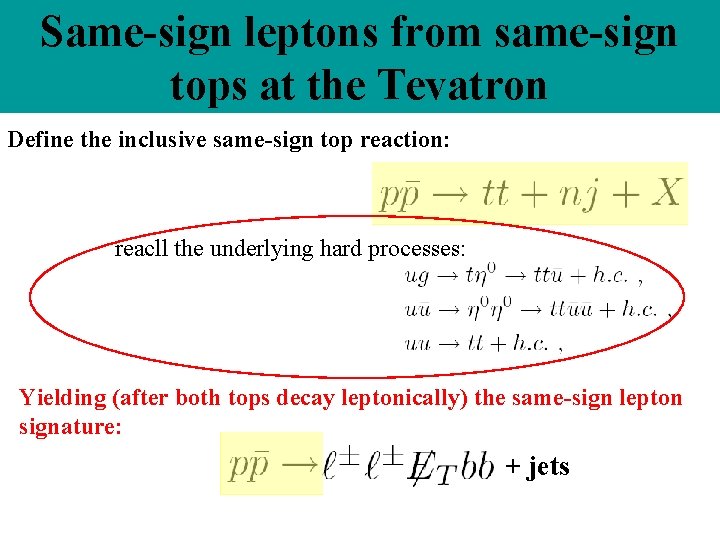
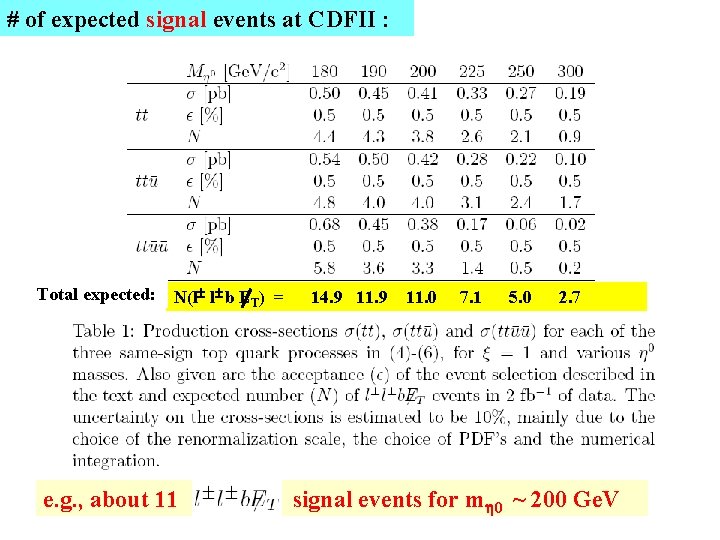
Same-sign leptons from same-sign tops at the Tevatron Define the inclusive same-sign top reaction: reacll the underlying hard processes: Yielding (after both tops decay leptonically) the same-sign lepton signature: + jets
# of expected signal events at CDFII : Total expected: N(l l b ET) = e. g. , about 11 14. 9 11. 0 7. 1 5. 0 2. 7 signal events for m 0 ~ 200 Ge. V
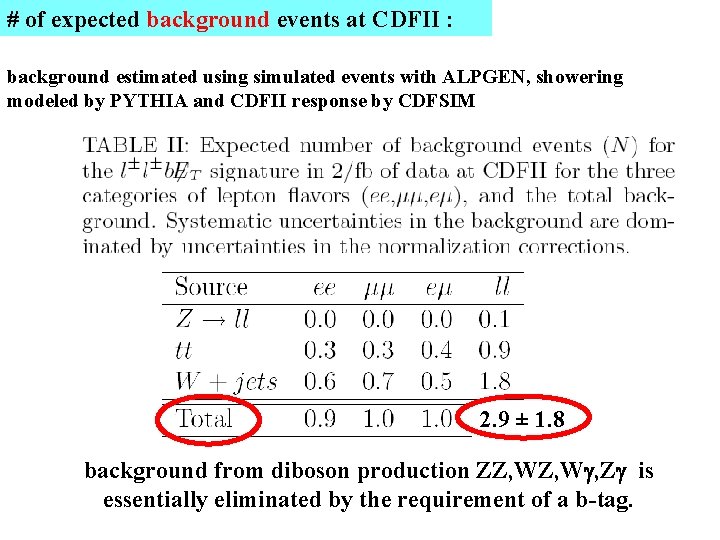
# of expected background events at CDFII : background estimated using simulated events with ALPGEN, showering modeled by PYTHIA and CDFII response by CDFSIM 2. 9 ± 1. 8 background from diboson production ZZ, W , Z is essentially eliminated by the requirement of a b-tag.
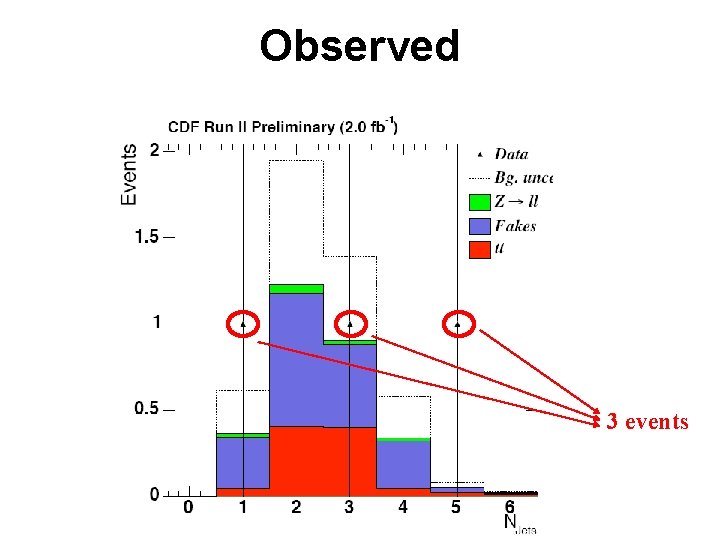
Observed 3 events
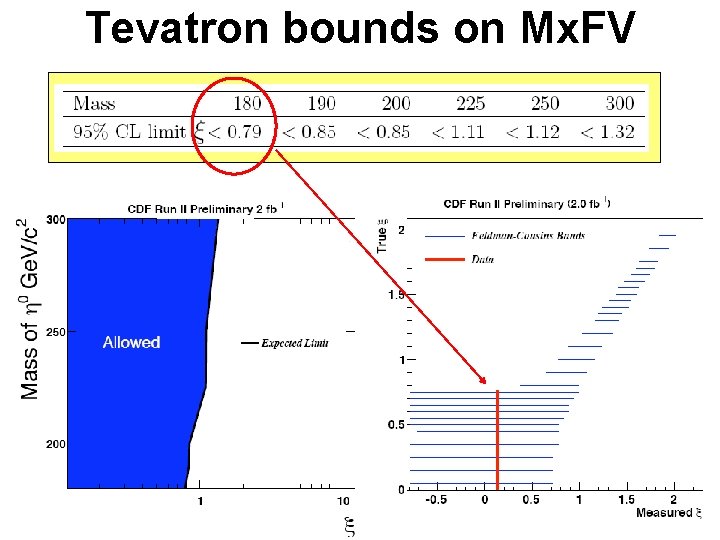
Tevatron bounds on Mx. FV
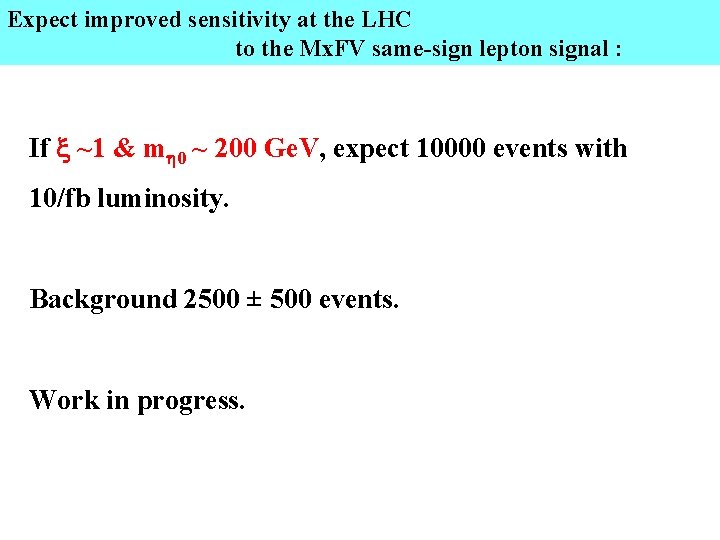
Expect improved sensitivity at the LHC to the Mx. FV same-sign lepton signal : If ~1 & m 0 ~ 200 Ge. V, expect 10000 events with 10/fb luminosity. Background 2500 ± 500 events. Work in progress.
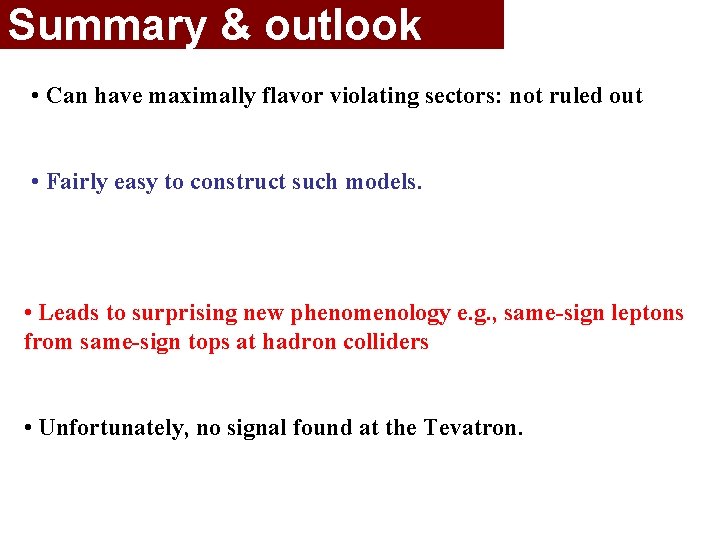
Summary & outlook • Can have maximally flavor violating sectors: not ruled out • Fairly easy to construct such models. • Leads to surprising new phenomenology e. g. , same-sign leptons from same-sign tops at hadron colliders • Unfortunately, no signal found at the Tevatron.
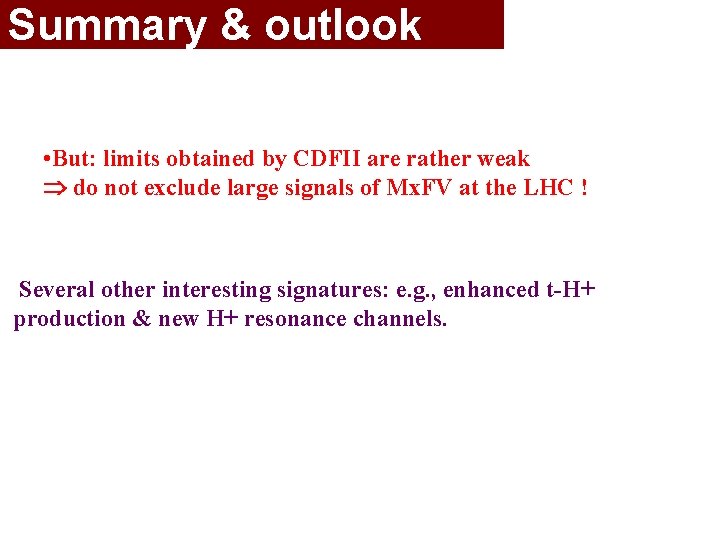
Summary & outlook • But: limits obtained by CDFII are rather weak do not exclude large signals of Mx. FV at the LHC ! Several other interesting signatures: e. g. , enhanced t-H+ production & new H+ resonance channels.