
Distributed Algorithms Rajmohan Rajaraman Northeastern University Boston May
Distributed Algorithms Rajmohan Rajaraman Northeastern University, Boston May 2012 Chennai Network Optimization Workshop Distributed Algorithms 1
Outline • Randomization in distributed computing – Maximal independent set • The local balancing paradigm – Multi-commodity flow and routing • Information dissemination in dynamic networks – Network coding based approach Chennai Network Optimization Workshop Distributed Algorithms 2
Randomization in Distributed Computing • A number of distributed computing tasks need “local algorithms” to compute globally good solutions – Maximal independent set – Minimum dominating set • Easy best-possible greedy algorithms – Inherently sequential – Place an ordering on the nodes • How to compute in a distributed setting? – At the cost of a small factor, can work with an approximate order – Challenge: Break symmetry among competing nodes [Luby 86] Chennai Network Optimization Workshop Distributed Algorithms 3
Maximal Independent Set • Given an undirected graph G = (V, E), find a maximal set S such that no two vertices in S are adjacent in G – Easy to compute using a sequential algorithm – Difficult to make it distributed • Model: In each step, each node can send an O(log(n)) bit message to each neighbor • Theorem [Luby 86]: There exists a distributed MIS algorithm that completes in O(log(n)) rounds whp Chennai Network Optimization Workshop Distributed Algorithms 4
Minimum Dominating Set • Given an undirected graph G = (V, E), find the smallest S such that every vertex is either in S or adjacent to some vertex in S – Special case of set cover – A greedy algorithm yields an O(log(n)) approximation – Difficult to make it distributed • Theorem [Jia-R-Suel 01]: There exists a distributed MDS algorithm that achieves an O(log(n)) approximation in O(log 2(n)) rounds whp Chennai Network Optimization Workshop Distributed Algorithms 5
Multi-commodity Flow and Routing • Given an directed capacitated graph G = (V, E), with k source destination pairs (si, ti), each with demand di – Goal: Find flow paths for the demands – Can be solved using LP and rounding, if necessary – Difficult to make it distributed • Routing problem: – The demands represent rates – Packets arriving at sources according to rates need to be routed to corresponding destinations Chennai Network Optimization Workshop Distributed Algorithms 6
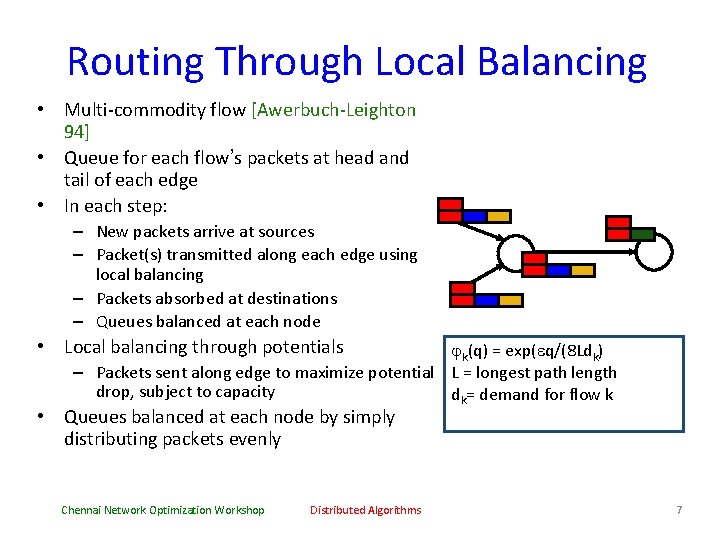
Routing Through Local Balancing • Multi-commodity flow [Awerbuch-Leighton 94] • Queue for each flow’s packets at head and tail of each edge • In each step: – New packets arrive at sources – Packet(s) transmitted along each edge using local balancing – Packets absorbed at destinations – Queues balanced at each node • Local balancing through potentials k(q) = exp( q/(8 Ldk) – Packets sent along edge to maximize potential L = longest path length drop, subject to capacity dk= demand for flow k • Queues balanced at each node by simply distributing packets evenly Chennai Network Optimization Workshop Distributed Algorithms 7
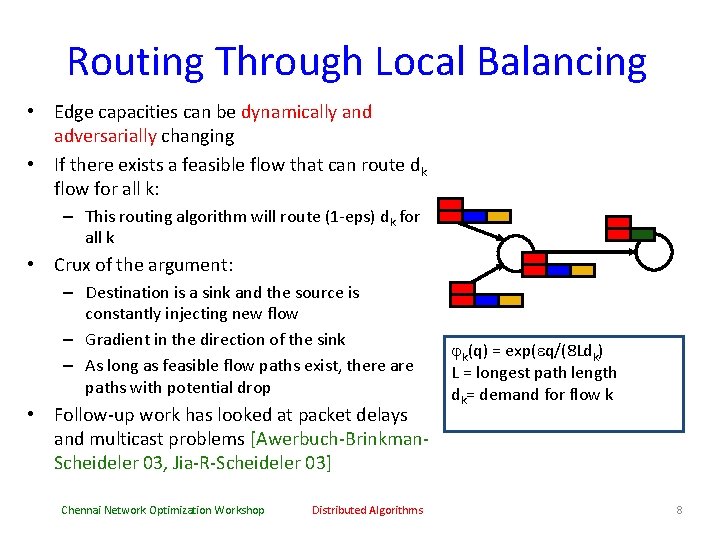
Routing Through Local Balancing • Edge capacities can be dynamically and adversarially changing • If there exists a feasible flow that can route dk flow for all k: – This routing algorithm will route (1 -eps) dk for all k • Crux of the argument: – Destination is a sink and the source is constantly injecting new flow – Gradient in the direction of the sink – As long as feasible flow paths exist, there are paths with potential drop • Follow-up work has looked at packet delays and multicast problems [Awerbuch-Brinkman. Scheideler 03, Jia-R-Scheideler 03] Chennai Network Optimization Workshop Distributed Algorithms k(q) = exp( q/(8 Ldk) L = longest path length dk= demand for flow k 8
Information Dissemination • Consider a highly dynamic network G in which each of n nodes has a message to share with all • What is the best way to perform the all-to-all dissemination? • Model: In each step, each node can broadcast an equivalent of O(1) messages to its neighbors • Static network: Can complete in O(n) steps • Dynamic network: Still open! Chennai Network Optimization Workshop Distributed Algorithms 9
Network Coding • A clever approach based on network coding seems very promising • Idea: Instead of sending out individual messages, send random linear combinations • If receiver receives enough such combinations, can reconstruct the original set of messages • Theorem [Haeupler 11, Haeupler-Karger 11]: If message sizes are Omega(n) bits, then networkcoding based gossip completes in O(n) steps whp • Provably beats “flow-based” dissemination in certain models [Dutta-Pandurangan-R-Sun 12] Chennai Network Optimization Workshop Distributed Algorithms 10
Take Away Messages • Randomization: – Very effective technique for breaking symmetry – Can beat deterministic algorithms in certain distributed computing models – Also effective for thwarting adversaries • Local balancing: – Useful for load balancing, flow, and routing problems – Potential function analysis effective to show • Network coding: – Provably more effective than flow-based dissemination – Extent of separation still open Chennai Network Optimization Workshop Distributed Algorithms 11
- Slides: 11