Matrix treatment of polarization Consider a light ray


- Slides: 27
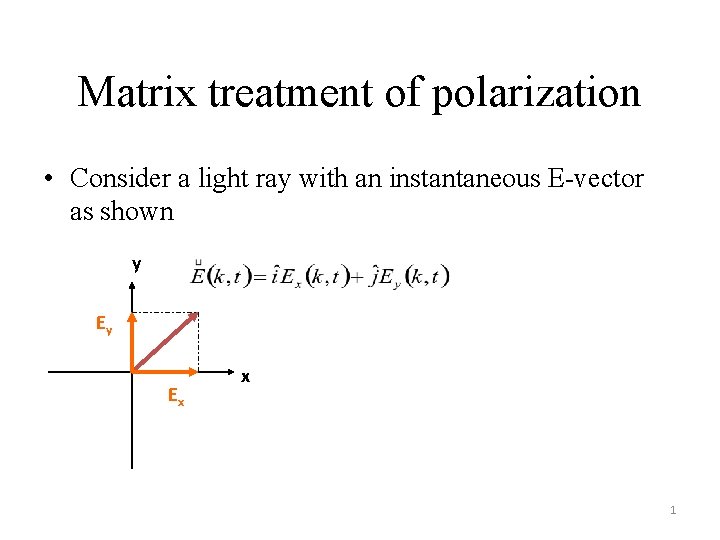
Matrix treatment of polarization • Consider a light ray with an instantaneous E-vector as shown y Ey Ex x 1
Matrix treatment of polarization • Combining the components • The terms in brackets represents the complex amplitude of the plane wave 2
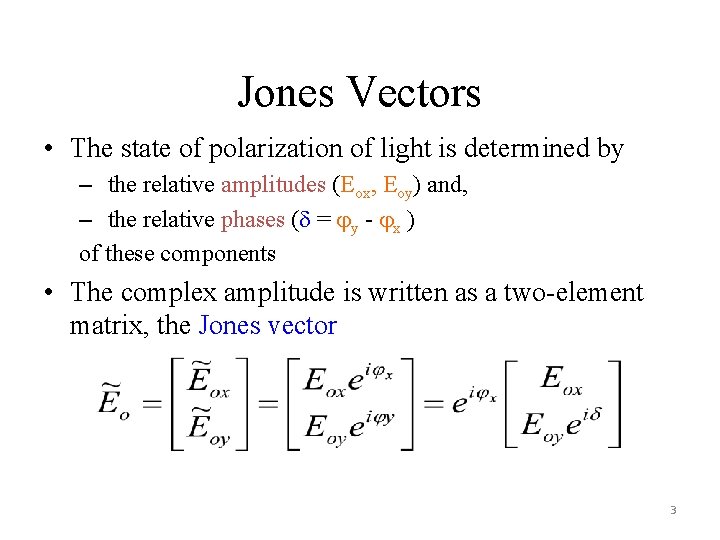
Jones Vectors • The state of polarization of light is determined by – the relative amplitudes (Eox, Eoy) and, – the relative phases ( = y - x ) of these components • The complex amplitude is written as a two-element matrix, the Jones vector 3
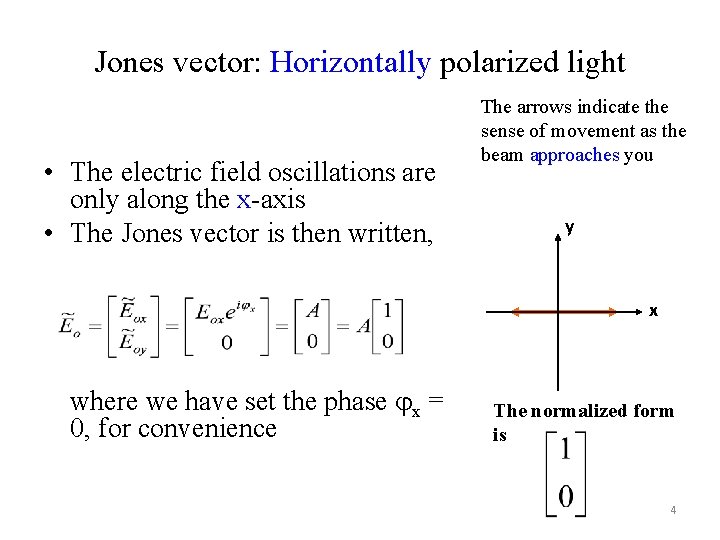
Jones vector: Horizontally polarized light • The electric field oscillations are only along the x-axis • The Jones vector is then written, The arrows indicate the sense of movement as the beam approaches you y x where we have set the phase x = 0, for convenience The normalized form is 4
Jones vector: Vertically polarized light • The electric field oscillations are only along the y-axis • The Jones vector is then written, • Where we have set the phase y = 0, for convenience y x The normalized form is 5
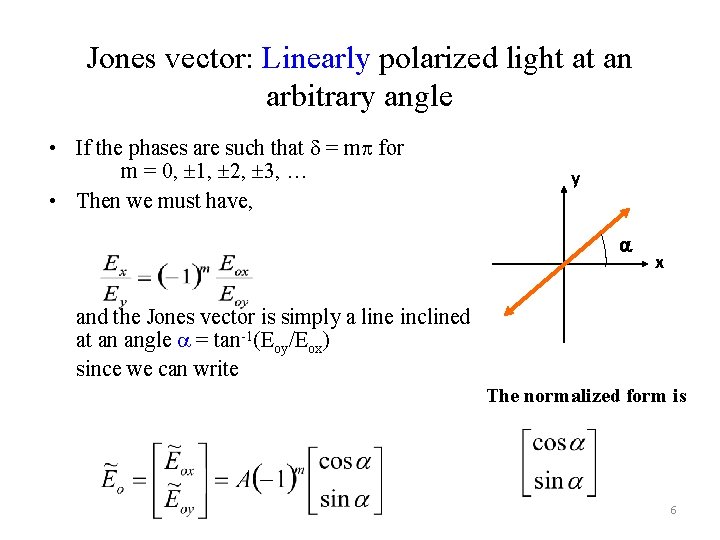
Jones vector: Linearly polarized light at an arbitrary angle • If the phases are such that = m for m = 0, 1, 2, 3, … • Then we must have, y x and the Jones vector is simply a line inclined at an angle = tan-1(Eoy/Eox) since we can write The normalized form is 6
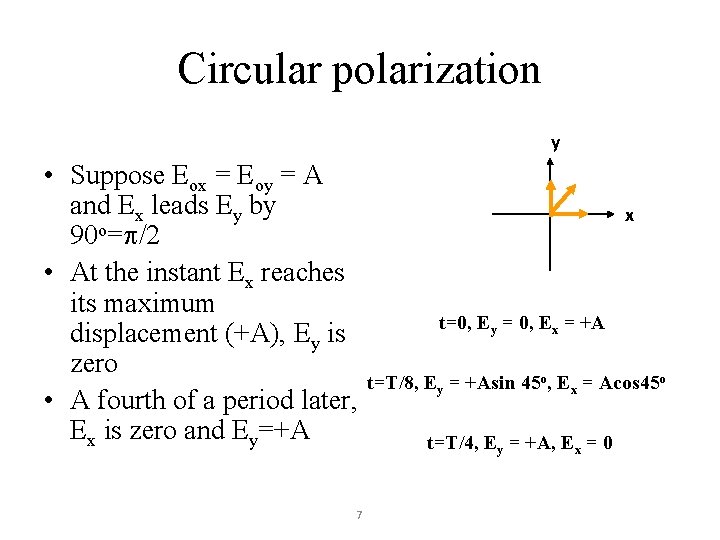
Circular polarization y • Suppose Eox = Eoy = A and Ex leads Ey by 90 o= /2 • At the instant Ex reaches its maximum displacement (+A), Ey is zero • A fourth of a period later, Ex is zero and Ey=+A 7 x t=0, Ey = 0, Ex = +A t=T/8, Ey = +Asin 45 o, Ex = Acos 45 o t=T/4, Ey = +A, Ex = 0
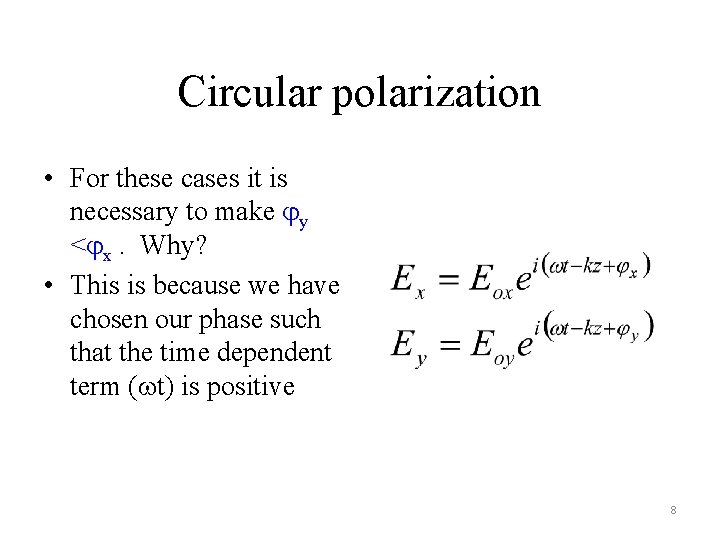
Circular polarization • For these cases it is necessary to make y < x. Why? • This is because we have chosen our phase such that the time dependent term ( t) is positive 8
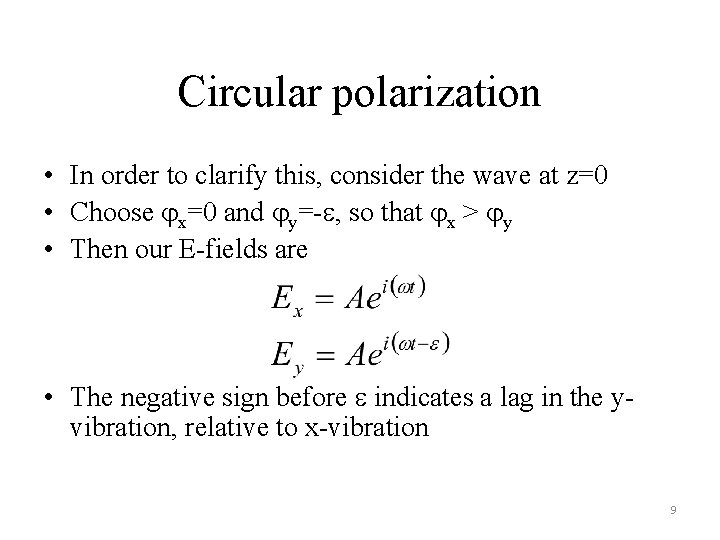
Circular polarization • In order to clarify this, consider the wave at z=0 • Choose x=0 and y=- , so that x > y • Then our E-fields are • The negative sign before indicates a lag in the yvibration, relative to x-vibration 9
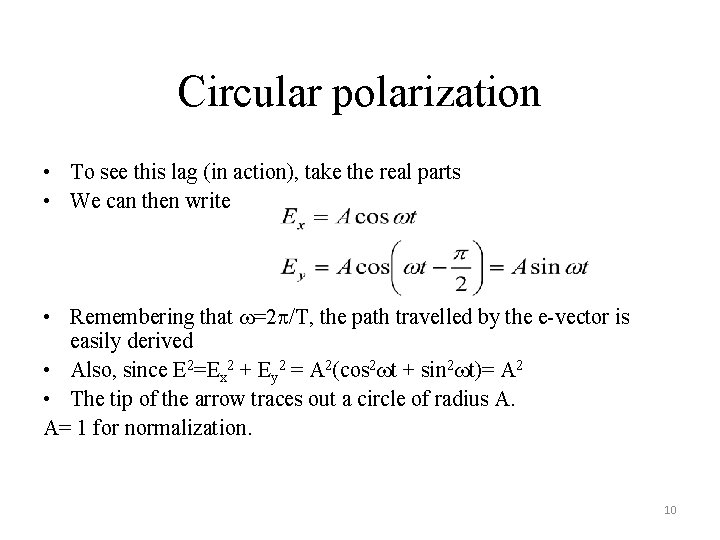
Circular polarization • To see this lag (in action), take the real parts • We can then write • Remembering that =2 /T, the path travelled by the e-vector is easily derived • Also, since E 2=Ex 2 + Ey 2 = A 2(cos 2 t + sin 2 t)= A 2 • The tip of the arrow traces out a circle of radius A. A= 1 for normalization. 10
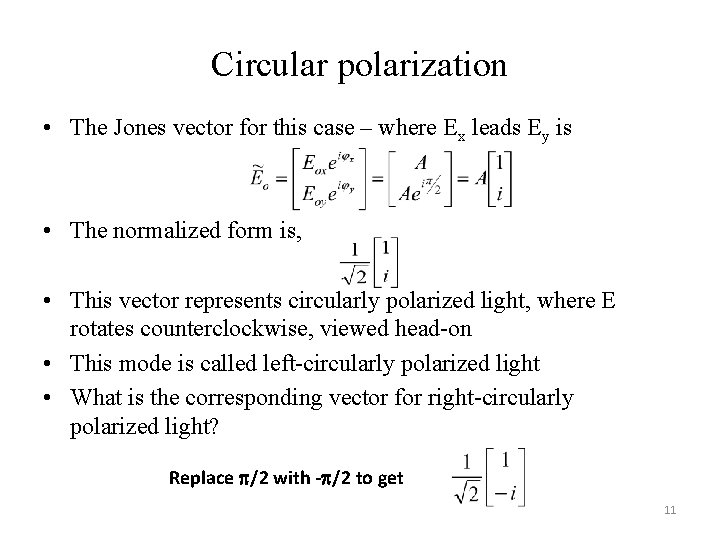
Circular polarization • The Jones vector for this case – where Ex leads Ey is • The normalized form is, • This vector represents circularly polarized light, where E rotates counterclockwise, viewed head-on • This mode is called left-circularly polarized light • What is the corresponding vector for right-circularly polarized light? Replace /2 with - /2 to get 11
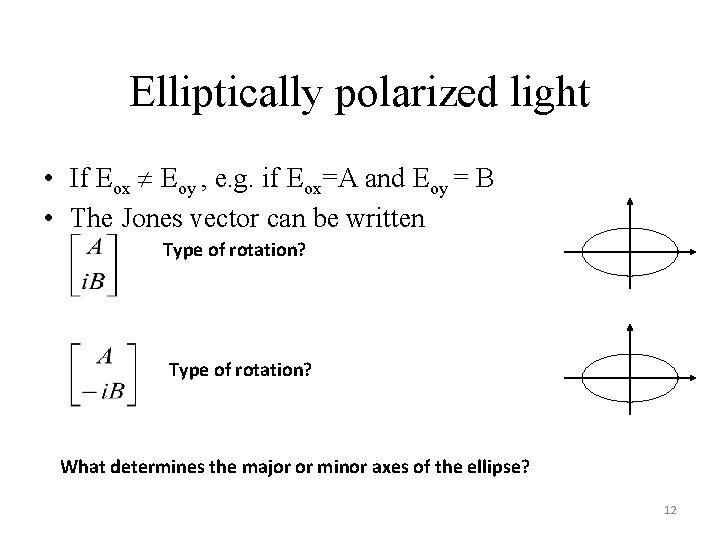
Elliptically polarized light • If Eox Eoy , e. g. if Eox=A and Eoy = B • The Jones vector can be written Type of rotation? counterclockwise What determines the major or minor axes of the ellipse? Here A>B 12
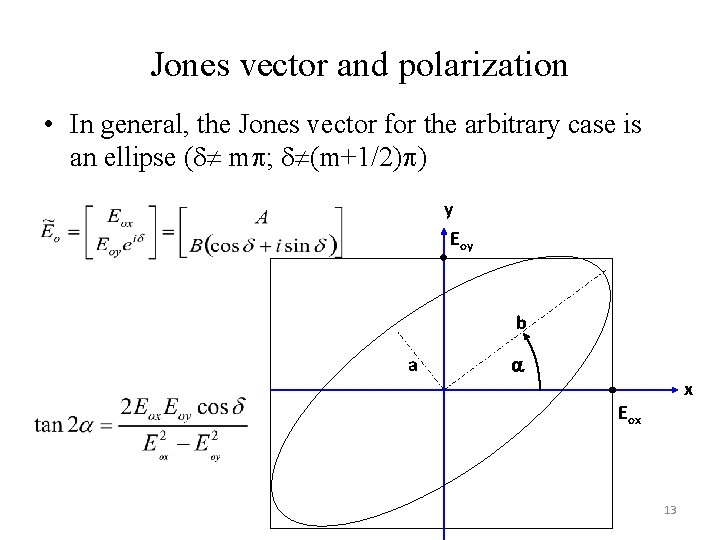
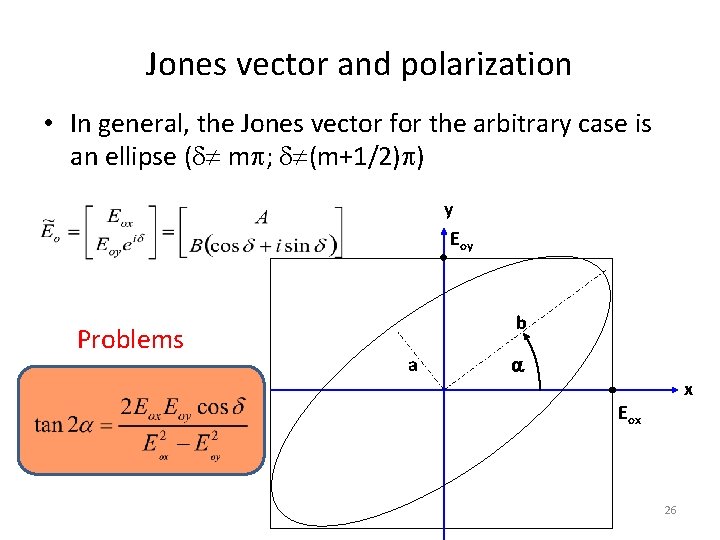
Jones vector and polarization • In general, the Jones vector for the arbitrary case is an ellipse ( m ; (m+1/2) ) y Eoy b a x Eox 13
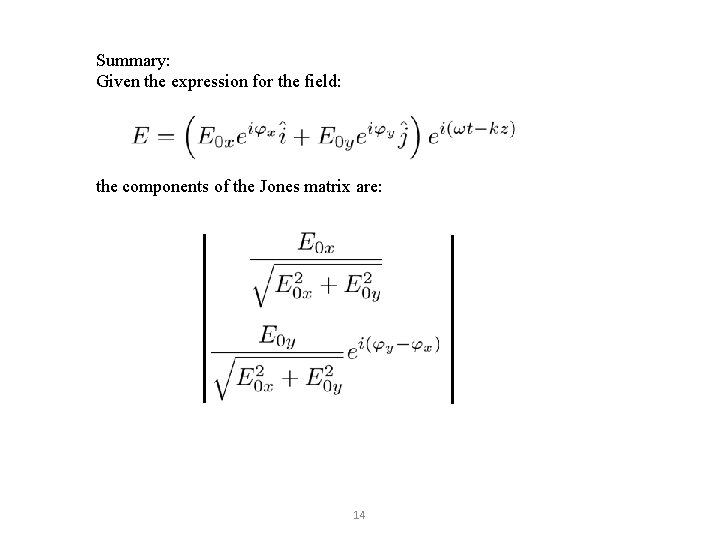
Summary: Given the expression for the field: the components of the Jones matrix are: 14
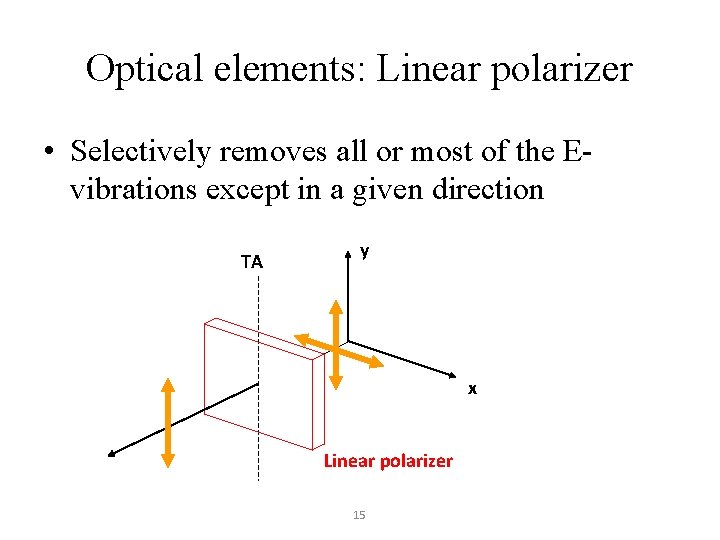
Optical elements: Linear polarizer • Selectively removes all or most of the Evibrations except in a given direction TA y x Linear polarizer 15
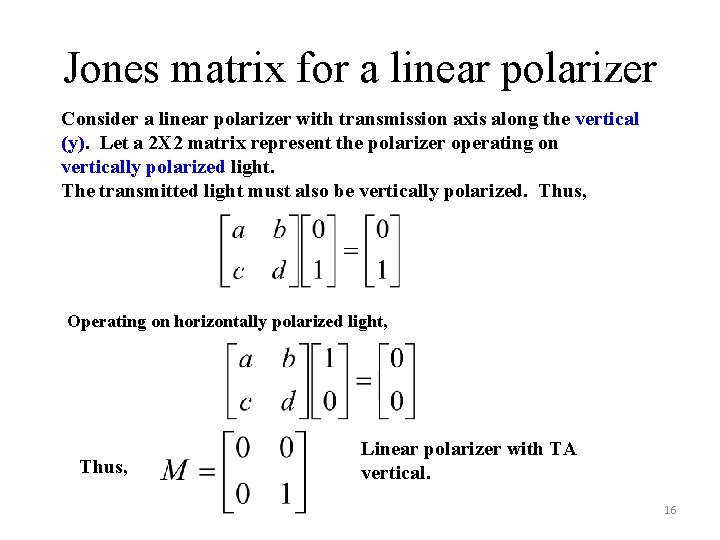
Jones matrix for a linear polarizer Consider a linear polarizer with transmission axis along the vertical (y). Let a 2 X 2 matrix represent the polarizer operating on vertically polarized light. The transmitted light must also be vertically polarized. Thus, Operating on horizontally polarized light, Thus, Linear polarizer with TA vertical. 16
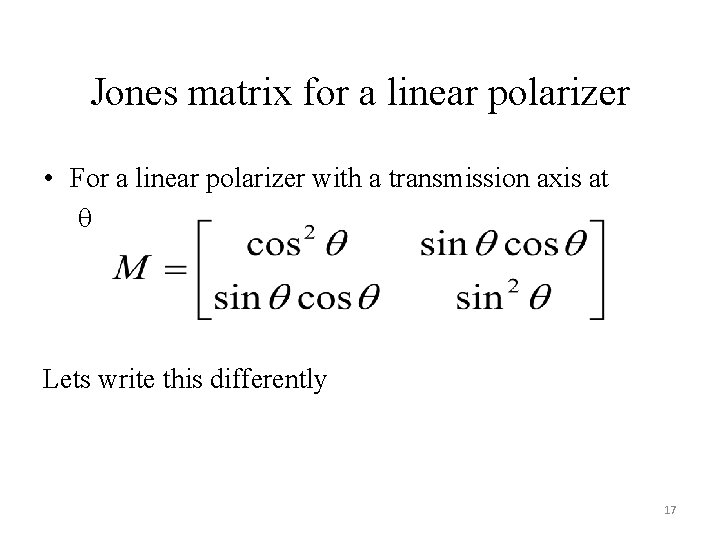
Jones matrix for a linear polarizer • For a linear polarizer with a transmission axis at Lets write this differently 17
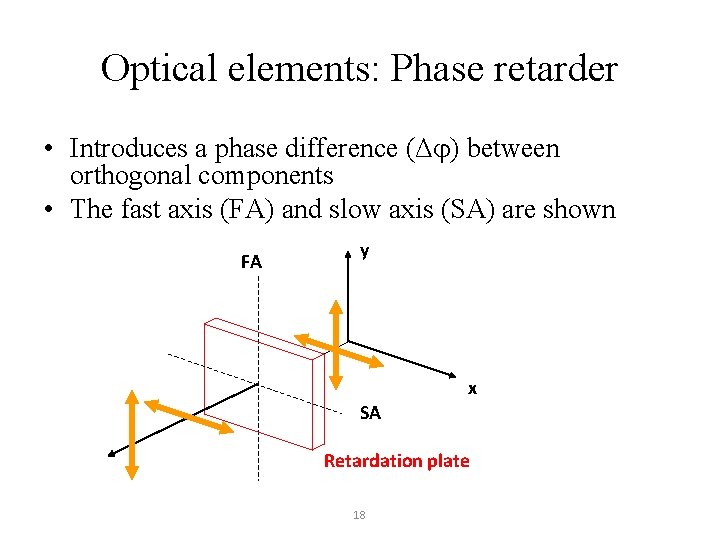
Optical elements: Phase retarder • Introduces a phase difference (Δ ) between orthogonal components • The fast axis (FA) and slow axis (SA) are shown FA y x SA Retardation plate 18
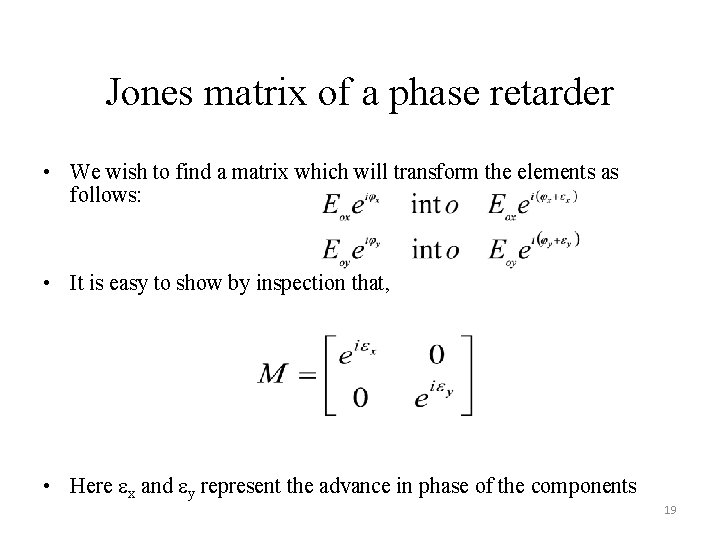
Jones matrix of a phase retarder • We wish to find a matrix which will transform the elements as follows: • It is easy to show by inspection that, • Here x and y represent the advance in phase of the components 19
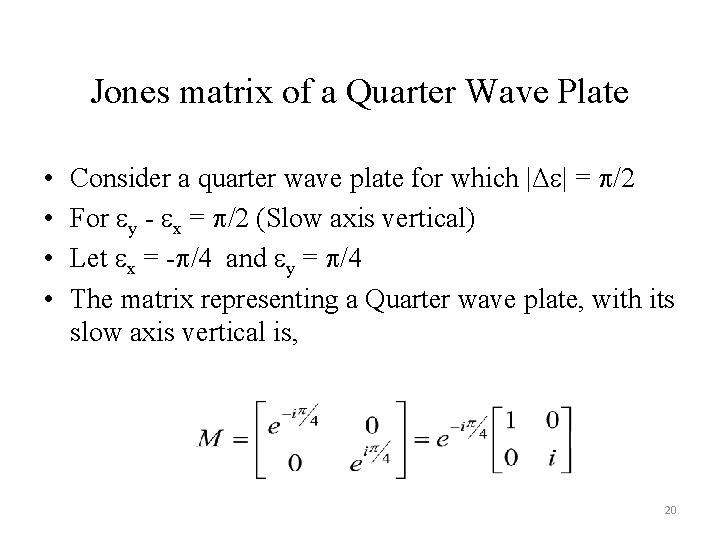
Jones matrix of a Quarter Wave Plate • • Consider a quarter wave plate for which |Δ | = /2 For y - x = /2 (Slow axis vertical) Let x = - /4 and y = /4 The matrix representing a Quarter wave plate, with its slow axis vertical is, 20
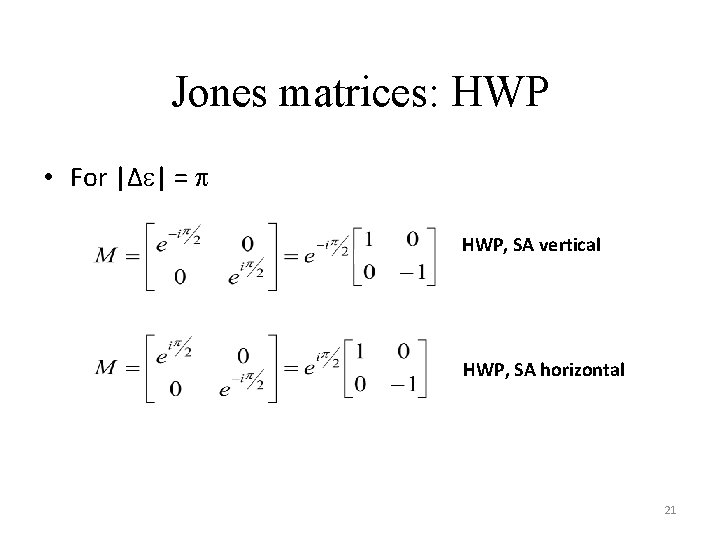
Jones matrices: HWP • For |Δ | = HWP, SA vertical HWP, SA horizontal 21
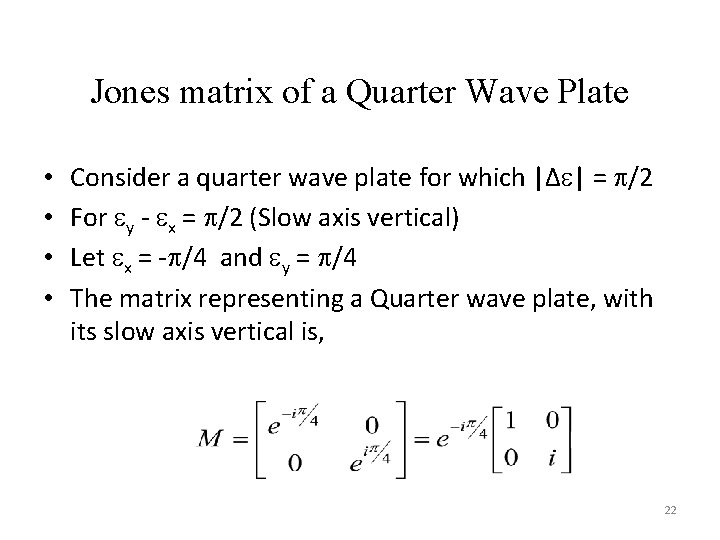
Jones matrix of a Quarter Wave Plate • • Consider a quarter wave plate for which |Δ | = /2 For y - x = /2 (Slow axis vertical) Let x = - /4 and y = /4 The matrix representing a Quarter wave plate, with its slow axis vertical is, 22
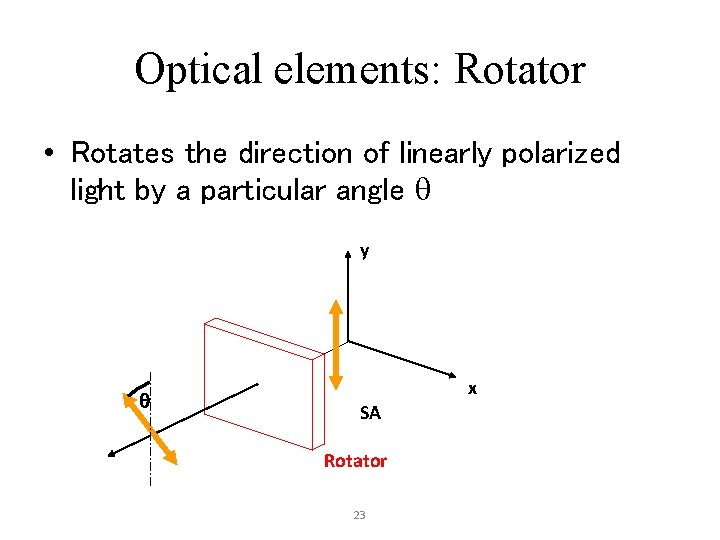
Optical elements: Rotator • Rotates the direction of linearly polarized light by a particular angle y x SA Rotator 23
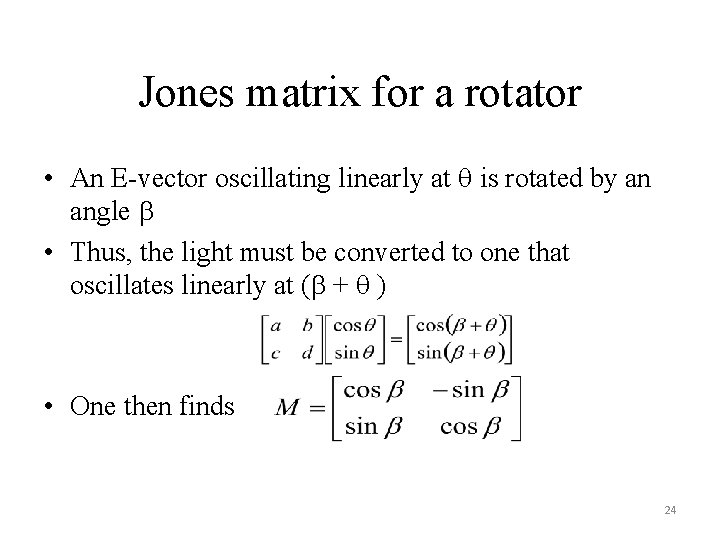
Jones matrix for a rotator • An E-vector oscillating linearly at is rotated by an angle • Thus, the light must be converted to one that oscillates linearly at ( + ) • One then finds 24
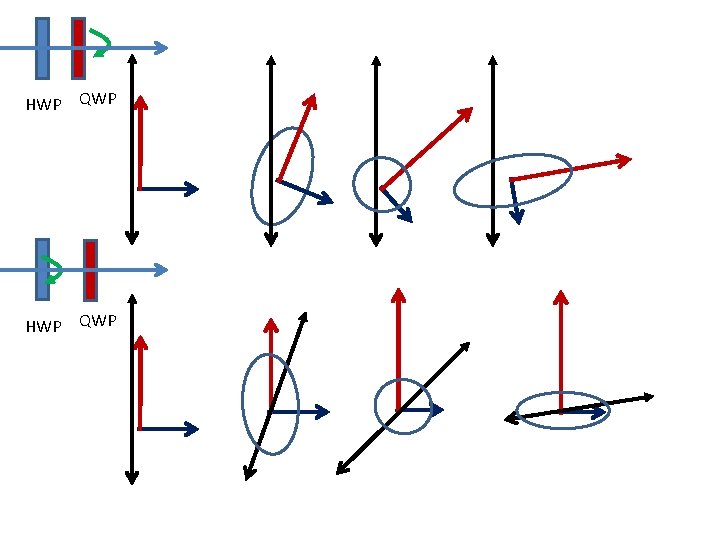
HWP QWP
Jones vector and polarization • In general, the Jones vector for the arbitrary case is an ellipse ( m ; (m+1/2) ) y Eoy Problems b a x Eox 26