Math Calculation Principles Copyright PRIMED 2015 Principles When


- Slides: 47
Math Calculation Principles Copyright PRIMED 2015
Principles When performing drug calculations always do the following: 1. Convert to the same units 2. Consider what dosage is reasonable 3. Calculate 4. When in doubt confirm with another resource
Mathematics Review Fractions: convert to the lowest term & lowest denominators
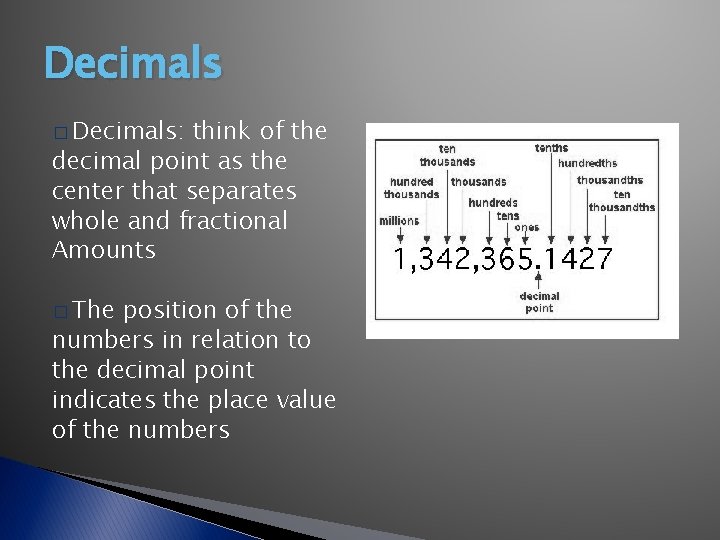
Decimals � Decimals: think of the decimal point as the center that separates whole and fractional Amounts � The position of the numbers in relation to the decimal point indicates the place value of the numbers
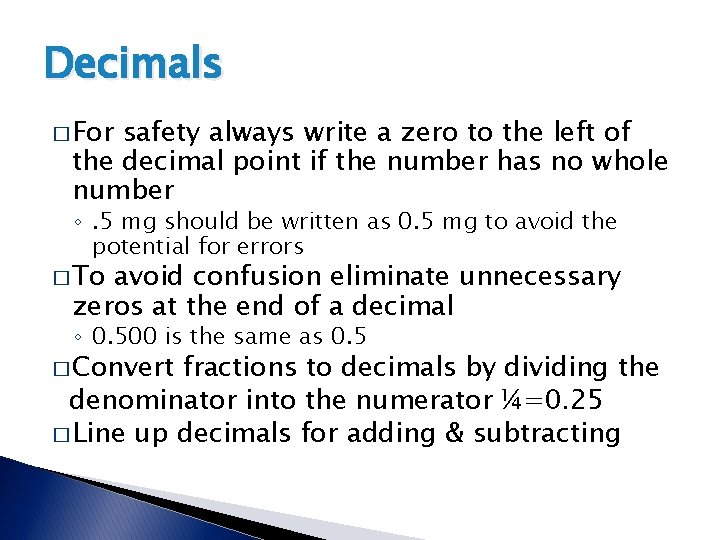
Decimals � For safety always write a zero to the left of the decimal point if the number has no whole number ◦. 5 mg should be written as 0. 5 mg to avoid the potential for errors � To avoid confusion eliminate unnecessary zeros at the end of a decimal ◦ 0. 500 is the same as 0. 5 � Convert fractions to decimals by dividing the denominator into the numerator ¼=0. 25 � Line up decimals for adding & subtracting
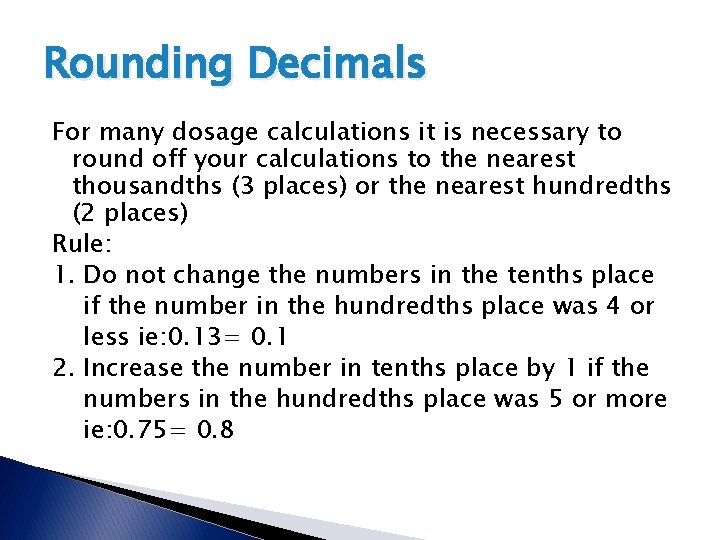
Rounding Decimals For many dosage calculations it is necessary to round off your calculations to the nearest thousandths (3 places) or the nearest hundredths (2 places) Rule: 1. Do not change the numbers in the tenths place if the number in the hundredths place was 4 or less ie: 0. 13= 0. 1 2. Increase the number in tenths place by 1 if the numbers in the hundredths place was 5 or more ie: 0. 75= 0. 8
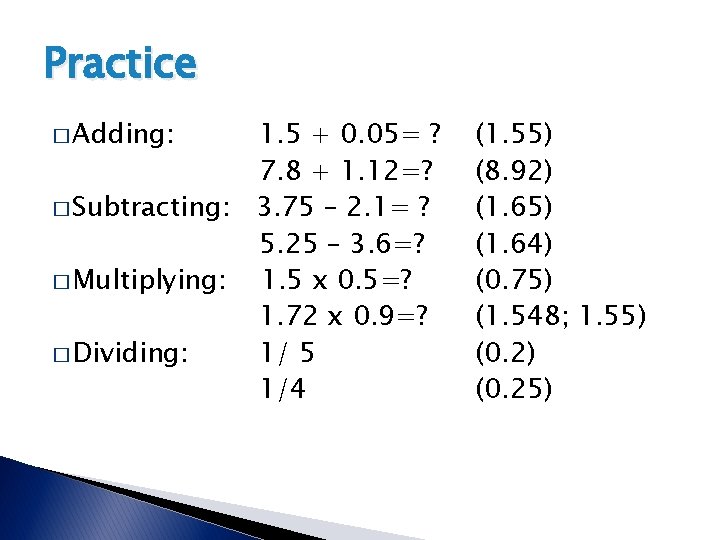
Practice � Adding: 1. 5 + 0. 05= ? 7. 8 + 1. 12=? � Subtracting: 3. 75 – 2. 1= ? 5. 25 – 3. 6=? � Multiplying: 1. 5 x 0. 5=? 1. 72 x 0. 9=? � Dividing: 1/ 5 1/4 (1. 55) (8. 92) (1. 65) (1. 64) (0. 75) (1. 548; 1. 55) (0. 25)
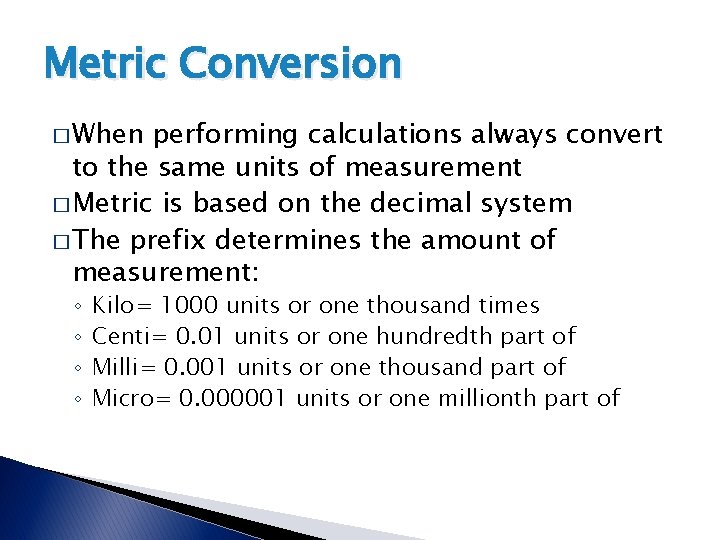
Metric Conversion � When performing calculations always convert to the same units of measurement � Metric is based on the decimal system � The prefix determines the amount of measurement: ◦ ◦ Kilo= 1000 units or one thousand times Centi= 0. 01 units or one hundredth part of Milli= 0. 001 units or one thousand part of Micro= 0. 000001 units or one millionth part of
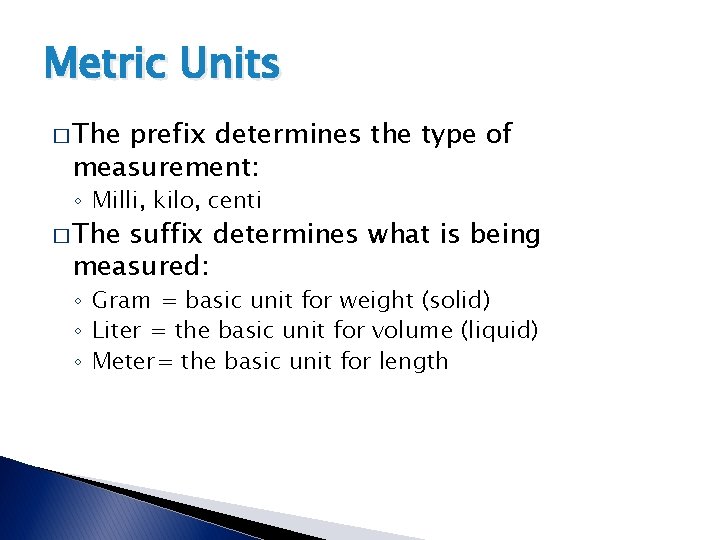
Metric Units � The prefix determines the type of measurement: ◦ Milli, kilo, centi � The suffix determines what is being measured: ◦ Gram = basic unit for weight (solid) ◦ Liter = the basic unit for volume (liquid) ◦ Meter= the basic unit for length
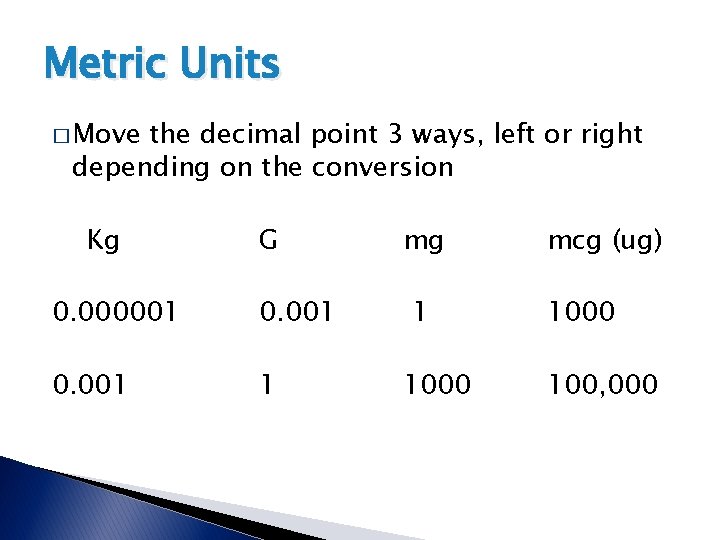
Metric Units � Move the decimal point 3 ways, left or right depending on the conversion Kg G 0. 000001 0. 001 1 mg 1 1000 mcg (ug) 1000 100, 000
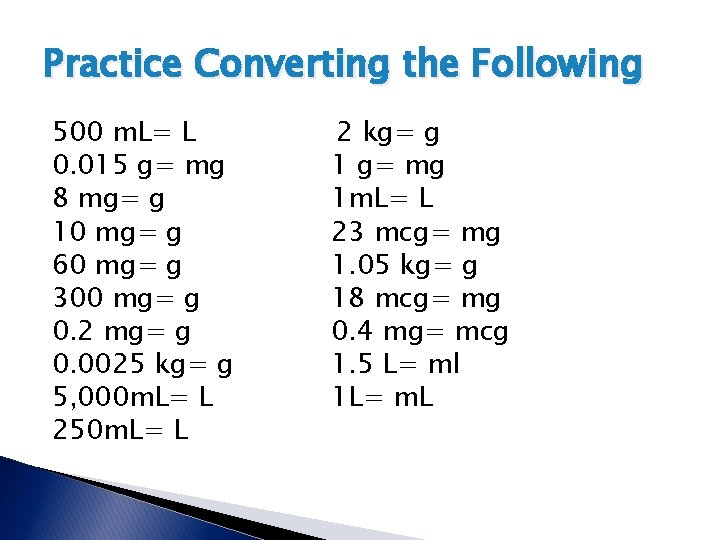
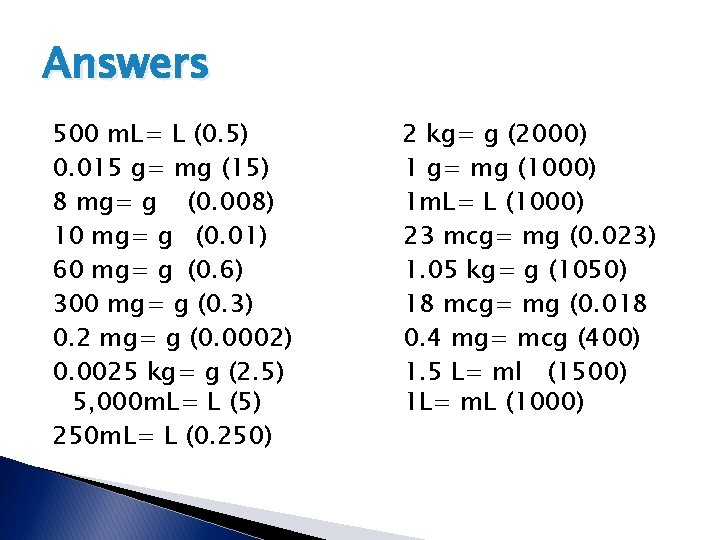
Practice Converting the Following 500 m. L= L 0. 015 g= mg 8 mg= g 10 mg= g 60 mg= g 300 mg= g 0. 2 mg= g 0. 0025 kg= g 5, 000 m. L= L 250 m. L= L 2 kg= g 1 g= mg 1 m. L= L 23 mcg= mg 1. 05 kg= g 18 mcg= mg 0. 4 mg= mcg 1. 5 L= ml 1 L= m. L
Answers 500 m. L= L (0. 5) 0. 015 g= mg (15) 8 mg= g (0. 008) 10 mg= g (0. 01) 60 mg= g (0. 6) 300 mg= g (0. 3) 0. 2 mg= g (0. 0002) 0. 0025 kg= g (2. 5) 5, 000 m. L= L (5) 250 m. L= L (0. 250) 2 kg= g (2000) 1 g= mg (1000) 1 m. L= L (1000) 23 mcg= mg (0. 023) 1. 05 kg= g (1050) 18 mcg= mg (0. 018 0. 4 mg= mcg (400) 1. 5 L= ml (1500) 1 L= m. L (1000)
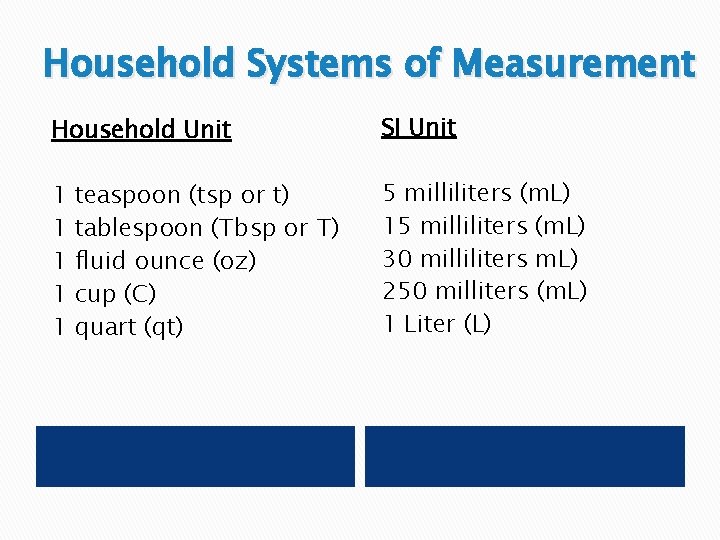
Household Systems of Measurement Household Unit SI Unit 1 1 1 5 milliliters (m. L) 15 milliliters (m. L) 30 milliliters m. L) 250 milliters (m. L) 1 Liter (L) teaspoon (tsp or t) tablespoon (Tbsp or T) fluid ounce (oz) cup (C) quart (qt)
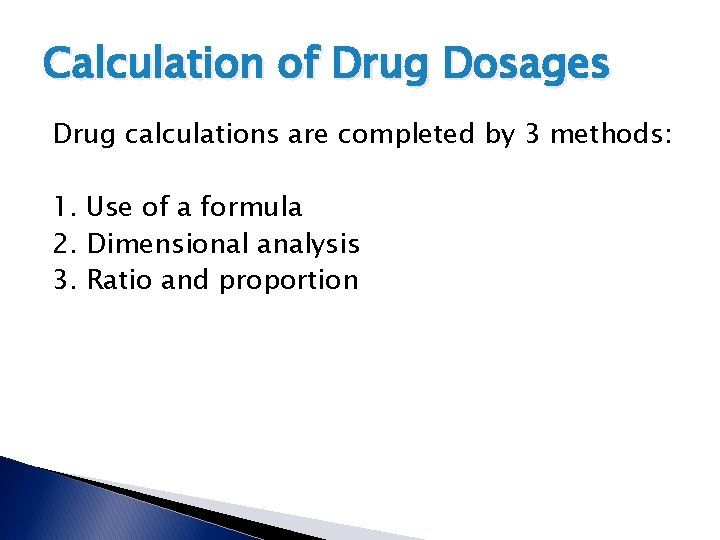
Calculation of Drug Dosages Drug calculations are completed by 3 methods: 1. Use of a formula 2. Dimensional analysis 3. Ratio and proportion
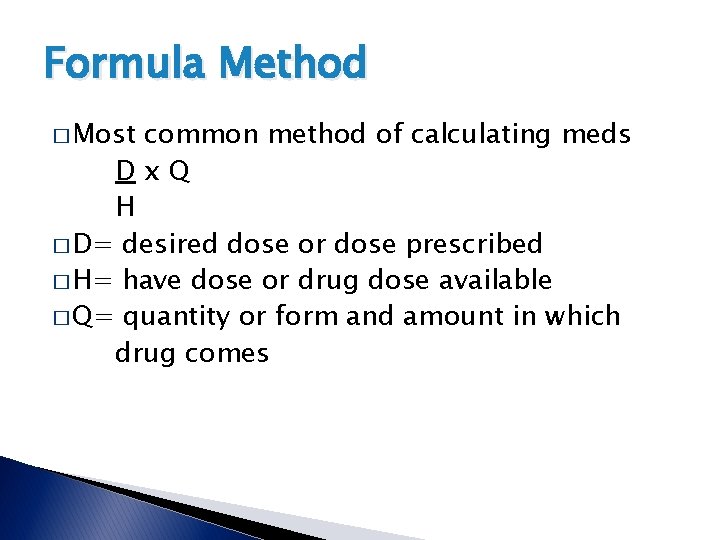
Formula Method � Most common method of calculating meds Dx. Q H � D= desired dose or dose prescribed � H= have dose or drug dose available � Q= quantity or form and amount in which drug comes
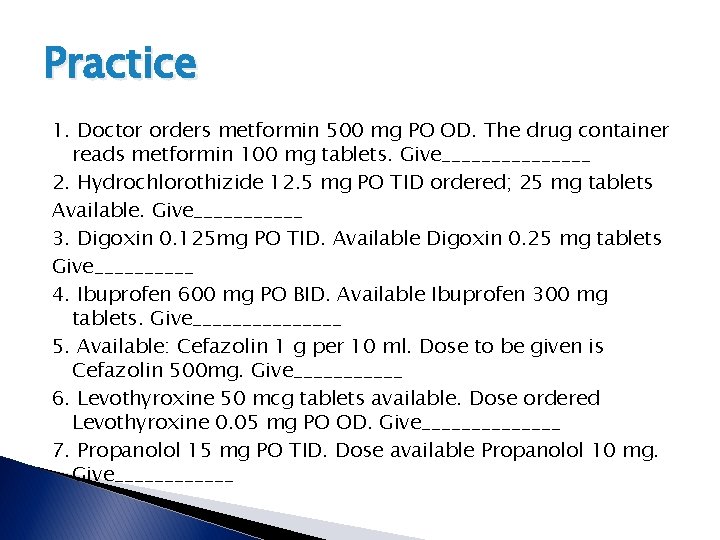
Practice 1. Doctor orders metformin 500 mg PO OD. The drug container reads metformin 100 mg tablets. Give________ 2. Hydrochlorothizide 12. 5 mg PO TID ordered; 25 mg tablets Available. Give______ 3. Digoxin 0. 125 mg PO TID. Available Digoxin 0. 25 mg tablets Give_____ 4. Ibuprofen 600 mg PO BID. Available Ibuprofen 300 mg tablets. Give________ 5. Available: Cefazolin 1 g per 10 ml. Dose to be given is Cefazolin 500 mg. Give______ 6. Levothyroxine 50 mcg tablets available. Dose ordered Levothyroxine 0. 05 mg PO OD. Give_______ 7. Propanolol 15 mg PO TID. Dose available Propanolol 10 mg. Give______
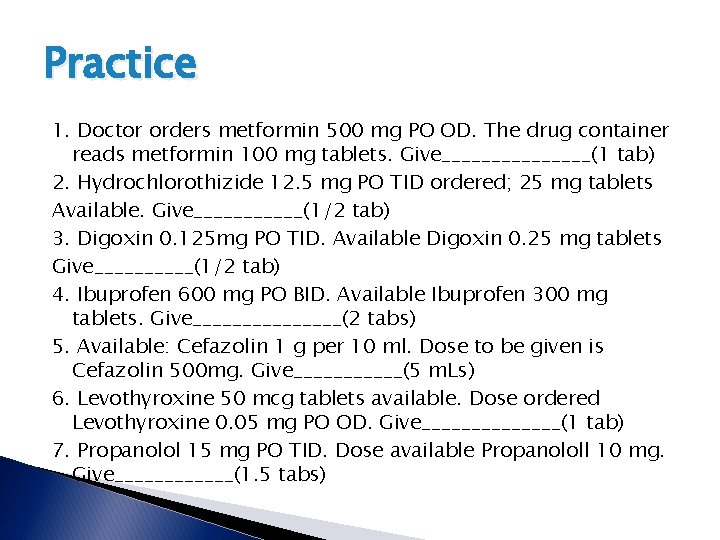
Practice 1. Doctor orders metformin 500 mg PO OD. The drug container reads metformin 100 mg tablets. Give________(1 tab) 2. Hydrochlorothizide 12. 5 mg PO TID ordered; 25 mg tablets Available. Give______(1/2 tab) 3. Digoxin 0. 125 mg PO TID. Available Digoxin 0. 25 mg tablets Give_____(1/2 tab) 4. Ibuprofen 600 mg PO BID. Available Ibuprofen 300 mg tablets. Give________(2 tabs) 5. Available: Cefazolin 1 g per 10 ml. Dose to be given is Cefazolin 500 mg. Give______(5 m. Ls) 6. Levothyroxine 50 mcg tablets available. Dose ordered Levothyroxine 0. 05 mg PO OD. Give_______(1 tab) 7. Propanolol 15 mg PO TID. Dose available Propanololl 10 mg. Give______(1. 5 tabs)
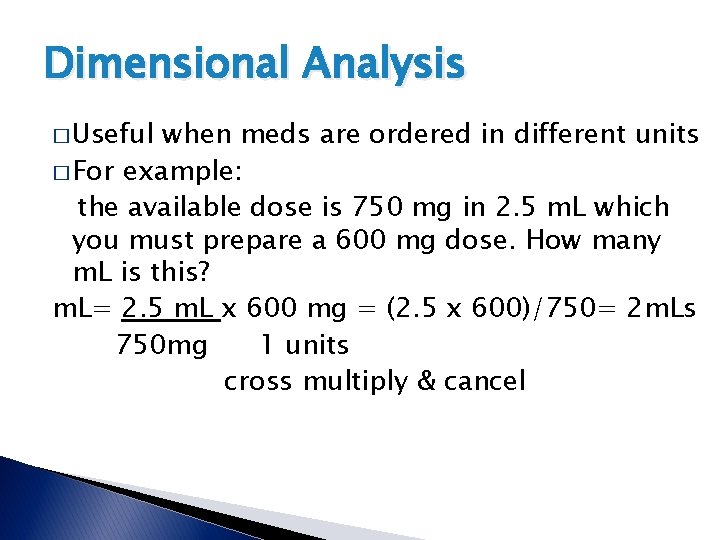
Dimensional Analysis � Useful when meds are ordered in different units � For example: the available dose is 750 mg in 2. 5 m. L which you must prepare a 600 mg dose. How many m. L is this? m. L= 2. 5 m. L x 600 mg = (2. 5 x 600)/750= 2 m. Ls 750 mg 1 units cross multiply & cancel
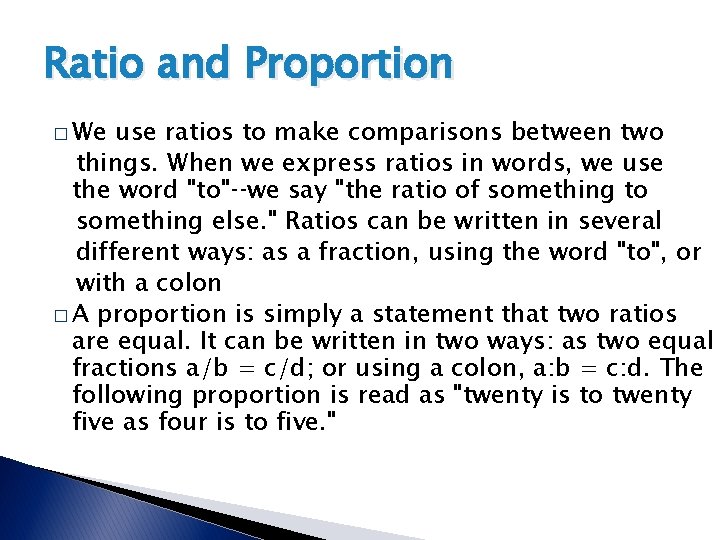
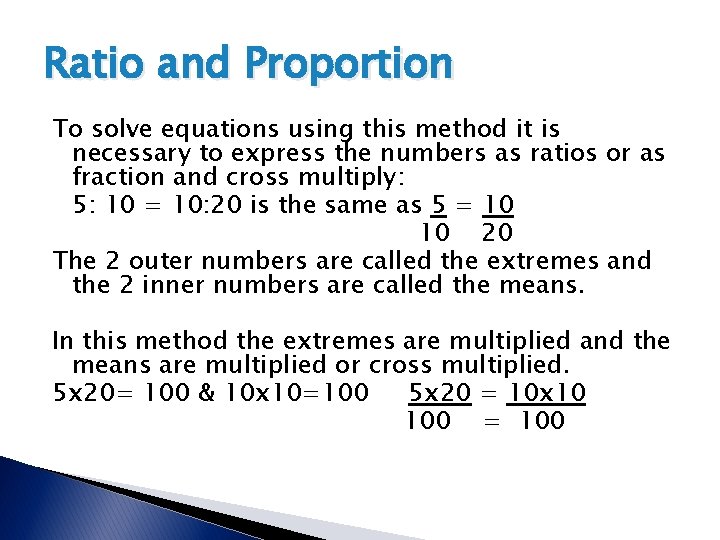
Ratio and Proportion � We use ratios to make comparisons between two things. When we express ratios in words, we use the word "to"‐‐we say "the ratio of something to something else. " Ratios can be written in several different ways: as a fraction, using the word "to", or with a colon � A proportion is simply a statement that two ratios are equal. It can be written in two ways: as two equal fractions a/b = c/d; or using a colon, a: b = c: d. The following proportion is read as "twenty is to twenty five as four is to five. "
Ratio and Proportion To solve equations using this method it is necessary to express the numbers as ratios or as fraction and cross multiply: 5: 10 = 10: 20 is the same as 5 = 10 10 20 The 2 outer numbers are called the extremes and the 2 inner numbers are called the means. In this method the extremes are multiplied and the means are multiplied or cross multiplied. 5 x 20= 100 & 10 x 10=100 5 x 20 = 10 x 10 100 = 100
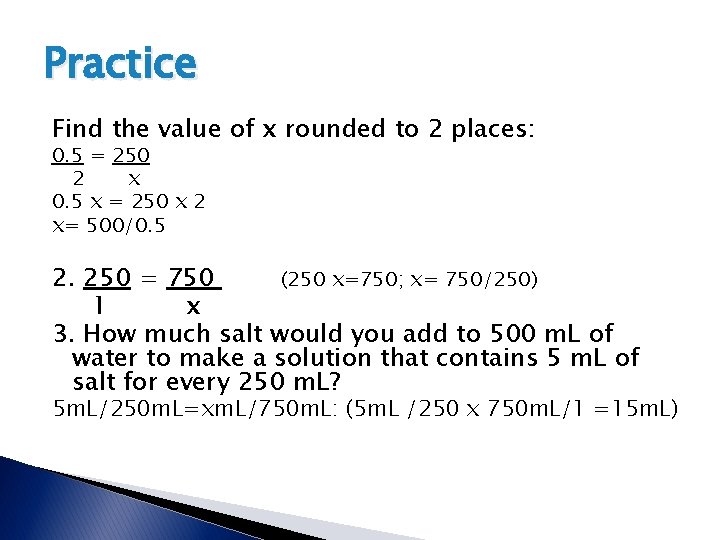
Practice Find the value of x rounded to 2 places: 0. 5 = 250 2 x 0. 5 x = 250 x 2 x= 500/0. 5 2. 250 = 750 (250 x=750; x= 750/250) 1 x 3. How much salt would you add to 500 m. L of water to make a solution that contains 5 m. L of salt for every 250 m. L? 5 m. L/250 m. L=xm. L/750 m. L: (5 m. L /250 x 750 m. L/1 =15 m. L)
Medical Calculations IV Therapy
Calculating IV Rates & Drip Rates • Drips rates need to be calculated to ensure safe delivery of IV fluids • Many are administered via a pump • To calculate manually you need to determine the hourly rate and then calculate the gtt/min to obtain the necessary rate
IV Calculations For infusion pump: Flow Rate (ml/hr) = Total infusion (ml) Hours of infusion 1000 ml/ 8 hr= 125 ml/hr Calculating based on drop factor: X gtt/min = amount of soln (ml) X drop factor time in min
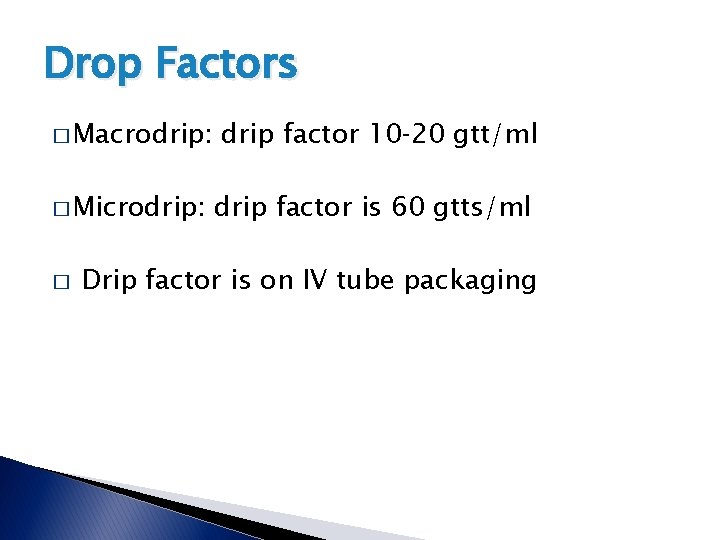
Drop Factors � Macrodrip: � Microdrip: � drip factor 10‐ 20 gtt/ml drip factor is 60 gtts/ml Drip factor is on IV tube packaging
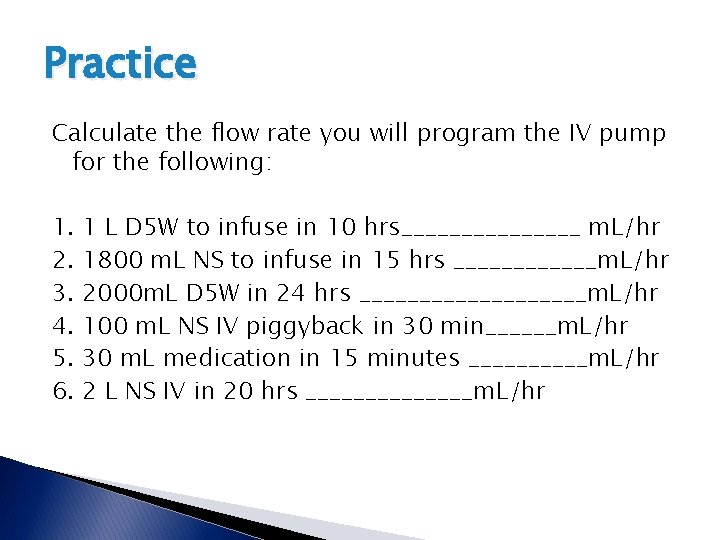
Practice Calculate the flow rate you will program the IV pump for the following: 1. 2. 3. 4. 5. 6. 1 L D 5 W to infuse in 10 hrs________ m. L/hr 1800 m. L NS to infuse in 15 hrs ______m. L/hr 2000 m. L D 5 W in 24 hrs __________m. L/hr 100 m. L NS IV piggyback in 30 min______m. L/hr 30 m. L medication in 15 minutes _____m. L/hr 2 L NS IV in 20 hrs _______m. L/hr
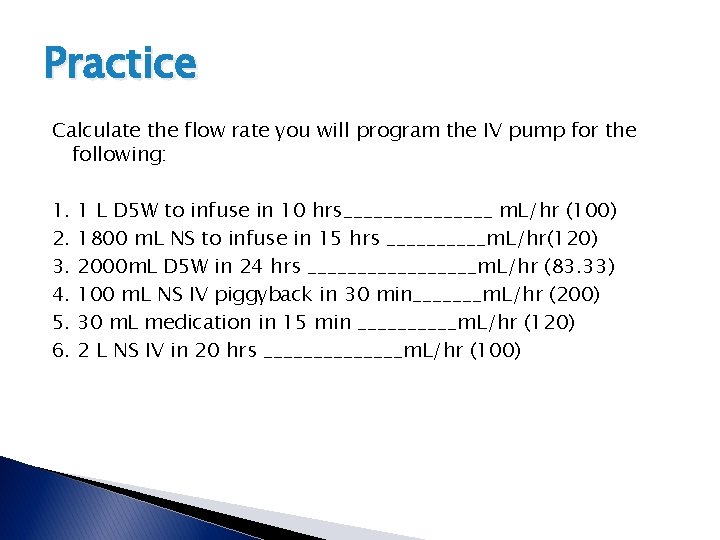
Practice Calculate the flow rate you will program the IV pump for the following: 1. 2. 3. 4. 5. 6. 1 L D 5 W to infuse in 10 hrs________ m. L/hr (100) 1800 m. L NS to infuse in 15 hrs _____m. L/hr(120) 2000 m. L D 5 W in 24 hrs _________m. L/hr (83. 33) 100 m. L NS IV piggyback in 30 min_______m. L/hr (200) 30 m. L medication in 15 min _____m. L/hr (120) 2 L NS IV in 20 hrs _______m. L/hr (100)
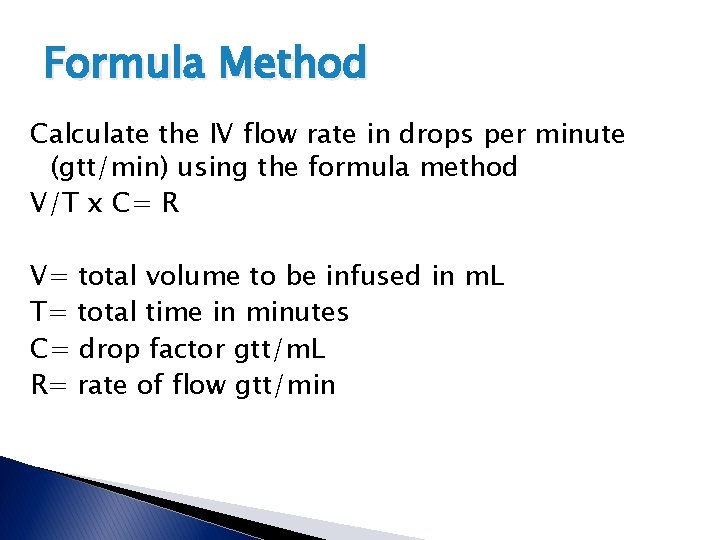
Formula Method Calculate the IV flow rate in drops per minute (gtt/min) using the formula method V/T x C= R V= total volume to be infused in m. L T= total time in minutes C= drop factor gtt/m. L R= rate of flow gtt/min
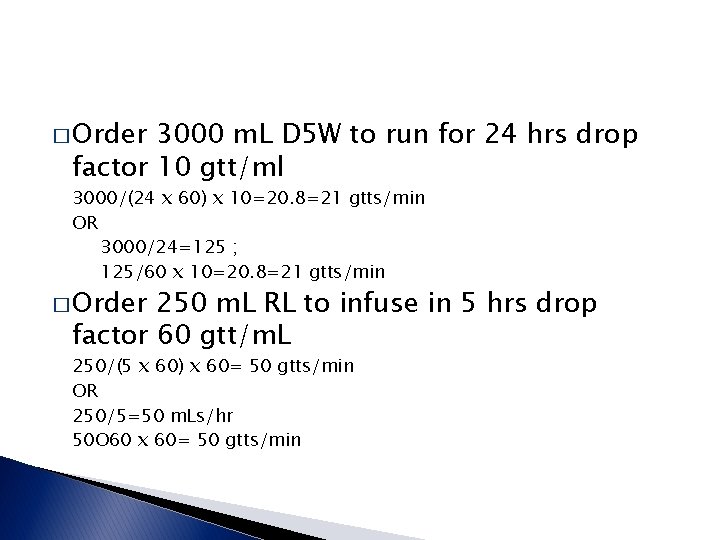
� Order 3000 m. L D 5 W to run for 24 hrs drop factor 10 gtt/ml 3000/(24 x 60) x 10=20. 8=21 gtts/min OR 3000/24=125 ; 125/60 x 10=20. 8=21 gtts/min � Order 250 m. L RL to infuse in 5 hrs drop factor 60 gtt/m. L 250/(5 x 60) x 60= 50 gtts/min OR 250/5=50 m. Ls/hr 50 O 60 x 60= 50 gtts/min
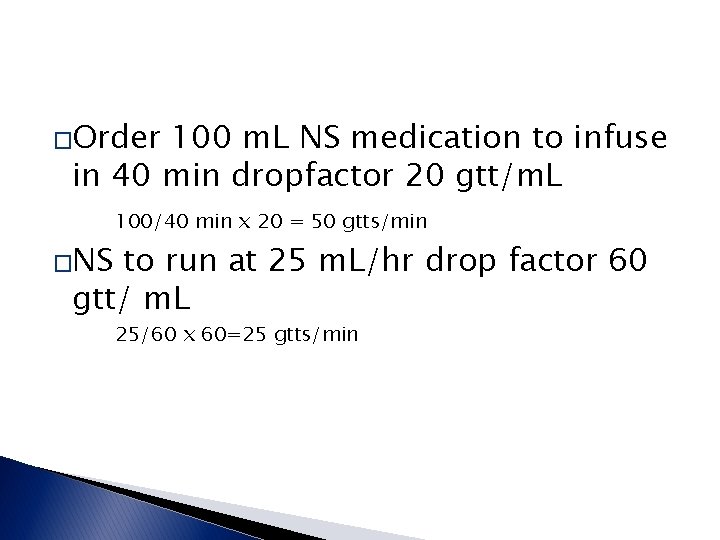
�Order 100 m. L NS medication to infuse in 40 min dropfactor 20 gtt/m. L �NS 100/40 min x 20 = 50 gtts/min to run at 25 m. L/hr drop factor 60 gtt/ m. L 25/60 x 60=25 gtts/min
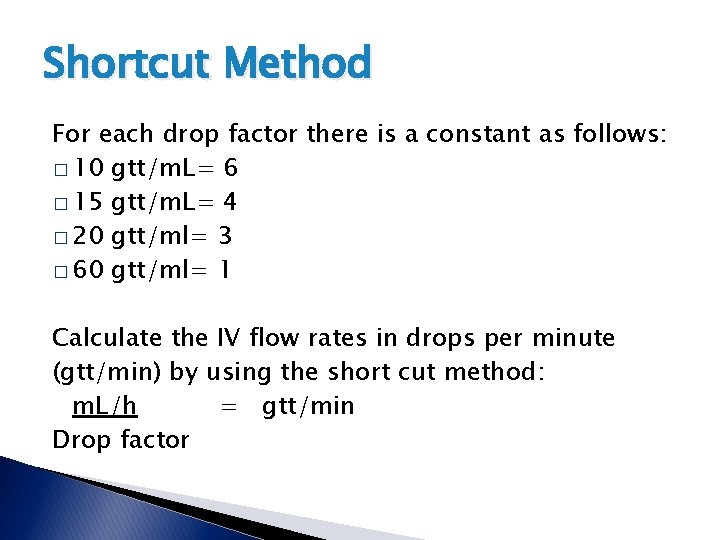
Shortcut Method For each drop factor there is a constant as follows: � 10 gtt/m. L= 6 � 15 gtt/m. L= 4 � 20 gtt/ml= 3 � 60 gtt/ml= 1 Calculate the IV flow rates in drops per minute (gtt/min) by using the short cut method: m. L/h = gtt/min Drop factor
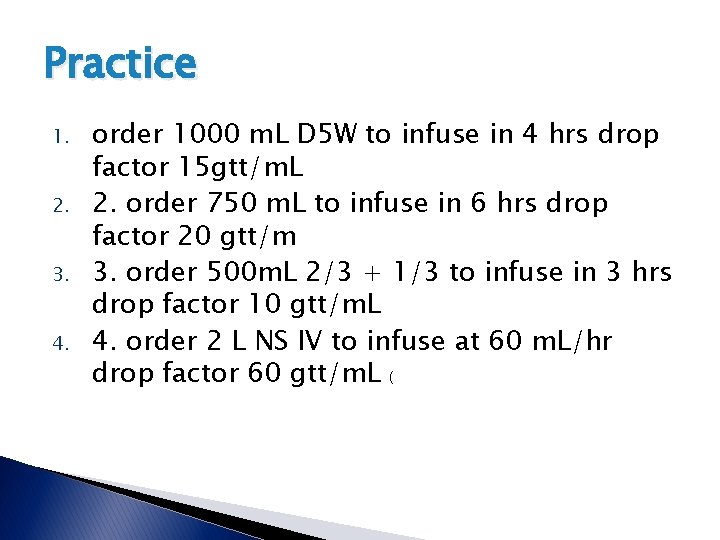
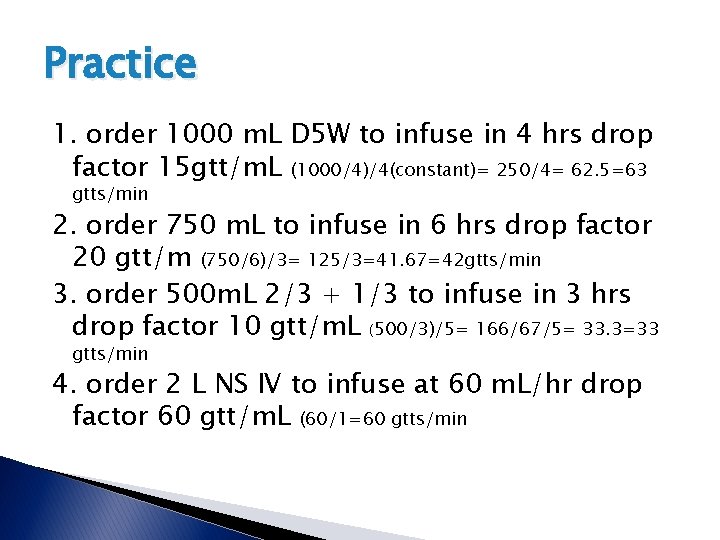
Practice 1. 2. 3. 4. order 1000 m. L D 5 W to infuse in 4 hrs drop factor 15 gtt/m. L 2. order 750 m. L to infuse in 6 hrs drop factor 20 gtt/m 3. order 500 m. L 2/3 + 1/3 to infuse in 3 hrs drop factor 10 gtt/m. L 4. order 2 L NS IV to infuse at 60 m. L/hr drop factor 60 gtt/m. L (
Practice 1. order 1000 m. L D 5 W to infuse in 4 hrs drop factor 15 gtt/m. L (1000/4)/4(constant)= 250/4= 62. 5=63 gtts/min 2. order 750 m. L to infuse in 6 hrs drop factor 20 gtt/m (750/6)/3= 125/3=41. 67=42 gtts/min 3. order 500 m. L 2/3 + 1/3 to infuse in 3 hrs drop factor 10 gtt/m. L (500/3)/5= 166/67/5= 33. 3=33 gtts/min 4. order 2 L NS IV to infuse at 60 m. L/hr drop factor 60 gtt/m. L (60/1=60 gtts/min
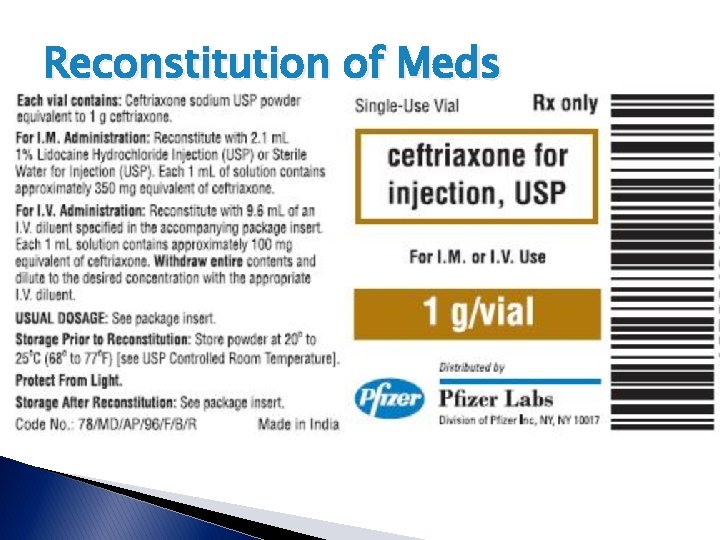
Reconstitution of Meds
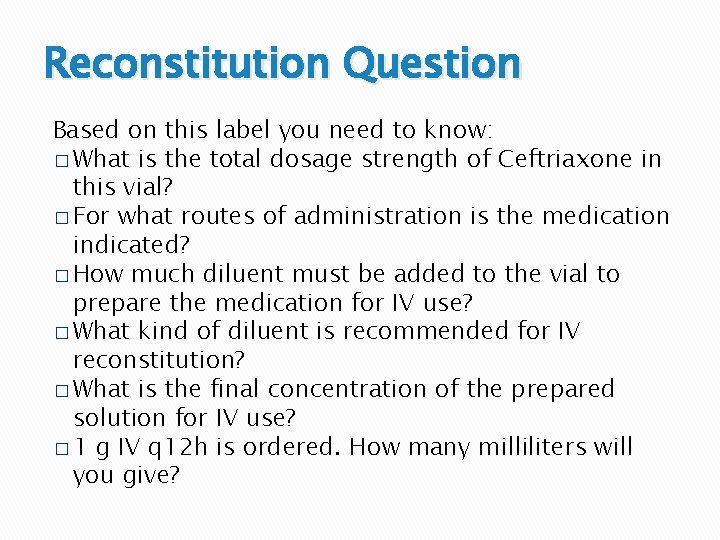
Reconstitution Question Based on this label you need to know: � What is the total dosage strength of Ceftriaxone in this vial? � For what routes of administration is the medication indicated? � How much diluent must be added to the vial to prepare the medication for IV use? � What kind of diluent is recommended for IV reconstitution? � What is the final concentration of the prepared solution for IV use? � 1 g IV q 12 h is ordered. How many milliliters will you give?
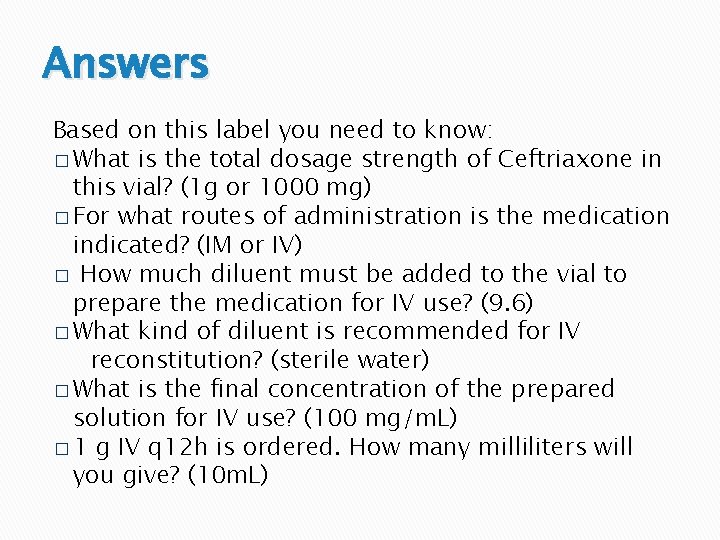
Answers Based on this label you need to know: � What is the total dosage strength of Ceftriaxone in this vial? (1 g or 1000 mg) � For what routes of administration is the medication indicated? (IM or IV) � How much diluent must be added to the vial to prepare the medication for IV use? (9. 6) � What kind of diluent is recommended for IV reconstitution? (sterile water) � What is the final concentration of the prepared solution for IV use? (100 mg/m. L) � 1 g IV q 12 h is ordered. How many milliliters will you give? (10 m. L)
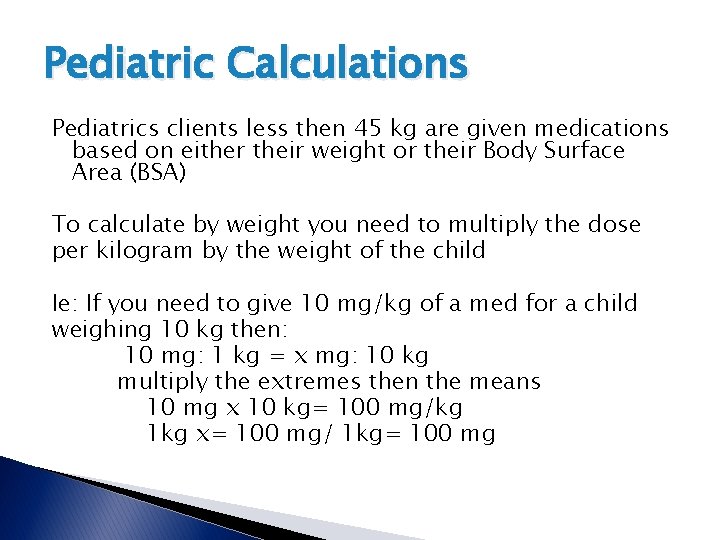
Pediatric Calculations Pediatrics clients less then 45 kg are given medications based on either their weight or their Body Surface Area (BSA) To calculate by weight you need to multiply the dose per kilogram by the weight of the child Ie: If you need to give 10 mg/kg of a med for a child weighing 10 kg then: 10 mg: 1 kg = x mg: 10 kg multiply the extremes then the means 10 mg x 10 kg= 100 mg/kg 1 kg x= 100 mg/ 1 kg= 100 mg
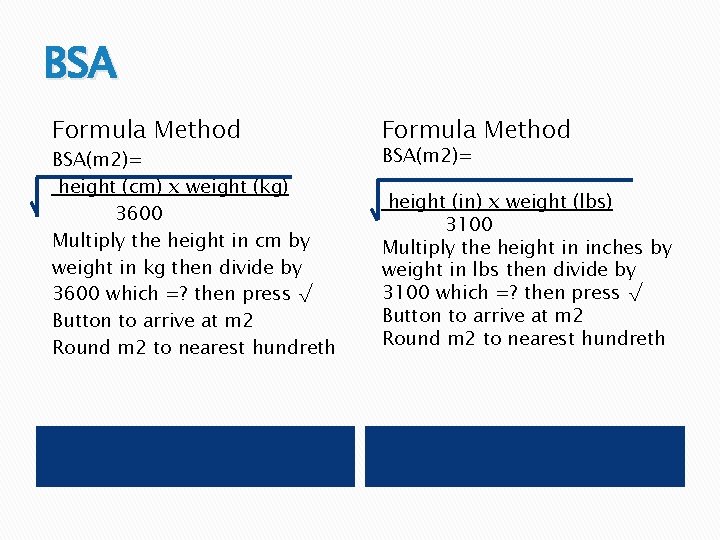
BSA Formula Method BSA(m 2)= height (cm) x weight (kg) 3600 Multiply the height in cm by weight in kg then divide by 3600 which =? then press √ Button to arrive at m 2 Round m 2 to nearest hundreth Formula Method BSA(m 2)= height (in) x weight (lbs) 3100 Multiply the height in inches by weight in lbs then divide by 3100 which =? then press √ Button to arrive at m 2 Round m 2 to nearest hundreth
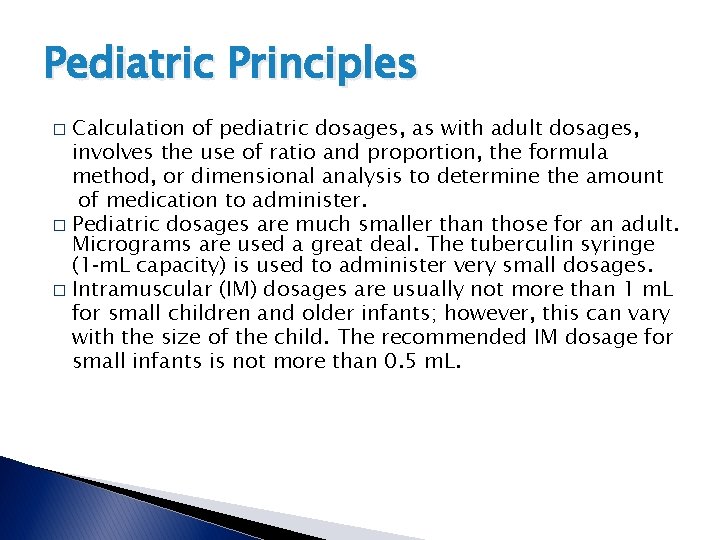
Pediatric Principles Calculation of pediatric dosages, as with adult dosages, involves the use of ratio and proportion, the formula method, or dimensional analysis to determine the amount of medication to administer. � Pediatric dosages are much smaller than those for an adult. Micrograms are used a great deal. The tuberculin syringe (1‐m. L capacity) is used to administer very small dosages. � Intramuscular (IM) dosages are usually not more than 1 m. L for small children and older infants; however, this can vary with the size of the child. The recommended IM dosage for small infants is not more than 0. 5 m. L. �
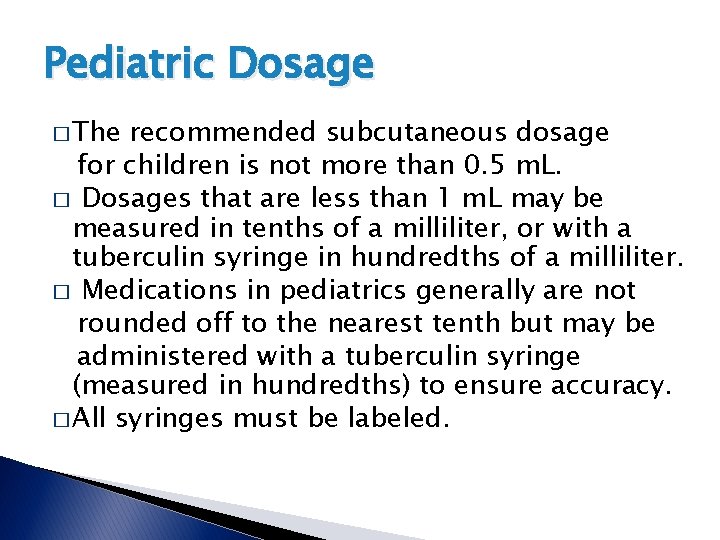
Pediatric Dosage � The recommended subcutaneous dosage for children is not more than 0. 5 m. L. � Dosages that are less than 1 m. L may be measured in tenths of a milliliter, or with a tuberculin syringe in hundredths of a milliliter. � Medications in pediatrics generally are not rounded off to the nearest tenth but may be administered with a tuberculin syringe (measured in hundredths) to ensure accuracy. � All syringes must be labeled.
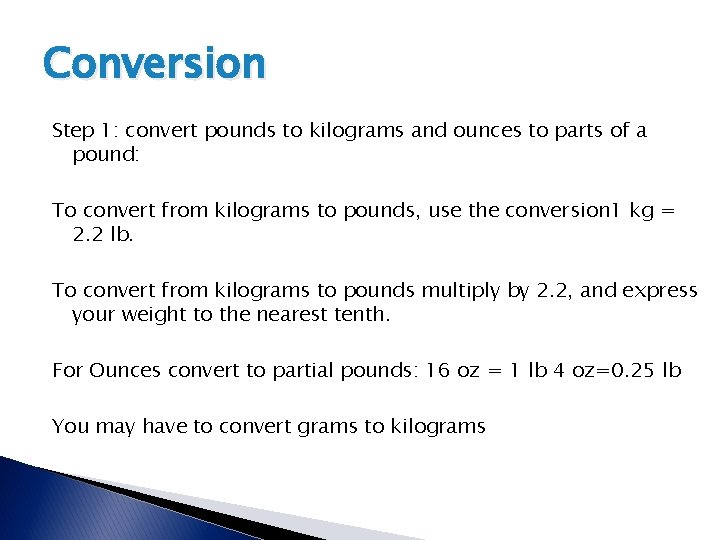
Conversion Step 1: convert pounds to kilograms and ounces to parts of a pound: To convert from kilograms to pounds, use the conversion 1 kg = 2. 2 lb. To convert from kilograms to pounds multiply by 2. 2, and express your weight to the nearest tenth. For Ounces convert to partial pounds: 16 oz = 1 lb 4 oz=0. 25 lb You may have to convert grams to kilograms
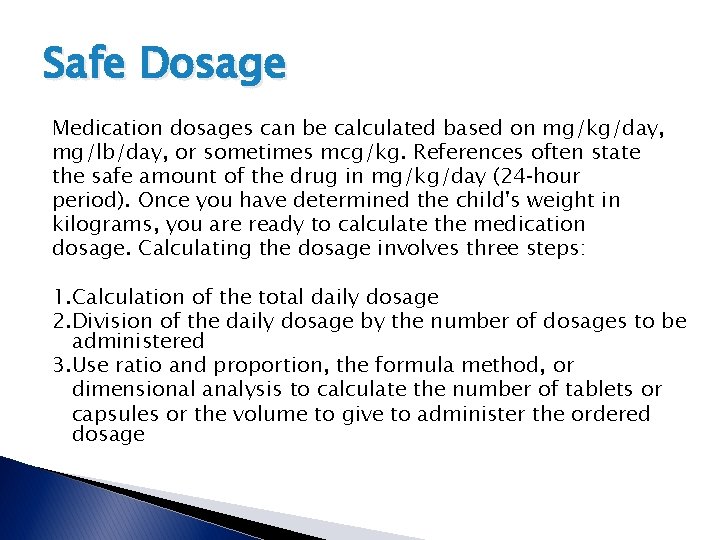
Safe Dosage Medication dosages can be calculated based on mg/kg/day, mg/lb/day, or sometimes mcg/kg. References often state the safe amount of the drug in mg/kg/day (24‐hour period). Once you have determined the child's weight in kilograms, you are ready to calculate the medication dosage. Calculating the dosage involves three steps: 1. Calculation of the total daily dosage 2. Division of the daily dosage by the number of dosages to be administered 3. Use ratio and proportion, the formula method, or dimensional analysis to calculate the number of tablets or capsules or the volume to give to administer the ordered dosage
Example
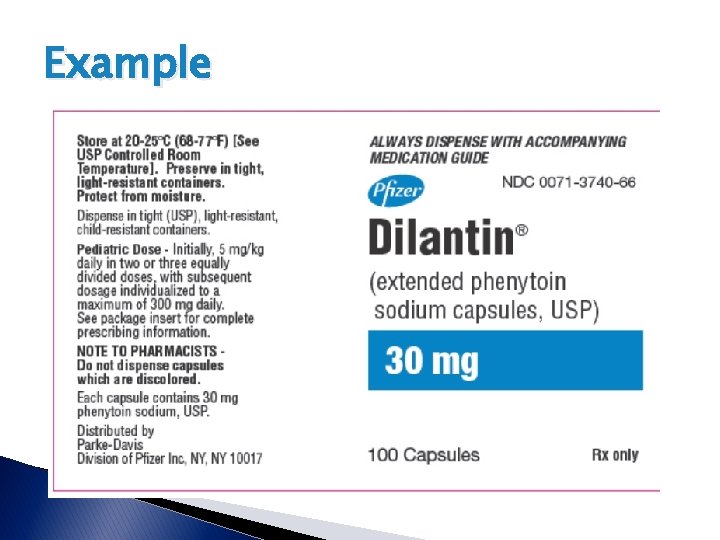
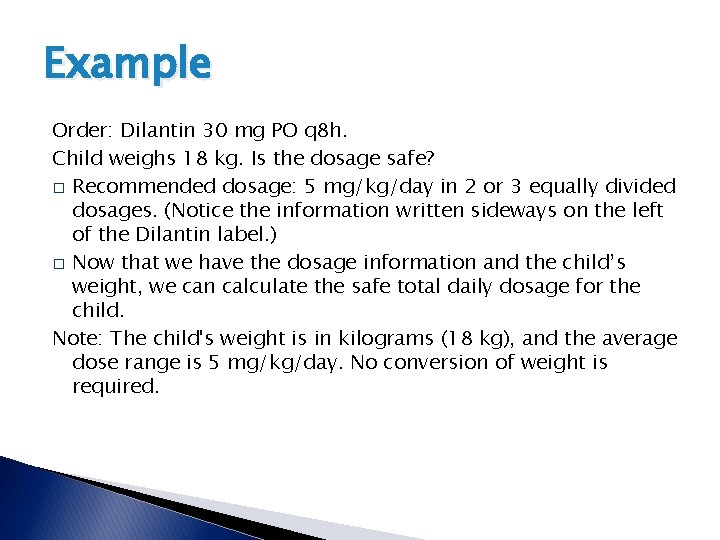
Example Order: Dilantin 30 mg PO q 8 h. Child weighs 18 kg. Is the dosage safe? � Recommended dosage: 5 mg/kg/day in 2 or 3 equally divided dosages. (Notice the information written sideways on the left of the Dilantin label. ) � Now that we have the dosage information and the child’s weight, we can calculate the safe total daily dosage for the child. Note: The child's weight is in kilograms (18 kg), and the average dose range is 5 mg/kg/day. No conversion of weight is required.
Calculating Safe Dose � � Start by calculating the safe total daily dosage for this child. Multiply the recommended dosage in milligrams by the child's weight in kilograms. The safe dosage for this child (total) is 90 mg/day. Now determine the amount of each dosage. The dosage is to be given in three equally divided dosages. Therefore: 90/3 = 30 mg per dose After calculating the safe dosage for a child, you can assess whether what the prescriber ordered is a safe dosage. The order is 30 mg Q 8 H= 24/8= 3 doses, 30 mg x 3= 90 mg= Safe Dose
How to Calculate Titrations This Is a quick way to calculate titrations 1. 2. Look at the units of measures in the order ( this is usually stated that you will give X units of measure/ min or hr) and the units of measure on medication in the IV bag ( this will say X units of measure in X m. L of solution). Convert these so that they are the same. Make sure you have the correct number of decimal point!!!! Look at the order or rate you are to infuse the medication. If the dose is dependent on the patient’s weight, figure out the number of units of medication the patient will get for their weight. This may mean converting lbs to kg. This will now give you the measurement of medication you must give. It may be /min or it may be/hr
How to Calculate Titrations 3. 4. If it is units of measure/min, you must then multiply this by 60 min. This is now your rate/hr and is your DD (Desired dose). Take your DD from step 3 , divide it by the converted units of measure from step 1 that is in the IV solution (this is you DH, dose on hand) and multiply by the volume (which is the number of m. L in the IV bag supplied.