
MAT 2720 Discrete Mathematics Section 2 5 Strong
- Slides: 18
MAT 2720 Discrete Mathematics Section 2. 5 Strong Induction http: //myhome. spu. edu/lauw
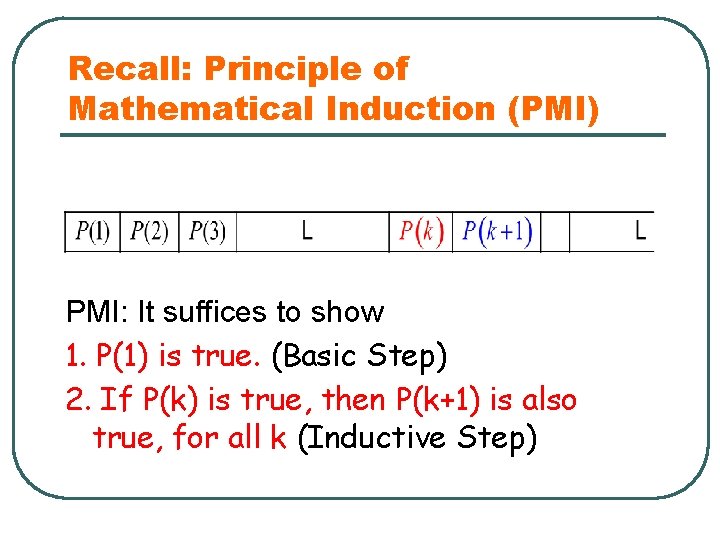
Recall: Principle of Mathematical Induction (PMI) PMI: It suffices to show 1. P(1) is true. (Basic Step) 2. If P(k) is true, then P(k+1) is also true, for all k (Inductive Step)
Goals l Principle of Strong Induction (PSI) • Why? When P(k) alone is not sufficient to • prove P(k+1). How? Use P(k-1), P(k-2), …etc.
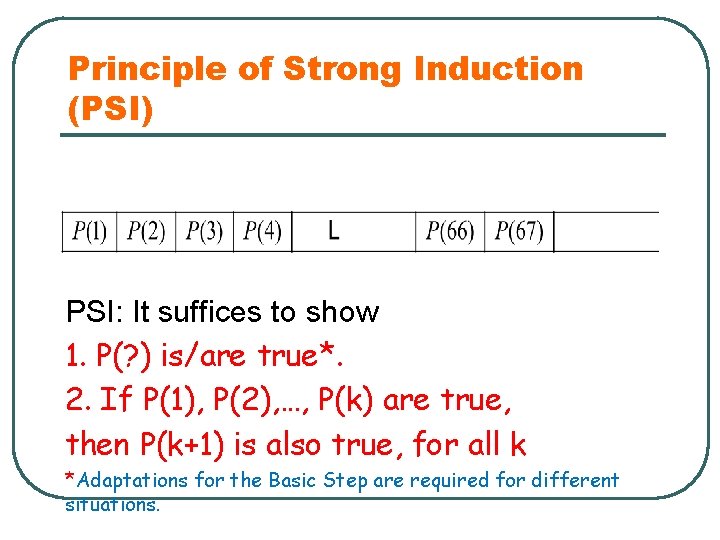
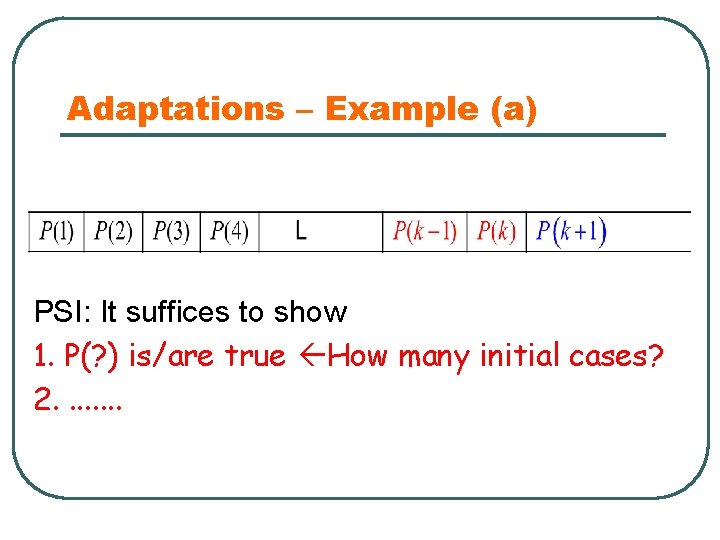
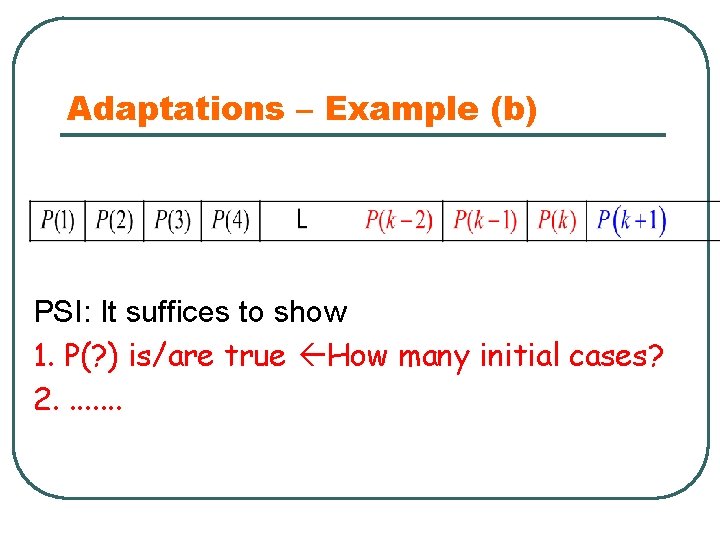
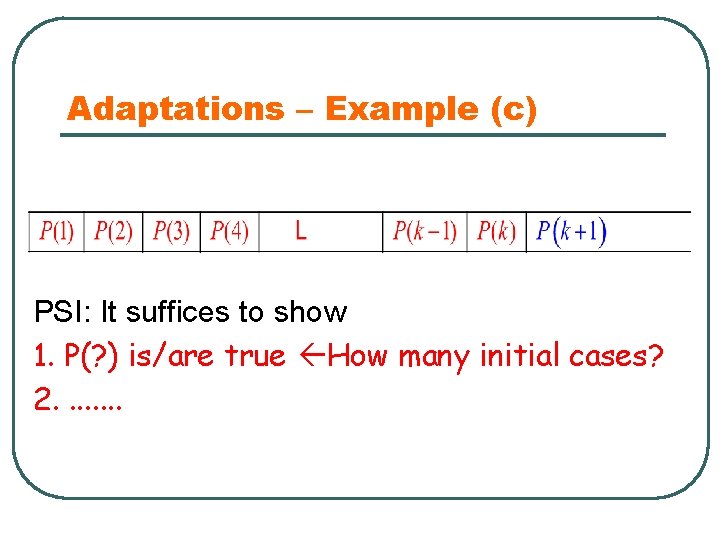
Principle of Strong Induction (PSI) PSI: It suffices to show 1. P(? ) is/are true*. 2. If P(1), P(2), …, P(k) are true, then P(k+1) is also true, for all k *Adaptations for the Basic Step are required for different situations.
Adaptations – Example (a) PSI: It suffices to show 1. P(? ) is/are true How many initial cases? 2. . . .
Adaptations – Example (b) PSI: It suffices to show 1. P(? ) is/are true How many initial cases? 2. . . .
Adaptations – Example (c) PSI: It suffices to show 1. P(? ) is/are true How many initial cases? 2. . . .
Move to Page 2. . . l To save paper, I squeezed in something at the end of page 1.
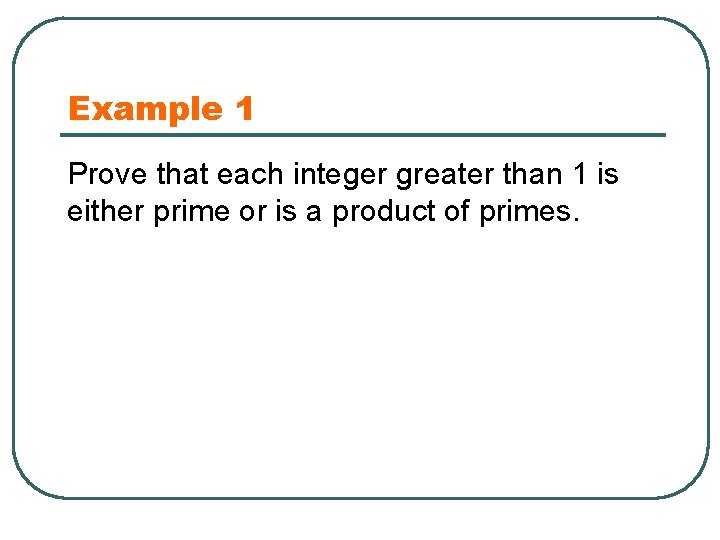
Example 1 Prove that each integer greater than 1 is either prime or is a product of primes.
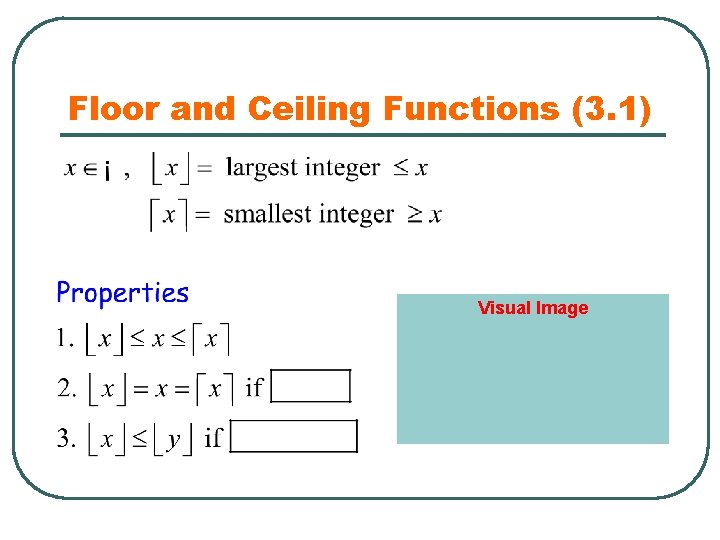
Before our next example, . . . l l We need to make sure everyone have seen the ceiling and floor functions. Typically, you have learned these functions in pre-calculus. They have a lot of applications, especially in CS. Go back to page 1, please.
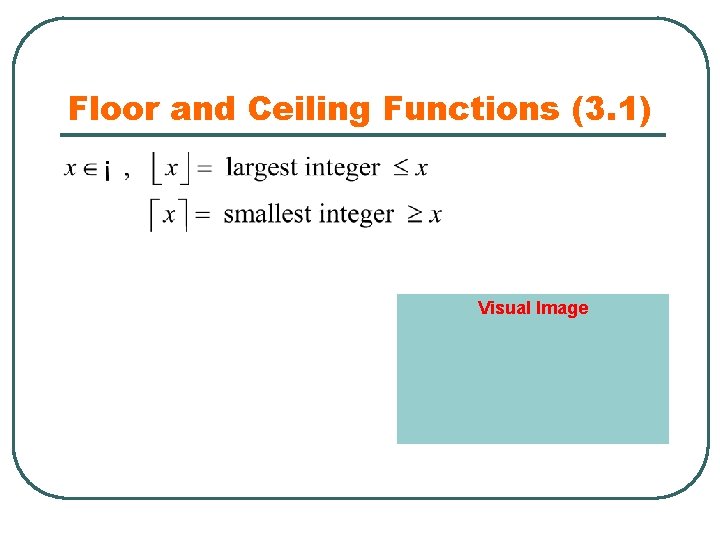
Floor and Ceiling Functions (3. 1) Visual Image
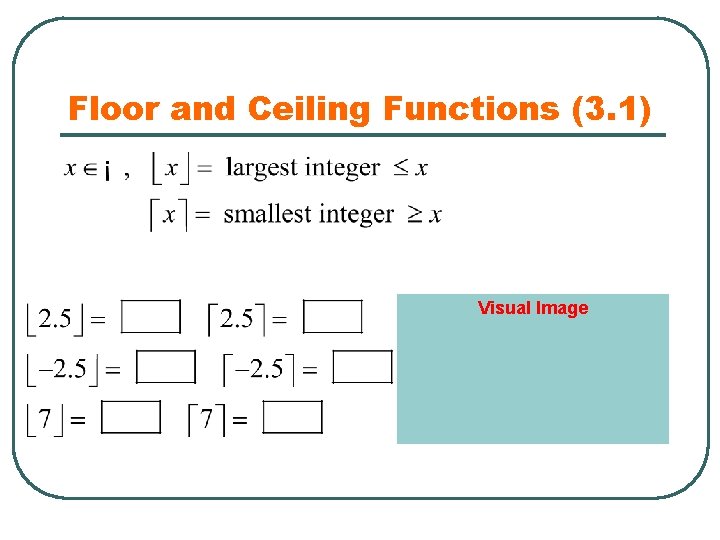
Floor and Ceiling Functions (3. 1) Visual Image
Floor and Ceiling Functions (3. 1) Visual Image
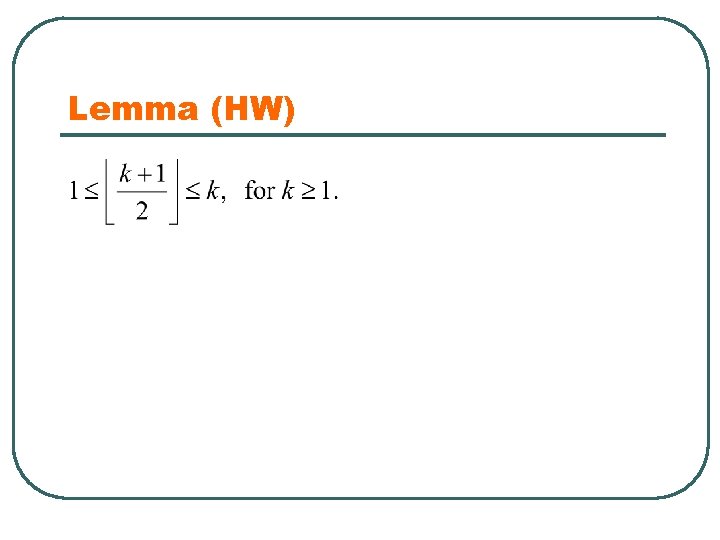
Lemma (HW)
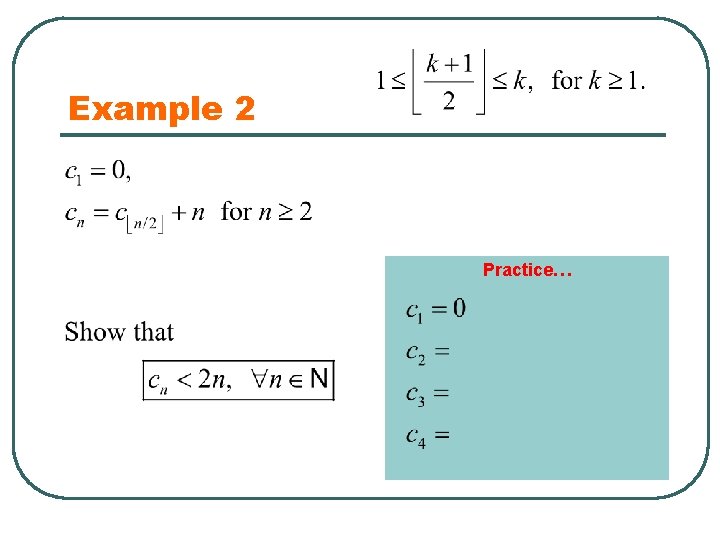
Example 2 Practice…
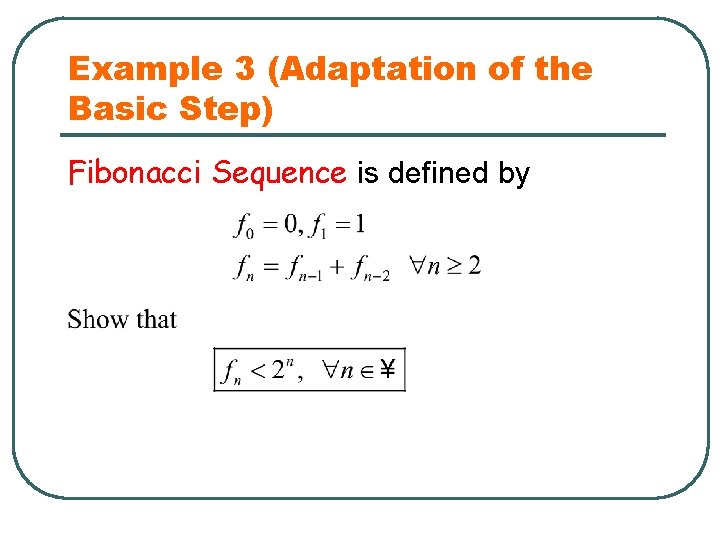
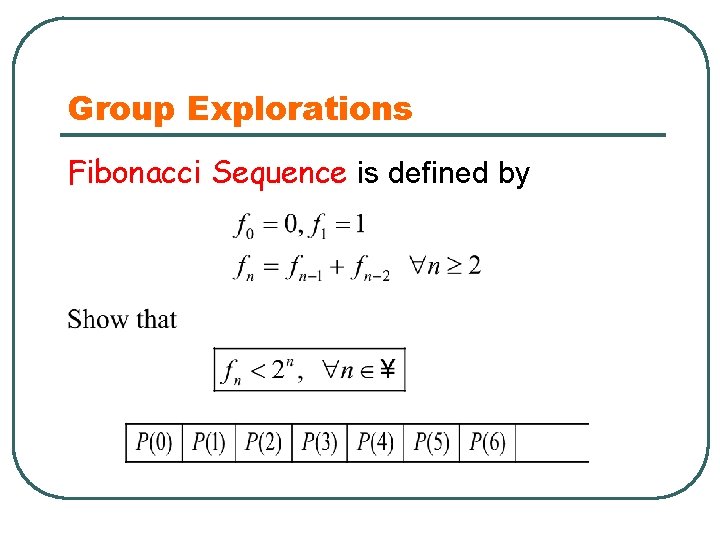
Example 3 (Adaptation of the Basic Step) Fibonacci Sequence is defined by
Group Explorations l l l Some steps are provided. Do the Inductive Step first. Decide how many cases you need to prove in the Basic Step.
Group Explorations Fibonacci Sequence is defined by