MANAGEMENT LEGAL IMPLICATIONS OF e COMMERCE Defamation on
- Slides: 55
MANAGEMENT & LEGAL IMPLICATIONS OF e. COMMERCE Defamation on the Internet “Defamation”, Arts Law Centre [Online: Accessed 4 th February 2004 URL: http: //artslaw. com. au/reference/info 05/ ] “Gutnick and Beyond”, Find. Law [Online: accessed: 28 th May 2003 URL: http: //www. findlaw. com. au/magazine/Article. asp? id=428 ]
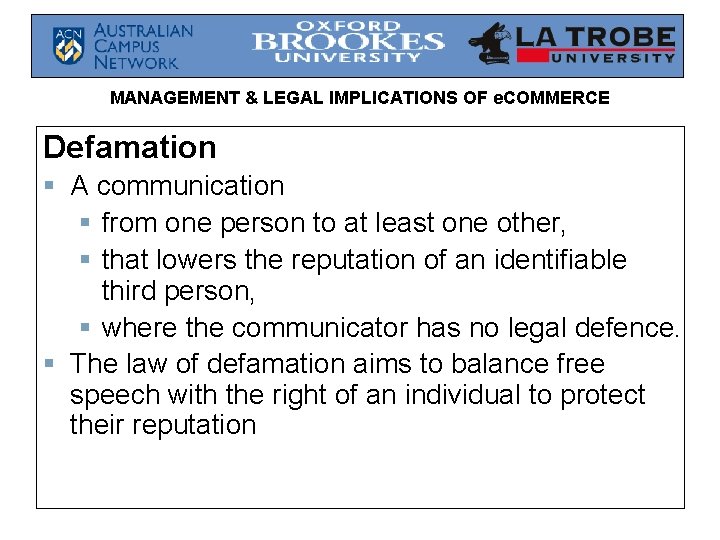
MANAGEMENT & LEGAL IMPLICATIONS OF e. COMMERCE Defamation § A communication § from one person to at least one other, § that lowers the reputation of an identifiable third person, § where the communicator has no legal defence. § The law of defamation aims to balance free speech with the right of an individual to protect their reputation
MANAGEMENT & LEGAL IMPLICATIONS OF e. COMMERCE Communication § Must be made ('published') to at least one person other than the plaintiff. § The intention of the communicator does not matter. Liability for defamation can arise from errors. § Everyone involved in the communication is equally liable § No defence to argue that you are only repeating rumours or a comment made by somebody else
MANAGEMENT & LEGAL IMPLICATIONS OF e. COMMERCE Identification § The person must be identified § False names are no defence if the person can be identified by other means. § Identification can be accidental § A class of people cannot be defamed, but a statement denigrating a group may be defamatory of a member of that group § A dead person cannot be defamed § Corporations can also sue for defamation.
MANAGEMENT & LEGAL IMPLICATIONS OF e. COMMERCE Reputation § 'Does the communication lower the plaintiff's personal or professional reputation, ridicule them, or lead others to shun and avoid them? ‘ § This is judged from the viewpoint of 'ordinary decent people in the community taken in general' and in light of contemporary standards.
MANAGEMENT & LEGAL IMPLICATIONS OF e. COMMERCE Imputations § Court considers the 'imputation', this might not be what you meant to say. § The literal meaning of the communication is not the only meaning that is considered. § The court looks at what it thinks the ordinary reader or viewer would have understood the communication to mean.
MANAGEMENT & LEGAL IMPLICATIONS OF e. COMMERCE Defences § Fair comment § Truth/Justification § Qualified privilege § Absolute privilege § Innocent publication
MANAGEMENT & LEGAL IMPLICATIONS OF e. COMMERCE Fair Comment § Statement is 'fair comment' on a matter of public interest. § Must prove: § It is comment - an opinion, criticism, deduction, judgment, remark, observation, or conclusion § The facts upon which the comment is based must be stated unless they are widely known § The communication has to be on a matter of public interest
MANAGEMENT & LEGAL IMPLICATIONS OF e. COMMERCE Justification § If your imputation is found to be defamatory, the law presumes it to be false. § To use this defence you have to prove it's true. § This can be difficult as you can only use evidence that is admissible in court § In some states you also have to prove that your publication was for the public benefit
MANAGEMENT & LEGAL IMPLICATIONS OF e. COMMERCE Qualified Privilege § Applies when you have an interest or a legal, social or moral duty to communicate something to a person and that person has a corresponding interest or duty to receive the information. § The defence will fail if you were actually motivated by malice to make the communication
MANAGEMENT & LEGAL IMPLICATIONS OF e. COMMERCE Absolute Privilege § Protects reports of court and parliamentary proceedings Innocent Publication § For those such as newsagents (and possibly ISP’s) who cannot reasonably be expected to be aware of the defamatory content of material they distribute
MANAGEMENT & LEGAL IMPLICATIONS OF e. COMMERCE Before you publish § Consider the communication as a whole including any headlines or illustrations. Consider the context. Which groups or individuals have been identified? What imputations arise? Are they defamatory? § See if editing or clarification can remove any unintended defamatory imputations; § Check who is identified in the communication. Potential problems can be avoided by narrowing the scope of the article, or removing details that can lead to identification;
MANAGEMENT & LEGAL IMPLICATIONS OF e. COMMERCE Before you publish (cont. ) § What defences might be relevant? If it is meant to be comment, ensure that it is clearly identified as such (for example by adding 'In my opinion‘) and that the facts on which it is based are stated or obvious; § If you want to argue that the defamatory imputations are true, how can they be proved? What has been done to verify their accuracy? Remember proof has to be to the stringent standards demanded by a court. Sources need to be first hand (what if they wish to remain confidential? ).
MANAGEMENT & LEGAL IMPLICATIONS OF e. COMMERCE Defamation Dow Jones v Gutnik – High Court of Australia § The law governing Internet defamation cases is the same as for other types of media. § If a defamation case involves more than one jurisdiction, the Court will apply the law of the place in which the cause of action arose. § Each time a new person accesses and reads defamatory material on a web site, a new cause of action arises and the place in which each case of action arises is the place of the reader. § Discussed in Forder & Quirk at pp 36 & 37
MANAGEMENT & LEGAL IMPLICATIONS OF e. COMMERCE Defamation (cont. ) § An Internet publisher will need to consider the law in many jurisdictions § Freedom of Speech defences may not apply § Conflicts in international law § US decisions that each mass media publication gives rise to only one cause of action and that the applicable law is that of the place of person that publishes the material.
MANAGEMENT & LEGAL IMPLICATIONS OF e. COMMERCE Cyber. Crime See: Brenner Susan W, 2001, “Cybercrime Investigation and Prosecution: The Role of Penal and Procedural Law”, [Online: Accessed 3 February 2004 URL: http: //www. murdoch. edu. au/elaw/issues/v 8 n 2/brenner 82. txt ]
MANAGEMENT & LEGAL IMPLICATIONS OF e. COMMERCE The Cybercrime Challenge § § Enforcement agencies lack tools Lack of specific cybercrime offences Lack of appropriate procedural rules Transnational nature of cybercrime § Lack of international agreement § Lack of uniformity prevents extradition § Offending often involves multiple and geographic diverse offences § High cost
MANAGEMENT & LEGAL IMPLICATIONS OF e. COMMERCE Types of crimes § § Crimes against the person Crimes against property Crimes against the administration of justice Crimes against the State
MANAGEMENT & LEGAL IMPLICATIONS OF e. COMMERCE Preparing for Cybercrime § Most criminal law is generic § Procedural law differs widely § Cybercrime can involve § Using a new means to effect a traditional crime § A completely new type of offending § A survey of 52 countries found that 33 had yet to update their laws to address cybercrime
MANAGEMENT & LEGAL IMPLICATIONS OF e. COMMERCE Crimes Against the Person § Non-Sexual Crimes § Murder § Assault § Threats § Sexual Crimes § Rape § Child pornography § Stalking
MANAGEMENT & LEGAL IMPLICATIONS OF e. COMMERCE Cyberstalking § Facilitated by enormous amount of personal information on the web § Impersonal and anonymous nature of Internet communications remove disincentives for stalking § Cyberstalkers effort is minimal § Difficult to locate, identify and arrest offender § Inflicts psycological but not physical damage § Conflicts with “freedom of speech”
MANAGEMENT & LEGAL IMPLICATIONS OF e. COMMERCE Cyberstalking (cont. ) § When should criminal liability be imposed for creating and disseminating artificial constructs and manipulating information that is freely available about individuals? § This is a "new" criminal § exploits computer technology to achieve results that would not have been achievable in years past. § A nation must maintain a balance between § protecting the safety and security of individuals and § guaranteeing the free dissemination of information and opinion.
MANAGEMENT & LEGAL IMPLICATIONS OF e. COMMERCE Crimes Against Property § § § Theft Forgery Fraud Malicious damage Hacking
MANAGEMENT & LEGAL IMPLICATIONS OF e. COMMERCE Theft § § Unlawfully taking property That belongs to another So as to deprive the owner of its use By § § § Carrying it away (larceny) Using force (robbery) Deception (fraud) Breaking & entering (burglary) Exploiting a position of trust (embezzlement)
MANAGEMENT & LEGAL IMPLICATIONS OF e. COMMERCE Theft (cont. ) § The law has had difficulty in reconciling the use of new technology with theft offences e. g. § “joy riding” in cars) § Cheques § Electronic funds § Cybertheft relies on the electronic transmission and manipulation of data-rather than acts and communications effected in the "real world“ § Cybertheft is traditional theft accomplished by rather non-traditional means
MANAGEMENT & LEGAL IMPLICATIONS OF e. COMMERCE Theft (cont. ) § Real world theft is a zero sum offence - the sole possession and use of property is transferred from the rightful owner to the thief. § Cybertheft may only involve copying information § Both the owner and the thief now have the information § The owner has lost value due to loss of exclusive use of the information
MANAGEMENT & LEGAL IMPLICATIONS OF e. COMMERCE Forgery § Using a computer to forge: § paper documents § Electronic documents § Same offence – new means § No new penal laws required
MANAGEMENT & LEGAL IMPLICATIONS OF e. COMMERCE Hacking § Analogous to traditional law of trespass § Difficulties with § Consent § Virtual worlds Requires specific penal laws § Hactivism § Analogous to vandalism § More damage caused § Is it free speech?
MANAGEMENT & LEGAL IMPLICATIONS OF e. COMMERCE Denial of Service § Cannot be prosecuted as: § Vandalism § Theft § Requires new penal laws
MANAGEMENT & LEGAL IMPLICATIONS OF e. COMMERCE Crimes Against Administration of Justice § § § Generating false evidence Altering court records Threatening judges, law enforcement officials etc. False reports of crime Impersonating police officers etc. Mostly, computer technology is simply a tool that is used to commit an existing offence
MANAGEMENT & LEGAL IMPLICATIONS OF e. COMMERCE Crimes Against Administration of Justice § Two new types of offending § Cybervigilantism § Raises similar issues to cyberstalking § Threats § Conflict with “freedom of speech” § Virtual activities may not be seen as a direct threat § Compilation of publicly available material
MANAGEMENT & LEGAL IMPLICATIONS OF e. COMMERCE Crimes Against the State § § Treason Espionage Sabotage Terrorism § One man’s terrorist is another man’s freedom fighter § Counterfeiting
MANAGEMENT & LEGAL IMPLICATIONS OF e. COMMERCE Procedural Laws § § Jurisdiction Place of offence Extradition Search and Seizure laws § What is a legal search in one country may not be in another § Often only cover tangible evidence
MANAGEMENT & LEGAL IMPLICATIONS OF e. COMMERCE International Agreements § The Council of Europe's Draft Convention on Cyber-Crime seeks "to improve the means to prevent and suppress computer- or computer related crime by establishing a common minimum standard of relevant offences. " § The convention proposed by the Center for International Security and Cooperation (CISAC) has similar provisions
MANAGEMENT & LEGAL IMPLICATIONS OF e. COMMERCE International Agreements (cont. ) § The Council of Europe’s convention addresses § § § misuse of computer data and computer systems; computer-related forgery and fraud; child pornography; infringement of copyright provisions governing the imposition of aiding and abetting and corporate liability. ; and § the availability of certain procedures used to investigate cybercrime and apprehend cybercriminals.
MANAGEMENT & LEGAL IMPLICATIONS OF e. COMMERCE The Australian Response Cybercrime Act 2001 § Creates 3 new serious offences § Unauthorised access, modification or impairment with intent to commit a serious offence § Unauthorised modification of data § Unauthorised impairment of electronic communications
MANAGEMENT & LEGAL IMPLICATIONS OF e. COMMERCE Cybercrime Act 2001 (cont. ) § Creates 4 lesser offences § Unauthorised access to, or modification of, restricted data § Unauthorised impairment of data held on a computer disk § Possession or control of data with intent to commit a computer offence § Producing, supplying or obtaining data with intent to commit a computer offence
MANAGEMENT & LEGAL IMPLICATIONS OF e. COMMERCE Cybercrime Act 2001 (cont. ) § increases investigation powers relating to search and seizure of electronically stored data § Defines computer terms e. g. § Access to data § Data held in a computer § Electronic communication § modification § Unauthorised access
MANAGEMENT & LEGAL IMPLICATIONS OF e. COMMERCE Hacker § Originally, an expert programmer § Today, someone who breaks into computers § Types of hackers § White-hat hackers § Black-hat hackers (crackers, dark side hackers) § Elite hackers § Superior technical skills § Very persistent § Often publish their exploits § Samurai – a hacker for hire
MANAGEMENT & LEGAL IMPLICATIONS OF e. COMMERCE § Script-kiddie (packet monkeys, lamerz) § Hacker in training § Disdained by the elite hackers § Phreaker § Person who cracks the telephone network § Insider § Trusted employee turned black-hat hacker § Very dangerous
MANAGEMENT & LEGAL IMPLICATIONS OF e. COMMERCE Password Theft § Easiest way to gain access § User carelessness § Poor passwords § Easily guessed § Dumpster diving § Observation, particularly for insiders § The sticky note on the monitor § Human engineering, or social engineering § Standard patterns (e. g. , Miami University) § Guess the password from the pattern
MANAGEMENT & LEGAL IMPLICATIONS OF e. COMMERCE Password Cracker Software § Available over the Internet § Recover lost passwords § Cracking techniques § Word list or dictionary § Brute force § Hybrid – l. Ophtcrack § Precaution – store encoded passwords
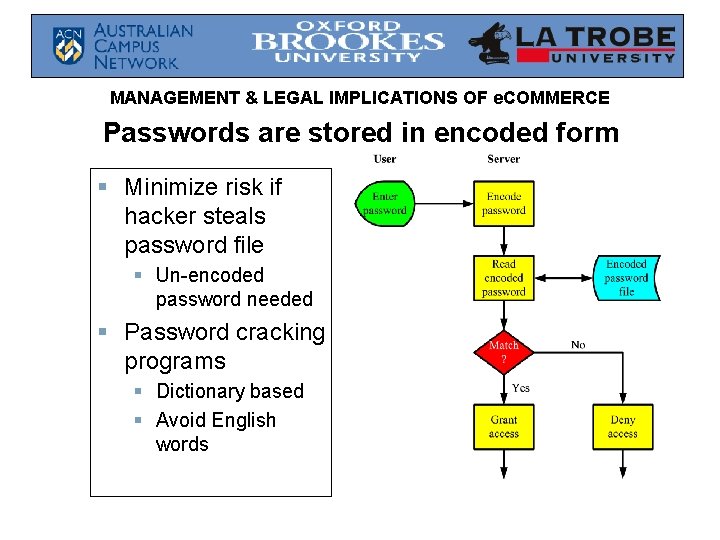
MANAGEMENT & LEGAL IMPLICATIONS OF e. COMMERCE Passwords are stored in encoded form § Minimize risk if hacker steals password file § Un-encoded password needed § Password cracking programs § Dictionary based § Avoid English words
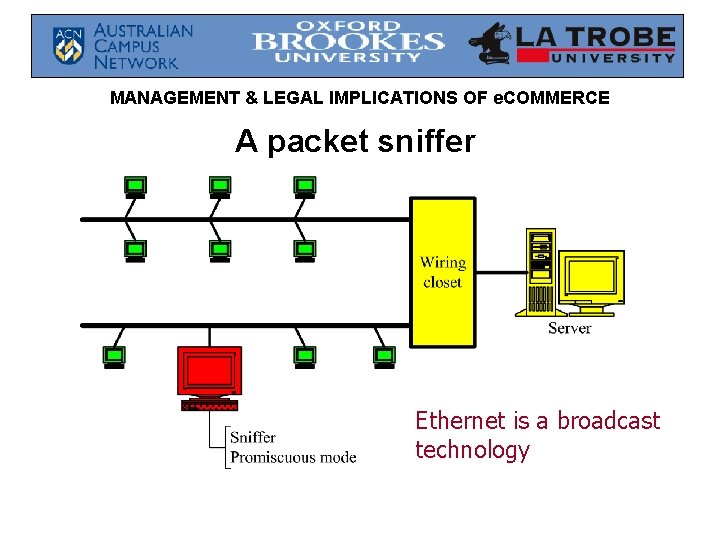
MANAGEMENT & LEGAL IMPLICATIONS OF e. COMMERCE Packet Sniffer § § Software wiretap Captures and analyzes packets Any node between target and Internet Broadcast risk § Ethernet and cable broadcast messages § Set workstation to promiscuous mode § Legitimate uses § Detect intrusions § Monitoring
MANAGEMENT & LEGAL IMPLICATIONS OF e. COMMERCE A packet sniffer Ethernet is a broadcast technology
MANAGEMENT & LEGAL IMPLICATIONS OF e. COMMERCE Backdoor § Undocumented access point § Testing and debugging tool § Common in interactive computer games § Cheats and Easter eggs § Hackers use backdoors to gain access § Programmer fails to close a backdoor § Trojan horse § Inserted by hacker on initial access § Back Orifice – the Cult of the Dead Cow
MANAGEMENT & LEGAL IMPLICATIONS OF e. COMMERCE Potentially Destructive Software § Logic bomb § Potentially very destructive § Time bomb – a variation § Rabbit § Denial of service § Trojan horse § Common source of backdoors
MANAGEMENT & LEGAL IMPLICATIONS OF e. COMMERCE Viruses § Parasite § Requires host program to replicate § Virus hoaxes can be disruptive Worms § Virus-like § Spreads without a host program § Used to collect information § Sysop – terminal status § Hacker – user IDs and passwords
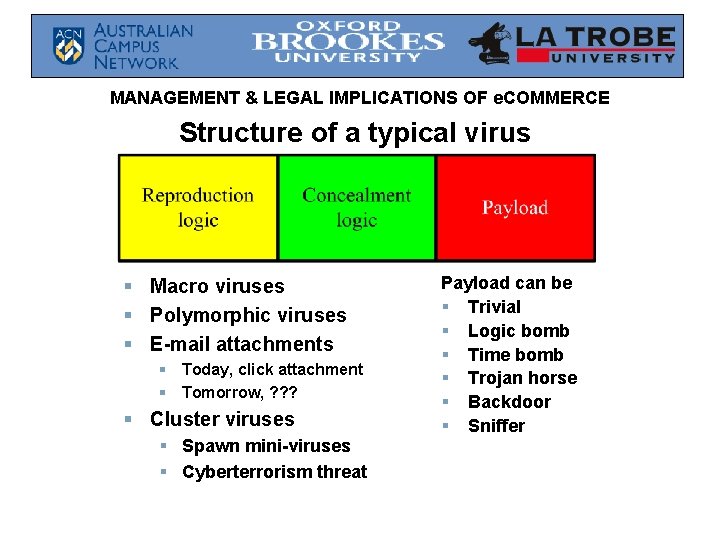
MANAGEMENT & LEGAL IMPLICATIONS OF e. COMMERCE Structure of a typical virus § Macro viruses § Polymorphic viruses § E-mail attachments § Today, click attachment § Tomorrow, ? ? ? § Cluster viruses § Spawn mini-viruses § Cyberterrorism threat Payload can be § Trivial § Logic bomb § Time bomb § Trojan horse § Backdoor § Sniffer
MANAGEMENT & LEGAL IMPLICATIONS OF e. COMMERCE Anti-Virus Software § Virus signature § Uniquely identifies a specific virus § Update virus signatures frequently § Heuristics § Monitor for virus-like activity § Recovery support
MANAGEMENT & LEGAL IMPLICATIONS OF e. COMMERCE System Vulnerabilities § Known security weak points § Default passwords – system initialization § Port scanning § Software bugs § Logical inconsistencies between layers § Published security alerts § War dialer to find vulnerable computer
MANAGEMENT & LEGAL IMPLICATIONS OF e. COMMERCE Denial of Service Attacks (Do. S) § An act of vandalism or terrorism § A favorite of script kiddies § Objective § Send target multiple packets in brief time § Overwhelm target § The ping o’ death § Distributed denial of service attack § Multiple sources
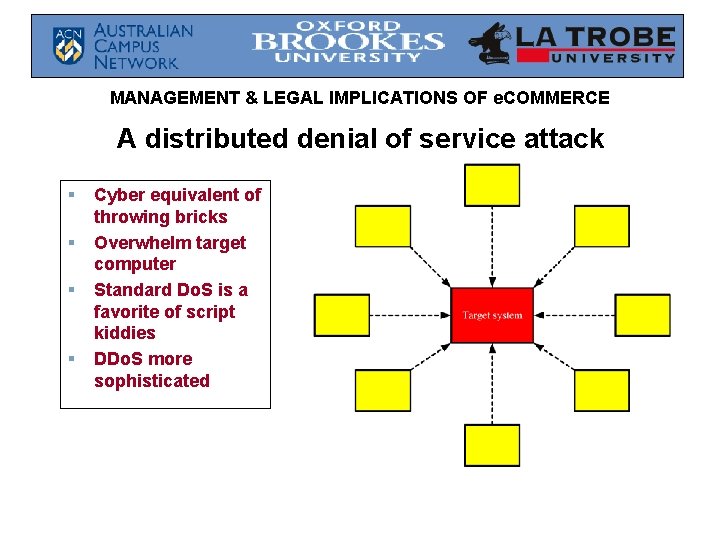
MANAGEMENT & LEGAL IMPLICATIONS OF e. COMMERCE A distributed denial of service attack § § Cyber equivalent of throwing bricks Overwhelm target computer Standard Do. S is a favorite of script kiddies DDo. S more sophisticated
MANAGEMENT & LEGAL IMPLICATIONS OF e. COMMERCE Spoofing § Act of faking key system parameters § DNS spoofing § Alter DNS entry on a server § Redirect packets § IP spoofing § Alter IP address § Smurf attack
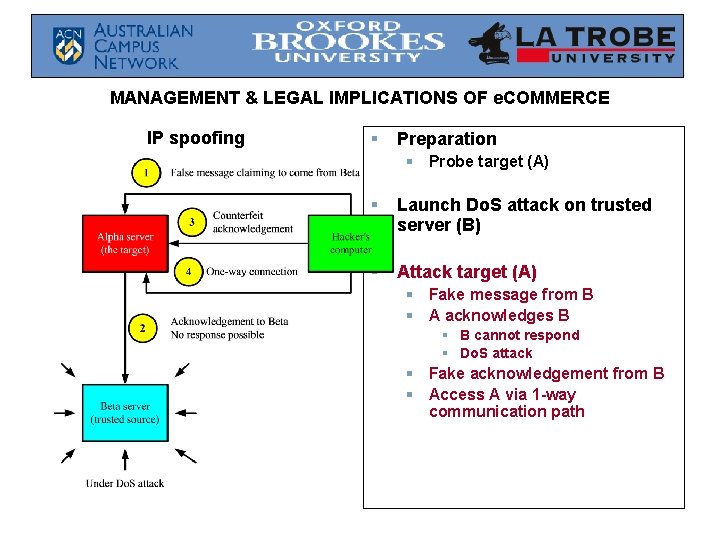
MANAGEMENT & LEGAL IMPLICATIONS OF e. COMMERCE IP spoofing § Preparation § Probe target (A) § Launch Do. S attack on trusted server (B) § Attack target (A) § Fake message from B § A acknowledges B § B cannot respond § Do. S attack § Fake acknowledgement from B § Access A via 1 -way communication path