M 2 M Service Session Management SSM CSF
- Slides: 18
M 2 M Service Session Management (SSM) CSF Group Name: WG 2 -ARC Source: IDCC, LGE, ZTE Meeting Date: TP 8 Agenda Item:
Outline • M 2 M Service Session Management (SSM) CSF – – SSM CSF capabilities SSM resources SSM stage-2 message flows Relationship of SSM with other CSFs © 2013 one. M 2 M Partners one. M 2 M-ARC-0397 R 01 2
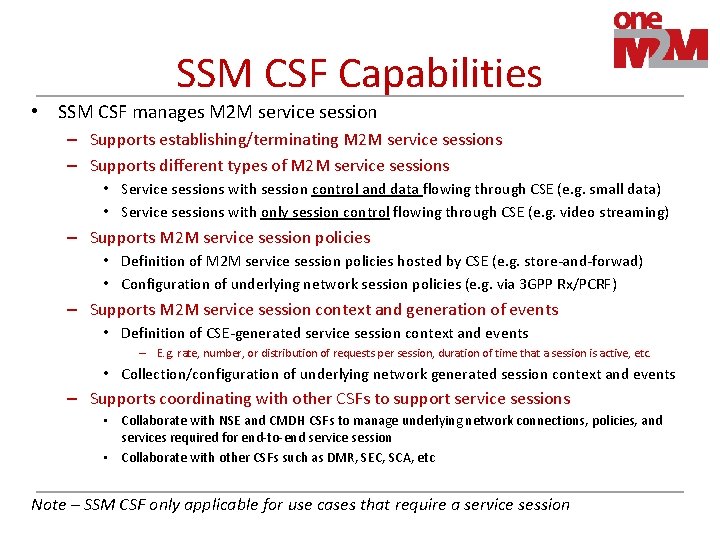
SSM CSF Capabilities • SSM CSF manages M 2 M service session – Supports establishing/terminating M 2 M service sessions – Supports different types of M 2 M service sessions • Service sessions with session control and data flowing through CSE (e. g. small data) • Service sessions with only session control flowing through CSE (e. g. video streaming) – Supports M 2 M service session policies • Definition of M 2 M service session policies hosted by CSE (e. g. store-and-forwad) • Configuration of underlying network session policies (e. g. via 3 GPP Rx/PCRF) – Supports M 2 M service session context and generation of events • Definition of CSE-generated service session context and events – E. g. rate, number, or distribution of requests per session, duration of time that a session is active, etc. • Collection/configuration of underlying network generated session context and events – Supports coordinating with other CSFs to support service sessions • Collaborate with NSE and CMDH CSFs to manage underlying network connections, policies, and services required for end-to-end service session • Collaborate with other CSFs such as DMR, SEC, SCA, etc Note – SSM CSF only applicable for use cases that require a service session
SSM Resources • • New attributes for <application> <session. Policy> <session. Context> © 2013 one. M 2 M Partners one. M 2 M-ARC-0498 R 01 4
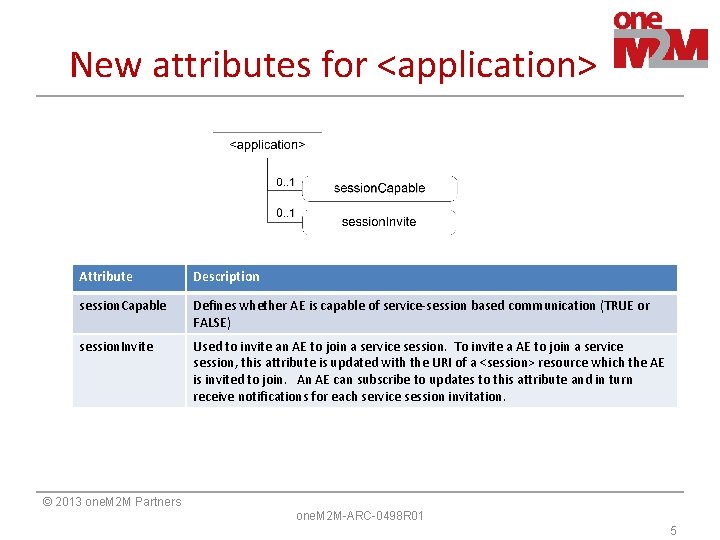
New attributes for <application> Attribute Description session. Capable Defines whether AE is capable of service-session based communication (TRUE or FALSE) session. Invite Used to invite an AE to join a service session. To invite a AE to join a service session, this attribute is updated with the URI of a <session> resource which the AE is invited to join. An AE can subscribe to updates to this attribute and in turn receive notifications for each service session invitation. © 2013 one. M 2 M Partners one. M 2 M-ARC-0498 R 01 5
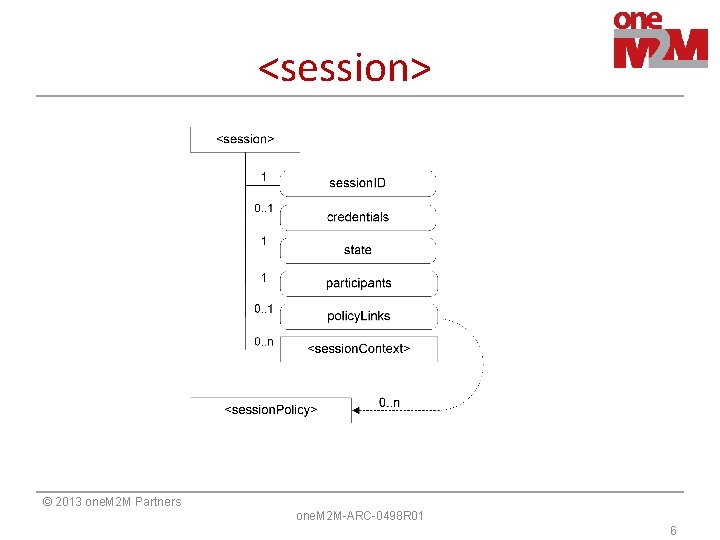
<session> © 2013 one. M 2 M Partners one. M 2 M-ARC-0498 R 01 6
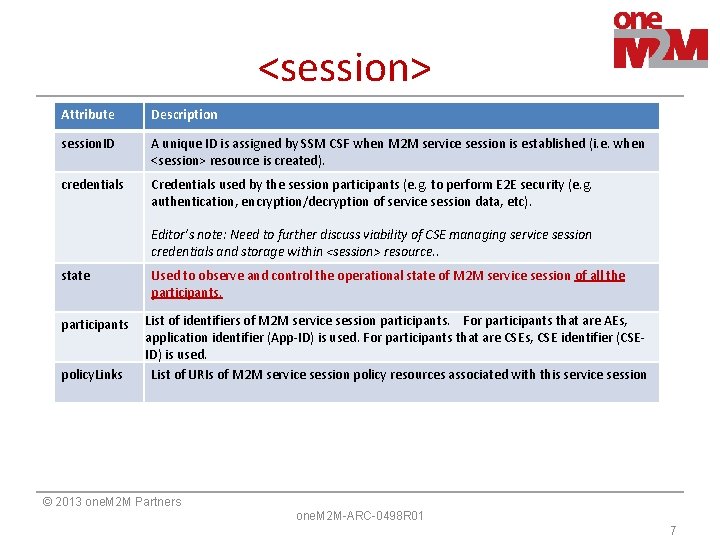
<session> Attribute Description session. ID A unique ID is assigned by SSM CSF when M 2 M service session is established (i. e. when <session> resource is created). credentials Credentials used by the session participants (e. g. to perform E 2 E security (e. g. authentication, encryption/decryption of service session data, etc). Editor’s note: Need to further discuss viability of CSE managing service session credentials and storage within <session> resource. . state participants policy. Links Used to observe and control the operational state of M 2 M service session of all the participants. List of identifiers of M 2 M service session participants. For participants that are AEs, application identifier (App-ID) is used. For participants that are CSEs, CSE identifier (CSEID) is used. List of URIs of M 2 M service session policy resources associated with this service session © 2013 one. M 2 M Partners one. M 2 M-ARC-0498 R 01 7
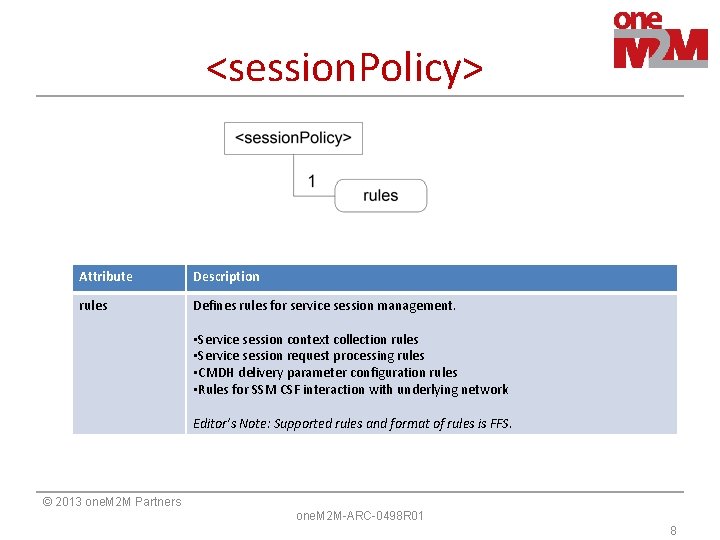
<session. Policy> Attribute Description rules Defines rules for service session management. • Service session context collection rules • Service session request processing rules • CMDH delivery parameter configuration rules • Rules for SSM CSF interaction with underlying network Editor’s Note: Supported rules and format of rules is FFS. © 2013 one. M 2 M Partners one. M 2 M-ARC-0498 R 01 8
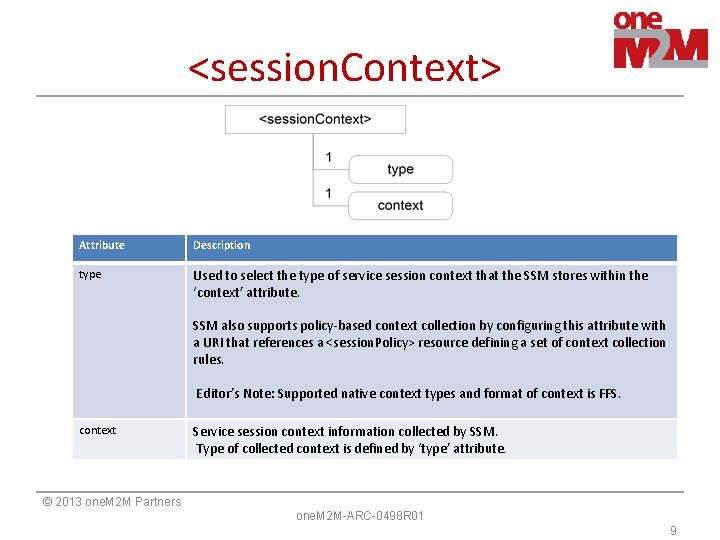
<session. Context> Attribute Description type Used to select the type of service session context that the SSM stores within the ‘context’ attribute. SSM also supports policy-based context collection by configuring this attribute with a URI that references a <session. Policy> resource defining a set of context collection rules. Editor’s Note: Supported native context types and format of context is FFS. context Service session context information collected by SSM. Type of collected context is defined by ‘type’ attribute. © 2013 one. M 2 M Partners one. M 2 M-ARC-0498 R 01 9
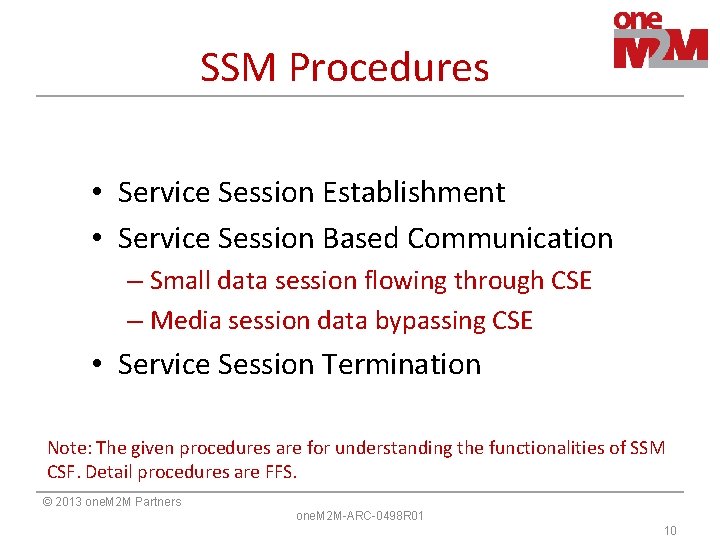
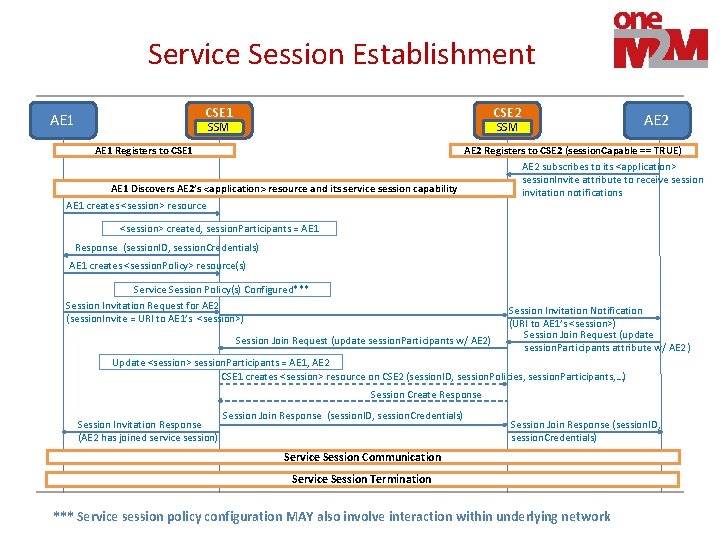
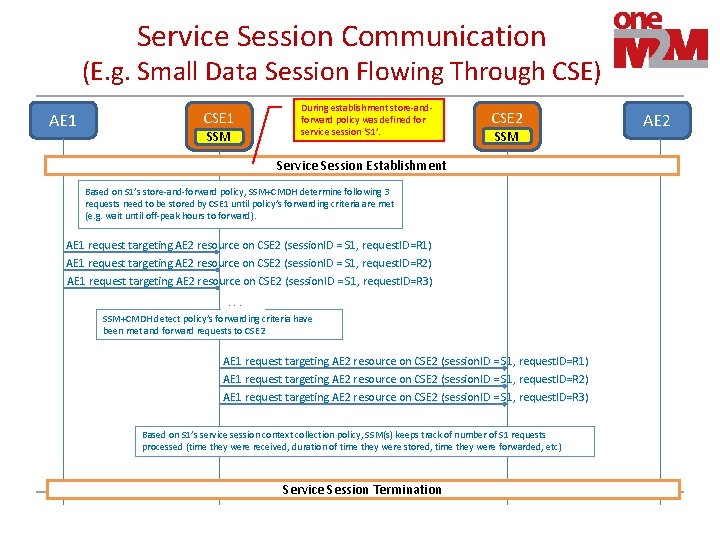
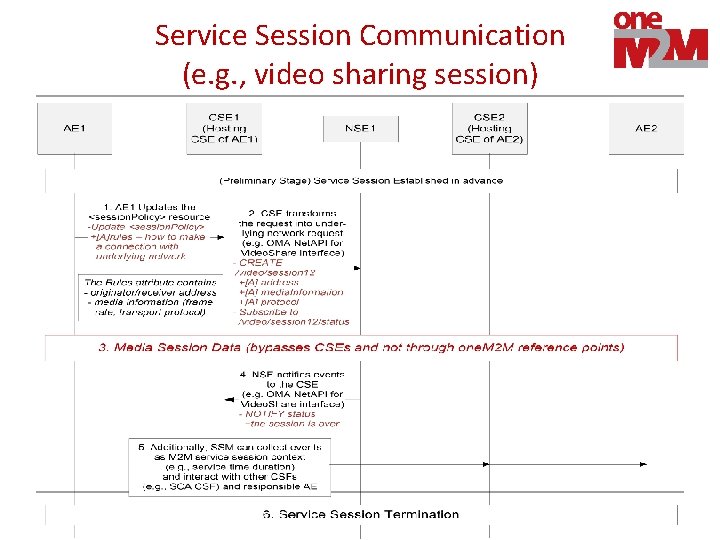
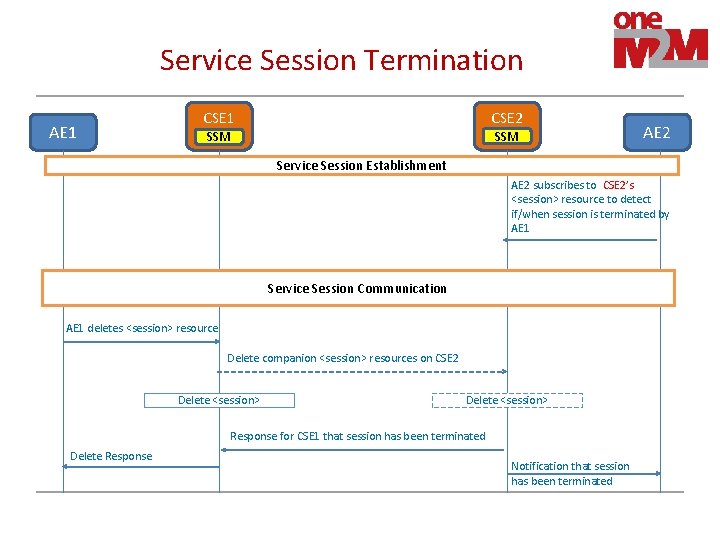
SSM Procedures • Service Session Establishment • Service Session Based Communication – Small data session flowing through CSE – Media session data bypassing CSE • Service Session Termination Note: The given procedures are for understanding the functionalities of SSM CSF. Detail procedures are FFS. © 2013 one. M 2 M Partners one. M 2 M-ARC-0498 R 01 10
Service Session Establishment CSE 1 AE 1 CSE 2 SSM AE 2 AE 1 Registers to CSE 1 AE 2 Registers to CSE 2 (session. Capable == TRUE) AE 2 subscribes to its <application> session. Invite attribute to receive session AE 1 Discovers AE 2’s <application> resource and its service session capability invitation notifications AE 1 creates <session> resource <session> created, session. Participants = AE 1 Response (session. ID, session. Credentials) AE 1 creates <session. Policy> resource(s) Service Session Policy(s) Configured*** Session Invitation Request for AE 2 (session. Invite = URI to AE 1’s <session>) Session Join Request (update session. Participants w/ AE 2) Session Invitation Notification (URI to AE 1’s <session>) Session Join Request (update session. Participants attribute w/ AE 2 ) Update <session> session. Participants = AE 1, AE 2 CSE 1 creates <session> resource on CSE 2 (session. ID, session. Policies, session. Participants, …) Session Create Response Session Invitation Response (AE 2 has joined service session) Session Join Response (session. ID, session. Credentials) Session Join Response (session. ID, session. Credentials) Service Session Communication Service Session Termination *** Service session policy configuration MAY also involve interaction within underlying network
Service Session Communication (E. g. Small Data Session Flowing Through CSE) AE 1 CSE 1 SSM During establishment store-andforward policy was defined for service session ‘S 1’. CSE 2 SSM Service Session Establishment Based on S 1’s store-and-forward policy, SSM+CMDH determine following 3 requests need to be stored by CSE 1 until policy’s forwarding criteria are met (e. g. wait until off-peak hours to forward). AE 1 request targeting AE 2 resource on CSE 2 (session. ID = S 1, request. ID=R 1) AE 1 request targeting AE 2 resource on CSE 2 (session. ID = S 1, request. ID=R 2) AE 1 request targeting AE 2 resource on CSE 2 (session. ID = S 1, request. ID=R 3). . . SSM+CMDH detect policy’s forwarding criteria have been met and forward requests to CSE 2 AE 1 request targeting AE 2 resource on CSE 2 (session. ID = S 1, request. ID=R 1) AE 1 request targeting AE 2 resource on CSE 2 (session. ID = S 1, request. ID=R 2) AE 1 request targeting AE 2 resource on CSE 2 (session. ID = S 1, request. ID=R 3) Based on S 1’s service session context collection policy, SSM(s) keeps track of number of S 1 requests processed (time they were received, duration of time they were stored, time they were forwarded, etc) Service Session Termination AE 2
Service Session Communication (e. g. , video sharing session)
Service Session Termination AE 1 CSE 2 SSM AE 2 Service Session Establishment AE 2 subscribes to CSE 2’s <session> resource to detect if/when session is terminated by AE 1 Service Session Communication AE 1 deletes <session> resource Delete companion <session> resources on CSE 2 Delete <session> Response for CSE 1 that session has been terminated Delete Response Notification that session has been terminated
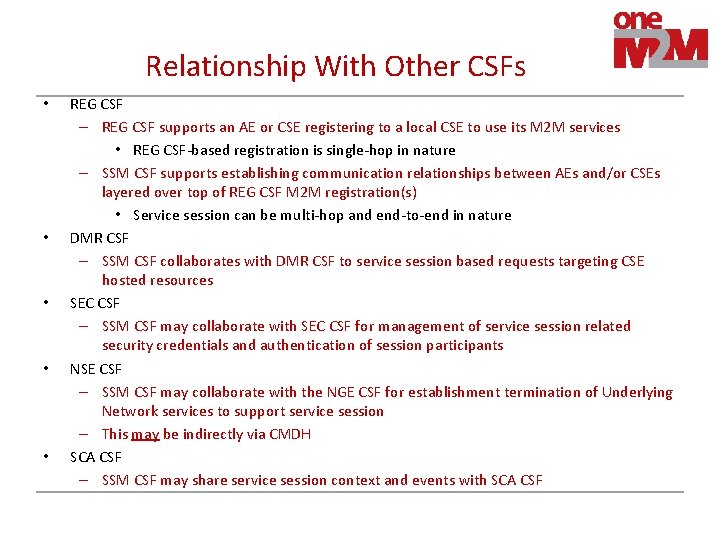
Relationship With Other CSFs • • • REG CSF – REG CSF supports an AE or CSE registering to a local CSE to use its M 2 M services • REG CSF-based registration is single-hop in nature – SSM CSF supports establishing communication relationships between AEs and/or CSEs layered over top of REG CSF M 2 M registration(s) • Service session can be multi-hop and end-to-end in nature DMR CSF – SSM CSF collaborates with DMR CSF to service session based requests targeting CSE hosted resources SEC CSF – SSM CSF may collaborate with SEC CSF for management of service session related security credentials and authentication of session participants NSE CSF – SSM CSF may collaborate with the NGE CSF for establishment termination of Underlying Network services to support service session – This may be indirectly via CMDH SCA CSF – SSM CSF may share service session context and events with SCA CSF
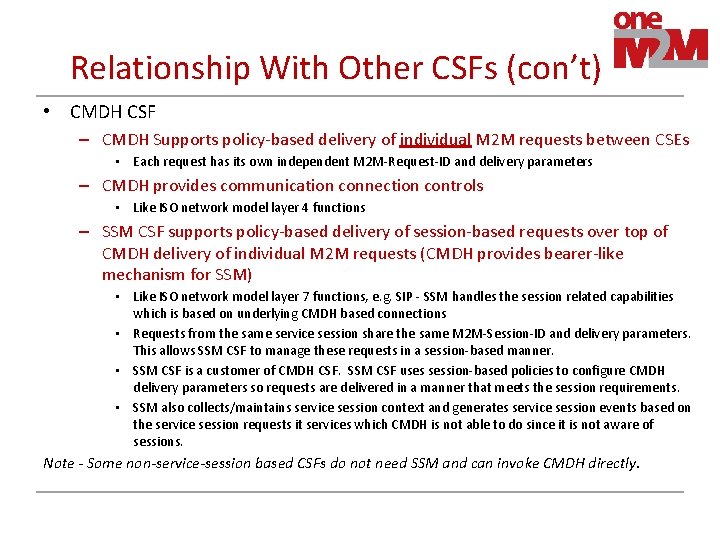
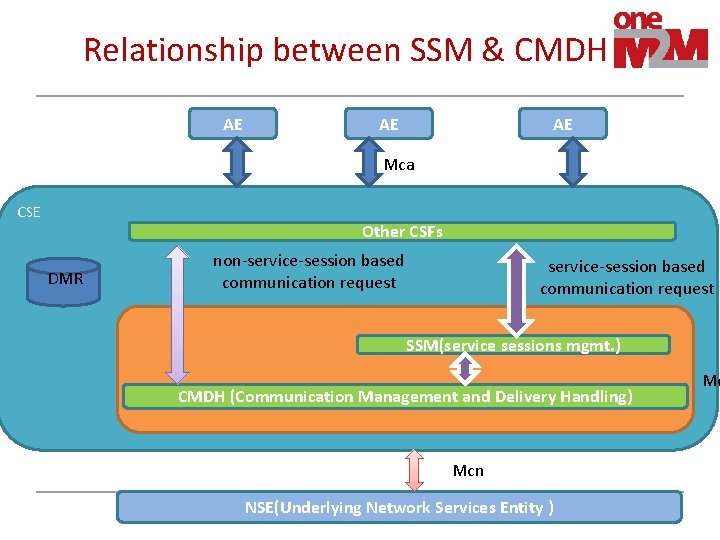
Relationship With Other CSFs (con’t) • CMDH CSF – CMDH Supports policy-based delivery of individual M 2 M requests between CSEs • Each request has its own independent M 2 M-Request-ID and delivery parameters – CMDH provides communication connection controls • Like ISO network model layer 4 functions – SSM CSF supports policy-based delivery of session-based requests over top of CMDH delivery of individual M 2 M requests (CMDH provides bearer-like mechanism for SSM) • Like ISO network model layer 7 functions, e. g. SIP - SSM handles the session related capabilities which is based on underlying CMDH based connections • Requests from the same service session share the same M 2 M-Session-ID and delivery parameters. This allows SSM CSF to manage these requests in a session-based manner. • SSM CSF is a customer of CMDH CSF. SSM CSF uses session-based policies to configure CMDH delivery parameters so requests are delivered in a manner that meets the session requirements. • SSM also collects/maintains service session context and generates service session events based on the service session requests it services which CMDH is not able to do since it is not aware of sessions. Note - Some non-service-session based CSFs do not need SSM and can invoke CMDH directly.
Relationship between SSM & CMDH AE AE AE Mca CSE Other CSFs DMR non-service-session based communication request SSM(service sessions mgmt. ) CMDH (Communication Management and Delivery Handling) Mcn NSE(Underlying Network Services Entity ) Mc
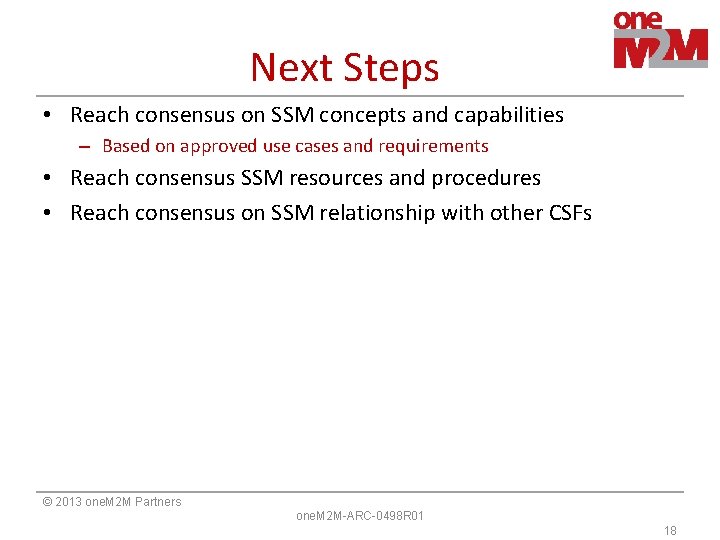
Next Steps • Reach consensus on SSM concepts and capabilities – Based on approved use cases and requirements • Reach consensus SSM resources and procedures • Reach consensus on SSM relationship with other CSFs © 2013 one. M 2 M Partners one. M 2 M-ARC-0498 R 01 18