Lossless Decomposition Anannya Sengupta CS 157 A Prof
- Slides: 27
Lossless Decomposition Anannya Sengupta CS 157 A Prof. Sin-Min Lee
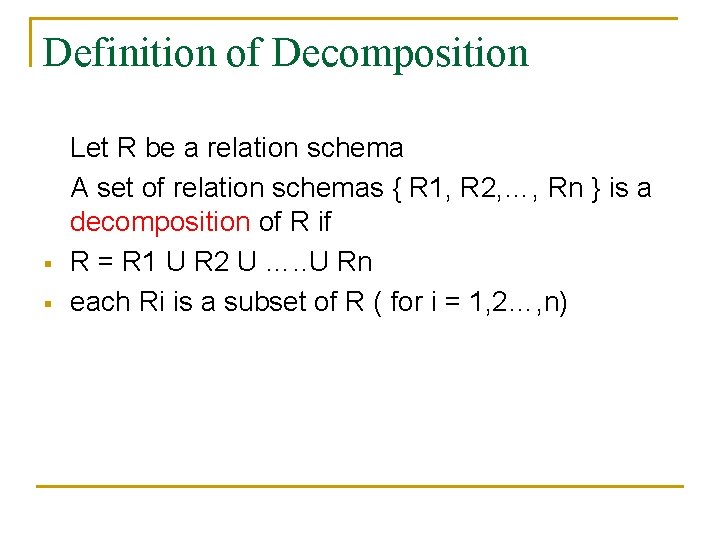
Definition of Decomposition § § Let R be a relation schema A set of relation schemas { R 1, R 2, …, Rn } is a decomposition of R if R = R 1 U R 2 U …. . U Rn each Ri is a subset of R ( for i = 1, 2…, n)
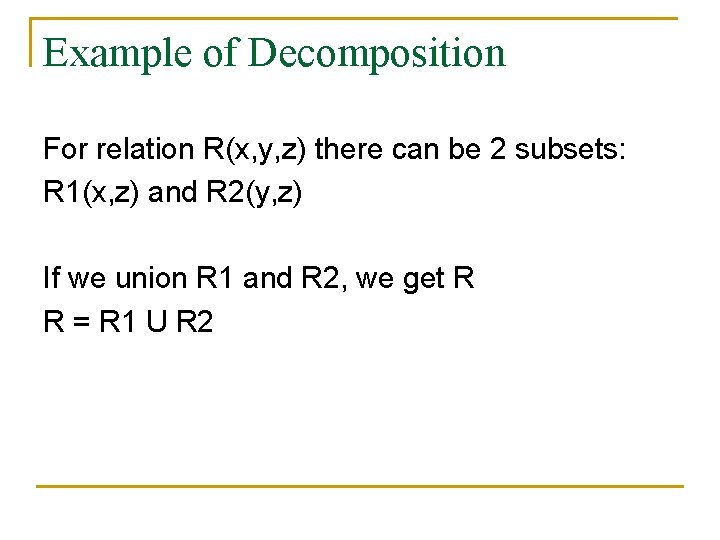
Example of Decomposition For relation R(x, y, z) there can be 2 subsets: R 1(x, z) and R 2(y, z) If we union R 1 and R 2, we get R R = R 1 U R 2
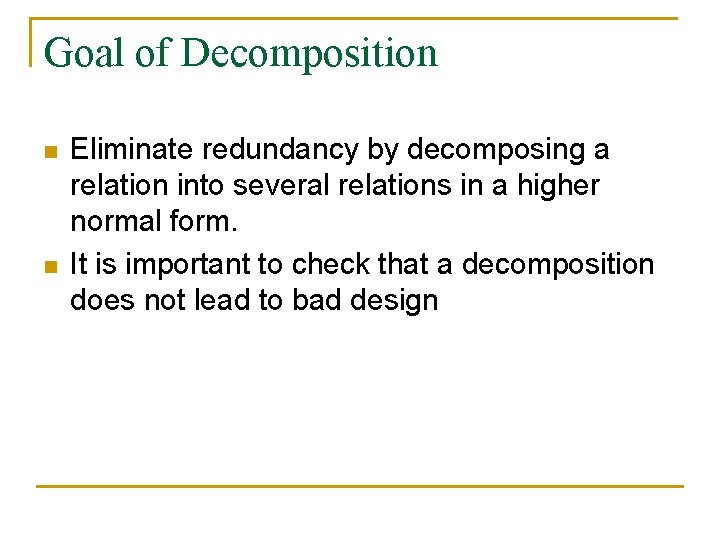
Goal of Decomposition n n Eliminate redundancy by decomposing a relation into several relations in a higher normal form. It is important to check that a decomposition does not lead to bad design
Problem with Decomposition n Given instances of the decomposed relations, we may not be able to reconstruct the corresponding instance of the original relation – information loss
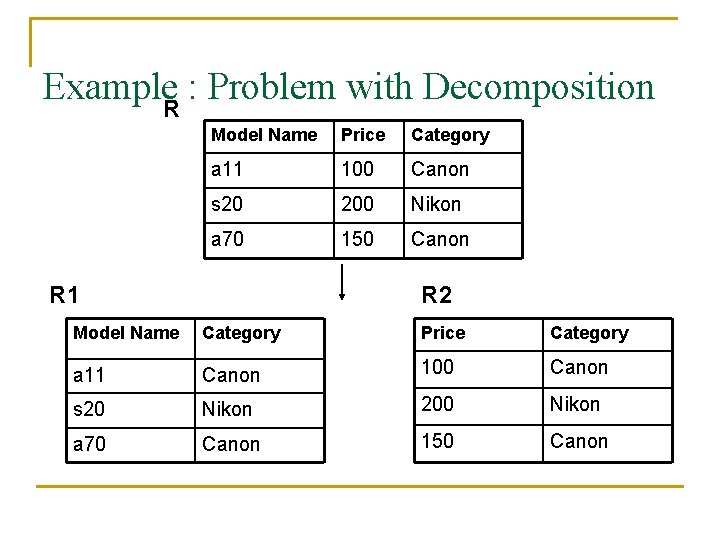
Example. R : Problem with Decomposition Model Name Price Category a 11 100 Canon s 20 200 Nikon a 70 150 Canon R 1 R 2 Model Name Category Price Category a 11 Canon 100 Canon s 20 Nikon 200 Nikon a 70 Canon 150 Canon
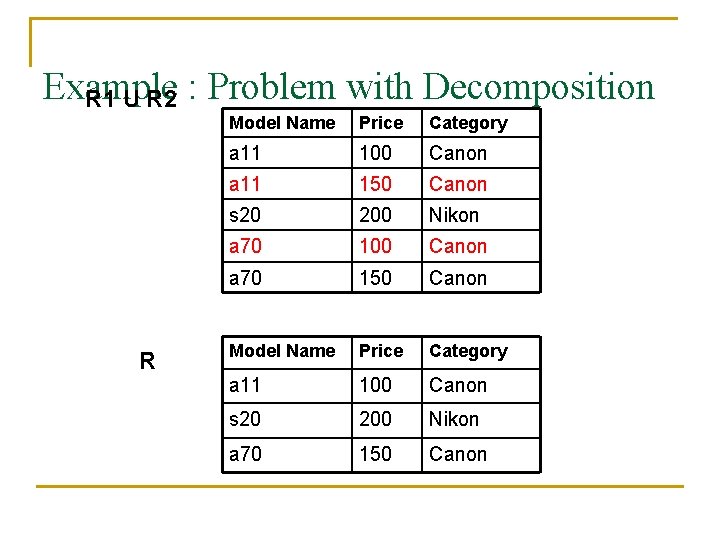
Example R 1 U R 2 : Problem with Decomposition R Model Name Price Category a 11 100 Canon a 11 150 Canon s 20 200 Nikon a 70 100 Canon a 70 150 Canon Model Name Price Category a 11 100 Canon s 20 200 Nikon a 70 150 Canon
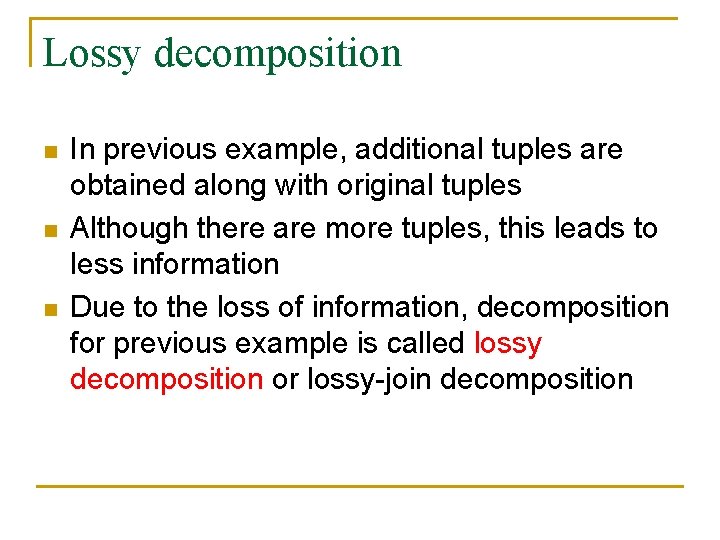
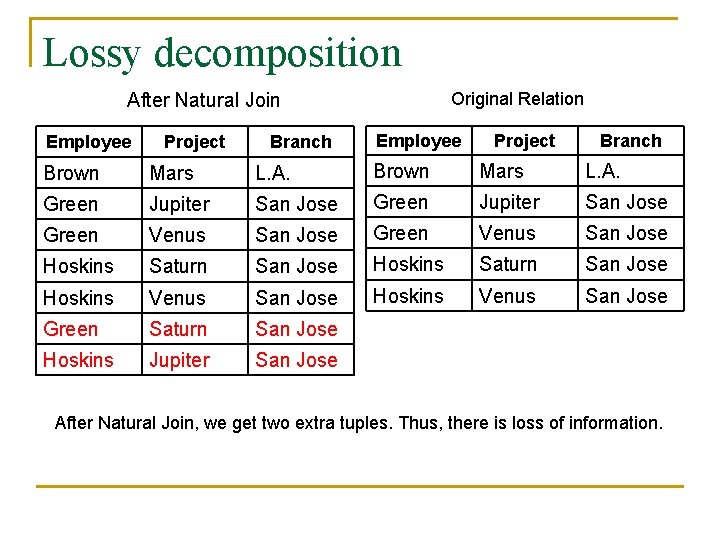
Lossy decomposition n In previous example, additional tuples are obtained along with original tuples Although there are more tuples, this leads to less information Due to the loss of information, decomposition for previous example is called lossy decomposition or lossy-join decomposition
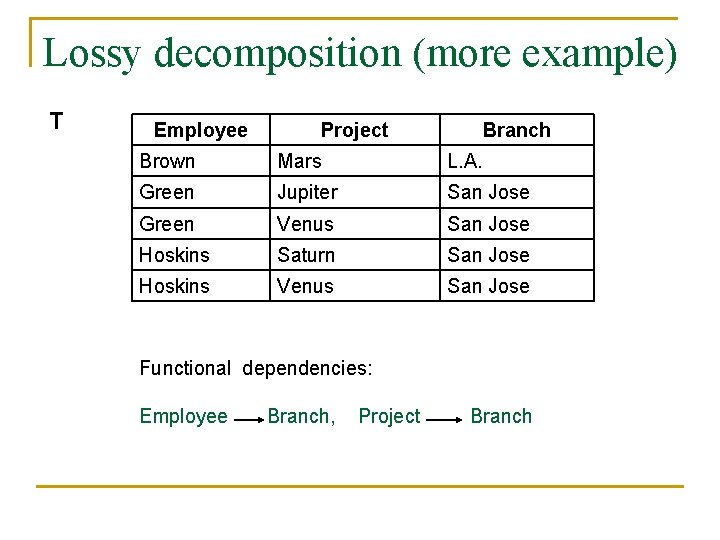
Lossy decomposition (more example) T Employee Project Branch Brown Mars L. A. Green Jupiter San Jose Green Venus San Jose Hoskins Saturn San Jose Hoskins Venus San Jose Functional dependencies: Employee Branch, Project Branch
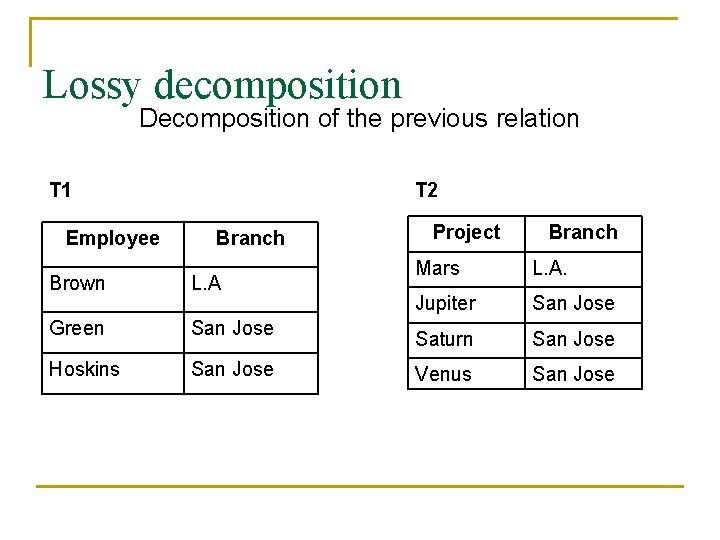
Lossy decomposition Decomposition of the previous relation T 1 Employee T 2 Branch Brown L. A Green San Jose Hoskins San Jose Project Branch Mars L. A. Jupiter San Jose Saturn San Jose Venus San Jose
Lossy decomposition Original Relation After Natural Join Employee Project Branch Brown Mars L. A. Green Jupiter San Jose Green Venus San Jose Hoskins Saturn San Jose Hoskins Venus San Jose Green Saturn San Jose Hoskins Jupiter San Jose After Natural Join, we get two extra tuples. Thus, there is loss of information.
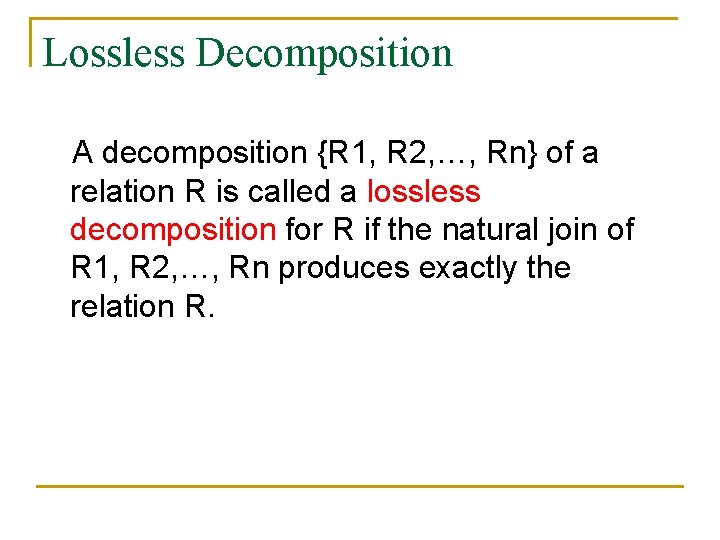
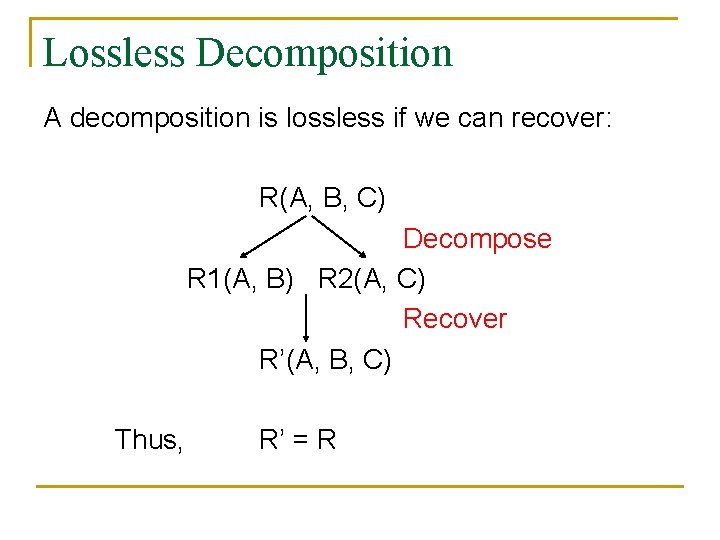
Lossless Decomposition A decomposition {R 1, R 2, …, Rn} of a relation R is called a lossless decomposition for R if the natural join of R 1, R 2, …, Rn produces exactly the relation R.
Lossless Decomposition A decomposition is lossless if we can recover: R(A, B, C) Decompose R 1(A, B) R 2(A, C) Recover R’(A, B, C) Thus, R’ = R
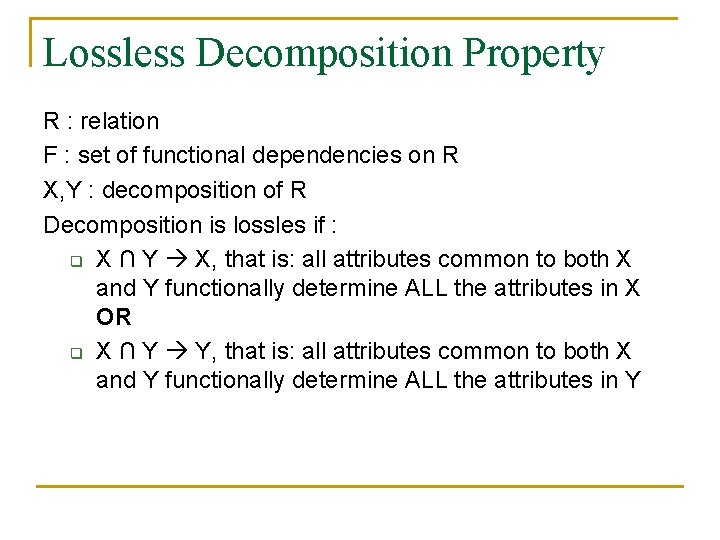
Lossless Decomposition Property R : relation F : set of functional dependencies on R X, Y : decomposition of R Decomposition is lossles if : q X ∩ Y X, that is: all attributes common to both X and Y functionally determine ALL the attributes in X OR q X ∩ Y Y, that is: all attributes common to both X and Y functionally determine ALL the attributes in Y
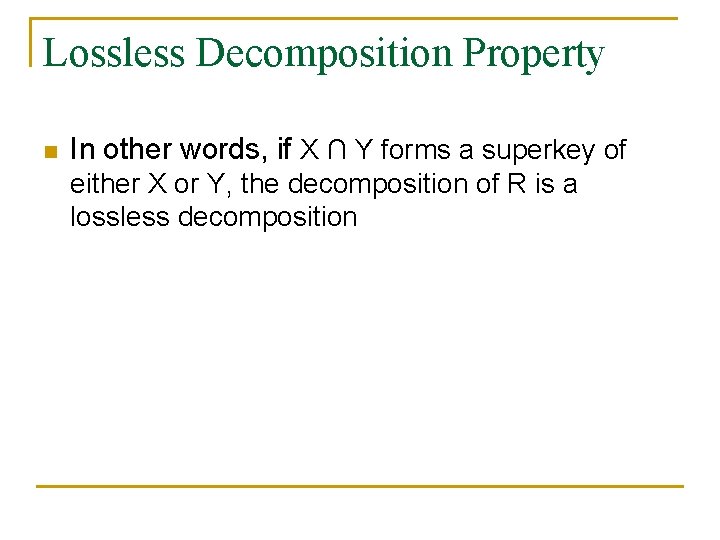
Lossless Decomposition Property n In other words, if X ∩ Y forms a superkey of either X or Y, the decomposition of R is a lossless decomposition
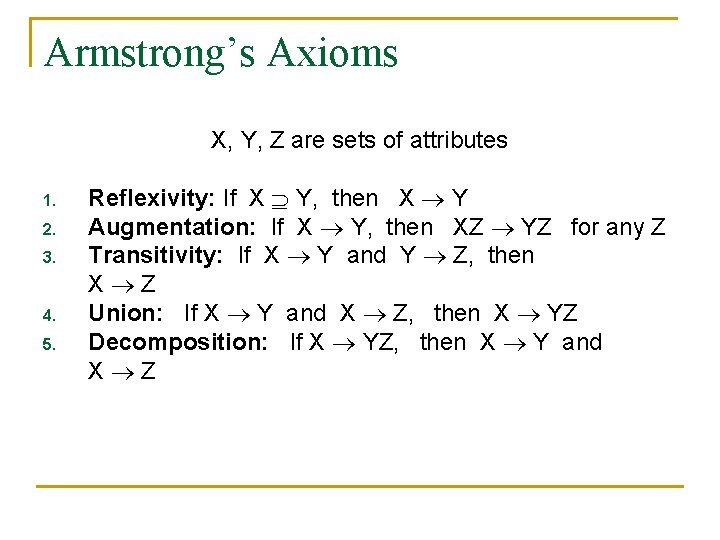
Armstrong’s Axioms X, Y, Z are sets of attributes 1. 2. 3. 4. 5. Reflexivity: If X Y, then X Y Augmentation: If X Y, then XZ YZ for any Z Transitivity: If X Y and Y Z, then X Z Union: If X Y and X Z, then X YZ Decomposition: If X YZ, then X Y and X Z
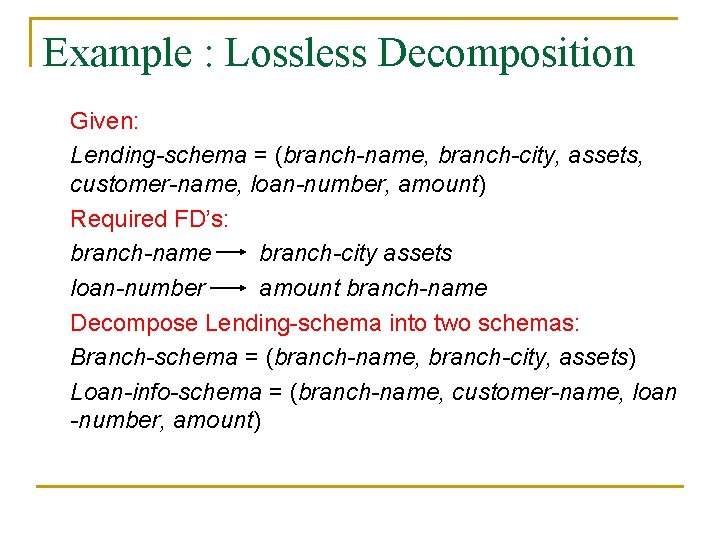
Example : Lossless Decomposition Given: Lending-schema = (branch-name, branch-city, assets, customer-name, loan-number, amount) Required FD’s: branch-name branch-city assets loan-number amount branch-name Decompose Lending-schema into two schemas: Branch-schema = (branch-name, branch-city, assets) Loan-info-schema = (branch-name, customer-name, loan -number, amount)
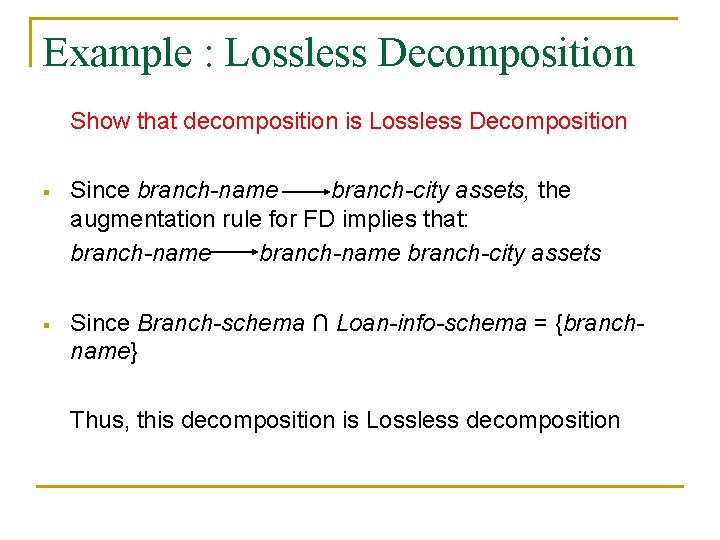
Example : Lossless Decomposition Show that decomposition is Lossless Decomposition § Since branch-name branch-city assets, the augmentation rule for FD implies that: branch-name branch-city assets § Since Branch-schema ∩ Loan-info-schema = {branchname} Thus, this decomposition is Lossless decomposition
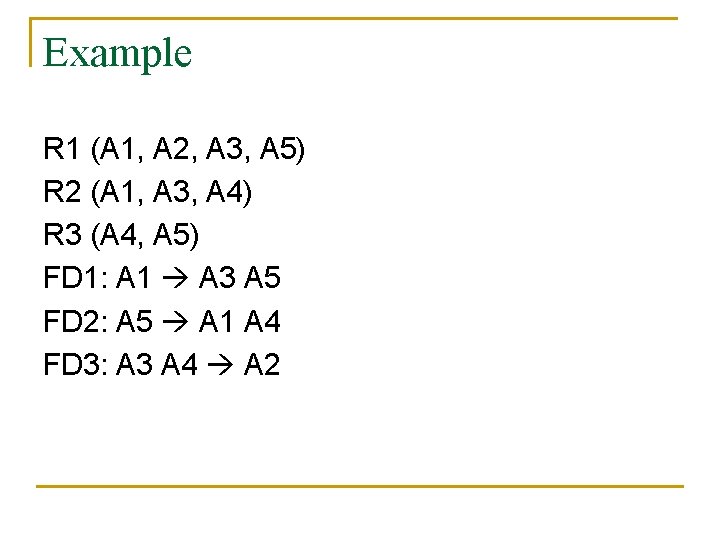
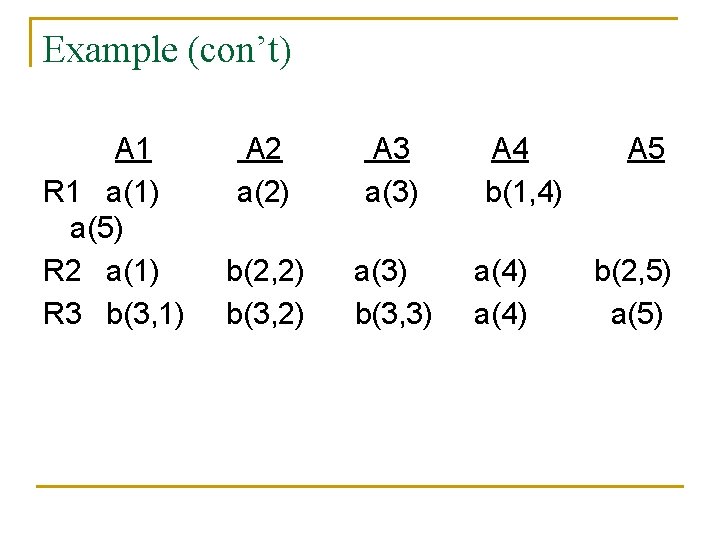
Example R 1 (A 1, A 2, A 3, A 5) R 2 (A 1, A 3, A 4) R 3 (A 4, A 5) FD 1: A 1 A 3 A 5 FD 2: A 5 A 1 A 4 FD 3: A 3 A 4 A 2
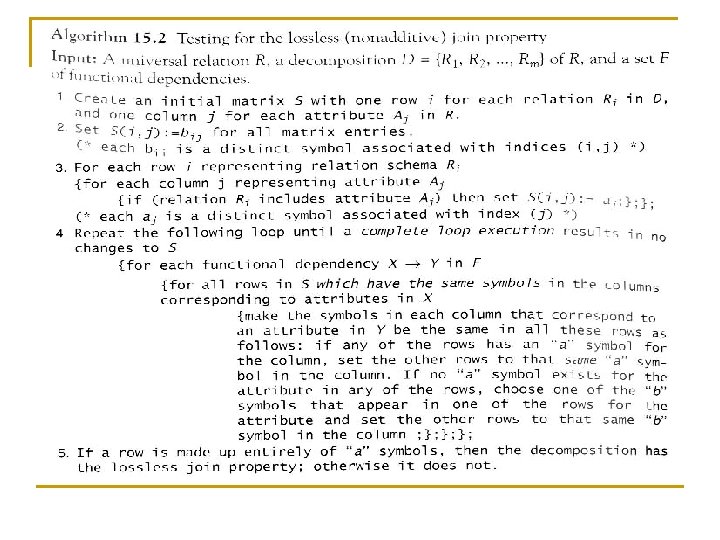
Example (con’t) A 1 R 1 a(1) a(5) R 2 a(1) R 3 b(3, 1) A 2 a(2) A 3 a(3) b(2, 2) b(3, 2) a(3) b(3, 3) A 4 b(1, 4) a(4) A 5 b(2, 5) a(5)
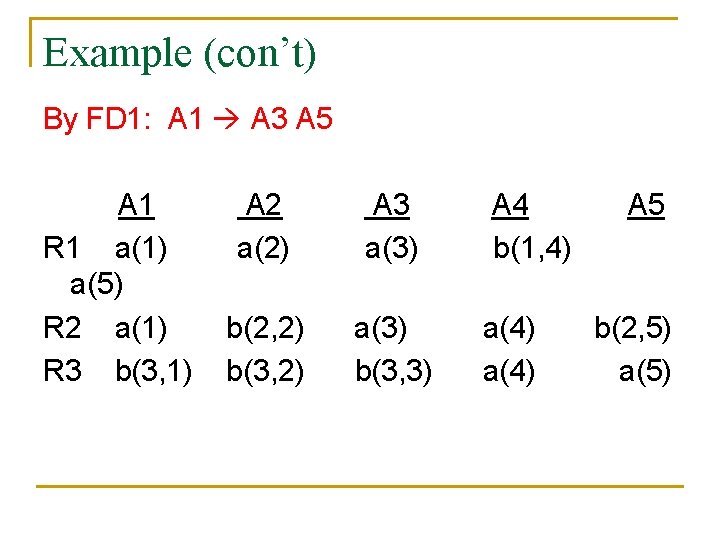
Example (con’t) By FD 1: A 1 A 3 A 5 A 1 R 1 a(1) a(5) R 2 a(1) R 3 b(3, 1) A 2 a(2) A 3 a(3) b(2, 2) b(3, 2) a(3) b(3, 3) A 4 b(1, 4) a(4) A 5 b(2, 5) a(5)
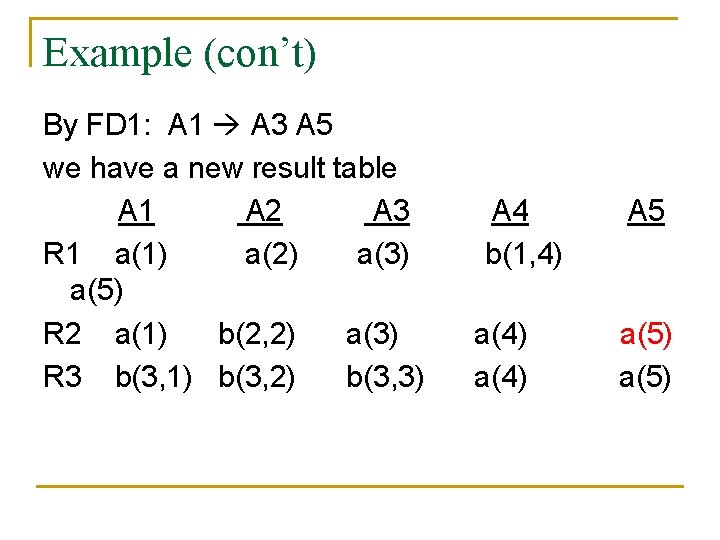
Example (con’t) By FD 1: A 1 A 3 A 5 we have a new result table A 1 A 2 A 3 R 1 a(1) a(2) a(3) a(5) R 2 a(1) b(2, 2) a(3) R 3 b(3, 1) b(3, 2) b(3, 3) A 4 b(1, 4) a(4) A 5 a(5)
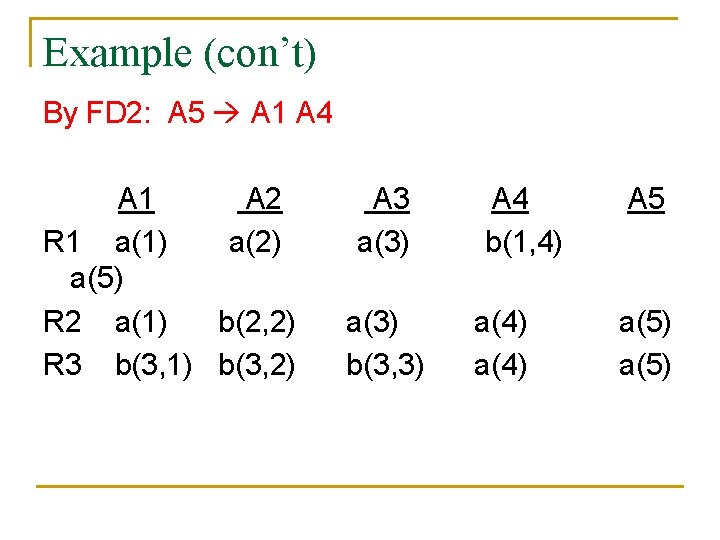
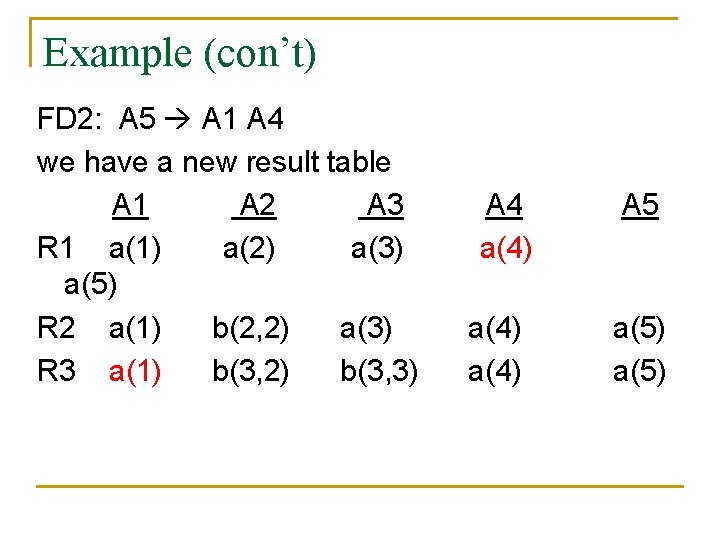
Example (con’t) By FD 2: A 5 A 1 A 4 A 1 A 2 R 1 a(1) a(2) a(5) R 2 a(1) b(2, 2) R 3 b(3, 1) b(3, 2) A 3 a(3) b(3, 3) A 4 b(1, 4) a(4) A 5 a(5)
Example (con’t) FD 2: A 5 A 1 A 4 we have a new result table A 1 A 2 A 3 R 1 a(1) a(2) a(3) a(5) R 2 a(1) b(2, 2) a(3) R 3 a(1) b(3, 2) b(3, 3) A 4 a(4) A 5 a(5)
Conclusions n Decompositions should always be lossless Lossless decomposition ensure that the information in the original relation can be accurately reconstructed based on the information represented in the decomposed relations.
References n n Fundamentals of Database Systems Fourth Edition Elmasri, Navathe Database System Concepts Fourth Edition Silberschatz, Korth, Sudarshan