Linked Lists in MIPS Lets see how singly
- Slides: 12
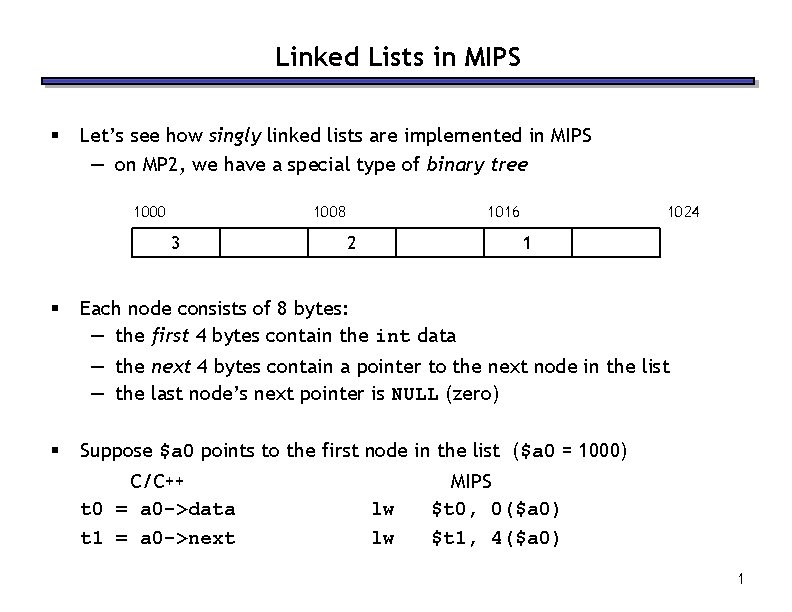
Linked Lists in MIPS § Let’s see how singly linked lists are implemented in MIPS — on MP 2, we have a special type of binary tree 1000 1008 3 § 1016 2 1024 1 Each node consists of 8 bytes: — the first 4 bytes contain the int data — the next 4 bytes contain a pointer to the next node in the list — the last node’s next pointer is NULL (zero) § Suppose $a 0 points to the first node in the list ($a 0 = 1000) C/C++ t 0 = a 0 ->data t 1 = a 0 ->next lw lw MIPS $t 0, 0($a 0) $t 1, 4($a 0) 1
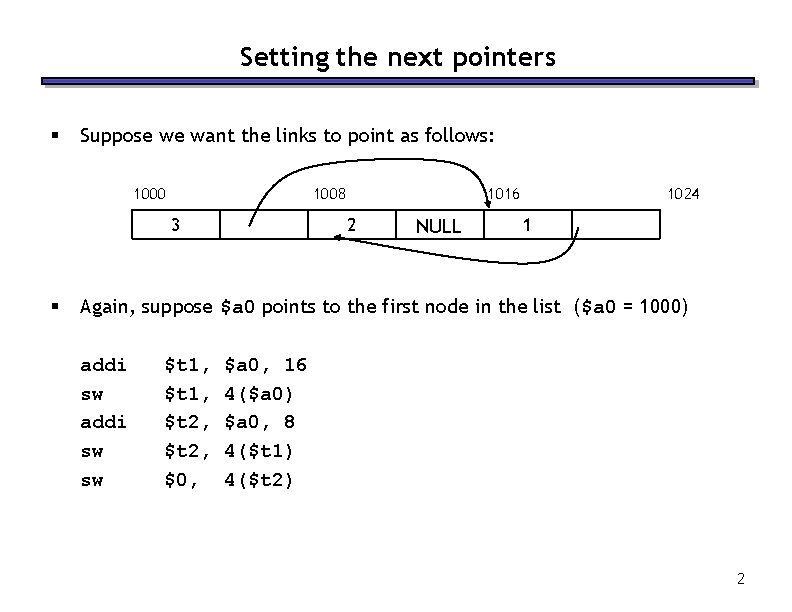
Setting the next pointers § Suppose we want the links to point as follows: 1000 1008 3 § 1016 2 NULL 1024 1 Again, suppose $a 0 points to the first node in the list ($a 0 = 1000) addi sw sw $t 1, $t 2, $0, $a 0, 16 4($a 0) $a 0, 8 4($t 1) 4($t 2) 2
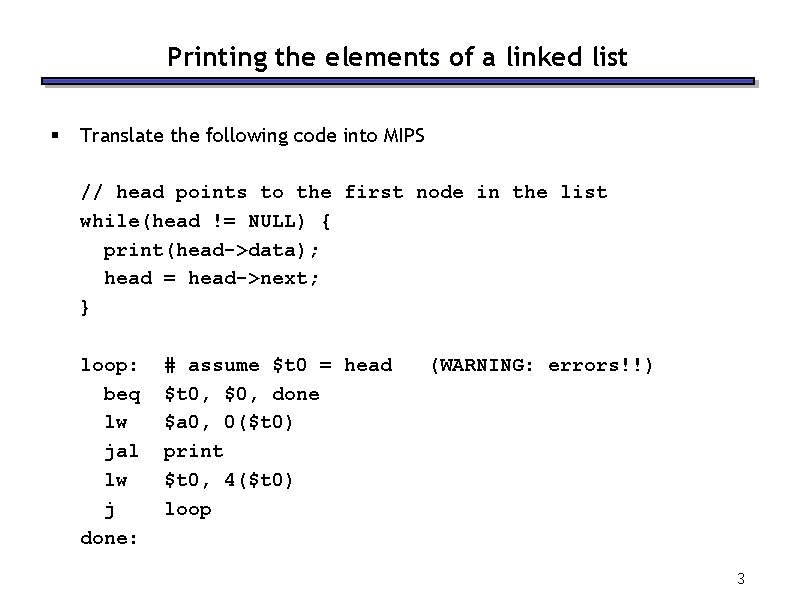
Printing the elements of a linked list § Translate the following code into MIPS // head points to the first node in the list while(head != NULL) { print(head->data); head = head->next; } loop: beq lw jal lw j done: # assume $t 0 = head $t 0, $0, done $a 0, 0($t 0) print $t 0, 4($t 0) loop (WARNING: errors!!) 3
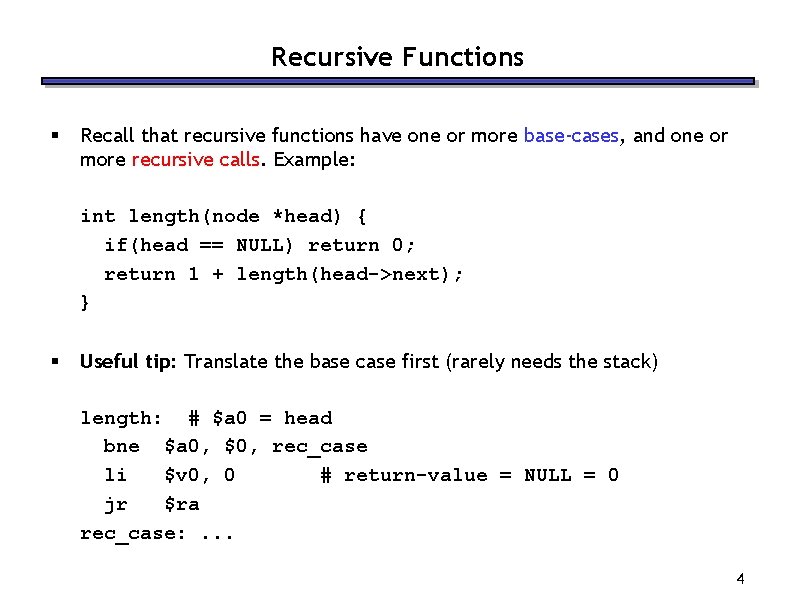
Recursive Functions § Recall that recursive functions have one or more base-cases, and one or more recursive calls. Example: int length(node *head) { if(head == NULL) return 0; return 1 + length(head->next); } § Useful tip: Translate the base case first (rarely needs the stack) length: # $a 0 = head bne $a 0, $0, rec_case li $v 0, 0 # return-value = NULL = 0 jr $ra rec_case: . . . 4
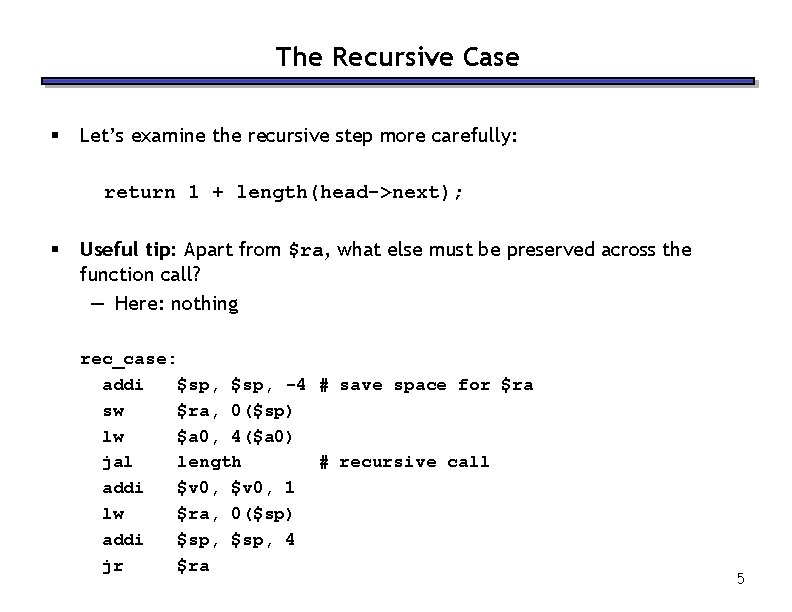
The Recursive Case § Let’s examine the recursive step more carefully: return 1 + length(head->next); § Useful tip: Apart from $ra, what else must be preserved across the function call? — Here: nothing rec_case: addi $sp, -4 # save space for $ra sw $ra, 0($sp) lw $a 0, 4($a 0) jal length # recursive call addi $v 0, 1 lw $ra, 0($sp) addi $sp, 4 jr $ra 5
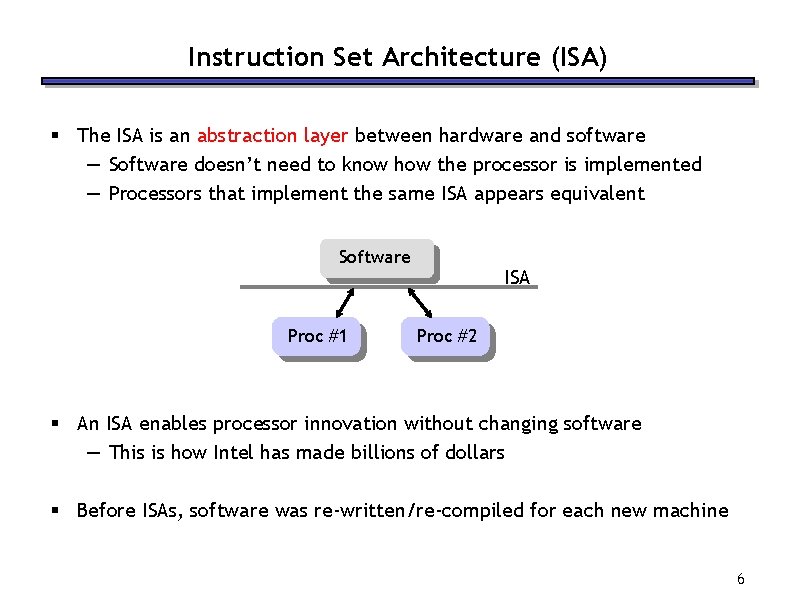
Instruction Set Architecture (ISA) § The ISA is an abstraction layer between hardware and software — Software doesn’t need to know how the processor is implemented — Processors that implement the same ISA appears equivalent Software Proc #1 ISA Proc #2 § An ISA enables processor innovation without changing software — This is how Intel has made billions of dollars § Before ISAs, software was re-written/re-compiled for each new machine 6
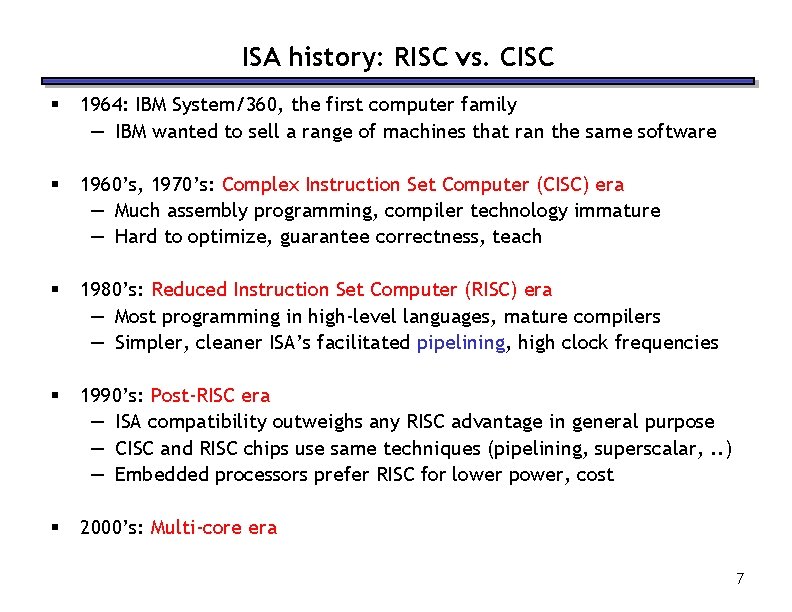
ISA history: RISC vs. CISC § 1964: IBM System/360, the first computer family — IBM wanted to sell a range of machines that ran the same software § 1960’s, 1970’s: Complex Instruction Set Computer (CISC) era — Much assembly programming, compiler technology immature — Hard to optimize, guarantee correctness, teach § 1980’s: Reduced Instruction Set Computer (RISC) era — Most programming in high-level languages, mature compilers — Simpler, cleaner ISA’s facilitated pipelining, high clock frequencies § 1990’s: Post-RISC era — ISA compatibility outweighs any RISC advantage in general purpose — CISC and RISC chips use same techniques (pipelining, superscalar, . . ) — Embedded processors prefer RISC for lower power, cost § 2000’s: Multi-core era 7
Comparing x 86 and MIPS § x 86 is a typical CISC ISA, MIPS is a typical RISC ISA § Much more is similar than different: — Both use registers and have byte-addressable memories — Same basic types of instructions (arithmetic, branches, memory) § A few of the differences: — Fewer registers: 8 (vs. 32 for MIPS) — 2 -register instruction formats (vs. 3 -register format for MIPS) — Additional, complex addressing modes — Variable-length instruction encoding (vs. fixed 32 -bit length for MIPS) 8
Why did Intel win? § x 86 won because it was the first 16 -bit chip by two years § IBM put it in PCs because there was no competing choice § Rest is inertia and “financial feedback” — x 86 is most difficult ISA to implement for high performance, but — Because Intel sells the most processors. . . — It has the most money. . . — Which it uses to hire more and better engineers. . . — Which is uses to maintain competitive performance. . . — And given equal performance, compatibility wins. . . — So Intel sells the most processors! 9
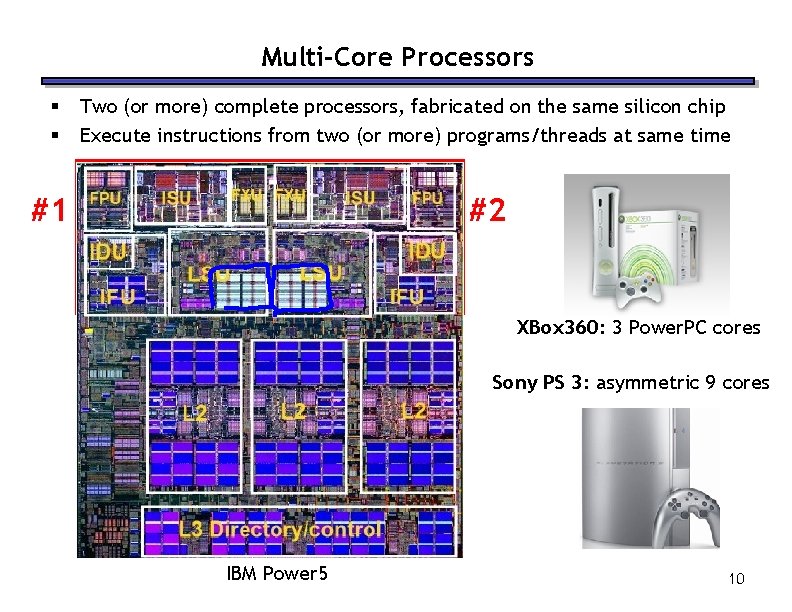
Multi-Core Processors § § Two (or more) complete processors, fabricated on the same silicon chip Execute instructions from two (or more) programs/threads at same time #1 #2 XBox 360: 3 Power. PC cores Sony PS 3: asymmetric 9 cores IBM Power 5 10
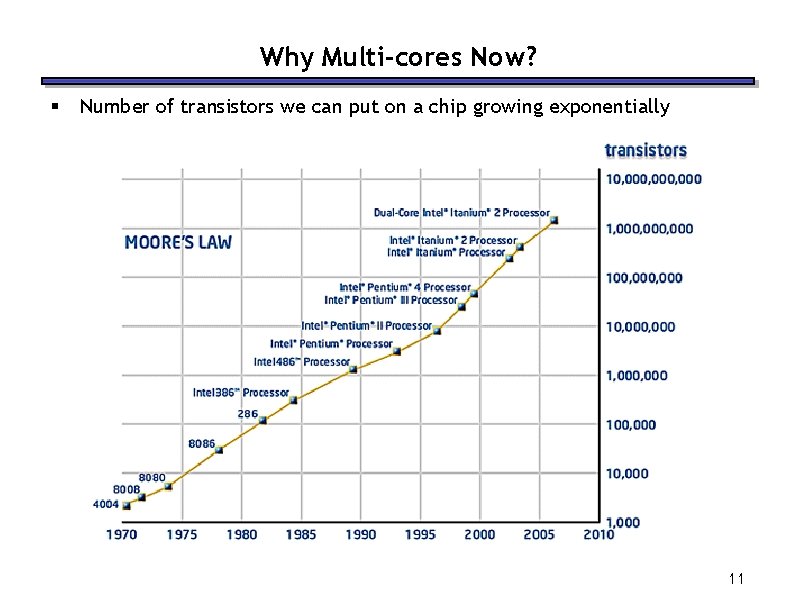
Why Multi-cores Now? § Number of transistors we can put on a chip growing exponentially 11
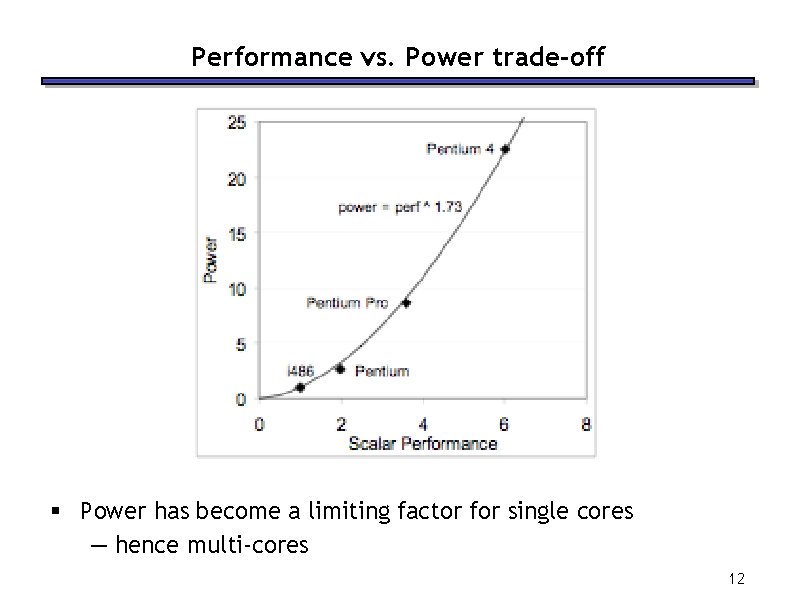
Performance vs. Power trade-off § Power has become a limiting factor for single cores — hence multi-cores 12