
Quiz Lets see how much you already know




- Slides: 67
Quiz Let’s see how much you already know!
Ch. 4 Male Reproductive System
Human Sexuality? Most people think of something bad. n It is physical, emotional and social. n How about the media’s view? n Most teenagers’ view? n What about your parents view? n
What is Reproduction? A cell divides and makes an exact copy of itself. n Genes are passed from generation to generation. Genes are what make you an individual. (hair, eye color, traits) n Making new individuals (babies) n
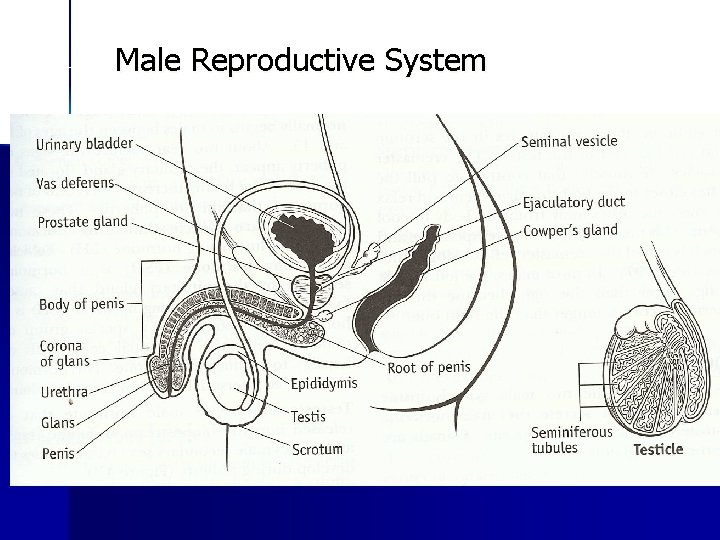
Male Reproductive System Z
Scrotum Sac like pouch in the groin n Holds the testicles n Regulate the temperature of the testicles. n Muscles contracts to pull testes closer to body, or relax to lower them away from body. n Has lots of sweat glands. n
Spermatic Cord Contains blood vessels, nerves and muscles n Each teste is held in the scrotum by the spermatic cord n Contains the Vas Deferens n Left cord is longer than right. n Most males, left testicle hangs slightly lower than the right. n
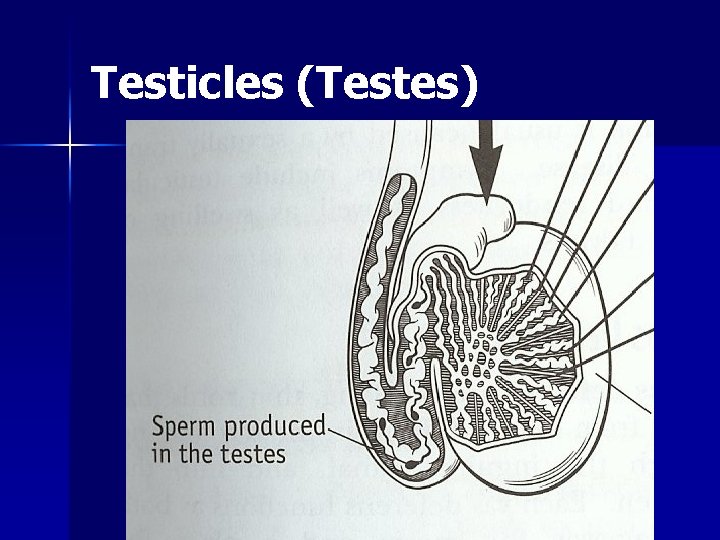
Testicles (Testes)
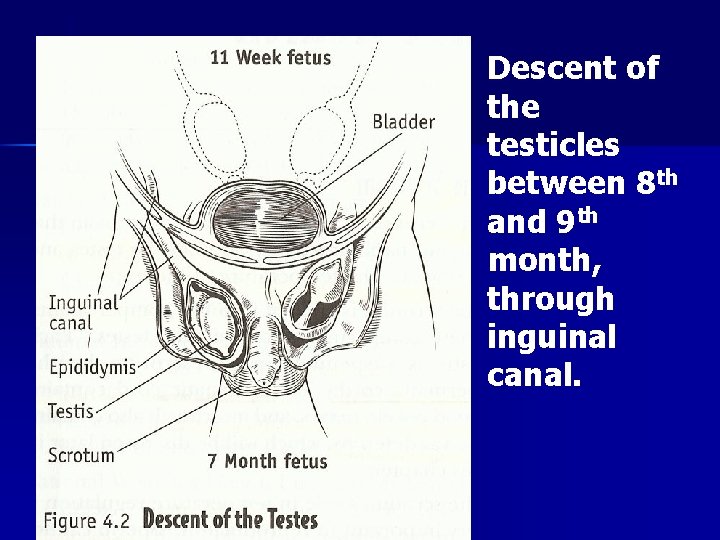
Facts about testicles Called gonads n Produce testosterone and sperm n Develop during 7 th – 8 th week of development n Sometimes one or both testicles don’t descend during the Fetus’s 7 th -8 th month n
Spermatozoa mature sperm cells n mature at a rate of about 300 million per day n once ejaculated (released from the penis), have a life expectancy of about 48 hours n
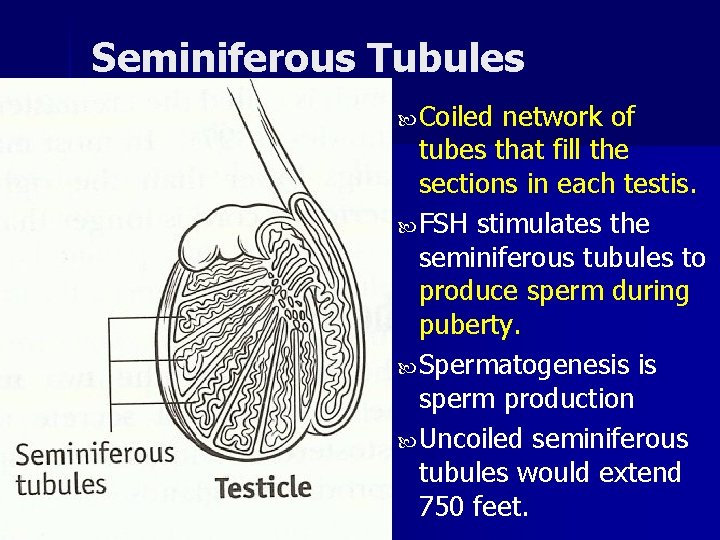
Seminiferous Tubules Coiled network of tubes that fill the sections in each testis. FSH stimulates the seminiferous tubules to produce sperm during puberty. Spermatogenesis is sperm production Uncoiled seminiferous tubules would extend 750 feet.
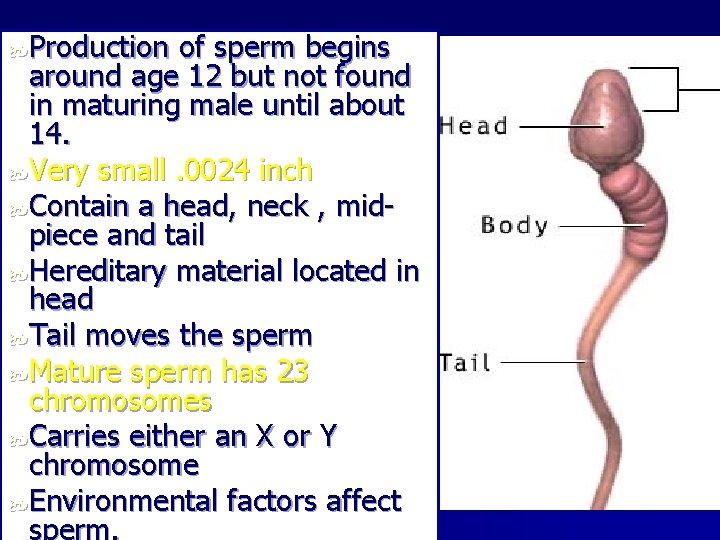
Sperm Production of sperm begins around age 12 but not found in maturing male until about 14. Very small. 0024 inch Contain a head, neck , midpiece and tail Hereditary material located in head Tail moves the sperm Mature sperm has 23 chromosomes Carries either an X or Y chromosome Environmental factors affect sperm.
Epididymis Sperm move to the epididymis after being produced in seminiferous tubules Comma shaped structure on back and upper surface of testes Sperm mature for 2 -6 weeks in epididymis Some stay for storage, some move to vas deferens after maturation
Epididymis consists of tightly coiled tubules n measures about 20 feet in length n the site of sperm final maturation (Final 10 to 14 days) n sperm may remain in the epididymis for up to 4 weeks after which they are either released or reabsorbed by the body n
Vas Deferens Two long thin cords extending from epididymis in the scrotum to abdomen n Serve as passageway for sperm and for storage n Contains cillia, which propel sperm cells. n
Seminal Vesicles A small pouch like structures lying behind to and at the bottom of the urinary bladder in front of the rectum secretes an alkaline fluid rich in fructose (sugar) used as an energy source for the sperm makes up about 60% of the volume of the semen
Prostate Gland Produces an alkaline fluid that aids sperm longevity (lives longer) n Lies under the bladder n Prostate cancer will affect almost 20% of males in the US. n
Prostate Gland A single donut shaped gland about the size of a chestnut located in front of the urinary bladder - surrounds the urethra n Helps the sperm live longer n makes up about 13% - 33% of the semen n often the site of cancerous growth in males n
Urethra Tube like passageway that extends from the bladder to the outside tip of the penis. n Passageway for semen and urine n About 9” long from bladder to tip of penis. n Ejaculatory duct prevents urine and semen from entering at the same time. n
Cowper’s Gland Located on each side of the urethra n Secretes a lubricating fluid n Alkaline to help aid sperm n Also known as the Bulbourethal gland: - Produces fluid to help neutralize acid and cleanse the urethra n
Penis Made up of spongy tissue that fills with blood during erection and becomes firm. n Covered by loose fitting skin called the Foreskin n Circumcision is the removal of the foreskin n Primary male sex organ n
Ejaculation Sperm move through vas deferens n Majority of Fluid from prostate gland-helps them live longer. n Fluid released from the seminal vesiclesnourishes the sperm n Approx. 360 mill sperm in less than 1 tsp. n Sudden release of semen from an erect penis. n
Semen 95% fluid is from prostate, seminal vesicles and bulbourethal gland. n 5% sperm n
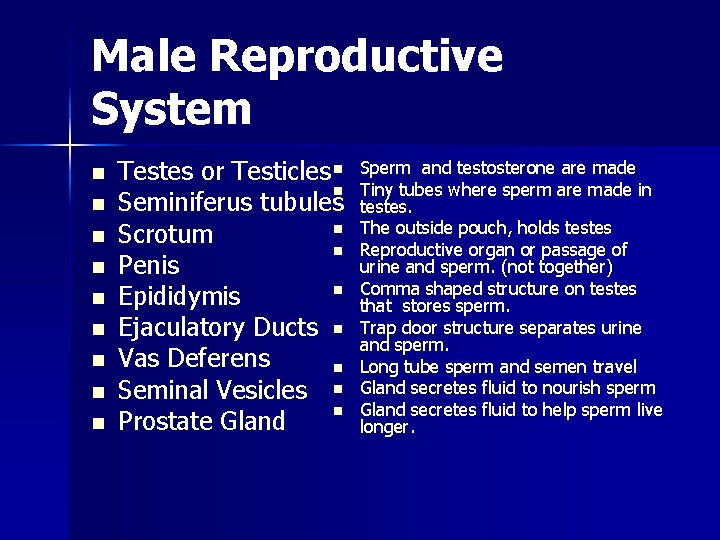
Male Reproductive System n n n n n Testes or Testicles n n Seminiferus tubules n Scrotum n Penis n Epididymis Ejaculatory Ducts n Vas Deferens n Seminal Vesicles n n Prostate Gland Sperm and testosterone are made Tiny tubes where sperm are made in testes. The outside pouch, holds testes Reproductive organ or passage of urine and sperm. (not together) Comma shaped structure on testes that stores sperm. Trap door structure separates urine and sperm. Long tube sperm and semen travel Gland secretes fluid to nourish sperm Gland secretes fluid to help sperm live longer.
Puberty in Males Begins between 10 -15 years of age. n Two yrs before, pituitary gland secretes FSH and LH n FSH – follicle stimulating hormone –causes follicles to grow inside testicles to produce sperm. n LH – causes cells to produce testosterone. n
Effects of Testosterone growth and development maintenance of sex organs bone growth closure of the epiphyseal (bone) plate influences sexual behavior influences final maturation of sperm cells stimulates the development of secondary male sexual characteristics
Male Secondary Sex Characteristics muscular and skeletal development n development of pubic, auxiliary, and chest hair n facial hair growth n temporal hairline recession n deepening of the voice n
Testosterone Released into the bloodstream from testes n Cause male secondary sex characteristics to develop during puberty. n Nocturnal Emissions n
MALE PROBLEMS AND THINGS THAT JUST HAPPEN
Nocturnal Emission Experience an erection and ejaculates while sleeping. n Frequency varies among males n Believed to be a natural release of pressure within the reproductive system. n A response to elevated hormone levels. n
Descent of the testicles between 8 th and 9 th month, through inguinal canal.
Prostate Problems Males should have a digital prostate exam every year after 40 years old. n Rates of prostate problems correspond with a man’s age( 60% or 60 year olds men have prostate problems) n Men should exercise; eat a diet high in fiber, including plenty of fruit and veg. n
These are signs of prostate problems: n Frequent urge to urinate n n n n Blood in urine or semen Painful or burning urination Difficulty in urinating Difficulty in having an erection Painful ejaculation Frequent pain or stiffness in lower back, hips or upper thighs Inability to urinate Dribbling of urine
Enlarge Prostate Can become enlarged as a result of an infection, a tumor, and age- related problems. n Presses against the urethra, resulting in frequent or difficult urination. n Lead to Prostate cancer. n
Prostate Cancer 4/100 men die from prostate cancer n 22, 000 deaths a year, and over 70, 000 new cases. n Early detection increases the chance of survival n Treatment includes surgery, radiation, and hormone therapy. n
Testicular Cancer n n n n Cancer of the testes Occurs most often in young men ages 15 – 34 One of the most common cancers in young men Cause is unknown but is more prevalent in males with a history of undescended or late descending testes Treatment involves removal of the effected testes Self Exams
Testicular Cancer *Warning signs are: - painless lump - swelling in either testicle - pain or discomfort in a testicle or in the scrotum.
Anabolic Steroids Drugs produced from male sex hormones Used for treatment –anemia, some breast cancers, osteoporosis, endometriosis, etc. Increases muscle mass and strength. Adverse affects include: strokes, myocardial infarctions, strokes, loss of limbs. Non life-threatening: baldness, aggressive behavior, testicular atrophy Withdrawal can include severe depression and thoughts of suicide.
Impotence and Sterility n n n Also known as Erectile Dysfunction Is the inability to achieve or maintain an erection long enough to complete intercourse. By age 65, over 25% of men are effected. n n Inability to have children. Straddle injury is the leading cause of males sterility Can result from too few sperm or sperm of poor quality. Use protective cup
Female Reproductive System
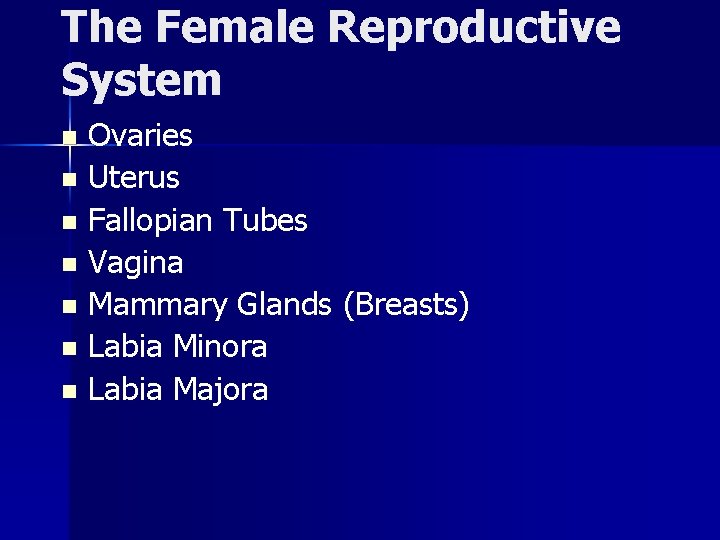
The Female Reproductive System Ovaries n Uterus n Fallopian Tubes n Vagina n Mammary Glands (Breasts) n Labia Minora n Labia Majora n
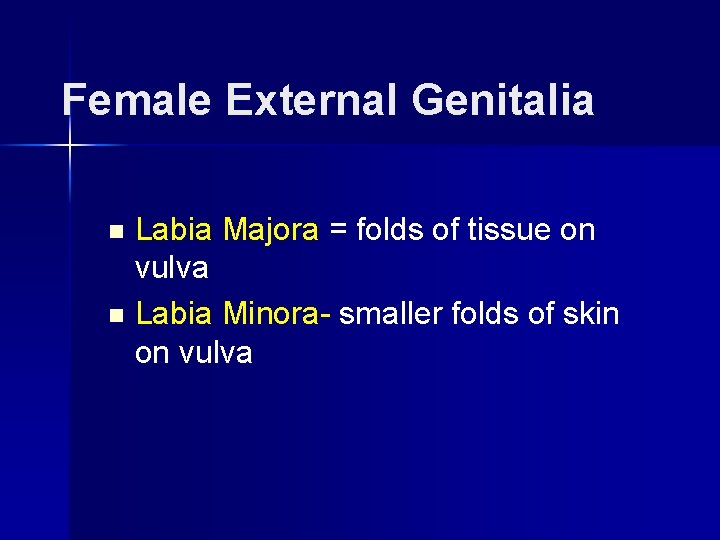
Female External Genitalia Labia Majora = folds of tissue on vulva n Labia Minora- smaller folds of skin on vulva n
Vulva n n - Entrance to the vagina is covered by the vulva It has 5 parts: Labia Vaginal opening Clitoris Urinary opening Mons pubis
Vaginal Opening and Hymen Opening from vagina to the outside of the body. n Hymen is thin membrane that stretches across inside the vagina. n An opening in the Hymen to allow menstrual flow to leave body. n
Urethral Opening n Tube like passageway, extending from the urinary bladder to the vaginal opening.
Mon Pubis n n Mound of tissue and skin just below your stomach. This area becomes covered with hair when you go through puberty.
Vagina a tubular organ lined with a mucous membrane n passageway for sperm and menstrual flow n sexual intercourse n lower part of the birth canal n Tissue inside is very stretchy and folded n
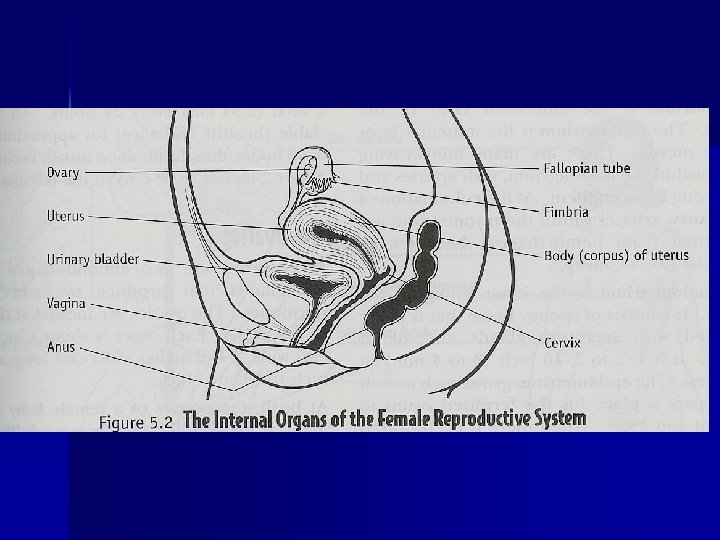
Uterus The hollow, muscular, pear- shaped organ that serves as the site menstruation, n implantation of a fertilized ovum n the development and maintenance of the fetus during pregnancy n 3” long and 2” wide at top. Narrows at bottom
Layers of uterus Perimetrium- outside layer of the uterus n Myometrium- muscular layer of the uterus. n Endometrium – inner lining of the uterus. Grows very thin layer each month to prepare for a fertilized ovum. Endometrium is shed as part of the menstrual flow. n
Fallopian Tubes n n n extend from near the ovaries to the uterus. Fimbria are fingerlike projections at end of each fallopian tube. Cilia are hairlike projections on inside of the fallopian tubes that help the egg move. An egg moves at a rate of 1 inch every 24 hours. An egg is alive for 48 -72 hours.
Ovaries the female gonads, 1” wide and 1 ½ “ long. n females are born with as many egg cells as they will ever have (200, 000400, 000) n 10, 000 remain at puberty n By age 50 most of them have disappeared. n
Function of the Ovaries produce mature Ovum (eggs) n Ovulation = the release of the ova (egg) n Production of Estrogen and Progesterone n
Cervix narrow, thick, muscular area that opens into the vagina n secretes a mucus that is thinner and helps the sperm pass into the uterus and uterine tubes during ovulation n
Female Puberty begins about the age of 7 - 8 n females begin to increase production of hormones n increases in estrogen causes the development female secondary sexual characteristics – outside her body n
Female Secondary Sexual Characteristics Begin between age 10 -14 n breast development n widening of the pelvic girdle n increased body fat storage n voice change n Menarche = first menstruation n – occurs at about 12 years of age
Women’s Problems AND THINGS THAT JUST HAPPEN
Disorders of the Female Reproductive System Menstrual Abnormalities n Toxic Shock Syndrome (TSS) n Ovarian Cysts n Endometriosis n Female Infertility n Cervical Cancer n Yeast infections n Breast Cancer (Self-Exams) n
Ovarian Cysts n n n Fluid filled sacs on the ovary. Most often benign( non-cancerous) Only discovered through a pelvic exam Can get infected Most disappear after a few menstrual cycles but is dang painful. Irregular bleeding, increase in body hair, press on the bladder causing frequent urination.
Yeast Infections Occur in 75% of women in their lifetime, but most common from the ages of 16 to 35. n Get it by taking a new antibiotic, or an overgrowth of fungus. n Symptoms are: itching, soreness, discomfort n Can be fixed with antibiotics. n
Breast Cancer After lung cancer, breast cancer is a leading cause of death in America. n 1 in 8 will develop this condition and nearly 50, 000 women a year die. n Occur when a small cluster of cancer cells grow into a lump in the breast. n Self Exam n
Infertility Endometriosis: Tissue that lines the uterus migrates and grows in the ovaries, fallopian tubes, uterus, or pelvic cavity. n Pelvic inflammatory Disease (PID): can get it from std’s. Damage a females reproductive organs. n STD’s: Most common cause of infertility. n
Menstruation (The Menstrual Phase) The release of a small amount of blood and tissue. n lasts approximately the first 5 days of the menstrual cycle n Menarche= First Menstruation - Occurs at about 12 years of age n the 1 st day menstruation begins the cycle n Explanation of the cycle n
Premenstrual Syndrome (PMS) n Signs and Symptoms include: – weight gain - swelling in legs – skin eruptions - mood swings – headache - depression – anxiety - clumsiness – fatigue and - increased sleep – cravings for sweets or salty foods
Menopause Cessation of the monthly menstrual cycle. n Occurs at age 51 on average. n Ovaries stop producing monthly ovum. n Not true if you start early, you end early. n
Menstrual Abnormalities Premenstrual Syndrome (PMS) n Starts then stops n Very heavy n Very light n Very painful n
Toxic Shock Syndrome (TSS) Caused by using tampons n Usually happens when girls use a super or super plus absorbency tampon when it is not needed. n Fibers in the tampon allow bacteria to breed and cause infection. n Avoid by changing tampon at least once every 4 to 8 hours. n