Limiting Reagent Any reactant that is used up
- Slides: 8
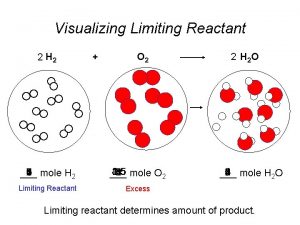
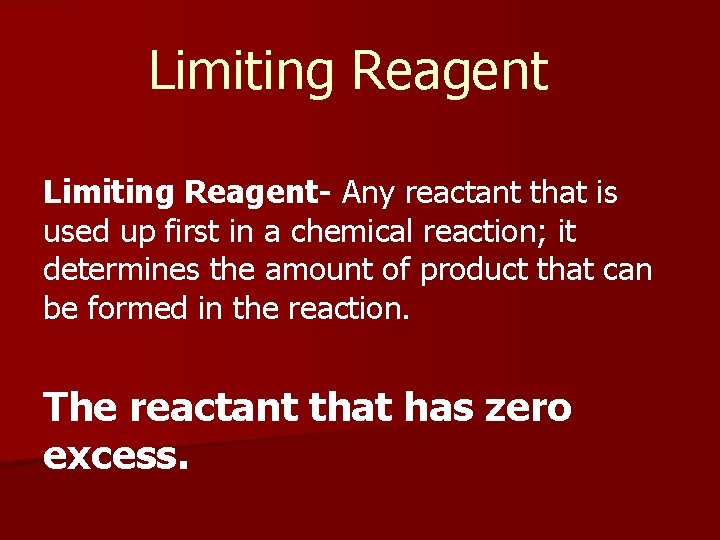
Limiting Reagent- Any reactant that is used up first in a chemical reaction; it determines the amount of product that can be formed in the reaction. The reactant that has zero excess.
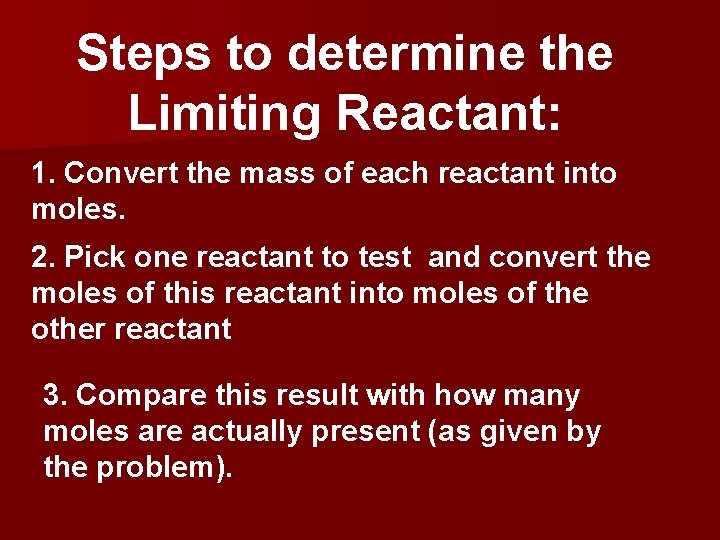
Steps to determine the Limiting Reactant: 1. Convert the mass of each reactant into moles. 2. Pick one reactant to test and convert the moles of this reactant into moles of the other reactant 3. Compare this result with how many moles are actually present (as given by the problem).
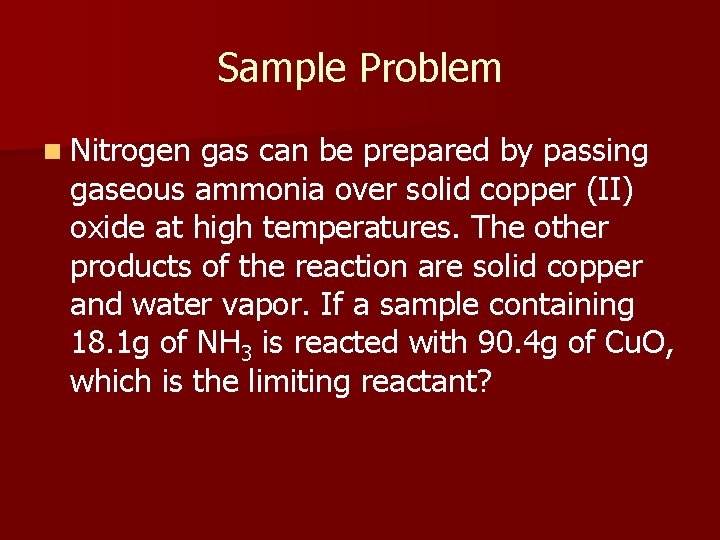
Sample Problem n Nitrogen gas can be prepared by passing gaseous ammonia over solid copper (II) oxide at high temperatures. The other products of the reaction are solid copper and water vapor. If a sample containing 18. 1 g of NH 3 is reacted with 90. 4 g of Cu. O, which is the limiting reactant?
The limiting reactant determines how much total product can be made. If you have to calculate theoretical yield of the reaction, you do your calculations based on the limiting reactant.
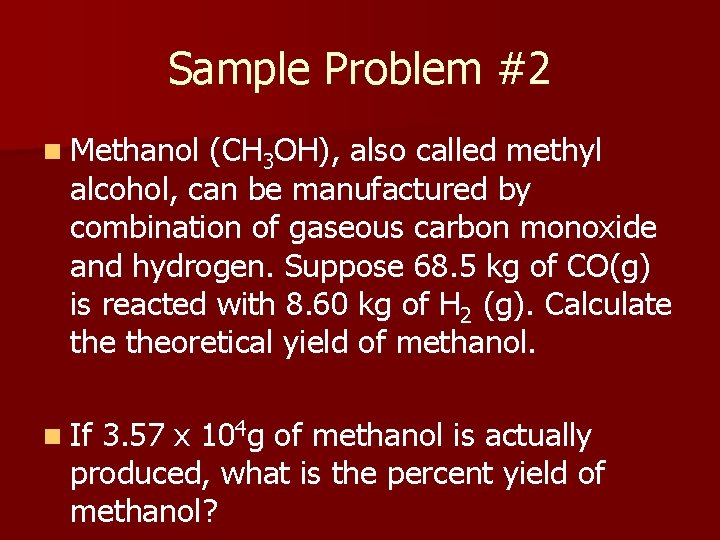
Sample Problem #2 n Methanol (CH 3 OH), also called methyl alcohol, can be manufactured by combination of gaseous carbon monoxide and hydrogen. Suppose 68. 5 kg of CO(g) is reacted with 8. 60 kg of H 2 (g). Calculate theoretical yield of methanol. n If 3. 57 x 104 g of methanol is actually produced, what is the percent yield of methanol?
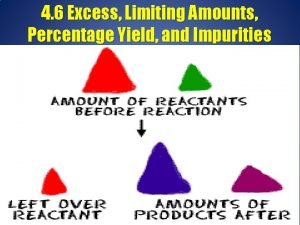
The limiting reactant is used up completely in the reaction. The other reactant is in excess and there will be some of it left over at the end of the reaction.
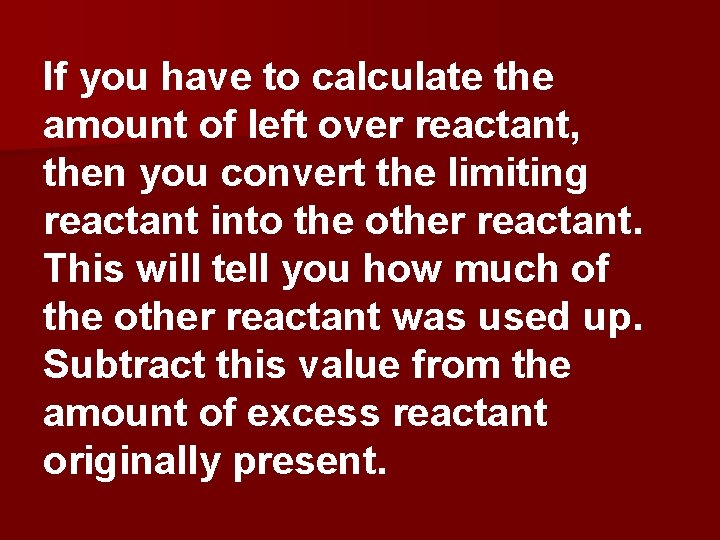
If you have to calculate the amount of left over reactant, then you convert the limiting reactant into the other reactant. This will tell you how much of the other reactant was used up. Subtract this value from the amount of excess reactant originally present.
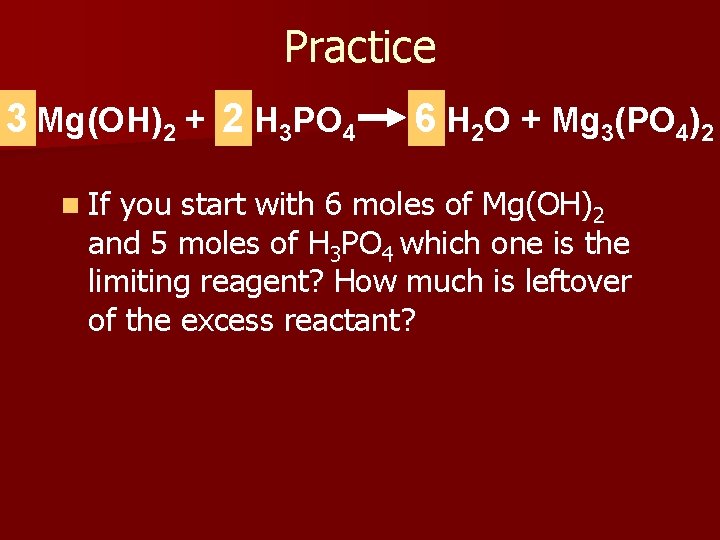
Practice 3 Mg(OH)2 + 2 H 3 PO 4 n If 6 H 2 O + Mg 3(PO 4)2 you start with 6 moles of Mg(OH)2 and 5 moles of H 3 PO 4 which one is the limiting reagent? How much is leftover of the excess reactant?