Lesson 9 Terminology and lexicography M 1 2009

- Slides: 54
Lesson 9 Terminology and lexicography M 1 2009
Summary • Lexicography – Status, development – Metalexicography • Terminology – Status, development
Lexicography and terminology • Lexicography – a long-established craft of writing dictionaries – a more recent academic discipline • teaching students to make dictionaries • analysing existing dictionaries (metalexicography) • Terminology – a relatively new field exploring • specialised vocabulary – using documentation (corpora), IT, conceptology…
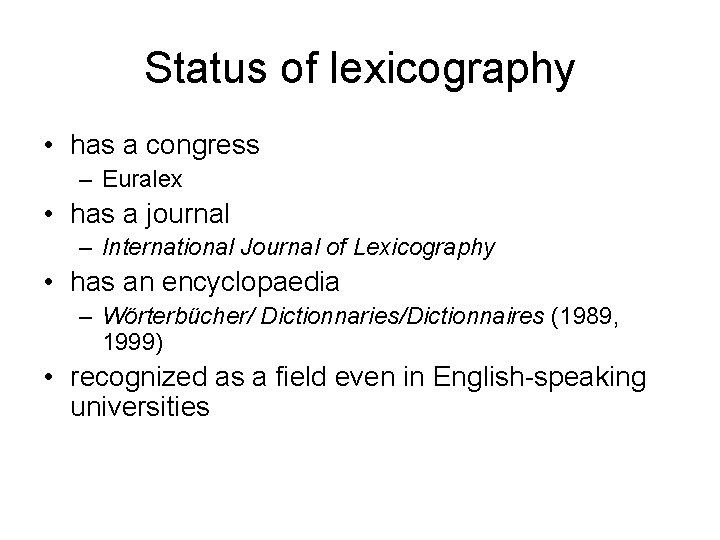
Status of lexicography • has a congress – Euralex • has a journal – International Journal of Lexicography • has an encyclopaedia – Wörterbücher/ Dictionnaries/Dictionnaires (1989, 1999) • recognized as a field even in English-speaking universities
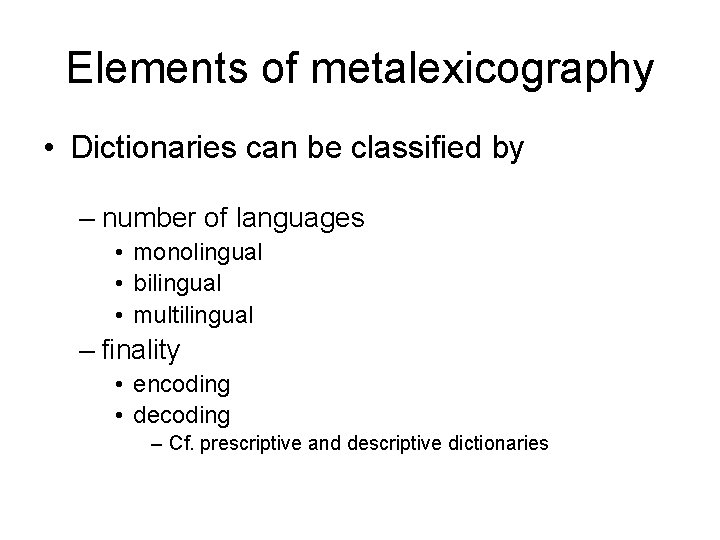
Elements of metalexicography • Dictionaries can be classified by – number of languages • monolingual • bilingual • multilingual – finality • encoding • decoding – Cf. prescriptive and descriptive dictionaries
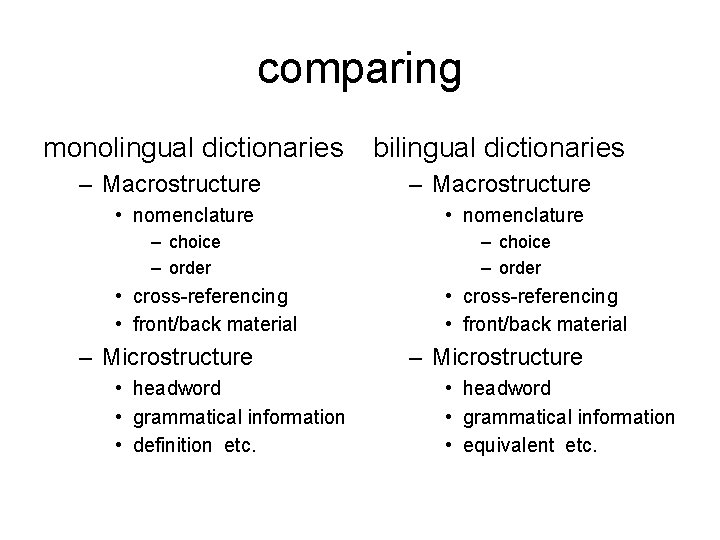
comparing monolingual dictionaries – Macrostructure bilingual dictionaries – Macrostructure • nomenclature – choice – order • cross-referencing • front/back material – Microstructure • headword • grammatical information • definition etc. • cross-referencing • front/back material – Microstructure • headword • grammatical information • equivalent etc.
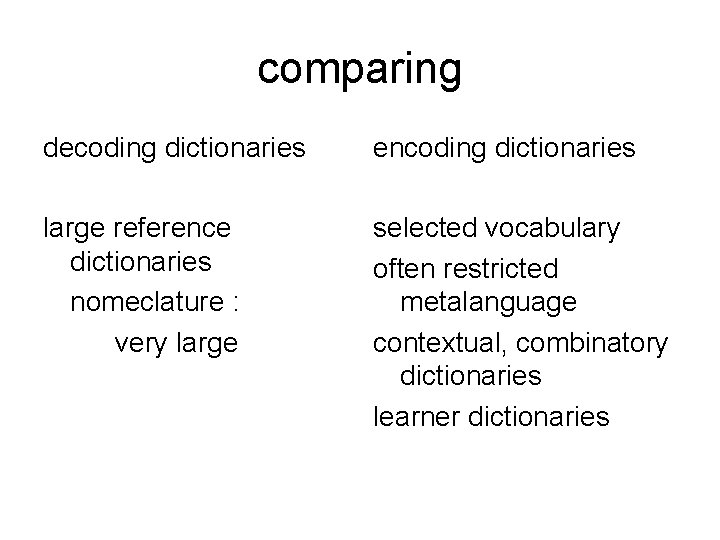
comparing decoding dictionaries encoding dictionaries large reference dictionaries nomeclature : very large selected vocabulary often restricted metalanguage contextual, combinatory dictionaries learner dictionaries
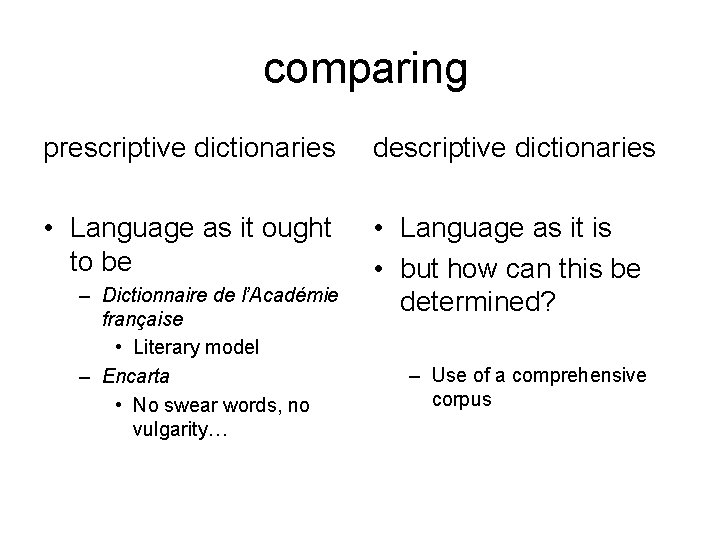
comparing prescriptive dictionaries descriptive dictionaries • Language as it ought to be • Language as it is • but how can this be determined? – Dictionnaire de l’Académie française • Literary model – Encarta • No swear words, no vulgarity… – Use of a comprehensive corpus
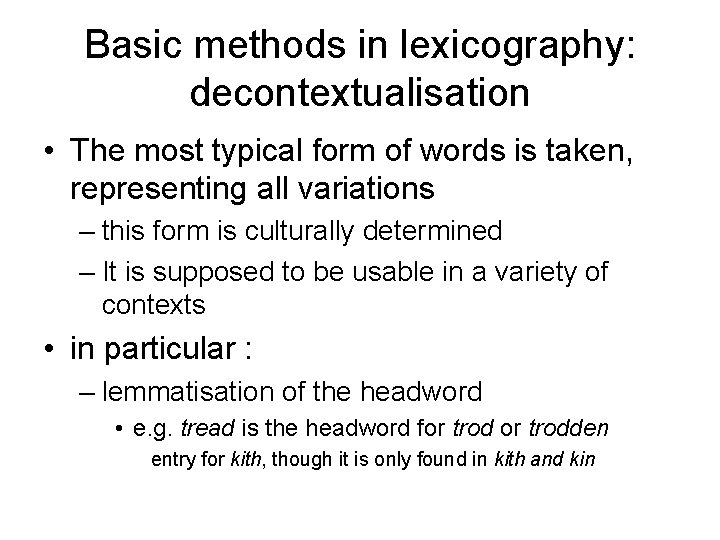
Basic methods in lexicography: decontextualisation • The most typical form of words is taken, representing all variations – this form is culturally determined – It is supposed to be usable in a variety of contexts • in particular : – lemmatisation of the headword • e. g. tread is the headword for trodden entry for kith, though it is only found in kith and kin
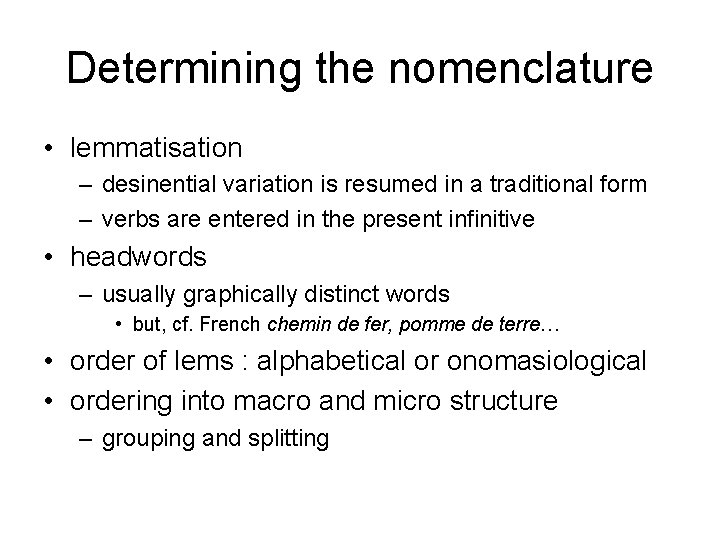
Determining the nomenclature • lemmatisation – desinential variation is resumed in a traditional form – verbs are entered in the present infinitive • headwords – usually graphically distinct words • but, cf. French chemin de fer, pomme de terre… • order of lems : alphabetical or onomasiological • ordering into macro and micro structure – grouping and splitting
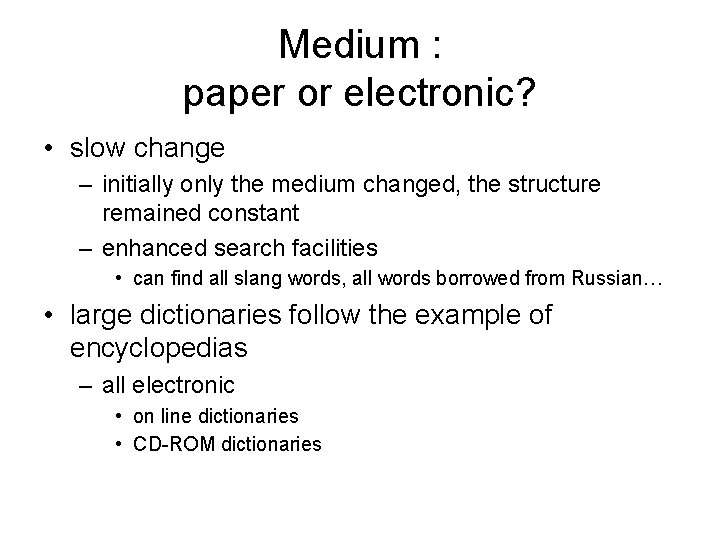
Medium : paper or electronic? • slow change – initially only the medium changed, the structure remained constant – enhanced search facilities • can find all slang words, all words borrowed from Russian… • large dictionaries follow the example of encyclopedias – all electronic • on line dictionaries • CD-ROM dictionaries
migration to electronic Adapting to the format Revising ideas of presentation • decontextualisation • headword • definition
trends • more emphasis on lexicography – (preparing lexical data bases) • less on dictionarics – (compiling dictionaries) (B. Quemada) – • mechanisation of dictionary makers
The changing corpus • A tried and true method, transformed by IT – Corpus of prescriptive and heritage dictionaries: great writers – Systematized in nineteenth century • Littré : Littré and his family • Oxford English Dictionary : James Murray (cf. Surgeon of Crowdace) – enlist volunteers • Disadvantage of the manual corpus – salience (cognitive salience Hanks 2000) takes precedence over frequency e. g. kick the bucket in fact almost absent from large samples of authentic English - supplemented by consulting previous dictionaries: Sue Atkins : “introspection at one remove”.
Electronic corpora Most English language dictionaries based on electronic corpus • statistically valid representation of a language sample – but the results reflect the sample e. g. downsizing: R. Moon first found in business context, but had been used for 10 years by IT specialists, in publications not analysed by linguists (LSP)
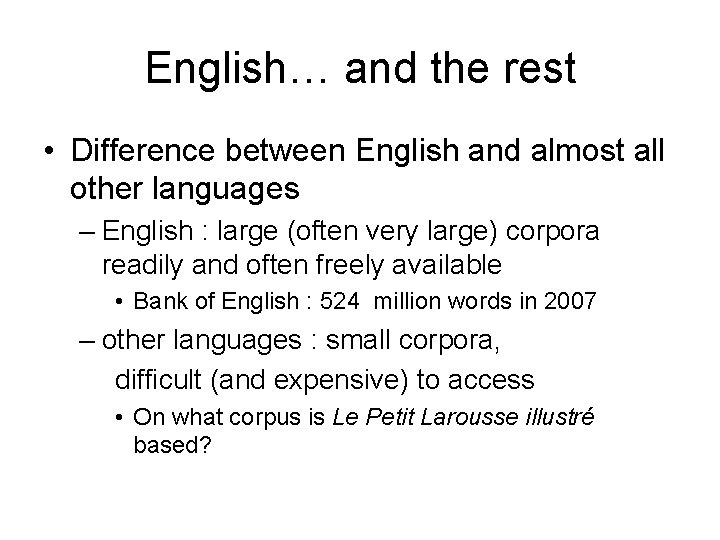
English… and the rest • Difference between English and almost all other languages – English : large (often very large) corpora readily and often freely available • Bank of English : 524 million words in 2007 – other languages : small corpora, difficult (and expensive) to access • On what corpus is Le Petit Larousse illustré based?
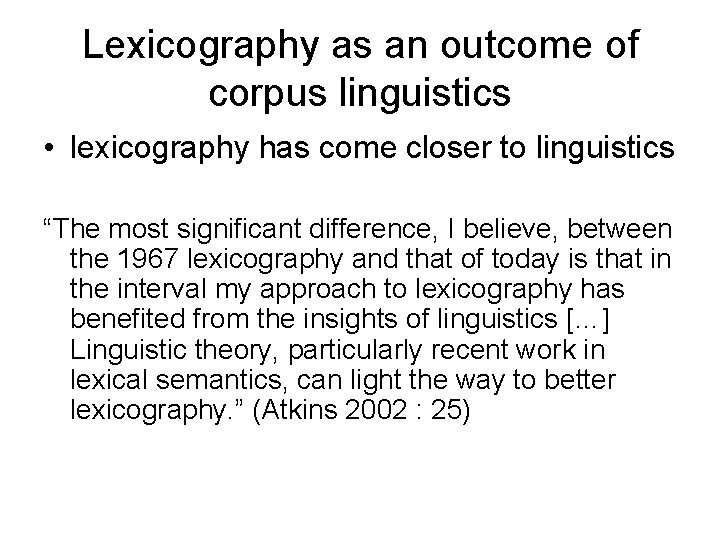
Lexicography as an outcome of corpus linguistics • lexicography has come closer to linguistics “The most significant difference, I believe, between the 1967 lexicography and that of today is that in the interval my approach to lexicography has benefited from the insights of linguistics […] Linguistic theory, particularly recent work in lexical semantics, can light the way to better lexicography. ” (Atkins 2002 : 25)
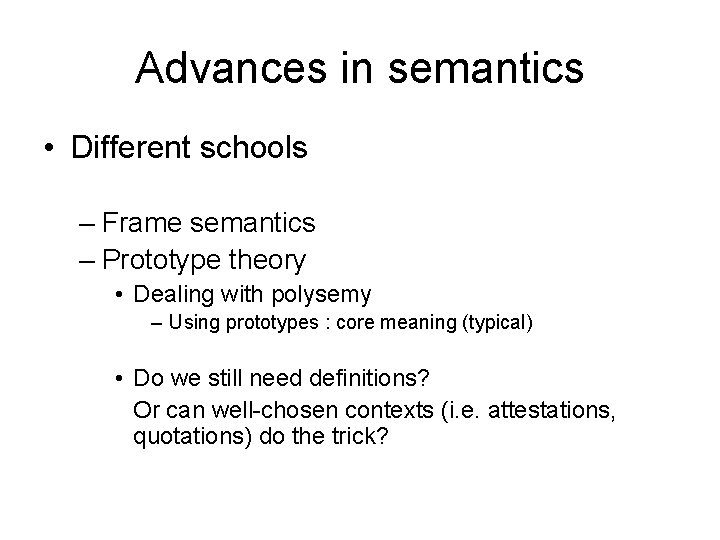
Advances in semantics • Different schools – Frame semantics – Prototype theory • Dealing with polysemy – Using prototypes : core meaning (typical) • Do we still need definitions? Or can well-chosen contexts (i. e. attestations, quotations) do the trick?
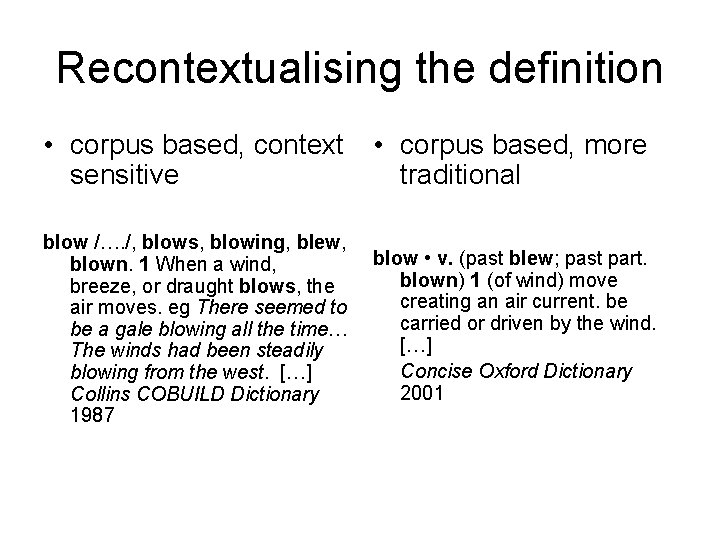
Recontextualising the definition • corpus based, context • corpus based, more sensitive traditional blow /…. /, blows, blowing, blew, blow • v. (past blew; past part. blown. 1 When a wind, blown) 1 (of wind) move breeze, or draught blows, the creating an air current. be air moves. eg There seemed to carried or driven by the wind. be a gale blowing all the time… […] The winds had been steadily Concise Oxford Dictionary blowing from the west. […] 2001 Collins COBUILD Dictionary 1987
Trends in lexicography • less distinction made between grammar and lexis • computational linguistics, corpus linguistics • synchronic outlook (etymology is less often given? do we need dictionaries of neologisms, when dictionaries are constantly updated ?
Development of dictionary studies • EURALEX (Barcelona July 2008) • Towards a theory of lexicography ? – Wiegand : functions – Bergenholtz : user-orientated • Differences between general lexicography, specialised lexicography, monolingual/bilingual encyclopaedias are less important.
and… • what about terminology ? – Is it just specialised lexicography ?
Terminology depends on its finality • • • Terminology and artificial intelligence Terminology and ontology Terminology and translation Terminology and cultural neology Terminology and automatic language processing Terminology and standardization Terminology and knowledge engineering Terminology and language planning Terminology and documentation Terminology and lexicography …
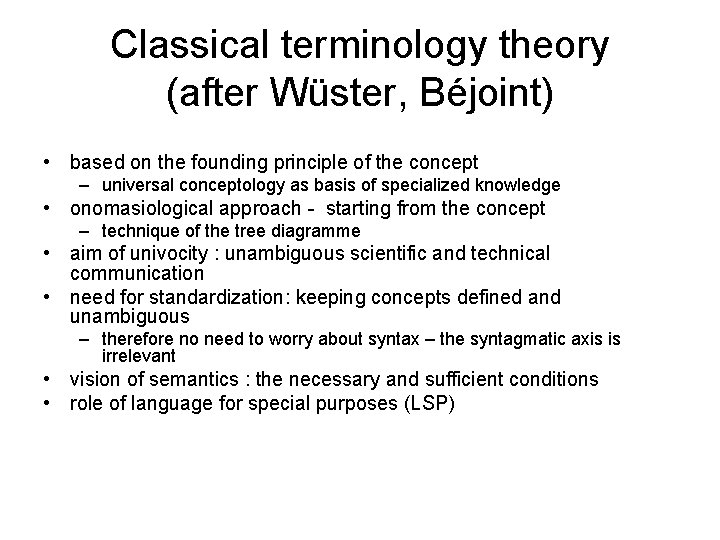
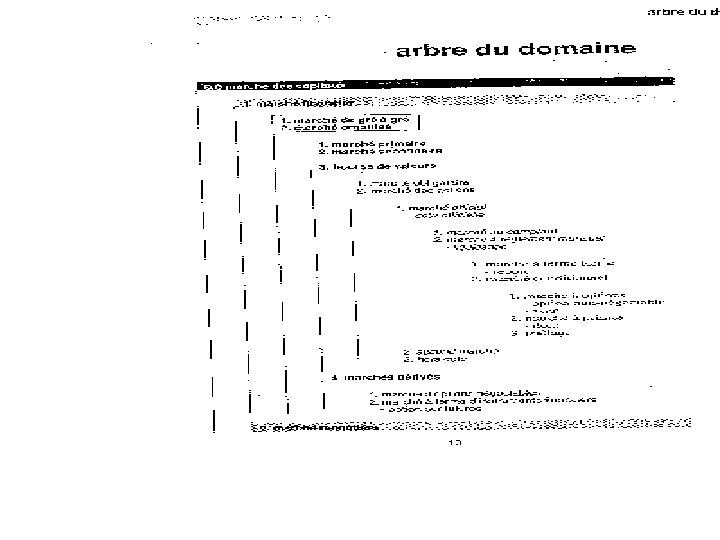
Classical terminology theory (after Wüster, Béjoint) • based on the founding principle of the concept – universal conceptology as basis of specialized knowledge • onomasiological approach - starting from the concept – technique of the tree diagramme • aim of univocity : unambiguous scientific and technical communication • need for standardization: keeping concepts defined and unambiguous – therefore no need to worry about syntax – the syntagmatic axis is irrelevant • vision of semantics : the necessary and sufficient conditions • role of language for special purposes (LSP)
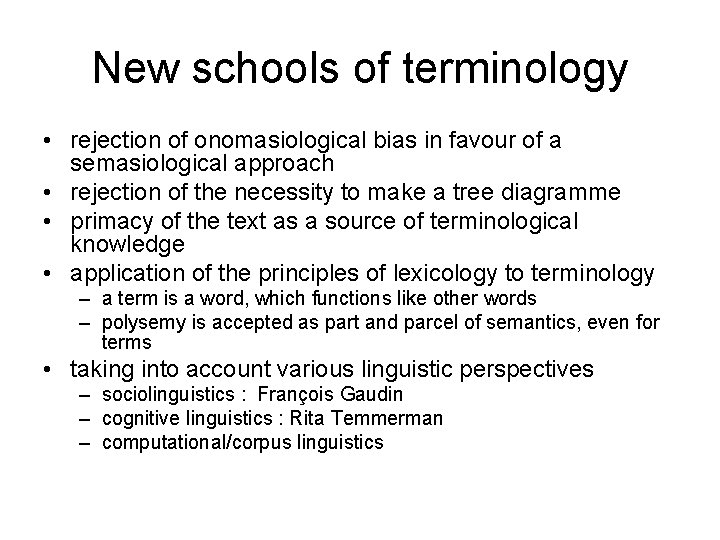
New schools of terminology • rejection of onomasiological bias in favour of a semasiological approach • rejection of the necessity to make a tree diagramme • primacy of the text as a source of terminological knowledge • application of the principles of lexicology to terminology – a term is a word, which functions like other words – polysemy is accepted as part and parcel of semantics, even for terms • taking into account various linguistic perspectives – sociolinguistics : François Gaudin – cognitive linguistics : Rita Temmerman – computational/corpus linguistics
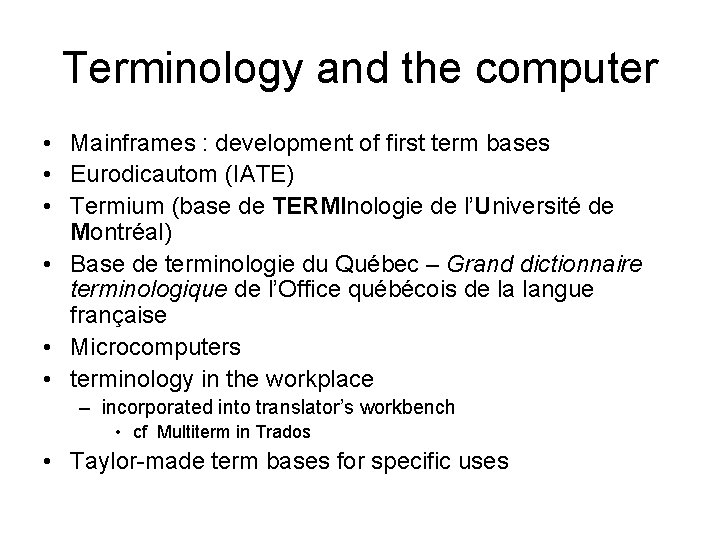
Terminology and the computer • Mainframes : development of first term bases • Eurodicautom (IATE) • Termium (base de TERMInologie de l’Université de Montréal) • Base de terminologie du Québec – Grand dictionnaire terminologique de l’Office québécois de la langue française • Microcomputers • terminology in the workplace – incorporated into translator’s workbench • cf Multiterm in Trados • Taylor-made term bases for specific uses
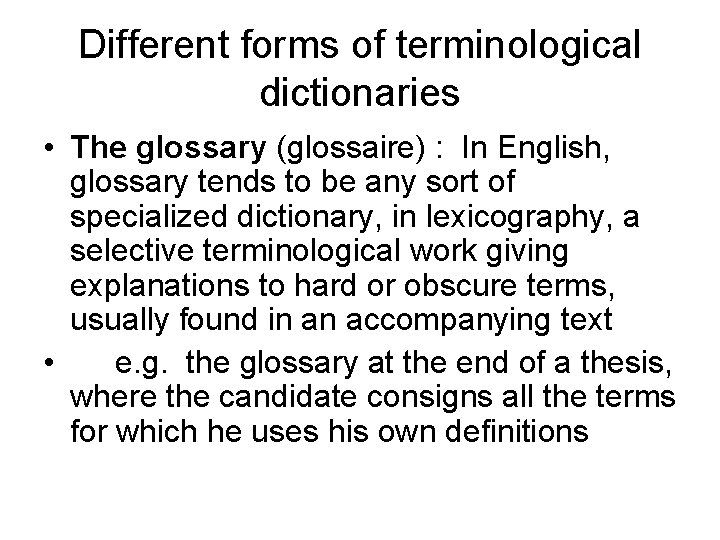
Different forms of terminological dictionaries • The glossary (glossaire) : In English, glossary tends to be any sort of specialized dictionary, in lexicography, a selective terminological work giving explanations to hard or obscure terms, usually found in an accompanying text • e. g. the glossary at the end of a thesis, where the candidate consigns all the terms for which he uses his own definitions
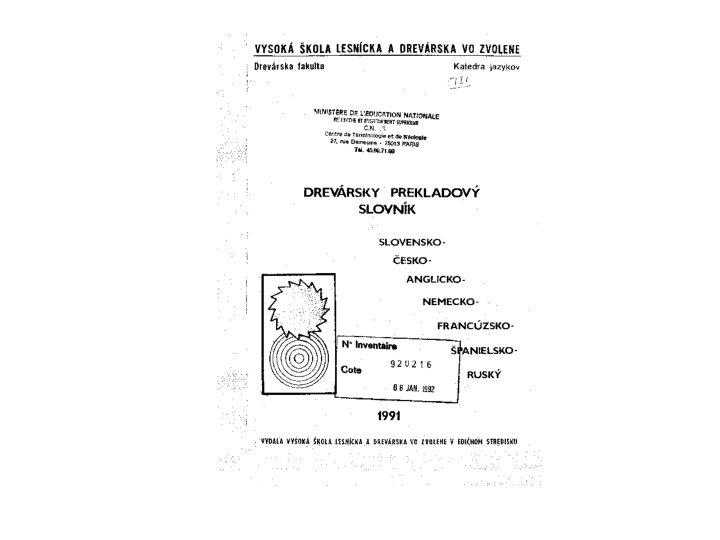
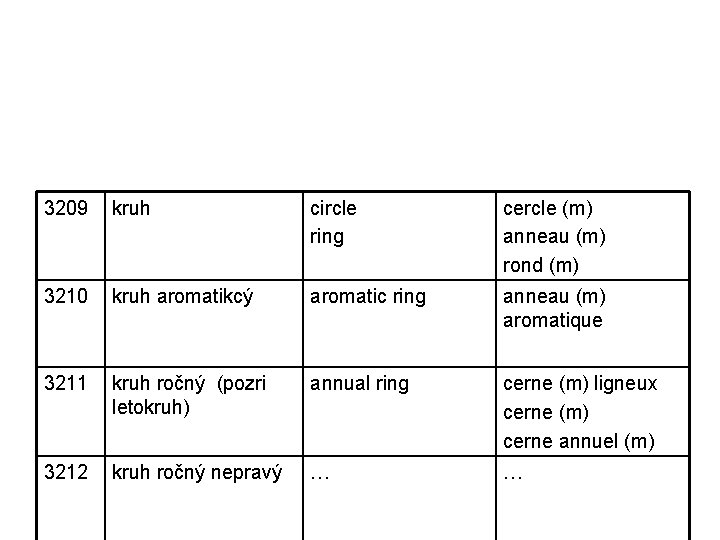
Bilingual or multilingual lexica • a fairly rudimentary terminological work giving only the equivalences of terms in one or more languages, but which claims to give the terms of a specialized field (claim to exhaustivity) – example: Drevársky prekladový slovník
3209 kruh circle ring cercle (m) anneau (m) rond (m) 3210 kruh aromatikcý aromatic ring anneau (m) aromatique 3211 kruh ročný (pozri letokruh) annual ring cerne (m) ligneux cerne (m) cerne annuel (m) 3212 kruh ročný nepravý … …
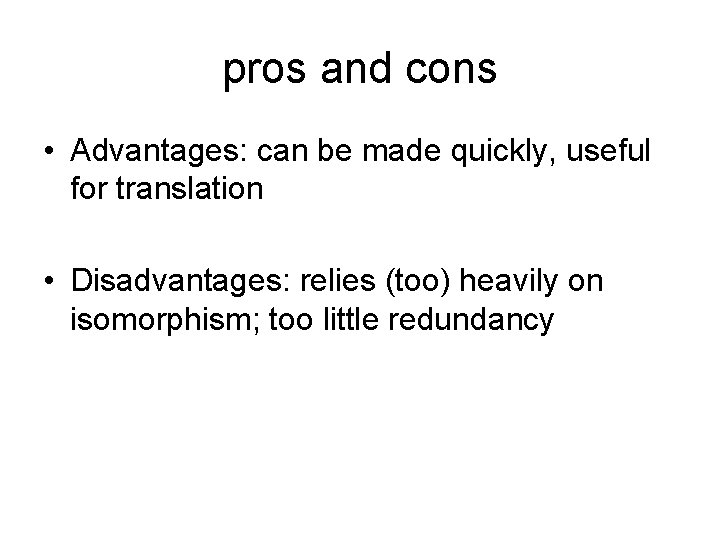
pros and cons • Advantages: can be made quickly, useful for translation • Disadvantages: relies (too) heavily on isomorphism; too little redundancy
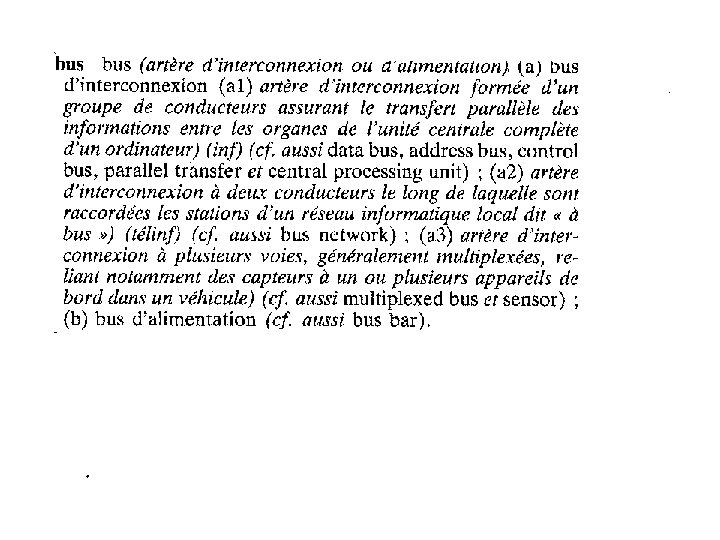
Supplementing the lexicon • to improve bilingual lexica • give additional indications – example : dictionary of food industries
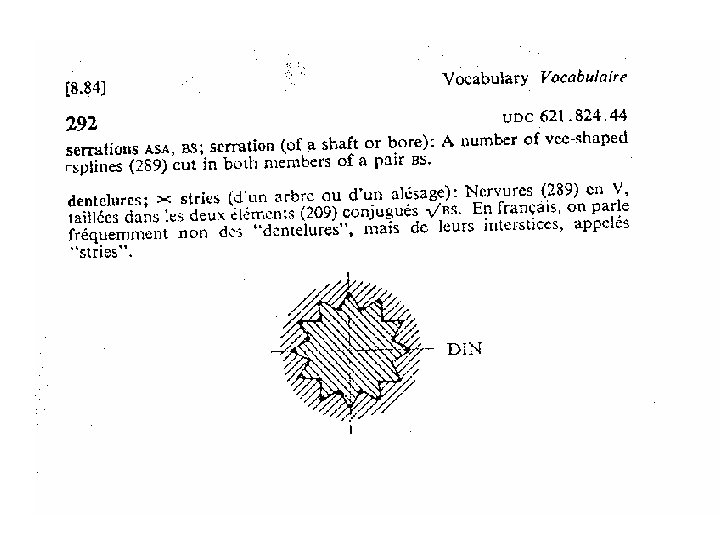
vocabularies • Terminological works giving the terms of a specialized field (claim to exhaustivity) • but including a definition • monolingual or bilingual • the bilingual vocabulary may only give the definition in one language
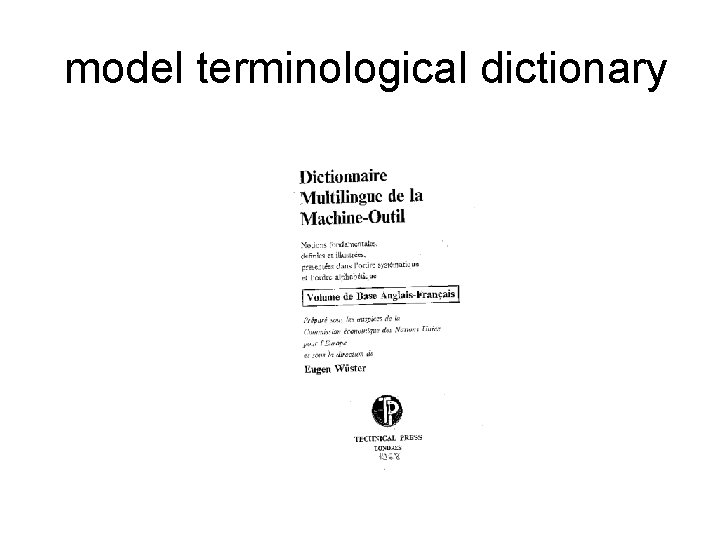
model terminological dictionary
A conceptual macro-structure • Since the terms of a subject field are structured a terminological dictionary attempts to reflect this structure
Focus on syntagmatic criteria Terminological dictionaries: - facilitate access to specialised knowledge - but give little information on how to use terms in texts, talks, translations…
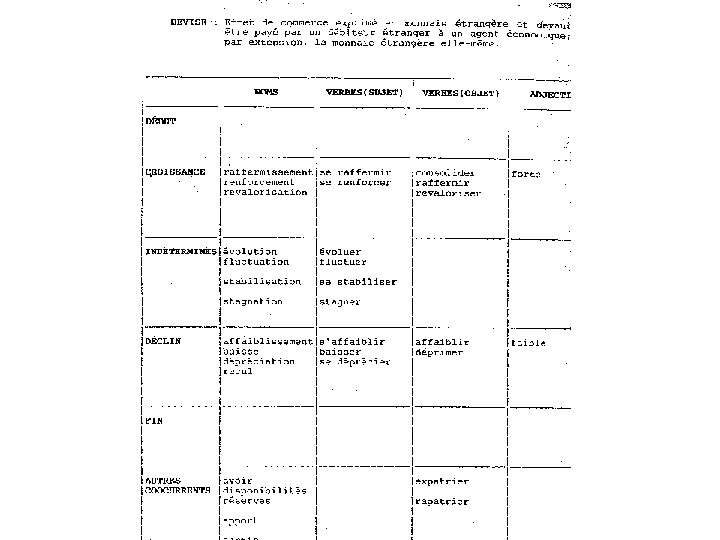
The combinatory dictionary – Betty Cohen (198 ? ), Dictionnaire combinatoire de la bourse et de la conjuncture – social need : Canadian French-speakers needed to talk freely about finance, then an English-speaking monopoly • combinatory vocabulary – but with classical terminological definition – organised conceptually (i. e. onomasiologically)
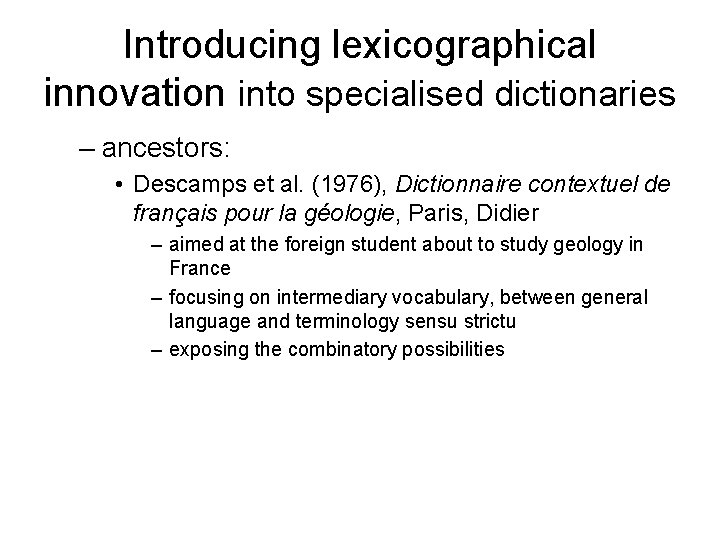
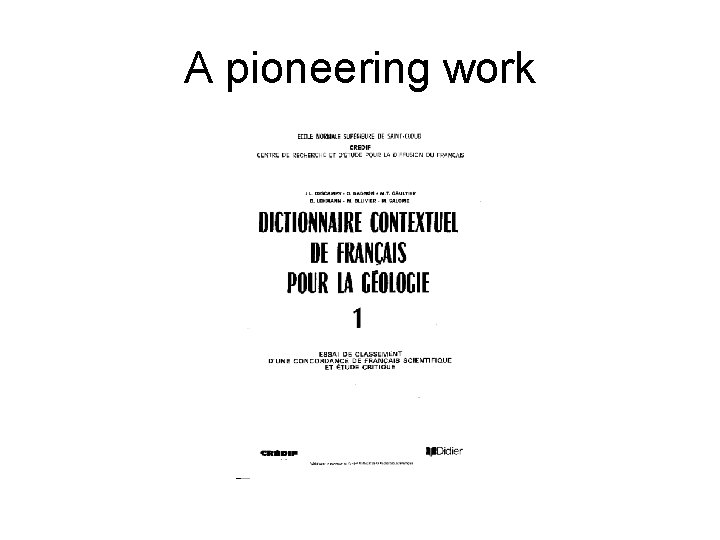
Introducing lexicographical innovation into specialised dictionaries – ancestors: • Descamps et al. (1976), Dictionnaire contextuel de français pour la géologie, Paris, Didier – aimed at the foreign student about to study geology in France – focusing on intermediary vocabulary, between general language and terminology sensu strictu – exposing the combinatory possibilities
A pioneering work
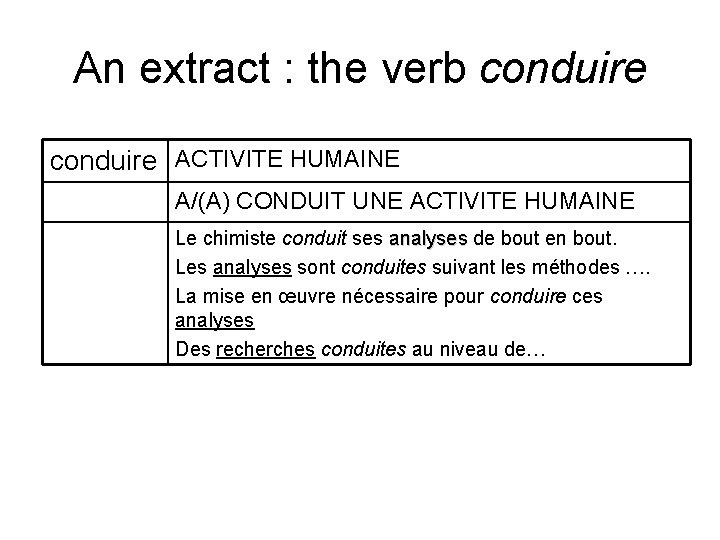
An extract : the verb conduire ACTIVITE HUMAINE A/(A) CONDUIT UNE ACTIVITE HUMAINE Le chimiste conduit ses analyses de bout en bout. analyses Les analyses sont conduites suivant les méthodes …. La mise en œuvre nécessaire pour conduire ces analyses Des recherches conduites au niveau de…
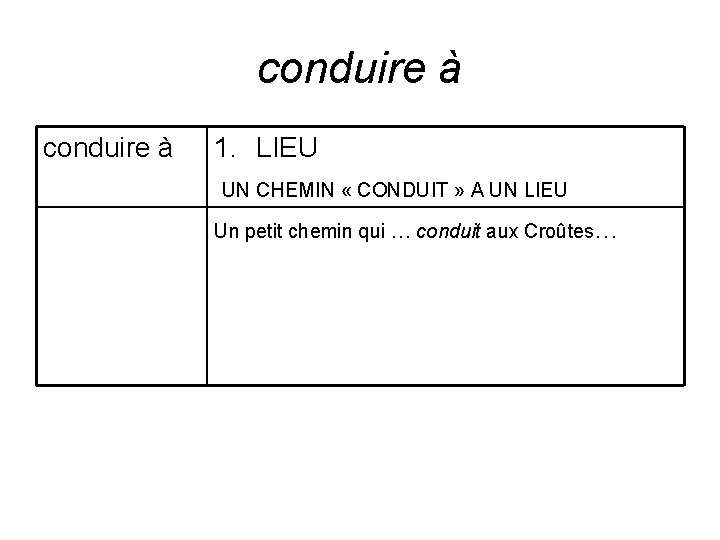
conduire à 1. LIEU UN CHEMIN « CONDUIT » A UN LIEU Un petit chemin qui … conduit aux Croûtes…
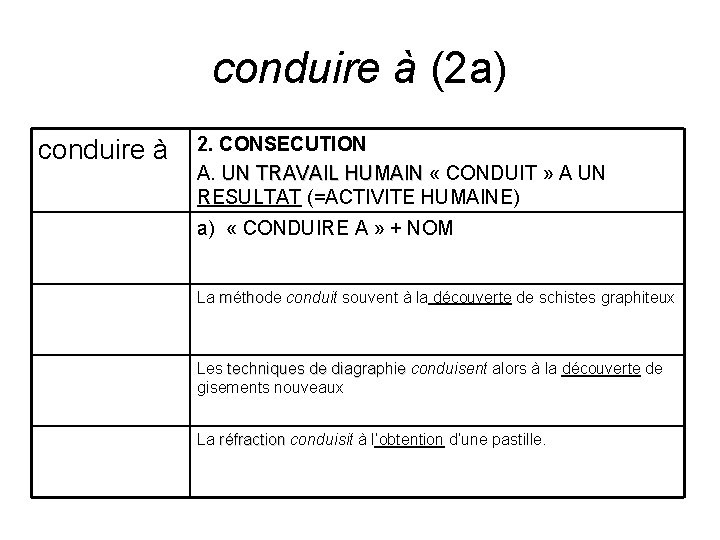
conduire à (2 a) conduire à 2. CONSECUTION A. UN TRAVAIL HUMAIN « CONDUIT » A UN UN TRAVAIL HUMAIN RESULTAT (=ACTIVITE HUMAINE) a) « CONDUIRE A » + NOM La méthode conduit souvent à la découverte de schistes graphiteux méthode Les techniques de diagraphie conduisent alors à la découverte de techniques de diagraphie gisements nouveaux La réfraction conduisit à l’obtention d’une pastille. réfraction
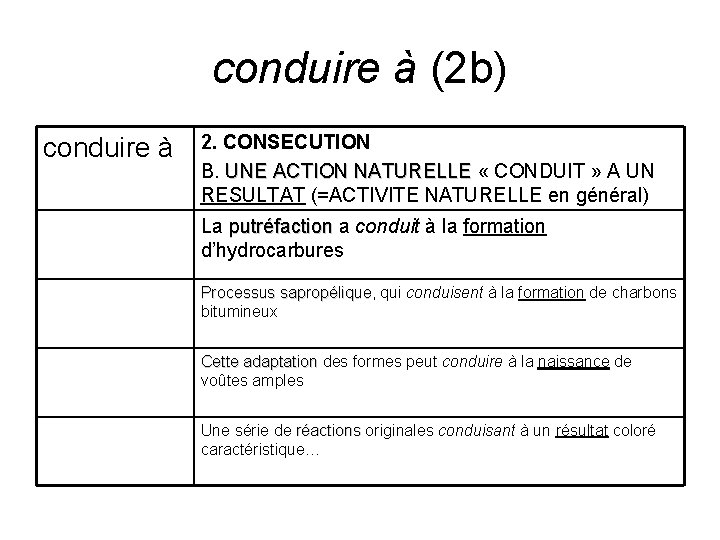
conduire à (2 b) conduire à 2. CONSECUTION B. UNE ACTION NATURELLE « CONDUIT » A UN UNE ACTION NATURELLE RESULTAT (=ACTIVITE NATURELLE en général) La putréfaction a conduit à la formation putréfaction d’hydrocarbures Processus sapropélique, qui conduisent à la formation de charbons sapropélique bitumineux Cette adaptation des formes peut conduire à la naissance de Cette adaptation voûtes amples Une série de réactions originales conduisant à un résultat coloré réactions caractéristique…
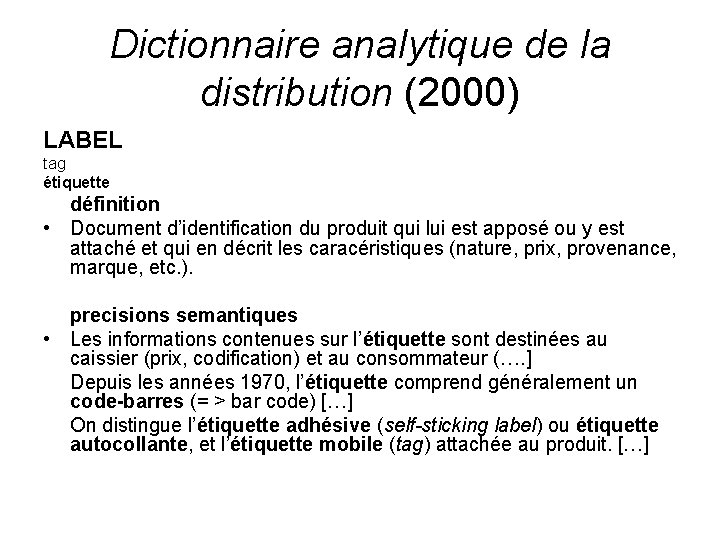
Dictionnaire analytique de la distribution (2000) LABEL tag étiquette définition • Document d’identification du produit qui lui est apposé ou y est attaché et qui en décrit les caracéristiques (nature, prix, provenance, marque, etc. ). precisions semantiques • Les informations contenues sur l’étiquette sont destinées au caissier (prix, codification) et au consommateur (…. ] Depuis les années 1970, l’étiquette comprend généralement un code-barres (= > bar code) […] On distingue l’étiquette adhésive (self-sticking label) ou étiquette autocollante, et l’étiquette mobile (tag) attachée au produit. […]
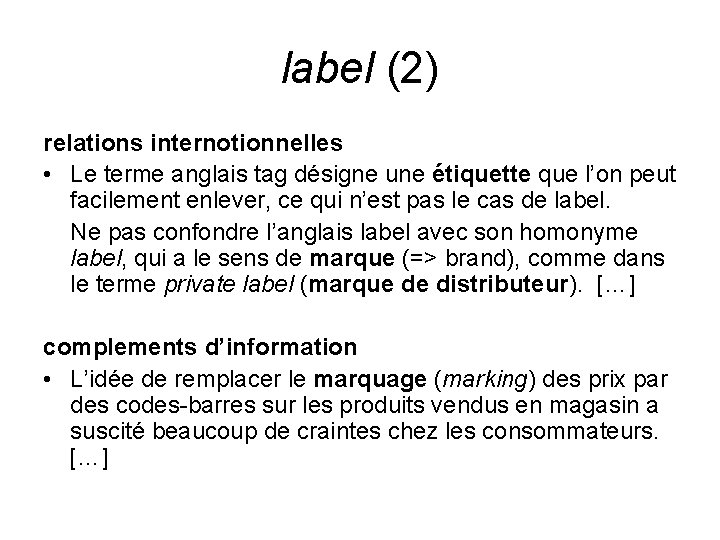
label (2) relations internotionnelles • Le terme anglais tag désigne une étiquette que l’on peut facilement enlever, ce qui n’est pas le cas de label. Ne pas confondre l’anglais label avec son homonyme label, qui a le sens de marque (=> brand), comme dans le terme private label (marque de distributeur). […] complements d’information • L’idée de remplacer le marquage (marking) des prix par des codes-barres sur les produits vendus en magasin a suscité beaucoup de craintes chez les consommateurs. […]
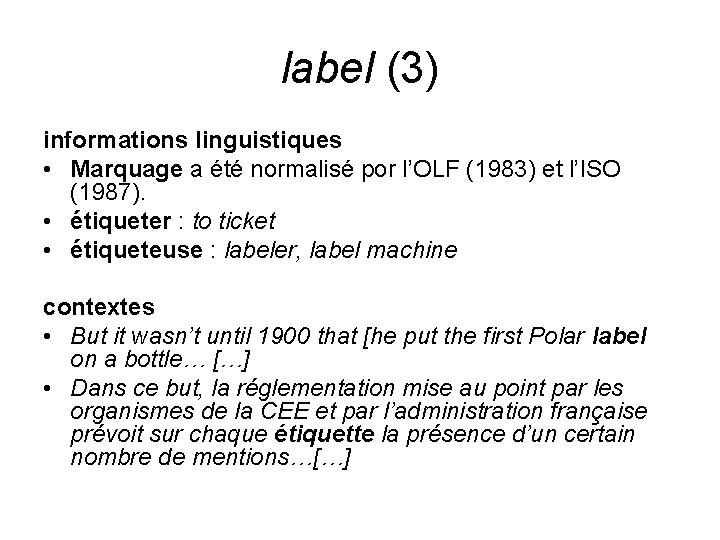
label (3) informations linguistiques • Marquage a été normalisé por l’OLF (1983) et l’ISO (1987). • étiqueter : to ticket • étiqueteuse : labeler, label machine contextes • But it wasn’t until 1900 that [he put the first Polar label on a bottle… […] • Dans ce but, la réglementation mise au point par les organismes de la CEE et par l’administration française prévoit sur chaque étiquette la présence d’un certain nombre de mentions…[…]
Satisfied? Do specialised dictionaries actually meet users’ needs? • Determining users’ needs • Determining how they are satisfied